The first of the 60 additional streetcars for Toronto’s fleet arrived at the Hillcrest Shops on August 9, 2023. Based on the budgeted cash flow over coming years, delivery of these cars is expected to complete in 2025.
2023: $58.434 million
2024: $193.248
2025: $82.644
2026: $5.759
Total: $340.265 million
Car 4604 at Harvey Shops on August 9, 2023 [Photo from a reader]
The currently active streetcar yards at Leslie, Russell and Roncesvalles can absorb 35 of these cars, but the remaining 25 will need additional storage and servicing facilities elsewhere. The TTC plans to adapt part of their Hillcrest site as a small carhouse that will serve the 512 St. Clair and possibly 511 Bathurst lines. Aside from providing space, this will also reduce dead-head costs for cars that now come to St. Clair from Leslie Barns.
The presentation erroneously states that “New streetcars will begin arriving at TTC facilities by 2025” [p. 2] when quite obviously this will be late in the overall delivery scheme. However, as the first 35 can be accommodated elsewhere, it would make sense that Hillcrest changes do not have to be ready until the latter half of the order arrives.
Some of the project schedule, however, extends into 2027 and this begs the question of why the work will take so long.
Aerial view of Hillcrest from the northeast. [TTC photo]
The TTC plans consultation sessions in the neighbourhood in August, although they have not yet announced dates or locations. Links:
This is a follow-on to my article about the number of spares on the bus fleet.
The question of the day is why do we have so many surplus streetcars and subway trains. This article will provide some history of how the fleets and service levels evolved in recent years.
The big items in the public portion of the agenda are the monthly CEO’s Report and an update on TTC’s finances and major capital projects to the end of 2022.
There are also two reports on collective agreements and non-union salaries. Although the details lie in confidential attachments, the public reports give an overview of the various labour contracts and salary drivers across the organization. I leave perusal of these to interested readers.
Finally there are a few references to the TTC’s eBus program scattered through reports. I will consolidate this info in its own section at the end of the article.
Correction April 18, 2023: It turns out that the size of the bus fleet shown in the graphic below is wrong. There are only 2041 buses, not 2114, in service as of March 2023. The article has been amended to reflect this.
Updated January 13, 2022 at 6:45 am: Sundry typos and scrambled phrases have been corrected. The projection of additional bus requirements for a 70 per cent service increase has been corrected to include spares.
At its recent meeting, Toronto Council endorsed a plan to move the City to Net Zero emissions by 2040. A review of the full plan is well beyond the scope of this blog, but some proposals affecting transit service and operations are very aggressive.
If Toronto is going to be serious about this we need a detailed examination of assumptions, scenarios, cost projection, and plans out to 2040. Where will population and job growth be? How will transit serve them?
Before I get into the report itself, a quotation from former TTC CEO Andy Byford is worth mention.
Andy Byford sums up the role of a transit system:
“…service that is frequent, that is clean, that goes where people want to go, when people want to go there, that is customer responsive, that is reliable, in other words that gets the basics right …”
Too often we concentrate on big construction projects, or a new technology, or a showcase trial on one or two routes rather than looking at the overall system. In particular, we rarely consider what transit is from a rider’s point of view. It is pointless to talk about attracting people to use transit more if we do not first address the question of why they are not already riding transit today. This is an absolutely essential part of any Net Zero strategy.
The reports contain a lot of material, although there is some duplication between them. They contain proposals for short and medium term actions. At this point, Council has not embraced anything beyond the short term plan.
From a transit point of view, that “plan” is more or less “business as usual” and does little to challenge the current status of transit service in the short term. There is hope that electrification of the diesel/hybrid bus fleet might be accelerated, but little sense of what, on a system-wide basis, would shift auto users to transit beyond works already in progress.
A vital point here is that transit has two major ways to affect Council’s Net Zero goals:
Conversion of transit vehicles to all-electric operation will reduce or eliminate emissions associated with these vehicles, depending on the degree to which the electricity sources are themselves “clean”. This is a relatively small part of the City’s total emissions.
Shifting trips from autos to transit (or to walking or cycling) both reduces emissions and relieves the effects of road congestion, including, possibly, making more dedicated road space available for transit and cycling. Emissions from cars are much more substantial than those from transit.
In the short term, the overwhelming focus is on conversion of the existing bus fleet to electric operation, not of expanding service to attract more riders. Improvements to specific routes might come through various transit priority schemes, but these will not be seen system-wide. Based on demand projections, large scale capital works, notably new subway lines, will primarily benefit existing riders rather than shifting auto users to transit.
The short term targets related to transit are quite simple:
Electrify 20 percent of the bus fleet by 2025-26.
This effectively requires that 400 diesel or hybrid buses be converted. The TTC already plans to buy 300 eBuses, and the Board has asked TTC management to look at accelerating this conversion. This target is very low hanging fruit provided that someone will pay for the buses.
Further targets are 50 per cent conversion by 2030, and 100 per cent by 2040.
Looking at the TTC’s likely replacement schedule (discussed in my Capital Budget Follow-Up), they will easily be achieved as much of the existing fleet is due for replacement by the early 2030s. Hybrid buses to be acquired this year will reach end of life in 2034-35.
This is an endorsement of “more of the same” in our transit planning, but no real commitment to making transit fundamentally better so that it can handle many more trips at lower emission rates than today.
Looking further out there are proposals for substantially more transit service and free fares, but these are not fully reflected in projected costs or infrastructure needs.
Some of the proposals for the NZ2050 plan are, shall we say, poorly thought-out:
Convert one lane of traffic to exclusive bus lanes on all arterials.
Many arterials are only four lanes wide and taking a permanent bus lane has considerable effects on how the road would operate. This is a particular problem for routes with infrequent service during some periods of operation.
Increase service frequency on all transit routes: bus by 70%, streetcar by 50%, subway off-peak service increased to every 3 mins.
This represents a very large increase in transit service with effects on fleet size, facilities and, of course, budgets. This would require an increase in the bus and streetcar fleets beyond what is already planned as well as construction of new garages and a carhouse.
Tolls of $0.66/km on all arterial roads.
This would apply only to fossil-fueled cars, and the forecast amount of revenue is less than half of the additional funding transit would require.
No transit fares.
The immediate cost of this would be about $1.2 billion in foregone fare revenue, offset by about ten percent in the elimination of fare collection and enforcement costs.
Shift 75% of car and transit trips under 5km to bikes or e-bikes by 2040.
This is truly bizarre. In effect, transit stops performing a local service for most rides and they are shifted to cycling. The average length of a transit trip is under 10km, and many are shorter. Moreover, trips are often comprised of multiple hops each of which might be quite small. There is a small question of how much uptake there would be in poor weather conditions.
Shift 75% of trips under 2km to walking by 2040.
Even some transit trips are short, and transit, especially with improved service, is the natural place for these trips. It is not clear whether the plan would be to somehow deter transit users from making very short trips just as, indeed, a car driver would.
[Revenue and cost issues are discussed in more detail later in this article.]
With all of the planned investment, transit’s mode share of travel is projected to fall, while walking and cycling would rise considerably in part because of the policy of diverting short trips. It simply does not make sense to push people off of transit just at the point where we are trying to encourage transit use. This part of the plan is laughably incoherent, and is an example of how good intentions can be undermined by poorly crafted policy.
For example, it is less than 5km from Liberty Village to Yonge Street, and if we were to take the proposal seriously, we would expect most people to cycle to work downtown, not take GO or the streetcar services. I look forward to the public meeting where this scheme is unveiled to the residents. If the demand for GO and for the King car is any indication, they do not want to use “active transportation”. Similarly, the planned development at East Harbour is less than 5km from downtown.
Meanwhile, transit electrification itself only eliminates 3 per cent of existing emissions, assuming a clean source of electricity. The subway and streetcar systems already are electrified, and both have capacity for growing demand if only more service were operated.
City Council endorse the targets and actions outlined in Attachment B to the report (December 2, 2021) from the Interim Director, Environment and Energy, titled “TransformTO Net Zero Strategy”.
Councillor Layton moved two amendments:
* Request the Board of the Toronto Transit Commission to identify opportunities to accelerate the Green Bus Program and to request the CEO, Toronto Transit Commission to report to the Board in the second quarter of 2022 on these opportunities.
* City Council request the City Manager, in consultation with the General Manager of the Toronto Transit Commission, to outline in the 2022 Budget proposal options to increase spending on surface vehicles and hiring additional operators aimed at increasing ridership to get us on the path to achieving the TransformTO goals.
The first amendment echoes a request from the TTC Board to its management at the December 20, 2021 meeting. Acceleration of eBus purchases will require additional funding from somewhere, as well as a vendor capable of meeting a larger order. It will also have effects on TTC infrastructure needs for garaging.
The second amendment is more pressing because it speaks to the 2022 Budget process that will launch on January 13. If the TTC is going to ramp up service this year, this must be factored into the budget. A likely problem will be that any growth beyond that now planned will be entirely on the City’s dime rather than supported by other governments. However, we need to understand what could be done, if only to know the cost should a “fairy godmother” show up with some spare change.
Neither the amendment nor the short-term target for 2022-2025 gives any indication of just what is meant by “better” transit service, nor do they distinguish between restoring pre-covid service levels and going beyond that to encourage more ridership.
The points listed above for NZ2050 are excerpted from Attachment C, the technical background report. A casual reader might think that Council has embraced a very expansive view of transit’s role, but they have not.
The tactics from Attachment C are notably absent from Attachment B which refers to them, but actually lists a much more restricted set of transit goals. I have confirmed with City staff that Council has only endorsed Attachment B.
Q: For clarification: There are, broadly speaking, two levels of a shift in the emphasis on transit in the short term plan to 2030 and in the longer term to 2040 and beyond. Reading the Council motion, it appears that Council has endorsed the short term plan (Appendix B), but has not endorsed the more aggressive targets of the longer term set out in Appendix C. Is this a correct interpretation?
A: Yes. City Council endorsed the targets and the actions outlined in Attachment B ‘TransformTO Net Zero Strategy’. Attachment C is a technical backgrounder report that was used to inform the targets and actions that were recommended and adopted.
Email from Steve Munro to Toronto Media Relations, December 29, 2021. Response from Toronto Environment & Energy Division, January 10, 2022.
That is a polite way of saying “we had some really aggressive ideas, but we know enough not to bring them to Council”.
“Transit” vs “Transition”
In the process of reviewing the reports, I searched on the word “transit”, but got hits more frequently on “transition” as there are many other sectors where reduction or elimination of emissions are possible and on a large scale.
According to the most recent greenhouse gas inventory, transportation is the second largest source of GHG emissions, accounting for 36 percent of total emissions with approximately 97 per cent of all transportation emissions originating from passenger cars, trucks, vans, and buses. Gasoline accounts for about 30 per cent of Toronto’s total GHG emissions.
TransformTO: Critical Steps for Net Zero by 2040. p. 30
Here is a pie chart showing the relative contribution of each proposed action in the Attachment C list which is a more aggressive set of changes than Council adopted. Note the small contribution of transit (red) compared with other areas such as personal and commercial vehicles and changes to building energy use.
Based on Section 7: Low-Carbon Actions pp 52-56 in the Net Zero Technical Report
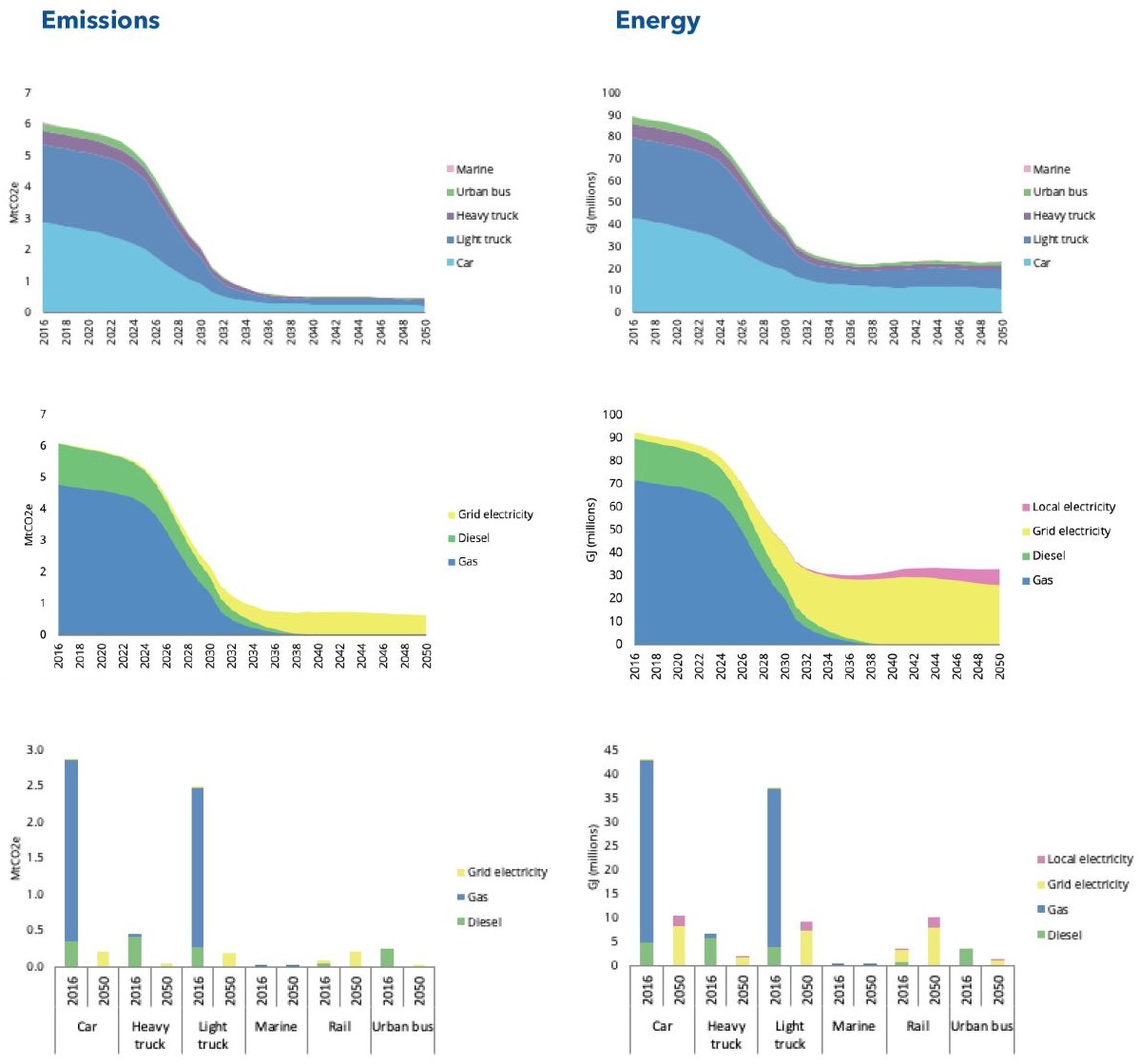
Another way to look at this is shown in a chart of energy sources and emissions generated by each transportation sector as the full NZ plan is implemented.
Top left: the emissions of urban buses are shown in green. This falls off to zero as the bus fleet electrifies.
Middle left: the decline in diesel (green) is a combination of transit, trucking and a small contribution from diesel-powered autos.
Bottom left: Cars and light trucks are the overwhelming contributors of emissions within the transportation sector.
On the right, the charts are harder to accept at face value because they include the effect of a very large shift of short trips to active transportation. An interesting comparison would be what might happen if autos electrified, but did not lose mode share.
That last point has a knock-on effect because if short trips are not shifted, but are only electrified, they will contribute a substantial demand to generating and charging capacity, not to mention continued auto traffic and competition for road space.
The topics here are a bit scattershot as was the Board debate, but they include:
The Toronto Net Zero 2040 plan and electric buses
The conflict between budget planning timeframes and available funding
The growing backlog in State of Good Repair
Fleet replacement timing issues
Where the money comes from
The need to co-ordinate related projects within the budget
Funding for capital programs
Future subway demand and capacity enhancements
There is always a problem with the complexity of the budget that drops on Board members at most a week before the meeting where it will be approved.
There is no “Budget Committee” at the TTC, and so there is no group within the Board who are primed for the debate and can vouch for management’s work in the same manner as the TTC’s Audit & Risk Management Committee. The Board used to have a Budget Committee, but it languished under an uninterested chair (ironically, a member of Council’s hawkish right) and the current Board is unwilling to recreate it.
This says a lot about how seriously (or not) they take their oversight role. Let a few pencils go missing and the Audit folks will be all over the problem, but billions in capital spending and the underlying policy decisions go with little review. This should be a job for whatever TTC Board is crafted for 2023 after the next municipal election.
The TTC’s 2022 Capital Budget report has been published as part of the December 20, 2021 TTC Board meeting agenda. This includes three components:
A 15-year capital investment plan giving an outlook on all projects, funded or otherwise, to 2036.
A 10-year capital budget for funded projects.
A real estate investment plan that ties property needs into capital planning. This is a new component in TTC capital planning.
For political reasons, the capital plans before 2019 were low-balled to stay within available funding, but this hid necessary projects that appeared as a surprise to the TTC Board and Council. One way this was done was to class them as “below the line” (not in the funded list), but more commonly to push their supposed delivery dates beyond the 10-year capital budget window. This made the City’s exposure to future spending appear lower than it was in fact.
A particularly bad case was the collection of projects and contracts for ATC implementation on Line 1. In order to “sell” this badly needed project politically, it was subdivided and some resulting contracts used mutually incompatible technology. The original chunk was simply a plan to replace the existing block signals used from Eglinton to Union and dating from the subway’s opening in 1954. One by one, other pieces were added, but the disorganization was such that ATC was actually an “add-on” to the Spadina extension because it had not been included in the base project.
The situation was further complicated by awards to multiple vendors with incompatible technologies on the premise that each piece could be tendered separately without regard for what was already underway. A major project reorganization during Andy Byford’s tenure as CEO untangled this situation, and provided a “lesson learned” for the Line 2 ATC project.
In 2019, the TTC changed tack and published a full list of its needs and extended the outlook five more years. This came as a huge shock to politicians and city management when the capital needs shot up from $9 billion to well over $30 billion.
At a time when TTC ridership is sitting at just under 50 per cent of pre-pandemic levels, this may not seem the time to ask a question like this article’s title. However, the service effects of an operator shortage are felt across the system and may not disappear soon.
The TTC puts recent service cuts down to vaccine hesitancy among a small group of staff. Leaving aside the internal union politics and the constant skirmishes between ATU and TTC management, there is more going on here.
At its meeting on November 29, the TTC Board received a third quarter financial update, and there was considerable praise for how management has “contained” costs shifting the year-end outlook to one where the TTC will not actually use all of subsidy monies available. In fact, $36 million will go into the City’s transit reserve where original budget projections forecast a draw, not a deposit. That’s money not being spent on transit, and moreover, it sets the bar lower for a starting point in 2022.
A big contribution to that saving is that the TTC is not scheduling as much service as it budgeted, and even then is not staffing at a level where all scheduled service actually gets onto the street. Cancelled runs and missing buses are common, and this problem continues even on the reduced schedules of November 21.
This situation is a complete reversal from past years when anyone who said “give us more service” received a stock two-part reply: we have no buses, and even if we bought more, there is no garage space.
The problem today is not buses – it is operators to drive them.
In this article, I turn the question around and ask how much service the TTC could provide if only they hired enough staff.
In Brief
The TTC has always owned substantially more buses than it requires to operate service. This is perfectly normal for any transit system, but the gap between what the TTC owns and what it operates widened over the past decade.
The proportion of the fleet that is “spare” (a word embracing many factors) has grown for two related reasons. Buses are more complex than they were a few decades back, and that affects maintenance work. Historically, the TTC aimed for a 18-year bus life cycle, but they are working toward a 12-year cycle to advance retirement of lower-reliability old buses and avoid the cost of major overhauls to keep them running. They have not yet reached that goal, and currently planned bus purchases do not fully achieve this.
One might argue that it says something about the robust nature of older buses compared to what we see today. To some extent, a shorter lifespan target can be a self-fulfilling prophecy when maintenance plans assume that a 12 year old bus will be discarded, and buses in what was once a middle age of 8-10 years are now seen as elderly.
There was a time when a ratio of buses in service to those held aside as spares was between 7:1 and 6:1, or a spare factor close to 15 per cent. By about a decade ago, this ratio fell to 5:1 or a 20 percent spare allowance. Since then, as a deliberate policy, the TTC has allowed it to fall to 4:1. There is no sign yet of a return to a better ratio. Two factors – a younger bus fleet and the benefits of electrification (partial or complete) – are yet to be reflected in the provision for spares. This affects not just capital costs – more buses are needed to provide a given level of service – but also the need for garage space.
In the pandemic era, the number of spares has risen considerably and the ratio is in striking distance of 2:1 thanks to recent service cuts.
If the ongoing cost of operating the TTC falls because of cutbacks, then the challenge to restore funding faces the double hurdles of cost inflation and a return to historic service levels both for operations and maintenance.
Turning back the clock can be difficult if a generous spare ratio becomes a “new normal” and buses can simply be sidelined rather than repaired. Even worse, if capital to buy new buses is plentiful, but operating funds to maintain the fleet are not, garages can fill up with vehicles that are tempting spare parts stores. This happened decades ago in Boston from which TTC CEO Rick Leary hails (but not on his watch).
Unpopular though this could be in some political circles, the TTC should ask the question: what service could we operate with the existing fleet if only we had enough money to hire drivers for all of the buses? Don’t tell Toronto what we “can’t afford”, tell us what would be possible and how much this would cost. This is a perennial problem with the TTC: a failure to advocate for the best we could have.
From time to time, I am asked about the TTC streetcar replacement policy and some of the history. To flesh out some of this, I have scanned three reports of interest.
1952: Buying Used Streetcars
In 1952, the TTC was still acquiring second-hand PCCs from other cities, but planned eventually to replace all of their streetcar lines by 1980 when subways downtown would make the streetcar lines obsolete.
This is a scan of a photocopy of a carbon copy of a typewritten report. [26MB PDF]
This report shows the TTC’s thoughts on the future of its streetcar system from just before the Yonge subway opened, and how it would be an important part of the network until about 1980.
The importance of the Bloor-Danforth corridor can be seen in the following text:
The Service Change Committee estimates that after the subway is in operation the Bloor service will require 138 cars for through service over the whole route, plus 36 cars for short-turn service between Yonge and Coxwell, or a total of 174 cars.
No present-day route comes close to requiring this much equipment to handle passenger demand.
A longer extract is worth highlighting:
At the present time … there are available good, used, P.C.C. cars of recent manufacture which are suitable for operation in Toronto. This situation will obviously only continue for a limited time. It is believed that the Commission should seize the opportunity to protect its future by the purchase of some of these cars.
It might be asked why Toronto should consider buying additional street cars when so many of the transit properties on this continent are giving them up and turning to trolley coaches, buses or rapid transit operation. It is, therefore, necessary and useful to examine the practice as to vehicular service, past and present, of other transit properties to determine what course should be followed in this city.
It is more or less true that there has been a gradual abandonment of street cars in a substantial number of large American cities and some smaller Canadian cities.
There is obvious justification for the abandonment of street cars in smaller communities but the policy of abandonment of the use of this form of transportation in the larger communities is decidedly open to question. In fact it is hardly to much to say that the results which have occurred in a good many of these larger cities leaves open to serious question the wisdom of the decisions made.
It may be not wholly accurate to attribute the transit situation in most large American cities to the abandonment of the street cars. Nevertheless the position in which these utilities have now found themselves is a far from happy one. Fares have steadily and substantially increased, the quality of the service given, on the whole, has not been maintained, and the fare increases have not brought a satisfactory financial result. Short-haul riding, which is the lifeblood of practically all transit properties, has dropped to a minimum and the Companies are left with the unprofitable long-hauls. Deterioration of service has also lessened the public demand for public passenger transportation. The result is that the gross revenues of the properties considered, if they have increased to any substantial degree, have not increased in anything like the ratio of fare increases, and in most cases have barely served to keep pace with the rising cost of labour and material. It is difficult to see any future for most large American properties unless public financial aid comes to their support.
These facts being as they are, Toronto should consider carefully whether policies which have brought these unfortunate results are policies which should be copied in this city. Unquestionably a large part of the responsibility for the plight in which these companies find themselves is due to the fact that the labour cost on small vehicles is too high to make the service self-sustaining at practically any conceivable fare.
Why then did these properties adopt this policy? It is not unfair to suggest that this policy was adopted in large part by public pressure upon management exerted by the very articulate group of citizens who own and use motor cars and who claim street cars interfere with the movement of free-wheel vehicles and who assert that the modern generation has no use for vehicles operating on fixed tracks but insists on “riding on rubber”. If there is any truth in the above suggestion it is an extraordinary abdication of responsibility by those in charge of transit interests. They have tailored their service in accordance with the demands of their bitter competitors rather than in accordance with the needs of their patrons.
The report goes on to talk about both the deterioration of physical plant and equipment in many cities, but not in Toronto, as well as the very high demands found on our street car routes.
Even if the Queen subway were to open “in the next decade”, the initial operation of this line would be with streetcars and the TTC would continue to need a fleet. This statement was made at a time when the Queen route, rather than Bloor, was seen as the next rapid transit corridor after Yonge Street.
The report recommends purchase of 75 used cars from Cleveland, 25 of which had been built for Louisville but barely operated there before that system was abandoned. The TTC already had second-hand cars from Cincinnati, and would go on to buy cars from Birmingham and Kansas City.
1971 and 1972: The Beginning of the End?
In 1971 and 1972, the TTC was still discussing their plan for a Queen Street subway, although it was looking rather uncertain as a project. As we all know, it did not open in 1980.
The 1971 report sets out a plan to discontinue all but the core routes of King, Queen (including Kingston Road) and Bathurst, with even these up for grabs should a Queen subway open in 1980, rather far-fetched idea for late 1971 and an era when all rapid transit planning focused on the suburbs.
This is a scan of an nth-generation photocopy and it is faint in places because that’s what my copy looks like. [6 MB PDF]
The 1972 report set in motion the political debate about the future of streetcars, and led to the formation of the Streetcars for Toronto Committee. Had its recommendations been adopted, the removal of streetcars from St. Clair would begun the gradual dismantling of the system.
It is amusing to see the sort of creative accounting by the TTC that we in the activist community associate with more recent proposals. There is an amazing co-incidence that the number of spare trolley coaches exactly matches the needs of the streetcar retirement plan for St. Clair even though this would have actually meant a cut in line capacity. Moreover, the planned Spadina subway would lead to an increase in demand as St. Clair would be a feeder route.
There is also the wonderful dodge that if the TTC abandoned the streetcars and claimed it was for the Yonge subway extension, they hoped to get Metro Council to pay for some of the conversion cost out of the subway budget.
In this report (as well as in the 1971 report above) we learn that the Dundas car just had to go because its continued operation would interfere with the planned parking garage for the then-proposed Eaton Centre.
Note: My copy of this report was in good enough shape to scan with OCR and convert to text rather than as page images. The format is slightly changed from the original, but all of the text is “as written”.
The Streetcars Survived, But the Network Did Not Grow
In November 1972, the TTC Board, at the urging of Toronto Council, voted to retain the streetcar system except for the Mt. Pleasant and Rogers Road lines. The former would be removed for a bridge project at the Belt Line, and the latter was in the Borough of York who wanted rid of their one remaining streetcar route.
The TTC had a plan for suburban LRT lines in the 1960s, but this was not to be. While Edmonton, Calgary and San Diego built new LRT, Toronto’s transit future was mired in technology pipe-dreams from Queen’s Park that bore little fruit and blunted the chance for a suburban network while the city was still growing. It is ironic that growth in the streetcar network, if it comes at all, will be downtown thanks to a renaissance of the waterfront when it could have happened decades ago while much of suburbia was still farmland.
September 2021 will see expansion of TTC service in anticipation of returning demand including in-person learning at schools and universities. Many express bus routes will be improved or enhanced.
In a reversal of past practice, schedule adjustments for “on time performance” will actually reduce rather than add to travel times in recognition that buses do not need so long to get from “A” to “B”, and that they can provide better service running more often on their routes than sitting at terminals.
Full details of the schedule changes are in the spreadsheet linked below.