Revised 506 Carlton Diversion Effective July 31, 2022

In my article detailing the planned service changes on the coming weekend, I included a proposed map showing how the 506 Carlton shuttle bus would divert around construction at Church Street. This route has been changed:

  • Original: From Jarvis & Carlton, south to Gerrard, west to Yonge, north to Wellesley, west to Bay, south to College (same route in reverse eastbound).
  • Revised: From Jarvis & Carlton, north to Wellesley, west to Yonge, south to College (same route in reverse eastbound).

The original roundabout diversion was due to concerns that construction at Yonge & College would prevent buses from turning there. Here is the updated map from the TTC’s website.

Adelaide Street Reconstruction Open House

The City of Toronto will hold an online open house for the Adelaide Street project on Thursday, July 21 from 6:30 to 8:00 pm.

A link to register for this session is on the project page.

Track on Adelaide has been inactive for many years thanks to various cuts for utility projects and the high level of building construction along the street. The TTC contemplated reactivating the track as a bypass for, among other things, the Tiff street fair, but the opportunity did not present itself until now.

The Ontario Line open cut construction at Queen Station will require diversion of streetcar service around Queen and Yonge for several years. Cars will operate westbound via existing track on Church, Richmond and York. Eastbound service will run via York, Adelaide and Church.

This requires reconstruction of the Adelaide Street trackage as well as installation of new tracks southbound on York from Queen to Adelaide. Although only the track east from York is required for the Ontario Line diversion, the TTC will restore the track between Spadina and York making provision for a longer diversion. York will become two-way from Queen to Adelaide.

It is not yet clear which special work will be added at intersections, notably Adelaide and York where a north-to-east curve would be useful, especially if the TTC adds an east-to-north at King and York when this is rebuilt in a pending King Street project. Unfortunately, with the lead time between planning and execution, the TTC has forgotten on occasion (or chosen for budgetary reasons) to include missing curves that would make their operations more flexible notably at Broadview and Gerrard and, this year at Church and Carlton. These opportunities only come along every 25-30 years.

The project also includes water main reconstruction from York to Church, and repaving. Parts of the street are in very bad condition after years of condo construction trucks pounding the pavement.

From Bathurst to Parliament, the bike lane will shift to the north side of the street where there will be less conflict with the streetcars and with vehicles stopped in the eastbound curb lane.

I will update this article with more info after the open house.

TTC Service Changes: July 31, 2022

There will be a small number of changes on July 31 for the schedule period running through to the Labour Day weekend.

Line 2 Service Improvement

Service on Line 2 Bloor-Danforth will be improved during all operating periods, notably off-peak and weekends. This will not fully restore pre-pandemic levels on the route, but should reduce crowding that has become a problem over past weeks.

King & Sumach Track Repairs

The intersection of King and Sumach (the point where the Distillery line branches off) will be rebuilt in an attempt to reduce noise and vibration.

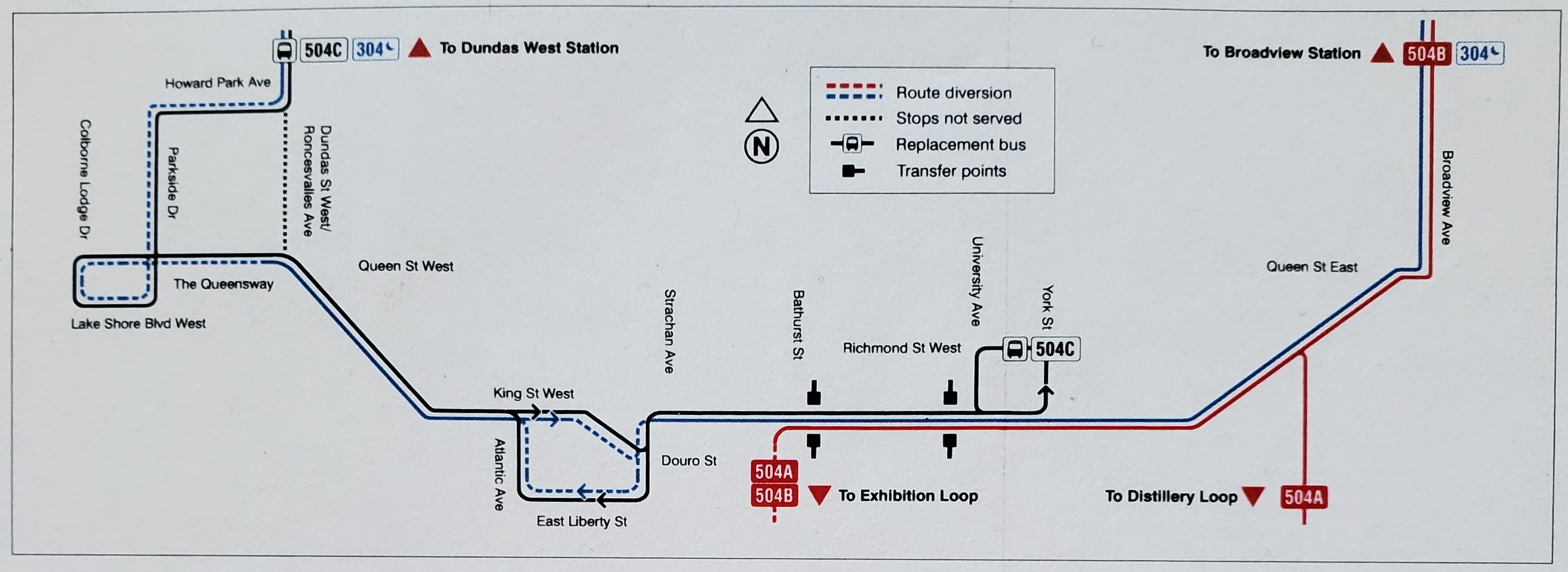
During this work, all 504 King service will operate to Broadview Station via Parliament and Queen Streets. The 503 Kingston Road route will also use this diversion.

A shuttle bus will operate to provide access to the Distllery, and it will also provide coverage for the 506 Carlton line during construction at Church Street (see below).

Church & Carlton Track Repairs

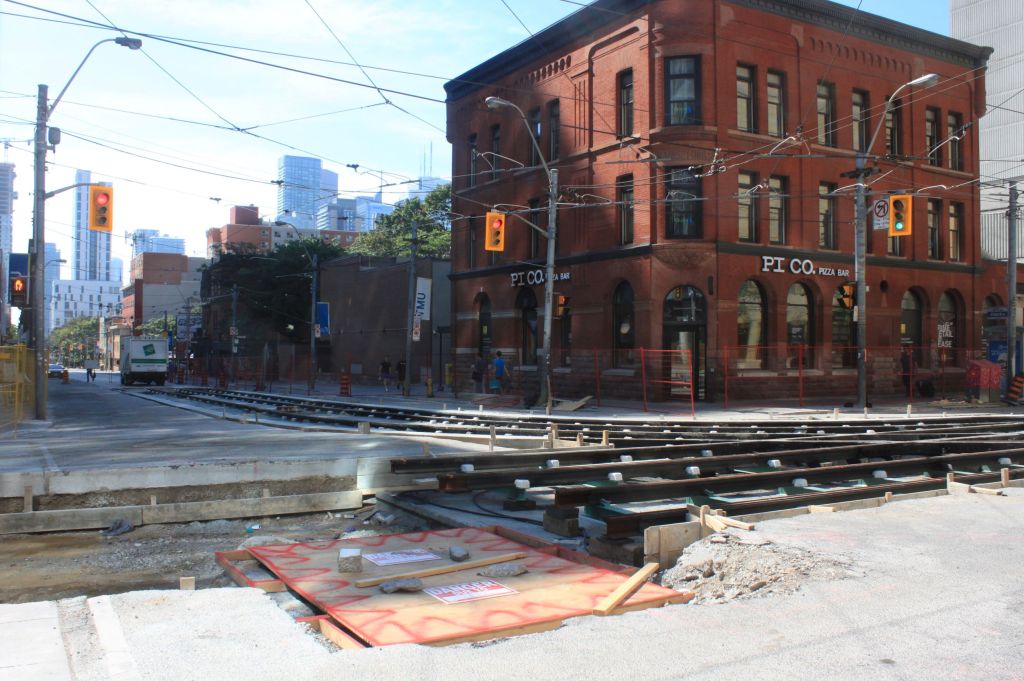
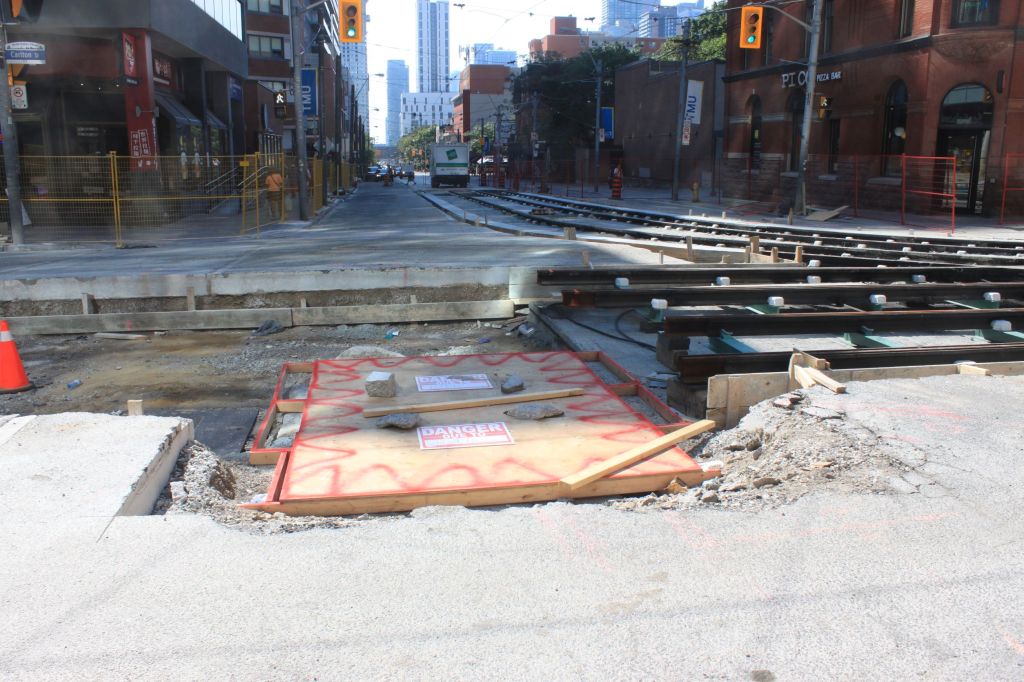
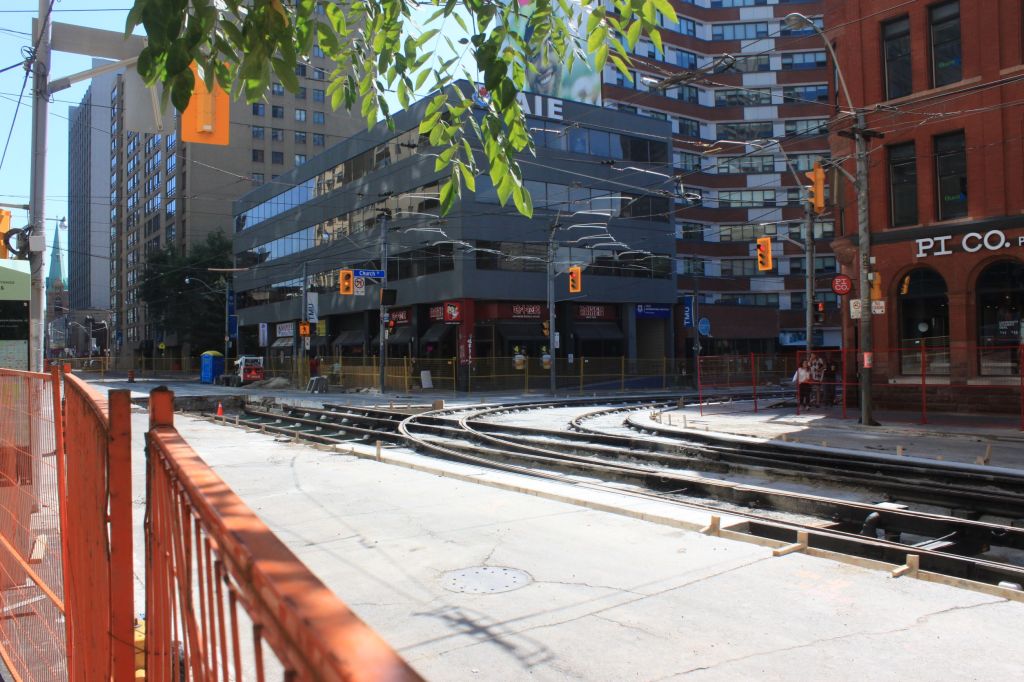
The intersection of Carlton and Church will be rebuilt as part of the regular maintenance program. This work will not include the addition of missing curves in the southeast quadrant.

506 Carlton service will divert around construction via Parliament, Dundas and Bay both ways. A replacement bus service will operate from Spadina Station to the Distillery District. The map below shows a proposed alignment for this service. This is subject to change depending on possible modifications to turn restrictions due to construction at College & Yonge.

Updated July 28, 2022: This diversion has been changed. See Revised 506 Carlton Diversion Effective July 31, 2022.

Other Changes

Running times on 32 Eglinton West will be adjusted to provide for delays due to the Line 5 Crosstown Extension construction, as well as to restore covid-era service cuts.

A planned reconstruction of the terminal at Kipling Station will require consolidation of loading areas and move of some routes to stops outside of the station. This project has been deferred to 2023, but a schedule change to support this work was already in the pipeline for the coming period. The 40 Junction and 49 Bloor West routes will be interlined.

Route 172 Cherry Beach will shift from “Old” Cherry Street to the “New” street across the future path of the Don River between Commissioners Street and the Ship Channel. Buses will use Old Cherry Street north of Commissioners Street, then jog west to New Cherry Street to cross the new river course.

Route 174 Ontario Place weekend and holiday service was dropped in June due to conflicting activities at the CNE and Ontario Place grounds. This change is now officially in the schedules.

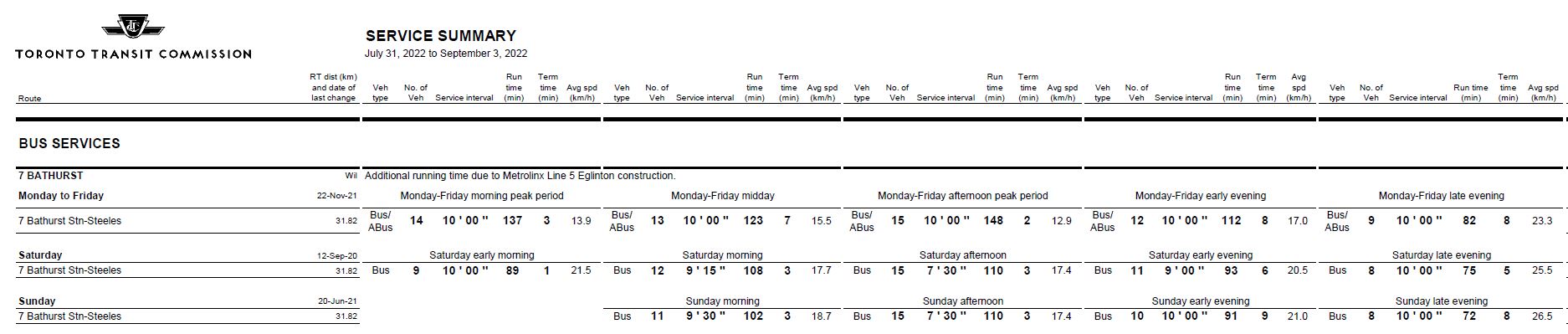
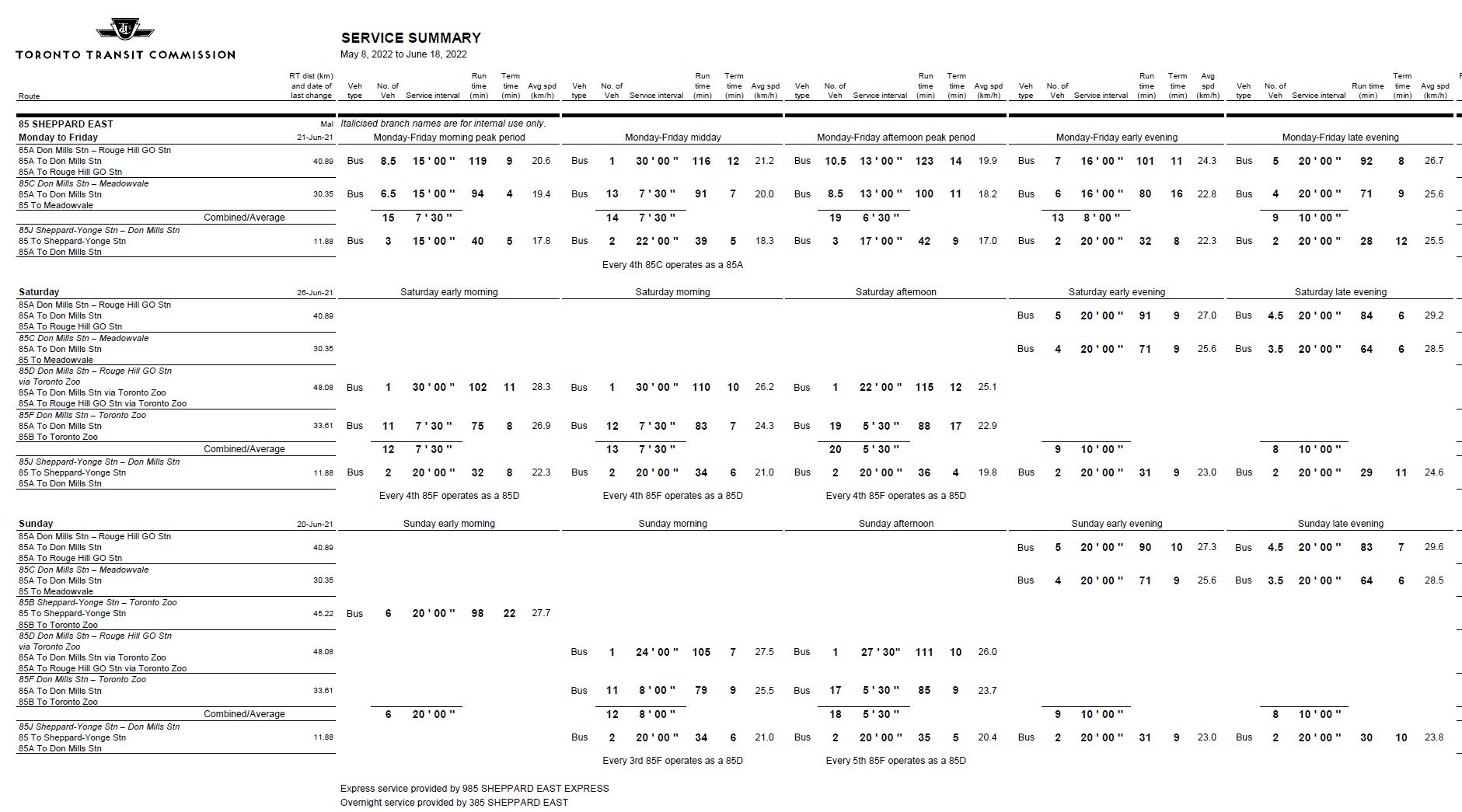
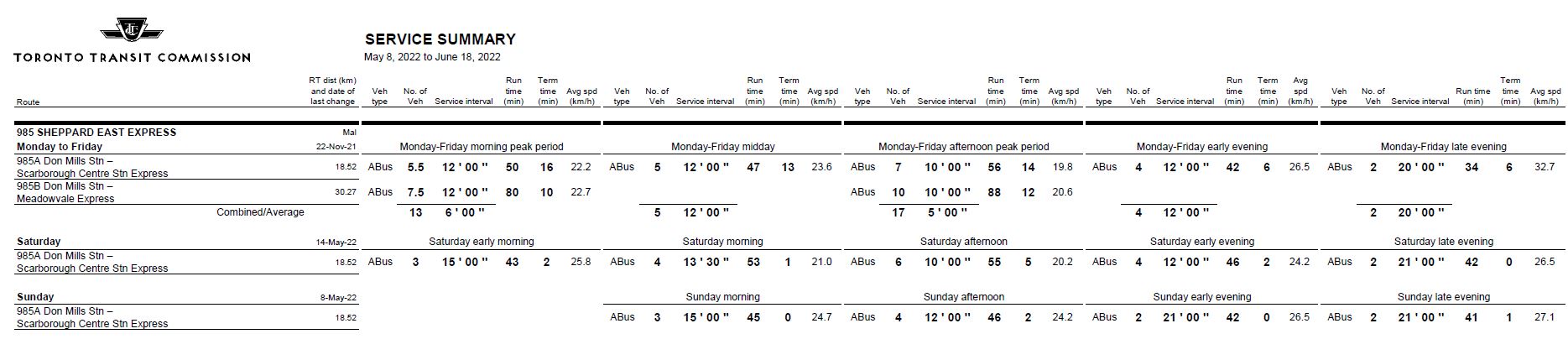
Details of the new service levels are in the spreadsheet linked below.

Major Construction at Russell Carhouse

Reconstruction of Russell Carhouse will begin both to make it fully compatible with the Flexity fleet, to improve the quality of yard paving and convert the overhead system for pantograph operation.

In the first phase of this work, the site’s capacity will be reduced to 28 cars including spares. Only the 504 King service will operate from the yard. Here is the new allocation of routes to the three carhouses.

Note that the maximum number of cars in service is well below the fleet of 204. Bus substitutions on portions of 501 Queen, 504 King and 506 Carlton will continue through the balance of 2022.

As the work at Russell progresses, the capacity of the site will change.

The Myth of “No Short Turns” (Revised)

Note: Calculations behind the charts in the original version of this article include a methodology problem. Short turn counts for vehicles crossing two screenlines (such as eastbound on Queen at Coxwell and at Woodbine) were distorted when these events did not occur in the same hour. Other problems included double counting of cars that looped twice at a short turn point (e.g. College Loop), and cars that were entering service via a loop being counted as short turns.

Changes in the text are shown by highlighting of the new version. All charts have been replaced.

My apologies for any confusion, but the charts used here avoid the potential confusion of values shown originally.

One of the many annoyances of trying to use transit service is to discover that your bus or streetcar has been “short turned”, that is to say, will not reach the destination advertised. This might happen before you board so that an arrival prediction turns out to be for a streetcar you can’t use, or as a “surprise” when the operator gets on the PA to announce that Transit Control wants to short turn the car.

This has been a problem for as long as I have been involved in advocacy for better transit service.

TTC Board members and Councillors hear about this problem a lot, and they in turn beat on management to eliminate the practice. This can produce unwanted side effects, notably the padding of schedules so that it is almost impossible, at least in theory, for a car to be late and, therefore, short turns should not be required.

Alas it is not quite that simple. Short turns occur for various reasons including schedule issues, crew change timing, major delays/diversions and “operational problems”, that catch-all phrase covering everything from a stuck door to a plague of locusts. (Some explanations for transit service problems have been with us so long they have taken on an almost Biblical character.)

Meanwhile, the CEO’s Report happily tells us every month that short turns are a thing of the past, that they are so rare that it might not even be worth tracking them as a service metric.

Source: June 2022 CEO’s Report

The big drop in the metric in spring 2019 coincides with a point where a “no short turn” edict was issued by the CEO. This is not really practical as there are many bona fide reasons for short turning vehicles, but the numbers obediently went down and have stayed down.

Regular riders, however, might choose to differ in their day-to-day observations.

Since 2019, we have come through the pandemic era when a great deal of traffic congestion and ridership disappeared. For a time, the type of event that would disrupt service was comparatively rare. However, with “normal” conditions returning, service is no longer insulated by these effects.

In my own travels, I routinely encounter streetcars that are not going to their scheduled destinations. Let me be the first to say that I understand the need for short turns, but am rather amazed that the reported counts stay very close to zero. This simply does not match actual experience. A short turn is a short turn, regardless of why it is required.

The question, then, is how to count these events reasonably easily without standing on street corners clipboard in hand. Vehicle tracking data that I already receive from the TTC’s Vision system (and which drives the many arrival prediction apps) provides a simple mechanism.

In this article I will review several common streetcar short turn locations to see what is actually happening.

If readers have specific bus routes and locations they would like to see, please leave your request in the comments.

Continue reading

The Myth of “No Short Turns”

Note: The charts in this article include a methodology problem. Short turn counts for vehicles crossing two screenlines (such as eastbound on Queen at Coxwell and at Woodbine) are distorted when these events do not occur in the same hour. This article has been replaced with a revised version, but I am leaving the original here for reference.

Continue reading

Service Quality on 26 Dupont: March-April 2022

Service quality and reliability are, as regular readers here know, central to many of my critiques of the TTC.

Whether a route is short or long, busy or not, the TTC seemed incapable of accepting much less addressing service problems. For years, long before the pandemic, riders have complained about long, unpredictable waits and crowded buses, but the answer has always been that things really are not that bad. This is demonstrably not true.

The TTC relies on metrics based on averages, not on individual vehicle behaviour and this masks the wide variation in rider experience. 26 Dupont is an infrequent route with few riders, and it does not figure in the high end of the TTC’s attentions.

We have been through two years where the pandemic and the need to keep something, anything running took precedence. Now, with the hoped-for recovery, the TTC must address long standing problems that predate covid.

Looking ahead to their 2023 Service Plan, the TTC will attempt to deal with this issue as it is essential to improving transit’s attractiveness and luring riders onto the system.

Continue reading

TTC Service Changes Effective June 19, 2022

June 19 will bring the summer schedules on some routes, a return of streetcars at Broadview Station, and various minor changes scattered across the system.

Subway

There is no change in subway service.

Streetcars

With the completion of watermain work on Broadview in May, the streetcar service to Broadview station on 504 King and 505 Dundas will return.

504A Distillery to Dufferin service will remain, but will be blended with the 504B from Broadview Station to Dufferin. The combined service on the two branches will be more frequent in almost all periods than the 504A service now operating.

The 504/505 shuttle bus from Broadview Station to Parliament will no longer operate.

505 Dundas service will operate between High Park Loop and Broadview Station on the same headways as are currently provided just to Broadview. Dundas cars will not return to Dundas West Station until later in the year following completion of new platforms and overhead.

The 504C King/Roncesvalles shuttle bus will return to Dundas West Station, but, like all bus routes there, will loop on street and stop on Edna Avenue (north side of the loop) while work inside the station continues. Other bus routes currently diverting to Dufferin and Lansdowne Stations will return to Dundas West at the same time.

Work on Phase 3 of the King Queen Queensway Roncesvalles project including the North Gate of Roncesvalles Carhouse will begin in September.

Carhouse allocations of 504 and 505 will change with additional 504 cars operating from Leslie, and some 505 cars shifting to Roncesvalles. Allocations will change in August when construction work begins at Russell Carhouse, and again in September with the Phase 3 KQQR work.

There will be seasonal service cuts on several routes:

  • 503 Kingston Road AM Peak
  • 505 Dundas AM Peak bus trippers removed
  • 506 Carlton AM Peak bus trippers removed
  • 511 Bathurst all periods
  • 512 St. Clair almost all periods

See the spreadsheet linked later in this article for details.

From July 11 to August 1, 501L Queen and 301 Queen Night buses will divert westbound from Lake Shore via 15th, Birmingham and 22nd Streets during reconstruction of the intersection at Kipling. Eastbound service is not affected.

With overhead on the central section of Queen now converted for pantograph use, streetcars running between Leslie Barns and routes 510 Spadina and 512 St. Clair will operate via Queen west of the Don River rather than via King.

Buses

Routing Changes Due To Frequent CNE Closures

The following routes will be changed because streets in and near the CNE are often closed during the summer.

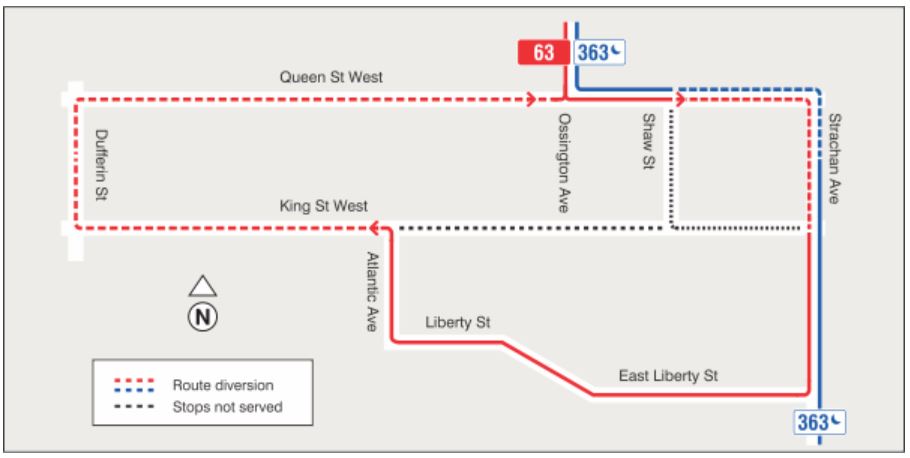
  • 29 Dufferin will loop through Liberty Village via King, Strachan and East Liberty.
  • 929 Dufferin will loop at Dufferin Loop.
  • 174 Ontario Place/Exhibition will operate via Fleet, Fort York and Lake Shore for the southbound trip.

30 High Park and 189 Stockyards Interline

Buses on routes 30 and 189 will interline to better use the running time on the combined route.

A new 30B High Park service will operate from High Park Station to the park via West Road and Colborne Lodge Drive. This seasonal shuttle will run separately from buses on the combined 30/189 service.

Seasonal Changes

The following routes are affected by seasonal reductions in demand:

  • 39/939 Finch East
  • 102 Markham Road
  • 905 Eglinton East Express
  • 927 Highway 27 Express

Miscellaneous Changes

  • 21C Brimley service to STC will be adjusted on Sundays.
  • 44/944 Kipling South service will divert both ways around track construction work at Lake Shore from July 15 to August 1.
  • 363 Ossington night service will return to Eglinton West Station Loop.
  • 72 Pape service will be adjusted during all time periods for reliability.
  • 86 Scarborough will have a trip added at 2:13 pm weekdays from Kennedy Station to fill a gap in the schedule.
  • 118 Thistle Down service will be improved in peak periods.
  • 134 Progress service will be adjusted on Saturdays.
  • 172 Cherry service will continue to bypass the Distillery District due to road construction.

600 Run As Directed

The number of scheduled RAD buses has been reduced substantial on weekdays from 40 to 5 crews. On weekends there will be more RAD buses with 39, up from 25, on Saturdays, and 32, up from 21, on Sundays.

Mount Dennis will not have any RAD buses. Details of the crew allocation are in the spreadsheet below.

Detailed Tables of Service Changes

Peak Vehicle Usage

Evolution of Travel Times on RapidTO Bus Routes 2020-2022 (Part 2)

This article is a companion to Part 1 of my update of travel time behaviour on key routes for 2020-2022. That article dealt with routes east of Yonge Street, and this part turns to routes west of Yonge:

  • 29 Dufferin from King to Wilson
  • 35 Jane from Eglinton to Steeles
  • 60 Steeles West from Finch Station to Kipling

These three routes show more variation over time than most of the routes east of Yonge reviewed in the first article. The greater variation implies that they are more sensitive to changes in overall road demand and have less headroom to begin with. They are more likely to benefit from priority measures, but taking road space for transit will be more politically challenging in car-oriented areas.

Any detailed study that purports to establish time savings through red lanes must be careful to be an apples-to-apples comparison avoiding projected savings against conditions (construction projects and future route changes) that will change on their own. Similarly, and by reference to what was done on the Eglinton-Kingston corridor, “savings” due to stop eliminations, if any, should not be counted as a “benefit” of transit priorty.

Continue reading

Evolution of Travel Times on RapidTO Bus Routes 2020-2022 (Part 1)

This article and one to follow is an update of an earlier review of the effect of pandemic-induced changes in traffic levels on the running time of buses. The target routes are those that already have “red lanes”, exclusive lanes for buses at all hours, and on the first group where red lanes were proposed.

Originally, the list of possible routes was shorter, and it is those routes whose vehicle tracking data I have collected over the past years:

  • Eglinton-Kingston-Morningside (implemented fall 2020)
  • Lawrence East
  • Finch East
  • Steeles West
  • Dufferin
  • Jane

A City study is underway to prioritize routes for detailed study and implementation under the RapidTO program.

An important premise behind RapidTO and bus priority is that service can be improved both because travel times are shorter and because they are more reliable leading to more regularly spaced and predictable service. Indeed, on the King Street transit project, the benefit was far more that variation in travel was reduced and reliability was increased, as opposed to reducing the average speed of travel under day-to-day conditions.

Too often, “priority” has been sold on the basis that it would reduce operating costs when the real goal should be to improve service with resources already in place, and to ensure that any additional buses or streetcars do not simply disappear into a “black hole” of unreliable service.

With the pandemic, we have an unexpected chance to see how much time is saved when traffic is, for a period, reduced from normal levels. This gives an indication of what we might expect from red lanes, or putting it another way, the best we are likely to achieve.

Continue reading

KQQR & Dundas West Update: May 2022 (Updated)

Updated May 11: The schedule for completion of the final phase of the work at KQQR has slipped to fall 2022 according to the project website:

Previous delays, combined with some periods of adverse fall/winter weather, COVID-19 related labour shortages and supply chain issues have deferred completion of Stage 2 work (KQQR intersection, The Queensway and King Street West) to September 3, 2022.

Work on Stage 3 (the final stage) will start on Roncesvalles Avenue from the KQQR intersection to Harvard Avenue on September 4, 2022, and will be completed by the end of December 2022.

Work on the King-Queen-Queensway-Roncesvalles project continues with installation of new overhead at the intersection, completion of some new lane layouts, and utility work along the Queensway. Track construction is moving, albeit slowly, west from Sunnyside Loop toward the end of the existing right-of-way east of Parkside Drive.

At Dundas West Station, the road has just been closed north of Bloor except for a single northbound lane, and on Edna from Dundas to the west end of the loop for special work replacement. (As of May 9/22)

Traffic in the area is quite snarled because there are also minor track repairs underway on Dundas south of Bloor, and reconstruction of Bloor Street continues westward in the area to which much traffic has diverted.

Bus diversions are not the same as originally advertised.

  • 40 Junction operates eastbound to Dufferin Station via Dupont and Dufferin returning westbound via Bloor, Lansdowne and Dupont.
  • 168 Symington eastbound turns east rather than west on Bloor to Dufferin, returning westbound via Dufferin, Dupont, Lansdowne and Bloor.
  • 504C King is supposed to be diverting southbound via Parkside Drive and Howard Park to Roncesvalles, but was running via Bloor and Dundas.

King-Queen-Queensway-Roncesvalles

May 9, 2022

Eastbound road traffic is now using the streetcar lane, but the new lane arrangement and the curb separating the streetcar lane are now in place. The King Street leg of the intersection is complete, but not yet open.

On The Queensway west from Sunnyside, road rebuilding and track installation proceeds in bite-sized segments. It has now reached the point of blocking eastbound access from The Queensway to St. Joseph’s Hospital’s main driveway, and there is still a “slalom” where traffic shifts from the regular curb lanes to the streetcar lanes for a short distance.

Along the south side of The Queensway, utility work is still underway.

Dundas West Station

May 9, 2022

At Dundas West Station, the rebuilt track for the 504 King platform and the exit to Edna Avenue are in place, and excavation for the new 505 Dundas track is underway.

Dundas Street is blocked off except for one northbound lane, and Edna Avenue is closed in anticipation of track replacement for the north and east sides of the loop.