Service Quality on 64 Main: July 2022

Updated August 24 at 11:10am with information about the sources of delays mentioned in the article.

This article is a follow-up to Service Quality on 64 Main: Oct-Dec 2021 to see how this route is behaving under summer conditions.

The 64 Main bus operates between Main Station at Danforth Avenue and Queen Street in The Beach looping at the south end via Wineva, Queen, Hambly and Williamson.

In the previous article, a major issue for the 64 Main bus was inadequacy of scheduled travel time. This was adjusted in November 2021, and the times were extended further in March 2022.

Scheduled service effective November 2021:

Scheduled service effective March 22. In general, headways are a bit wider and running times extended without the addition of vehicles to the route except during the AM peak and Sunday afternoons.

Data presented here cover the month of July 2022. Note that Friday July 1 was a holiday. and its data are included in the Sunday charts.

The overwhelming problem on 64 Main was not that schedules were impossible for operators to keep, or that buses were running in twos or threes. Quite commonly, one or two buses were missing from service, a major problem when the scheduled service is at best three buses.

How much service is lost because there is nobody to drive a vehicle, and why this is not regularly reported as a measure of service quality in the CEO’s Report?

Continue reading

TTC Service Changes Effective September 4, 2022

Updated:

  • The spreadsheet detailing all of the changes has been added at the end of this post.
  • The number of the Mimico GO shuttle has been corrected to 176.
  • Transfer arrangements at Queen & Dufferin for the 501 bus and streetcar services have been clarified.
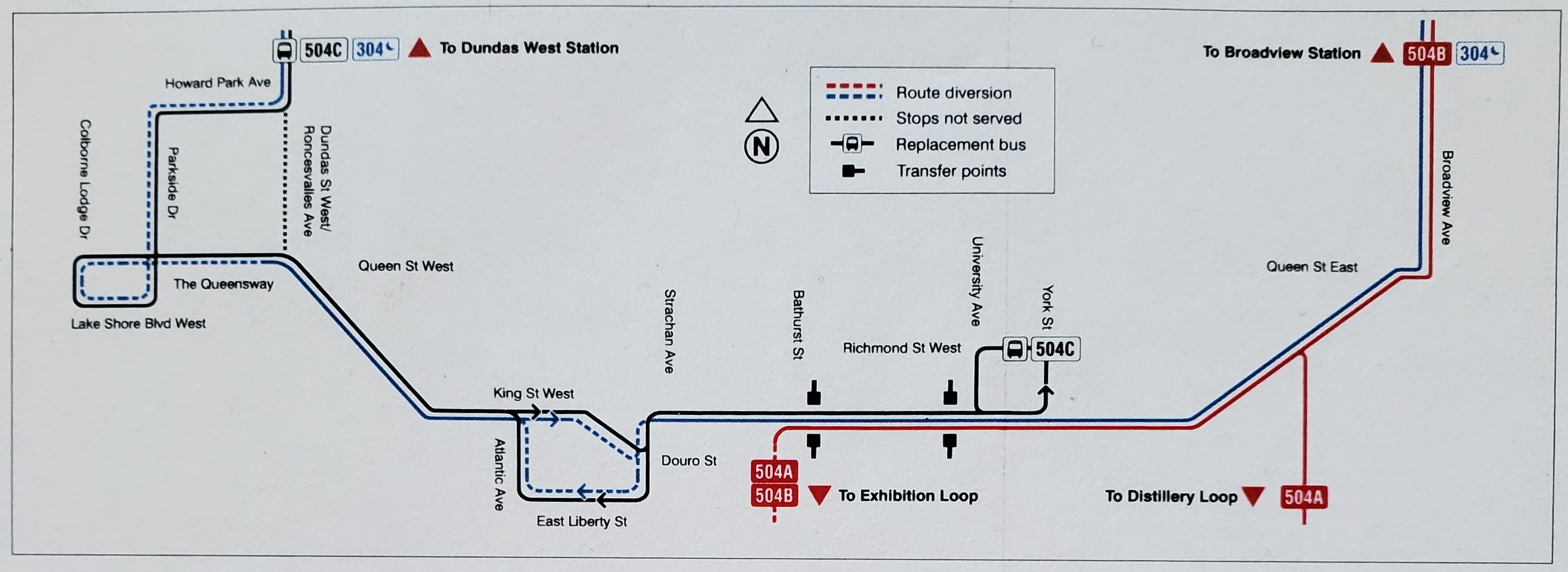
  • Transfer arrangements at Queen & Roncesvalles for the 501 and 504 bus services have been added.

Updated September 5, 2022:

  • The spreadsheet listing all of the changes has been corrected for route 504 King. The original version included a description of the route carried over from the August version. This has been changed to reflect the September arrangements.

The TTC will make many changes to its scheduled service on September 4, 2022 with restorations of previous service levels on many routes. This will not get the system back to 100% of pre-pandemic levels.

An important distinction is between three values:

  • The amount of service scheduled before Spring 2020
  • The amount of service budgeted for 2022
  • The amount of service scheduled for 2022

The TTC plans to be back to 97% of budgeted service for bus, 84% for streetcar and 92% for subway. The overall numbers are compared below.

Hours/WeekRegularConstructionTotal
January 2020 Scheduled185,8257,068192,893
September 2022 Budgeted186,3796,398192,777
September 2022 Scheduled177,9304,965182,895

In the original 2022 service budget, the TTC planned to be back to roughly the same level of service as in January 2020 by September 2022. However, slower ridership recovery coupled with staffing constraints produced a lower scheduled service expressed as hours/week.

There are further caveats:

  • The distribution of hours by time of day might not be the same in 2022 as in 2020 because of changing demand patterns.
  • Changes in running times to deal with congestion or service reliability can mean that the same service hours are stretched over wider headways. Not all vehicle hours are created equal.

All that said, there are many changes in service levels, and with the bus network being back to 97%, the schedules for September 2022 are often based on old versions before service cuts were implemented. Another change for this month is the reintroduction of school trips on many routes.

Continue reading

Local and Express Service on 41/941 Keele

A few weeks ago, in a conversation on Twitter, there was a remark about the tendency of express and local buses to run in pairs on the Keele route. Normally, when I do service analyses, I keep the express and local routes separate partly to see each service on its own, and partly because some riders can only use the local service at the origin or destination of their journeys.

That comment led me to examine the two services in the same set of charts to see how they behaved. First off, however, a look at them separately. An important issue for all local/express pairs is that the chronic unreliability of TTC headways means that there is no “blended” service in any sense even when it is scheduled that way. Moreover, the difference in travel times over the length of an express route is usually fairly small. Achieving that “saving” can be offset by the unpredictable wait for an express bus to actually show up.

The data presented here are from June 2022.

Updated August 18, 2022 at 11:55pm: Charts of travel time averages for express and local services have been added at the end of the article.

Continue reading

Queen West Construction Update: August 14, 2022

Various projects on the west end of the 501 Queen route continue, some faster than others, with one real surprise.

King-Queen-Queensway-Roncesvalles

Little has changed here since my last visit except that the new contact wire is now attached to span wires in places, and some of the frogs (crossing pieces) have been installed.

The new contact wire still ends just east of Sunnyside Loop. Until reconstruction of the south side of The Queensway including bases for new overhead poles has completed, the loop’s overhead suspension system cannot be installed.

Further west at Glendale (St. Joseph’s Hospital), the concrete work now extends to the west side of the intersection, and the beginnings of a new eastbound stop stop are evident.

Lake Shore & Kipling

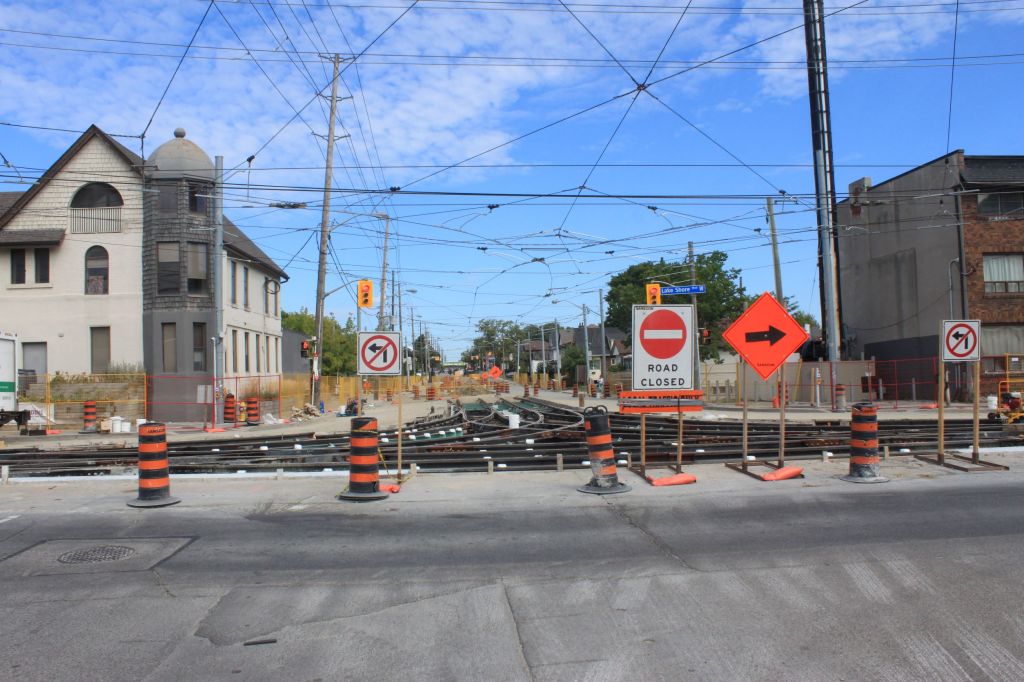
The TTC is rebuilding both the intersection at Kipling as well as Kipling Loop. To my amazement, they have not only replaced the rarely used east-to-north curve, but have added a new south-to-west. It will now be possible to short turn a Queen car eastbound at Kipling!

This is the same organization that forgets to add much-needed curves during other reconstruction projects or leaves them out on the basis that the budget won’t handle the expense. There is probably a special award for this sort of thing.

In a classic right hand, left hand, situation, note that the new pantograph compliant overhead includes the east-to-north curve, but does not include the south-to-west.

Just east of the intersection, rails have been removed on the approach for replacement. This is a particularly clear example of how the “new” method of track construction adopted in the 1990s pays off with the need to only strip the top layer of concrete and expose existing attachment points to existing ties.

Looking east on Lake Shore east of Kipling

Louisa to Mimico

The track replacement and repaving of Lake Shore from Louisa to Mimico is complete, and only a few traffic cones prevent full use of the roadway.

The Myth of “No Short Turns” (July 2022)

This post includes short turn counts for the month of July on the major east-west streetcar routes downtown. See also:

Updated August 14, 2022: Charts of travel times on King between Strachan and Dufferin have been added to show that although there were congestion problems, they existed only on specific days due to special events, not pervasively through the month of July.

According to the TTC CEO’s Report, short turns (a situation where a vehicle does not reach its scheduled destination but instead turns back at an earlier point) were all but eliminated in May 2019.

This is not to say that short turns should not exist. They are an inevitable part of transit operations where delays can occur, and are essential to restoration of regular service. Back in 2019, the TTC’s problem was that they were used very frequently either as a lazy way to manage service or in response to unrealistic schedules. Now they occur but are not reported.

Meanwhile, other problems with service such as bunching, gaps and missing vehicles are not reported or tracked (at least publicly) at all.

There is no way to avoid saying this: the reported level of short turns is a total misrepresentation of what actually happens on the street as any regular rider knows. Management gets to claim they have eliminated a problem, but in fact it persists.

  1. Methodology
  2. 501 Queen Eastbound at Kingston Road
  3. 504 King Westbound at Spadina and at Bathurst
  4. 504 King Eastbound at Parliament
  5. 504 King Eastbound at Dundas/Broadview
  6. 505 Dundas Westbound at Lansdowne
  7. 505 Dundas Eastbound at Parliament
  8. 506 Carlton Westbound at Lansdowne
  9. 506 Carlton Eastbound at Coxwell

Methodology

From TTC vehicle tracking data, it is possible to count the number of streetcars passing any point on the line. In order to determine how many short turns occur at a specific location, counts on either side of a turnback will reveal the answer.

For example, if the screenlines for counts on Queen are defined as Coxwell Avenue and Woodbine Avenue, then the difference in counts shows how many cars short-turned at Woodbine Loop.

For these analyses, the counts are grouped by hour and by day through a month. Next, all weekdays, Saturdays and Sundays are consolidated to show the difference between types of day. The weekday counts are broken out by week to catch short-lived effects.

Friday, July 1, Canada Day, is counted as a Sunday. Note that this means that there are six “Sundays” and only five “Saturdays” included in the totals. That is the reason the count of trips within the month is higher for Sundays than for Saturdays.

An important distinction in any analysis is between overall averages and a detailed view of operations. TTC has a bad habit of reporting stats, when they do so at all, on a monthly average basis. This blends together periods when service is good with periods when it is very bad giving the impression that things are going fairly well. Riders, of course, encounter and are angered by the bad times which happen too often and fairly predictably.

The raw data are at a minute-by-minute, vehicle-by-vehicle level. In the charts here, I have tried to strike a balance between “information overload” with too much detail, and high level views that obscure what is happening on the street.

Continue reading

Service Analysis of 53/953 Steeles East for May-July 2022

This article continues a series reviewing the service on major routes in Scarborough. Previous articles include:

Other routes to be reviewed include 85/985 Sheppard East, 102/902 Markham Road, 43/943 Kennedy and 68/968 Warden. Routes in the Eglinton-Kingston corridor will be reviewed as part of a “red lane” update in the Fall.

  1. Overview
  2. Service Standards vs Service Reliability
  3. Service Eastbound From Finch Station
  4. Service Westbound From Staines
  5. Service Westbound From Passmore
  6. Service Westbound from Markham Road
  7. Express Vs Local Travel Times
  8. Service Charts
  9. The Last Two Weeks of June 2022
  10. Saturday May 7
  11. Victoria Day Monday May 23
  12. Saturday July 30

Overview

Scheduled service on Steeles East is unchanged since Fall 2021. There are various route branches which overlap to provide a frequent combined service on paper, although individual branches on wider headways can be less reliable.

Peak service is provided by three branches:

  • 53B Finch local to Markham Road
  • 953A Finch express to Staines
  • 953B Finch express to Markham Road

The scheduled headway on the express service is every 7’00” (am) or 7’15” (pm) as opposed to every 6’00” on the local service. This means that even if everything runs exactly on time, there will be uneven spacing between the express and local buses.

Midday and early evening service operates with 53A and 53B local buses to Staines and to Markham Road respectively, but the 1-in-3 (midday) or 1-in-4 (early evening) pattern of 53A buses produces gaps in service on the 53B branch that serves the Amazon fulfillment centre via Markham and Passmore Roads. Late evening weekday service alternates between the branches.

There are similar uneven weekend headways on the 53B because of the gaps produced by the occasional 53A trips.

Service Standards vs Service Reliability

A point worth mentioning here is that even the fairly well-behaved periods of service on both the local and express branches show a problem with an on-time target window that is close to the scheduled headway. Service can be “on time” within a six minute window, but still operate in bunches.

For example, if the scheduled departures are on the 0, 6, 12, 18 … minute marks, buses could actually leave on 5, 5, 17, 17 … and be “on time” by TTC standards. Half of the buses would be five minutes late (the upper bound allowed), while the other half would be 1 minute early (the lower bound). This is a worst case scenario, but it shows what the standards allow.

In effect, the six minute window allows gaps of up to twelve minutes followed by a pair of buses to be considered “on time”. This allows reported service quality to be much better than what riders actually experience, and leaves a gap (so to speak) between the claimed and actual service quality.

Overall, service reliability on Steeles East is fairly good simply because it is so frequent on weekdays on the common part of the route west of Markham Road. However, the outer branches suffer from gaps and bunching that is hidden by the frequent service further west. Weekend service is particularly uneven, and the degree of headway management varies from one weekend to another. The express service headways are spread over a range wider than the time saving an express trip offers.

Continue reading

West End Streetcar Construction Update: July 31, 2022

Several projects are in various stages on the west side of Toronto’s streetcar system. Here is an omnibus update.

King-Queen-Queensway-Roncesvalles

The reconstruction of this junction has reached the point where all of the contact wire for the new intersection is in place, but it is not yet attached to the hangers on the spiderweb of span wires above the intersection. Contact wire extends west of Roncesvalles through the South Gate area, but ends just east of Sunnyside Loop.

Further west, the track is in place to Glendale Avenue (St. Joseph’s Hospital stop), but not fully concreted. One block remains to be installed from Glendale to the existing right-of-way.

According to the most recent City construction notice, service west of Bathurst Street will resume in two stages, and even then will not yet be through to Humber and Long Branch.

  • Effective September 4th:
    • 501/301 Queen streetcar service will be extended west to Dufferin Street from Bathurst Street. 501L replacement buses will be shortened to operate from Long Branch Loop to Dufferin Street.
    • The 504/304 King streetcar will continue to be replaced by bus service west of Dufferin Street.
  • As of October 9th:
    • 501/301 Queen streetcar service will be extended as far west as the KQQR intersection. 501L Replacement buses will continue to operate between Long Branch Loop and Dufferin Street.
    • The 504/304 King streetcar will continue to be replaced by bus service during construction and will have no service on Roncesvalles Avenue south of Howard Park Avenue. Route adjustments are: Howard Park, Parkside, Lake Shore, Colborne Lodge, The Queensway (both directions).

Detailed service plans will likely be published by the TTC in mid-to-late August.

Lake Shore Boulevard West

The track between Louisa Street and Mimico Avenue was not replaced in the last round of TTC upgrades on this route. They are now completing this section. A few points to note in the photos below:

  • In the view looking west, work on overhead conversion to pantograph mode including staggering of the contact wire is in progress. Over the entire route from Humber to Long Branch the contact wire is not yet attached to many of the new hangers.
  • In the view looking east, note that the rail is not yet fastened down with Pandrol clips. The previous rebuild here is recent enough that the track foundation already has steel ties, and so the rebuild only requires removal of the top pavement layer. The new track is then attached to the existing foundation.

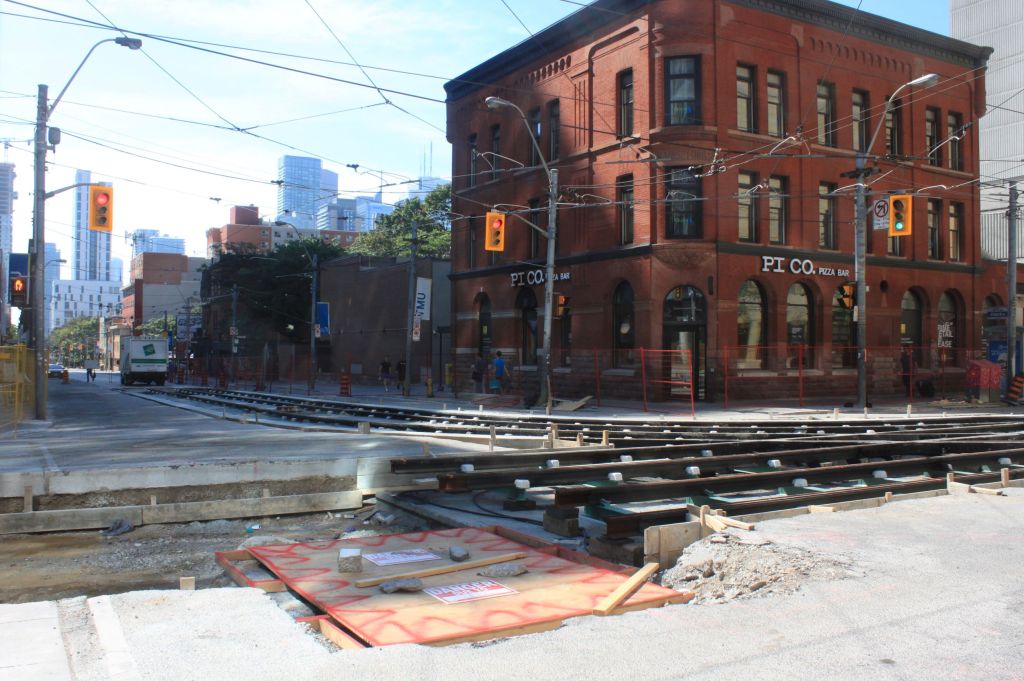
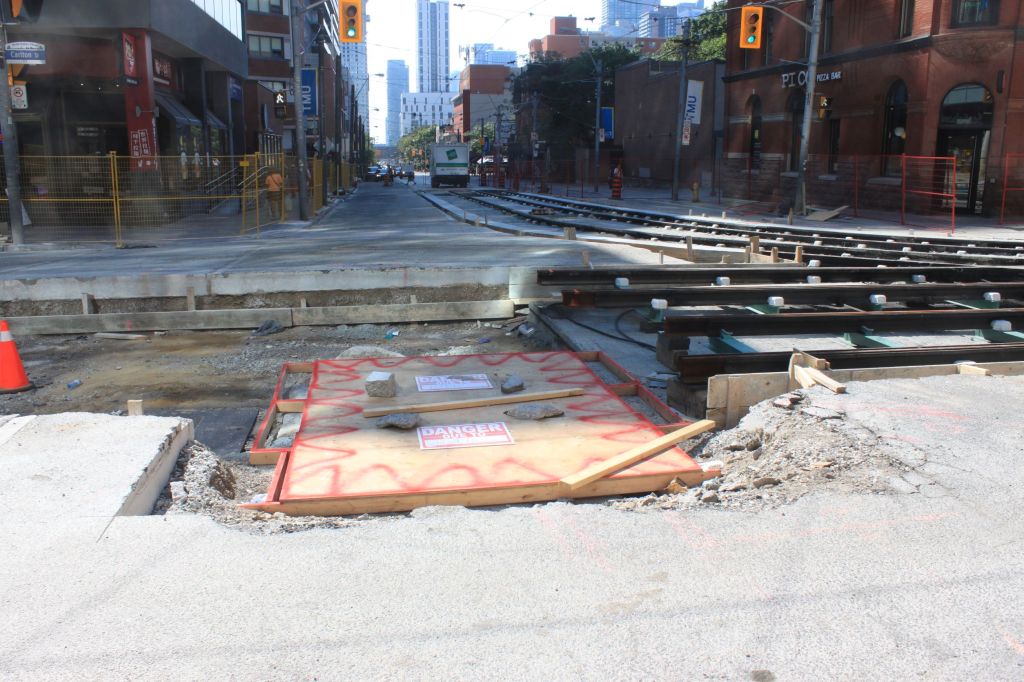
At Kipling and Lake Shore, construction has just begun on replacement of the intersection and Kipling Loop. From the pre-assembled track already sitting on trailers near the site, it appears that the east-to-north curve will be replaced rather than removed. This curve is only ever used by railfan charters, and yet it survives. Meanwhile, on another project at Church & Carlton where missing curves in the south-east quadrant would add to network flexibility, the TTC is rebuilding the track as is without them.

Dundas West Station

The new extended platform for 505 Dundas cars is now in place, although still missing guardrails, and the track replacement for the loop has been complete for a few weeks. The new platform will allow two 505 Dundas Flexitys to be in the station at once (this was already possible for 504 King cars) relieving a source of congestion on Dundas Street at the station entrance.

Currently announced plans are for buses to return to this loop in September, but 505 Dundas streetcars will continue diverting to High Park until early October pending completion of new overhead and the platform.

504 King streetcars will not return here until completion of the last phase of the KQQR project likely in late Fall 2022.

Revised 506 Carlton Diversion Effective July 31, 2022

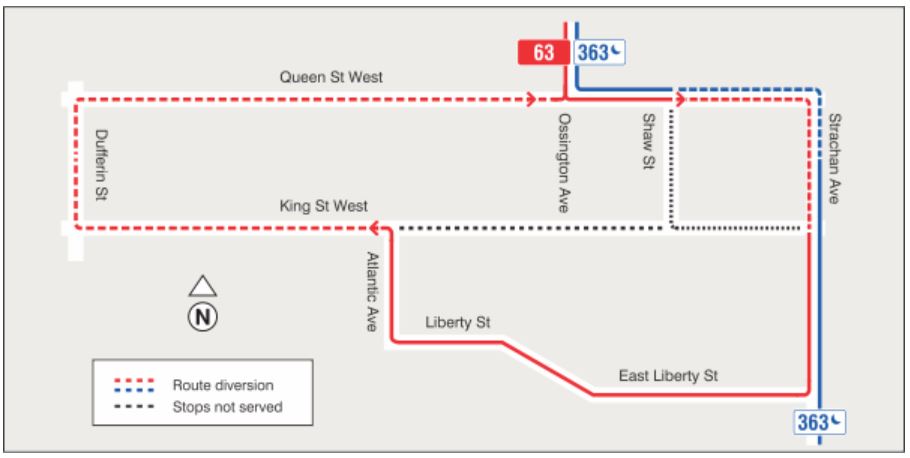
In my article detailing the planned service changes on the coming weekend, I included a proposed map showing how the 506 Carlton shuttle bus would divert around construction at Church Street. This route has been changed:

  • Original: From Jarvis & Carlton, south to Gerrard, west to Yonge, north to Wellesley, west to Bay, south to College (same route in reverse eastbound).
  • Revised: From Jarvis & Carlton, north to Wellesley, west to Yonge, south to College (same route in reverse eastbound).

The original roundabout diversion was due to concerns that construction at Yonge & College would prevent buses from turning there. Here is the updated map from the TTC’s website.

Adelaide Street Reconstruction Open House

The City of Toronto will hold an online open house for the Adelaide Street project on Thursday, July 21 from 6:30 to 8:00 pm.

A link to register for this session is on the project page.

Track on Adelaide has been inactive for many years thanks to various cuts for utility projects and the high level of building construction along the street. The TTC contemplated reactivating the track as a bypass for, among other things, the Tiff street fair, but the opportunity did not present itself until now.

The Ontario Line open cut construction at Queen Station will require diversion of streetcar service around Queen and Yonge for several years. Cars will operate westbound via existing track on Church, Richmond and York. Eastbound service will run via York, Adelaide and Church.

This requires reconstruction of the Adelaide Street trackage as well as installation of new tracks southbound on York from Queen to Adelaide. Although only the track east from York is required for the Ontario Line diversion, the TTC will restore the track between Spadina and York making provision for a longer diversion. York will become two-way from Queen to Adelaide.

It is not yet clear which special work will be added at intersections, notably Adelaide and York where a north-to-east curve would be useful, especially if the TTC adds an east-to-north at King and York when this is rebuilt in a pending King Street project. Unfortunately, with the lead time between planning and execution, the TTC has forgotten on occasion (or chosen for budgetary reasons) to include missing curves that would make their operations more flexible notably at Broadview and Gerrard and, this year at Church and Carlton. These opportunities only come along every 25-30 years.

The project also includes water main reconstruction from York to Church, and repaving. Parts of the street are in very bad condition after years of condo construction trucks pounding the pavement.

From Bathurst to Parliament, the bike lane will shift to the north side of the street where there will be less conflict with the streetcars and with vehicles stopped in the eastbound curb lane.

I will update this article with more info after the open house.

TTC Service Changes: July 31, 2022

There will be a small number of changes on July 31 for the schedule period running through to the Labour Day weekend.

Line 2 Service Improvement

Service on Line 2 Bloor-Danforth will be improved during all operating periods, notably off-peak and weekends. This will not fully restore pre-pandemic levels on the route, but should reduce crowding that has become a problem over past weeks.

King & Sumach Track Repairs

The intersection of King and Sumach (the point where the Distillery line branches off) will be rebuilt in an attempt to reduce noise and vibration.

During this work, all 504 King service will operate to Broadview Station via Parliament and Queen Streets. The 503 Kingston Road route will also use this diversion.

A shuttle bus will operate to provide access to the Distllery, and it will also provide coverage for the 506 Carlton line during construction at Church Street (see below).

Church & Carlton Track Repairs

The intersection of Carlton and Church will be rebuilt as part of the regular maintenance program. This work will not include the addition of missing curves in the southeast quadrant.

506 Carlton service will divert around construction via Parliament, Dundas and Bay both ways. A replacement bus service will operate from Spadina Station to the Distillery District. The map below shows a proposed alignment for this service. This is subject to change depending on possible modifications to turn restrictions due to construction at College & Yonge.

Updated July 28, 2022: This diversion has been changed. See Revised 506 Carlton Diversion Effective July 31, 2022.

Other Changes

Running times on 32 Eglinton West will be adjusted to provide for delays due to the Line 5 Crosstown Extension construction, as well as to restore covid-era service cuts.

A planned reconstruction of the terminal at Kipling Station will require consolidation of loading areas and move of some routes to stops outside of the station. This project has been deferred to 2023, but a schedule change to support this work was already in the pipeline for the coming period. The 40 Junction and 49 Bloor West routes will be interlined.

Route 172 Cherry Beach will shift from “Old” Cherry Street to the “New” street across the future path of the Don River between Commissioners Street and the Ship Channel. Buses will use Old Cherry Street north of Commissioners Street, then jog west to New Cherry Street to cross the new river course.

Route 174 Ontario Place weekend and holiday service was dropped in June due to conflicting activities at the CNE and Ontario Place grounds. This change is now officially in the schedules.

Details of the new service levels are in the spreadsheet linked below.

Major Construction at Russell Carhouse

Reconstruction of Russell Carhouse will begin both to make it fully compatible with the Flexity fleet, to improve the quality of yard paving and convert the overhead system for pantograph operation.

In the first phase of this work, the site’s capacity will be reduced to 28 cars including spares. Only the 504 King service will operate from the yard. Here is the new allocation of routes to the three carhouses.

Note that the maximum number of cars in service is well below the fleet of 204. Bus substitutions on portions of 501 Queen, 504 King and 506 Carlton will continue through the balance of 2022.

As the work at Russell progresses, the capacity of the site will change.