TTC Service Changes Effective Sunday, September 3, 2023 (Preliminary)

This is a preliminary version based on GTFS data (the standard format for transit schedules used by online services) and some Service Advisories on the TTC site. I expect to receive the full list of September service changes early in the week of August 28 and will update this article accordingly including the usual detailed comparison of service levels.

Updated August 26 at 9:15 pm: 512 St. Clair updated to reflect complete bus replacement for work at various locations on the line.

Updated August 27 at 4:30 pm: At 10:30 am on August 28, the Mayor, TTC Chair and CEO will hold a press conference at STC Station to “outline how the TTC will increase service beginning September and into the fall.”

Updated August 29 at 5:30 pm: Due to changes in the Metrolinx schedule for work on the Lake Shore East Queen Street bridge, there has been a further revision of planned service. Please see this post for details.

Continue reading

Short Turns and Wait Times on Streetcar Routes

At the TTC Board meeting on July 12, 2023, there was a brief discussion of the problem of short turns on streetcar lines. The information provided by management was, shall we say, less than a full accounting of what is actually going on.

This issue flared up many years ago particularly with short turns of service in The Beach among other areas, and in general a problem with erratic, gap-filled service on the outer ends of routes. TTC management committed to reducing or eliminating this problem, and to that end there was a “no short turns” policy that everybody seemed to know about at the operational level, but which was officially denied.

The stats did go down, but looking under the covers showed that not all was well:

  • Short turns are a bona fide service management tactic for dealing with delays to restore even spacing of service. There is nothing wrong with a short turn of some cars in a parade because this will restore service sooner than if every car trundles to the terminal and they return in a pack.
  • The official count of short turns fell to almost zero. However, this was due in part to selective reporting that was clear to (a) anyone actually riding the system and (b) anyone looking at vehicle tracking data.

Rick Leary got the equivalent of a gold star from the Board who frankly did not know any better, but occasionally wondered why claims of improved service did not align with complaints from constituents. The standard excuses for occasional upsets due to congestion and construction were regularly trotted out even though service could be erratic at times and locations when these were clearly impossible.

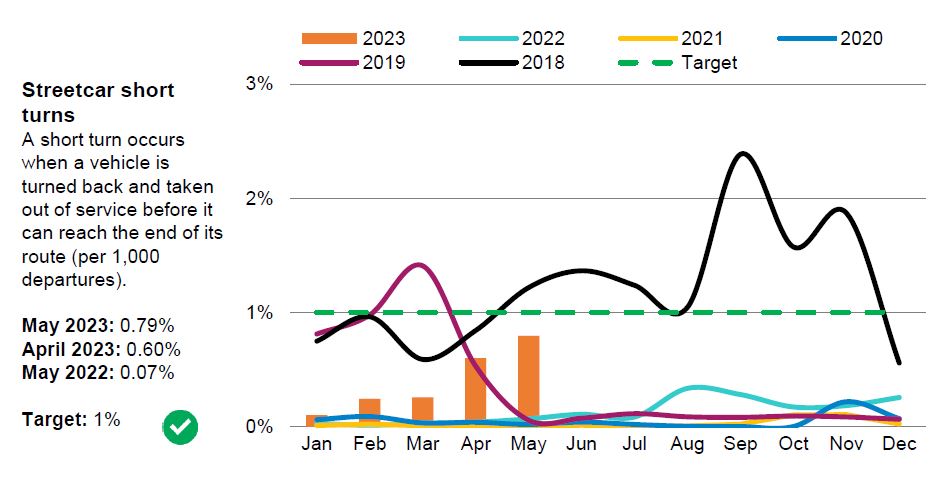
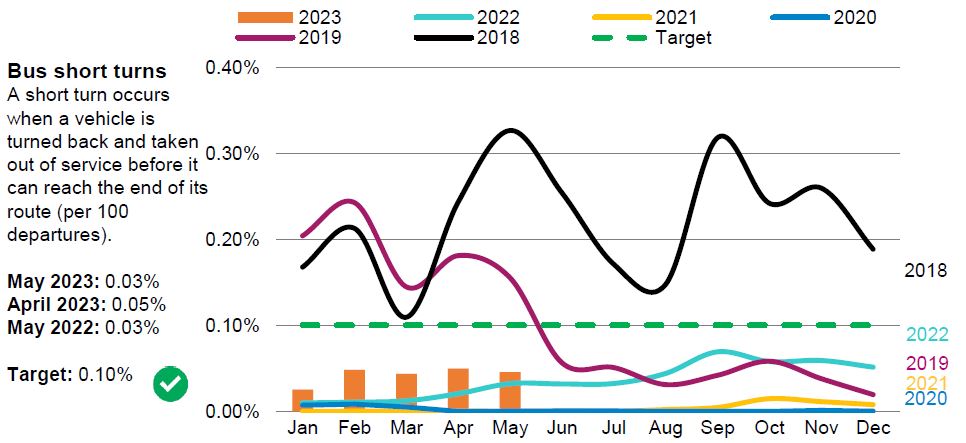
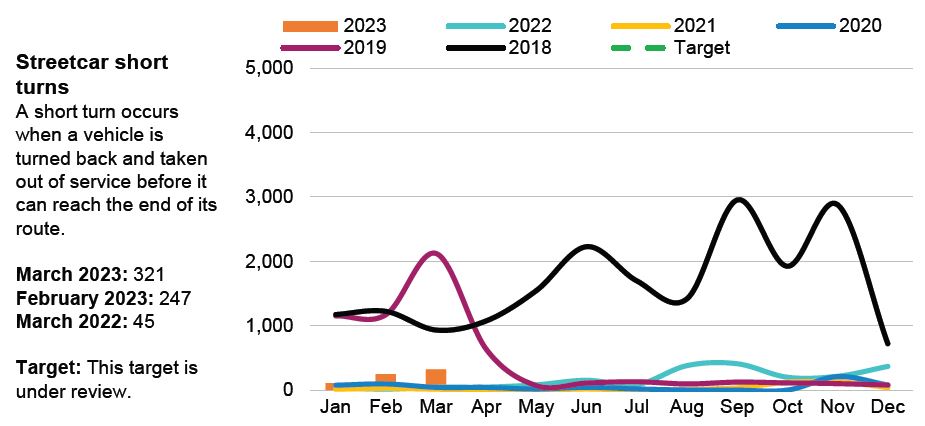
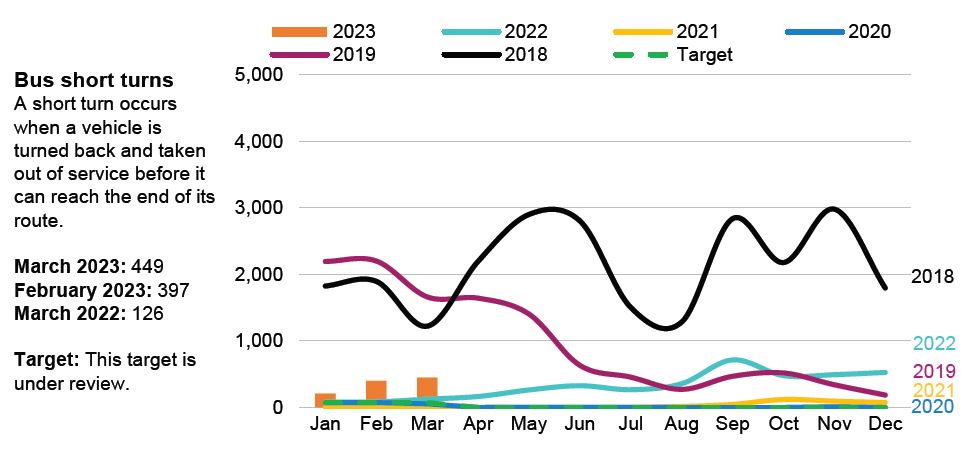
The charts below from the July 2023 CEO’s Report show the official count of short turns on the streetcar and bus network. An important factor in comparing the two is that the buses overall have many routes where congestion and construction do not affect most, if any, trips. The figures are not broken out by route to flag the “bad actors”. Moreover, the values are presented as a percentage of all trips so that time-of-day effects are hidden.

The “no short turns” policy implementation is quite clear in the data from Fall 2018 through Spring 2019. In reviewing actual short turn counts from tracking data, I have found that the values are consistently under-reported, and they do not represent actual conditions. For example, the proportion of service outbound on 501 Queen from downtown (as counted at Woodbine vs Greenwood) reaching Neville Park ranges from 100% to below 50% in January to June 2023.

Updated July 15, 2023: In June 2023, the TTC changed its reporting of short turns from an absolute number to a percentage. The scale of these charts does not make sense because the streetcar chart claims it is per 1000 departures, but cites a percentage (per 100). For comparison, the May 2023 charts are below.

I have written many times on this site about service quality and there are many factors at play including:

  • Unreasonably short or long scheduled travel times. This may sound like an odd pairing, but both can produce erratic service.
    • Too short times lead to short turns to keep operators on time especially for crew changes.
    • Too long times lead to extended layovers at terminals.
  • Lack of headway discipline at terminals and along routes.
  • Lack of headway management for vehicles re-entering service from a short turn to “split” a gap rather than simply running behind a through vehicle and carrying few passengers.

There are, of course, ad hoc situations where accidents, short-term construction or special events produce conditions that are not “standard”. These are normal and have to be managed to the degree possible. One side effect of the overall reduction in service on streetcar lines to a 10 minute level on many routes is that there is no spare capacity when delays occur, and wider headways make the effect on riders of any missing vehicle (either not in service or short-turned) greater.

This is not the first time the system encountered that problem, and tuning out surplus capacity has been a generic issue across the network any time budget “efficiency” takes precedence over service. The phrase “adjusting service to meet demand” goes back over four decades.

Service standards that allow for some empty space on vehicles are important because they guarantee some flexibility to absorb small problems without service collapsing. An analogy for motorists is that a highway totally jammed with cars does not move traffic at all well, and some empty space is necessary to ensure the road is usable. On transit, empty space is viewed as waste while on our roads no congestion is a holy grail.

The remainder of this article reviews the short-turning situation on most streetcar routes and the underlying causes.

Continue reading

Where Is My Diversion Notice (July 2/23 Edition) (Update 2)

Oh the irony! The TTC’s Annual Service Plan consultations are all about how to handle a few (but not all) of the construction projects coming in 2024, but the elephant in the room remains bad communications and changes on the fly.

The new routes implemented in May and June 2023 were in cases impractical thanks to a combination of unduly optimistic running times in schedules, less than adequate transit priority and line management whose priority was not the provision of well-spaced, reliable service. Several changes will take effect on July 4 and 5 to correct some of these problems, but the information is scattered through the TTC’s website, if you can find it at all.

First, a summary of the changes:

  • The 501/504 shuttle bus (an ad hoc service implemented to cover for the absence of the 503 Kingston Road car to King Street downtown) will be rebranded as “503” and will serve Kingston Road to Bingham Loop until 8pm every day. This will become a scheduled bus service at the end of July, and will revert to 503 streetcars likely in October.
  • The 505 Dundas car will only operate east on Queen from Broadview to Woodbine Loop, except after 8pm when service to Bingham will be provided by streetcars.
  • The 506 Carlton car will only operate to Queen and Broadview and will return west to route via Queen and Parliament Streets without running east to Woodbine Loop.
  • The 512 St. Clair car will be restored, temporarily, west of Lansdowne to Gunns Loop. While it lasts, this will correct for the erratic service now provided there by the 47 Lansdowne extension.

The challenge is to find out that this is happening to your route. The TTC website is very poorly organized with information in many places that is inconsistently placed and linked (or not) to the main route pages affected. Some items are out of date, but remain in place to confuse riders. Some items describe major changes but are hard to find if you don’t know the site in detail.

These are the hallmarks of a site maintained by many groups each with its own (probably jealously guarded) responsibility for providing information. Nobody appears to care about overall site consistency and ease of navigation, or if they do, are in any position to change what is a clearly broken process. Some information is just plain wrong indicating that whoever created or updated the page was either sloppy, or does no know what is actually happening.

Updated July 4, 2023 at 7:10am: Changes to the TTC website since this article was posted are noted in various places below.

Updated July 5, 2023 at 4:30pm: Changes to the TTC website since the July 4 update are noted throughout the article.

Continue reading

TTC Service Changes Effective September 4, 2022

Updated:

  • The spreadsheet detailing all of the changes has been added at the end of this post.
  • The number of the Mimico GO shuttle has been corrected to 176.
  • Transfer arrangements at Queen & Dufferin for the 501 bus and streetcar services have been clarified.
  • Transfer arrangements at Queen & Roncesvalles for the 501 and 504 bus services have been added.

Updated September 5, 2022:

  • The spreadsheet listing all of the changes has been corrected for route 504 King. The original version included a description of the route carried over from the August version. This has been changed to reflect the September arrangements.

The TTC will make many changes to its scheduled service on September 4, 2022 with restorations of previous service levels on many routes. This will not get the system back to 100% of pre-pandemic levels.

An important distinction is between three values:

  • The amount of service scheduled before Spring 2020
  • The amount of service budgeted for 2022
  • The amount of service scheduled for 2022

The TTC plans to be back to 97% of budgeted service for bus, 84% for streetcar and 92% for subway. The overall numbers are compared below.

Hours/WeekRegularConstructionTotal
January 2020 Scheduled185,8257,068192,893
September 2022 Budgeted186,3796,398192,777
September 2022 Scheduled177,9304,965182,895

In the original 2022 service budget, the TTC planned to be back to roughly the same level of service as in January 2020 by September 2022. However, slower ridership recovery coupled with staffing constraints produced a lower scheduled service expressed as hours/week.

There are further caveats:

  • The distribution of hours by time of day might not be the same in 2022 as in 2020 because of changing demand patterns.
  • Changes in running times to deal with congestion or service reliability can mean that the same service hours are stretched over wider headways. Not all vehicle hours are created equal.

All that said, there are many changes in service levels, and with the bus network being back to 97%, the schedules for September 2022 are often based on old versions before service cuts were implemented. Another change for this month is the reintroduction of school trips on many routes.

Continue reading

Service Reliability on 47 Lansdowne: September 2021

This article continues a series reviewing service on relatively short routes within the TTC network in areas where one might expect service reliability to be easily achieved.

Overview

The southern part of the route lies between St. Clair and Queen Street. Every second bus continues north to Yorkdale Station on what was once a separate 18 Caledonia route. (These routes will be split apart at Caledonia Station in 2022 when Line 5 Crosstown opens.) During peak periods, the Yorkdale branch splits at the north end with an alternate route via Orfus to Yorkdale Station.

In addition to the type of problems shown in the previous articles on 22 Coxwell, 47 Lansdowne suffers from having what should be a blended frequent service on the common portion of the route. However, headways are not reliable either from the point where the branches merge at St. Clair southbound, nor at Queen northbound, the route’s southern terminus.

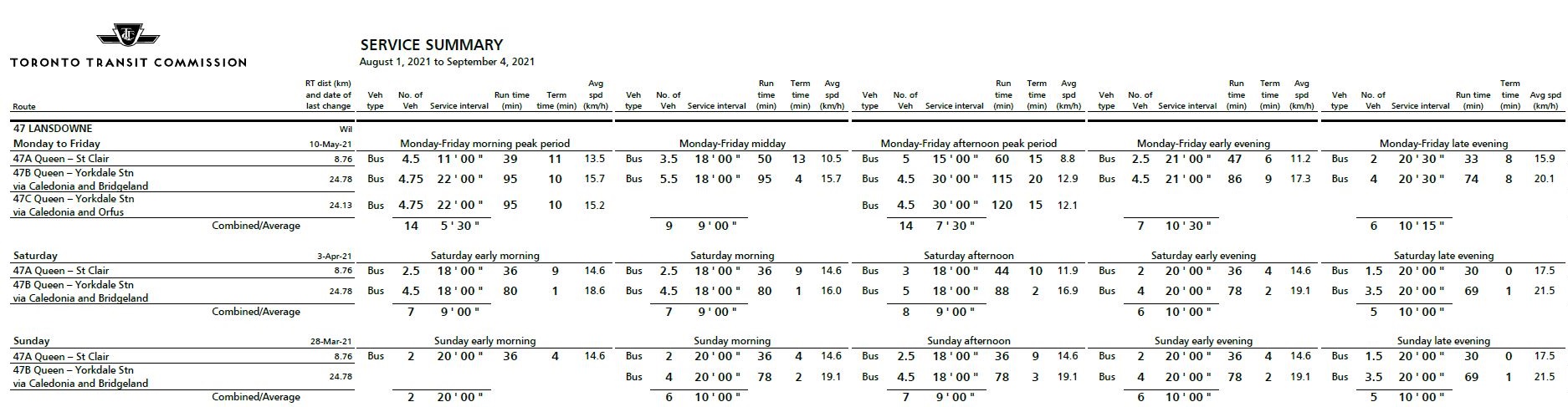
This schedule was in effect from September 1 to 4.

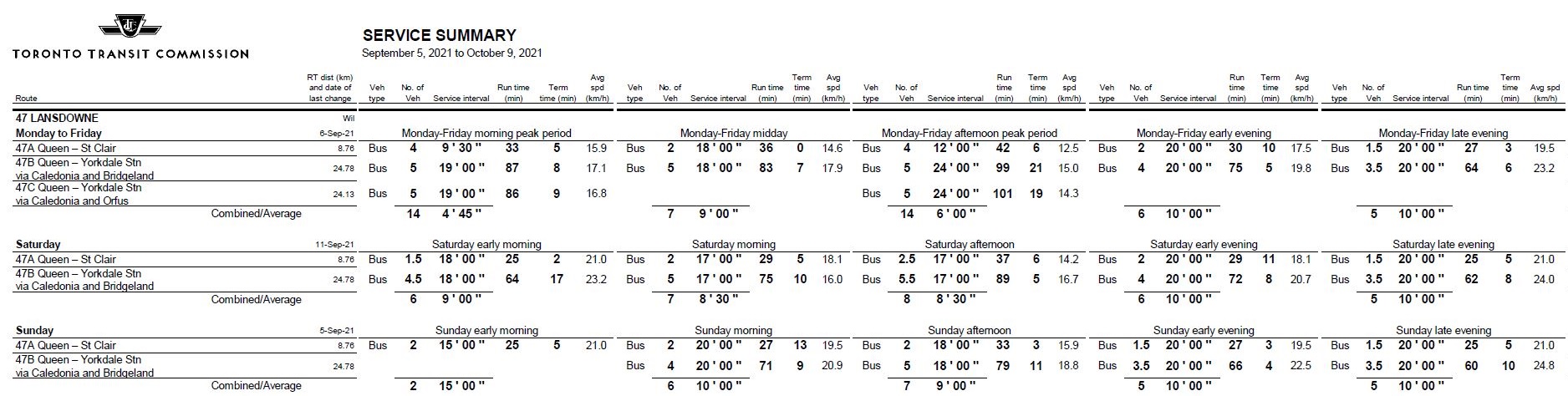
This is the schedule in effect from September 5 onward.

Change-offs, Breakdowns and Crew Changes

A common effect seen across the route is for a bus to disappear from service and, eventually, to be replaced by another in the same relative position.

  • In some cases, the same bus re-appears more or less where it disappeared indicating that it probably sat out of service awaiting a new operator.
  • In some cases, notably early in the day, a bus will remain in service for one trip or less, and then disappear. This implies that the bus was somehow faulty rather taken out of service because of a missed crew change.
  • In some cases, it is possible that a crew change is done by bringing a new bus into service from the garage replacing both the operator and the vehicle. This is not a scheduled event as can easily be seen by comparing operations on similar days (weekday to weekday, for example).

Where buses are missing for even a partial trip on a branch with a wide headway like the 47B Yorkdale service, the resulting gap can be very wide. These events are not reported as part of overall service quality and standards, just as bunching is not reported because it can often occur within the “approved standards” and their considerable margin for exceptions.

Northbound from Queen

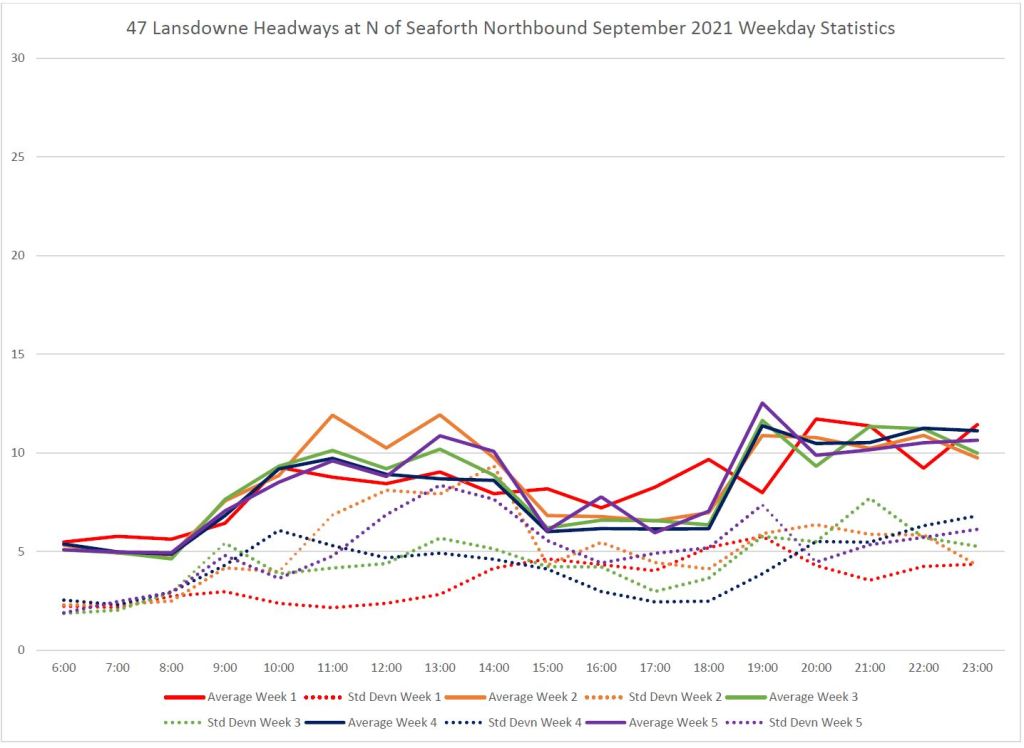
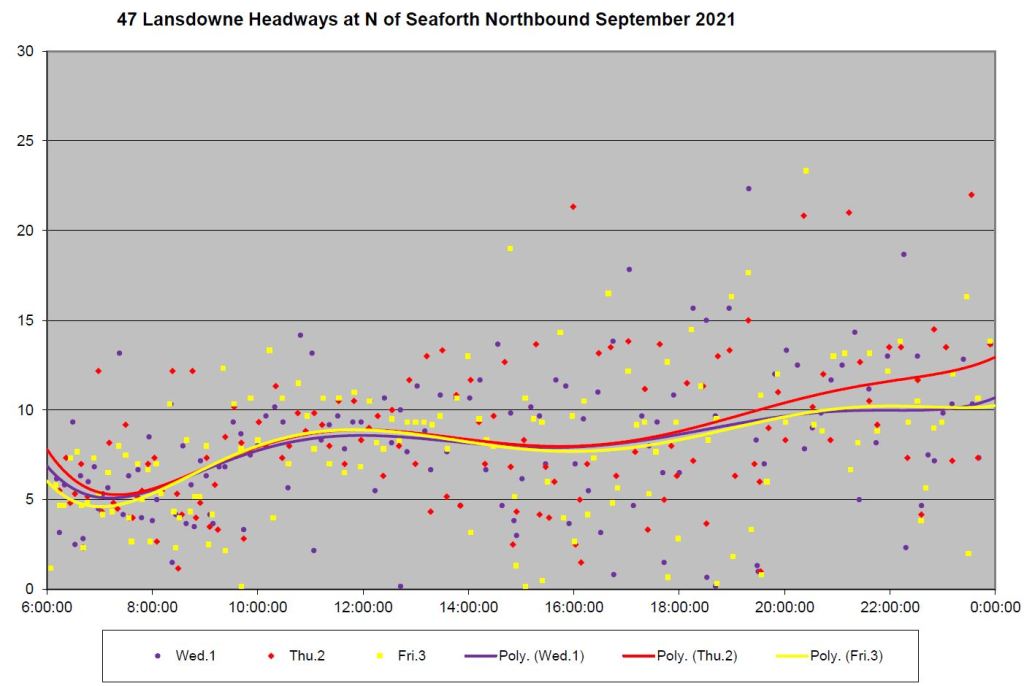
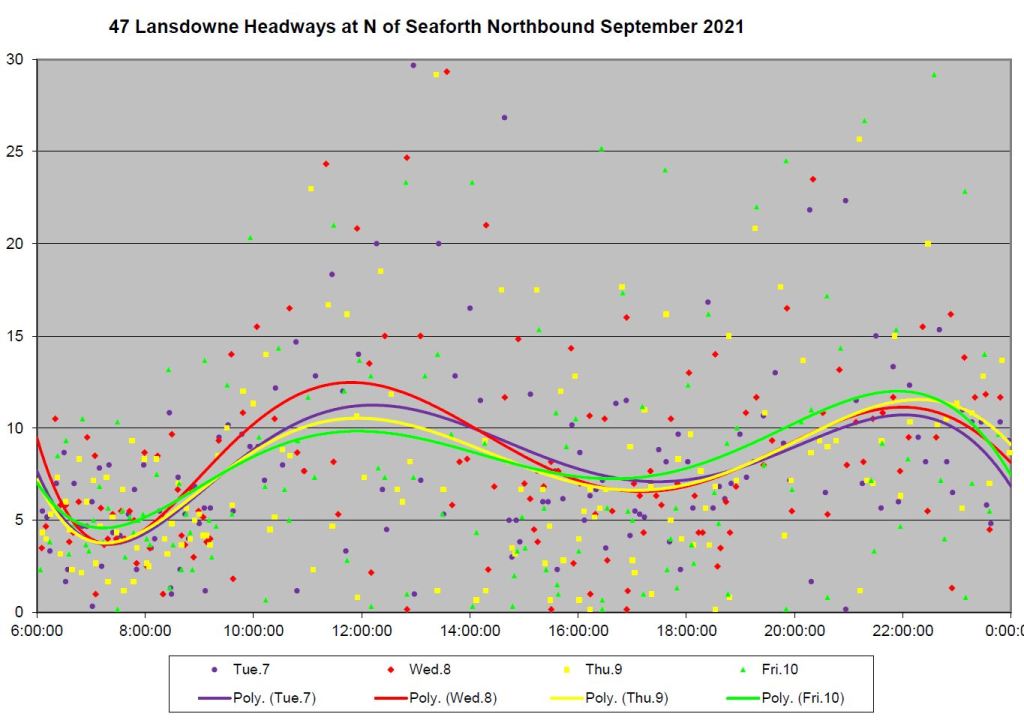
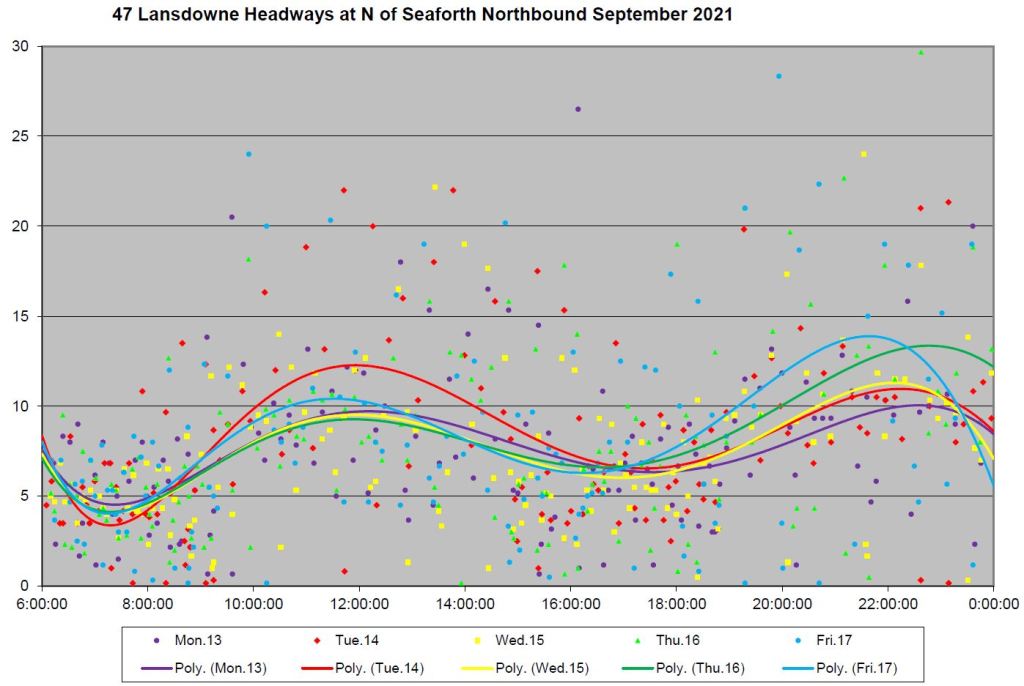
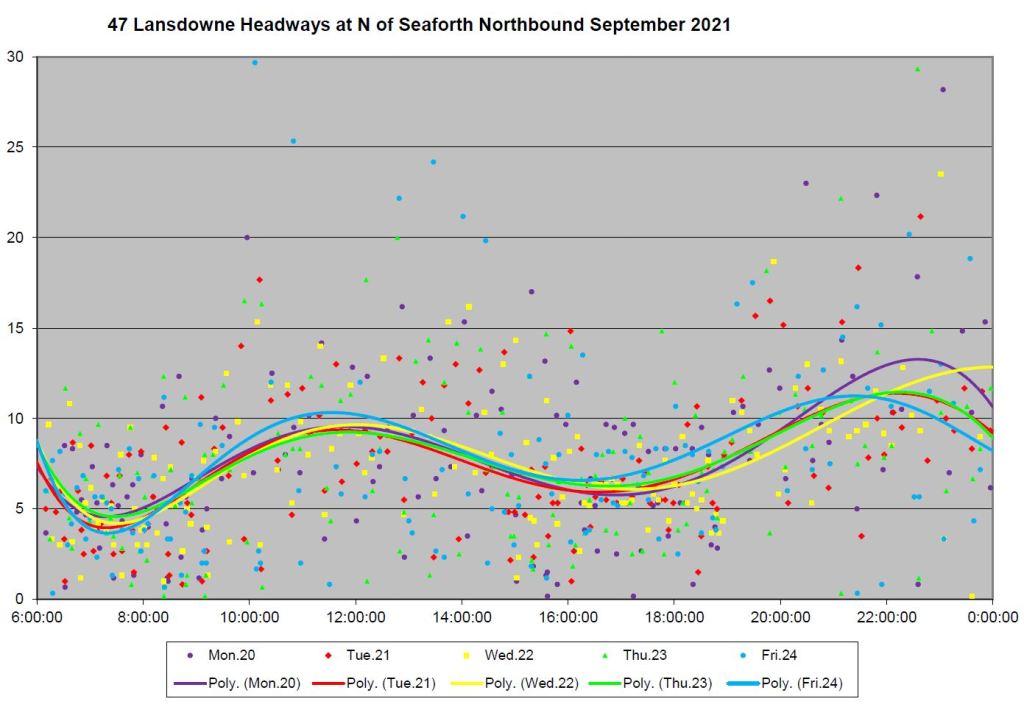
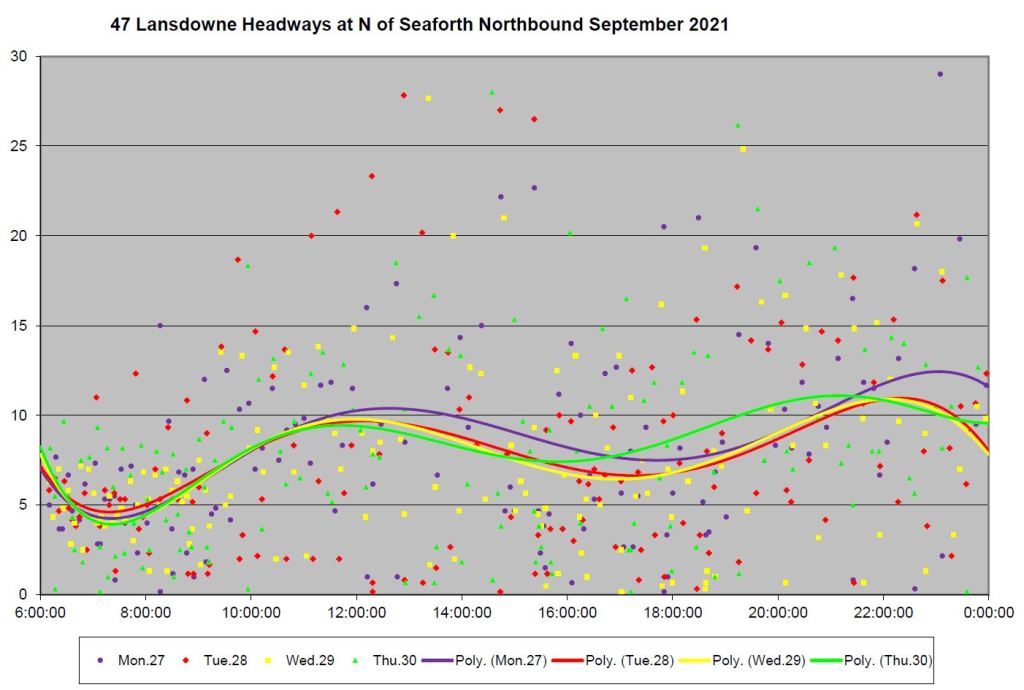
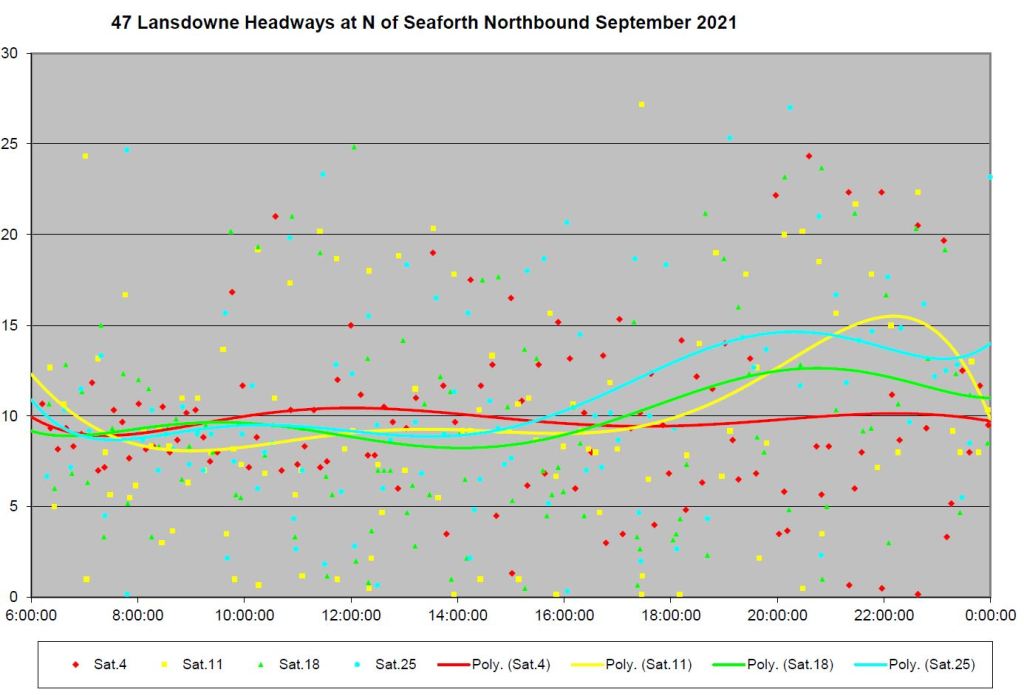
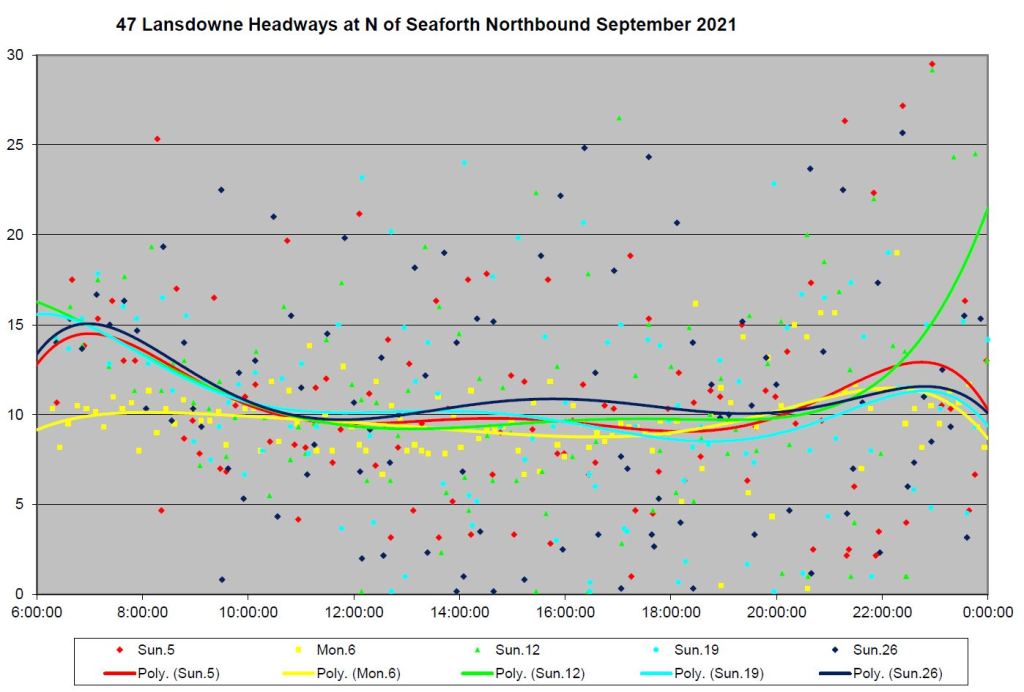
Headways from Queen are measured north of Seaforth, the north end of the on-street loop. The averages and standard deviations of headways are well-behaved only for the first few hours of the day, and they deteriorate from 9am onward. There is considerable difference in values from week to week.

Note that because of the schedule change on the Labour Day weekend, the shape of the trendlines in week 1 of these charts are different than in weeks 2 to 5.

The clouds of data points span a range above 15 minutes for most of the day. This corresponds to the point where the standard deviation values rise after the am peak period. There are so many days with very short headways that I will not review each one in detail here, but give a sample. Days with very wide headways are of particular interest because this typically indicates either that buses are missing, or that bunching of more than two vehicles occurs.

This set of charts is particularly important because it shows the service at a terminal before the effects of passenger loads or congestion could disrupt service. This is also, as of September 5, a new set of schedules where any problems with the schedule itself should have been resolved. If anything, the service is worse in weeks 2 to 5 than in week 1, although this could be due to other factors.

Saturdays show bad bunching and gapping throughout the month. Sundays also show very erratic service except, oddly enough, on Labour Day (an honourary Sunday for these charts) when headways lie much closer around the trend line.

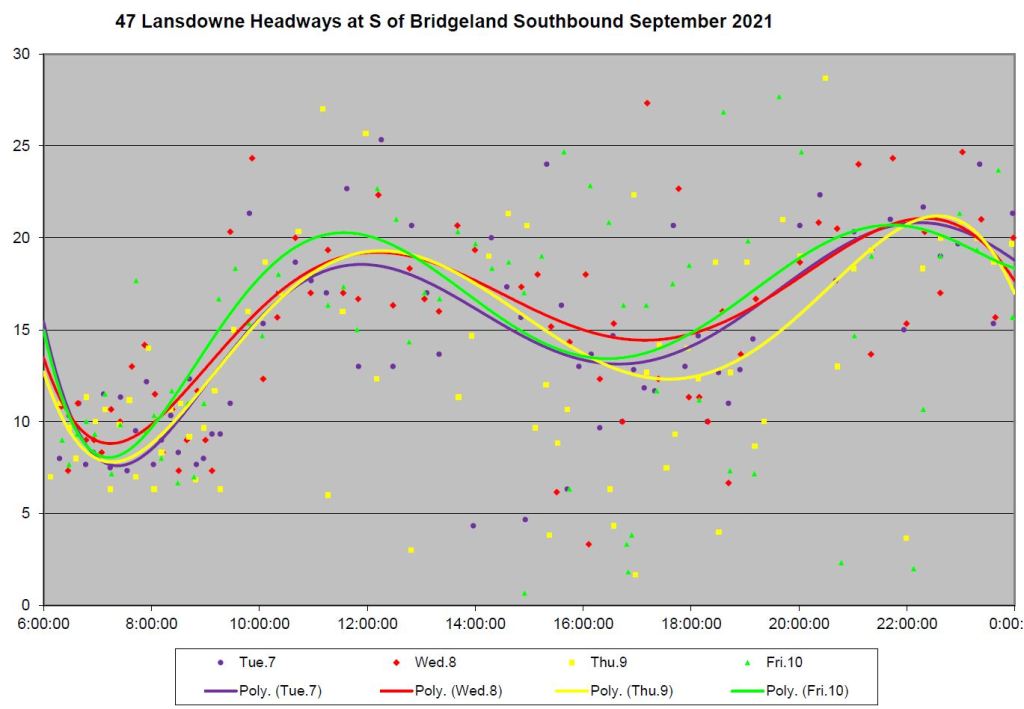
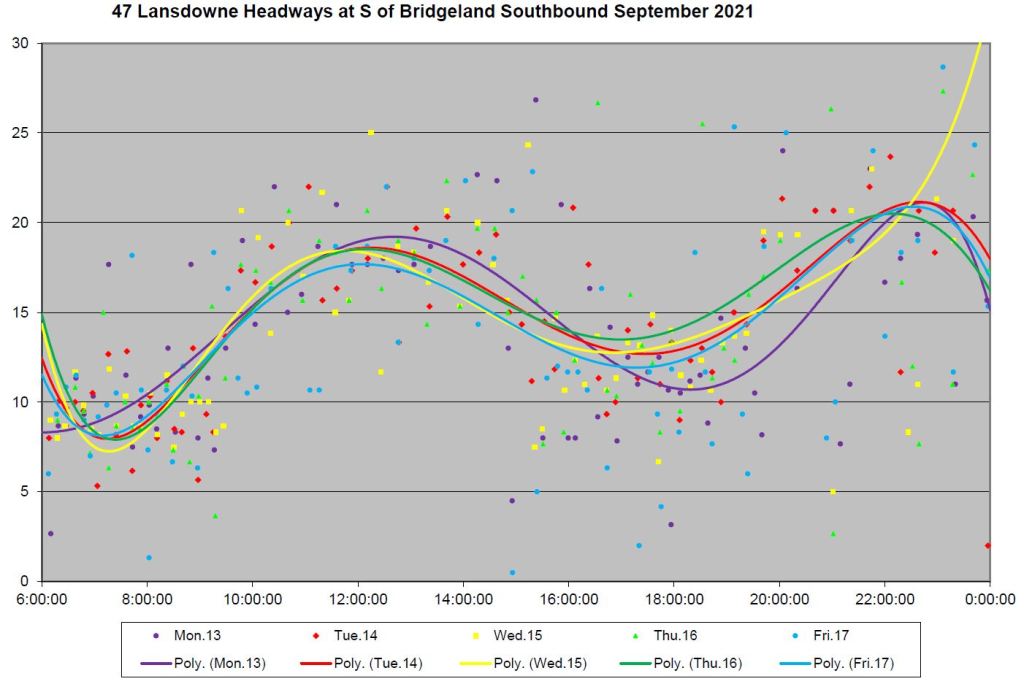
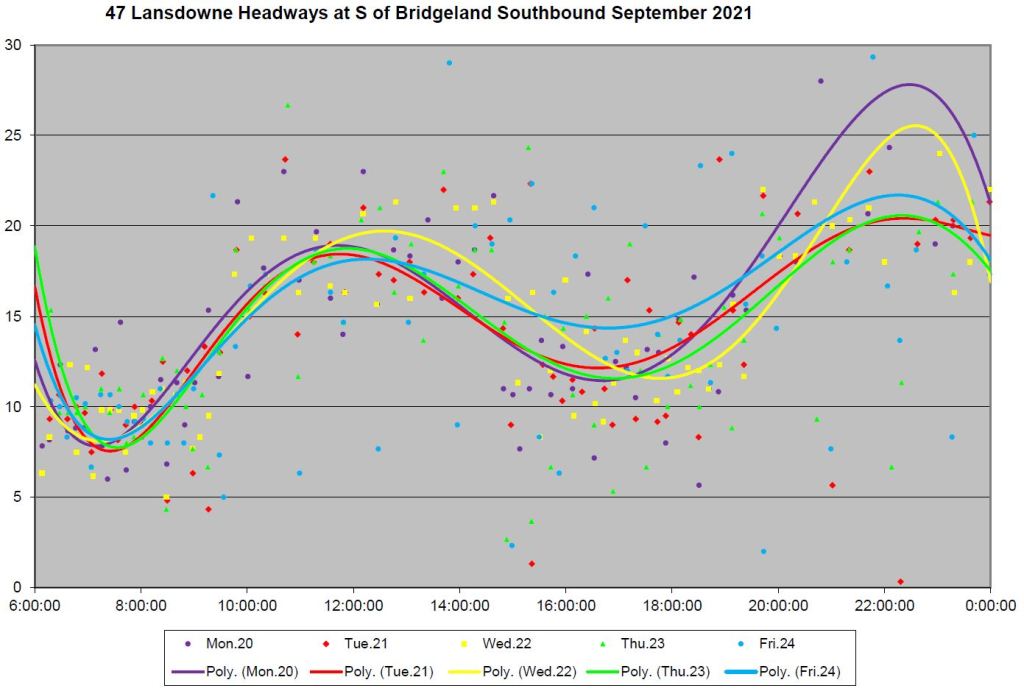
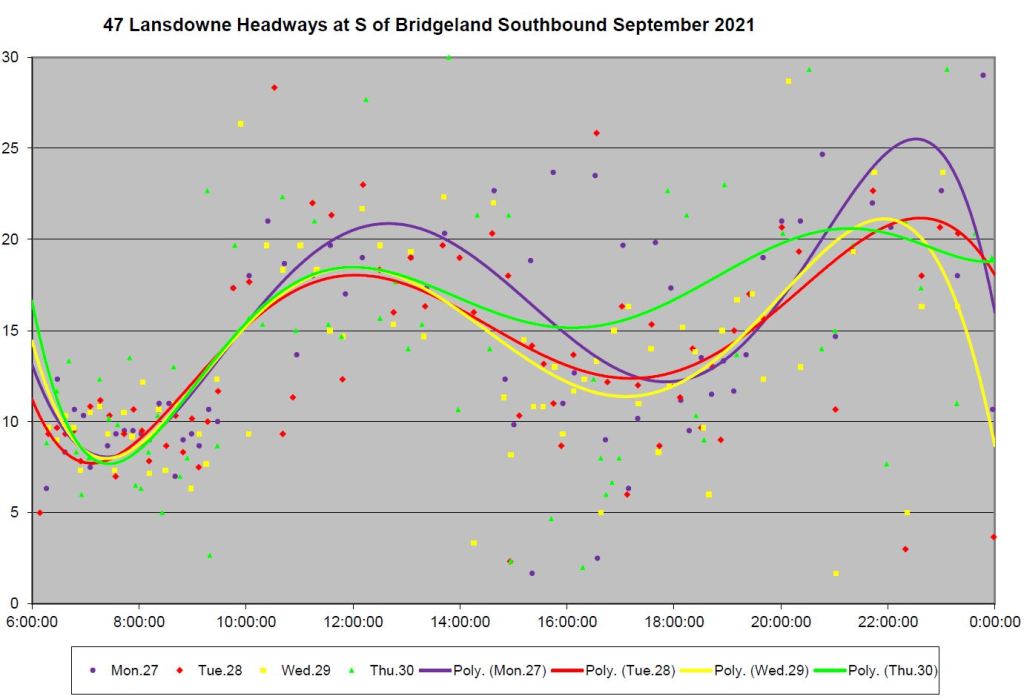
Southbound from Yorkdale Station at Bridgeland

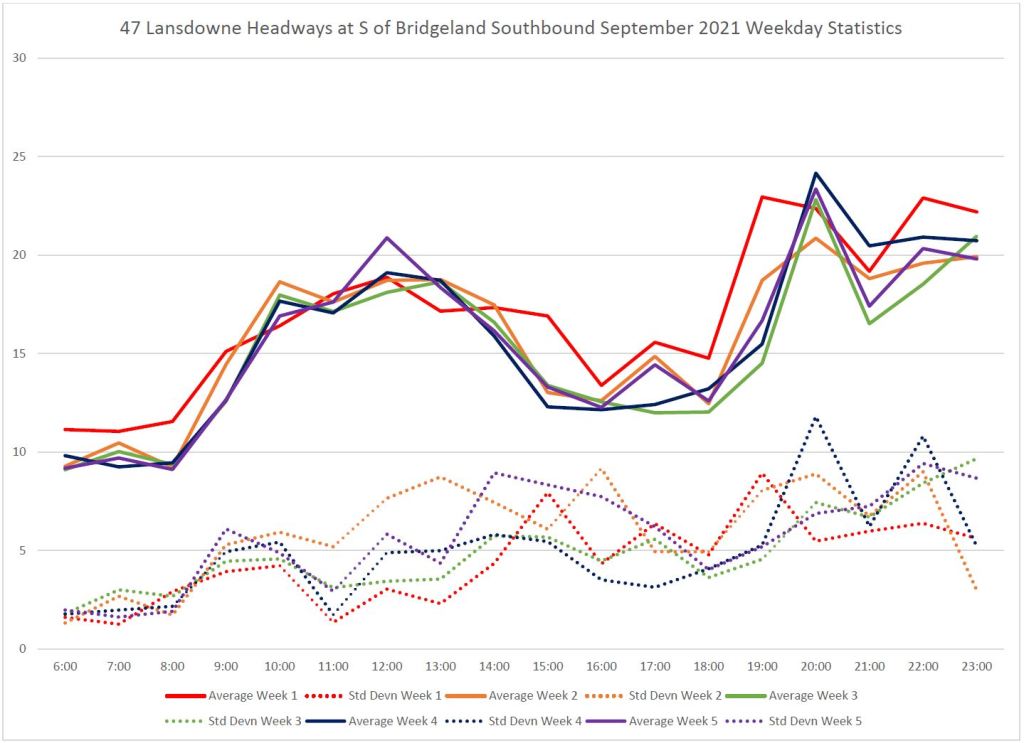
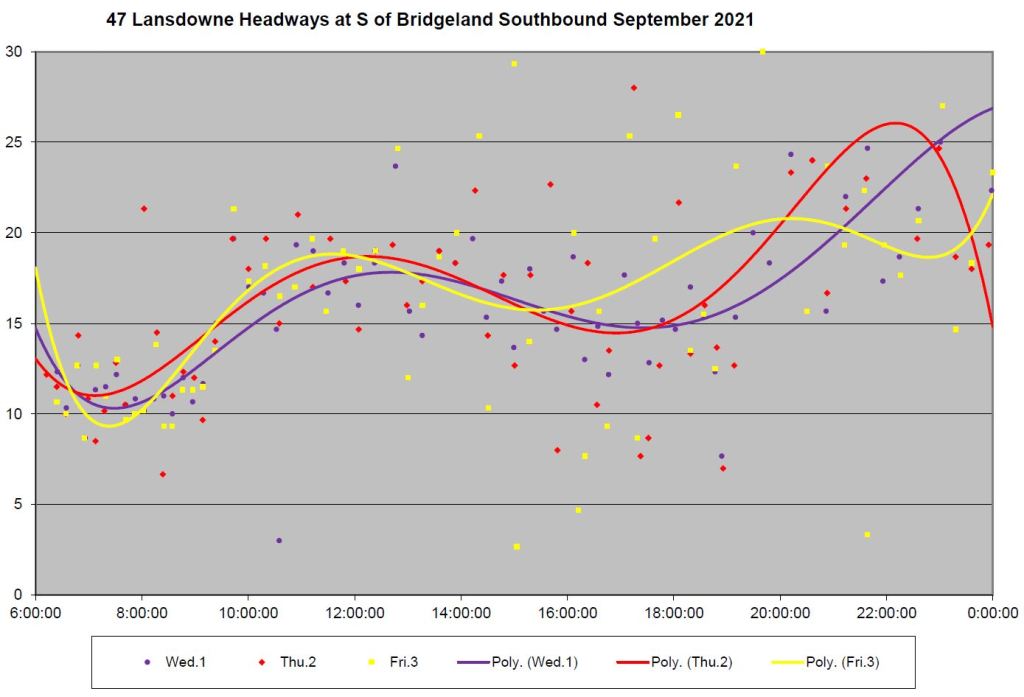
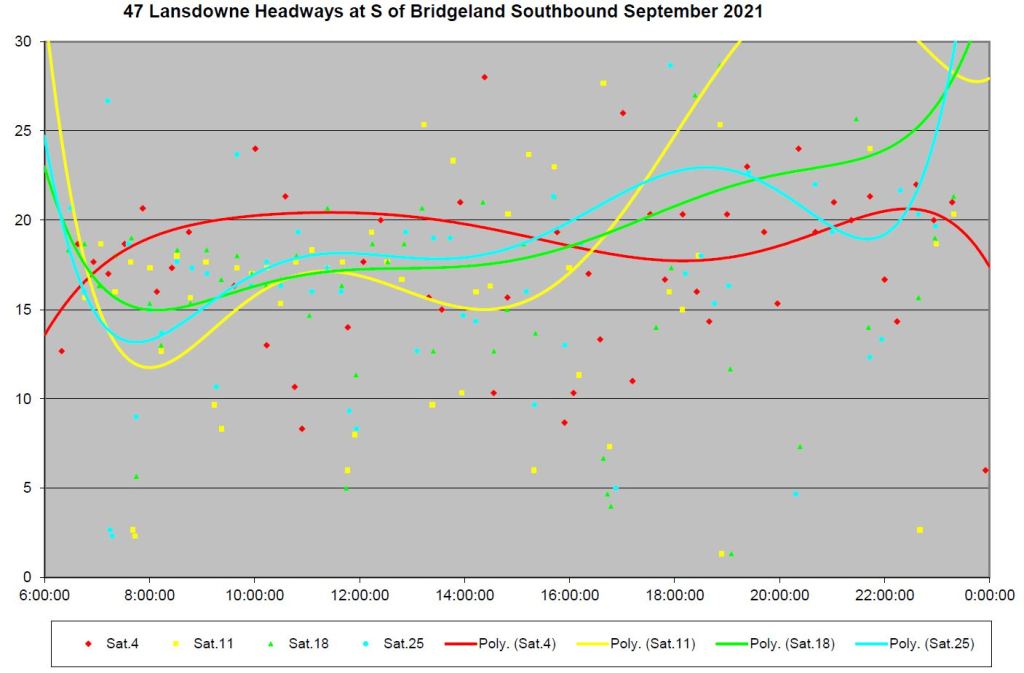
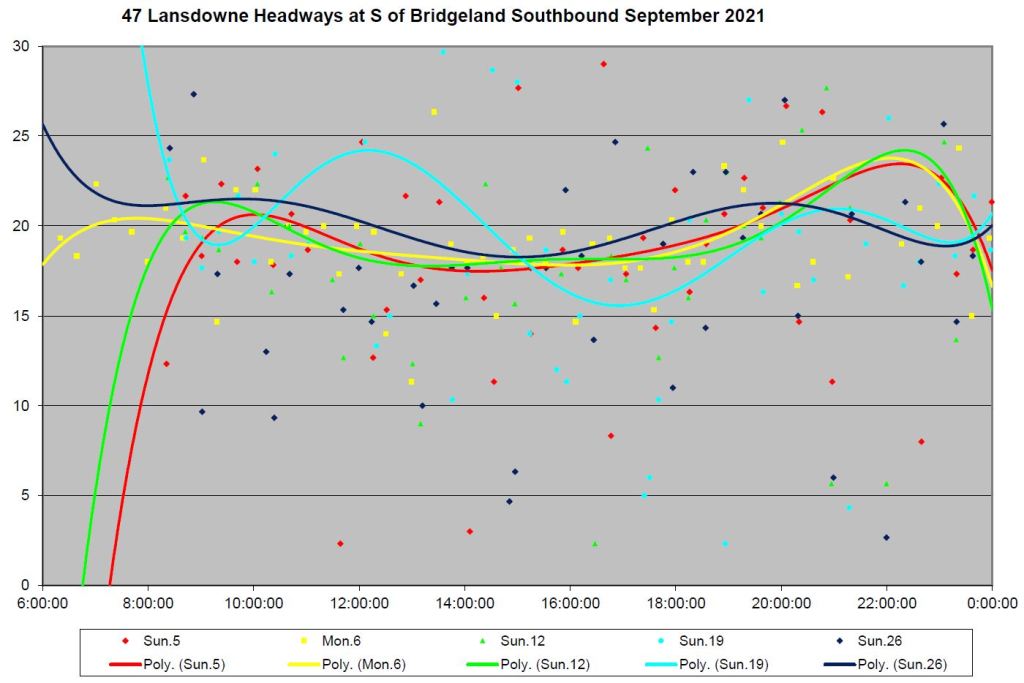
The screenline for these charts is on Caledonia south of Bridgeland where route turns east to serve Yorkdale Station. As above, the shape of the week 1 chart differs from other weeks because of the schedule change.

Only half of the service reaches this point because of the 47A scheduled turnback at St. Clair. As at other locations, the SD values are high, but they are particularly so thanks to the wide scheduled headways and greater dispersion of data values. Weekend service is particularly unreliable with headways ranging over a wide span.

Note that some values go above the Y-axis cutoff, that is to say above half an hour.

Southbound from St. Clair

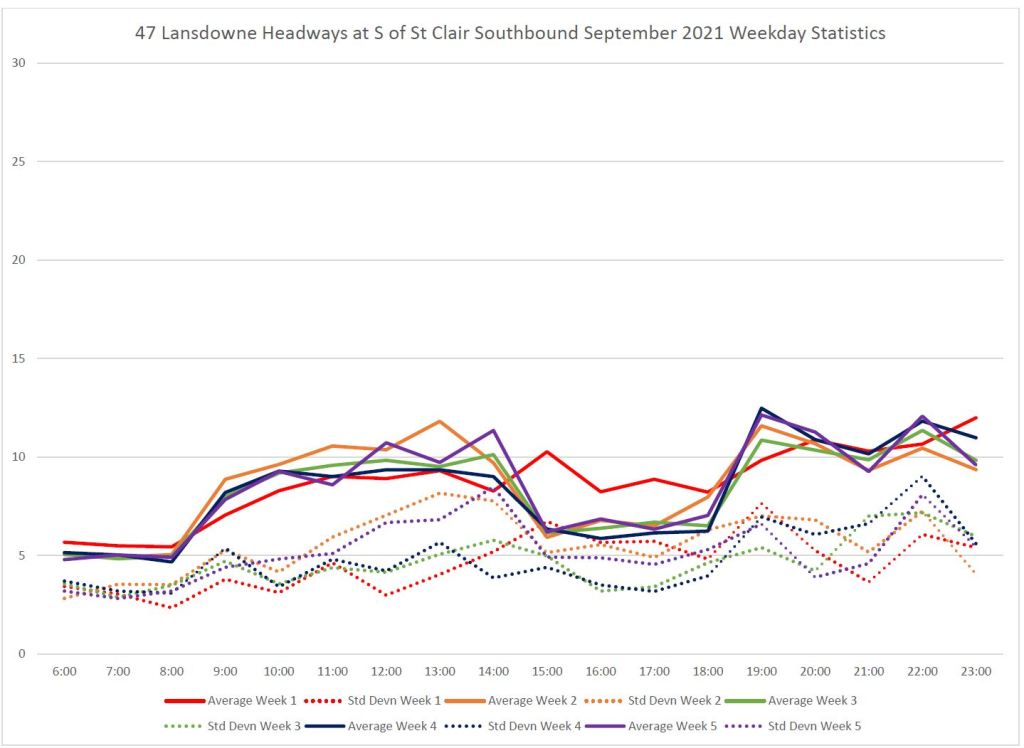
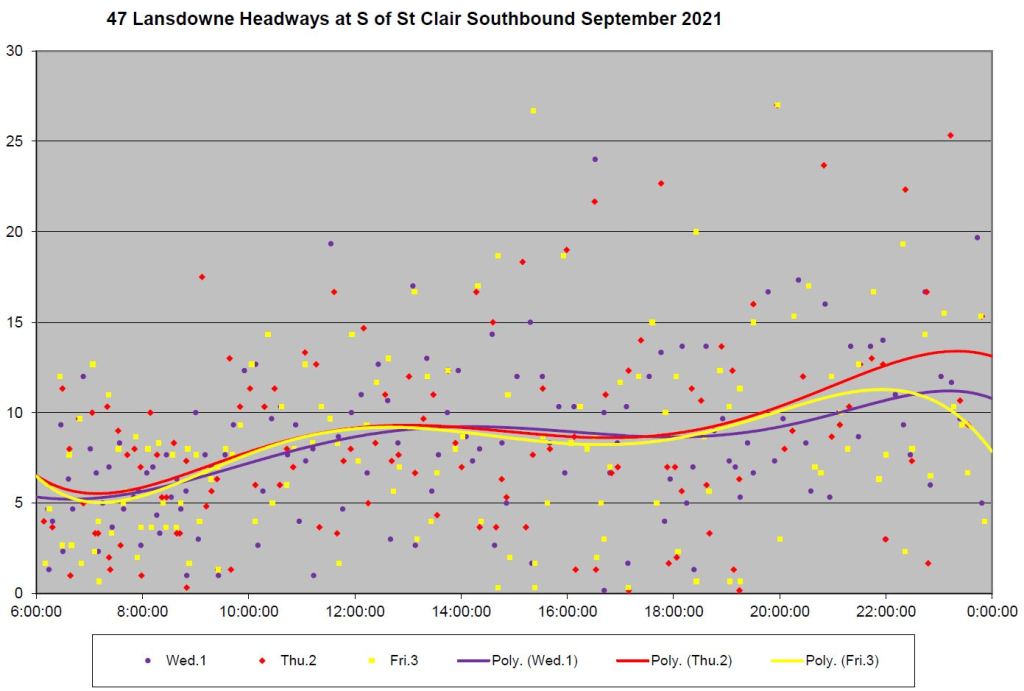
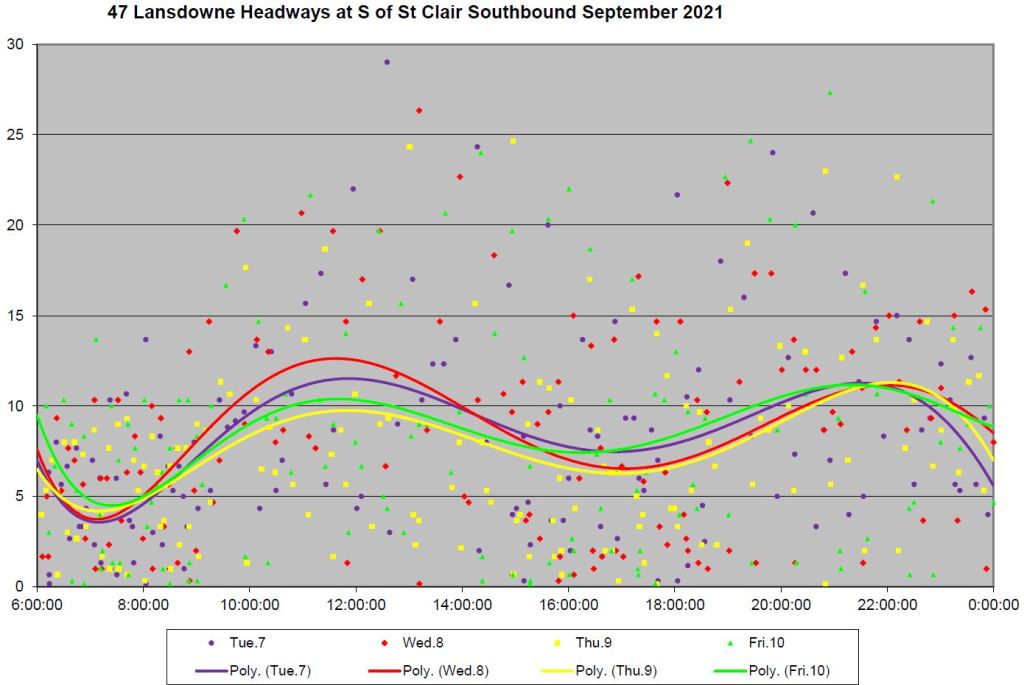
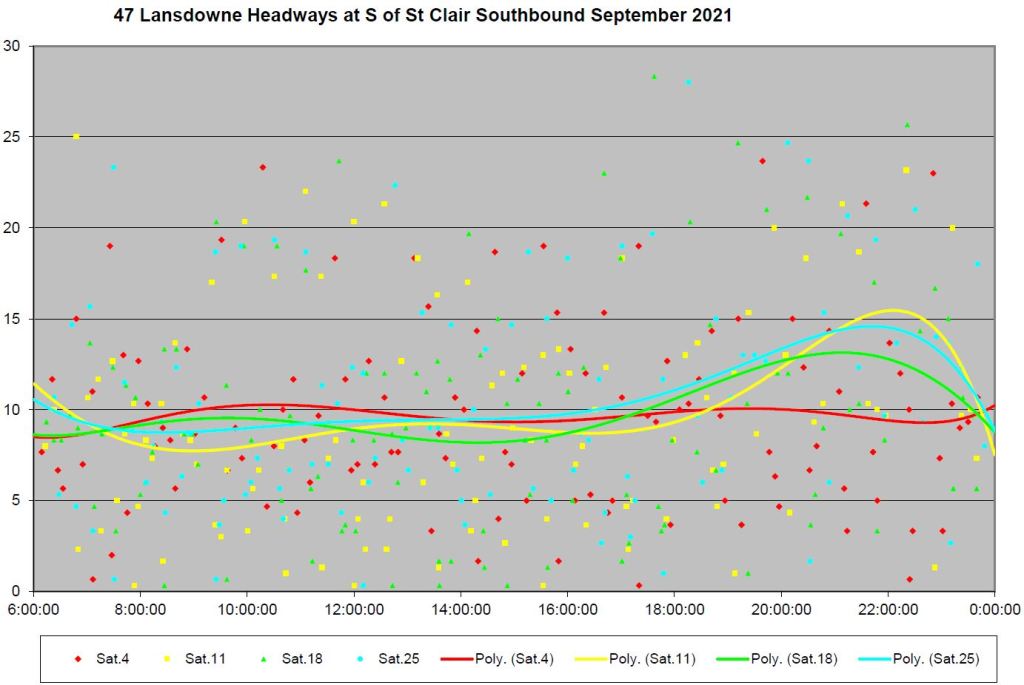
Service at St. Clair includes both the 47A buses originating at Earlscourt Loop and the 47B/C service from Yorkdale via Caledonia. The SD values are typical of a midroute location where branching services “merge” with little regard for each other. The clouds of headway values are spread over a wide range with values far from the average/scheduled service.

Continue reading

Transit Service Reliability on Short Routes

A common theme in these pages is the TTC’s constant problem with providing reliable service. Many problematic routes lie outside of the core on long east-west routes that must deal with varying traffic conditions, the difficulties of blending branched services, and a faster return of demand and post-pandemic traffic levels than in the central area.

These are not excuses for poor service, but at least represent some of the challenges faced. This is not true for short routes primarily in the old City. For these routes, a trip between Eglinton and Lake Ontario is comparatively long, and some reach only a few kilometres from Line 2 Bloor-Danforth south.

They should be routes that run like a clock, but they suffer many problems seen on their longer cousins outside of the core. If the TTC cannot operate these reliably, how can we expect them to fare with behemoths like east-west routes on Lawrence or Finch, or routes from Line 2 north to Steeles and beyond?

This article is an introduction to a series that will examine service on:

A factor among many of these routes is that service is not particularly frequent. If there is a bus missing, or pack of buses running together (effectively the same thing), the gap is wide. The added waiting time (assuming a rider bothers) can be greater than the time they will spend riding from point “A” to “B” on the route. Waiting times hurt transit because riders see them as unproductive, and this can be compounded by uncertainty about the next bus’s arrival and capacity.

Here is an overview of service frequencies on these routes during selected periods. Some of these have 10 minute or better service during some periods, but many do not.

RouteAM PeakMiddayEveningSat AftSat EveSun AftSun Eve
22A Coxwell (Victoria Park)10′9’30”10′10′10′
22B Coxwell (Queen)8’20”8’20”
47A Lansdowne (South)4’45”9′6′8’30”10′9′10′
47B/C Lansdowne (North)9’30”18′12′17′20′18′20′
63A Ossington (Eglinton)9′7’30”8′7′10′8′10′
63B Ossington (S of St. Clair)4’30”
65 Parliament13′13′17′20′17′18′16′
70 O’Connor (South)10′11′13′13′11′11’30”15′
70 O’Connor (North)20′22′26′26′22′23′30′
72 Pape (on Pape)6′9’30”9′9′9′9′9′
72B Pape (to Union)19′19′18′18′18′18′18′
75 Sherbourne5’30”7’30”16′10′30′20′30′
94 Wellesley (East)7’30”7’30”8’30”6’30”9′6’15”9′
94 Wellesley (West)15′15′17′13′9′12’30”9′
Source: TTC Scheduled Service Summary for September 5, 2021

Common problems on these routes include:

  • Buses running in groups of two or more.
    • In some cases, pairs of buses run together over the course of two or more trips indicating that there is no effort made to evenly space service.
    • For branching services, buses on each branch do not blend evenly where the branches combine.
    • In the worst case situations, all of the vehicles on the route are running as a pack.
  • Buses missing from service, with the remaining buses not spaced to account for the gap. In some cases, a route is served by only one bus when there should be two or three.
    • Missing buses are most common during evening and weekend periods when spare operators are harder to come by, in part because many of the “run as directed” operators are used for subway replacement services. Because TTC has fewer operators than crews in some cases, there are open crews that are only filled if there is a spare operator available.

Although the TTC has standards defining what constitutes acceptable service, almost none of these address the problems listed above. That is because:

  • Buses can be running close together but still be “on time” according to the service standard.
  • There is no standard that addresses gaps and bunching explicitly.
  • There is a standard related to missed trips, but no statistics have ever been reported for it.
  • The standards accept a wide range of exceptions with a goal of achieving targets only 60% of the time. There is no reporting of the proportion of service lying outside the standard even if it would be within the target.
  • There is no co-relation of vehicle crowding with service reliability.

To put it quite bluntly, these so-called standards allow management to claim to operate the system to “Board approved” targets, even though the TTC Board members probably have no idea of just how lax these standards actually are.

In turn, when riders complain, they are often told that the service is operating within standards, and that where there are problems, “run as directed” buses are dispatched to fill the gaps. This is simply not possible because there are not enough RAD buses to fill all of the holes in the service. Moreover, the TTC does not track or report on the usage of these buses to establish that they really do provide the benefits claimed for them.

TTC management hopes to lure riders back to buses, but the single most common complaint is that more service is needed. Part of “more” service involves simply running what is already there better. There is no point in advertising frequent service if what is actually on the street is anything but.

When they were approved, there was a staff presentation that set out the standards but did not actually explain what they might allow. The Board nodded in approval of something technical that looked impressive, but was clearly beyond their ken. The old Razzle-Dazzle works every time.

TTC Service Changes: September 5, 2021

September 2021 will see expansion of TTC service in anticipation of returning demand including in-person learning at schools and universities. Many express bus routes will be improved or enhanced.

In a reversal of past practice, schedule adjustments for “on time performance” will actually reduce rather than add to travel times in recognition that buses do not need so long to get from “A” to “B”, and that they can provide better service running more often on their routes than sitting at terminals.

Full details of the schedule changes are in the spreadsheet linked below.

Continue reading

TTC 2022 Service Plan Consultation

Updated June 28, 2021 at 6:10 pm:

The TTC has filled in some of the details on 51 Leslie, 88 South Leaside and 354 Lawrence East Night. See the individual sections of this article for details.

The TTC has launched public consultations for its 2022 Service Plan. This will be a difficult year in which ridership is expected, at best, to climb back to 75 per cent of pre-pandemic levels. Budgets will be tight because the transit system plans to be operating close to 100 per cent of is former service (building up gradually on the buses for January 2022, then streetcars and finally the subway) even though fare revenue will be at a lower level. The TTC recognizes that it needs to provide good service to attract riders back to the system.

For the week of June 4-11, boardings on each of the TTC’s networks by vehicle type are still below 50 per cent of January 2020 values:

  • Bus: 40%
  • Streetcar: 27%
  • Subway: 23%
  • Overall: 31%

Trip occupancy for buses is generally below the target level.

  • 4% of trips are over 50% full
  • 0.6% of trips are over 70% full
  • 0.3% of trips are over 80% full

An important distinction about crowding measurements is that as ridership recovers, a the definition of a “full” bus will rise from 25 riders today, to 35 and then to the “standard” full load of 51. Service levels and crowding in 2022 will be measured and allocated against this shifting target. In the short term, service will be provided at a crowding level below pre-pandemic times.

Crowding levels reported now are all day, all route, all week values, and they hide problem areas in the system. The TTC still does not break out reports on crowding or service quality by route, location or time of day. Their “On Time Departure Report” has not been updated in several years, and although there is still a link to it from the Customer Service page, the link is dead.

The 2018 Customer Charter is still linked and it includes a commitment, carried forward from the 2013 Charter:

Posting the performance of all surface routes on our website so you know how your route is performing.

One might ask why Rick Leary, the man Andy Byford hired to improve service, is incapable of producing reports of service quality beyond the extremely superficial level found in his monthly CEO’s Report. The TTC have detailed crowding data and use them internally, but do not publish them. As for on time performance or headway reliability, I have written extensively about problems with service quality and these metrics. Even though service is the top of riders’ desires, it is not reported by the TTC probably because the numbers would be too embarrassing.

This is a gaping hole in TTC Service – the absence of meaningful reporting and measurement of service quality as experienced by riders.

Although the TTC plans to return to 100 per cent service, this does not mean that the service patterns will match those of early 2020. Demand patterns have changed both in daily patterns (peaks or their absence) and location (heavier demand to suburban jobs in sectors where work from home is impossible). To the extent that peaks are smaller or non-existent, this works in the TTC’s favour by allowing a higher ratio of service hours to driving hours (buses spend less time, proportionately, going to and from garages). This also, of course, spreads out demand and can reduce crowding.

A new phenomenon is the early morning peak caused by commutes to jobs outside the core. This produces crowding even on some Blue Night Routes, and the TTC is looking at how this can be resolved.

There is a page on the TTC’s site including a link to a survey about planned changes including some new and revised routes, as well as the plan for route restructuring to accompany the opening of Line 5 Eglinton Crosstown. Tentatively, that line is expected to begin running on July 31, 2022 according to the TTC, but that is simply a planning target, not a hard date.

In this article, I have grouped the planned changes geographically to pull together information on related routes rather than numerically as they appear on the TTC’s site. I have also included information on some changes planned for later in 2021 to put the proposed 2022 route structure in context.

There is a separate consultation process launching soon regarding the future service design for the period between the shutdown of Line 3 Scarborough RT in mid 2023 and the opening of the Line 2 Scarborough extension in fall 2030.

There are three major components in the 2022 plan:

  • Optimize the network to match capacity with demand.
  • Restructure the network for the opening of 5 Eglinton Crosstown.
  • Modify the network to respond to customer requests, evolving demand patterns and new developments.

All maps in this article are from the TTC’s website.

Continue reading

TTC Bus Service Frequency and Reliability in 2020 (Part V)

This is the final set of route-level reviews of TTC service reliability within this series.

The routes discussed here serve parts of the central area and the old “inner” suburbs York and East York.

Continue reading