The TTC will implement many changes to its services effective June 21 including the usual seasonal reductions, another phase in the rollout of the Ten Minute Network, and new Blue Night service on Steeles West.
Finance
TTC Proposes Service Restorations and Expanded Blue Night Network (Updated)
The TTC Board will consider two reports at its meeting on May 27, 2015 relating to service improvements announced jointly by TTC Chair Josh Colle and Mayor John Tory on May 24, 2015.
Most of the 2011 service cuts rammed through by former Mayor Rob Ford and former Chair Karen Stintz will be restored. The “greater good” of the system, a phrase beloved of Ms. Stintz, clearly no longer includes slashing transit service.
One rather contorted paragraph in the report gives an insight into the process by which routes got on the 2011 list:
The use of the productivity standard of boardings per service hour, commonly used throughout the transit industry, began in 2011 at the TTC. It was first used to identify the services that were recommended for removal as part of the budget cuts in that year. The standard used at that time was 15 boardings per service hour or, in some cases where there was a long walk to alternate service, the standard was reduced to ten boardings per service hour. For 2015, the boardings per service hour standard has been continued, but at the lower, currently-affordable level of nine boardings per service hour. The calculation of boardings has also been simplified, and now counts all customers on the entire route or branch section, as appropriate. Previously, a more-detailed and labour-intensive evaluation was used to try to separate and weight differently the boardings that would be made at unique stops, at stops with intersecting routes, and at stops along common sections of multiple routes. The new, simplified method of counting substantially all passengers is simpler to apply and understand, and allows the threshold level to be lowered.
In other words, the 2011 evaluations didn’t actually count passengers, but applied a formula and process to determine which routes made the cut. It is no wonder that some riders and Councillors were baffled to see routes with real live riders, but be told that there were not enough of them.
One oddity is that Kingston Road 12B and 12C (the branches that do not serve Variety Village) will not be operated at late evenings. However, the proposed all night service on Kingston Road will take the 12B/C path and bypass Variety Village leaving a gap in service between early evening and overnight service.
Details of the changes are in the report.
Several routes will be added (and a few restored) to the Blue Night Network. This will fill in many gaps and address service in areas where there is potential demand. In a few cases, existing routes will be modified to simplify their layout and bring them more into consistency with daytime routes.
- The King night car will be restored. Because this includes service on Broadview and on Roncesvalles where there are already night buses, the following changes will also occur:
- The Jane night bus will operate straight south on Jane to Jane Station rather than southeast via Dundas and Roncesvalles to The Queensway.
- The Don Mills night bus will operate straight south over the same route as the daytime Pape bus to Eastern Avenue rather than southwest via Danforth and Broadview to Queen.
- The St. Clair night bus will take over service on Dundas between Jane and Dundas West Station.
- The Bloor-Danforth night bus will be extended to Kennedy Station via Danforth Road and Eglinton.
- The Danforth-McCowan night bus will be rerouted at its south end to serve Kingston Road from Brimley to Bingham Loop.
- The Lawrence East night bus will operate to Starspray replacing the Eglinton East night bus.
- The Eglinton East night bus will operate north to Malvern taking over the outer end of the existing Lawrence East and York Mills routes.
- The York Mills night bus will operate east and north via Meadowvale to Sheppard.
- All night service to York University will be provided by the new Keele night bus, and by extensions of the Jane and Steeles night buses.
- The Steeles night bus will be extended east and south to a common terminus in Malvern with the Finch East and Eglinton East night buses.
- Service on Lawrence will be extended west to the airport and east to Sunnybrook Hospital.
- The Dufferin night bus will be extended north to Steeles.
- New all-night services will be added on Sheppard West, Spadina to Union Station, Parliament, Kennedy, and on a night version of the Evans bus that will connect to Long Branch Loop.
Details of the changes are in the report.
Note that the extension of 353 Steeles to York University has already been scheduled to occur on June 21, 2015 in anticipation of the Pan Am Games at York University..
One important aspect of the very old night service network, probably remembered by only a few old hands, is that there were published schedules for major stops and timed connections where possible between routes. This was lost when the Blue Night network was created decades ago, and the TTC would do well to restore accurate information and more rigourous operation of the night routes. The quarterly performance measures are particularly bad for the night routes, a serious problem for people attempting to travel when 30-minute headways can play havoc with trip planning.
TTC Board Meeting Wrap-up April 28, 2015
The TTC Board met on April 28, 2015, with what looked on the surface like a light agenda. Maybe a 3:00 pm finish after a short two-hour meeting, but in fact the whole thing dragged on to 6:00. Although parts were tedious, there was comic relief (a classic put-down of Denzil Minnan-Wong on funding of Seniors’ Fares), and some actual discussion of policy. Among the items on the agenda covered in this wrap-up are:
- A request to Metrolinx re audit controls on Presto
- A discussion of Mobility Hubs notably at Danforth Station
- A presentation about TTC’s Procurement Process
- Council decisions regarding the TTC’s 2015 Budget
- A presentation about the quarterly Customer Satisfaction Survey
- A presentation about TTC service to the Pan Am Games
- The April 2015 CEO’s Report
- Lease of additional office space for TTC capital program staff
Separate articles posted earlier on this site deal with:
- Reduced off-peak fares for seniors
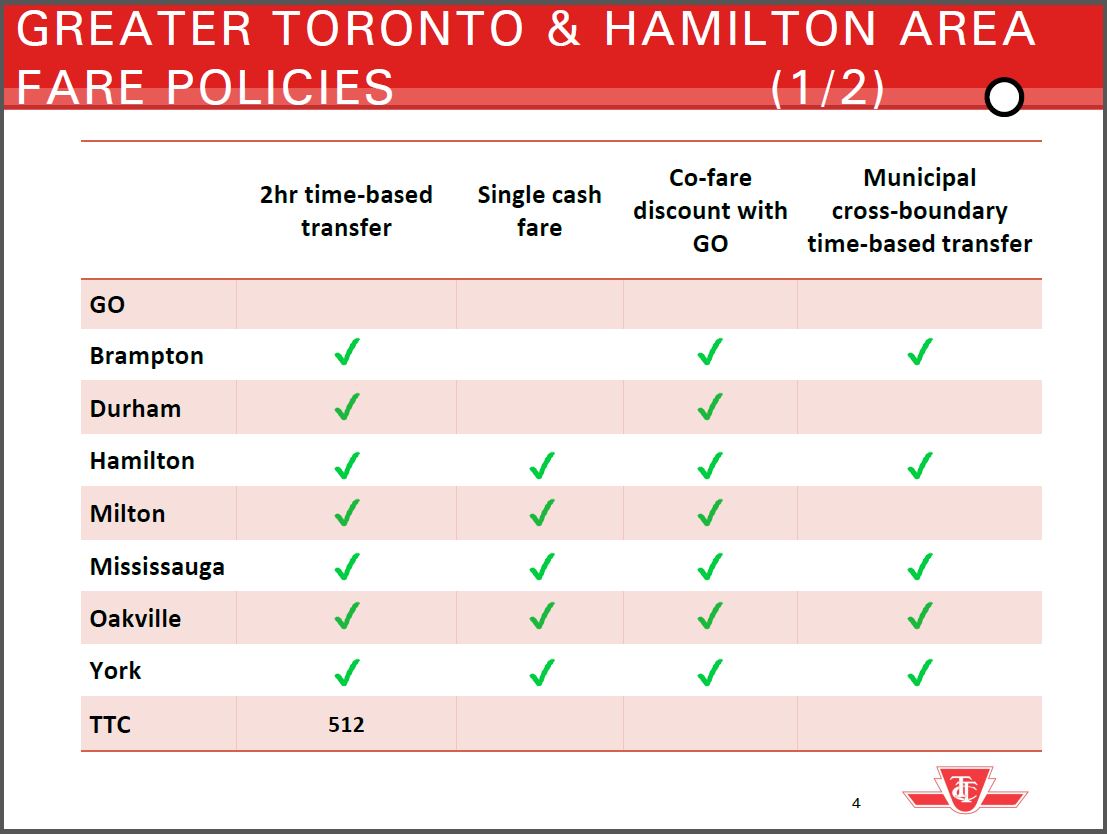
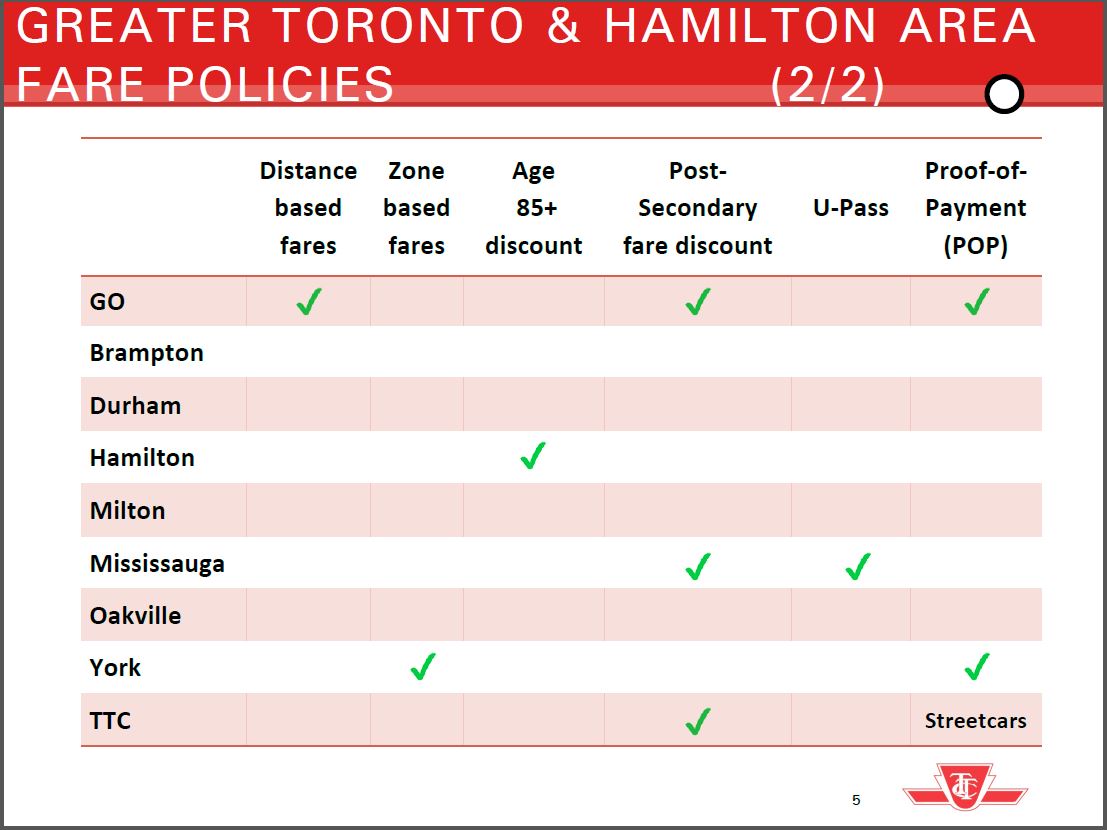
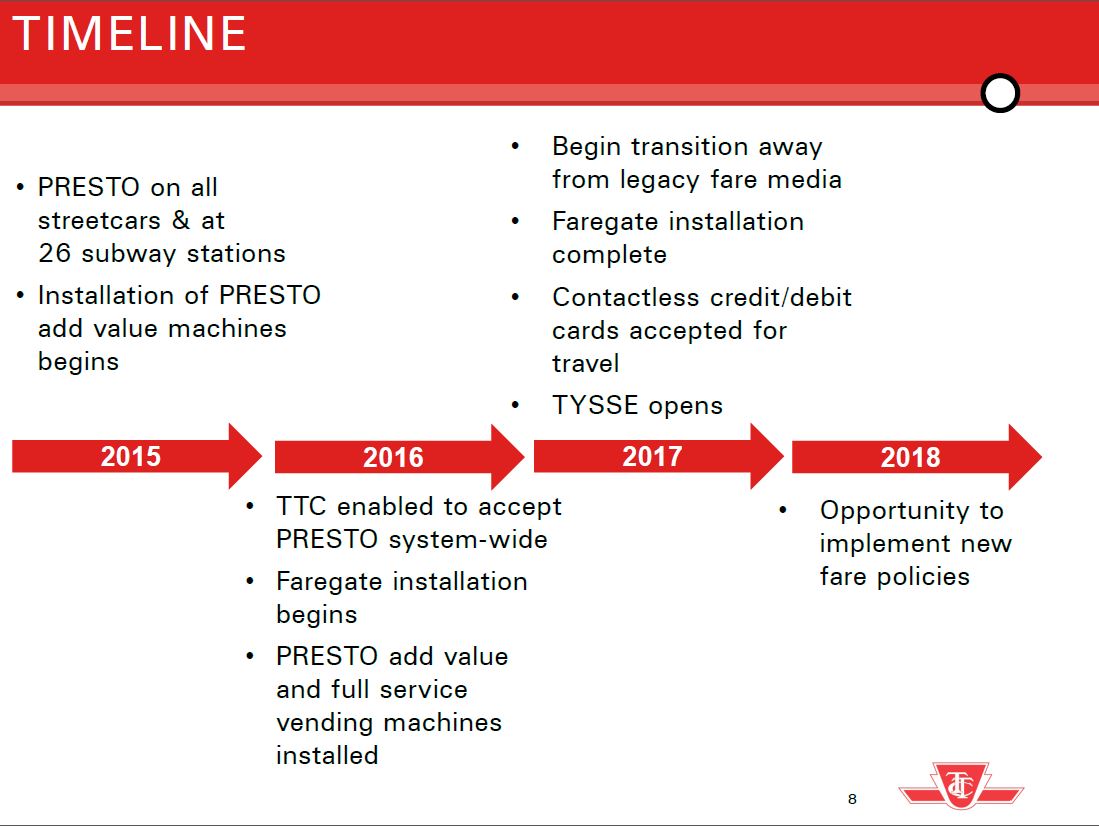
- Fare policy for TTC and regional travel
Metropass Turns 35: Time To Talk About Fare Options
May 1, 1980, saw the introduction of Toronto’s Metropass and the beginning of a shift away from pay-as-you-ride travel on the TTC.
The pass did not come without some political battles, and the stock TTC line was that this just wouldn’t work in Toronto. What they really worried about, of course, was lost revenue, a topic that comes up every chance TTC management gets to cry in their beer about the good old days when people actually paid full fares to ride.
The fare multiple in 1980 was 52 – the price of the pass at $26 was the equivalent of 52 tokens at, wait for it, fifty cents each. Over the years it was wrestled down to 46, but has been drifting up again in an attempt to make those pesky pass holders pay more. The ratio stands at 50.5 today for a regular pass with no discounts.
In fact, passholders now represent over half of all TTC rides. In 2014, out of a total 534.8-million rides, 290.7m were paid for with transit passes. It is long past time that we should think of pass users as if they are some small privileged group, but rather that they take the majority of trips on the TTC. It is their fares which are the “standard”, not the higher priced token users nor the real cash cows, those who pay the full cash fare. The chart below shows the evolution of fare media usage over the past three decades.
1985-2014 Analysis of ridership
At its April 29, 2015 board meeting the TTC approved a request that staff report on various fare options including:
- fare by time of day
- 2 hour transfer
- Seniors fares by time of day, including $1.00 seniors fare during off-peak hours
- Fare by distance
- Concession policy overall as informed by Fare Equity Strategy
- Monthly pass versus daily / weekly / monthly capping
- Free regular transit fares for Wheel-Trans qualified passengers in addition to the visually impaired
This report is expected to arrive on the October 2015 board agenda.
Should Seniors Get Even Cheaper Transit Fares? (Updated)
Updated April 30, 2015 at 12:40 pm:
The text of motions passed regarding this item have been added at the end of the update below.
Updated April 30, 2015 at 9:30 am:
The debate on the motion asking for a report on a pilot project for a $1 off peak seniors’ fare went on at great length at the April 29 TTC board meeting and provided some political theatre along the way.
At its heart, there are interlocking issues in any debate about fares:
- Should seniors as a class of riders receive discounted fares, and how generous should this discount be?
- Are other groups of riders equally or more deserving of discounts?
- Should a “pool”of subsidy related to discounts be allocated to various groups based on needs, or should the scope of such subsidies be increased?
- How will eligibility for any subsidy be administered?
- How should any fare subsidies be funded, and what is their priority relative to other transit needs such as improved service and maintenance?
- Should the standard fare structure be revised to provide benefits to all riders rather than targeted groups?
The proposal for a $1 off peak seniors’ fare came from Commissioner Vince Crisanti, a member of the Ford faction in the previous administration who was not noted for his generosity on the subject of social programs. Moreover, when he did sit on the TTC board (before the coup d’état that ousted many of the Ford crew), his knowledge of transit matters could not be described as encyclopaedic. To be fair, at this point the proposal was only a report request – tell me whether it would be feasible to have a pilot program to test the lower fare – and one might expect the whole thing to disappear if the result proved impractical, especially from a financial standpoint.
The problem, of course, is that everyone wants cheaper fares for one or more deserving groups, or even for all riders as Mayoral candidate Tory advocated, without getting into the questions of whether this is the best use of transit dollars or how a net new subsidy would fit into the allegedly tight city budget situation.
Public deputations on the issue, of which there were few despite the large crowd of seniors in the audience who arrived as a group, concentrated on support for the lower fare. In one case, the presentation by TTCRiders ran into a basic problem that their primary desire is to help low-income riders, but they have been pulled into the $1 fare issue as a jumping off point for their larger cause.
Questions from board members were generally civil, although there was a common thread of “how should we pay for this”. One deputant tartly replied that if the city can afford to eat the sunk costs of cancelled LRT projects and build the Scarborough Subway Extension, then availability of revenue is not the issue.
Toronto Councillors love to pretend that any discussion of new services or expenditures must be a zero-sum game with higher costs in one area balanced by reductions in others. This ignores the considerable taxing powers of the City that go unused thanks to pandering to motorists (the vehicle registration tax) and to the no-new-taxes philosophy that hobbles modern political debate.
The best moment came in a testy exchange between an old Chinese lady, speaking through an interpreter, who was harangued by Commissioner Denzil Minnan-Wong with a series of questions ending up with, to paraphrase, how can we pay for fuel if we let people ride for free? After a short pause, the reply came back: “that’s a stupid question”.
For far too long DMW and others have grandstanded at the expense of citizens who just want to exercise their right to speak on public issues, and chairs of meetings (including the TTC’s Chair Josh Colle) have failed to rein in such abuse. That one response burst DMW’s balloon, and will long be remembered.
Colle himself noted that he had come to the TTC a few years ago with a similar incentive – helping seniors with lower fares – but has since learned that as a group, seniors are rather well off. The real issue is to identify those who are in need regardless of their age.
Commissioner Alan Heisey proposed a motion asking for a report on a variety of fare options to come forward in October 2015 as input to the 2016 budget process. This would allow TTC staff to explore a range of new or revised fares, and in particular whether technical capabilities or limitations of the Presto fare card would affect the implementation.
The decision on future subsidy levels will be up to Toronto Council, but the TTC board should already have taken a position on the matter rather than simply inheriting a campaign promise as they did with the free rides for children in the 2015 budget.
Voting on the items took a bit of diplomacy as nobody wanted to actually vote against Vince Crisanti’s proposal. In the end, it was amended to request a “briefing note” by June, and then Heisey’s much broader motion was passed. A briefing note does not come back to the TTC agenda and simply updates members on information from staff. A report becomes the subject of future debate.
The motions as they were passed are:
How (Un)Reliable Is My Service
This article updates my ongoing compendium of TTC route performance statistics to include the first quarter of 2015.
Route_Performance_Summary_15Q1
The numbers reported by the TTC represent performance relative to the planned headways (time between vehicles), not to scheduled arrival times on routes:
The percent means that proportion of vehicles that were within +/- 3 minutes of the scheduled headway. More specifically that when each vehicle passes a ‘timing point’ it is compared to the vehicle in front of it that last crossed that same point. [From TTC Route Performance report]
In my version of the table, the TTC data are arranged in route number order with values for each quarter. Where there are blanks in the table, there was no data in the corresponding TTC quarterly report.
Also shown are the maximum, minimum, average and standard deviation values for each route’s statistics. This gives a sense of how much these values have moved around. A high standard deviation flags data that have widely varying values.
Of the 179 routes reported, 87 have higher ratings in 15Q1 than their averages for the nine quarters reported to date. To put it another way, about half of the routes did better than average for the first part of 2015, while about half did worse. If the extremely bad winter were a factor overall, one would expect a less balanced situation. On the streetcar lines, only three of eleven routes bettered their averages in 15Q1 (King, Lake Shore and St. Clair), but many of the differences are small with five of eleven falling within one standard deviation.
Headway reliability numbers are consistently bad on the 14x Downtown Express routes, and this implies that these infrequent services have a problem with running on time. What is not known is the measurements times and locations used to produce the stats for these routes and whether the service is at least on time where it collects passengers.
Similarly, headway measures for the 3xx Blue Night services are unimpressive, and what matters much more for these routes is on time performance and reliability of connections between routes, such as they exist.
The TTC claims that it will be introducing new “Journey Time Metrics” later in 2015, but there are as yet no details of what exactly these will measure. In parallel, there are moves to change the service reliability standards so that they look at routes end-to-end, not simply at their central points. (This was described in a presentation at the TTC board meeting in March 2015 (see p7 of TTC Modernization).
The TTC has yet to settle on a reporting mechanism that takes into account the difference in rider needs depending on the nature of a service. When a route is supposed to provide “frequent service”, the important point is that it be reliable. A 5 minute headway is not “frequent” if this actually means three buses every 15 minutes. When service is less frequent, then waiting times for off-schedule vehicles are a huge annoyance and on time performance is key. Short turns, of course, play havoc with both of these measures for riders who need a route beyond its common turnback points. Plans to measure the proportion of service that actually arrives at termini will highlight these problems.
Underlying all of this is the absence of a clear goal, a definition of what constitutes “good” transit service. Too often the goal has been to constrain cost increases and make the best of whatever resources the TTC has at hand.
Ontario’s 2015 Budget and GTHA Transit Projects
To no great surprise, Ontario’s budget for 2015 included a lot of transit spending, although the degree to which this is new money rather than old repackaged announcements is a tad vague.
The transportation portion of the budget, “Moving Ontario Forward”, begins on page 42 of the main budget document (which is page 74 of the linked pdf). The financial information can be confusing because projects are grouped in various sections depending on their source of funding.
To support Building Together, Ontario’s long-term infrastructure plan, investments of more than $100 billion over 10 years are underway, including $50 billion for transportation infrastructure. This is above the commitment to make $31.5 billion in dedicated funds available through Moving Ontario Forward.(p. 38)
In other words, there are now two pools of funding: the original $50b announced for the first parts of The Big Move, and a further $31.5b for recently green-lit projects. The original $50b is going toward various projects including:
- UP Express
- Mississauga Transitway
- vivaNext Rapidways
- Eglinton Crosstown LRT
- Finch and Sheppard LRT projects.
On the Finch and Sheppard projects, the Budget has this to say:
The Finch West and Sheppard East LRT projects, which will provide reliable and improved transit service on these busy corridors. The Finch West LRT will run along Finch Avenue between Humber College and Keele Street, and the Sheppard East LRT will run along Sheppard Avenue from Don Mills Station to Morningside Avenue. The procurement process for the Finch West LRT project is expected to begin later in 2015. (p. 39)
Additional investments not tied to specific project groups of funding streams include:
- The PRESTO fare card.
- Region of Waterloo’s ION LRT/BRT rapid transit project.
- Ottawa’s Confederation LRT line.
- Toronto’s streetcar fleet renewal.
- The Scarborough Subway Extension.
- Various highway projects. (pp. 40-41)
Moving Ontario Forward: Asset Optimization and Dedicated (Redirected) Taxes
This process began with the 2014 budget and, basically, involves land sales to fund infrastructure costs. In 2014, the target amount was $3.1-billion, but this has now been increased to $5.7b. The projects supported from this source include:
- Accelerate service enhancements to the GO Transit network, which will lay the foundation for Regional Express Rail (RER);
- Launch a new Connecting Links program, which provides funding for municipal roads that connect to provincial highways;
- Develop a new program to expand the natural gas network, which would help more communities generate economic growth; and
- Enhance regional mobility by investing in Metrolinx’s Next Wave projects of The Big Move, such as the Hurontario–Main Light Rail Transit project in Mississauga and Brampton, and rapid transit in Hamilton. (p. 43)
A further $25.8b (unchanged from the 2014 budget, see list on pp. 44-45) comes partly from tax revenues that are explicitly directed to the Moving Ontario Forward program. Some of this money is not yet in hand, notably contributions expected from the Federal Government.
A big chunk of Moving Ontario Forward is the GO Regional Express Rail (RER) scheme that has already been announced. The map in Chart 1.7 (at page 47) shows RER service to Oshawa, Unionville, Aurora, Bramalea and an unnamed point somewhere east of Hamilton, as well as service improvements on the Milton and Richmond Hill lines, plus the portions of the Stouffville, Barrie and Kitchener corridors beyond the RER limits. This is similar to information in the recent RER announcement, but with a notable difference regarding electrification:
The Province is also enhancing train service on all lines, including fully electrifying the Barrie, Stouffville and Lakeshore East corridors. (p. 47)
The description of RER service is also intriguing:
Regional Express Rail will deliver electrified service, at about 15-minute frequencies, along the following routes:
- Lakeshore East and Lakeshore West corridors, between Oshawa and Burlington;
- Union Station to Unionville on the Stouffville corridor;
- Union Station to Bramalea on the Kitchener corridor, including UP Express; and
- Union Station to Aurora on the Barrie corridor. (p. 47)
Given that the UPX will itself operate on a 15-minute headway, I hope that this description is merely a drafting error that has conflated two separate services in one corridor.
The Budget goes on to say that beginning in 2015-16, trains will be added on all corridors during various periods. This is an operating cost, not (in the main) a capital cost, and it is unclear whether this is coming from the “Moving Ontario Forward” pot or from general budgetary allocations to Metrolinx/GO.
Funding Partnerships
The budget is quite clear that Ontario is not going to build every project solely with provincial money.
The GO system, strengthened by the Province’s investments in RER, including on the Stouffville and Kitchener lines, will provide the backbone for a regional network. This network will also be the foundation for the SmartTrack proposal in the City of Toronto. Additional funding is needed to support key elements of this proposal, such as new stations along the route and an extension along Eglinton to the busy airport area. The SmartTrack funding proposal entails contributions of about $5.2 billion in new funding from partners, including the City of Toronto and the federal government. (p. 49)
At this point, Queen’s Park is not getting into a technology debate about the Eglinton West branch of SmartTrack and still describes this line as an airport service. However, as we will see later, the “Eglinton Extension” has been hived off as a separate budget item, and it is to be entirely funded with “partnership” money.
Another role for “partnership” funds lies in improvements to the Richmond Hill corridor with flood mitigation. It appears that Queen’s Park regards this as part of the larger bundle of projects that relate to core area capacity relief that should have money from more than one government. Whether Ontario would contribute anything is uncertain, and probably the subject of a future budget announcement if others come to the table.
The Next Wave
The Metrolinx “Next Wave” includes several projects that have not proceeded beyond lines on the map, but for which the province will continue planning and design work:
- Dundas Street Bus Rapid Transit, linking Toronto, Mississauga, Oakville and Burlington;
- Durham–Scarborough Bus Rapid Transit;
- Brampton Queen Street Rapid Transit;
- Toronto Relief Line; and
- Yonge North Subway Extension. (p. 51)
Moreover:
In addition to RER, the Province will work with related municipalities to move towards implementation of the Hurontario–Main Light Rail Transit project in Mississauga and Brampton, and rapid transit in Hamilton. (p. 51)
Exactly what “rapid transit in Hamilton” might be is not specified.
The status of various projects is summarized in the following chart (p.52).
As noted above, the SmartTrack elements of this plan at a cost of $5.2b are left for others to finance, and the Eglinton Extension is shown separately with 100% “new partner” requirements. An obvious place where Mayor Tory might save substantially would be to return to the Eglinton Crosstown LRT option for this segment, but we are unlikely to see any shift in his position until evidence from studies now underway shows just how impractical his SmartTrack scheme is in this regard.
What’s In and What’s Out
Notable by its absence is any reference to Waterfront transit which appears to be left in Toronto’s (or the tripartite Waterfront Toronto’s) hands. There is a generic reference to the proposed works at the mouth of the Don River, but nothing specific.
The status of route and technology selections in Scarborough is not touched both because this is a hot potato, and because legitimately Queen’s Park can point to studies now in progress that will sort out the potential role of various lines. Any move away from the subway option will not happen without a shift in Toronto Council’s position, and that is only likely if the project’s cost escalates well beyond the currently projected level.
Further enhancements to GO, notably on the Milton and Richmond Hill corridors, are topics for another day. In particular, Richmond Hill is unlikely to get serious attention until Queen’s Park and Metrolinx wrestle with the combined issues of routes serving the core area from the north and which infrastructure improvements make the most sense as a package.
No other Toronto rapid transit schemes are listed including perennial pet projects such as the Sheppard West and Bloor West subway extensions, nor is there any talk of enhancing the ongoing funding via gas tax revenue that contributes, in part, to the operating subsidy. Moreover, the question of funding accessibility is still clearly in Toronto’s hands.
The Budget doesn’t give Toronto everything it wants, and puts the City on notice that it has to come up with its own funding to address various problems, even if there might be a bona fide call on Queen’s Park for some areas.
At a minimum, there is more definition to what the government claims it will do in coming years. The challenge will be actual delivery, something for which the Liberals at Queen’s Park don’t have a good track record.
Ottawa’s 2015 Budget Transit Funding: Smoke and Mirrors
The federal government has announced a transit fund for coming years and given the impression that this is new money over and above whatever cities might receive today. It’s not, and folks like Mayor Tory who see this “fund” as a way to underwrite their pet projects like SmartTrack will come up short.
The detailed budget paper shows where the transit money actually comes from (jump down to page 187 of the linked pdf), and includes the following chart.
Of the $53b promised over the 10 years 2014-2024, much of this already exists in the budget:
- Gas tax: $21.8b. Toronto already receives about $150m annually from this source and has built the funding stream into its future capital spending projections.
- Existing infrastructure funding: $6b. This is self-explanatory, and is not new money.
- GST Rebate: $10.4b. This is another existing program, and it’s not really a payment to municipalities, merely a foregone source of federal revenue.
- P3 Canada Fund: $1.25b. This is an existing program, although some of this may be new money. However, it is small change in the overall scheme of transit needs, and is subject to a “merit-based” allocation.
The new “Public Transit Fund” is not a block grant program, but will be based on “merit”, a concept with which Toronto is all too familiar thanks to the machinations of various transit lobbies and politicians. Moreover, Ottawa looks to deliver projects through a combination of P3s and municipal financing backstopped by federal funding over the life of a project. This effectively defers the cash outlays to future years when a completed project would be paid for like a mortgage. This fund is expected to ramp up to $1b annually, but not immediately, and it is far from clear how much this would actually bring to Toronto or the GTHA.
Whether the private sector actually has the capital and wishes to invest, let alone whether they could do so at a cost competitive with crown borrowing, is a question best not asked. As for municipalities, the borrowing would still be on their books and affect their debt ratios, even with “guaranteed” federal funding to pay this off. To what degree those future debt payments would crowd out net new spending would depend on prevailing economic conditions at the time.
I am more than happy to see money flow from Ottawa to municipal projects, but the budget hype implies a much higher level of new spending than will actually occur. We are a long way from funding the many badly-needed transit projects in the GTHA, let alone seeing a reliable federal contribution on a par with provincial or local governments.
The Dubious Economics of the Union Pearson Express
In today’s Toronto Star, Tess Kalinowski writes about recently released Metrolinx reports concerning the Union Pearson Express (UPX).
The items of interest are down at the bottom of the Reports & Information page and they include ridership forecasts from December 2011 and May 2013. The latter report was cited as background to the Auditor General’s 2012 Report on Metrolinx [beginning on p. 6 of the pdf].
Given that the projection is almost two years old, one might be tempted to say “maybe things have improved”, but that’s a tad hard to believe in the absence of any newer studies from Metrolinx.
There are great hopes, and even greater hype, for the UPX, and getting some basic information on the table is certainly worthwhile. Continue reading
A New Way To Measure Service Quality?
At its recent Board Meeting, the TTC received a presentation [scroll to p. 3] from Chief Service Officer Richard Leary on plans to update management and measurement of surface route service quality.
The monthly CEO’s report includes a number of “Key Performance Indicators” (KPIs) intended to track various aspects of the transit system. However, the methodology behind some of the KPIs, notably those related to service quality, leaves a lot to be desired. Moreover, information that could track basic issues such as vehicle reliability is not included. This begs the question of whether the indicators exist more as a security blanket (“we have KPIs therefore we are good managers”) than as meaningful management tools, not to mention as reports to the politicians and public.
A telling chart on page 6 of the presentation shows how badly the TTC has drifted from transit industry norms:
The TTC aims to have almost enough vehicles available for service relative to actual needs, and operates with a lower spare ratio than the industry overall. This has two effects.
- When unusual demands for service arise, there is no cushion to roll out extras.
- Vehicles are not maintained often enough to prevent in service breakdowns. This shows up in a mean distance between failures that is very much lower than the industry average.
The situation is actually compounded by an internal measure of service delivery: a garage counts a bus as “entering service” if it makes it across the property line onto the street. Whether the bus runs for an entire day or breaks down a block from the garage, it counts toward service provided. This is complete nonsense, but shows how the construction of a metric can induce behaviour that is counterproductive. Actually keeping the bus in the garage could allow it to be repaired and improve reliability, but that’s not what the garage is measured for.
Moving to a higher spare ratio and more frequent routine maintenance on vehicles is expected to yield better service with fewer in service breakdowns. Late in 2014, the TTC began this shift by slightly increasing spare ratios at each garage, and the MDBF for the bus fleet has risen to 7,000km. This will have to be tracked over a longer time, however, to ensure that the improvement is permanent and can be linked to further increases in spares and maintenance work.
This has a non-trivial cost for the TTC. With a total scheduled service of about 1,500 buses, a 6% increase in spares represents 90 vehicles, or a substantial portion of a typical yearly bus purchase, not to mention a fair amount of garage space.