
The entire purpose of this article is to take over the discussion thread about fare collection on the Queen car which launched itself in the service analysis piece.
Finance
Coming Soon: July 2015
Since that blizzard of articles about TTC budgets and fares, it’s been rather quiet in here. Fear not! I actually have works in progress to tide us over the relatively quiet summer months until the political season heats up in the fall.
There will be a series of articles about the operation of the downtown streetcar lines looking at their behaviour over time, and reviewing how changes that have been made (or are planned) affected them. These include:
- 501 Queen (including the effect of split operation with a bus shuttle on Lake Shore to Long Branch)
- 502/503 Downtowner & Kingston Road (including the recent move to a 10-minute off-peak headway on 502)
- 504 King (including the effect of additional running time on service levels and terminal operations)
- 505 Dundas
- 506 Carlton (including a look at the effects of the College/Spadina construction diversion)
- 509 Harbourfront (including a review of the changes on Queens Quay)
- 510 Spadina
The TTC plans additional meetings of its Budget Committee and these will, no doubt, produce more details about plans and options for 2016 and beyond. I will cover this material as it becomes available.
A Little Rant About Transit Fares
A recent article, The Flirtation With Fare By Distance, has sparked a debate in the comment thread about the relative merits of flat vs distance-based fares, and the whole issue of how we choose to subsidize some groups of riders versus others. In a recent reply, I took strong issue with some of the concepts advanced by writers, and the thread of my argument is strong enough that it deserves to be seen in an article of its own.
There are two related comments, and I will reproduce them here to set the stage:
Rishi (@PlanGinerd) wrote:
Fare-by-distance is a tricky one that I’m not yet firmly decided on. It clearly works on many large systems worldwide, and I have tons of friends and family who live in Zone 4 or Zone 6 in London who while they do complain the Tube is expensive, they still take it daily and never ever drive or take a cab or a regional train into the core. Perhaps it can only be coupled by changing the economics/costs of driving?
I am 100% sympathetic that FBD benefits those who can afford to live closer to the core, whilst disadvantaging those who live within the borders of Toronto but farther out. I haven’t done enough research yet, but I always think about why someone who lives so far from the City of TO core, would still choose to live within our borders vs. in Peel, York, or Durham regions. Is it really the cheap access to the TTC or is it other services? In other words, what incentives are there to convince them to live in “expensive” Toronto in the first place?
My friends deep within Metrolinx and TTC are also torn. They feel that it is not the role of the operator to handle the social equity, but the role of the province through transfers and tax breaks. I ask Steve and the community, if the province was to pair FBD for all GTA transit agencies and truly integrated fares, with a tax break to help those disadvantaged, would that change your mind?
It reminds me of a conversation I had last week on Twitter with Moaz RE how social programs that give out free TTC fares would cope without tokens. I see Presto tech. as enabling if done right, and it would be easy to give out cards with balances on them, or a periodic reload to help with fares, whilst also giving valuable O-D and usage data.
Maybe I’m too much of an optimist but things like this, and exiting fare gates are commonplace and the norm in cities everywhere. Yes local context is critically important, but I think we have to get away from the nay-saying that Toronto is always different and every other best practice could never work here.
Jonathan C wrote:
Flat fares are a very ineffective way to reduce inequality as the benefit is not well-targeted to those who need the help. There are plenty of people making long trips who could afford a higher distance based fare, and plenty who struggle to pay the flat fare for short trips or end up walking long distances because they can’t justify the cost. In most cases everyone would prefer better service. If you want to help those in need then push for an increase in the low income tax credits, don’t try to use the transit system as it is a very blunt instrument.
In a way the flat fare leads the poor to live further from the core as only those who are better off can afford higher housing costs plus the flat fare. The poor service to far-flung locales also pushes commuters into cars, while those who can’t afford to drive end up trading their time for a lower fare.
My replies:
This discussion seems to be taking place as if we were proposing to introduce flat fares as a net new subsidy that would benefit people who don’t need it. If that were the case, I could certainly understand arguments for targeted rather than broad-brush subsidies.
We are not. The discussion is of the potential effect on a wide range of transit users who now have a common fare no matter how far they travel compared to what they pay today. If you want to talk about actual need, then let’s expand the debate to free fares for all children, or reduced fares for all students and seniors. During the whole debate over cheaper fares for university students, I was struck by the absence of advocates for the truly poor saying “hey, what about us”, and the hand-wringing extended to a group that on the whole comes from relatively affluent backgrounds.
I have yet to hear a cogent argument for distance-based fares beyond “other people are doing it”. Well, no, throughout much of the GTHA, “local” fares are flat. Even London UK, that oft-cited bastion of fare-by-distance, uses flat fares for its surface system with time-based transfer privileges.
Correction: London does not have time-based transfers on its surface routes, with very limited exceptions. [July 2, 2015]
The question of flat fares vs fare by distance has nothing to do with “nay-saying” or “best practices”, it is a political and social choice the city has made. If we want to talk about fare collection technology, or the best way to operate a transit system, those are fair game for criticisms of the “not invented here” syndrome so common in Toronto.
“Equity” as Toronto defines it may well mean a flat fare. Don’t forget that the pesky border with the 905 is a comparatively recent phenomenon, and problems of low market share for transit within 905 systems (i.e. for local travel in York Region, or Durham, or Mississauga) have nothing to do with fare by distance, but with built form and the relative lack of competitive transit services. Fare by distance will only “solve” the problem for trips that are now cross-border by giving them a (presumed) discount. It won’t add better bus service unless there is a substantial jump in revenue to offset costs, net costs that are higher in the 905 because of the much richer per rider subsidies.
Where people choose to live is a product of many factors including income and service (broadly defined) availability. Try living without a car out in the 905 — the TTC for all its problems is a damn sight better, and it can certainly be argued that there is a stronger, longer history of community support services within Toronto than elsewhere even if these are stronger in the “old city” than in Toronto’s suburbs. Some of this is also historical — the 905 suburbs simply didn’t exist when many families moved to the outer 416, or they were aimed at a very different demographic. Markham is not noted for its large pool of social housing.
When we speak of transit discounts as a “social service”, this is usually in the context of truly disadvantaged groups who for mainly economic reasons are deemed worthy of additional social supports. There is a big problem with arguments that they should be funded through alternative means to transit fares such as tax rebates. Social subsidy programs are chronically underfunded and have exclusionary eligibility tests. Tax credits are a wonderful thing, but they are almost always structured to benefit those who have a taxable income in the first place, and can even disproportionately benefit the well off.
If we start talking of flat transit fares generally as a “social service”, we miss the whole point that encouraging people to use transit has an economic benefit for the city by avoiding pressure for more road construction, and a general benefit to all residents by reducing the need for one or more cars in their families. This is the sort of thing that would show up in any full accounting of costs and benefits. The hidden subsidies to motorists are not subject to the same scrutiny, nor are they regarded as some sort of social service. We also build roads for the economic benefit of the trucking industry and all of its clients. Maybe we should start thinking of that as a “social service” too because it is a form of job creation.
It is very easy to characterize things we don’t want to spend money on as “social service” or even worse “welfare”, while the things we prefer (often for political and ideological reasons) as “investments”.
Any scheme that discourages transit use relative to what is and has been in place for decades is the equivalent of a “disinvestment”, almost like asset stripping where dividends are more important than the health of a company.
If you want to call me a “nay-sayer” for that attitude, you have that right, but it’s a pejorative term, an artificial, ad hominem argument that does not engage in debate of the basic principles.
I would remind you that the “nay-sayer” epithet was used by John Tory during his campaign against those who criticized SmartTrack, and we now know what a bag of crap that proposal was.
The availability of vast amounts of travel data is routinely cited by those who would move us to fare by distance. Dare I remind readers that distance-based fares have existed for much, much longer than the ability to collect this data, and they are a product of political and business decisions about pricing service, not a means to collect O-D info.
The next time you go shopping and someone makes it harder for you to get through the store because they want detailed data about your buying habits, be sure to co-operate fully.
The TTC does not, repeat, not need a mountain of O-D data to provide better service. You can find out where the riders are simply by looking at the buses and streetcars, and broad network demands can come from O-D data in the TTS survey.
They already have a mountain of data documenting the behaviour of their vehicles, and after many decades are finally starting to analyze it in ways similar to the work I have published. Problems with vehicle bunching and poor headway management contribute a great deal to crowding on the TTC. Even with this documented in excruciating detail, little is done to fix problems of “TTC culture”. This is even a double-edged sword in that with all this data, some claim that all we need to do for more capacity is to improve management and schedules, not to actually operate more service. This is a variation on the “efficiency” argument that neatly avoids an actual commitment to better service.
Let us have a debate on fare structure by all means, but let it be a real debate, not simply a fait accompli that shows up because Andy Byford and Bruce McCuaig decide to impose fare-by-distance on us all as a matter of simplicity for Presto’s implementation. The technology should serve what we, collectively as cities and a region, want to help transit achieve, not get in the way or penalize riders who happen to live in the wrong place. Let’s talk about GO Transit’s uneven handling of short trip fares and the discount structure that makes travel from Kitchener to Union Station far cheaper, by distance, than travel from Rexdale. Let’s talk about what is needed to make transit service in the 905 truly attractive so that more people will want to use it, and transit will have political support for spending on more than a few subway extensions and GO improvements.
That would be a real debate. What we have today is an utter sham.
TTC 2016 Budget Intro: Part 2 – Capital Budget
The TTC Budget Committee will meet on June 29, 2015 to consider a preview of the 2016-2025 ten year Capital Budget. This gives a sense of where the TTC is headed in its search for funding at the City of Toronto, Queen’s Park and Ottawa, as well as its priorities for future spending.
The Capital Budget often can be daunting both from its size (the detailed project description material fills two large binders), the complexity of its funding (many sources of money, one-time or ongoing schemes, and the fact that huge projects like subway extensions are mixed together with the more mundane work of routine repairs to refresh aging infrastructure.
This mix also shows the ongoing competition for attention between the megaprojects and the equally important job of keeping the TTC rolling.
The budget spans ten years, and each year brings updates to reflect planned work that now falls within the ten-year window, new projects that have not been included before, and changes to existing projects either in their scope or timing. For many years, the total budget has exceeded projected funding for the next decade, and many projects sit in limbo awaiting their own dedicated financing scheme, or the arrival of more money through increased subsidies. The balancing act the TTC faces is to keep the vital projects going in the short term while beating the drum for for better transit support in future budgets.
Funding from “senior” governments – Ontario and Canada – has declined considerably over the years. Although specific projects have large investments – notably the Spadina extension (TYSSE) and the Eglinton-Crosstown (which is now a Metrolinx project) – funding for basic capital maintenance is a hard sell. Toronto receives gas tax revenue from both governments, and in the case of the provincial stream, a bit over half is dedicated to operating subsidy, not to capital. The total gas tax capital flow each year from both Queen’s Park and Ottawa is about $220-million, less than one quarter of the typical annual spending. Almost all of the remainder comes from the City of Toronto.
This, together with other City financial pressures, has created a very tight squeeze in coming years which is shown in a chart from a recent budget presentation.
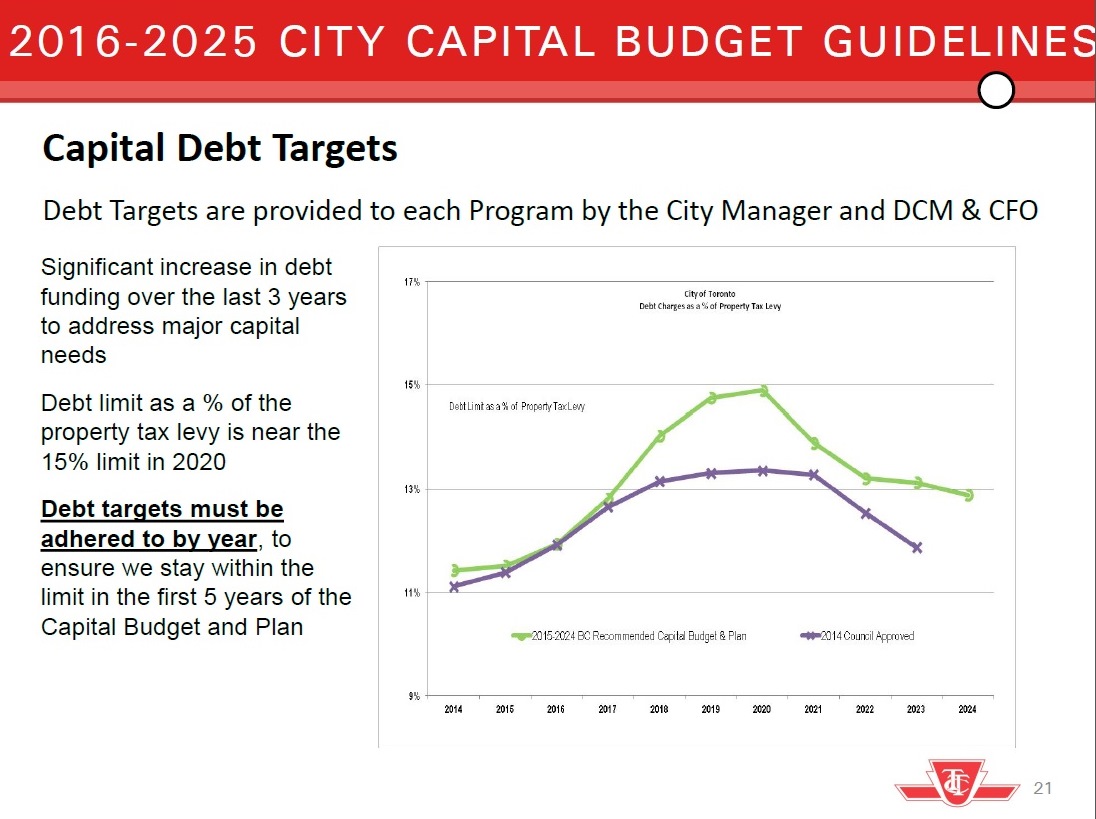
Recent decisions by Council have eaten up all of the headroom that formerly existed in the City’s capital debt plan. In order to keep spending on debt service under control, the City sets a ceiling of 15% of property tax revenues for this expenditure. This is actually much less than 15% of the overall City budget because property tax covers only about 1/3 of the total (for example, transit fares are roughly 10% of total City revenues). However, the other revenue streams are spoken for because they are dedicated to specific purposes, not to general operations. Also, some of these are non-recurring such as special grants, “surpluses” (actually underspending from previous years), or proceeds from asset sales. Such revenue cannot be counted on in future years as a source for debt payments. In simple terms, you can only spend an inheritance, or lottery winnings, or money from selling your antique furniture, once.
By 2020, the anticipated debt payments bump into that 15% line and there is no headroom. Any new capital project, especially one that starts in the next five years, and which is financed by debt, would push the debt service cost beyond that 15% by 2020. For example, you may have spare cash today to cover a car purchase loan, but if you are facing another loan for a planned home renovation project in a few years, you won’t be able to carry both when the crunch comes. That is the situation the City finds itself in, and current budget guidelines call for no new debt-funded projects to be added for the next nine years until there is headroom once again for borrowing. (Note that the City’s projections allow for anticipated future changes in interest rates, although these take time to build into the debt service base because of long-term fixed interest rates on City debt.)
One obvious solution is to either raise the amount of tax revenue so that the 15% is measured against a higher income stream, or to get a new source of revenue to pay for capital costs without borrowing. Neither of these is palatable to City Council, and they look to other governments to increase funding.
Project-based grants can shift individual items off of the books (for example a new rapid transit line might be “free” because someone else pays for it), but these projects are not necessarily our top priority (we might value better accessibility in existing stations over a new subway through vote-rich ridings). Moreover, the completed projects could bring additional operating costs (the TYSSE will certainly do this) for which money must be found in the Operating budget.
The presentation includes a long list of funding programs created by various governments that have run their course (end dates in parentheses) [see pp. 41-45]:
- Canada Ontario Infrastructure Program (2003)
- Ontario Bus Replacement Program (2010)
- Golden Horseshoe Transit Improvement Fund (2012)
- Ontario Rolling Stock Infrastructure Fund (2012)
- Canada Strategic Infrastructure Fund (near complete)
- Metrolinx Quick Wins (near complete)
- Transit Secure (2009)
- Infrastructure Stimulus Fund (2011)
A few remain in place:
- Light Rail Vehicle Procurement (to 2019)
- TYSSE (to 2018)
- Provincial Gas Tax (ongoing)
- Federal Gas Tax (ongoing)
Promised funding for future projects such as the Scarborough Subway Extension (SSE) are not included in this list because they are not yet approved beyond preliminary planning and engineering. Metrolinx projects do not appear in this list because they are entirely handled at the provincial level and do not affect City capital requirements.
The Flirtation with Fare by Distance
Recent presentations by TTC CEO Andy Byford both to his own Board and at a recent Metrolinx Board meeting included an undercurrent of references to charging fares based on distance travelled or some form of zone system. This shows up in the description of new fare gates for subway stations that would be provisioned at the TTC’s expense as part of the Presto farecard rollout.
What, you ask, is this all about? Don’t we already have Presto readers on existing turnstiles? Well, yes, but they have two problems according to Byford:
- The reader is not ideally located (“it is too low”) for customers, and
- New fare gates can be designed with provision for future “tap out” capability that would be needed for a distance or zone based fare structure.
The cost of this change is projected to be $38.1-million, and this is a net addition to the TTC’s already bulging 10-year capital project list.
Oddly enough, the new fare equipment arises from a joint effort with Metrolinx/Presto and it would be no surprise if the same gates show up at stations on the Eglinton Crosstown line.
TTC 2016 Budget Intro: Part 1 – Ridership Forecasts & Service Planning
Recently, the TTC Board, a largely dormant entity during the era of Rob Ford and Karen Stintz, decided to take a more active role in oversight of the organization by striking new subcommittees. In addition to the already existing Audit Committee, there is now a Budget Committee with members Rick Byers, Councillor Shelley Carroll, Councillor John Campbell, Councillor/Chair Josh Colle, and Councillor Joe Mihevc.
Agenda materials for this Committee are available on the TTC’s website, but on a different location from the those for full Board meetings. The Budget Committee met on June 17, 2015, and its agenda included two reports related to ridership and service levels:
These are intended as introductory overviews for Commissioners who are not steeped in the details of TTC planning or policy, and they give a general sense of management’s focus as the TTC enters the 2016 round of budgets.
Note: The Service Standards document has most of its content in portrait format even though the pages are primarily in landscape. Save the document, open it with Adobe Reader, and then rotate the displayed images.
The State of TTC Streetcar Track Switches (Updated)
Updated June 28, 2015: Additional historical information from TTC Budgets has been added to the end of this article.
Ever since the introduction of the articulated streetcars back when the earth was still cooling, automatic track switches have been plagued with less-than-ideal reliability of the new system that was installed to operate them. This was triggered by the different lengths of ALRVs and, hence, the different distance from the front of the car to the point where the trolley pole sits on the overhead. A system based on a contactor on the overhead simply would not work with the ALRVs. The new system uses antennae at the front and rear of each car together with antennae in the pavement. This system allows the “front” of the car (rather than the rear) to signal the direction it wants to turn, and also provides a lock-unlock logic based on the rear end antenna passing the switch.
A project to replace this system has been on the books for years, but with little progress. Meanwhile, many switches that should be automatic (and through that automation interface with traffic signals) are manual. At the newly opened Queens Quay and Spadina, a pointman operates the switches.
I wrote to the TTC about this situation. Here are my questions and their replies.
Q: With the Queens Quay project finishing, an issue has shown up (again) that the switches at Queens Quay and Spadina are still being manually operated usually by a point duty operator, sometimes by the streetcar ops themself.
A: We are in the process of prioritizing restoration of a number of out-of-service switches in the network. Resources will be made available to restore the four (4) switches on Spadina and Queens Quay as a top priority.
Q: This delays service and also means that the transit priority signals cannot work as intended because they don’t “know” where a car intends to go. Two points:
For years there has been a budgeted project to update the switch electronics because the old equipment has never been reliable.
A: We would not characterize the equipment in those terms. We are short of replacement parts due to the OEM changing ownership, losing interest in supplying parts, and that the original design files were lost in a major fire.
Q: If I remember correctly, this was one of the projects sloughed off to 2016 due to budget cuts. Is this correct?
A: We are still working on a new equivalent design and taking steps to secure its safety certification. Our objective is to create a controller with identical functionalities and a design that we own and take control.
Q: A commenter on my blog claims that there are long delays because Hydro must to an inspection when a switch is activated. Switches that are ready to be energized sit for months in manual mode. Is this correct?
A: New installation of wiring and controller must be performed in accordance with Hydro’s electrical safety code. Safety inspection by Hydro can indeed be a lengthy process. We would normally submit our application for inspection partway through the Work to reduce wait time gap.
There really is only one obvious question left here: if this were a subway signal system, would the problem have been left outstanding this long?
Updated June 28, 2015:
On the afternoon of June 27, an eastbound streetcar on Queens Quay at the entrance to Queens Quay Loop took an open switch and turned into the side of a westbound car. As luck would have it, this was one of the new LRVs, 4404. The story was covered in brief by CBC and several photos appeared on Twitter including this overhead view. The Star also has an article.
TTC Struggles to Handle Bus Demands (Updated)
Updated June 27, 2015: The TTC’s 2016-2025 Bus Fleet Plan has been added to the end of this article.
At its June 21, 2015, meeting, the TTC Board approved leasing the former York Region Transit Concord garage at 8301 Keele Street (between Highway 7 and Langstaff Road). With 50 new buses to be delivered at the end of 2015 and no place to put them, the TTC desperately needs more garage space. The planned McNicoll Garage will not come on stream until 2020 and this leaves Toronto with a shortfall to handle both ridership growth and restoration of better crowding standards for peak service just as political support for improved transit has returned to City Hall.
The capacity of existing garages in May 2015 shows how close to the line the TTC already is. The numbers below are stated in 12m bus equivalents counting each artic as 1.5 vehicles. Maintenance spares are additional to the scheduled service, and this ratio is planned to rise from 16.8% to 18% in 2016. Capital spares are vehicles that are either in warranty/retrofit programs, or are going through mid-life cycle rebuilds.
Garage               Capacity   Scheduled

Arrow Road              235         227
Birchmount              202         195
Eglinton                252         246
Malvern                 244         245
Mount Dennis            235         230
Queensway               147         144
Wilson                  252         244

Total                 1,567       1,531
Maintenance Spares      263
Capital Spares           77
Grand Total           1,907
[Source: Service Changes for the May 2015 Board Period]
The capacity of the garages including room for maintenance is only 1,630 [per TTC Board report], but the rest of the fleet is not sitting at Hillcrest for overhaul. In fact, the garages are overcrowded because more space is needed for routine maintenance than is actually available.
If the loading standards for peak service are improved by 10%, this will not affect every route in the system because some of the minor ones operate with elbow room to spare. This typically occrs on routes with few vehicles where adding or removing one bus has a very large effect on the average load and service cannot be scheduled exactly to the current standard. However, if more buses are needed on, say, routes using 2/3 of the fleet, this would represent an increase of about 100 buses for service plus at least 120 spares. Ridership growth at 3% per year over the next five years would add at least another 250 buses to fleet requirements absent any offsets for expansion of the rail network.
The TTC’s 2015 Fleet Plan was based on a lower growth rate, and had no provision for improvement in the crowding standard.

Some buses will be released by the opening of the TYSSE at the end of 2017, and there is another drop in 2021 after the Eglinton Crosstown line replaces busy routes in that corridor. Only at that point does the number of scheduled buses drop back to current levels, and so extra space is needed in the interim just to maintain loading standards, never mind to improve them.
Concord Garage can handle up to 90 12m buses, but planned service improvements to 2020 will push the fleet to almost 500 buses beyond existing garage capacity. McNicoll Garage will be completely consumed the day it opens, and the TTC will still require another new garage subject to whatever savings new rail lines might bring.
An updated fleet and garage plan will appear as part of the 2016 budget process. The challenge will then be for Council to continue its pro-transit stance with funding for better bus service, not just for construction projects.
Updated June 27, 2015: 2016-2025 Bus Fleet Plan added
As part of the Preliminary 2016 Capital Budget background material, the updated fleet plan is now available.
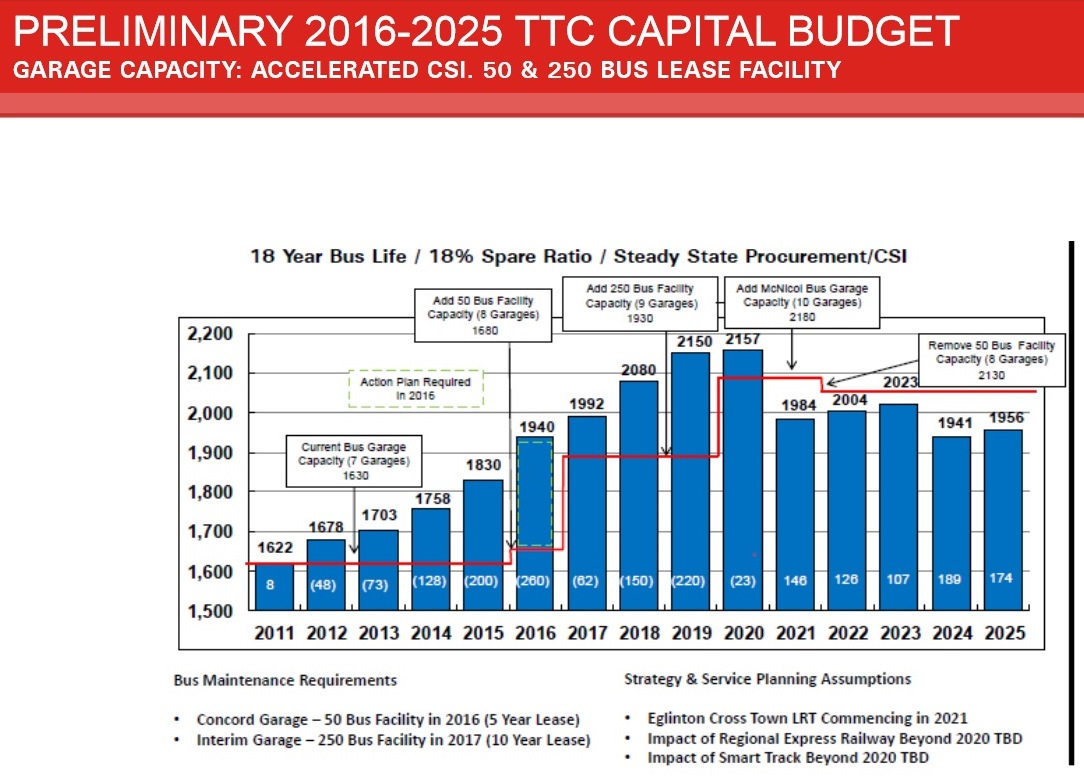
This shows the evolution of fleet requirements relative to garage capacity. The planned increase in the total fleet shows that the TTC is making provision for service increases in coming years, despite original indications that the 50 buses coming late in 2015 were a “one shot” improvement. What exactly will be proposed is not yet clear because the details of future operating budgets are not yet public.
There is a drop in the rate of increase in 2017 likely due to the net effect of the TYSSE opening late that year, and future drops the correspond to the opening of the Eglinton Crosstown and the GO/RER/SmartTrack service and Scarborough Subway a few years later.
This shows how an additional garage beyond even McNicoll is required well into the next decade. Indeed, even with some additional rapid transit capacity, the bus fleet is hardly going to vanish. A 2% annual fleet growth would be equivalent to about 40 buses, or a full garage worth in about 6 years. The intriguing part about this plan is that a new garage of the same size as McNicoll is needed by 2017. We could have McNicoll by then if the project had not been sidelined thanks to the service and funding cuts of the Ford/Stintz era. “Saving money” does not always save money.
(Note that the capacities shown are in 12m buses or equivalent for planning purposes.)
TTC Announces The End for Tokens, Tickets, Transfers
The TTC has announced that the use of traditional fare media will be phased out starting in 2017 with the goal of complete conversion to smart card technology by the middle of that year.
A presentation by Deputy CEO Chris Upfold at the June 22, 2015 TTC Board meeting outlined the project.
Current plans for migration to Presto will see all streetcars and subway stations equipped with readers by the end of 2015, and the bus fleet by the end of 2016. This will lead to all-door loading and proof-of-payment operation on the entire streetcar system by the end of 2015.
Presto (part of Metrolinx) is responsible for the entire fare collection system with only a few exceptions, notably the gates in subway stations. In return, they will receive 5.25% of fares collected through their system, a lower cost to the TTC than its estimated 7% on the existing system.
As riders on the new streetcars already know, the procedure for obtaining a paper “transfer” or fare receipt is cumbersome for Presto users as this is handled by a completely separate device which is not beside the Presto reader. This will be a major disincentive for riders who must transfer to a route where Presto is not in use. (Moreover, given the TTC’s chronic inability to reliably schedule its fleet, I fully expect non-Presto buses to show up on “Presto” routes.)
Riders who now use tokens would still require them up to the point where their travel is all in “Presto” territory. A pass user whose travel involves non-Presto routes has no incentive to change to Presto because they would have to revert to the standard fares rather than the pass-based discounts. The transitional year, 2016, will be a challenge.
TTC management will propose, in November 2015, a scheme for the new fare structure. Among major decisions the TTC and City Council (because of subsidy implications) must consider will be:
- How much transit usage will one “fare” purchase? There has been talk of a time-based fare (two hours, say), but this has been opposed in some quarters, including the Mayor’s office. With luck, he will reconsider.
- If the TTC moves to a zonal system, this will require “tap off” at vehicle and station exits to ensure that the appropriate fare is paid. This would be a major change for the TTC, and could produce severe congestion for passenger handling on surface vehicles.
- The handling of transfers between surface and subway is now designed in most locations to be barrier-free. Riders do not necessarily “leave” the system on the route where they started.
- Through services into other jurisdictions (e.g. Toronto to York Region by bus or subway) raise the questions of zones and revenue sharing. Does York Region collect a YRT/VIVA fare for the inbound trip and TTC a fare for outbound? At stations like Vaughan Centre, the process is simple – set up a fare barrier – but for routes crossing the boundary, the situation is not as straightforward. Gone are the days when an operator could walk through a bus with a hand-held farebox at the zone boundary.
These are just some of the issues facing the TTC for its own system, and another whole layer is added for “integration” with other transit networks, notably GO and the future SmartTrack which will share GO facilities, but operate with TTC fares and transfer privileges. Metrolinx plans to produce its own study on fare integration in September 2015, and this will probably set the stage for the options available to the TTC.
Although initially the system will accept only Presto cards, support for credit/debit cards and smart phones will follow in 2018. This entails a major change in the Presto architecture, work that is now underway for an implementation in Washington DC. Instead of storing your account balance on the card, this information will be kept by the “back end” systems and your card (or smart phone app) will only be used as an identifier. (A good analogy is a phone bill where the record of calls and billing are handled by the carrier, not by equipment where the phone is used nor by the phone itself.)
In subway stations, new fare gates will be installed at both the primary and “secondary” entrances which are now only available for token and pass users. These gates will initially be set up with readers only on the “entry” side, but will have the capability of “exit” readers if a fare scheme requiring “tap out” functionality is implemented. The need for new gates, and to move away from some existing equipment such as “high gate” turnstiles, comes from limitations of the current setup, especially at “automatic” entrances which cannot be used by many people. With Presto and the move away from fare inspection by a collector at entry, the distinction of an “automatic” entrance disappears.
It may be possible to wean everyone onto new fare media fairly quickly once the bus system is converted, but there are many issues related to casual users and a variety of concession fares notably free rides for children, family/group passes, and the distribution of fares for low income riders by social agencies.
The TTC seems very “gung ho” to get on with this migration, but in the absence of details, people will inevitably pepper them with “how will you do this” questions. Waiting for the November report is, I believe, a poor strategy and at least a preliminary discussion of options and implications should be published now if only to frame the debate.
Infrastructure or Operations? A Big Debate?
On June 16, the Transit Alliance hosted a debate, of sorts, on the topic of which is more important: spending on transit infrastructure or on operations. The panel of six was arbitrarily divided into two camps although a few on each side felt it was a faulty premise – both are needed.
The audience was definitely pro-infrastructure. This is not surprising in an environment where the major calls are for building something, anything, new to “fight gridlock” by providing transit alternatives where they either don’t exist today, or are a poor substitute for driving. Only yesterday, we saw this attitude on a grand scale with Stephen Harper’s announcement at TTC’s Hillcrest Shops, of all places, that Ottawa would fund 1/3 of John Tory’s $8-billion SmartTrack scheme even though it has yet to progress beyond preliminary investigations. As a route crossing municipal boundaries, SmartTrack would be a “national” program, although if the Feds actually spend the full $2.6b share, it would take a huge bite out of the 10-year transit funding program, leaving almost nothing else for Toronto or much of Ontario.
Such are the problems of megaprojects. We see the same contradiction at work within Toronto where Queen’s Park regularly trumpets the Eglinton Crosstown line and its billions as an example of provincial commitment while other projects languish for want of funds at the municipal level. The Crosstown is always cited in “look what we’re doing for you” responses to calls for increased provincial funding. The same would no doubt be true if SmartTrack proceeds and Ottawa “buys off” its need to support other transit plans.
A Little Context
Before I get into the actual debate, a few comments about the panel overall, and about the topics that were completely missed.
Misinformation was no stranger to this “debate”, and the poor knowledge of the transit situation politically and at the technical level did little to enlighten the audience. Moreover, the format didn’t allow much scope for corrections even in the cases where the opposing groups might notice them.
The focus on gridlock inevitably meant that for the purpose of debate, commuting trips were almost exclusively the subject. Even then, the debate did not often look beyond the standard trips to and from downtown even though congestion is a pervasive problem in the suburbs where building and operating transit is a greater challenge, and the travel patterns are much more diverse. The “one line to rule them all” solution simply does not work when there are so many origins and destinations.
There was no mention of travel at times that did not match the standard workday commuting pattern, and little discussion of 416-905 cross-border travel including service levels remote from downtown. There was no mention of the large volume of travel by students whose “commute” is not to King & Bay, but to the many schools around the region.
The panel had no representation from any number of minorities, economic or racial, and Toronto’s Chief Planner Jennifer Keesmaat was the sole woman in the group. The audience had a strong professional tinge in light of the time of day (5:30 pm), location (near Bloor-Yonge) and entrance fee.
Most importantly, the debate took place absent any information about spending patterns today. The common assumption is that we’re not spending much on infrastructure, certainly not enough to overcome a decades-long backlog, and this area deserves more support. Panelists from the construction industry agreed wholeheartedly for obvious reasons.
In 2013-2014, Metrolinx spending [See Annual Report starting at p. 35] on capital projects totalled $1,894.6-million while operating costs consumed only $600m of which 2/3 was funded from the farebox. Metrolinx is very much a construction company, although in years to come the balance will shift to operations and will require a different corporate culture dealing much more with the day-to-day rather than the grand plans.
For 2014, the TTC spent about $1,200m on capital projects and $1,549.7m on operations (not including WheelTrans) with about 3/4 coming from the farebox [See Draft Financial Statement]. These projects include a substantial amount of capital maintenance on the existing system as opposed to expansion. About 3/4 of the capital subsidies received in 2014 came from the City of Toronto. It is important to note that the bulk of spending on widely-shared programs such as the Spadina extension is mainly in past years, and current projects have a far higher proportion of City money in them.
If we consolidate Metrolinx and TTC as the two major transit entities in the GTHA, the totals would be about $3.1b on capital and $2.1 on operations with the majority of the latter coming from the farebox. This puts the level of public spending on infrastructure and operations in context, a tiny detail that was completely absent from the debate.

