
Note: The charts in this article include a methodology problem. Short turn counts for vehicles crossing two screenlines (such as eastbound on Queen at Coxwell and at Woodbine) are distorted when these events do not occur in the same hour. This article has been replaced with a revised version, but I am leaving the original here for reference.
Continue readingFinance
Service Quality on 26 Dupont: March-April 2022
Service quality and reliability are, as regular readers here know, central to many of my critiques of the TTC.
Whether a route is short or long, busy or not, the TTC seemed incapable of accepting much less addressing service problems. For years, long before the pandemic, riders have complained about long, unpredictable waits and crowded buses, but the answer has always been that things really are not that bad. This is demonstrably not true.
The TTC relies on metrics based on averages, not on individual vehicle behaviour and this masks the wide variation in rider experience. 26 Dupont is an infrequent route with few riders, and it does not figure in the high end of the TTC’s attentions.
We have been through two years where the pandemic and the need to keep something, anything running took precedence. Now, with the hoped-for recovery, the TTC must address long standing problems that predate covid.
Looking ahead to their 2023 Service Plan, the TTC will attempt to deal with this issue as it is essential to improving transit’s attractiveness and luring riders onto the system.
Continue readingTTC 2023 Annual Service Plan Preview
The TTC began consultations for its 2023 Service Plan on June 29 with a pair of online meetings for community groups, and more will follow. There will be an online survey available starting on July 11.
At this point, the Service Plan is only a collection of proposals. The TTC seeks feedback on them that will lead to a revised version in the fall and a second consultation round before they go to the TTC Board for approval. The round one proposals relate mainly to the SRT shutdown in fall 2023 and the opening of Line 6 Finch West. In the second round, these proposals will be fine-tuned and other possible changes unrelated to the rapid transit plans will be added.
2022 Service Plan Follow-Up
Some service changes proposed in the 2022 plan have been implemented, and others will follow later this year:
- Seasonal service on the new 172 Cherry Beach route (replacing the former 121 Front-Esplanade bus) was implemented in May, but the planned route through the Distillery District was impossible due to construction on Cherry at Lake Shore.
- 65 Parliament will be extended to George Brown College’s Waterfront Campus in September. There is no word on an extension of the 365 Parliament Blue Night bus which originally was going to be dropped. The 365 lost its weekend service in 2021, but that was recently restored.
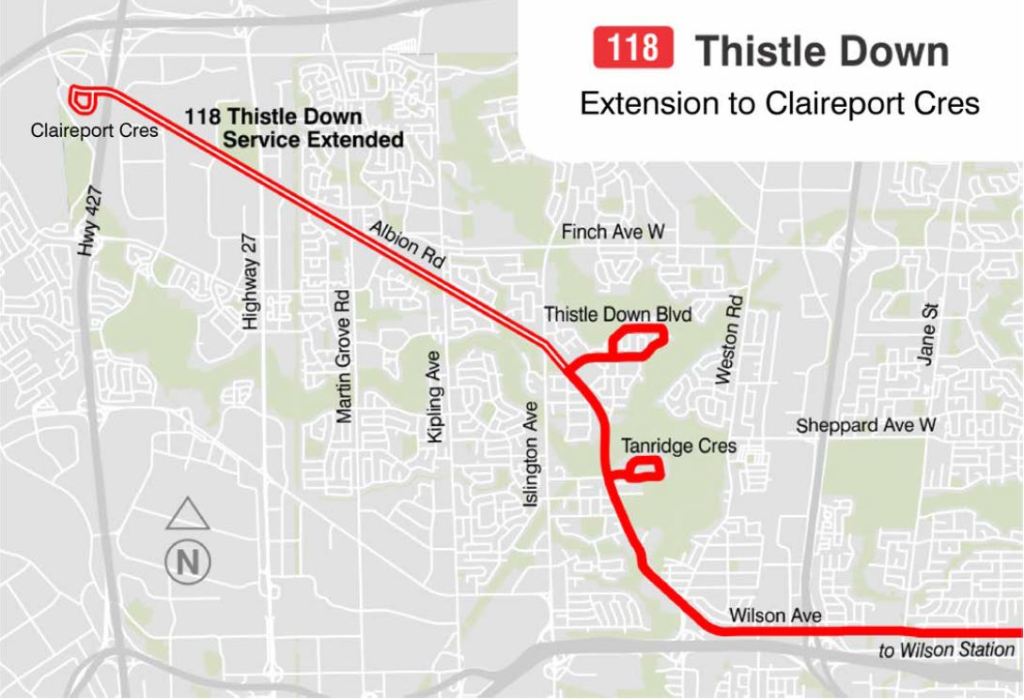
- The 118 Thistledown extension to Claireport & Albion and the 8 Broadview extension to Coxwell Station will occur later in the fall, date TBA.


With the completion of the Line 1 Automatic Train Control project later this year, the TTC will be able to improve service on the subway. However, just what this means depends on the base against which “improvement” is measured.
- There is a planned service improvement in September. Current service is not running at pre-pandemic levels, and we do not yet know if September will see a full restoration.
- ATC will provide two benefits: trains can run closer together, but also travel times can be trimmed to reduce the number of trains needed. The degree that each of these will show up in new schedules remains to be seen. A related problem is that more frequent service can compound with excess running time to worsen terminal approach queues driving up travel time for riders.
Overall system ridership was at 57 per cent of pre-pandemic levels in June 2022 and is expected to rise to 70 percent in the fall. The TTC is finalizing their fall service plan to accommodate some return to in person office travel and post secondary demand. They plan to restore services to post secondary schools that were cut because of online courses. Details TBA.
There is no announced date for the opening of Line 5 Crosstown by Metrolinx, and so the planned route restructuring to support that line will likely not occur in 2022.
Continue readingTTC Board Meeting, June 23, 2022
The TTC Board met on June 23 with a fairly modest agenda. This is the second last scheduled Board meeting before the October 2022 civic elections and, unless there is an emergency situation, the current Board will have little to do with transit’s future in Toronto.
This is an unfortunately typical situation in election years. By the time a new Board is in place to discuss key issues with the 2023 budget, fares, service levels and hoped-for subsidies, it will be a new Board presented with whatever plan management devises and with little chance for adjustment.
In a previous article, I wrote about the TTC’s funding crisis, a topic that receives almost no discussion at Board meetings. June 23 was no exception.
The major items on the agenda were:
- CEO’s Monthly Report
- Quarterly Financial Update
- 10-Year Fare Collection Outlook & Presentation
- Financial Statements for 2021
The Gaping Hole in TTC Funding
At the TTC Board Meeting on June 23, 2022, the quarterly financial update reviews the status of the 2022 operating and capital budgets together with the status of major capital projects. This report is one of the more valuable contributions to understanding the state of the TTC, certainly in more detail than the superficial CEO’s Report. But even at that, its concern is primarily with the current year.
For 2022 the TTC is not out of the woods on its operating budget and political efforts continue to “shake the tree” at the federal and provincial level for funding to make up the Covid deficit caused by running nearly full service with less than 60 per cent of historical ridership. To the degree that governments recognize that the country is still in a pandemic and provide backstop funding, the TTC can continue to appear close to normal to its riders. However, that level of support will not last forever and 2023 will bring hard decisions to Toronto Council about how much service they can afford to provide, and whether a continued freeze on fares is affordable.
Lurking out of sight is a much larger deficit in capital program support. Before the pandemic, the TTC published its capital plan including many, many items that had previously not been publicly disclosed or which were listed “below the line” in the budget as being without funding commitments from governments. The heart-stopping total was three times the level historically acknowledged as the TTC’s capital needs, and this did not include major new transit projects. Ontario took over some of the largest, but also inflated their cost with design decisions such as undergrounding the Eglinton Crosstown West Extension (ECWE). Meanwhile, the Eglinton East LRT to Malvern and the Waterfront East LRT do not show up on TTC’s books beyond a modest amount of design funding.
This chart from the 2022 Capital Budget shows the severity of the problem. In the short term, money is available from one-time, project-oriented subsidies. In the long term, funding depends on finding political support for transit spending at a much higher rate than in past years and largely on projects that do not involve system expansion.
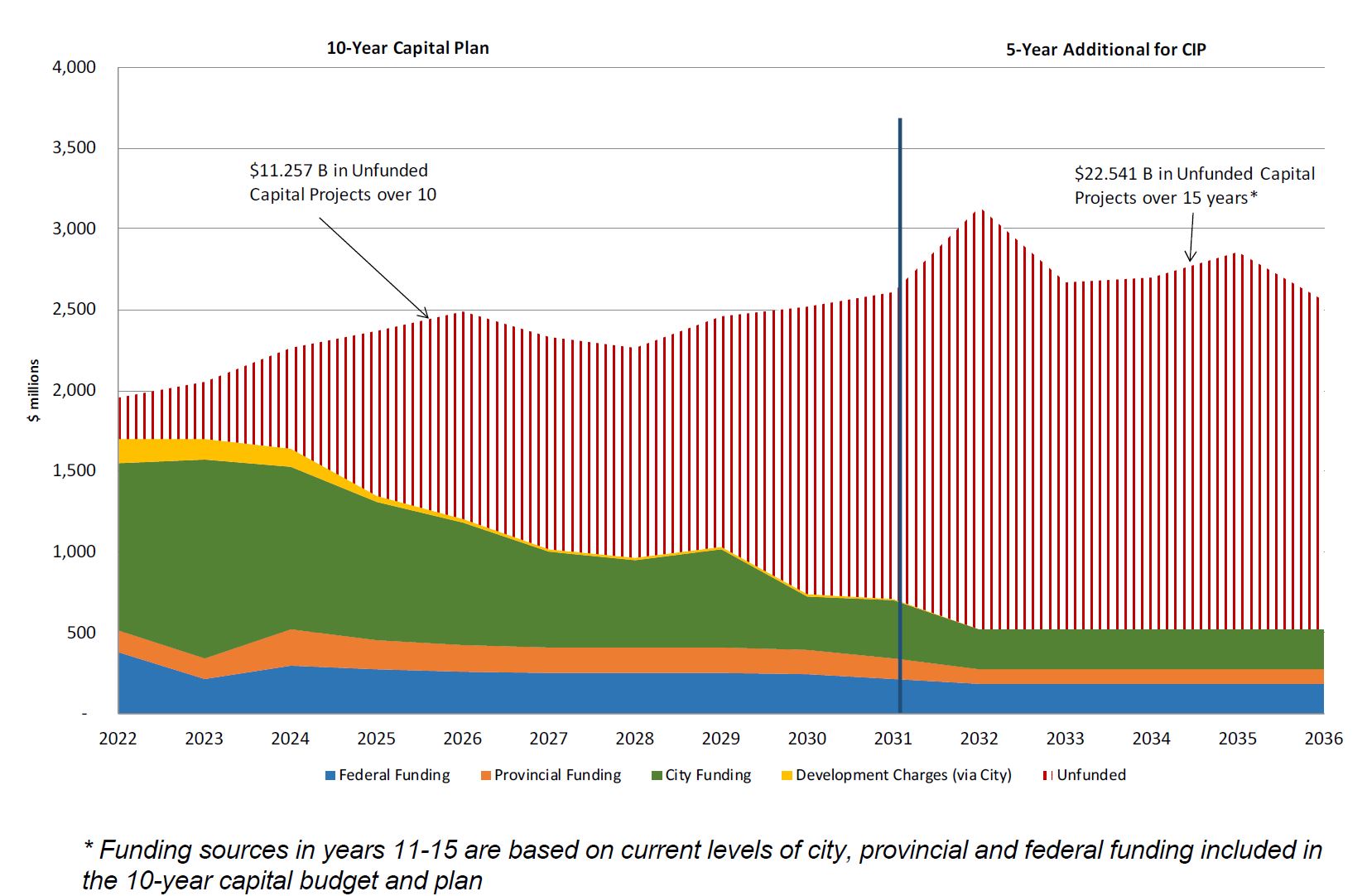
For many years, Toronto and the TTC have muddled through the Capital Budget cycle by scraping together enough money to fund near term requirements and hoping for a better tomorrow. Concurrently, the focus of transit debates has been on new builds, the “we deserve” school of transit planning, while funding for other projects is left for another debate. Two special levies, one implemented during Rob Ford’s mayoralty to fund the Scarborough Subway, and one under John Tory to fund other transit projects, placed an additional charge on the property tax base over and above the so-called inflationary increase. Tory’s City Building Fund is still not at its full level, and there will be little desire to add even more transit taxes in the medium term.
This problem is not unique to transit, and other calls for funding by various governments are obvious: housing, health care, education, just for starters. Transit neither gets nor deserves all of the pie. What we do not really know is how big that pie is, and when governments will say “enough”.
When the feds were handing out large transit subsidies both as a city building and economic stimulus, a question asked by some transit advocates and community groups was “why are you not imposing conditions on which projects are built” including environmental responsibility and overall transit needs. The response was simple: Toronto Council identified its priorities, that’s where the money is going and, by the way, do you really want the feds dictating which transit projects are funded?
There are many key projects without funding, and at some point the obvious response will be “but we already gave you billions” out of a national program that is shared across the country.
The TTC Board appears particularly unwilling to discuss these matters in public and is generally overwhelmed by the size and complexity of the budget. Once upon a time, the TTC had a Budget Committee that almost never met, and recent attempts to re-establish one were voted down by the Board. This is an abdication of responsibility for a core function.
Continue readingTTC Revamps “Transit Planning” Web Page
The Planning web page on the TTC site contained, until recently, some rather elderly files and reports. Updates were confined to the Scheduled Service Summaries posted about every six weeks.
This page has now been revised. All of the old files/links have been removed, and there is now current (2019-2021) ridership data at a route level.
For the convenience of readers looking for the old files, I have created a new page in the Reference section of this site (see the drop down menu at the top of the page). That section already contains a page for Scheduled Service Summaries going back many years.
TTC Service Changes Effective June 19, 2022
June 19 will bring the summer schedules on some routes, a return of streetcars at Broadview Station, and various minor changes scattered across the system.
Subway
There is no change in subway service.
Streetcars
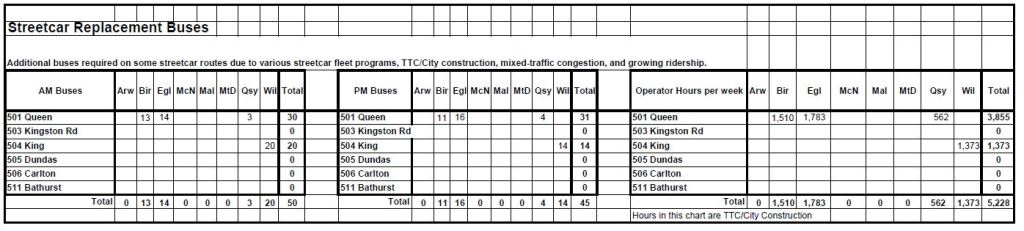
With the completion of watermain work on Broadview in May, the streetcar service to Broadview station on 504 King and 505 Dundas will return.
504A Distillery to Dufferin service will remain, but will be blended with the 504B from Broadview Station to Dufferin. The combined service on the two branches will be more frequent in almost all periods than the 504A service now operating.
The 504/505 shuttle bus from Broadview Station to Parliament will no longer operate.
505 Dundas service will operate between High Park Loop and Broadview Station on the same headways as are currently provided just to Broadview. Dundas cars will not return to Dundas West Station until later in the year following completion of new platforms and overhead.
The 504C King/Roncesvalles shuttle bus will return to Dundas West Station, but, like all bus routes there, will loop on street and stop on Edna Avenue (north side of the loop) while work inside the station continues. Other bus routes currently diverting to Dufferin and Lansdowne Stations will return to Dundas West at the same time.
Work on Phase 3 of the King Queen Queensway Roncesvalles project including the North Gate of Roncesvalles Carhouse will begin in September.
Carhouse allocations of 504 and 505 will change with additional 504 cars operating from Leslie, and some 505 cars shifting to Roncesvalles. Allocations will change in August when construction work begins at Russell Carhouse, and again in September with the Phase 3 KQQR work.
There will be seasonal service cuts on several routes:
- 503 Kingston Road AM Peak
- 505 Dundas AM Peak bus trippers removed
- 506 Carlton AM Peak bus trippers removed
- 511 Bathurst all periods
- 512 St. Clair almost all periods
See the spreadsheet linked later in this article for details.
From July 11 to August 1, 501L Queen and 301 Queen Night buses will divert westbound from Lake Shore via 15th, Birmingham and 22nd Streets during reconstruction of the intersection at Kipling. Eastbound service is not affected.
With overhead on the central section of Queen now converted for pantograph use, streetcars running between Leslie Barns and routes 510 Spadina and 512 St. Clair will operate via Queen west of the Don River rather than via King.
Buses
Routing Changes Due To Frequent CNE Closures
The following routes will be changed because streets in and near the CNE are often closed during the summer.
- 29 Dufferin will loop through Liberty Village via King, Strachan and East Liberty.
- 929 Dufferin will loop at Dufferin Loop.
- 174 Ontario Place/Exhibition will operate via Fleet, Fort York and Lake Shore for the southbound trip.
30 High Park and 189 Stockyards Interline
Buses on routes 30 and 189 will interline to better use the running time on the combined route.
A new 30B High Park service will operate from High Park Station to the park via West Road and Colborne Lodge Drive. This seasonal shuttle will run separately from buses on the combined 30/189 service.
Seasonal Changes
The following routes are affected by seasonal reductions in demand:
- 39/939 Finch East
- 102 Markham Road
- 905 Eglinton East Express
- 927 Highway 27 Express
Miscellaneous Changes
- 21C Brimley service to STC will be adjusted on Sundays.
- 44/944 Kipling South service will divert both ways around track construction work at Lake Shore from July 15 to August 1.
- 363 Ossington night service will return to Eglinton West Station Loop.
- 72 Pape service will be adjusted during all time periods for reliability.
- 86 Scarborough will have a trip added at 2:13 pm weekdays from Kennedy Station to fill a gap in the schedule.
- 118 Thistle Down service will be improved in peak periods.
- 134 Progress service will be adjusted on Saturdays.
- 172 Cherry service will continue to bypass the Distillery District due to road construction.
600 Run As Directed
The number of scheduled RAD buses has been reduced substantial on weekdays from 40 to 5 crews. On weekends there will be more RAD buses with 39, up from 25, on Saturdays, and 32, up from 21, on Sundays.
Mount Dennis will not have any RAD buses. Details of the crew allocation are in the spreadsheet below.
Detailed Tables of Service Changes
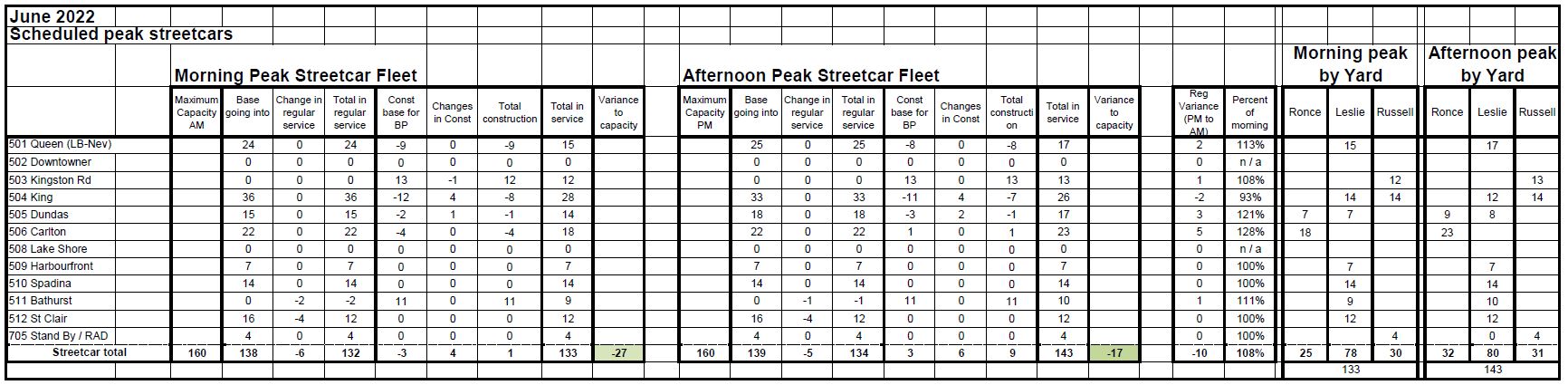
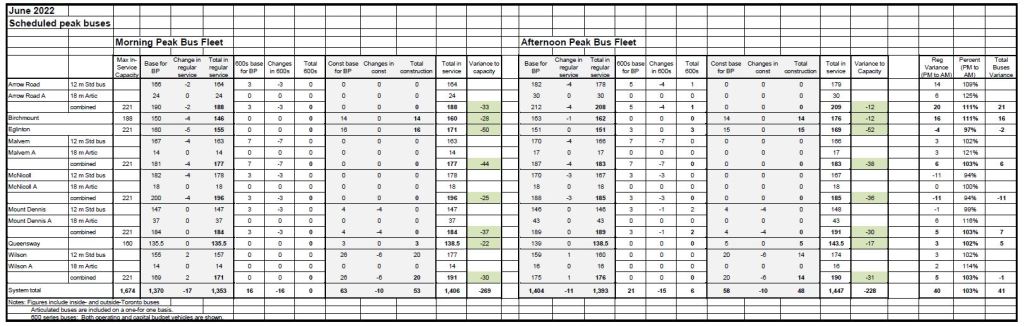
Peak Vehicle Usage
Evolution of Travel Times on RapidTO Bus Routes 2020-2022 (Part 2)
This article is a companion to Part 1 of my update of travel time behaviour on key routes for 2020-2022. That article dealt with routes east of Yonge Street, and this part turns to routes west of Yonge:
- 29 Dufferin from King to Wilson
- 35 Jane from Eglinton to Steeles
- 60 Steeles West from Finch Station to Kipling
These three routes show more variation over time than most of the routes east of Yonge reviewed in the first article. The greater variation implies that they are more sensitive to changes in overall road demand and have less headroom to begin with. They are more likely to benefit from priority measures, but taking road space for transit will be more politically challenging in car-oriented areas.
Any detailed study that purports to establish time savings through red lanes must be careful to be an apples-to-apples comparison avoiding projected savings against conditions (construction projects and future route changes) that will change on their own. Similarly, and by reference to what was done on the Eglinton-Kingston corridor, “savings” due to stop eliminations, if any, should not be counted as a “benefit” of transit priorty.
Continue readingEvolution of Travel Times on RapidTO Bus Routes 2020-2022 (Part 1)
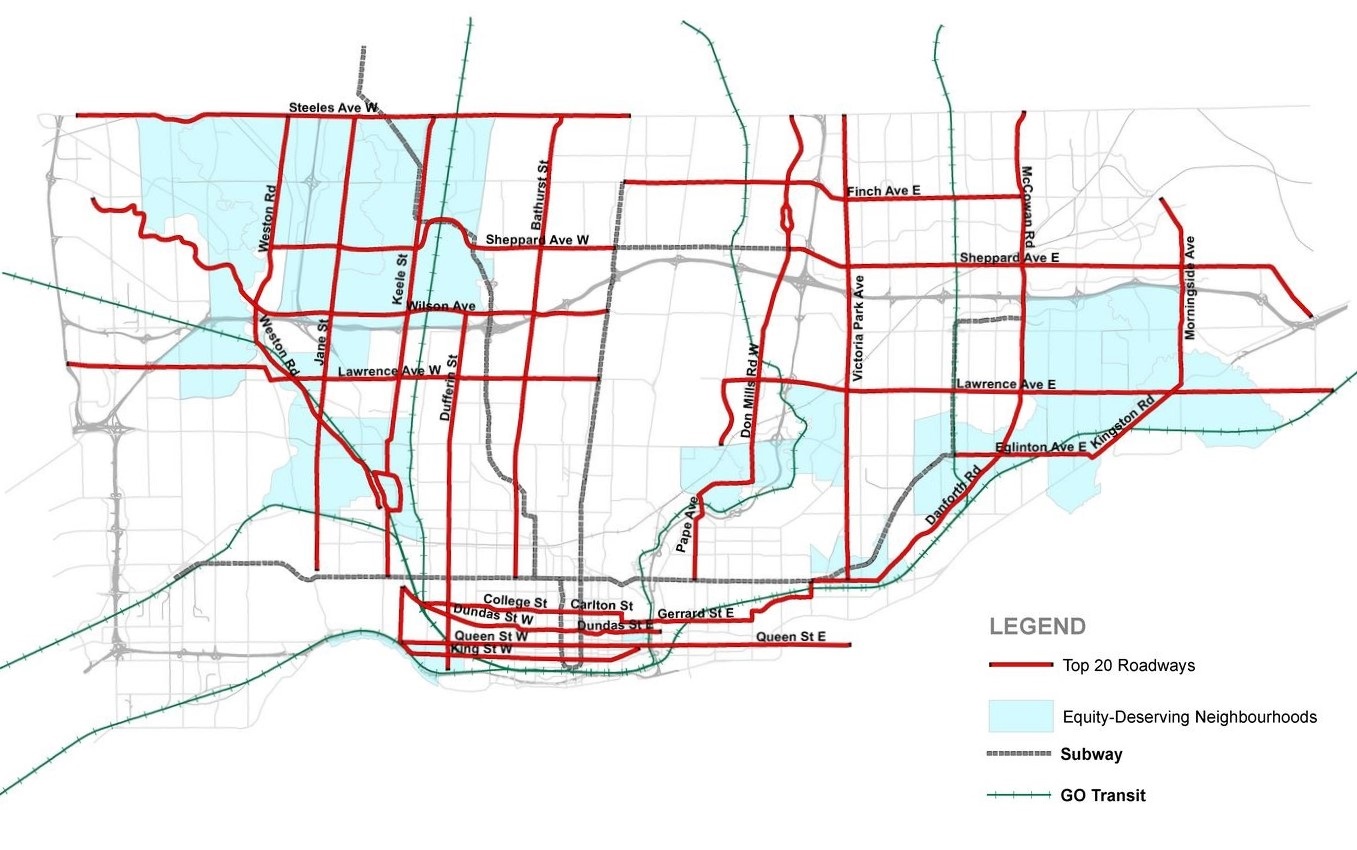
This article and one to follow is an update of an earlier review of the effect of pandemic-induced changes in traffic levels on the running time of buses. The target routes are those that already have “red lanes”, exclusive lanes for buses at all hours, and on the first group where red lanes were proposed.
Originally, the list of possible routes was shorter, and it is those routes whose vehicle tracking data I have collected over the past years:
- Eglinton-Kingston-Morningside (implemented fall 2020)
- Lawrence East
- Finch East
- Steeles West
- Dufferin
- Jane
A City study is underway to prioritize routes for detailed study and implementation under the RapidTO program.
An important premise behind RapidTO and bus priority is that service can be improved both because travel times are shorter and because they are more reliable leading to more regularly spaced and predictable service. Indeed, on the King Street transit project, the benefit was far more that variation in travel was reduced and reliability was increased, as opposed to reducing the average speed of travel under day-to-day conditions.
Too often, “priority” has been sold on the basis that it would reduce operating costs when the real goal should be to improve service with resources already in place, and to ensure that any additional buses or streetcars do not simply disappear into a “black hole” of unreliable service.
With the pandemic, we have an unexpected chance to see how much time is saved when traffic is, for a period, reduced from normal levels. This gives an indication of what we might expect from red lanes, or putting it another way, the best we are likely to achieve.
Continue readingService Levels May 2022 vs January 2020 (Revised)
Revised May 21, 2022: The original tables in this article were based on headway data that was rounded to minutes. This produced distortions in comparison of 2020 and 2022 service especially on routes with frequent service where rounding substantially altered values, proportionately.
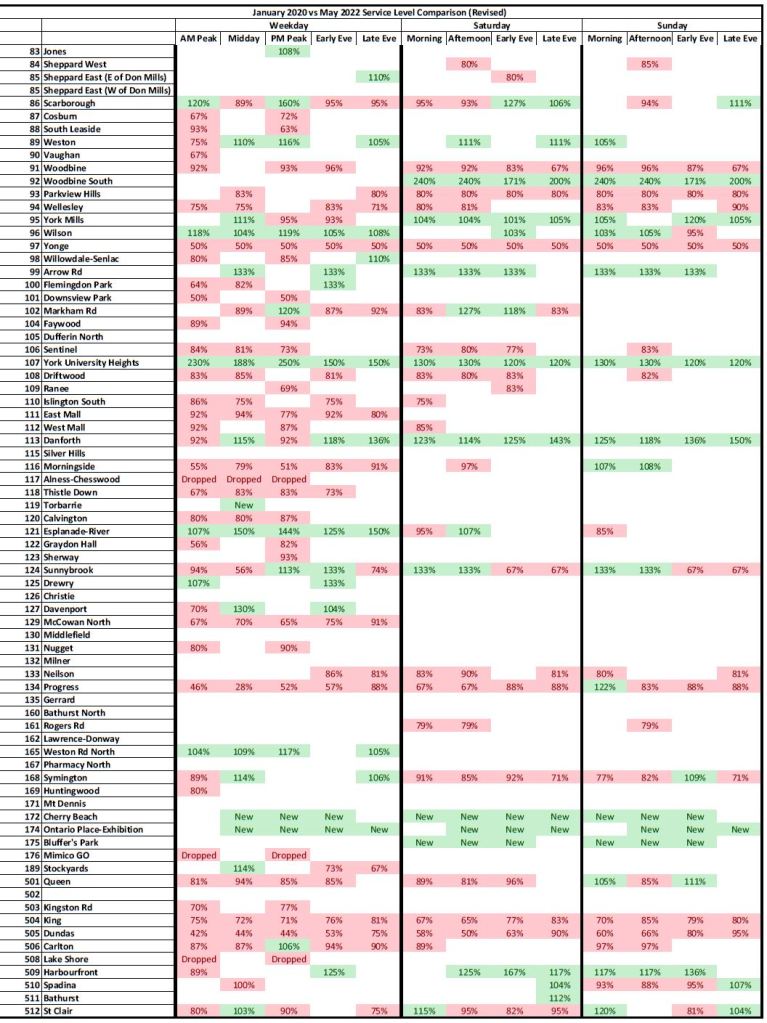
The TTC regularly reports that it is running service at “x” percent of pre-covid levels. They aim to be back at close to full service and 80% of pre-covid demand by the end of 2022 with hopes for 100% in 2023.
Like so much of the info TTC publishes, this is a system average, and the actual ratio of pre-pandemic to current-day service varies from route to route and by time of day.
The charts in this article map the ratio of old and new service by percentages, and by the change in scheduled headway (time between vehicles). The data are taken from the Scheduled Service Summaries published by the TTC.
For convenience these are available on my site:
The pages below (click to open in a larger format) show which time periods and routes are operating less service today than in January 2020 (red) or more (green). Cells that are white indicate that the service is unchanged.
The key point here is that there are routes operating with considerably less service compared to January 2020 than implied by TTC claims of service recovery. It is no surprise that riders on many routes complain of less frequent service. This is compounded by the TTC’s inability to operate reliable headways making waits for buses and streetcars both longer and less predictable.
In a few cases there have been vehicle type changes on a route such as the restoration of streetcar service on 505 Dundas. The percentages are relative to the scheduled vehicles per hour with no adjustment for capacity. Similarly, a few bus routes have changed between regular sized and articulated vehicles.
This set of charts shows the percentage change in service from January 2020 to May 2022. A table at the end lists the major route changes affecting headway comparisons.


The charts below show the difference in headways (in minutes) between January 2020 and May 2022. Negative values (red) indicate vehicles that arrive less frequently while positive ones (green) show more frequent service. For example, Line 1 Yonge-University now operates every 3’36” in the AM peak compared to 2″21″ pre-pandemic, a difference of 1’15”.


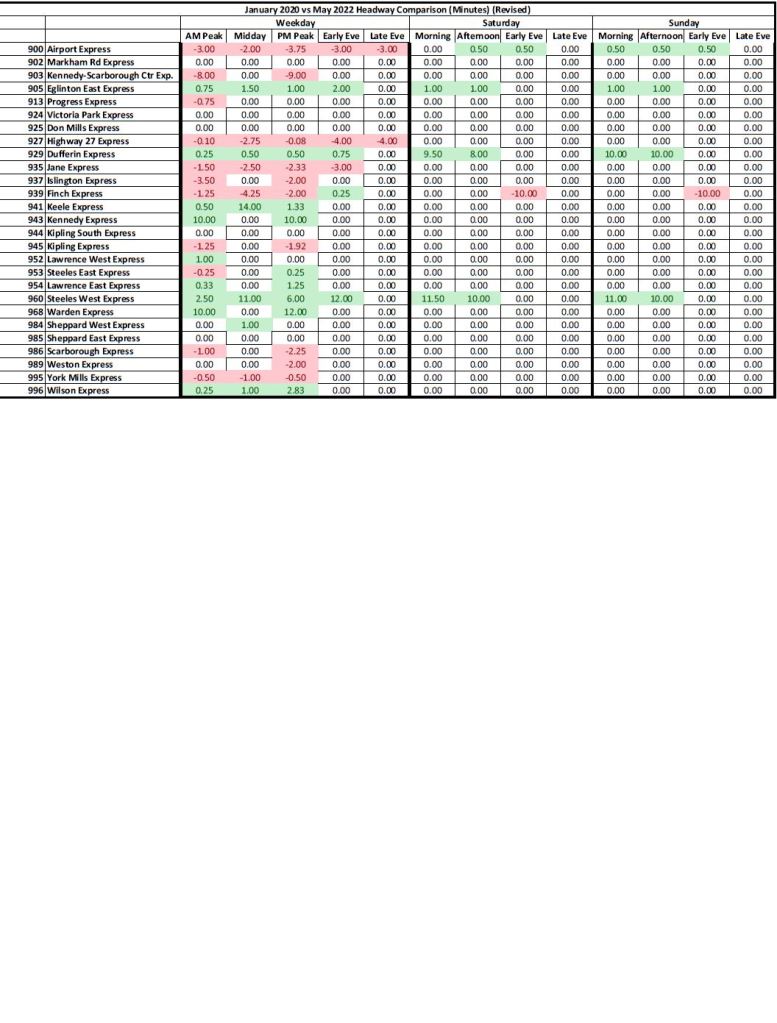
The full set of charts is available in this PDF.
 Steve Munro