
This installment completes Chapter 3 of the study with the evaluation of alternative signalling strategies. The recommented alternative is Automatic Train Control, no surprise there, based on the premise that it provides the maximum benefit versus the expenditure. Underlying this, however, is the goal of a 90-second headway and the increasing challenges to subway operations as the headway drops. ATC is treated as a means to achieve this dubious goal rather than a worthwhile move in its own right.
Subways
Yonge Subway Headway Study 1988 (Part 3)
This section presents considerations for the vehicle fleet and yards required to house these cars. An important consideration for any decrease in headway is that the number of trains in service goes up. This generates added capital and operating costs for an expenditure that addresses only peak period demand.
A proper comparison of lines would look at what happens if the fleet is expanded (regardless of the technology) elsewhere so that new off-peak service is available in a corridor that does not now have rapid transit.
As we will see later, the additional vehicles are a substantial portion of the total project cost for peak headway improvements on an existing line.
Yonge Subway Headway Study 1988 (Part 2)
This thread began with an introduction to the “problem” of capacity at Bloor-Yonge Station which dates back to the 1980s, an era when all expansion of capacity for travel from the suburbs to downtown was assumed to be on the subway network. If you accept that premise, then it follows that massive expansion of subway capacity is absolutely required. However, as we have recently seen from demand projections by Metrolinx, when there are good alternatives to the existing subway, people may find other ways to get downtown.
In this section, I will present another chunk from the long Chapter 3 in the TTC’s 1988 study. This part includes descriptions of four ways to achieve shorter headways on the Yonge line through signalling changes.
Yonge Subway Headway Study 1988 (Part 1)
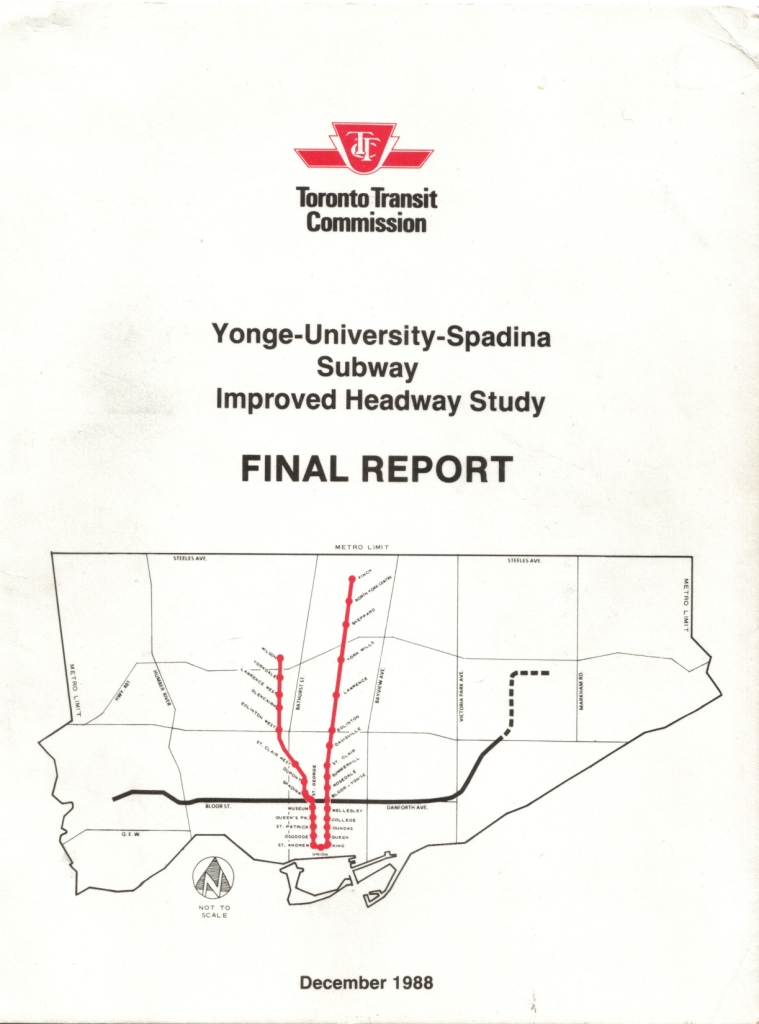 Recently, there has been a lot of discussion here about the practicality and desirability of adding capacity to the Yonge-University subway. My position is clear: there is more to be gained by adding new capacity in other corridors that can, in addition to relieving pressure on the Yonge line, provide alternatives in the transportation network to what now exists.
For twenty years, the focus has always been on beefing up the Yonge line, and this reflects the TTC’s long-standing tradition of looking only at their network when planning transit capacity. Earlier subway expansion schemes completely omitted the GO Transit network from calculating potential regional demand and modelled all growth in riding on the subway system. The effect of this shows up in the Network 2011 proposal that projected large increases in subway demand. Those increases triggered a study in 1988 of what could be done to add capacity to the Yonge line, and we are still living with some of the fallout from that study today.
When I dug the report out of my archives, I thought that I would only scan, edit and post a few chapters. However, I soon realized that the arguments of 20 years ago are worth reading today because they are instructive both for the basics of transit operations, and because they show the origins of some current thinking.
For convenience, I have chopped up the document into sections. The text, which was originally doublespaced typewriter (Courier) format, has been converted to single spaced Times Roman (yes, I know some of you just hate Times Roman). Some exhibits that didn’t lend themselves to text-based conversion have been scanned separately as jpegs.
The first installment (this post) contains chapter 2 and the first parts of chapter 3 of the Final Report (chapter 1 was the Executive Summary) dealing with the problem of projected congestion and the various ways in which signal changes could be used to reduce headways. In the next installments, we will see:
- detailed descriptions of four schemes for signalling changes to achieve closer headways
- a discussion of vehicle requirements
- conclusions and recommendations for signalling
- four schemes for a reconstructed Bloor-Yonge Station
- evaluation of impacts at other stations and terminals, notably Finch and Wilson
- options for the Yonge-Spadina loop
- final summary and recommendations
Chapter 4 (the Bloor Yonge schemes) contains useful material to those of you who have been, figuratively speaking, drawing lines on maps for the past few weeks with possible alignments for additional tracks. It helps to know the lay of the land both above and below ground.
Because we have already had quite a lot of discussion about routing alternatives, I will exercise my editorial prerogative to delete or severely cut repetitions of past discussions. The main reason I am putting this material up is to show what was actually considered and how the history of past studies like this colours future projects. That’s an important context for the current Regional Transportation Plan discussions — things that seem trivial today will take on the aura of historical received wisdom in less than a decade. Maps drawn on stone tablets are hard to change.
Transit City — The Movie
Today’s TTC meeting brought us an update on the various parts of the Transit City plan. You can read the full report yourself, and there is a quick review of the status of various lines and studies below.
Meanwhile, the TTC is starting a media campaign to tell people about Transit City and about LRT. You can watch the video on the TTC’s website. Although it is a breath of fresh air to see the TTC promoting LRT after all these years, there are a few oddities in this piece (the timings where they occur are included below).
- (0:39) “Work on Transiy City is already well underway.” Hmmm … a few traffic barriers does not make a construction project. I wonder why they don’t show the upheaval on St. Clair? Shortly later we see a new car mockup superimposed on the westbound stop at Yonge Street.
- (0:55) “What is Light Rail Transit?” We learn that LRT is used around the world including, wait for it, in Vancouver! Er, ah, there’s a heritage streetcar line running with a former BC Electric interurban car, but no LRT. This is a howling error. Other cities shown on the world map are many fewer than the actual inventory.
- (1:15) “LRT can operate in a street, but has the flexibility to operate underground like a subway.” LRT advocates will be amused to hear that their chosen mode has the “flexibility” to be just like a subway, when the real issue is the inflexibility and cost of 100% grade separated modes.
- (1:50) Light rail is bigger than standard streetcars, and allows level boarding from platforms. It’s nice to hear how LRT is a streetcar, but not a streetcar.
- (2:10) LRT cars don’t need loops! Amazing what you can do with modern technology. See also Kennedy Station Loop.
- (2:20) All door loading … but wait .. it’s a subway car!
- (2:38) LRT will be separated from the effects of traffic congestion, not to mention pesky “transit priority” signals if the animation can be believed.
- (3:32) Streetscaping. Aside from the gigantic, fast-growing trees (maybe they’re from Vancouver too), note the typical suburban layout with wide setbacks of buildings from the street. Contrast this with later illustrations of dense suburban redevelopment.
- (4:05) Transit will be an even better travel alternative. With a new subway train? What’s that doing here?
The map of projects reflects the original Transit City announcement because many possible changes are still under study by both TTC and Metrolinx.
Transit City project updates follow the break.
A Slightly Less Grand Plan
Ontario’s Finance Minister, Dwight Duncan, yesterday announced that the province will run a half-billion dollar deficit thanks to the international financial upheavals and declining economic outlook. In this context, I spent the day at a Metrolinx “stakeholders’ meeting” where we discussed details of the Draft Regional Transportation Plan and Investment Strategy. The whole discussion has a surreal air because nobody is quite sure where the billions to pay for this plan will come from.
There is reasonable agreement about the need for better transit, but much suspicion of whether this plan will join its predecessors on library shelves.
In the informal post-meeting chats, I was asked what I would do if the promissed $11.6-billion MoveOntario money didn’t materialize, if we had to cut back the scope of the “top priority” projects to fit a tighter budget. This is too big an issue for a short chat, and it deserves a post of its own.
Any budgetary cutback discussion must first consider whether to make the “death of 1000 cuts” or to look hard at big ticket items. If you need to defer or cut spending, there is more money to be found in large projects than small ones, but we may skip reviews of smaller items that really don’t belong at the top of the pile.
A major problem lies in the dearth of information Metrolinx has published about the detailed performance projections and roles of each component in the plan. We have demand forecasts only for year 2031 where the combined effect of future job and population growth interact with a completed network. The published data show only peak point counts, not the demands for each network link. There is no way to understand which links are cost-effective, and there is no data for intermediate states (such as after the “first 15” are built) to show whether they are an appropriate use of whatever resources might be available.
Metrolinx must publish this information as soon as possible. Meaningful discussions of cutbacks are impossible without it.
This brings me to the “Business Case Analyses” that are in progress already for some of these lines. These analyses are proceeding in the old, worn-out style of looking at each project individually rather than collections of projects for their combined effect on the network. From the 2031 projections, we can see that the regional express rail lines and other new major elements have a big impact on demand on the existing network. Notably, the forecast overload of the subway system doesn’t materialize because there are other high-capacity lines where the demand can flow.
Meanwhile, the TTC’s report on the north Yonge extension to Richmond Hill raises an old, hare-brained scheme to add a third platform at Bloor-Yonge station for increased capacity. I won’t go into a detailed discussion here beyond saying that this is horrendously complex and expensive, but at least the TTC finally recognizes that subway capacity involves more than new signalling and more trains.
The real question, however, is whether the money would be better spent on alternate services to divert riding with new options for travel to the core area. Should some projects — the Richmond Hill regional express and/or the east leg of the Downtown Relief subway — be moved up as alternatives or as key pre-requisites? That’s the kind of comparative analysis Metrolinx and the TTC are not doing, but should.
Next we come to project phasing. Do we really need a line all the way to Richmond Hill? Is there a shorter “phase I” that will have significant benefits without the cost of the full line? Analysis on an all-or-nothing basis doesn’t give us staging options.
We need to be open about “the untouchables”, the projects with political clout that soak up billions of dollars because someone wants to see them built. There is no point in talking about fiscal restraint if billions in proposed spending can’t be reviewed. A related question is how that “top 15” list came into existence in the first place.
Some time ago, the Metrolinx Board approved this grab-bag as likely top candidates that should be analyzed in more detail. However, that analysis isn’t even started for many of them, and there is every possibility that the analyses may show that some projects don’t pull their weight, at least in the short term. I may be splitting hairs, but that “top 15” has gone from candidates for early study to the definitive list of first projects without benefit of formal approval. If we are to have a spending review, we must stop assuming that this list has the force of detailed review and blessing.
Oddly, it’s almost an afterthought in the Draft RTP — Metrolinx doesn’t even include a map showing the network with only these lines completed.
The subway to Vaughan is a special case. There is supposed to be a trust fund holding the funding from Queen’s Park, Ottawa, York Region and Toronto. Is this money really sitting in a bank somewhere? Does the provincial share come out of the $11.6-billion MoveOntario pot? Can we step back and ask questions about why this line is so important? For starters, someone has to reconcile demand projections in York Region’s own EA that would make the Sheppard subway look busy with the impetus to build this line. Metrolinx does not break out the section north of Steeles as a separate project, and the published demand for the line gives only the peak point value (likely just north of Downsview Station).
The TTC is already studying alternatives to the SRT including LRT conversion of the existing line. The original recommendation to keep Skytrain technology only made sense for a line that remained at its existing length or had a short extension. The further north it goes (Markham is a mooted destination), the less practical and more expensive Skytrain is relative to LRT. Keeping the RT was a bad recommendation skewed by a desire to preserve Bombardier’s showcase technology, and we cannot afford to avoid this debate.
On the Sheppard/Finch corridor, current thinking is headed toward an eastward extension of the Finch LRT to Don Mills (where it would connect to the Don Mills line) and a westward extension of the subway to Downsview. These may be viable projects in the long term, but we have to consider them separately from the original Transit City proposals. Indeed, the Don Mills LRT isn’t even in the “top 15”, and there isn’t much point building the Finch line east of Yonge until it has something to connect with.
At Finch Station, there are big problems with the bus terminal and with the design of a future LRT interchange. What happens if the subway extension gets underway and much of the bus operation shifts north?
On Eglinton, a line whose projected peak ridership is similar to both of the subway extensions, but whose extent provides rapid transit service to a far larger area, we are faced with an expensive central tunneled section that cannot be avoided. Indeed, the size of this project requires that it be started sooner rather than later so that its benefits as a key part of the overall network can be available.
In the Don Mills corridor, should the DRL end at Danforth or continue north to Eglinton with a major transit hub linking the Eglinton and Don Mills LRT lines to the DRL subway? This won’t be part of the “top 15” list, but the Don Mills Transit City study would make a lot more sense if the TTC stopped trying to shoehorn an LRT right-of-way into Pape or Broadview. That scheme (and related alignments) are holdovers from the days when this was a BRT study, and this nonsense has to stop.
On the Weston/Brampton rail corridor, why do we persist with the fantasy of the Toronto Air Rail Link (TARL, formerly called “Blue 22”) that will chew up track space for a premium fare service on the same route as a proposed regional express service to Brampton? How much does the private sector-proponent of the line hope to make from this service? Can they be bought off? Is it cheaper to not build Blue 22 and devote the resources to upgrading GO in the same corridor?
What are the possibilities for the CPR North Toronto Subdivision? What options do we have for cross-region service via this corridor especially as an alternative way for riders from the north-east to get into the city without using the RT/subway network? Negotiating with CPR won’t be easy, but doing nothing may condemn us to building rapid transit capacity elsewhere we might not actually require.
If there is a common thread in all of this, it’s a simple message: Metrolinx started off designing a network, and they must not lose sight of the network view of any solutions. Look at revisions to the plan as a whole, look at where the benefits are greatest in the short term so that we spend what money is available on projects that will show real improvements for transit.
Toronto has decades of making wrong, expensive choices, and transit suffers a well-deserved reputation as an “also ran” thanks to those decisions. Provincial belt-tightening is just the opportunity we need to focus on what really works, on what we really need.
TTC’s October Supplementary Agenda
The supplementary agenda for this month has now been posted, and it contains some reports of interest.
At this point, I am only posting links here for information, but will comment on these after the meeting on October 23.
Queen Car Update: No route changes at this time. Continue attempts to improve line management.
Clean Subway Stations! Vintage Tiles!
The October TTC agenda includes a report on the Subway Station Appearance Improvement program.
Things are proceeding, but slowly. One major change will come in stations that have/had ceiling slats over the track areas. These are hard to clean, and it is simpler to remove them and spray paint the ceiling black. A similar approach was taken on the walls of Union Station.
There is some irony in this tactic. Originally, the ceilings were bare plaster, but this made for noisy stations. Next came sound-absorbing foam, but it quickly turned dark thanks to the ever-present dust in the subway environment. What to do? Cover the foam with slats. Now we have come almost full circle.
Where slats covered station ceilings, they will be removed to provide easy access to all of the conduits hiding underneath. This will bring on a minimalist look in many locations. Probably we could paint all of those conduits beautiful colours, but a few millions would be needed (via charitable donations of course) to grease the wheels, hire a prominent architect to select the paint chips, and then give us a half-finished project. Nobody would think much about maintenance, but there would be a nice photo op.
Speaking of Museum Station, a similar tactic for the outside walls will be installed as a trial at St. Andrew. An ilustration within the report (page 10) shows the process of removing the old slats. What do we have underneath? The original vitrolite tiles! Catch them while you can!
Lest I appear to be unfairly carping about the TTC’s ability to look good while saving money, I must applaud the basic housecleaning practices they are using and hope that they will remain and improve, not fall victim to budget cuts. However, we seem to be moving in the direction of dulling already functional, but not beautiful, stations down to a level of poverty. As a temporary measure, this may do, but for the future, especially for new and rebuilt stations, we need to do better.
Some Day My Train Will Come (Updated)
Over the past week, I have spent a lot of time in Dundas Station what with the AMC theatre being a major venue for the Film Festival and the location of the principal box office.
On opening night, September 4, the “Next Train” information was up and running on the One Stop video monitors. Alas, by closing night, September 13, all we got was a black band with “No Information Available”.
As those who’ve been reading here for a while know, I am not impressed by technological tricks, especially when they are of dubious value and don’t work reliably. There’s probably some very good reason for the system’s failure, and this is part of the 90-day pilot, but I can’t help wondering whether the TTC will be any better at keeping information systems running than escalators.
The full rollout of One Stop monitors is supposed to be completed, along with the in-station “Next Bus” info screens, by the end of 2009. This brings me to one huge problem with One Stop: It’s an advertising medium, and it is located to be seen by the most people, up to a point. Many stations (including the one right under TTC head office) still have Metrons, some with working displays advertising for that same kennel near the Airport. Donlands may even have a full set of working displays, and the ones at Museum were carefully preserved until days before the station redecorations were unveilled.
At Yonge Station, the monitors are far enough apart that the “Next Train” info, were it present, would be illegible to half the waiting passengers, and Yonge has more than one monitor per direction. The problem, of course, is that if signs are intended to offer information, there have to be lots of them and this runs headlong into the design issue of overwhelming stations with video screens.
Speaking of Museum, the white columns are starting to look dirty, and there has been at least one naked lady (at least a classical reference) sketched on a column. This sort of thing is endemic on the TTC. Projects start but never finish. Things are built but not maintained.
During the whole 9 days the displays at Dundas actually worked, I didn’t experience a delay to see whether they gave accurate info, or resolutely showed the same estimated time for 10 minutes running while the next train sat somewhere down the line. I didn’t get to see a display with any value higher than 3 minutes, and have no idea of how reliably the system will deal with service holds and gaps. We shall see, once they get it working again. Any other observations of the displays’ behaviour would be appreciated.
Updated Sept 14: I have been advised that different versions of the “next train” software will be tested and that the display will be out of service from time to time. All the same, it bears watching to see how reliably available and accurate the information will be.
The Psychology of Free Parking
Over the past week, since the TTC proposed, then approved, the elimination of free parking for Metropass holders, I have been amazed by the volume of comments on this blog, other sites and in feedback in the mainstream media on this subject.
Parking is something dear to the hearts of motorists, and taking away free parking seems to be on a par with kidnapping a firstborn child.
Several people commenting on my site have claimed that getting rid of free parking at TTC or at GO lots will drive people (sorry about that) into commuting all the way downtown even if they have to pay for parking. There is a long comment by Andrew currently at the end of the thread comparing the costs and time required for various types of trip (all car, part transit, paid and unpaid parking). The viewpoint embedded in his calculations mirrors that of many who write about the need for free parking. Continue reading

