GO/RER Details Emerge in Business Case Analysis

Metrolinx has published a set of documents containing the “Initial Business Case” for the GO Transit Regional Express Rail (GO/RER) network.

Updated Dec. 13, 2022: Due to a reorganization of Metrolinx’ site, the reports are no longer available there. However, I have archived copies of them. The Summary and Full Report links below are to my site. The Appendices are not yet available as I must break them into chunks small enough that WordPress will allow them to be uploaded.

  • Summary
  • Full Report
  • Appendices A-J
    • A: Corridor Specifications
    • B: Corridor and System Schematics
    • C: Model Assumptions and Results
    • D: Record of Assumptions – Direct Demand Model
    • E: Financial Performance of RER Systems
    • F: Sensitivity Analysis
    • G: Wider Economic Benefits
    • H: Line Speed Analysis
    • I: Environmental Assessment Program
    • J: Fare Structure Issues and Solutions
  • Appendix K:  Station Access Analysis

[Note that except for the Summary, the documents are large PDFs.]

This article begins a review of these documents and of the various RER proposals examined in the Metrolinx studies.

Overview

Work on this review of GO/RER began in April 2014 following the announcement by Queen’s Park of its commitment to the RER concept. Unlike previous reports, this study looks in depth at all of the GO corridors, and reviews the technical issues associated with both increased service and electrification. This is not a final review, and much engineering work remains to be done, but there is a great deal more information now publicly available as the basis for discussions.

These documents were completed sometime in 2015 as is clear from references to future events that will occur later in the year, notably reports from the City of Toronto on SmartTrack. That scheme gets only passing mention, some of it the usual political cover story, because the specifics had yet to be decided. Exactly what the incremental effect of ST will be beyond the proposed GO/RER configuration is not yet known. Preliminary information in City reports implies that ST will amount to considerably less than was foreseen by the Tory election campaign, possibly as little as a few more stations and some sort of TTC/GO fare integration.

Five scenarios were reviewed to compare the effects, benefits, costs and technical issues associated with various possible future networks.

  1. The “Do Minimum” scenario provides only marginal peak period improvements to the existing system in response to projected demand growth, but with no electrification. This is effectively a “business as usual” model for the base case.
  2. The “Two-Way All-Day” scenario expands off peak service, but with diesel operation and no electrification. This is a minimal level of service expansion.
  3. The “10-Year Plan” would provide frequent service on the inner parts of some corridors, but with limited electrification.
  4. The “Full Build” extends beyond the 10-Year Plan to provide frequent service on the inner parts of all corridors, and with full electrification.
  5. The “10-Year Plan Optimized” extends the scope of electrification beyond that contemplated in scenario 3.

This progression implies a certain sequence of events during the study where a full build is impractical and the original 10-year plan was not aggressive enough with electrification, a key component of the announced government direction.

The estimated capital costs rise from $5 billion for scenario 1, through $10b, $12b and $19b for scenarios 2 to 4. The price tag for the latter is well above what Queen’s Park has available, and scenario 5 was developed with a projected cost of $13.5b. All but scenario 4 are said to be achievable by 2024. Given that it is now 2016, and this is a 10 year plan, that date probably requires some adjustment.

Scenario 5 is the 10-Year Plan Optimized, it represents significant progress towards implementing the service levels of Scenario 4. It goes beyond the investments and service included in Scenario 3 (10-Year Plan), with electrification also to Bramalea, Barrie, Stouffville and to Pearson Airport. This scenario and the resulting recommended RER program has been defined to maximize return on investment while mitigating risks. Depending on resolving various challenges, it can be delivered over 10 years for approximately $13.5 billion. It does not preclude, but rather prepares for, services to Milton and Kitchener to be eventually electrified and frequent all-day services introduced when agreement is reached on co-existence of GO and freight on these privately-owned corridors. [p. iv, Full Report]

Annual ridership is expected to go up by a factor of 2.5 over the coming 15 years, but operation costs will not rise at the same rate. The study postulates that an operating profit would be possible, eventually, but that will depend a lot on future fare policies, and on the evolution of trip patterns (length, direction, average fare). The ridership model foresees that “hundreds of thousands” of auto trips would be replaced by GO ridership each weekday comparing scenario 5 to scenario 1. The proportion of trips and its relationship to expected growth is not specified in the Executive Summary. (Possibly in the demand modelling later.)

The rate of demand increase on GO overall is projected at 2.3% which is lower than recent levels, but allows for some leveling off in a more mature service.

One big issue is the problem of getting riders physically to and from the GO trains. Either this will be done with substantially improved local transit services (an option that brings many issues associated with fare integration and cross-system subsidies), or with parking. The cost estimates include $750m for 15,000 new parking spaces, or $50k per space. At that scale, simply paving empty lots is not an option. The study notes the possibility that some of this cost “may not be necessary if service integration and fare integration with local transit services can be improved”. [p. v]

Those 15,000 spaces represent nowhere near the ratio of new parking spaces to existing facilities that the projected ridership growth would entail if everyone arrived by car. Parking charges are listed as a way of raising additional capital for the RER project, and of encouraging a shift to ride sharing and public transit feeder services.

It is amusing to read about the benefits of proven technology, something for which Ontario has not been noted in past endeavours.

Virtually all of the works are within existing rail corridors, so environmental and community impacts are limited mostly to noise and vibration. RER will use proven technology that is working around the world. [p. v]

Descriptions of RER cite similar operations in more than 50 city regions worldwide [page 6], and list a number of factors that simplify implementation [p. 4]. I cannot help thinking of how badly past studies have downplayed the benefits of LRT which bears a family resemblance, but at a local rather than a regional level.

The first electric railway opened in 1883 (the Volks Tourist Railway on the Brighton seafront in the U.K.). Ever since that time, electric traction has increasingly become the default source of power for the world’s more intensively used rail systems. [p. 14]

Finding this statement in a Metrolinx report is quite amusing considering some of the remarks made during community meetings on electrification before Metrolinx and GO “got religion” on the subject. The report skirts that debate by observing that GO is now at the threshold where electrification makes sense:

Until recently, diesel traction has been the appropriate mode of traction for the GO rail operation. However, the service enhancements envisaged in the near future will take GO rail beyond the threshold of service intensity appropriate for electrification. Continued use of diesel traction will become a source of financial and economic inefficiency. [p. 14]

Metrolinx intends to pursue discussions with the railways regarding the upgrades needed on their trackage, and also intends to review “modern, proven technology” with Transport Canada and the railways.

This is an “initial” analysis, and changes are likely depending on the evolution of expectations, changes in provincial funding, and who knows what political meddling that could arise.

A decade is a long time in politics, and the likelihood that the current governing parties or councillors will still be in place at that distant time is minuscule. Moreover, changes could come at any level part way through the project, and only a very strong, unshakeable commitment (i.e. very popular and difficult to derail) is likely to survive. This is not simply a case of showing up for a photo op or two with a gigantic prop cheque, but of supporting the plan for the long haul, including building a constituency that can survive beyond current governments. The arrival of a Ford-equivalent who simply wanted to start over with his own plan would be disastrous.

Continue reading →

Is Anything Left of SmartTrack?

In the City Planning report at Executive Committee on March 9, 2016, two options for the configuration of a “combined” SmartTrack and GO Transit/Regional Express Rail (RER) service remain on the table. These are referred to as Option C and Option D.

OptionC

OptionD

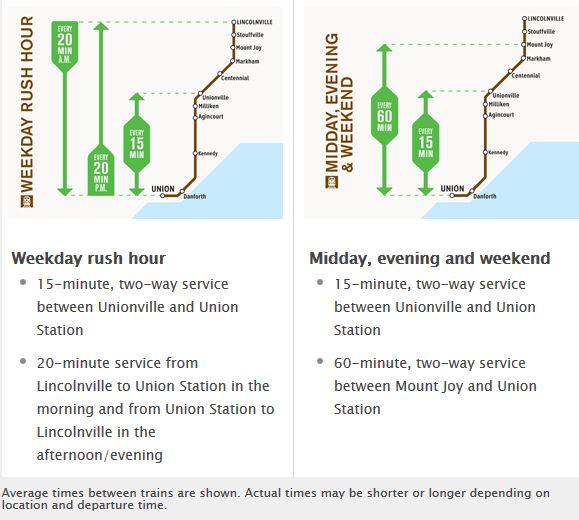
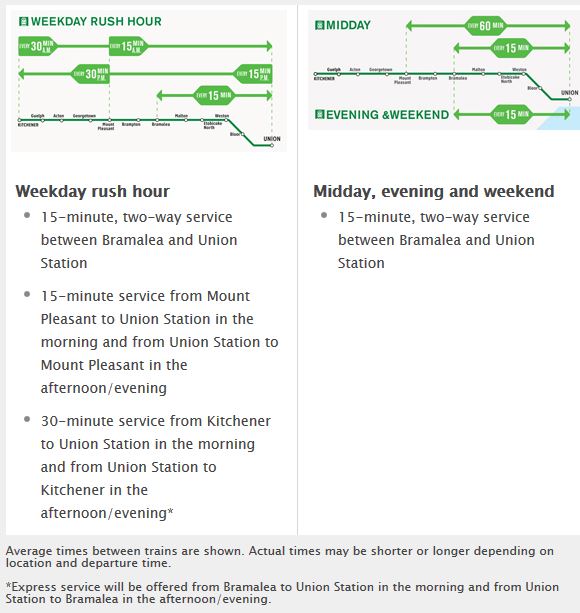
The number of trains/hour cited here has bothered me for some time, and a recent conversation with Jonathan Goldsbie of NOW Magazine got me digging a bit deeper. Here is the service plan for the Stouffville and Kitchener corridors as shown on the Metrolinx RER website, in the “How Will I Benefit” page.

GORER_StouffvilleService

Peak service on the Stouffville corridor totals 7 trains/hour or one every 8.6 minutes as shown in Options C and D.

GORER_KitchenerService

In the Kitchener corridor, there are 8 trains/hour, but two of these are service to Kitchener which would run express from Bramalea to Union leaving only 6 “local” trains in that segment.

The service levels and station plans have profound implications for the transit network now under study.

  • There is no distinct SmartTrack service, only GO trains and (maybe) a few new stations. There will be no “SmartTrack” branded fleet.
  • If TTC fares will be offered on SmartTrack, this will really consist of giving people cheaper rides on service GO is already operating.
  • If “Regional Fare Integration” means that TTC rapid transit (subway) fares rise and GO fares for short trips come down, then SmartTrack will be a cash grab from subway riders to cross-subsidize SmartTrack riders on GO trains.
  • Demand models for SmartTrack indicate that very frequent service at TTC fares is required to attract substantial ridership, with 12 trains/hour (one every 5′) performing best in the model runs. The proposed service is considerably less frequent. “TTC fares” implies full transfer rights at no premium to and from the TTC network.
  • The existence of frequent SmartTrack service and stations in Scarborough is an integral part of the plan to build the subway extension as a one-stop express route to the Town Centre.
  • Part of the justification for keeping the Relief Line alignment to the north along Queen Street rather than King is to avoid competition with SmartTrack. However, there won’t be any SmartTrack service for it to compete with, only GO trains.
  • Tax Increment Financing requires that SmartTrack contribute something to the uplift in property values that would not occur absent the new service. However, the “new” service will entirely be GO Transit’s, and it will occur whether anything called SmartTrack exists or not.

The obvious question here is “where is SmartTrack”? In fact, it has completely vanished from the map, and at best would be represented by a handful of new stations, none of which is in Scarborough in Option D.

Is this the master plan, the culmination of John Tory’s election campaign and all of the vitriol poured over his critics?

The emperor has no clothes.


GO Transit to Take Over UP Express

According to Oliver Moore in The Globe, the separate Metrolinx division responsible for the Union Pearson Express will be placed under GO Transit’s control. The fate of UPX President Kathy Haley is unclear.

UPX even managed to win awards from the Global AirRail Alliance for:

2015 Travelport Project of the Year – UP Express

2015 AccesRail Integrated Partnership of the Year – UP Express

2015 Personality of the Year – Kathy Haley, UP Express

2014 Air Rail Concept of the Year – UP Express: Strategic Partnerships, Toronto, Canada

2014 Travelport Project of the Year – UP Express: The Airport Connection

2013 Travelport Project of the Year – Union Pearson Express Project

One wonders who they were competing against, but the Alliance’s site does not list nominees, only winners. It is am impressive “project” that can rake in the hardware before ever carrying a passenger or proving its viability as a business. Such is the back-scratching nature of the industry, I must assume.

While it may be convenient to target Haley as the culprit here, the real question is how the structure and corporate attitude that led to UPX’ creation arose in the first place. From the beginning, this has been a project for which the word pretentious is almost inadequate. Despite the abandonment of this scheme by its original private sector proponent – for the simple reason that it was judged financially unsound – Ontario forged on with this as a signature project, part of the Bid Book for the Pan Am Games. We would show the world what Ontario could do.

Haley may take the fall for this fiasco, but she worked for a board who lapped up the praise, who bought into the flawed vision of what UPX would become. That board, and the government who set all of this in motion to begin with, owe us all an explanation.

When Is a GO Train not a GO Train? When It’s UPX!

Among the mysteries of the internal organization at Metrolinx is the presence of separate “divisions” for GO Transit (the commuter rail service), Presto (the fare card service) and UP Express (the premium fare airport shuttle service).  Rather than using the GO brand for the airport service and integrating its operation and fares, Metrolinx treats UPX as a completely separate entity, no doubt so that it could isolate the operation as a profit centre on the books. We now know that “profit” is the furthest thing from a UPX future where just finding riders now takes precedence.

Soon, fares on UPX will be much lower and this might encourage some to incorporate the UPX into their journeys. However, there are two glaring holes in the new arrangement.

UPX, being a separate operation, does not have fares integrated with connecting GO services at Union. Riders transferring between these services will pay separate fares for each leg of their journey. Presuming that UPX fares stay low, this should be corrected, at the latest, in the next annual review of GO’s tariff.

But the really bone-headed decision (or lack of decision) lies with the TTC. Although GO fares discourage “local” travel within the 416, there is a legal transfer move a rider can use called TTC Times Two. A trip can start on the TTC, transfer to GO, and then back onto the TTC again using the original TTC transfer.

With UPX moving to lower fares and the likelihood that it will attract commuter trade within the city, the question becomes “is TTC Times Two valid for UPX”? I asked the TTC’s Brad Ross and Chris Upfold this question at the recent TTC Board meeting. Their answer? “No” because (a) UPX is not a GO train and (b) a TTC policy change would be required.

The irony, of course, is that GO operates in the same corridor as UPX, and it would be impossible to distinguish whether a traveller with a transfer from the Lawrence 52 bus arrived at Union Station via GO or via UPX, except of course that GO service only runs in the peak period.

During the March 1 subway shutdown thanks to a power vault fire, TTC riders travelled on GO and UPX for no extra charge. The reverse courtesy has been extended to GO riders on occasion. This did not require a formal meeting and policy decision, simply the recognition that there is one transit network regardless of the logo on the train.

How riders get from one connection point to another should not matter. Between now and March 9 when the new UPX fares take effect, can someone at the TTC show a small spark of initiative and decide that a traveller on either a GO or UPX train can use TTC Times Two? Or will we continue to have an artificial distinction between two services provided on the same track by the same agency?

TTC Board Meeting Review: February 25, 2016

The TTC Board met on February 25, 2016. This article is a review of some of the reports and discussions at that meeting. For the full list, please refer to the agenda.

In this article:

As part of an update on cycling initiatives, the Board passed a motion asking staff to work together with the City on improved parking facilities for bicycles at subway stations. An article on this appeared on Torontoist’s website.

Continue reading →

A Rainbow of Rapid Transit

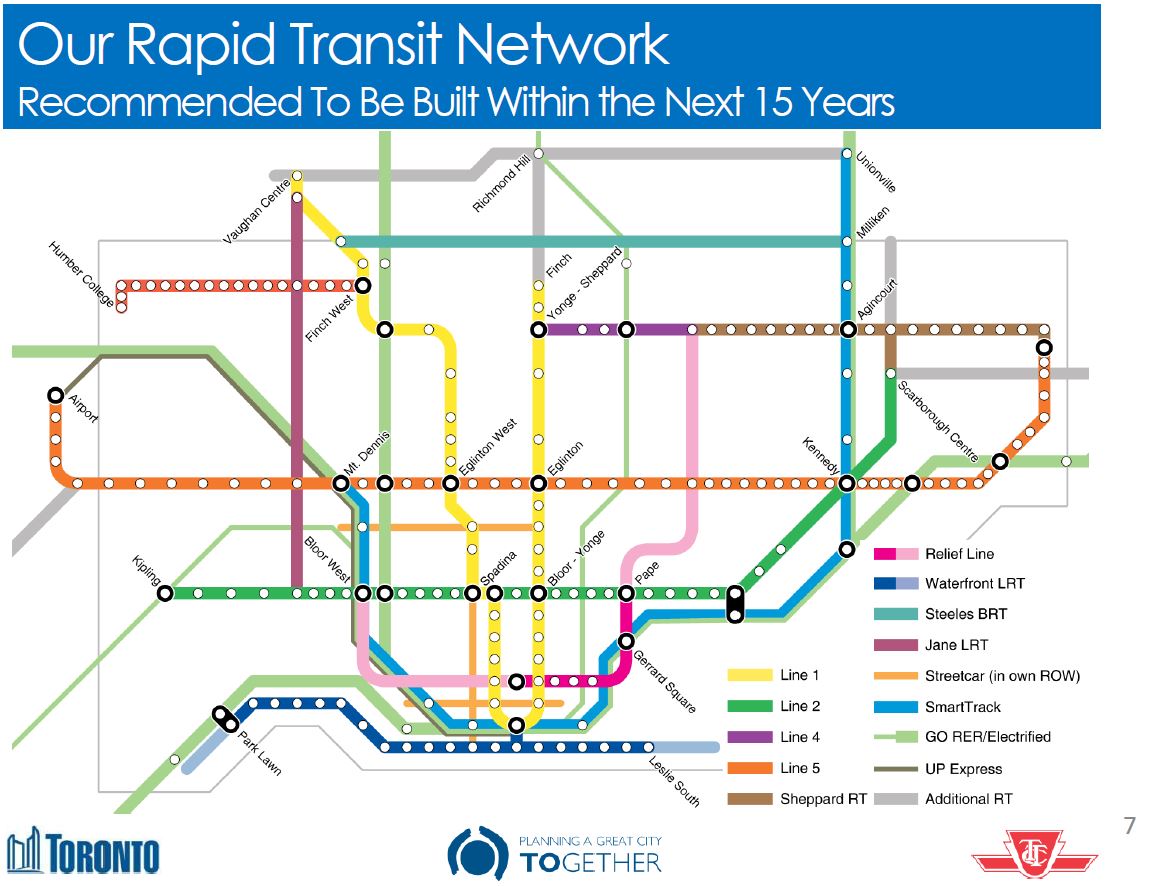
In Toronto’s never-ending fascination with new transit maps, the City Planning department has released a vision for our rapid transit network as it will be in 15 years.

201602_15YrPlan

Despite much talk of “evidence-based” planning, this is a very political map, and I cannot help remembering then-Premier David Peterson’s announcement of 1990 (not long before he lost an election and Bob Rae wound up as his much-surprised replacement) that amounted to a chicken-in-every-pot map.

There is nothing wrong with network-based planning, and indeed I have been beating a well-worn drum on that subject for years. But let us also remember that the Scarborough Subway exists because of the political clout of Brad Duguid, a former City Councillor, now Ontario’s Minister of Economic Development. Mayor John Tory, in Toronto Life, cites Duguid as saying that “if anyone tries to cancel the [Scarborough] subway, they’ll do it over his dead body”. “Evidence” apparently includes having a large cudgel to keep wandering pols in line.

The map also includes the Mayor’s pet project, SmartTrack, and it’s no wonder that he steers clear of the Minister’s position given the need for a provincial agency, Metrolinx, to accommodate SmartTrack on their network.

All of this is part of the “Motherlode” of public consultation sessions now running in various places around the City, and through Metrolinx in the wider GTHA. Background information and links to related material are available at Toronto’s TransitTO web site.

Continue reading →

How Will SmartTrack and GO/RER Co-exist?

Metrolinx has published an update on studies of how the proposed SmartTrack service will be integrated with its own GO/RER (Regional Express Rail) offering. This will be considered at their board meeting on February 10.

This covers several issues, and begins to nail down just what SmartTrack might, or might not, resemble that is beyond the scale of postcard election literature. As we already know, major changes are planned to the western leg where the Crosstown West LRT will take over the function proposed for SmartTrack beyond Mt. Dennis. To the east, SmartTrack remains in the GO Stouffville corridor, but the Scarborough Subway Extension (SSE) has been scaled back to a one-stop line serving only the Town Centre, and the Crosstown East LRT will provide service to eastern Scarborough.

What is GO RER?

WhatIsRER

This graphic is amusing for its complete contrast with the way that Metrolinx/GO presented electrification of their services during early days of public consultation. That hit a low point when it was suggested that electric trains might not work in snow.

Note that the official line now is that lots of cities use this type of service, and that electrification is an integral part of the package.

Metrolinx owes us all an apology for their initial foot-dragging and misinformation campaign. Now if only they had been more supportive of LRT during the dark days of Rob Ford.

Continue reading →

Metrolinx Fare Integration: Get Ready to Pay More For Subway Trips

One of the great mysteries surrounding the roll out of Presto on the TTC has been the whole debate about “Regional Fare Integration”. Now and then, discussion papers surface at Metrolinx, but folks at the TTC, especially the politicians, are strangely silent on the subject. “Wait and see” is the order of the day.

Well, folks, we have waited and now we are beginning to see the direction Metrolinx is heading in for a consolidated GTHA-wide fare structure. The results will not please folks in suburban Toronto or the inner 905 for whom long subway trips are a routine part of their commutes.

The Metrolinx Board will consider an update on this subject at its meeting on February 10.

The presentation is in a sadly familiar Metrolinx format: lots of wonderful talk about consultation and fairness, and philosophical musings about what a fare system should look like. One big omission is any evaluation of the relative numbers of riders who would be affected by various schemes, and even worse of any sense of calibration of the fares to produce different results.

This comes at a time when we know from SmartTrack demand studies the importance of fare levels in attracting ridership. It is important here to remember that we are not talking the relatively small differences between types of TTC fares, or year-by-year increments, but the much larger deltas between TTC fares and those on GO Transit.

The problem begins with the arbitrary segmentation of the travel market into “local”, “rapid transit” and “regional transit”.

201602_DefiningServiceTypes

This is a wonderful theoretical view of the world that might find a home in a sophomoric academic paper, but it ignores the very real world in which (a) “rapid transit” today only exists within Toronto and (b) Toronto decided over 40 years ago that “local” trips paid one fare regardless of the mode they used. The entire system is designed on this principle, one that has consistently evaded Metrolinx planners.

If only the world were so simple. Why is Bus Rapid Transit omitted from this list? Why is a streetcar (aka LRT) on right of way “rapid transit”, but not a bus? How close must subway or LRT stops be to each other for the service to drop back to a lower tier? Conversely, if someone slaps a “19x” route number on a bus, should it become “rapid transit”?

The basic problem with this world view is that transit modes, especially bus and streetcar/LRT, have a wide range of overlapping implementations.

Continue reading →

GO Transit Electrification Study Public Meetings

Metrolinx has announced a series of meetings for public participation in the TPAP (streamlined Environmental Assessment for Transit Projects) for their GO Rail Network Electrification Study.

Four of these overlap with sessions previously announced by City Planning for other projects under review:

  • Tuesday February 16: John Vanier school in Scarborough
  • Wednesday February 24: Metro Toronto Convention Centre in downtown Toronto
  • Wednesday March 9: Lakeshore Collegiate in Etobicoke
  • Tuesday March 22: Nelson Mandela Park school in Toronto

The area of this study covers only the trackage already owned by Ontario through Metrolinx.

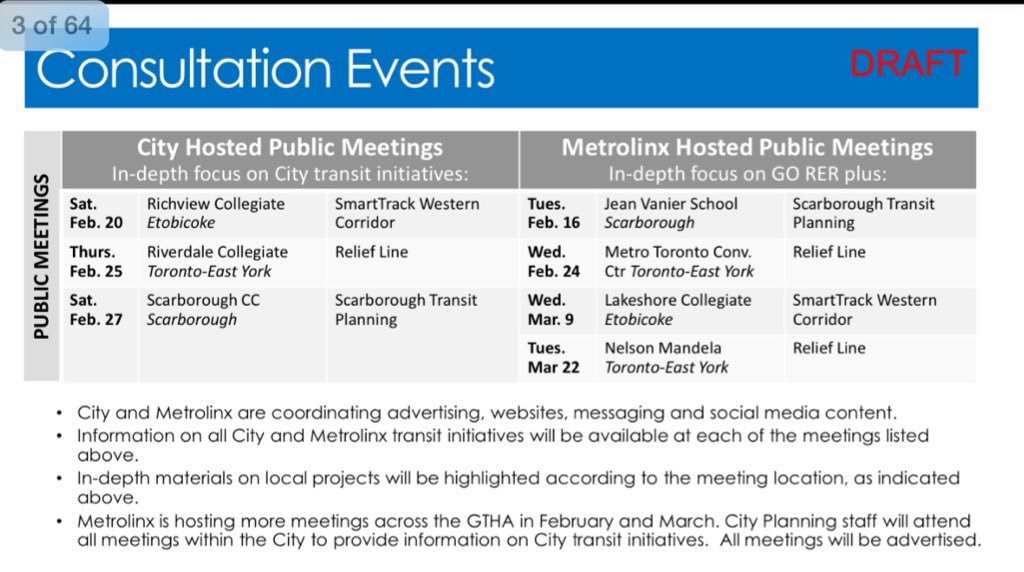
Relief Line, SmartTrack, GO/RER, Scarborough Subway Consultations

Toronto City Planning has released a draft list of upcoming public consultations on various transit plans including:

  • The Relief Line
  • The Scarborough Transit Plan (Subway, SmartTrack, Crosstown East LRT)
  • The Western SmartTrack Plan (SmartTrack, Crosstown West LRT)

2016_ConsultationCalendar

Additional meetings and information about Metrolinx plans (GO Regional Express Rail) will be organized by that agency.

Even more information will be available in March 2016 when the City releases a compendium report on all transit initiatives currently under study. These will include items listed above as well as the “Waterfront Reset” study, TTC Fare Integration proposals and a review of how (or if) Tax Increment Financing can contribute to the many transit projects under review. The intent is that this report will form the basis for public consultation and debate leading to recommendations at Council in June 2016. This is a very aggressive schedule, and there is no indication how consensus will actually be achieved in so short a time, especially with the usually-secretive Metrolinx as an essential player. At least the discussion will be at a network level, not ward-by-ward with a “relief” line for every member of Council, and there will be some filtering of various schemes based on engineering and operational realities.

What is sadly missing from all of this is a discussion of day-to-day transit operations and the backlog in the state-of-good-repair budget. We can blithely discuss billions worth of subway building to Scarborough and a Relief line, but Council won’t fund the basics of running a transit system.