Metrolinx Safety Deep Dive: Union Station Derailment

Recently, Metrolinx released a “Deep Dive” report into a derailment at Union Station that severely disrupted GO Transit operations.

As public Metrolinx documents go, this one is refreshingly candid about the events of February 2, 2026, although there are issues not mentioned that deserve both further study and public review.

In brief, a GO train was leaving Union Station westbound when a wheel on the last coach of the train derailed on out-of-gauge track. This affected both the coach and the locomotive which was at the rear (east end) of the train with the engineer in a cab car at the front (west end). The derailment was noticed by a passing UPX train whose crew sounded an emergency alarm, and the GO train stopped shortly thereafter.

Many issues were revealed by the subsequent investigation, and some bear an uncanny resemblance to the TTC’s investigation of its own SRT derailment in July 2023.

The severity of underlying problems with inspection and maintenance on GO’s Union Station Corridor were downplayed at a recent Board meeting by CEO Michael Lindsay who, in best Metrolinx tradition, put as positive a spin on the incident as possible. Only those who read the full report or the detailed media coverage based on it would know the full story. None of the Metrolinx Board members, a group who can be counted on for silence or only the softest of softball question, raised any issues in the public meeting.

An important finding in the report was that although Metrolinx had updated and tightened its standards for track fastening, there was no program to review existing infrastructure nor to bring it up to the new standard. Only if track were undergoing significant maintenance or renewal would the new standards kick in.

A further problem lies with inspection protocols that could detect the type of failure that led to the derailment. Most of this work is done by manual inspection, is repetitive, and problems with track fastenings might not be immediately obvious especially under the snowy conditions in early February. A post-incident review of the USRC (Union Station Rail Corridor) found a large number of similar failures in track fastening, almost one quarter of the areas checked. This is obviously not a problem that developed overnight or after one snow storm. Moreover, the report is silent on a review of the full GO network for compliance with current track standards.

The TTC parallel shows up first in their review of the SRT which revealed previously undetected failures similar to the one at the TTC’s derailment site where loose track fasteners went undetected. In turn this led to greater attention to subway track conditions and public reporting of Restricted Speed Zones (RSZs) that have bedeviled subway operation in past years.

Both the TTC and Metrolinx derailments raise serious questions about the integrity, accuracy and frequency of track inspections and corrective maintenance.

Another section of the report deals with the post-incident response and handling of complex needs for train and station operations, passenger information, and co-ordination of the entire process through various parts of the Metrolinx/GO organization. Processes that were adequate for day-to-day failed under the stress of many concurrent, urgent activities and the need for communication both among bodies responsible for various parts of the operation, and with passengers who needed to know where and when their trains would show up.

Because most of Metrolinx service operates on provincially-owned track, the Transportation Safety Board of Canada was not involved in this review, although they were notified of the incident.

Causes and Recommendations

There is a long section summarizing the causes, findings and recommendations of this report on pp 46-51 which I leave to readers to peruse rather than copying all of that text here.

Among the actions already taken are:

  • Bi-annual inspections of the USRC.
  • Autonomous track geometry testing technology to be operational in January 2027.
  • A $15-million program to address track surface conditions and make localized repairs in the USRC.
  • Additional Metrolinx Track Inspectors have been hired.

Several additional recommendations are in the report [p. 50].

Every Metrolinx meeting begins with a “Safety Moment”, but one cannot help asking how strong a connection to safety exists between this pro forma exercise and actual conditions on the ground. The response to this derailment showed a strong desire by staff to support passengers even, at times, in the face of inadequate supporting command and communication structures. However the derailment itself should not have occurred, and the question remains of just how strong a safety culture extends down to maintenance of critical infrastructure.

Continue reading
Are You Riding the TTC More, But If Not, Why Not?

Liaison Strategies published a poll today, September 9, conducted for their Toronto Pulse Series and the Toronto Star. The questions concern mainly the coming mayoral election, and these have been covered in the mainstream media. However, there are four questions about TTC usage that make interesting reading considering how much transit policies are discussed (or not) in various circles.

The questions are:

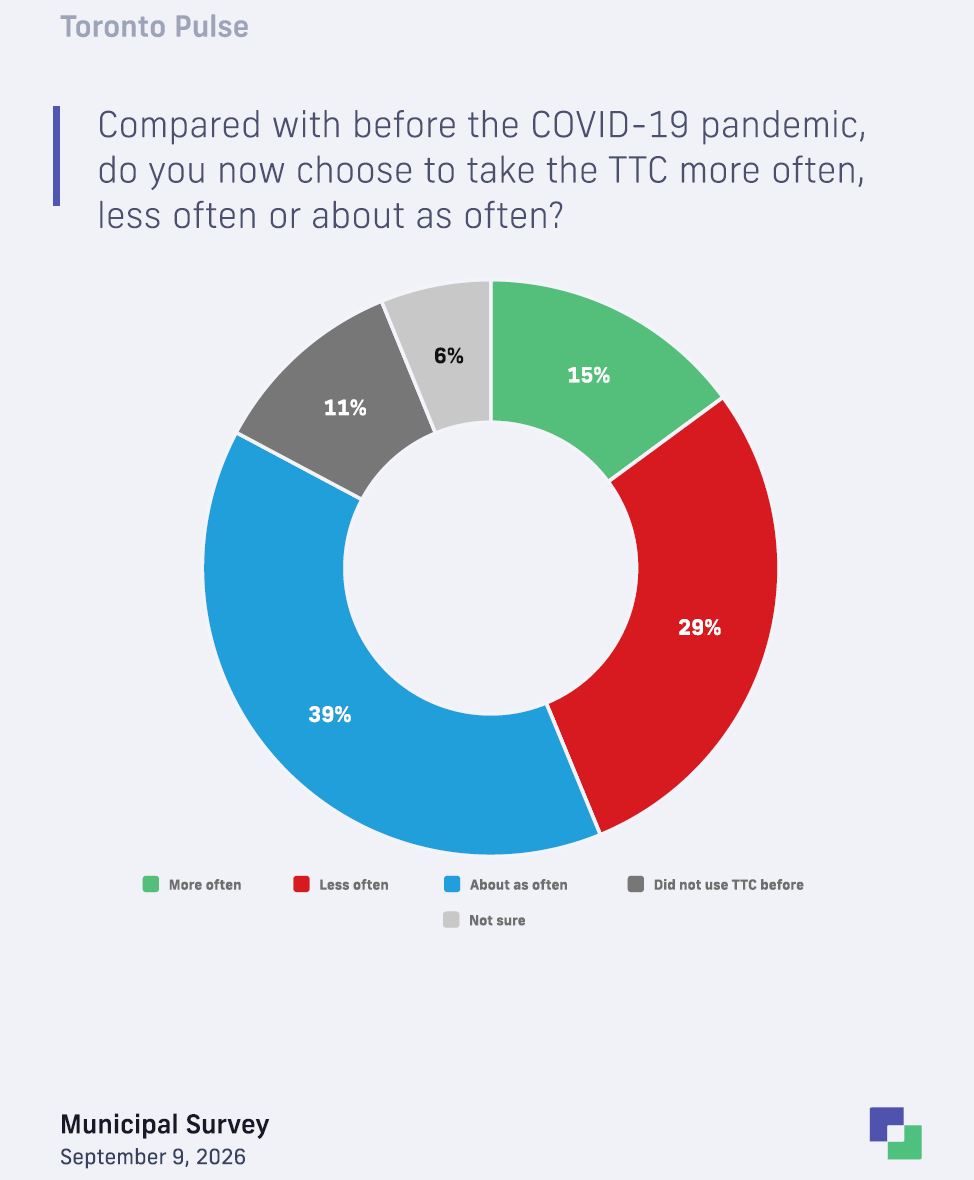
  • Compared with before the COVID-19 pandemic, do you now choose to take the TTC more often, less often or about as often?
  • For those who cite “less often”:
    • What is the main reason you choose the TTC less often than you did before the pandemic?
    • What do you now use most often instead of the TTC for trips you previously made by transit?
  • What one of the following would be most likely to encourage you to choose the TTC more often?

The high level numbers are discouraging for transit advocates. Although 39% ride TTC about the same as before, 29% say less often while only 15% say more often. The remaining 17% are split between non-TTC users and “not sure”.

The detailed breakdown of these groups shows interesting differences across the city, but to a much lower extent by age and sex.

Unsurprisingly, the “more often” group is concentrated downtown with 27% of responses coming from there. The numbers drop off in the suburbs with 13% in North York, 11% in Etobicoke, and 9% in Scarborough.

Conversely, the “less often” group is 33% in Scarborough, 29% in North York, 28% in Etobicoke and 24% downtown.

The “About as often” numbers have a smaller range from 36% in Etobicoke to 41% in Scarborough.

The non-TTC-riders pre-pandemic were highest in Etobicoke at 19% and lowest downtown at 6%.

The details of why riders have left the TTC, and how both ex-riders and those still on the system can be encouraged to ride more follow in the long version of this article.

Overwhelmingly, riders (past and present) want better service — a combination of frequency, reliability and speed.

Better service usually means more vehicles and drivers, not to mention line management and a culture that values reliability. Transit priority has to be real, not something at selected locations when enough traffic wardens are free to wrangle motorists, pedestrians and cyclists who make up their own rules.

These cost serious money and step on political toes. Toronto Council has a dream of massively improved transit service, but no sense of how it would be implemented nor any plan for the necessary fleet, infrastructure and staff needed to ramp up service. Meanwhile we celebrate multi-billion dollar lines on maps in media events and election campaigns.

The TTC had a Strategic Planning Committee for the past few years, but it did not spend much time on real “strategy”, certainly not on options that might bring riders back to the TTC. Everyone seems afraid to talk about any policy that has a cost, and some penny-pinchers think every problem can be solved with belt-tightening. Exactly what is needed and possible is never debated nor presented for public discussion. Toronto bumbles from year to year with minimal changes most riders cannot see in their daily travels.

This survey and others like it from past years should be a wake-up call to Toronto that service matters, and Toronto politicians should explain just how much they will fight to improve the TTC beyond the status quo.

Continue reading

TTC Service Changes Effective September 30, 2026 — Scarborough Busway Opens

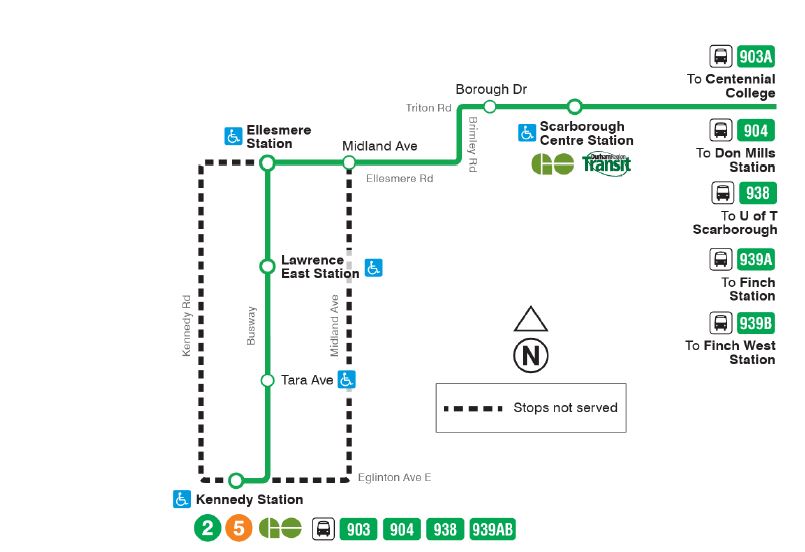
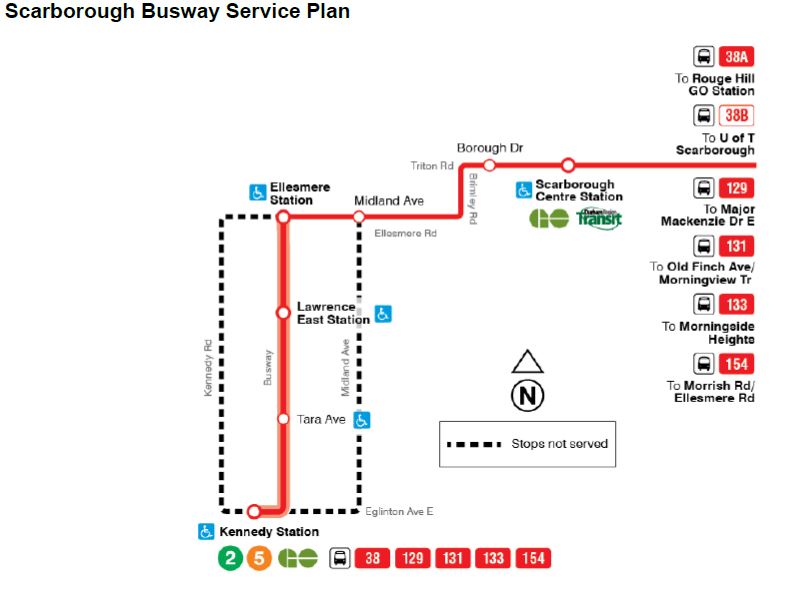
The Scarborough busway using the former Line 3 Scarborough RT right-of-way will open on September 30. Most routes now using Midland and Kennedy to reach Kennedy Station will switch to the new busway. Affected routes are 38 Highland Creek, 129 McCowan North, 131 Nugget, 133 Neilson, 154 Curran Hall, 903 Kennedy Stn-Scarborough Express, 904 Sheppard-Kennedy Express, 938 Highland Creek Express & 939 Finch Express.

Buses will stop enroute at the former Ellesmere and Lawrence East stations, as well as a new stop at Tara Avenue midway between Lawrence and Eglinton.

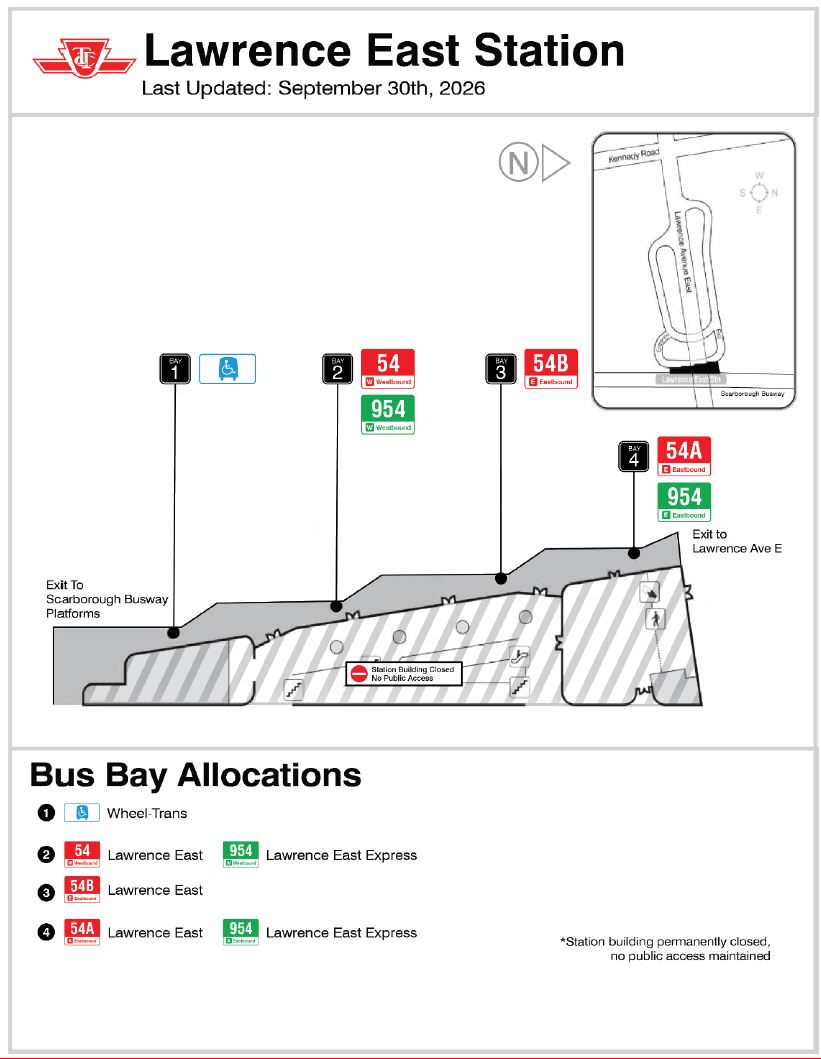
Lawrence East Station will also be served by the 54/954 Lawrence East bus services as shown below. The station building will not be open, but riders can transfer via a walkway at the south end of the platform to the busway station.

Scheduled service levels and travel times remain the same on September 30 because this is a mid-board period change. The next board period with an opportunity for changes begins on Sunday, November 1, 2026. The TTC has not yet announced plans for schedule updates to take advantage of faster travel times on the busway.

I have been collecting tracking data on some routes using Midland and Kennedy for historical comparison, and will review actual operations in November once the October data are available.

TTC Service Changes Effective Sunday, September 6, 2026 (Part II)

This article deals with the main batch of September 6 changes including:

  • Seasonal service changes
  • Warden Station construction
  • Routing changes at Kennedy Station
  • New services
  • Modified bus diversion for College/Carlton construction

Also included are various tables showing vehicle allocations, the service budget, and construction projects.

Detailed before-and-after service plan comparisons as well as destination sign changes are now available at the end of the article.

Continue reading