
Recently, Metrolinx released a “Deep Dive” report into a derailment at Union Station that severely disrupted GO Transit operations.
As public Metrolinx documents go, this one is refreshingly candid about the events of February 2, 2026, although there are issues not mentioned that deserve both further study and public review.
In brief, a GO train was leaving Union Station westbound when a wheel on the last coach of the train derailed on out-of-gauge track. This affected both the coach and the locomotive which was at the rear (east end) of the train with the engineer in a cab car at the front (west end). The derailment was noticed by a passing UPX train whose crew sounded an emergency alarm, and the GO train stopped shortly thereafter.
Many issues were revealed by the subsequent investigation, and some bear an uncanny resemblance to the TTC’s investigation of its own SRT derailment in July 2023.
The severity of underlying problems with inspection and maintenance on GO’s Union Station Corridor were downplayed at a recent Board meeting by CEO Michael Lindsay who, in best Metrolinx tradition, put as positive a spin on the incident as possible. Only those who read the full report or the detailed media coverage based on it would know the full story. None of the Metrolinx Board members, a group who can be counted on for silence or only the softest of softball question, raised any issues in the public meeting.
An important finding in the report was that although Metrolinx had updated and tightened its standards for track fastening, there was no program to review existing infrastructure nor to bring it up to the new standard. Only if track were undergoing significant maintenance or renewal would the new standards kick in.
A further problem lies with inspection protocols that could detect the type of failure that led to the derailment. Most of this work is done by manual inspection, is repetitive, and problems with track fastenings might not be immediately obvious especially under the snowy conditions in early February. A post-incident review of the USRC (Union Station Rail Corridor) found a large number of similar failures in track fastening, almost one quarter of the areas checked. This is obviously not a problem that developed overnight or after one snow storm. Moreover, the report is silent on a review of the full GO network for compliance with current track standards.
The TTC parallel shows up first in their review of the SRT which revealed previously undetected failures similar to the one at the TTC’s derailment site where loose track fasteners went undetected. In turn this led to greater attention to subway track conditions and public reporting of Restricted Speed Zones (RSZs) that have bedeviled subway operation in past years.
Both the TTC and Metrolinx derailments raise serious questions about the integrity, accuracy and frequency of track inspections and corrective maintenance.
Another section of the report deals with the post-incident response and handling of complex needs for train and station operations, passenger information, and co-ordination of the entire process through various parts of the Metrolinx/GO organization. Processes that were adequate for day-to-day failed under the stress of many concurrent, urgent activities and the need for communication both among bodies responsible for various parts of the operation, and with passengers who needed to know where and when their trains would show up.
Because most of Metrolinx service operates on provincially-owned track, the Transportation Safety Board of Canada was not involved in this review, although they were notified of the incident.
Causes and Recommendations
There is a long section summarizing the causes, findings and recommendations of this report on pp 46-51 which I leave to readers to peruse rather than copying all of that text here.
Among the actions already taken are:
- Bi-annual inspections of the USRC.
- Autonomous track geometry testing technology to be operational in January 2027.
- A $15-million program to address track surface conditions and make localized repairs in the USRC.
- Additional Metrolinx Track Inspectors have been hired.
Several additional recommendations are in the report [p. 50].
Every Metrolinx meeting begins with a “Safety Moment”, but one cannot help asking how strong a connection to safety exists between this pro forma exercise and actual conditions on the ground. The response to this derailment showed a strong desire by staff to support passengers even, at times, in the face of inadequate supporting command and communication structures. However the derailment itself should not have occurred, and the question remains of just how strong a safety culture extends down to maintenance of critical infrastructure.
The Derailment
On February 2, 2026, GO train 3009 consisting of a cab car, 11 coaches and a locomotive, left Union Station at about 8:05 westbound to Bramalea. [The locomotive was in “push” mode, and was controlled from the cab car at the west end of the train.] It was operating on track A1 (see photo and map below), but the rear truck of the last coach derailed on wide-gauge track and cause that truck and the locomotive to follow track A2 at a switch.
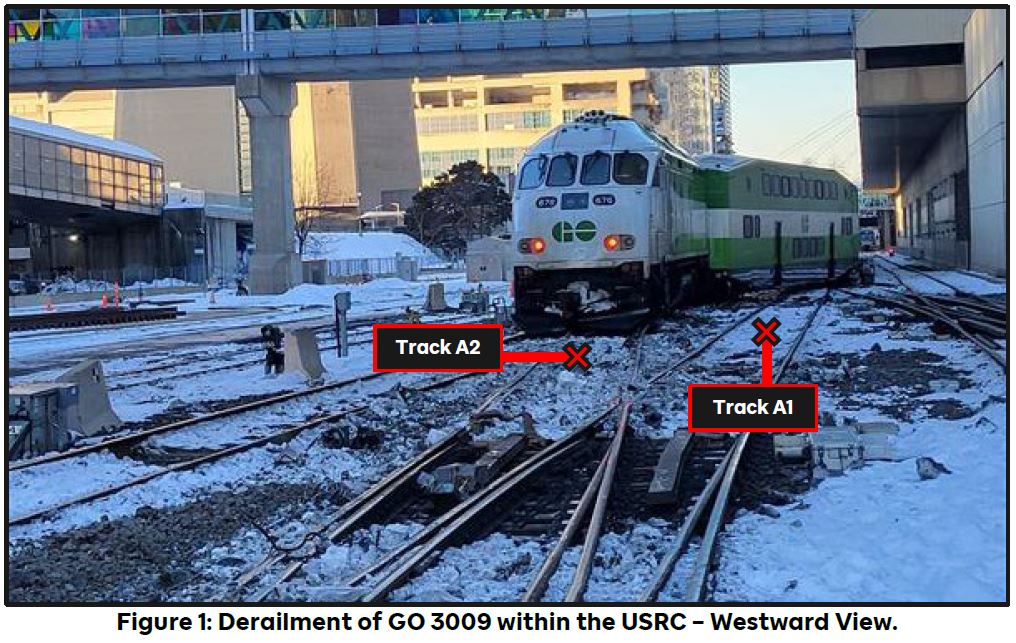
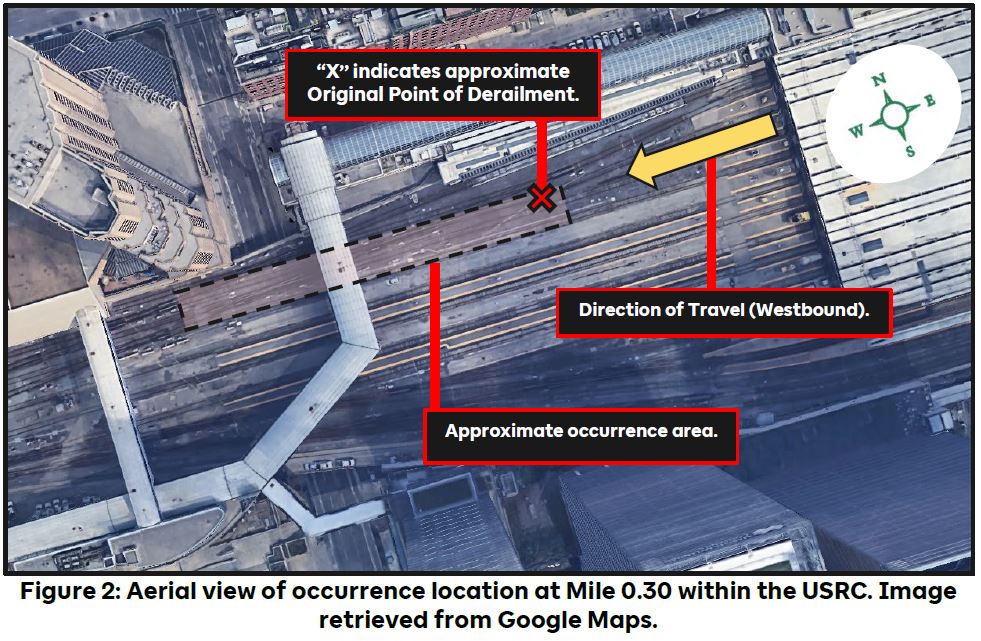
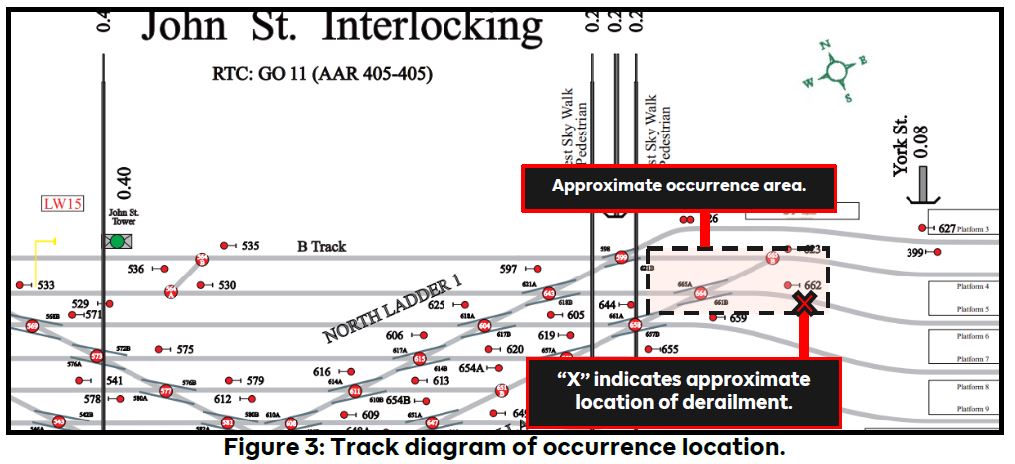
[In the diagram above, “Platform 3” is actually the northernmost platform, and it is used by the Union Pearson Express. It is number “3” because at some point in the Union Station reconstruction, the two tracks/platforms in Union subway station were counted as “1” and “2”.]
Because of the corridor’s design with multiple tracks and platforms accessed by a series of ladders and slip switches, operations on all services through the station were affected either directly or by the congestion of diverted traffic.
The derailment and its aftermath spread over some time. Passengers on the affected train were transferred onto another train at about 9:15am. Rerailing of the coach and locomotive was deferred until after the PM peak to lessen the effects on regular traffic. The train was taken to Willowbrook maintenance facility just after 2am.
It was quite cold at the time (11°C, or -12.2°F). “Operational weather coordination calls are held three times a week with participants from Metrolinx operational business units and TTR. It was confirmed during the call that the temperature did not meet the thresholds to initiate cold weather inspections or restrictions.” [Report p. 8]
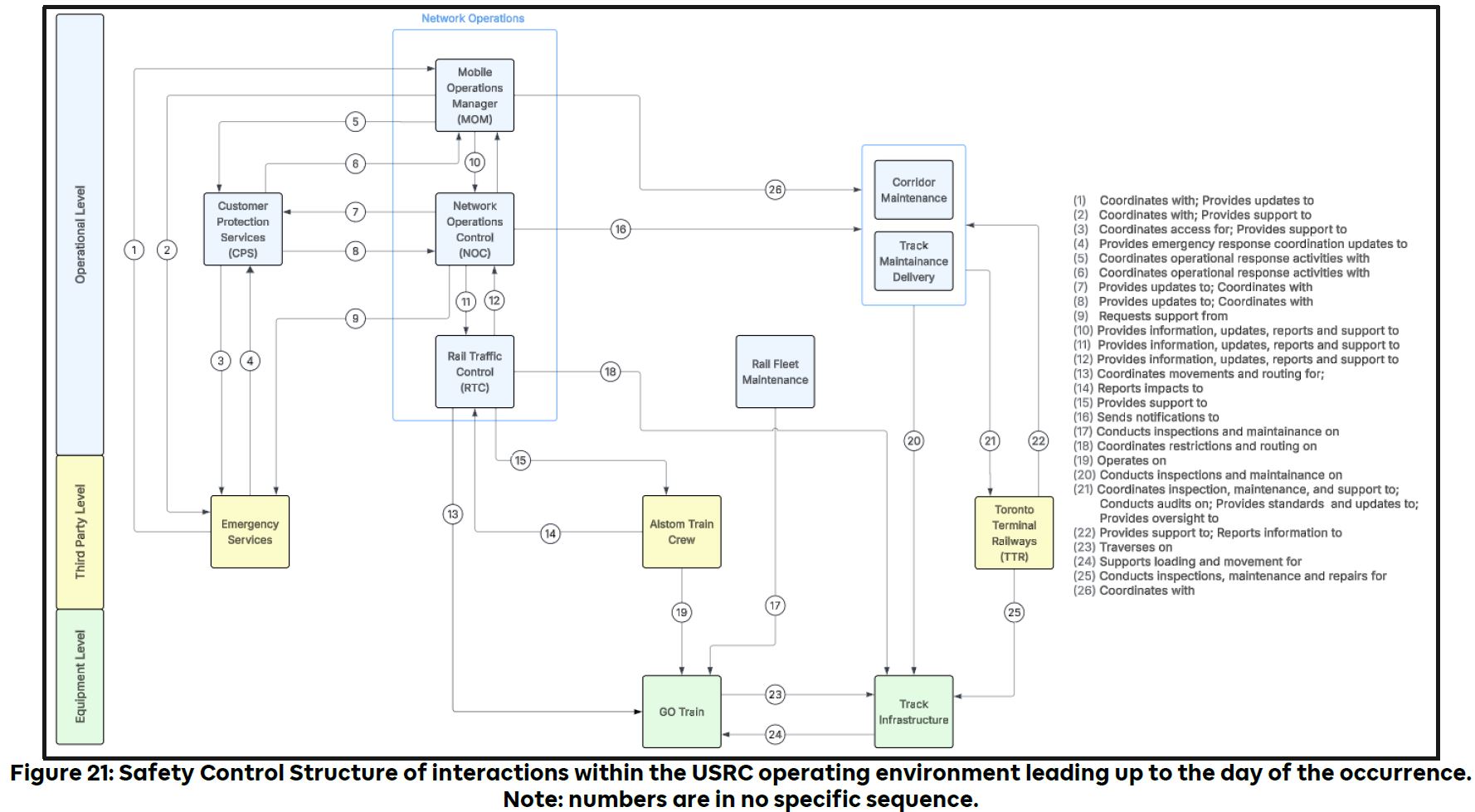
Many organizational units, not all of them within Metrolinx itself, were involved in this incident. The table below is a précis of a longer table on pp 9-10 in the report. Note that responsibilities will differ in other parts of the network beyond the USRC depending on ownership and and operational management of each section.
| Stakeholder | Role |
|---|---|
| Metrolinx Rail Traffic Control (RTC) | Rail Operations Control |
| Metrolinx Network Operations Centre (NOC) | Infrastructure Monitoring |
| Metrolinx Mobile Operations Managers (MOM) | Operational Incident Response/ Incident Commander |
| Metrolinx Rail Fleet Maintenance | Rail Fleet Maintenance Oversight |
| Metrolinx Corridor Maintenance | Rail Track Maintenance Oversight |
| Metrolinx Customer Protection Services | Customer and Passenger Support |
| Toronto Terminal Railways (TTR) | Infrastructure Maintenance and Inspection Provider |
| Alstom | Train Operations |
| Train Crew | Engineer (1) and Conductors (2) |
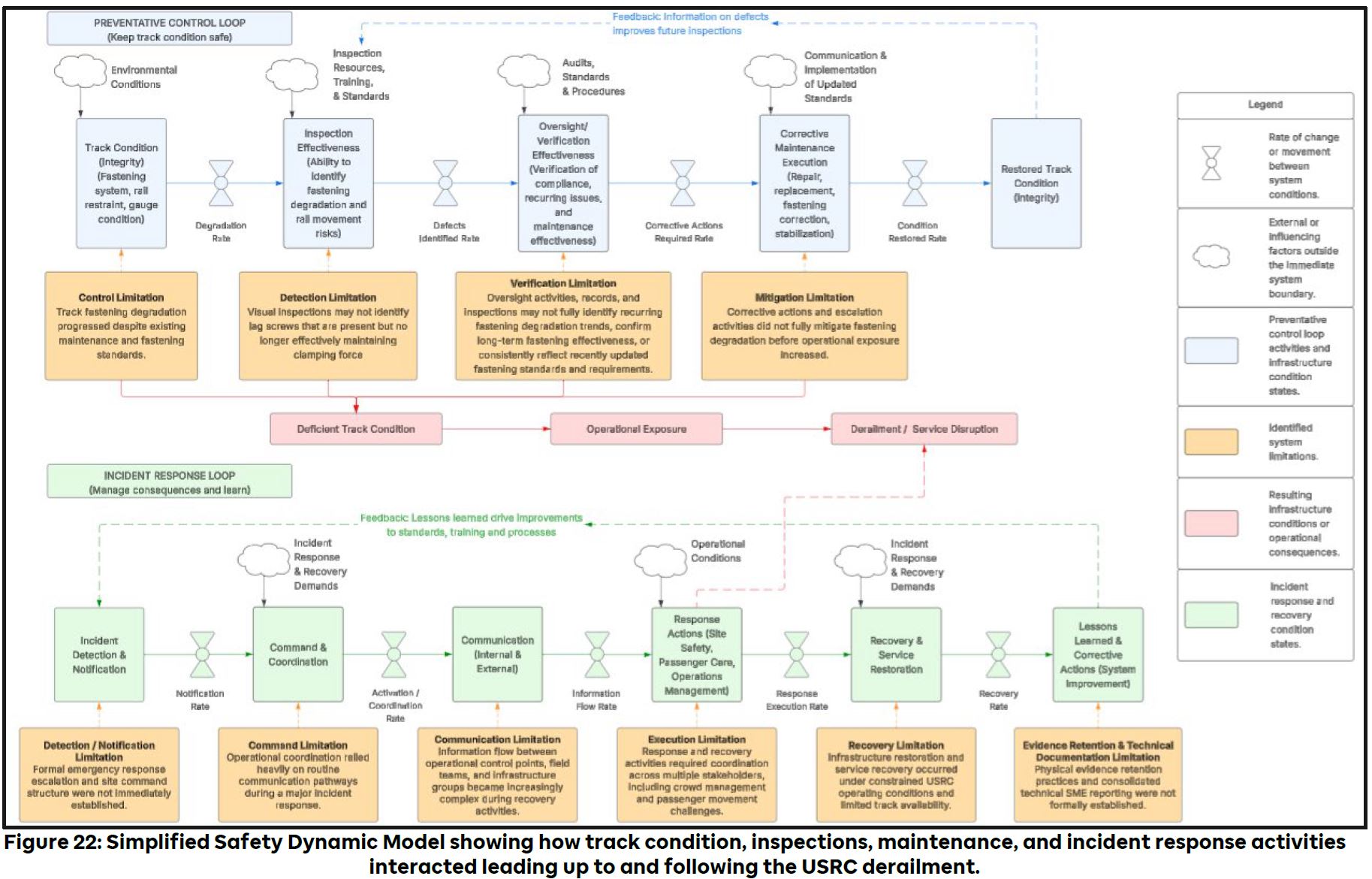
The relationship between various units and responsibilities is set out in the following diagrams. I include them not expecting readers will pore over every detail, but to show the number of players and processes at work under normal conditions. The derailment posed a challenge that communication and co-ordination across the organization could not be sustained in a major emergency where the demands on each unit and between them grew substantially and suddenly.
The analysis modeled the structure of responsibilities and communication in the organization because “the occurrence was not limited to one component or one point in time. Although the physical derailment occurred at the track level, the condition developed within a broader system involving fastening standards, inspection practices, maintenance activities, contractor oversight, operational loading, and response coordination.” [p. 31]
The [Safety Dynamic Model (below)] displays how track condition degradation progressed leading up to the derailment, including interactions between fastening condition, inspection activities, oversight functions, maintenance activities, and operational loading conditions. The model also illustrated how the occurrence created additional operational demands related to service disruption, customer movement, infrastructure restoration, and network recovery activities following the derailment. [p. 33]
Track Standards and Geometry
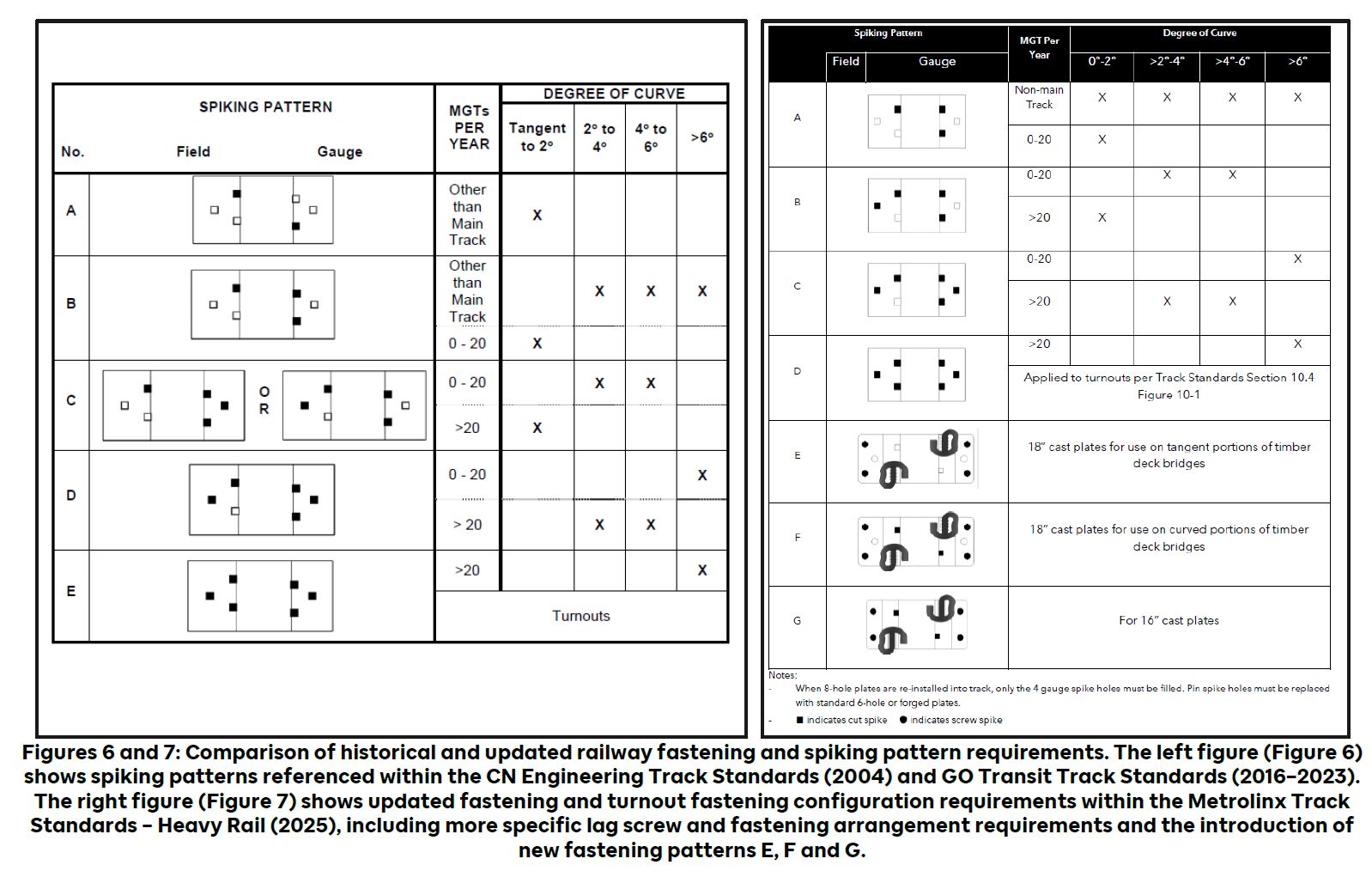
Three sets of standards governed rail construction in the USRC, and these reflect the railway’s evolution.
- Canadian National (CN) Engineering Track Standards (2004)
- GO Transit Track Standards which were adapted from the CN standards, first issued in 2016, evolving into …
- Metrolinx Track Standards – Heavy Rail (2025)
The Metrolinx Heavy Rail Standards “included changes to track design requirements, excavation requirements, inspection requirements, and maintenance practices, along with updates based on lessons learned from previous engineering exceptions, standard deviations, and operational experience.” [report p. 11]
During the evolution of the standards they changed from use of track spikes (CN standard) through a mixture of spikes, lag screws and Pandrol clips with various configurations where these should be used depending on the circumstance. [There is a detailed description on pp 12-13 of the report.]
Note that requirements vary depending on the expected load (MGT or Megatons Per Year) over the track. They become progressively more demanding in the recent standard (E through G below right).
This is all very interesting but it begs the question of whether crews doing routine track inspections know which standard applies to which piece of track, especially in a complex area like the ladders at USRC. On top of this is the “grandfathering” of existing track built to an earlier standard. In effect two pieces of track side-by-side could have different applicable standards depending on when they were built. When the new standards were adopted there was no move to retrofit existing trackage.
Again, note that this report deals only with the USRC, not with the much larger rail network that is substantially owned by Metrolinx and should be subject to its standards.
Many factors affect track geometry and not all can be identified by a walking inspection. By the Metrolinx standards for track at the incident location, there is a requirement for annual electronic inspection to assess track condition. Minor defects are identified so that they can be corrected before they create major problems. A specific test applies to wide gauge conditions where a manual pressure test evaluates the potential movement of track under heavy load.
There are many potential failure modes for track fastening listed in the report [pp 15-16]:
- Missing lag screws or fastening components.
- Loose lag screws or reduced fastening engagement within timber ties.
- Fractured or deteriorated lag screws reducing fastening effectiveness.
- Reduced clamping force between the rail, tie plate, and timber tie.
- Tie plate movement or rail movement under loading conditions.
- Wide gauge conditions resulting from reduced rail fastening.
- Reduced fastening effectiveness within curves, turnout areas, or special trackwork locations.
- Progressive infrastructure deterioration affecting rail fastening performance over time.
The last point is important in this case because track at the site was inspected in April 2024, and several defects were corrected. In April 2025, the annual inspection found no defects. A visual inspection on January 30, 2026 found that “No track defects requiring regulatory action were identified.” [p. 17] This was two days before the derailment.
An additional failure mode identified by the study is “ice jacking” caused by snow and ice packing under rails causing an upward force between rails and ties. There was no indication of whether this was at work in the derailment.
The occurrence took place during a period of winter weather conditions and cold temperatures. Snow accumulation, ice, and cold weather conditions reduce visibility of fastening systems, tie plates, and tie conditions during inspections and maintenance activities. Post-occurrence inspection blitz activities identified locations requiring corrective actions related to ice jacking conditions and winter-related track deterioration. [p. 40]
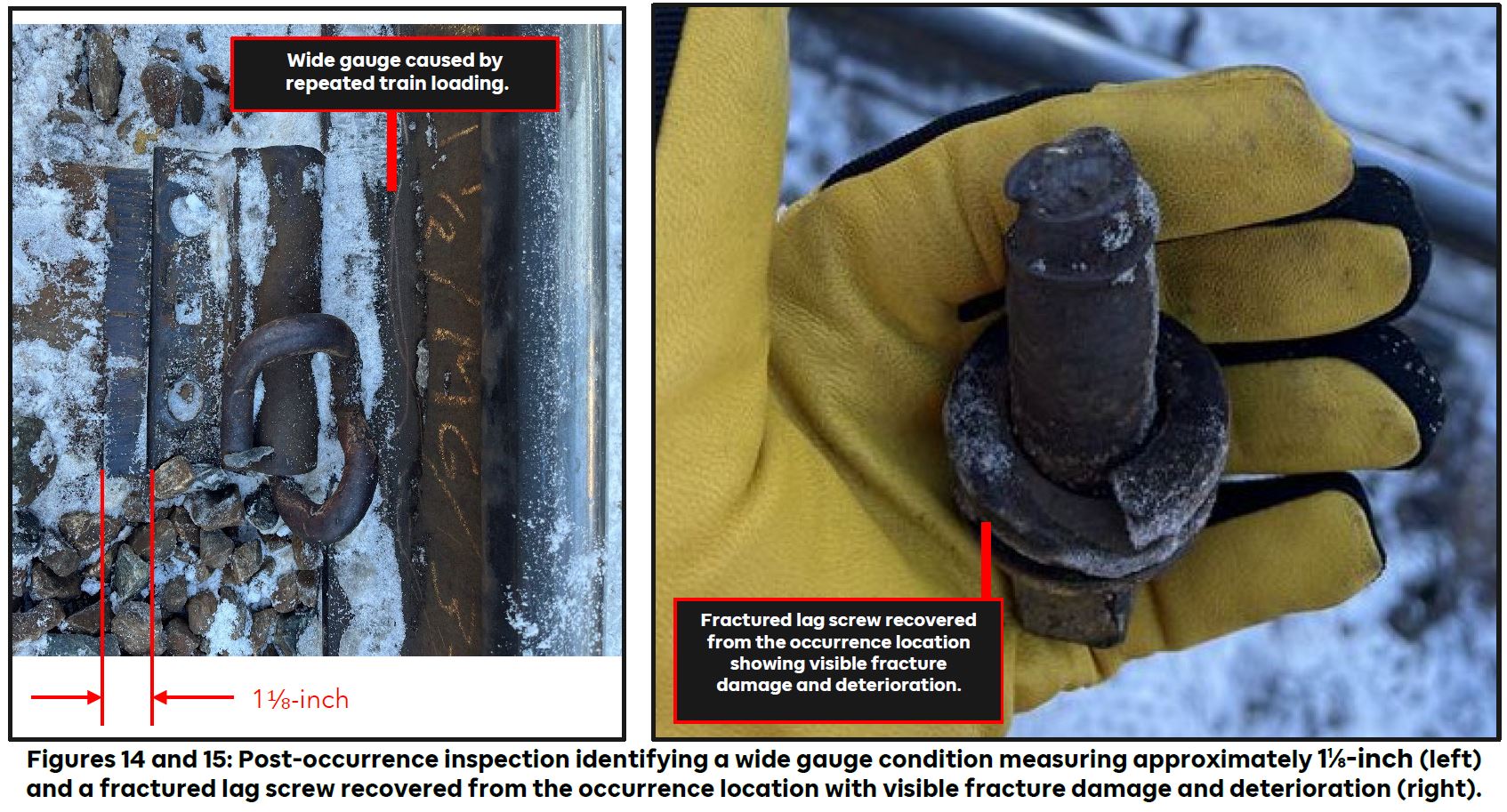
Following the incident, “inspections identified broken, loose, and missing lag screws across multiple timber ties, resulting in inadequate rail fastening. The rail fastening system was observed to be non-compliant with Metrolinx Track Standards, with fewer lag screws installed per plate than required. [p. 22]
Nine consecutive ties were found to have “broken, loose or missing lag screws” [p. 22] and there was a wide gauge condition of 1 1/8″ caused by the outward pressure of the passing train. The photos below show the slippage of the rail from its usual position on the tie (left) and an example of a broken lag screw (right).
The left photo is interesting also because it shows a Pandrol clip, a device that is part of the newer, more restrictive track standard where multiple spikes or lag screws are required to anchor the metal plate supporting the rail to the tie below. The inspection found that only two lag screws were present even though the standard called for four.
Evidence reviewed identified wheel contact markings indicating that the rail had shifted outward under load, allowing the train wheel to climb out of its normal position on the rail. The wheelset remained displaced as the train continued through the track layout until reaching the 664 double slip switch, where the wheel followed a diverging route and the derailment progressed. [p. 24]
A full inspection of the USRC revealed that this condition was not isolated to a few locations, contrary to the impression given by Metrolinx CEO Michael Lindsay at the September 11 Board meeting.
A joint inspection blitz was completed across all 169 curves within the USRC. The inspections found 40 non-compliant locations where rail fastenings did not meet the required standards. The conditions identified included missing or insufficient fasteners, rolled plates, mixed fastening configurations, and locations requiring additional spikes or lag screws to properly secure the rail. [p. 27]
Lindsay described this as a “legacy infrastructure condition that developed over time”, and that the inspection blitz found “some non-compliant locations that we remedied immediately”. He also indicated that inspection protocols over the system are being strengthened, and implied that more of this work would be done on an automated basis. This technique allows a more robust and detailed review of track conditions.
The remarks understate the importance of finding nearly one quarter of the inspected curves being non-compliant, and give no indication of the scope of inspections beyond the USRC. This was not a single point of failure waiting for an accident to happen, but a pervasive problem showing that track standards were not maintained.
Post-Incident Review
Many issues emerged in the aftermath of the derailment including not just technical, physical problems with track conditions, but with the management of trains and passengers in the busy Union Station environment for many hours before normal service was restored.
The review identified operational impacts associated with reduced track availability, manual train routing, disrupted train sequencing, customer impacts across Union Station and the GO network, and operational challenges related to prolonged non-standard operating conditions.
The review further identified challenges related to command and control, escalation processes, communication flow, customer recovery planning, and coordination across operational teams during portions of the disruption.
Union Station was identified within the review as a secondary incident site due to crowding, delayed platform assignments, customer movement challenges, and trains over capacity during peak periods.
The review concluded with a corrective action program intended to strengthen emergency response coordination, communication protocols, escalation processes, and service recovery activities during future major disruptions. [p. 27]
Track inspection methods were described as follows:
It was identified that the fastening arrangement at the occurrence location had existed within the infrastructure for an extended period prior to the release of the 2025 standards update. Based on inspection records, maintenance information, post-occurrence observations, and technical information reviewed, there was no evidence identified that the condition was knowingly accepted as compliant.
The information reviewed supported that the fastening condition progressively developed over time through a combination of infrastructure degradation, historical maintenance practices, and reduced fastening effectiveness under repeated loading conditions.
Earlier inspection and maintenance practices completed by TTR may not have consistently assessed fastening configurations against the more explicit fastening expectations later introduced within the updated standards. [p. 35]
This is a rather delicate way of saying that although Metrolinx adopted new track standards, actual conditions were not measured against them. If these conditions were not “knowingly accepted as compliant”, this begs the question of what standards, if any, were actually being enforced as opposed to assumed to be in effect. The report recommends:
If updated infrastructure standards introduce new requirements for existing infrastructure, clear direction regarding implementation expectations, grandfathering provisions, or compliance timelines is required to support consistent application and verification. [p. 36]
The report observes that there are limitations to visual track inspection including the absence of specific check lists of items to be verified.
Visual inspections helped identify surface level conditions such as missing fasteners, damaged ties, displaced plates, or visible track defects. However, visual inspections are limited to conditions that are visible at the time of inspection. Snow accumulation, ice, ballast coverage, or other environmental conditions may reduce visibility of track components and fastening systems. Visual inspections could not reliably determine the remaining holding strength or clamping effectiveness of lag screws.
As fastening effectiveness progressively decreased, repeated train loading increased stress on the remaining fasteners, further accelerating deterioration within the fastening system. [p. 36]
The report notes that “electronic geometry testing and Manual Gauge Pressure Testing (MGPT) provided a better ability to assess track behaviour under load and identify developing wide gauge conditions associated with reduced fastening effectiveness.” [p. 36] However, such tests occurred infrequently (annually for electronic testing) leaving a long window for problems to evolve between tests. Metrolinx has since shortened the testing interval to semi-annual. (For comparison, the TTC now performs full electronic system scans quarterly.)
The combination of visually based inspections, limited inspection prompts, annual geometry testing intervals, and discretionary use of enhanced testing methods reduced the likelihood of identifying track infrastructure irregularities and progressive fastening degradation before the condition escalated into a derailment risk. [p. 36]
This situation was further complicated by the introduction of the updated track standards.
Information reviewed during the investigation indicated that alignment of existing infrastructure with revised spiking and lagging pattern requirements may have been expected to occur through future rehabilitation, renewal, upgrade, or other infrastructure work activities, rather than through immediate retrofit following implementation of the updated standard.
There was no formalized implementation verification process, documented gap assessment, or structured follow-up activities confirming how updated fastening configuration requirements were assessed against existing legacy infrastructure and inspection practices. The standards also did not identify implementation timelines, transition requirements, or guidance regarding applicability to existing infrastructure. [pp 37-38]
Even though inspections and repairs based on earlier standards did occur, they were not necessarily sufficient to actual traffic and load conditions:
The condition appeared to redevelop before the next scheduled annual geometry inspection cycle. This indicates that while the previous corrective actions restored the track to acceptable operating tolerances at the time of inspection, the underlying factors contributing to fastening degradation and reduced rail fastening were not fully eliminated.
Based on the available information, it could not be conclusively determined when the fastening effectiveness within the occurrence location first began to degrade. The condition may have developed progressively over time due to repeated train loading, infrastructure degradation, historical maintenance practices, or fastening installation conditions affecting long-term rail fastening performance. [p. 39]
Incident Response
The immediate response to the derailment focused on the train itself, and as the effects became more evident, this expanded to train control centres and field staff. An important secondary area, especially in the AM peak period, was the problem of maintaining service and coordinating passenger movements in Union Station.
The Operational Response and Recovery Review identified that command structures, information flow, and sources of truth were not always visible or consistently understood.
A formal Incident Command Structure was not established until after the derailment had already resulted in significant operational and customer impacts. Responders further indicated that while an Incident Command Structure was believed to be in place, the Incident Commander and reporting pathways were not always clearly understood on site.
Despite these challenges, responding stakeholders continued coordinating operational decision-making, customer movement, service recovery, and recovery planning activities throughout the occurrence as conditions evolved.
The absence of an activated Emergency Operations Centre (EOC) during early response limited Metrolinx’s ability to coordinate multiple incident sites simultaneously and provide structured alignment across responding stakeholders. [pp 41-42]
With Union Station as the hub of the GO rail network, any disruption or limitation there quickly affects services everywhere else. Approaching trains cannot access their usual routes and platforms, and train departures can be delayed or cancelled. Network-wide information is needed both for operating personnel and passengers.
Communication channels were limited, and in some cases conflicting or incorrect information might flow.
It was noted that “multiple unsanctioned communication channels and chat threads emerged” during the disruption, reducing consistency of messaging and creating challenges related to authoritative information sharing.
Frontline teams and customers also did not always receive timely or realistic information regarding expected service impacts. Digital departure boards, trip planning tools, and customer-facing systems struggled to keep up as well. [p. 42]
The changes in train locations and times, in turn, produced passenger congestion within Union Station and ongoing coordination to keep staff and passengers advised of current conditions. Display screens were not always up-to-date with constant changes.
The recovery of passengers on the derailed train, then rerailing of the train itself, and finally the infrastructure repairs were constrained by the continued operation of peak service, and in turn caused ongoing challenges to maintain that service on the still-functioning tracks and platforms.
One concern of the investigation was that there was not a clear protocol for preservation of evidence such as failed or damaged infrastructure for future study. This is contrary to industry best practices. There was also a fragmentation of the review process.
Post-occurrence inspections, corrective actions, and engineering reviews were carried out within individual disciplines. These efforts were not consolidated into a single, multi-disciplinary subject matter expert (SME) technical report integrating track, mechanical, and operational perspectives of the occurrence.
Industry guidance, including the American Public Transportation Association (APTA) Recommended Practice for Derailment Investigation Reports, identifies practices related to evidence retention, technical documentation, and integrated review across track, equipment, and operational disciplines. [p. 44]
Causes and Recommendations
As mentioned earlier in this article, there is a long section summarizing the causes, findings and recommendations of this report on pp 46-51 which I leave to readers to peruse rather than copying all of that text here.
 Steve Munro