Yonge Subway Headway Study 1988 (Part 6)

I am inserting a little sidebar into the discussion because my archives yielded up an exhibit not included in the TTC’s report.

This is the demand analysis shown in Chapter 2 which establishes the need for additional capacity on the Yonge line, specfically at Bloor-Yonge Station.

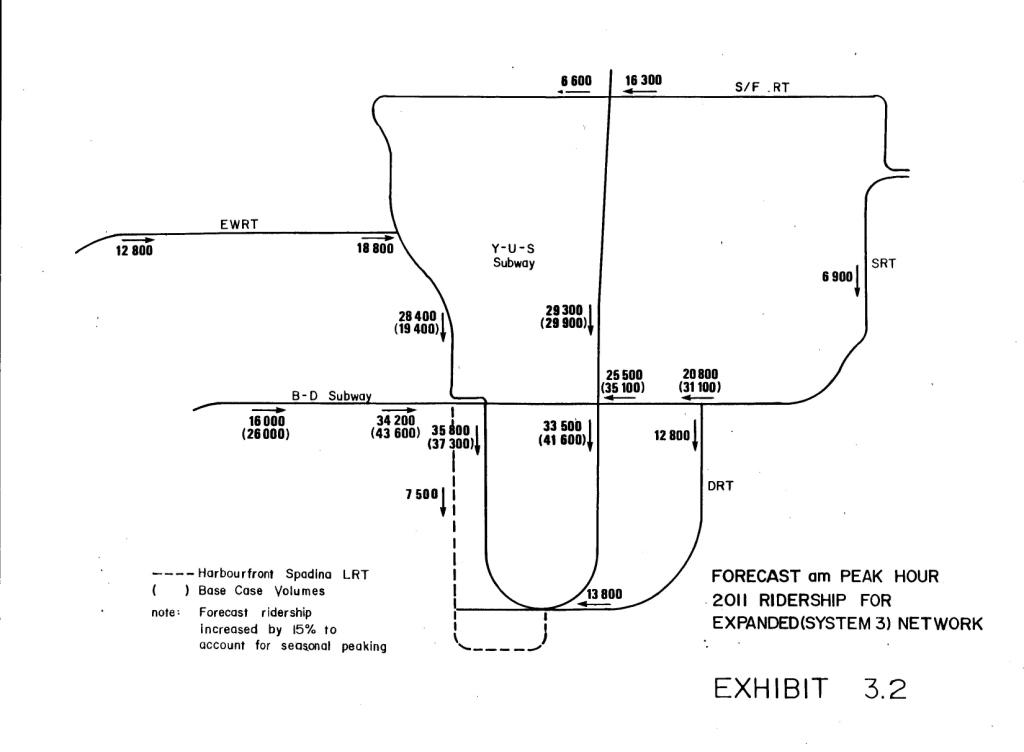
This is the companion chart from the Network 2011 study showing the projected demand on the rapid transit network with the addition of lines on Eglinton West, Sheppard, the DRL and the Spadina/Harbourfront line.


These two charts appear side by side in the Network 2011 study, but only the first one was included in the Improved Headway Study.

The DRL diverts a good chunk of traffic off of the Yonge line below Bloor, although this is partly backfilled by new riding pouring in at the top of the line. (Other studies had different versions of this line including routes that went further north.)

The projected demand on the Spadina line, 7,500 per hour, was rather high considering it was to be a surface operation crossing many streets. Oddly enough, only the Harbourfront portion was built initially, and we waited until 1997 for the Spadina streetcar.

I don’t intend this to be a definitive example of a demand model (I don’t think “definitive” is a word one can use in that context anyhow), but it points out how the importance of the DRL was recognized over 20 years ago. Indeed, in the Network 2011 plan, it was the second priority for construction with 1st place going to a Sheppard line only as far east as Victoria Park.

Yonge Subway Headway Study 1988 (Part 5)

In this section, we begin Chapter 4 of the study with a description of the centre platform option at Bloor-Yonge Station.

Some of the work needed for this scheme was built during construction of 33 Bloor Street East and the Toronto Parking Authority lot between Hayden and Charles Streets.  The TTC took advantage of the subway structure being uncovered to widen the station and replace the centre columns with a roof spanning both platforms and tracks.  As you can see from visiting the station, this work ends at the northern third of the station because this is physically inside the structure of The Bay.

The section on construction feasibility describes what is necessary to continue this layout further north and it involves, among other things, closing the Bay’s concourse during construction.  That entire passage is almost surreal because it details problem after problem with the construction, but forges bravely onward.  There’s also the small matter of closing Bloor-Yonge Station because the existing platforms must be removed before the tracks can be relocated.

Continue reading

Yonge Subway Headway Study 1988 (Part 4)

This installment completes Chapter 3 of the study with the evaluation of alternative signalling strategies.  The recommented alternative is Automatic Train Control, no surprise there, based on the premise that it provides the maximum benefit versus the expenditure.  Underlying this, however, is the goal of a 90-second headway and the increasing challenges to subway operations as the headway drops.  ATC is treated as a means to achieve this dubious goal rather than a worthwhile move in its own right.

Continue reading

Yonge Subway Headway Study 1988 (Part 3)

This section presents considerations for the vehicle fleet and yards required to house these cars.  An important consideration for any decrease in headway is that the number of trains in service goes up.  This generates added capital and operating costs for an expenditure that addresses only peak period demand.

A proper comparison of lines would look at what happens if the fleet is expanded (regardless of the technology) elsewhere so that new off-peak service is available in a corridor that does not now have rapid transit.

As we will see later, the additional vehicles are a substantial portion of the total project cost for peak headway improvements on an existing line.

Continue reading

Yonge Subway Headway Study 1988 (Part 2)

This thread began with an introduction to the “problem” of capacity at Bloor-Yonge Station which dates back to the 1980s, an era when all expansion of capacity for travel from the suburbs to downtown was assumed to be on the subway network.  If you accept that premise, then it follows that massive expansion of subway capacity is absolutely required.  However, as we have recently seen from demand projections by Metrolinx, when there are good alternatives to the existing subway, people may find other ways to get downtown.

In this section, I will present another chunk from the long Chapter 3 in the TTC’s 1988 study.  This part includes descriptions of four ways to achieve shorter headways on the Yonge line through signalling changes.

Continue reading

Yonge Subway Headway Study 1988 (Part 1)

Recently, there has been a lot of discussion here about the practicality and desirability of adding capacity to the Yonge-University subway.  My position is clear:  there is more to be gained by adding new capacity in other corridors that can, in addition to relieving pressure on the Yonge line, provide alternatives in the transportation network to what now exists.

For twenty years, the focus has always been on beefing up the Yonge line, and this reflects the TTC’s long-standing tradition of looking only at their network when planning transit capacity.  Earlier subway expansion schemes completely omitted the GO Transit network from calculating potential regional demand and modelled all growth in riding on the subway system.  The effect of this shows up in the Network 2011 proposal that projected large increases in subway demand.  Those increases triggered a study in 1988 of what could be done to add capacity to the Yonge line, and we are still living with some of the fallout from that study today.

When I dug the report out of my archives, I thought that I would only scan, edit and post a few chapters. However, I soon realized that the arguments of 20 years ago are worth reading today because they are instructive both for the basics of transit operations, and because they show the origins of some current thinking.

For convenience, I have chopped up the document into sections.  The text, which was originally doublespaced typewriter (Courier) format, has been converted to single spaced Times Roman (yes, I know some of you just hate Times Roman).  Some exhibits that didn’t lend themselves to text-based conversion have been scanned separately as jpegs.

The first installment (this post) contains chapter 2 and the first parts of chapter 3 of the Final Report (chapter 1 was the Executive Summary) dealing with the problem of projected congestion and the various ways in which signal changes could be used to reduce headways.  In the next installments, we will see:

  • detailed descriptions of four schemes for signalling changes to achieve closer headways
  • a discussion of vehicle requirements
  • conclusions and recommendations for signalling
  • four schemes for a reconstructed Bloor-Yonge Station
  • evaluation of impacts at other stations and terminals, notably Finch and Wilson
  • options for the Yonge-Spadina loop
  • final summary and recommendations

Chapter 4 (the Bloor Yonge schemes) contains useful material to those of you who have been, figuratively speaking, drawing lines on maps for the past few weeks with possible alignments for additional tracks.  It helps to know the lay of the land both above and below ground.

Because we have already had quite a lot of discussion about routing alternatives, I will exercise my editorial prerogative to delete or severely cut repetitions of past discussions.  The main reason I am putting this material up is to show what was actually considered and how the history of past studies like this colours future projects.  That’s an important context for the current Regional Transportation Plan discussions — things that seem trivial today will take on the aura of historical received wisdom in less than a decade.  Maps drawn on stone tablets are hard to change.

Continue reading

Metrolinx Board Meeting October 2008

After all the other posts of the past week, here is one to catch up on bits and pieces from the Metrolinx Board meeting on October 24.  These are not trivial issues, and they relate to each other in ways that will become clear.

Status of the Regional Plan

There was considerable discussion of the timetable leading up to approval of a plan on November 28.  It turns out that there will be a Board “retreat” to consider the status of things on November 3, but this is nearly two weeks before the deadline for public comments.  This might suggest just how much impact public input might have in the process, but more to the point, some of that “public comment” includes reviews of the draft by regional planning staff.

Even assuming they all work a bit harder to hit the early November dealine, there remains the question of Metrolinx staff reviewing the comments, and the Board deciding what to do with them.

Rob MacIsaac, Metrolinx Chair, was clearly upset (as he has been on several previous occasions) with the idea that the plan will not be “finished” and approved on November 28.  His position, and by extension that of whoever is lighting fires under his butt, is fundamentally wrong on this.

From a purely political and process point of view, nobody plans to fund, much less start building, all of the Metrolinx plan out of the 2009 budget.  The Board has already identified projects that enjoy a quick start, and these will chew up the lion’s share of spending for several years.  Most projects that will generate spending at least for the next few budget cycles are already known, and that list can be nailed down in November. 

In fact, Metrolinx somehow got from selecting projects for advanced evaluation to approving them for implementation without benefit of detailed review, something that is only now starting.

Moreover, there is a legislative requirement to review the regional plan from time to time, and so we can expect changes long before work is started on building much of the plan, assuming we find money to actually build any of it.  Although a 10-year review is the current thinking, some members of the Board argue for a shorter 5-year cycle.

MacIsaac is creating unnecessary strain on the Board and bad feelings about what must be done in November to no good end.  Nobody casts a 25-year plan in stone on day 1, and it’s time MacIsaac stopped trying to force the Board, the municipalities, the regional transit agencies and the public down this path.  It is a manufactured crisis that has no place in this important discussion.

How Much Money Do We Have?

Another long discussion turned on the question of the $11.6-billion MoveOntario nest egg promised to us by Queen’s Park.  We are all taking it on faith that this is still money in the bank, but from a purely bookkeeping point of view, much of it won’t actually be spent from the next few budgets anyhow.

The Board got into a heated debate about what to do if this is the only money Metrolinx ever sees.  This brought on visions of the old regional “build my subway first” rivalries, and Mayor McCallion, among others, wanted nothing to do with it.  She argued that the Metrolinx role is to propose a network, to identify what is actually needed, not to get into political horse-trading and construction of pet projects.

This issue involves questions of additional revenue streams such as tolls, sales taxes and other ways to extract money for the greater benefit of transit systems.  The Board didn’t stop at capital funding, but is also very concerned with operating dollars because the local transit systems will be on the hook to operate all of the new services.  As if that isn’t bad enough, Metrolinx reports now speak of “eligible costs”, and the municipalities may find themselves on the hook for project costs everyone thought would be picked up by Queen’s Park.

It’s hard on one hand to publish glowing reports about mobility hubs and neighbourhood design, and then turn around and suggest that making a line look nice isn’t a Queen’s Park expense.  This sort of thing undermines the confidence of municipal leaders, and puts them in the ludicrous position of not being able to afford the new toys Uncle Dalton might give them.  The word is “downloading”, and it’s not a popular word around the Board table.

We don’t know yet whether we can even build the “top six” projects with the $11.6-billion, let alone anything else in the Regional Plan.  By the way, one slice has already been taken out of that pie — the Spadina Subway extension funding counts against Queen’s Park’s Metrolinx commitment.

Where Does the Growth Plan Fit In?

Brad Graham, ADM for the Ontario Growth Secretariat, gave a presentation about how Metrolinx’ plans fit so well with the direction of the Growth Plan.  Much back patting and kind words were heard.

There’s only one problem.

While Ontario is busy stimulating, regulating, generating new transit-oriented neighbourhoods out in the 905, what is actually going to be built by Metrolinx focuses much more on existing travel patterns and particularly core-oriented movements.  All that stuff about Mobility Hubs looks good until you realize that a lot of them (and associated services) it won’t be built soon.  This is partly related to funding, and partly to the pressing need for more capacity into the core.

Another problem is that the projected modal split in much of the 905 is still poor, and will take years to improve.  A lot of that will come from better commuter service to downtown, not from inter-regional travel.  How this is supposed to stimulate interest in transit-supportive neighbourhoods is unclear.  Yes, there’s a chicken-and-egg problem.  Without new neighbourhood designs, transit in the 905 is doomed.  But without transit in the 905, car oriented planning will be the standard.

Mayor McCallion raised the issue of infrastructure to support new population.  This is not just a question of transit capital, but of sewers and water, hospitals, schools and all the other bits and pieces that go into a city.  Without money to build and operate these facilities, there is no point in talking only about new transit lines.

The Mysterious Benefits Case Analyses

The process for getting a line built by Metrolinx is supposed to be:

  • Propose a line
  • Study the line for its benefits
  • Study the line for its financing options (including “alternative procurement”) (AFP)
  • Approve the line as part of the Regional Plan

However, the current process doesn’t work like this.  In fact, we have lines that already have, more-or-less, Board approval (the “top six”) that are (or are about to be) going through “Benefits Case Analysis” (BCA) by Metrolinx (actually, by their consultants).  Although nobody has actually said so, it appears that parallel studies for alternative procurement are already underway.  All of these threads will come together (or more likely collide) at a Metrolinx Board meeting that may or may not be in public.

The BCA for York Viva was supposed to come to the public meeting in October, but it was held until the private session.  Adam Giambrone raised a question of whether it could be made public, and in the course of discussion, Rob MacIsaac implied that parts of the report might include confidential commercial information that they wouldn’t want to (or couldn’t) release.  That smells a lot like an AFP study to me.

To further complicate things, the BCA process has already spawned many optional schemes for the projects under study.  Some of these make changes in the draft Regional Plan that have never gone through any sort of public review.  Ironically, some of them are alternatives that have been suggested by folks like me who, in the past, have been told to go play with their toy trains and leave the real work to the pros.

In practice, a line in the Metrolinx RTP doesn’t seem to mean much because it’s all subject to detailed study and alternatives analysis through the unseen BCA and AFP processes.  So much for the vaunted public input we hear so much about.

Metrolinx really needs to sort out its processes for project definition, investigation and inclusion in updated regional plans.  I understand the pressure to cut corners to get the first projects underway, but some very bad precedents are being set.

Studying Projects or Studying Networks

The draft regional plan is a network, not a set of lines that exist in complete isolation from each other.  Work toward the draft operated, we are told, by finding the correct set of lines to have the best effect in the 15 and 25-year timeframes.  All of the demand estimates are based on a fully built-out network.

However, the BCA process goes one line at a time, and this risks missing the links between projects, the possibilities of looking at alternatives that span project boundaries.

I will explore the question of subway capacity in a separate thread, but the analysis for the Yonge Subway extension to Richmond Hill is deeply troubling.  This extension triggers higher riding on the existing subway which the TTC has finally admitted cannot be handled by the existing infrastructure.  It’s not just a question of buying more trains, putting in new signals to run them closer together, and fine-tuning terminal operations.  Now we know that there are capacity problems from Bloor south with the stations themselves.

The TTC has resurrected a scheme for a third platform at Bloor, and it’s fairly easy to see that this is not the only location where more platform and circulation capacity are needed.  Moreover, if the Yonge line delivers more transfer passengers per hour to the Bloor line in the PM peak, this will trigger capacity and service issues on that line too.

The RTP itself includes alternatives both on the comuter rail network and the subway system to divert traffic off of the Yonge line.  Why aren’t any of these being studied at the same time as the Yonge extension?  Could we avoid the need for massive capacity expansion on Yonge by operating other parallel services?  What are the comparative costs and implementation issues?  Could we get better network coverage for comparable or modestly higher investment?

That’s the sort of thing Metrolinx should be doing, but it’s not.  We risk many of the mistakes of past decades by studying lines in isolation from each other.

A Few Concluding Words

Metrolinx is so fixated on the short term, on giving Queen’s Park a finished report and a “quick start” set of projects, that we risk an opportunity to do proper comparative analysis and planning.  The Board needs to seize control of the process and set out a few basics: 

  • a short-to-medium term plan that will give Queen’s Park enough to munch on for budgetary purposes,
  • a review even of that plan to ensure that project sequencing is appropriate and alternatives really have been considered,
  • a clear process that keeps debate in public fora as much as possible and ensures input by municipal and transit system staffs together with the public.

This is not the time to sit back and admire the map on the wall, but to treat it as a living, changing and challenging guide to our future transportation network.

Transit’s Lost Decade Updated: 1990 vs 2008

Back in 2002, I collaborated with Rocket Riders and the Toronto Environmental Alliance to produce Transit’s Lost Decade, a report on the savage cutbacks in transit during the 1990s thanks to budget cuts.

This morning, I received a comment in the thread about the November service changes from James who asked:

How does total service, as of November 23, 2008 compare with peak service prior to the big cuts of the early 90’s?

This sent me digging into my archives to see how we have been doing.  For the details, please refer to this linked spreadsheet.

By November 2008, the AM Peak bus service will stand at 1505, still 43 less than the 1990 level of 1548.  The difference in capacity is slightly greater on two accounts:

  • 1990 includes articulated buses (fleet of 90, number in service unknown)
  • 2008 includes 21 buses replacing streetcars on St. Clair for construction

If we assume that at least 70 artics were in service, this is the capacity equivalent of 35 more 40-foot buses.  Adjusting the totals gives an effective service of 1583 buses in 1990 versus 1484 in November 2008.  During this period, the Spadina subway was extended from Wilson to Downsview, and the Sheppard subway largely replaced bus service from Yonge to Don Mills.  However, these do not completely offset the difference in peak bus operations.

On the streetcar network, the AM peak service is down by 37 cars even though the Spadina route did not exist in 1990 (15 vehicles).  The level of streetcar service is much, much lower now than it was in 1990 and shows no sign of improving.  The long delay in decision-making on rebuilding and/or replacing the streetcar fleet means that “Ridership Growth Strategy” is a hollow term to patrons of those routes.

Please refer to this list of streetcar vehicles and headways for November 1990 and 2008.

Finally, you will note the presence of the Trolley Coach fleet in 1990.  With the recent difficulties involving Hybrid Buses, Toronto continues to see how a fascination with new technology first with CNG buses, then with hybrids, has turned out.  Hybrids may come into their own as battery technology improves, but today we can only look to our sister-city, Vancouver, to see a real commitment to electric buses.  That’s another thread, and I will turn to it soon.

Ridership Growth Service Changes in Late November 2008 (Updated)

After many, many years, the service improvements promised by the Ridership Growth Strategy are here.  Starting November 23, we will see the rollout of more service on many, many routes to implement the following new service standards:

  • Peak bus loading standards are reduced by about 10% (a route will be considered to be “full” with a lower average load).  This triggers service improvements on many routes, but loading generally has been rising and there is already a backlog of changes waiting to begin.  This affects 62 routes with a total of 89 more am and 65 pm peak buses.
  • Off peak bus standards, as well as streetcar and rapid transit standards for all periods, are unchanged at, effectively, a seated load.  Note that this is an average over an hour and local variations will occur.
  • Routes with services less frequent than 30 minutes will be improved to the new 30-minute maximum headway.  This affects 26 routes.
  • All routes will operate seven days a week during all periods until at least 1:00 am.  This affects about 86 routes.

Also, Mount Dennis Garage will open roughly a year after it was actually finished.

One caveat, of course, is the already known problems with hybrid bus availability.  The degree to which the TTC can get and keep its fleet of these vehicles on the road will affect the full rollout of the new peak period services.

Meanwhile, I cannot help noticing the breadth of the changes across the system with 20% better service found fairly commonly on some routes and periods just to get average loading within the standards.  This shows a combination of deferred improvements and of the unusual rate of riding growth on some routes.

Updates October 25: 

A summary of the changes, boiled down from the 80-odd page original, is now available.

A table of the revised loading standards is now available.

Updates November 6:

A list of division assignments is now available.