On December 5, 2023, Toronto’s Executive Committee will receive an update on the Eglinton East LRT project. Readers with long memories will recall that there was a time when a “peace in our time” solution to the Scarborough Subway debate would have seen both an extended subway and at least part of the EELRT built with the monies already earmarked for the Scarborough projects. This claim was a work of creative fiction, but it got the subway extension’s approval through Council.
We are still waiting for the LRT, and Scarborough will be lucky to see it until the late 2030s at best.
This set of reports keeps the ball rolling on the EELRT, albeit slowly. Until the Provincial aims for extension of Line 4 Sheppard are clear, the degree of conflict with the LRT plans and the scope of the LRT will not be known.
The most recent proposal has a U-shaped line running from Kennedy Station east and north to the University of Toronto’s Scarborough Campus (UTSC), and then north and west to Sheppard and McCowan with a branch to Malvern Centre. These shadow the original Transit City proposals for a Scarborough-Malvern line and a Sheppard East line, although the latter would have run west to Don Mills Station.
The cost estimate for the full EELRT project sits at $4.65 billion based on construction in the 2027-2034 period. This is a class 3/4 estimate with a potential range of -20% to +30%. This excludes key items including: property, procurement, vehicles, lifecycle maintenance, and future operations and maintenance.
With Ontario studying potential expansion of the Sheppard subway west to Downsview and east to at least McCowan, any Sheppard branch of the LRT has an uncertain status.
The map on the left shows the City’s version of the EELRT while the one on the right shows how the Metrolinx study area extends to Meadowvale road.
Metrolinx claims to be reviewing a range of technologies including subway, “light metro” and LRT, but it does not take a genius to figure out that any true extension of Line 4 Sheppard would use subway technology just as extensions to Lines 1 Yonge and 2 Bloor-Danforth already do. This would be especially important for a westward connection to Downsview which would not make any sense as a short, free-standing route.
After several weeks of behind-the-scenes discussions between the Ontario and Toronto governments, amid various side-shows such as the Greenbelt scandal, the bribes for planning overrides, the potential destruction of both Ontario Place and the Science Centre, there is a deal, sort of.
In the immediate publicity after the announcement on November 27, the level of information varied depending on which document one read all the way from simple, enthusiastic political statements up to terms sheets and draft legislation.
Toronto comes out of this with a better fiscal situation, including some benefits for transit, but some battles are now over, conceded as part of the deal.
Recovery Through Growth Act (City of Toronto), 2023
Rebuilding Ontario Place Act, 2023
The Rebuilding Ontario Place Act has considerable detail on the redevelopment of Ontario Place, and it is clear that this was not pulled together at the last moment. Although the announcement speaks of design changes and makes passing reference to the Science Centre, neither of these is mentioned in the Act which confers substantial power on the Province to do anything it wants, and compels Toronto to stay out of the way.
The Recovery Through Growth Act, by contrast, is threadbare with only the most cursory provisions recognizing the discussions between Toronto and Ontario, and leaving the bulk of any details to Regulations that might be enacted by the Lieutenant Governor in Council (the Provincial Cabinet).
The new financial arrangements for Toronto extend only three years, roughly until after the next provincial and municipal elections, when the context of any renewal might be different. Meanwhile, the Province and City will “undertake a longer-term targeted review of the City’s finances to be completed by 2026”. [Detailed Term Sheet Cover Letter, p. 2]
Both parties expect added support from the federal government, although the dollar amounts and target projects vary between the City and Province.
The “core commitments” in the Detailed Terms begin with a recognition that housing and transportation are intertwined issues:
Toronto needs to expeditiously streamline and optimize planning approvals and accelerate the delivery of affordable, attainable, and rental housing across the continuum. As density is added, Toronto’s transit and city-enabling infrastructure needs to keep up. The upload of the Gardiner Expressway and the Don Valley Parkway will create significant additional capacity for the City to support building more homes faster in Toronto and across the GTHA.
The City commits to using immediate financial benefits as well as all future financial benefits of the upload (pending Provincial due diligence) to support historic investments in housing and the infrastructure that supports and enables growth such as transit, water and wastewater infrastructure, and local road improvements.
What is needed now from the City is an updated pro forma 2024 budget showing the effects of this agreement. This would inform consultation and debate now in progress leading into the budget cycle at Council.
On the transit front, the entire debate about service restoration and quality must be updated with a sense of the monies that will be available in coming years, and the possible targets Toronto can aim at depending on how much additional support is provided to the TTC.
The following sections are arranged by major topic area and are reordered from the Detailed Terms.
The presentation includes a chart showing major construction plans in 2024. The overhead projects are for the completion of migration to pantograph-only overhead. (It is hard to believe that they would take Queens Quay and Fleet out of service during the CNE in Q3, but I’m not planning the City’s infrastructure projects.)
The overhead projects raise the question of whether they will actually occur on time. Past work has been scheduled, diversions implemented, and then nothing happened. Riders should not have to put up with disorganized project scheduling.
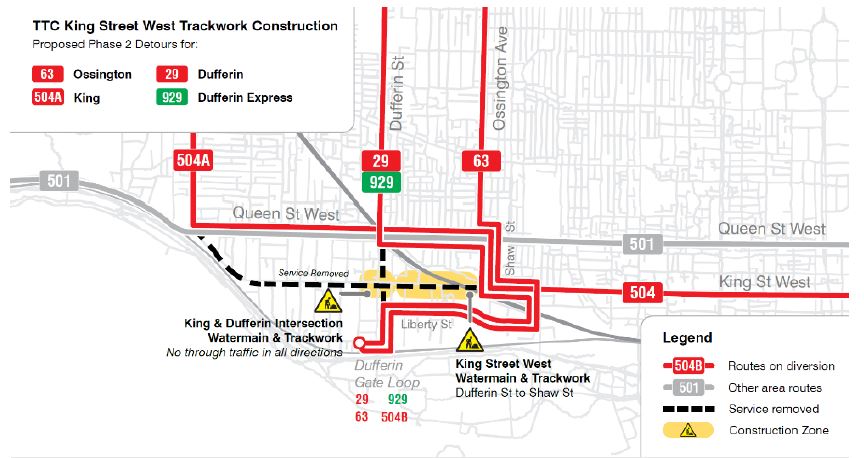
The only major track project (beyond completion of St. Clair West Station and the 501 Queen via Adelaide connection) is on King West from Dufferin to Shaw. In the Service Plan report, one set of diversion routes was shown for the 504 King, 29/929 Dufferin and 63 Ossington routes. This has been revised, and there are now two options under consideration, both different from the one in the report.
Here is the original plan which has two phases with the second being for the duration of the intersection replacement at Dufferin planned for June/July 2024. Note the removal of service on King west of Dufferin in this version.
For phase 1 (mid-February to late June, August to late October) there are two new options which preserve service on King between Dufferin and Roncesvalles by extending 63 Ossington buses west to Sunnyside Loop. In both options, the 504 King service diverts north via Shaw to Queen, but the difference lies in what happens at Dufferin Street.
In option 1 (left below), the 501A Queen cars divert south to Dufferin Loop. Service on Queen west of Dufferin is provided by the 504 King cars with the 504B service running to Humber Loop until late evening. Late evening service through to Long Branch will be provided by the 501C as it is today.
In option 2 (right below), the 501 Queen cars stay on Queen Street, and the 504B diverts south to Dufferin Loop.
508 Lake Shore cars operate via Queen and Shaw in both options.
The 29/929 Dufferin bus service only diverts for the period that the King/Dufferin intersection is closed (not shown here).
The TTC is conducting a survey to determine which of these is preferable to riders.
Service reliability will be addressed on various fronts. The phrase “expanding beyond on-time performance and adding emphasis on consistent, well-spaced, and completed service” is very gratifying. If the TTC actually pulls off this change in focus, it should repair many long-standing issues that the simplistic terminal departure metrics completely ignore.
With the change in ridership patterns, there are new periods requiring better service. Even with the system as a whole running at less that 100% of pre-covid ridership, there are routes and time periods that are over 100%. This is compounded by traffic congestion that is, in some places, worse than in 2019.
Budget Directions
The chart below shows two possible futures for TTC service. On the left is at best a stand pat scenario where service is trimmed to reduce the call on City subsidy and savings, if any, might go to reduce deficits, not to support operations. On the right is a scenario for improvement with better funding and service quality.
The 2024 budget will likely appear at the TTC Board in December, but the final choice will be up to Council and, indirectly, to other governments and their support for municipal spending.
The TTC is conducting its final round of consultation about its five year service plan covering the period from 2024 to 2028. This is a longer view of what the TTC might focus on over multiple years, a related but separate process from the Annual Service Plan for 2024 that will come to the TTC Board’s November 22 meeting. Although the range begins in 2024, in practice, 2025 will be the first budget year informed by the five year plan.
There is an online survey covering many topics, and I will review that it more detail later in this article.
Of particular interest as background to this process is the result of the third consultation round conducted in late summer. The TTC’s overview of the action plan and consultation includes detailed notes of feedback from various groups: online survey respondents, stakeholders (community groups and advocates), employees, riders, and youth ambassadors. There is a common thread through all of them about problems with information and communications, service quality and management. What remains to be seen will be whether the TTC has any appetite for addressing these issues rather than making superficial changes that sound good but achieve little.
I recommend reading those consultation summaries both to transit riders who might think they are lonely voices crying into the wind for better service, and to politicians who have only a tenuous grasp of what riders really want and need. Open the overview page for the service plan, and scroll down to Consultation Documents, Round Three.
Of course any major change depends on funding if more service is involved, but it also requires an organizational recognition that every transit problem cannot be blamed on uncontrollable, external forces. The issue of communications is entangled with the TTC’s organizational structure and the fractured responsibility for various aspects of getting the message out to riders.
The service plan itself echoes these limitations in that it talks about what might be done in general, but it is silent on basic matters such as how much service the TTC can physically provide (fleet size and availability, staffing limitations), and the magnitude of costs involved in changing service levels. Some issues, such as better management of service frequency and reliability require recognition that simplistic definitions for “on time” have little meaning in the real world faced by riders and operators.
The time is long overdue to stop the kudos for achieving “key performance indicators” that misrepresent the actual quality of operations. Lest this seem a rather broad indictment without background, I refer readers to the many articles I have written both on the content of the CEO’s Report and detailed reviews of day-to-day operations.
A review of the fourth round online survey follows below together with notes on information from this round of stakeholder meetings.
The TTC is in a very difficult position for capital planning because for many years it understated the size of the capital backlog and also tended to treat related projects, or even components of the same project, as separate items. This led to low-balled estimates of total costs and, in some cases, piecemeal execution of projects. Now that we see “all in” costs, the problems facing the system are perceived more seriously, but just at a point when new money to invest in existing subways is hard to find.
Although the TTC called for proposals for a replacement of the Line 2 fleet of T1 trains, with add-on provisions for system expansion, this was cancelled in June 2023 due to lack of funding commitments from either the Provincial or Federal governments.
The report proposes three scenarios depending on when new trains and facilities would be delivered and built at total costs ranging from $8.5 to $10 billion including inflation. Very little of this has committed funding.
This is not just a question of buying new trains, but of building, or renewing, many facilities:
Greenwood Carhouse dates back to the opening of the BD subway and needs to be modernized and rebuilt to handle a new fleet.
The signal system on Line 2 dates to the 1960s and must be replaced both to maintain reliability, improve operations and provide for service growth.
Additional trains for both Lines 1 and 2 will require more storage including a major new maintenance facility for Line 1.
The funding sought by this report does not include companion upgrades that have been flagged in the overall capital plan:
Running more frequent service requires more traction power on top of state of good repair work needed for both subway lines’ power systems.
More service means more passengers, and some key stations cannot handle additional demand between the platform and street without additional circulation capacity.
Moreover, there are major projects beyond subway fleet renewal that are either partly or totally unfunded even at the City level, never mind its partners:
Ongoing replacement of the bus fleet including electrification
Any provision for service growth to improve transit coverage and encourage a shift to transit riding especially in areas where it is not competitive with auto
LRT lines in the waterfront or Eglinton East
Platform screen doors to prevent access to track level
Even if the fleet and signal renewal for Line 2 finds much-needed financial support, this is only the beginning of the TTC’s search for capital, and I have not even mentioned the need for ongoing state of good repair.
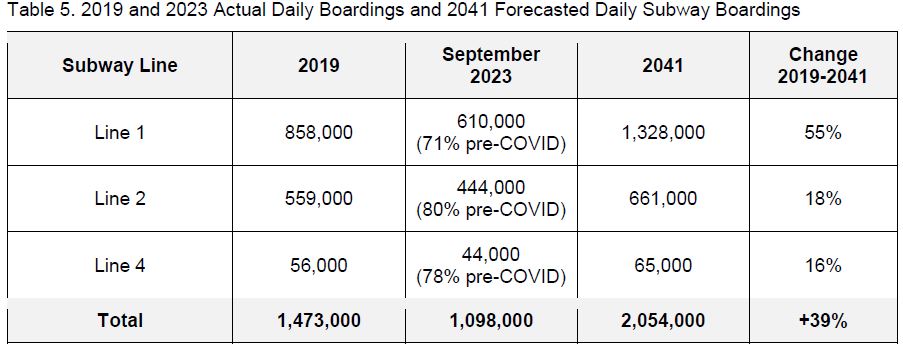
In the short term, the TTC has been “saved” from a capacity crisis by the covid pandemic and the loss of subway riding. Only a few years ago, the concern was not empty trains, but platforms full of riders who could not move. Although the subway is not back at full demand, recovery is well underway. Here are historical figures and projections for the future from the report.
2041 might sound a long way off, but in the scheme of subway fleet planning, it is fairly near given both the lead time to buy new trains and their 30-year design life. What we plan for today will affect the system for decades to come.
This forecast will be updated with results from the current Transportation Tomorrow Survey and other planning work to provide an outlook to 2051.
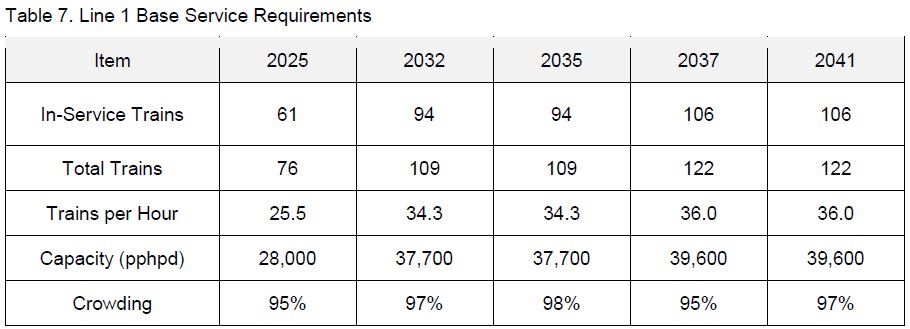
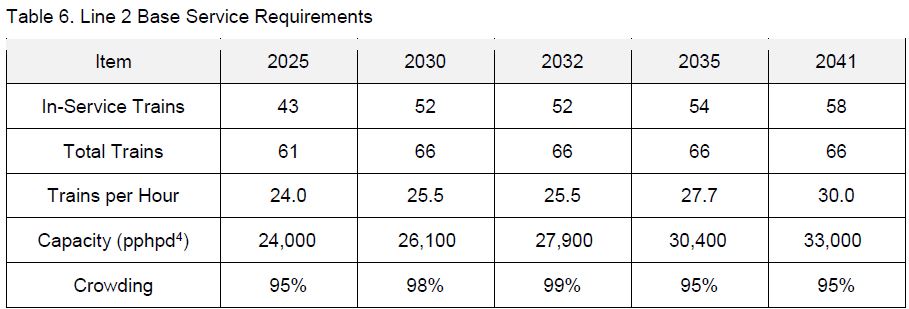
These projections translate to service requirements on the two lines. Note that this is likely based on the historical ratio of peak to all day demand. Although work-from-home may shift some riding away from peaks especially on Mondays and Fridays, this would still leave the midweek days facing crowding. It would be dangerous to make plans for lesser demand as a short-term cost saving measure.
Line 1 has already been converted to Automatic Train Control (ATC) with moving block signalling that can handle more trains/hour. Note that the projected Line 1 service is at 36 trains/hour, or every 100 seconds. This will be challenging to sustain especially at busy stations and terminals.
The current signal system on Line 2 cannot support headways below about 140 seconds, the pre-pandemic peak service level on that route. This is equivalent to 25.7 trains/hour which gets us only to the 2032 projected requirement.
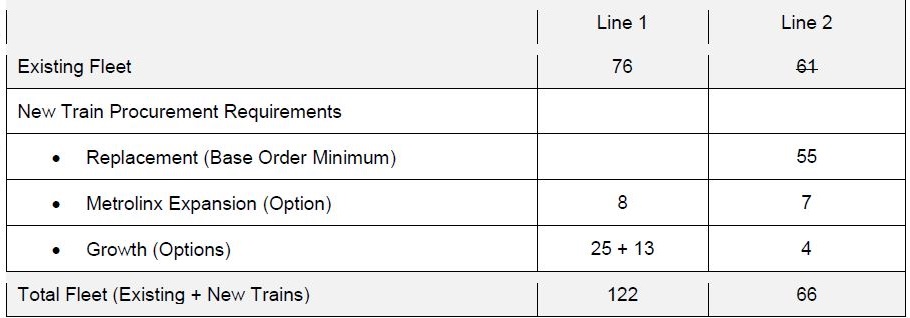
This translates into the following requirements for a larger fleet.
The 55-train replacement for Line 2 where there are now 61 trains is based on the capacity with new trains (similar to those now on Line 1) with about 10% more room than the old ones. This finally addresses the excess of T1 trains in the fleet ever since the TTC decided to run Lines 1 and 4 entirely with new “TR” trains and ATC, and relegated the T1 fleet to Line 2.
The Metrolinx options are for the Richmond Hill and Scarborough extensions. Growth trains are to permit the operation of more frequent service than the existing fleet can support.
Note that Line 4 Sheppard is not included here as it has a dedicated set of six 4-car trains that can handle projected growth on that line. Depending on the extension of Line 4, a future procurement of trains and storage facilities could be required.
In the remainder of this article, I will describe the scenarios and implications of choices the TTC, Council and its funding partners will make in the near future.
Recommendations
The report recommends that:
The TTC prioritize funding in the capital budget for:
New subway cars and related projects with a cost of $3.2 billion as the City’s share.
A 30-year state of good repair overhaul of the T1 fleet.
Risk mitigation activities for Line 2 related to fleet and signal system life extension.
Subject to confirmation of funding, the CEO issue an RFP for new trains needed on the existing Line 2 with options for extensions and demand growth on the system.
This will have effects not just for subway planning but for other TTC capital project funding and timing.
The 2024 Annual Service Plan will be presented by TTC management at the November 22, 2023 meeting of the TTC Board. It is a 219 page long document, and I have boiled down the highlights here.
This report really should have been subdivided into digestible parts because it simply will not be absorbed by even the most dedicated transit nerd, let alone by the Board and Council responsible for setting policy. In particular, there is no discussion of the budgetary implications and option of proposals in this plan, and therefore no basis for discussion in the pre-budget consultations now underway.
This plan’s origins go back a few years, and its size is partly due to being a compendium of past years’ proposals. Two large groups are associated with the opening of Lines 5 Eglinton and 6 Finch which were expected to occur earlier than 2024. Another large group arises from area studies in various parts of the city. Still others come from the analysis of poorly-performing routes, a process that has been on hold during the covid years.
Despite implementation delays, consultation continued with a variety of online and in person sessions going back to 2022, some in support of the upcoming Five Year Plan for 2024-28 (which I will review in a separate article).
Through many sessions, TTC heard a message loud and clear about what riders and their own staff want to see:
The key priorities include:
Service reliability – on-time service when expected and predictable travel times.
Frequency – vehicles come more often and reduced crowding and wait times on routes.
Safety – physical safety when travelling at night or during quiet periods.
Communication – accurate and clear communications, especially during service disruptions.
2024 Annual Service Plan at p 5
Poor communications are repeatedly flagged in surveys and Service Plan consultations, but reorganization and improvement of TTC’s various information channels lies outside of the plan’s scope even though it is badly needed.
Both riders and operators flagged crowding as a problem. There is an issue with the reporting of ridership that masks crowding by looking only at rolled up weekly or annual statistics, and routes as a whole rather than trips.
TTC reports its ridership recovery relative to pre-pandemic times on a weekly basis, and for budgetary purposes, on an annualized basis. This brings two problems:
Weekly numbers do not account for day-to-day variations. Midweek days are known to be busier than Mondays and Fridays due to work-from-home patterns, and weekends are already reported with stronger recovery. With two lighter days in the mix, the recovery will not be uniformly distributed, and crowding will be a greater problem on the busy midweek days.
In a recovery scenario, ridership growth over a year will mean that the revenue versus historic data will be an average from the start to the end of the year. This will understate the situation “now” in the fourth quarter, let alone the needs going into a new budget year.
The Service Plan report includes more detail:
For September 2023, ridership averages approximately 78% and revenue averages approximately 77% of pre-pandemic levels. In comparison to budget, ridership was expected at 75% and revenue at 74% of pre-pandemic levels.
Similar to pre-COVID experience and in line with seasonality, weekly ridership increased in September. However, September ridership increased more than expected, averaging ~5% above budgeted levels for the Period, with ridership likely to remain at these levels for the balance of year. During Period 9, 2023, up to 97% of unique PRESTO riders used the system each week. While riders have returned to the system, the travel frequency of the riders has dropped. For example, the number of unique riders classified as “commuters” (i.e. ride four of five weekdays per week) are at 65% of March 2020 levels, whereas riders who use transit less frequently (ride less than four weekdays per week) are at 121% of March 2020 levels.
Day-of-week use is highest and consistent across Tuesday to Thursday, averaging approximately 76% of pre-COVID levels for Tuesday through Thursday during Period 9. Weekend recovery is at approximately 90% of pre-COVID levels, consistently stronger than weekday recovery.
2024 Service Plan at p 22
Emerging travel patterns from changes to work patterns – downtown office occupancy has averaged at approximately over 50% through the first half of 2023, representing between 2 and 3 days of in-office work per week. Peak day office occupancy has averaged at almost approximately 70%. This creates variability in travel demand by day-of-week and resulting challenges in scheduling the right capacity.
2024 Service Plan at p 23
Too many politicians, budget hawks especially, look at the average numbers without recognizing the difference between these and the current day-to-day requirements.
The preliminary projections for budget show a range of ridership and revenue figures through 2024. Note that this shows a modest ridership increase, year-over-year, of only 2%. That affects both the available fare revenue (from a budgetary point of view) and the mindset behind service improvements, if any.
2024 Service Plan at p 27
The Service Plan echoes a familiar refrain from the Ford and Tory eras: service improvements will only come if they can be offset by savings elsewhere. Overall, planning is a zero-sum game and key changes such as rapid transit expansion can elbow aside other deserving services. Ridership growth brings more revenue, but not enough to offset the cost of more service. Unless Council allocates more money for subsidies, transit service remains mired in small-scale tweaks with little hope for network wide change.
Even worse, a decision to withhold funding at budget time echoes throughout the year. All the fine words about a return to service and the importance of transit ring hollow when the phrase “subject to budget availability” clouds every proposal. In 2023, the TTC had an unexpected budgetary nest egg with the unused headroom for Line 5 opening. That will not be repeated in 2024 and beyond
The report has an intriguing note about the Service Standards changes that came in with the 2023 Budget. This was a controversial action not just taken unilaterally by management before Board approval, but followed by stonewalling about what effects the new standards would have on service. It should not have required an FOI request to pry this information loose from management’s grip. Quite clearly, someone in this town did not want the effects of budgetary limitations to be known. “Transparency” was not a priority.
The 2024 Plan states:
In spring 2023, as the pandemic impacts on customer demand were expected to have stabilized, we realigned our transit services to pre-pandemic peak service standards with confidence that service levels will be appropriate for the customer demand. A temporary adjustment to the TTC Board-approved Service Standards was approved through the 2023 Budget. The realigned service plan protected periods of service and network coverage on all routes. As part of the ongoing service reliability program, schedules were adjusted to reflect actual operating conditions throughout the year.
This resulted in changes to 47 routes to match capacity to customer demand and to modify schedules to reflect current operating conditions and congestion. These changes represented a better calibration of scheduled service to today’s context. Demand-responsive service was also operated to protect for unforeseen changes to customer demand, travel patterns, and construction.
2024 Service Plan at p 14
What is not clear is when, or if, there is any plan to reverse this “temporary” change which saw off-peak standards revert to a level predating the ridership growth initiatives of Mayor Miller’s era. The 2024 plan talks about a review and update of the Service Standards as part of the Five Year Plan, but there has been no mention of this in the consultation sessions for that plan.
Meanwhile, the TTC acknowledges that it fails to achieve its current standards. Note that there are five daily periods from the AM peak through late evening, and a few hundred routes making a total of roughly 1,000 “periods” for comparison. A 92% figure may not sound bad, but much depends on the times and locations of that 8% (roughly 80 periods) that don’t make the grade. Beyond that 8% on average, a portion of trips on “acceptable” routes will be crowded thanks to uneven loads, gaps and bunching. This illustrates the danger of reporting averages rather than specifics.
It should also be noted that the “temporary” 2023 standards set off-peak crowding levels only slightly below peak levels as against earlier standards of a seated load, or seated plus 10%, that used to apply. This is a particular problem due to the extra space needed for baby carriages, shopping carts and mobility devices all of which tend to be seen more at off peak in anticipation of less crowding. The Service Standards make no provision for this type of demand and space usage.
2024 Service Plan at p 32
The 2024 plan explicitly states that the standards adopted in early 2023 will continue to be applied.
Service adjustments will continue to be consistent with TTC Service Standards, which were applied to the system-wide realignment exercise to match service to ridership demand in the spring of 2023.
2024 Service Plan at p 27
This puts Mayor Chow’s desire to restore full service in question, and shows how TTC management continues to resist proposing a more aggressive service policy.
This morning, after a ceremony at Leslie Barns, car 4604 entered service on 504 King. It is running as an extra and is not visible to tracking apps, but can be located with a vehicle-specific search such as this on Transsee.ca. As I write this just after 3pm on November 17, the car is headed back to Leslie Barns.
The second car of the new set, 4605, is in Russell Carhouse. The remaining vehicles in the 60-car order will be delivered from now through 2025.
The real question remains what the TTC will do with these cars. Of the 204 they already own, the peak service has rested at about 140 cars for a few years. In February 2020, pre-pandemic, it was about 160. This is not just a question of construction projects and bus replacements, but of the TTC’s operating budget and staffing levels which prevent full fleet utilization of any mode on the system.
Lacking in TTC budget information, especially notable at a time when Mayor Chow calls for open dialog and transparency, is a clear statement of how much service the TTC can actually operate at various funding levels.
It is convenient for management to point to system ridership at about 80% of pre-covid numbers, but this does not account for the unequal level of recovery through the week. Weekends are already a time of strong demand, and Sundays are running above pre-covid levels.
Weekdays might, on average, be lower than historical numbers, but a well-known issue is that Tuesday through Thursday are the busiest days when more people come to work. On average, weekdays might be below early 2020 levels, but the TTC does not report how this demand is spread by day, and complaints of crowding are common.
Openness in budget and service planning might aid the debate, but so far proposals have been more “business as usual” with an asterisk beside possible improvements due to budget constraint. The freshly minted TTC Board has yet to demand a wider range of options, the costs they would entail, and an analysis of the TTC’s ability to actually field more service.
The 2024 Service Plan is part of the TTC Board’s November 22 agenda, and I will report on it in a few days (it’s a thick agenda this month).
Two new cars with more to follow are welcome, but they will simply add to the 30% of the streetcar fleet that sit idle every day, far more than should be needed for maintenance spares. It is the classic budget problem: money for new capital purchases, but no money to operate them.
The construction work on Broadview north of Danforth has not run particularly quickly with a few intervals where nothing happened at all for over a week. This appeared to be not the TTC’s problem, but rather the contractor, Sanscon, who simply did not have anyone working on site at times.
As of November 16, they have only now reached the point of excavating the north end of Broadview Station Loop. Both track and concrete are incomplete, albeit progressing, on Broadview and at the loop entrance. Broadview Avenue cannot reopen until this track work has finished and the pavement is restored.
The reopening of the station for bus service is now expected in December (exact date unspecified).
The schedules for “normal” operation at Broadview Station are already in place, but service will operate in an interim configuration pending completion of work at the station.
8 Broadview will operate from Broadview & O’Connor Mortimer to Warden Station. It will no longer interline with 62 Mortimer. [Corrected 6:35 pm, November 16]
62 Mortimer will operate from Broadview & Mortimer to Main Station. It will no longer interline with 8 Broadview.
87 Cosburn will continue operating to Pape Station via Mortimer and Pape.
72 Pape will no longer provide replacement service for Broadview Avenue, but this will be taken over by a 504/505 shuttle. 72A Pape will no longer be interlined with 100 Flemingdon Park.
100 Flemingdon Park will operate from Pape Station independently of 72A Pape.
The 504/505 Broadview shuttle will operate from Castle Frank Station to King & Parliament via Bloor, Danforth, Broadview, Queen and King, and it will use on-street stops at Broadview & Danforth.
304 King Night Bus will operate from Castle Frank Station east to Broadview and then over the 504 King daytime route to Dundas West Station.
322 Coxwell Night Bus will divert to Pape Station.
When Broadview Station Loop reopens, routes 8, 62, 87, 100, 504/505, 304 and 322 will resume their normal routes to that loop.
The TTC has not yet published information about on street stops for the temporary western terminals of 8 Broadview and 62 Mortimer.
Here are two views of construction work at the north end of Broadview Station on November 16.
Looking SW from Erindale to BroadviewLooking S into Broadview Station from Erindale
Streetcar operation to Broadview Station will resume in mid-February 2024 following sewer rehab work by Toronto Water.
Although there was no regular TTC Board meeting in October, a CEO’s Report was issued for that month. It contains two separate sets of charts about ridership, one more recent than the other.
In the CEO’s commentary, data for the week ending October 13 are cited:
For the week ending October 13, excluding Thanksgiving Monday, the TTC’s average weekday boardings stand at 82 per cent of pre-COVID levels, or 2.55 million boardings. Weekend ridership continues to exceed weekday demand, being 96 per cent for this week. Bus boardings are leading recovery, at 96 per cent of pre- OVID levels, while streetcar boardings sit at 65 per cent and subway at 73 per cent. Wheel-Trans ridership is at 75 per cent of pre-COVID levels.
October 2023 CEO’s Report p 5
The chart of ridership only goes to the end of August, and reports an expected seasonal decline for that period. Fare revenue follows the same pattern.
October 2023 CEO’s Report p 10October 2023 CEO’s Report p13
The chart of boardings runs to early October, and shows September’s jump in demand.
CEO’s Report October 2023 p 25
Crowding levels continue to rise, although stats are reported only for the bus network. An important issue about this chart is that it reports all-day values. There are many routes with uneven demand by direction, and with more lightly-loaded trips at some times of the day or week. Even at the pre-covid demand of January 2020, only 27% of trips reported more than 70% of capacity. However, depending on where and when they are concentrated, they can have a disproportionate effect on the perceived crowding level. An empty bus at 10pm on Sunday evening is of little use to someone who cannot board a packed weekday bus on a busy route in the peak period.
CEO’s Report October 2023 p 26
There are two issues that might skew some of the quoted statistics.
First, with the conversion of the SRT from rapid transit to bus, an additional set of “boardings” is created. Boardings for the subway network are treated as a single event with no extra count for transfers between lines. With the SRT replaced by the 903 Scarborough Express bus, former SRT trips create an extra boarding for that leg of their journey. This will change again on November 19 when many bus routes formerly ending at STC will be extended to Kennedy Station, and that leg will no longer count as a separate boarding.
Second, boardings are counted based on the mode actually operating on a route. If buses replace streetcars, the riders count toward the bus total, not the streetcar total.
In January 2020 (pre-covid), the streetcar route service was provided by:
501 Queen: Streetcars from Neville to Long Branch, except for 6 bus trippers in each of the peak periods.
502/503 Downtowner/Kingston Road: Buses on a combined 503 route.
504 King: Streetcars
505 Dundas: Buses
506 Carlton: Streetcars except for 8 bus trippers in the AM peak.
508 Lake Shore: Streetcars
509 Harbourfront: Streetcars
510 Spadina: Streetcars
511 Bathurst: Streetcars
512 St. Clair: Streetcars
Over the past years, various construction projects, notably on Queen, have caused bus substitutions and diversions accompanied by declining reliability and challenges for riders in how to get from “A” to “B”. Comments like “I’ve given up on the TTC” are not uncommon, and yet for a large part of the city served by buses, demand is strong.
By October 2023, 503 Kingston Road and 505 Dundas had reverted to streetcar operation, 512 St. Clair operated with buses, and the bus trippers on 501 Queen and 506 Carlton had been removed.
Construction on Broadview causes the east end of 504 King to be replaced by buses, and 505 Dundas streetcars divert to Woodbine Loop. This is expected to end in February 2024. A partial or complete return date for 512 St. Clair service is not yet certain.
It is not clear when the TTC speaks of streetcar ridership recovery whether this refers to the network of streetcar routes regardless of the mode actually operating, or if only riders who are actually on streetcars are counted. I have a query in with TTC to clarify this.
Update: The TTC has confirmed that total riding on the streetcar network is agnostic about the vehicles actually used on these routes.
The TTC’s Planning page does include a chart of streetcar route boardings from 2019 to 2022, but does not reflect the substantial growth in system riding overall in 2023. Note also that these are annual totals that will not reflect current daily demand because of growth through the recovery years.
2023 figures, when they are published, will be affected by the number of construction projects that disrupted streetcar service and the constant wandering paths of some substitute services.
The TTC plans many service changes for November 19 of which the largest group relates to the Line 3 replacement bus service. Other groups of changes include the restoration of service at Broadview Station, the return of streetcar service to Long Branch, and the closure of Lawrence Station bus loop for accessibility retrofits.
Notable by its absence is any change in subway service.
Although the list of routes affected is substantial, there is little change in the total number of vehicles in service. Bus service during the AM peak gains 3 vehicles, and in the PM peak loses 10. Streetcars gain 8 due to the restoration of 507 Long Branch service. This is only a rebalancing of resources across the system.
Much of the additional service operated in 2023 was due to construction projects, while the basic service level on the system did not change much until late in the year. We have yet to see budget proposals for the 2024 service levels.