GO Transit to Take Over UP Express

According to Oliver Moore in The Globe, the separate Metrolinx division responsible for the Union Pearson Express will be placed under GO Transit’s control. The fate of UPX President Kathy Haley is unclear.

UPX even managed to win awards from the Global AirRail Alliance for:

2015 Travelport Project of the Year – UP Express

2015 AccesRail Integrated Partnership of the Year – UP Express

2015 Personality of the Year – Kathy Haley, UP Express

2014 Air Rail Concept of the Year – UP Express: Strategic Partnerships, Toronto, Canada

2014 Travelport Project of the Year – UP Express: The Airport Connection

2013 Travelport Project of the Year – Union Pearson Express Project

One wonders who they were competing against, but the Alliance’s site does not list nominees, only winners. It is am impressive “project” that can rake in the hardware before ever carrying a passenger or proving its viability as a business. Such is the back-scratching nature of the industry, I must assume.

While it may be convenient to target Haley as the culprit here, the real question is how the structure and corporate attitude that led to UPX’ creation arose in the first place. From the beginning, this has been a project for which the word pretentious is almost inadequate. Despite the abandonment of this scheme by its original private sector proponent – for the simple reason that it was judged financially unsound – Ontario forged on with this as a signature project, part of the Bid Book for the Pan Am Games. We would show the world what Ontario could do.

Haley may take the fall for this fiasco, but she worked for a board who lapped up the praise, who bought into the flawed vision of what UPX would become. That board, and the government who set all of this in motion to begin with, owe us all an explanation.

When Is a GO Train not a GO Train? When It’s UPX!

Among the mysteries of the internal organization at Metrolinx is the presence of separate “divisions” for GO Transit (the commuter rail service), Presto (the fare card service) and UP Express (the premium fare airport shuttle service).  Rather than using the GO brand for the airport service and integrating its operation and fares, Metrolinx treats UPX as a completely separate entity, no doubt so that it could isolate the operation as a profit centre on the books. We now know that “profit” is the furthest thing from a UPX future where just finding riders now takes precedence.

Soon, fares on UPX will be much lower and this might encourage some to incorporate the UPX into their journeys. However, there are two glaring holes in the new arrangement.

UPX, being a separate operation, does not have fares integrated with connecting GO services at Union. Riders transferring between these services will pay separate fares for each leg of their journey. Presuming that UPX fares stay low, this should be corrected, at the latest, in the next annual review of GO’s tariff.

But the really bone-headed decision (or lack of decision) lies with the TTC. Although GO fares discourage “local” travel within the 416, there is a legal transfer move a rider can use called TTC Times Two. A trip can start on the TTC, transfer to GO, and then back onto the TTC again using the original TTC transfer.

With UPX moving to lower fares and the likelihood that it will attract commuter trade within the city, the question becomes “is TTC Times Two valid for UPX”? I asked the TTC’s Brad Ross and Chris Upfold this question at the recent TTC Board meeting. Their answer? “No” because (a) UPX is not a GO train and (b) a TTC policy change would be required.
The irony, of course, is that GO operates in the same corridor as UPX, and it would be impossible to distinguish whether a traveller with a transfer from the Lawrence 52 bus arrived at Union Station via GO or via UPX, except of course that GO service only runs in the peak period.

During the March 1 subway shutdown thanks to a power vault fire, TTC riders travelled on GO and UPX for no extra charge. The reverse courtesy has been extended to GO riders on occasion. This did not require a formal meeting and policy decision, simply the recognition that there is one transit network regardless of the logo on the train.

How riders get from one connection point to another should not matter. Between now and March 9 when the new UPX fares take effect, can someone at the TTC show a small spark of initiative and decide that a traveller on either a GO or UPX train can use TTC Times Two? Or will we continue to have an artificial distinction between two services provided on the same track by the same agency?

TTC Board Meeting Review: February 25, 2016

The TTC Board met on February 25, 2016. This article is a review of some of the reports and discussions at that meeting. For the full list, please refer to the agenda.

In this article:

As part of an update on cycling initiatives, the Board passed a motion asking staff to work together with the City on improved parking facilities for bicycles at subway stations. An article on this appeared on Torontoist’s website.

Continue reading

TTC Streetcar Track Plans 2016-2020

My apologies to readers for not posting this information sooner. There has been an inconsistency between schedule information for a major project on the west end of the Queen line between the TTC’s five-year plan taken from their capital budget, and the City of Toronto’s Transportation Services plans. The TTC still has not provided updated information to resolve this although it was requested some weeks ago.

The five-year plan for streetcar track renewal was part of the 2016-2020 Capital Budget. Whether all of this work will actually occur as planned remains in doubt because the relevant budget lines are subject to limitations on capital spending imposed by Council.

StreetcarTrackPlan20162020

(Source: Adapted TTC 2016-2020 Capital Program, Streetcar Track Plan pp 5-7)

The notes in the plan above show the changes in 2016 from the version in the 2015 budget.

With this plan, the TTC has reached a “steady state” replacement plan for track thanks to construction of more robust infrastructure including new track foundations, the use of steel ties, and a return to continuously welded rail strings with thermite welds where needed. Special work is now laid in panels and, like the tangent rail, is better welded so that intersections do not fall apart only a few years after they are installed.

Planned dates for some of the 2016 work have already been announced:

  • Work at CNE Loop, integrated with a GO Transit project, is already underway
  • Roncesvalles Carhouse work will begin in late March
  • Charlotte Street Loop will be rebuilt from March 29 to April 22
  • College & Bathurst will be rebuilt from June 20 to July 22
  • College & Lansdowne will be rebuilt from July 18 to August 15

Continue reading

TTC Service Changes Effective Sunday, March 27, 2016

The major changes for the new schedules effective March 27 involve routes where new express services will be added.

25 Don Mills

A new service, the 185 Don Mills Rocket, will operate weekdays until mid-evening, and weekend daytime. The combined service at express stops will improve over current schedules, while service at local stops will decrease.

The stopping pattern for the 185 Don Mills Rocket will be:

  • Northbound: Buses stop only at Cosburn Avenue, Thorncliffe Park Drive (west leg), Thorncliffe Park Drive (east leg), Don Mills Road/Gateway Boulevard (south leg, north side), St. Dennis Drive (Ontario Science Centre), Eglinton Avenue East, Green Belt Drive, Lawrence Avenue East, York Mills Road, Graydon Hall Drive, Parkway Forest Drive, Don Mills Station, Van Horne Avenue, Finch Avenue East, McNicoll Avenue, Steeles Avenue East, Freshmeadow Drive/Don Mills Road.
  • Southbound: Buses stop only at McNicoll Avenue, Finch Avenue East, Van Horne Avenue, Don Mills Station, Havenbrook Boulevard, Duncan Mill Road, York Mills Road, Lawrence Avenue East, Barber Greene Road, Eglinton Avenue East, St. Dennis Drive (Ontario Science Centre), Overlea Boulevard/Don Mills Road (west side), Thorncliffe Park Drive (east leg), Thorncliffe Park Drive (west leg), Cosburn Avenue, Pape Station.

39 Finch East

Services on Finch East will be reorganized:

  • Route 139 Finch-Don Mills will be discontinued.
  • Route 199 Finch Rocket will be extended west to York University weekdays during the daytime and early evening, and east to Morningside Heights during peak periods.
  • The 39C Seneca College branch will be extended east to Gordon Baker Road.

The stopping pattern for the 199B Finch Rocket to York University will be:

  • Eastbound: Buses stop only at Murray Ross Parkway & Busway, Dufferin & Finch, Bathurst Street, Finch Station, Bayview Avenue, Leslie Street, Don Mills Road (farside stop), Seneca Hill Drive, Victoria Park Avenue, Pharmacy Avenue, Warden Avenue, Birchmount Road, Kennedy Road, Midland Avenue, Brimley Road, Finch & McCowan, McCowan & Sheppard, and Scarborough Centre Station.
  • Southbound: Buses stop only at McCowan & Sheppard, Finch & McCowan, Brimley Road, Midland Avenue, Kennedy Road, Birchmount Road, Warden Avenue, Pharmacy Avenue, Victoria Park Avenue, Seneca College, Don Mills Road (farside stop), Leslie Street, Bayview Avenue, Finch Station, Bathurst Street, Dufferin & Finch, Murray Ross Parkway & Busway, and The Common.

The stopping pattern for the 199C Finch Rocket to Morningside Heights will be:

  • Eastbound: Buses stop only at Bayview Avenue, Leslie Street, Don Mills Road (farside stop), Seneca Hill Drive, Victoria Park Avenue, Pharmacy Avenue, Warden Avenue, Birchmount Road, Kennedy Road, Midland Avenue, Brimley Road, McCowan Road, then all local stops east of McCowan Road.
  • Southbound: Buses stop at all local stops to McCowan Road, then stop only at Brimley Road, Midland Avenue, Kennedy Road, Birchmount Road, Warden Avenue, Pharmacy Avenue, Victoria Park Avenue, Seneca College, Don Mills Road (farside stop), Leslie Street, Bayview Avenue, and Finch Station.

44 Kipling South

A new service, the 188 Kipling South Rocket, will provide an express service to Humber College Lake Shore Campus weekdays during peak and midday periods.

The stopping pattern for the 188 Kipling South Rocket will be:

  • Northbound: Colonel Samuel Smith Park Loop, Colonel Samuel at Humber College Building M, Colonel Samuel at Lake Shore Boulevard, Kipling at Birmingham, Kipling at Evans, Kipling at The Queensway (farside stop) and Kipling Station.
  • Southbound: Kipling Station, Kipling at The Queensway (far side stop), Kipling at Evans, Kipling at Birmingham, Kipling at Lake Shore Boulevard, Colonel Samuel at Humber College Building M, Colonel Samuel Smith Park Loop.

24 Victoria Park

A new peak period express service will be added.

The stopping pattern for the 24E Victoria Park Express will be:

  • Northbound: Buses stop only at St. Clair Avenue, Eglinton Square, Eglinton Avenue (farside), Lawrence Avenue, Rowena Avenue, Ellesmere Road, Pachino Avenue, Sheppard Avenue, Finch Avenue, McNicoll Avenue, and Steeles Avenue.
  • Southbound: Buses stop only at Steeles Avenue, McNicoll Avenue, Finch Avenue, Sheppard Avenue, York Mills Road, Parkwoods Village Drive, Rowena Avenue, Lawrence Avenue, Eglinton Avenue, O’Connor Drive, St. Clair Avenue, and Victoria Park Station.

96 Wilson

The Wilson route will be broken into four separate designations to simplify scheduling (eliminating interlining between some branches).

  • The 96E Wilson Express to Humber College will be replaced by the new 186 Wilson Rocket. This route will operate during the peak periods and weekday middays (the 96E is peak only).
  • Route 118 Thistle Down replaces the 96C service.
  • Route 119 Torbarrie replaces the 96G service.
  • Both routes 118 and 119 operate from Wilson Station during all periods. The 96 services they replace operated from York Mills Station during peak periods.

The stopping pattern for the 186 Wilson Rocket will be:

  • 186 eastbound: Buses will stop at Humber College Bus Terminal, Westmore Drive, Martin Grove Road and John Garland Boulevard, Kipling Avenue and Brookmere Road, Islington Avenue and Elmhurst Drive, Armel Court, Albion Road and Weston Road, Walsh Avenue and Weston Road, Clayson Road, Jane Street, Julian Road, Keele Street, Dubray Avenue, Dufferin Street, Wilson Station, Bathurst Street, Avenue Road, and York Mills Station.
  • 186 westbound: Buses will stop at York Mills Station, Avenue Road, Bathurst Street (far side), Wilson Station, Dufferin Street, Dubray Avenue, Keele Street, Julian Road, Jane Street, Clayson Road, Walsh Avenue and Weston Road, Albion Road and Weston Road, Armel Court, Islington Avenue and Elmhurst Drive, Kipling Avenue and Brookmere Road, Martin Grove Road and John Garland Boulevard, Westmore Drive, and Humber College Bus Terminal.

Roncesvalles Carhouse Track Reconstruction

Reconstruction of the north ladder tracks will require that cars back out of the yard onto The Queensway, loop west through Sunnyside Loop, and enter service eastbound from that point. Schedules for all routes based at Roncesvalles will be adjusted with extra running time for their departure trips.

Charlotte Street Track Reconstruction

Track on Charlotte from Adelaide to King will be replaced. During this work, the 510 Spadina service that normally short turns there will be extended south to Queens Quay.

Service arrangements for 504 King during the reconstuction of the King-Charlotte intersection have not yet been announced.

Harbourfront Route

This route will now be designated as a 100% low floor route. In the event that Flexitys are not available, ALRVs will be used in their place. Schedules will be adjusted to remove some of the extra running time that had been added for Queens Quay construction.

2016.03.27 Service Changes Rev1

There’s A New Subway On The Way (7)

February 25, 1966, saw the ceremonial first train operate over the Bloor-Danforth line, but it was also the last day of service on many streetcar routes.

The fans, of which I was a very junior member in those days, were out in force trying to ride as many “last cars” as possible. This took some careful planning, and it was not physically possible to be everywhere.

The Bathurst service to Adelaide and the St. Clair service to Weston Road were rush-hours only, and so these were the first to be visited. It was a very dim late February afternoon as people photographed the last car to Avon Loop at Rogers Road. The destination signs said “Northland”, the name of a loop further south that had been replaced by Avon years earlier (before I was born), but the roll signs were never changed.

Next to go was the Parliament car, a route that operated until just after midnight. It was a short shuttle from Bloor at Viaduct Loop to King at Parliament Loop, but it was an important line it its day. The trackage was also used at times to route some King cars to Broadview & Danforth avoiding the congestion of streetcars at eastbound Queen & Broadview that could back up from the intersection to the Don Bridge on a bad day.

That Parliament car on its trip in to Danforth Carhouse conveniently crossed Pape & Danforth just before the last westbound Harbord car whose operator faced an unexpected surprise waiting at his first stop. Harbord wandered through the city in a vaguely U-shaped route from Pape & Danforth (see description below) to Davenport & Lansdowne. The running in trip down Lansdowne to the carhouse brought us to Bloor Street where it was time for a 3 am snack and a wait for what would be one of the two “last” Bloor cars.

The Bloor trip took us to both Jane and Luttrell Loops, and the car became so crowded as the night wore on that we started to leave passengers at stops. It was not quite dawn when the car pulled in to Lansdowne Carhouse, and everyone walked down the street to the brand new subway entrance where the Bloor night car transfer got us on to complete the night’s entertainment.

Many routes were affected by the subway’s opening.
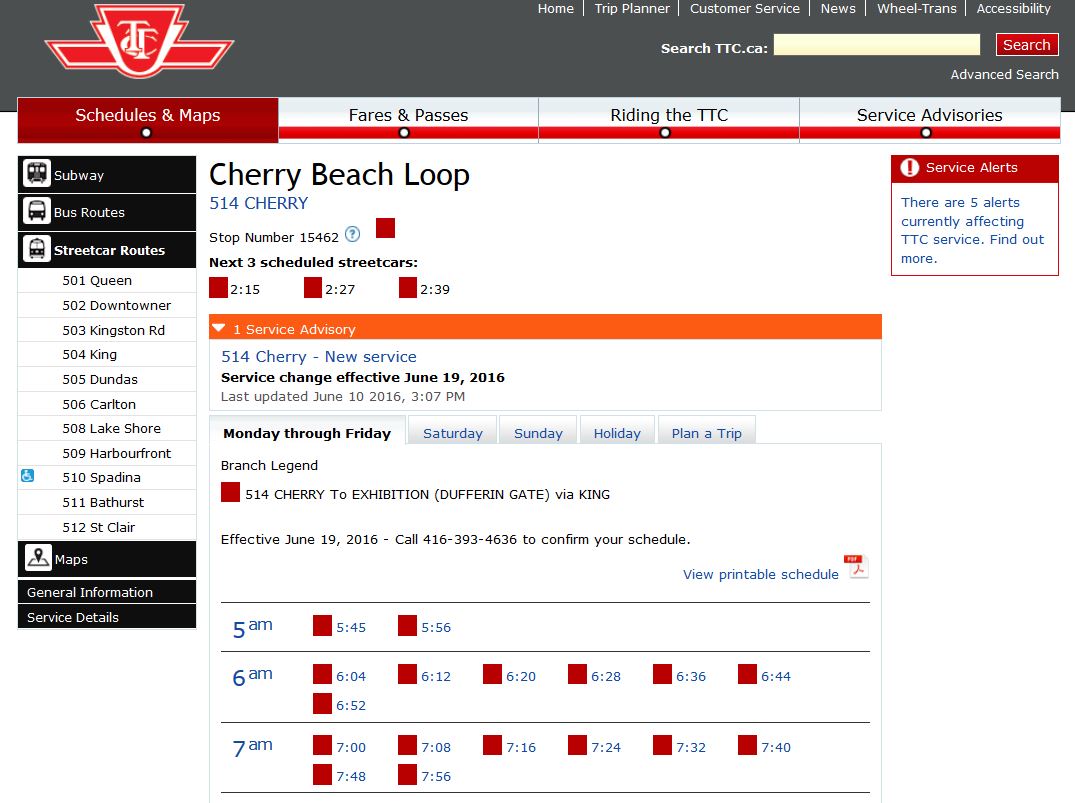
The Bloor and Danforth routes vanished except for shuttles on the outer ends that would operate until the first of the BD extensions opened in 1968.

Jane Loop has been replaced by a new office building and parking lot, although the TTC history is still visible from the old traction pole sporting a Canadian flag on Google Street View. Bedford Loop, a terminus for peak-only services on Bloor-Danforth has vanished under the OISE building and a parkette. Hillingdon Loop (a peak-only short turn at Danforth Carhouse) now hosts a branch of the Toronto Public Library. Luttrell Loop is now occupied by housing that is newer than its surroundings, but the role as a TTC loop is clear from the road layout and the still-present traction pole.

The Parliament car was replaced by the 65 Parliament bus operating to Castle Frank Station at its north end. Viaduct Loop was abandoned and is now a parkette. Parliament Loop at King was for many years the terminus of the bus until it was extended south and west to serve the St. Lawrence district. The loop is now a parking lot for a Porsche dealership.

This was part of a complicated land swap some years ago between the TTC, the dealership and the Toronto Parking Authority. The TTC had plans to build a new streetcar loop on Broadview north of Queen where there is now a parking lot, the City wanted the land south of Front once occupied by the dealership as part of the “First Parliament” site, and the TPA wanted replacement parking if the TTC built on its lot. The dealership moved to the TTC lands, the City got the land south of Front, and the TTC bought a vacant lot on Broadview for a new TPA lot to replace the capacity that would be lost when the loop went in. The loop has never been built.

Much of the track used by the Coxwell car (daytime route, just like 22 Coxwell today) and Kingston Road-Coxwell (weekends and evenings, again just like the bus) remains in place from Coxwell & Gerrard south, east via Queen, and northeast via Kingston Road to Bingham Loop. Coxwell cars used a very small loop on the southeast corner at Danforth now occupied by a commercial building, and Coxwell-Queen Loop which still exists. The track north of Gerrard remained operational for some months after the subway opening and Carlton cars preferentially used it to loop at Danforth Carhouse rather than Coxwell-Queen when short-turning. Eventually, the power was cut and overhead removed. The carhouse remained active as a storage site for PCCs that were rotated into the pool used by Russell Carhouse, but the link was via Danforth, not Coxwell.

The Harbord car, whose route I described earlier, ran from Pape and Danforth at Lipton Loop (replaced during station construction by Gertrude Loop) to St. Clarens Loop at Lansdowne and Davenport. The route meandered a lot running south to Riverdale & Pape, a block west to Carlaw (jogging around the railway), then south to Gerrard (at the corner now home to the “Real Jerk” restaurant), west along Gerrard to Broadview, south to Dundas, west to Spadina, north to Harbord (finally on the street from which the route took its name), west on Harbord to Ossington, north to Bloor, west to Dovercourt, north to Davenport and west to Lansdowne. There had been track on Pape north of Lipton Loop for a proposed extension into the Leaside industrial district south of Eglinton, but this was never built due to the recession.

The Dundas car operated from Runnymede Loop to City Hall and service further east was handled by Harbord. With the subway opening, the routes were consolidated, and Dundas was extended east to Broadview Station. Various chunks of Harbord became other routes including the 72 Pape bus, 94 Wellesley, 77 Spadina (now 510 Spadina). Service on Dovercourt and Davenport was abandoned not to be replaced by bus routes until decades later.

The Carlton car, the only “zone 1” streetcar route in 1966 to retain the red ink from the days of multicoloured transfers, still operates over its old route much as the King car does although loops at Vincent and Erindale were replaced by Dundas West and Broadview Stations respectively.

The St. Clair and Earlscourt services were reorganized (this would happen a few times over the years until the “Earlscourt” route simply became a short-turn variant of St. Clair), and service to Weston Road was dropped. The 89 Weston trolley coach extension south from Annette to Keele Station provided a direct subway link for riders on Weston.

Bathurst and Fort were consolidated into a single route from Bathurst Station to Exhibition Loop which, in those days, was located where the Trade Centre (whose name changes with its sponsorship) is today. Service between St. Clair and Bloor was taken over by 7 Bathurst and 90 Vaughan which formerly shared Vaughan Loop at St. Clair with the streetcars. Service on Adelaide to Church (returning westbound via King to Bathurst) was abandoned. Active track remains on Adelaide today only from Spadina to Charlotte, and from Victoria to Church.

Where Should A Relief Line (East) Go? (Updated)

Updated February 24, 2016 at 10:40 pm: A map showing the various options for a Pape-Queen routing to downtown has been added at the end of this article.

The City of Toronto Planning Division has released the detailed technical scoring for evaluation of six possible routes for a Relief Line linking the core area to the Danforth subway.

The possible routes that survived a preliminary cull were:

  • A: Broadview to Queen crossing the Don River at Queen
  • B1: Pape to Queen crossing the Don River at Queen
  • B2: Pape to Queen, dodging south to serve the Unilever site before crossing the Don and swinging back to Queen Street
  • C: Broadview to King crossing the Don River at Queen
  • D1: Pape to King crossing the Don River at Queen
  • D2: Pape to King crossing the Don River at the Unilever site

Of these, the two Broadview options don’t fare very well, and the real debate is between the four remaining Pape options.

The scoring extends through many categories and pages, but to simplify things and understand just how each factor was ranked, I have consolidated the scores into a spreadsheet. (For the detailed evaluation, refer to the scoring document linked above.)

ReliefLineAlignmentScoringSummary

In place of the scoring system used in the city summary, I have converted each of the symbols to a numeric value:

  • Full moon = 4 points
  • 3/4 moon = 3 points
  • Half moon = 2 points
  • 1/4 moon = 1 point
  • New moon = 0 points

Within each major grouping of scores, the values were totalled and then normalized to the range of zero to one. For example, if a group contained 4 topics, then the maximum possible score is 16, and each alignment’s score is divided 16 to get a normalized value. This allows the scores from each group to be compared with each other.

At the end, the scores can either be summer individually (each topic counts equally), or the group averages can be totalled (each group count equally regardless of how many topics it contains) and normalized.

On a grand total basis, both the city’s technical evaluation and public feedback came to the same conclusion: even though there are variations between the four alignments, they all average out to a 3/4 score.

The point scores also come out close to the same with higher values on one item balancing lower values on others for, overall, an even ranking.

Quite simply, all other things being equal, the four alignments are more or less equivalent using this scoring system. However, the City opted for alignment B1 because, among other things, is is claimed to be cheaper and simpler to build.

The costs estimates in the City’s evaluation [at p.19] are:

  • $3.7-billion for either of the Pape via Queen options regardless of whether they follow Queen or King to the core
  • $4.0-billion for the Pape-Unilever-King option
  • $4.1-billion for the Pape-Unilever-Queen option

The ridership estimates are generally higher for the via King options, and higher still for the routes serving the Unilever site. In all cases, off-peak riding tends to be low compared to the rest of the network with roughly 2/3 of all boardings on the Relief Line being during the AM or PM peak. The effect is even more striking for configuration where frequent SmartTrack service at 12 trains/hour competes with the Relief Line for customers. This demonstrates the problem of a line aimed at primarily peak period “relief”. As and when we see projections for longer versions of the RL (to Eglinton or Sheppard), the balance of off-peak travel may change because the route will serve new subway territory, not simply provide an alternate route for existing trips.

Despite the even scoring overall, the preferred corridor was selected based on giving some criteria additional weight as shown in the table below.

201602_ReliefLineB1Selection

This evaluation, like so much other recent work, depends very much on the presumed presence of frequent SmartTrack service in the rail corridor. If that is found to be impractical, then the relative importance of the RL changes along with its appropriate alignment to serve the core. This is particularly critical at the Unilever site which would have only SmartTrack serving it if the RL stays on Queen Street.

One point above misrepresents the technical evaluation: both of the Queen Street crossing routes have the same cost estimate regardless of which route they take to the core area (Queen or King) and they share the same river crossing characteristics.

In summary, the choice “makes sense” in the limited context that a frequent SmartTrack service will actually be feasible and will be built. If SmartTrack cannot be provided on a five minute headway with a low fare, then the entire planning process will require a major rethink.

Updated February 24, 2016: The following map shows possible alignments for a route from Pape & Danforth to the core area. Notes on the map talk of a track connection at Danforth to provide access to Greenwood Yard. The technical scoring paper also mentions a southerly route under the rail corridor from Gerrard & Pape eastward. While this is longer, it would avoid the complexity of adding linking curves at Danforth.

201602_ReliefLinePapeOptions

There’s A New Subway On The Way (6)

From time to time, the question of just what constitutes “subway demand” comes up in various threads on this site. As a matter of comparison, here is the TTC Scheduled Service Summary for April 7, 1964.

Headways on the Bloor-Danforth service itself were quite impressive. Two-car trains of PCCs, roughly the equivalent of the new Flexity cars, ran throughout the day until mid-evening, and the peak headways shown below are for trains.

                          AM Peak         PM Peak
                          Hdwy   Veh      Hdwy   Veh
Bloor route                      100             110
  Jane to Luttrell        2'30"           2'30"
  Jane to Bedford                         4'00"
Danforth route                    30              48
  Bedford to Hillingdon   3'20"
  Bedford to Luttrell                     3'00"
Combined                         130             158
  Bedford to Hillingdon   1'26"
  Jane to Bedford                         1'32"
  Bedford to Luttrell                     1'22"

Jane Loop was at Bloor & Jane.
Luttrell Loop was on Danforth between Main and Victoria Park at the old city boundary.
Bedford Loop was at St. George Station.
Hillingdon Loop was at the east side of Danforth Carhouse east of Coxwell.

The Bloor-Danforth streetcars could not carry all of the demand into downtown, and that work was shared with many parallel routes.

  • 2’00” Bathurst car from Vaughan Loop (at St. Clair) to Church & Adelaide
  • 1’30” Carlton car
  • 1’40” Dundas car from Runnymede & Dundas to City Hall
  • 2’30” Harbord car from Lansdowne & Davenport to Pape & Danforth via Dundas & Yonge
  • 1’20” King car
  • 2’00” Kingston Road car (now “Downtowner”)
  • 5’00” Kingston Road Tripper car (Victoria Park to Roncesvalles & Queen)

The streetcar system required 640 cars in the am peak, 684 in the pm peak.

UPX Fares are Falling Down, Falling Down

After months of ignoring the obvious, Metrolinx and their Queen’s Park masters will lower fares on the Union Pearson Express.

UPXFares_20160309

Although the Board does not meet to ratify the change until 6:00 pm February 23, 2016 (as I write this), the report has been online for a few hours, and the change was announced by Minister of Transportation Stephen del Duca earlier in the day.

Not shown in the chart above is a reduction in the monthly pass for workers at the airport. It will fall from $300 to $140, according to The Star.

The official story told both in the management report and accompanying presentation is that UPX did everything it set out to do – it was built on time and on budget, it ran (mostly) on time, and its customers were highly satisfied with the service. Only one small problem – not enough customers.

The low ridership is attributed to four problems.

People Don’t Know It’s There

It has been more challenging then expected to reach both local and non-local markets to ensure they are aware of the service. Notwithstanding the significant media focus on the service and the marketing efforts that have been undertaken, more effort is required to build awareness of the service. [p.2]

This is just a tad hard to swallow given the amount of puffery around town about the new service beginning well before the line opened. Metrolinx now talks about a variety of strategies including staff not just at Pearson Airport to lure travellers to their service, but even with marketing further afield including the ability to buy UPX tickets at airports like Montreal that originate a lot of Toronto-bound traffic. One cannot help wondering what the effective cost per passenger will be.

People Use The Service They Know

Second, engrained habits on how people travel between Pearson Airport and downtown Toronto have proven to be difficult to change. Individuals are used to driving, taking a taxi or limousine to the airport, and with the recent rise of car/ride sharing services, more effort is required to incent people to change their past practice and test the new service.

What is completely ignored in this statement is any concept of convenience, the possibility that auto-based travel (shared or otherwise) provides point-to-point service, whereas UPX by definition is a transit service one must access where it actually stops. This is a major impediment. The demand modelling done for Metrolinx included a fairly wide catchment area, but most of the trips from the various modelled zones required a transit journey just to reach a UPX station. If someone is already on transit, especially the Bloor subway, then continuing to Kipling and the 192 Rocket is not a difficult choice. The problem lies in getting an airport traveller onto public transit in the first place.

People Don’t Know How To Find It

Third, there is uncertainty among potential customers about the beginning and end portions of their trip. This includes the “first mile/last mile” topic, in terms of the total trip time experienced by customers, and navigating at Pearson Airport and Union Station, both of which are complex visual environments, and with ongoing construction at Union Station making wayfinding and signage more complex.

That “first mile” also includes getting to the UPX station, never mind navigating through it, and yet Metrolinx looks only at the last leg of such a journey as the source of problems. Without question, Union Station is a challenging place these days for anyone who doesn’t know it well. Regular commuters adjust as the paths change, but for would-be airport travellers, this could be a first journey. As for the airport, bad signage has been an issue since the line opened. Trotting out this among the excuses begs the obvious question of why this had not been fixed months ago.

People Think It Costs Too Much

The fourth barrier to ridership growth has been perceptions about price. The research indicates that there is a view that UP Express is expensive, without knowledge among potential customers what the exact price is.

This is really the most bizarre explanation for corporate failure I have ever seen. It’s like saying that people don’t buy a Rolls Royce because they think it would cost too much, but they’ve never been into a dealership on the off chance of a one-day sale. Instead of just saying “the fares are too high”, Metrolinx proposes to jetison the “business class” fare structure and go after a completely different market.

As evidenced by the large turnout on the recent Family Day Weekend, when more than 43,000 riders waited in line up to 2-3 hours in order to ride for free, there is a great deal of interest in and curiosity about UP Express. Management is proposing a multi-faceted strategy to build on this interest. A key part of this strategy is a new fare structure.

The proposed new fare strategy is designed to attract new riders, change air travellers’ ingrained travel habits around ground transportation, provide a viable new travel option for travel between downtown Toronto and communities served by UP Express, and reinforce UP Express as a high-quality component of the region’s transportation network.

In otherwords, rather like Porter Air, the UPX is going to have a never-ending sale, although whether it will feature daily adverts with cuddly critters exhorting us to fly UPX remains to be seen.

Let us be honest: you can have the greatest engineering and project management and the nicest trains (even with a drab colour scheme), but without customers, you have failed. The new fares will generate more riding, although how much effect they will have on the bottom line is quite another matter. Fares for non-airport trips will sit at the same level as GO Transit which remains uncompetitive, except on speed, for local travel within Toronto.

A huge, obvious, and totally missing part of the equation is fare integration with the TTC. If, like the 192 Rocket, a trip on UPX included free transfer to the TTC for inbound riders, and a discounted outbound fare with the same effect for outbound trips, then UPX would truly be part of the transit system, not a tantalizing, but annoying service that looks nice on the map, but isn’t worth the effort.

After Metrolinx spent months telling us that the line just had to find its market, the market proved Metrolinx wrong. All the brave talk about success on other fronts is a nice show, but it is meaningless because the service was not properly designed from the outset. I wonder how many awards they will collect from the Air Rail Association for that little blunder?