Comparison of Streetcar and Bus Operations on 501 Queen

The summer 2017 conversion of the entire 501 Queen streetcar route to bus operation presents an opportunity to compare the behaviour of the two modes on this route.

Apologies to readers in advance for the length and number of charts, but that’s the nature of the subject.

Background and Data Sources

The raw data for this article comes from the TTC’s vehicle tracking system, CIS, for which much thanks, but the processing and interpretation are entirely my own. The machinery behind the digestion and presentation of TTC data is explained in Methodology for Analysis of TTC’s Vehicle Tracking Data.

In this article, there are data from two separate time periods:

  • April 1-30, 2017: At this time, 501 Queen service consisted of two overlapping routes. 501 streetcars operated from Neville Loop to Roncesvalles, while 501L buses operated from Dufferin to Long Branch. A local shuttle, the 501M, provided service on Marine Drive in the Humber Bay area, but it is not part of this analysis.
  • May 7-31, 2017: All service on the 501 operated with buses on two branches. 501L buses ran between Neville and Long Branch Loops, while 501P buses ran between Neville and Park Lawn Loops. Buses alternated between the two branches so that, in theory, there would be a 501P half way in between every 501L east of Windermere and The Queensway where the routes diverged.

Many readers will be familiar with charts on this showing the distribution of monthly headways (time between vehicles) and link times (time required to travel between two points). In addition to the detailed data, these charts include summaries of values by hour including averages and standard deviations. The latter values indicate the degree to which actual values differ from the average, and the higher the SD value, the worse the dispersion of individual values. This translates to “bunching” of vehicles which, in the worst case, sees buses running in pairs and trios.

For the purpose of this article, I have created charts pulling together the statistics for streetcar (April) and bus (May) operation. In the case of May, only data from the 7th onward when the route had been converted are included.

Are These Data “Typical” and “Representative”?

In the process of working through the data, I became concerned at the gap between bus and streetcar times. In order to verify whether the April 2017 streetcar values were typical, I also pulled the values for January through March and found that travel times were generally lower for streetcars, although there remain periods (notably evenings) when the bus times over the route are shorter than the streetcar times. However, the difference is not as great as the April 2017 streetcar data implies.

The chart below shows the travel time from Roncesvalles to Silver Birch by month from January to May. (Silver Birch is used as the origin rather than Neville Park because vehicle layovers at the end of the route sometimes occur west of that street, and measurements from that point could include layovers.) May data is bus only, and the other months are streetcar.

This chart shows clearly that April (blue) was an unusual month, and streetcar travel times are higher than for previous months. The May (green) data is for buses which are slightly faster in the evenings, but which lie in the same travel time range as streetcars for the months of 1Q17. The same data can also be shown as a percentage difference relative to the May (bus) data.

Where the values fall below the 0.00% line, the streetcars are faster. As we will see in the detailed charts for April and May below, the advantage varies over the route and by time of day.

The differences westbound are not as striking, but they are still an improvement over the April-to-May comparison.

The moral of the story here is that a data comparison may not be what it seems, and a few weeks’ data are not necessarily representative. For example, if the first part of September were used as a reference, this would be during the traffic mess downtown brought on by TIFF and especially the 504 King diversion. This would not be representative for either mode.

Similarly, the situation under poor weather may not produce the same comparison as under the generally fair weather experienced in May, the base month for the bus comparison here.

Continue reading

TTC Service Changes Effective Sunday June 18, 2017

The TTC’s June 2017 schedule changes bring the summer schedules with cutbacks in service on many routes. The effects of lower than expected ridership numbers, fleet and budget pressures show up in the following comment in the covering memo for details of pending changes:

The total number of weekly hours of regular service planned for the June board period will be approximately 2,600 hours below the level specified in the planned 2017  Service Budget for June (August 3, 2016 version). This is a result of current bus and streetcar fleet limitations as well as deeper summer cuts than originally budgeted for.

To put this number in context, the budgeted hours were 175,410 compared to the schedule hours of 172,807, a reduction of about 1.5%.

Scheduled hours to deal with construction-induced delays and diversions are also down from a budget of 38,022 to actual of 24,365 over the first half of 2017. This translates to savings partly in the Operating Budget (costs the TTC absorbs itself), the Capital Budget (service operated to deal with projects like the TYSSE) and recoveries from other parties.

At some point, the fleet limitations will cease to be a valid explanation for service levels, and the TTC will face increased costs simply to operate the service its own standards dictate. Worth watching for will be the fall 2017 schedules and the degree to which the summer cuts are actually restored. TTC’s recent mixed messages complain of lower ridership while observing that service on some major routes is well below the level of demand.

2017.06.18_Service_Changes

Streetcar Diversions

The rider challenge for this summer will be to figure out where all of the streetcar services are actually running.

  • 501 Queen continues with bus operation over the entire route due to various construction projects. Streetcars will return to parts of the route in stages through the fall, but will not operate over its full length from Neville to Long Branch until January 2018.
    • Streetcar service resumes between Connaught (Russell Carhouse) and Roncesvalles in September.
    • Streetcar service will return to Neville in mid-October, but there will be a diversion around trackwork at McCaul & Queen until late November.
    • Streetcar service resumes west of Roncesvalles in January 2018.
  • 502 Downtowner remains as a bus operation at least until mid-fall.
  • 503 Kingston Road Tripper will continue with streetcars in June/July, but will revert to bus operation thanks to construction at Coxwell & Queen later in the summer. Construction on Wellington requires a continued extension of the route westward to Spadina.
  • 505 Dundas will continue its diversion via Bay, College, Carlton and Church around water main and track construction east of Yonge Street until October.
  • 506 Carlton will have two diversions. Bus shuttles will cover the gaps.
    • In the east, for June/July, overhead work requires a diversion via Queen between Coxwell and Broadview/Parliament (EB/WB).
    • In the west, completion of City roadwork begun, but botched by the contractor in 2016, triggers a diversion via Bathurst and Dundas until October.
  • 504 King, 509 Harbourfront, 510 Spadina, 511 Bathurst, 512 St. Clair and 514 Cherry remain on their regular routes with streetcar operation.

504 King

Some of the peak period trippers now operated on King are being removed because of the “on-going delivery of new Low Floor streetcars”. The line is still scheduled as CLRV operation although many ALRVs, freed up from 501 Queen, now operate there at all hours. The real question, of course, will be what will happen in the fall when streetcars return to Queen and the ALRVs are not available for King. Moreover, current plans are for the Flexity cars to go next onto 512 St. Clair, and it is unclear just how the growth of the new fleet removes the need for trippers.

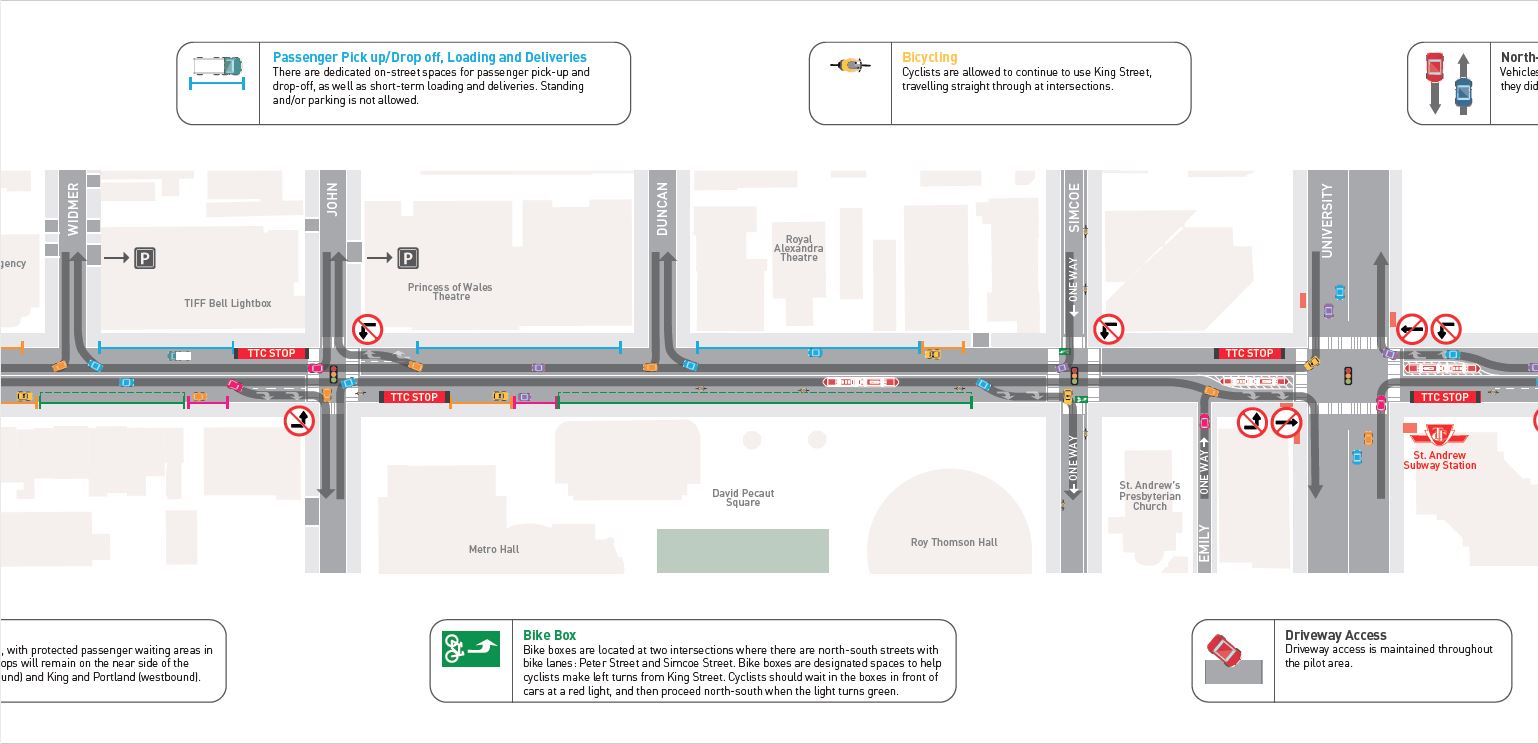
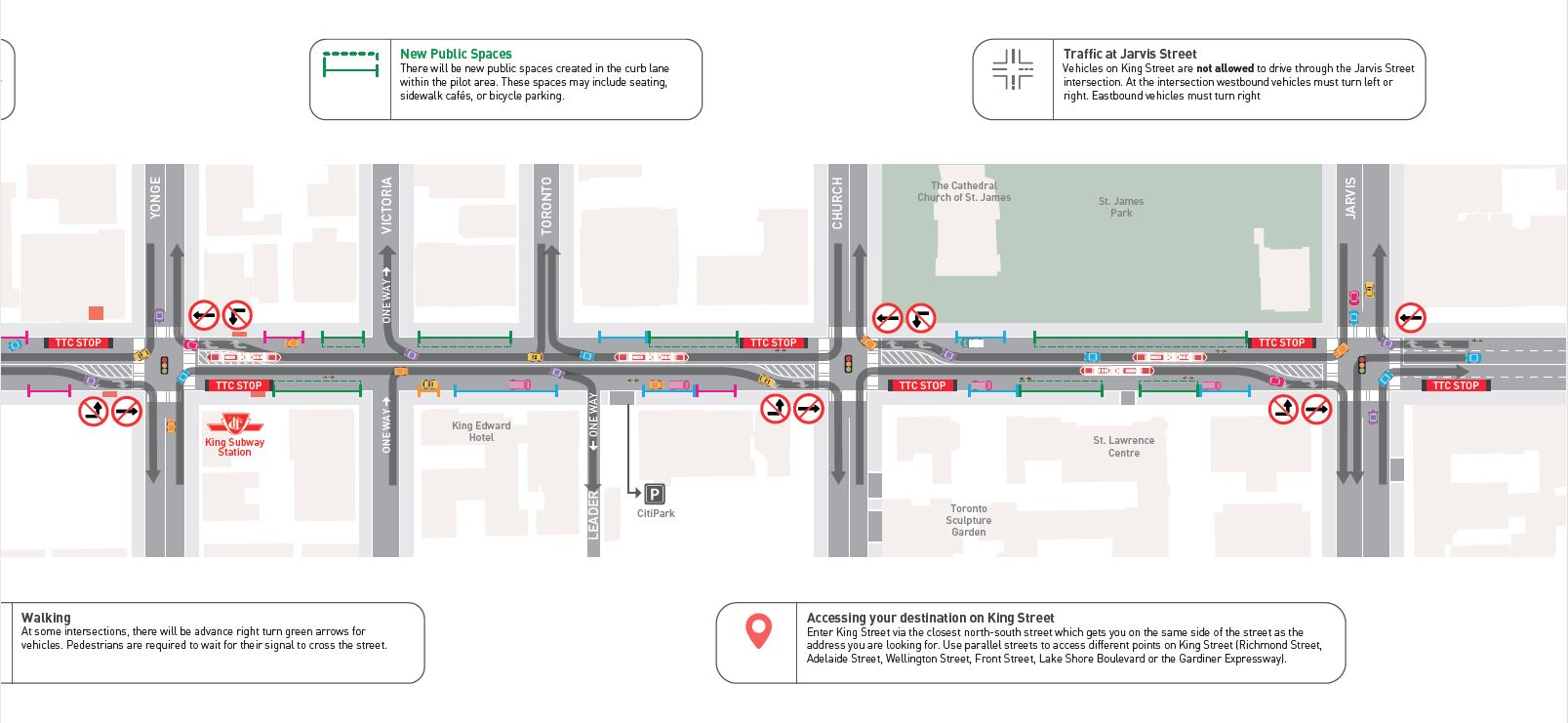
This ties into plans for a King Street transit priority scheme to go into effect late in 2017. It will be counterproductive for the TTC to cut back in service on 504 King just when better priority might be provided.

Keele Yard

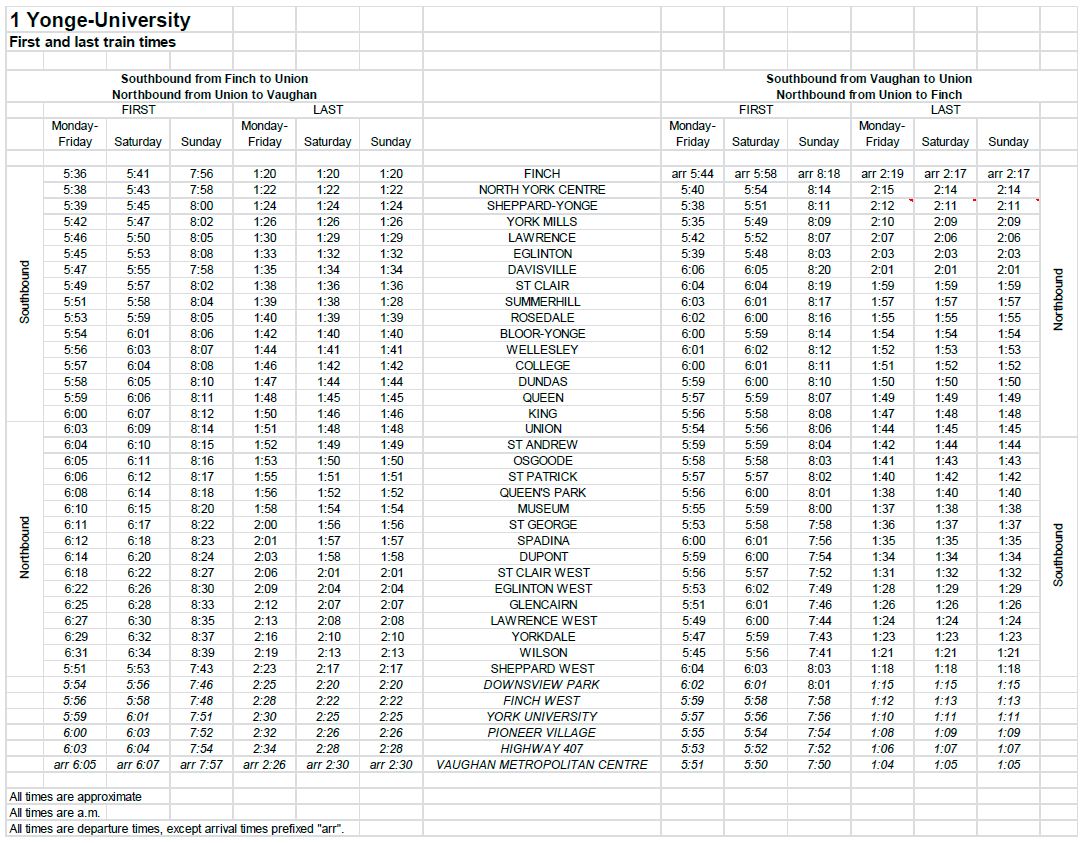
The yard east of Keele Station (originally named “Vincent Yard” after the former Vincent Loop) has not been used for revenue vehicles for many years, but the shift of all of the T1 fleet to Line 2 BD has forced the use of all available storage. The TTC will shift four trains to Keele Yard, with remaining capacity (the yard extends underground beside Dundas West Station and can hold eight trains) to be used by work cars. Moves to and from the yard will occur at the beginning and end of service providing added maintenance time in the overnight break in service.

This yard is in a residential neighbourhood, and with its long inactivity the TTC is aware of the potential for disturbing the neighbours:

Morning service train preparations and noise control

Each night, four trains will typically return to Keele Yard at around 2 – 2:20 a.m., when crews will run system checks to ensure the trains are safe-ready for morning service. The trains will then leave the yard between about 5:45 – 6 a.m. Currently, the first westbound train is scheduled to travel past Keele Yard at 6:01 a.m. Local residents are likely to hear two short horn sounds – required for safety – whenever a train is about to move inside the yard, as well as the sound of trains moving. Efforts to minimize noise will include ongoing noise monitoring, regular reminders to staff at Keele Yard to keep noise to a minimum, sounding subway horns only when necessary for safety and ensuring that the warm-up periods of subway workcars parked on outside storage tracks is kept to a minimum.

Subway workcars will generally leave Keele Yard shortly before the four passenger trains arrive at the yard for the night, and workcars will return to the yard minutes before the passenger trains leave the yard for morning service. Workcar storage in the yard will fluctuate depending on scheduled work in the west. [From TTC Notice]

Presto Effects

A new section has been added to the service memo listing changes that will require new Presto transfer definitions. For June 18, this section reads:

506/306 CARLTON – streetcar diversion/shuttle bus operation requires customers transferring between cars and buses for through travel

There are many cases where Presto cannot deal with legitimate transfers, and the TTC expects operators and riders to know how the rules vary from route to route. Even their own web site is inconsistent on this point:

On the main Presto page, they say:

Transfers using PRESTO

If you have a PRESTO card you no longer need a paper transfer. This is because a transfer is applied to your PRESTO card when you first tap onto a card reader. The transfer for your one-way continuous journey is valid for two hours from the first time you tap your card on a reader. Standard transfer rules apply.

More extensive descriptions of bus-to-other mode transfers are on the bus Presto page. Again, the rule is that no transfer is required.

But on a completely different page, the general one for bus routes, the TTC tells riders of an exception:

PRESTO card customers require a paper transfer on the following routes.

Transfers must be shown to station staff when entering Union or Royal York stations and to operators when boarding these buses. Please make sure you obtain a paper transfer at the start of your trip.

15 Evans
121 Fort York
72 Pape
48 Rathburn
73 Royal York
76 Royal York South

This information does not appear on the pages for the individual routes, nor does it appear on the pages describing fare rules.

Honesty in Subway Planning

Toronto Council recently approved further study on both the “Relief” subway line, and the Yonge Subway Extension north to Richmond Hill. This approval came with several caveats about the timing of projects and the sharing of both capital and operating costs for the YSE.

Meanwhile riders who attempt to use the system as it is are expected to take hope from the fact that “Relief” might appear in only 15 years.

The entire debate about subway capacity in Toronto has, for many years, taken place in among incomplete information, policy directions that looked outward from the core to the suburbs, and in some cases blatant misrepresentation of the complexity of problems the City of Toronto faces.

A major issue throughout the debates has been that individual projects, or even components of projects, are discussed as if they are free-standing “solutions” to the problem when they are only one of many necessary components. Costs are low-balled by omission of critical parts of an overall plan, and the pressures on capital spending are understated by artificially planning major projects beyond the 10-year funding window used for City budgets. This gives the impression that money is “available” for other projects within the City’s financial capacity by stealing headroom in future plans to pay for things that, strictly speaking, should have a lower priority.

The situation is not helped one bit by the lack of strategic planning at the TTC and City where serving the political philosophy of the day often takes precedence over taking a wider view. Indeed the TTC Board, at times, almost prefers to be ignorant of the details because this would force a re-examination of cherished political stances. At Council, although Toronto now has its “Feeling Congested” study and an attempt at prioritization of projects, efforts continue to advance schemes near and dear to individual Councillors who simply will not accept that their wards are not the centre of the known universe.

What Toronto desperately needs is a thorough review of its rapid transit plans and the funding needed to achieve them. This must take into account, and modify where needed, the historical reasons we are in the current situation, and examine what can be done for the future, when this can be achieved and at what cost. The cost question must come second, in the sense that determining what the City needs is an essential first step. Only then can we examine possible alternative ways to address the issues, the cost this will bring and the funding mechanisms that might be used.

Continue reading

Reconstruction of Dundas & Parliament Streets

On Monday, May 15, the TTC began demolition of the intersection of Dundas & Parliament for complete replacement of the special work. By the morning of Saturday, May 20, most of the new track was in place although much of the concrete pour remains to be done as well as installation of the approach tracks connecting the neighbouring tangent rails to the intersection.

Continue reading

Congestion on King Street Downtown: Spring 2017 Update

The King Street Transit Pilot study will hold its next public meeting on May 18 to review the proposed design for that street. As background to that study, this article includes a review of travel times over the King Street corridor in recent months.

Important issues raised by these data include:

  • Travel time issues on King are not restricted to peak periods or to weekdays.
  • Problems in the PM peak are generally worse than in the AM peak.
  • Conditions can be perfectly “normal” one day and severely upset on another. Some weekdays are consistently worse than others, but “abnormal” days occur often enough that they are part of the landscape, not rare exceptions.
  • Congestion is not confined to the pilot study area between Bathurst and Jarvis, but some portions of King Street see little effect from congestion. A “one size fits all” approach will not deal with all of King’s problems, and could produce little benefit in some areas. Expansion beyond the pilot area, if any, requires detailed understanding of just where and what the problems might be.

This is a chart-heavy article intended as background material for readers interested in what the route looks like today.

Continue reading

The Reliable Unreliability of TTC Service

In a recent article, I reviewed the TTC’s Service Standards Update. These standards included targets for headway reliability which are extremely generous and allow the TTC to claim that services operate “to standard” when actual rider experience is less than ideal.

Reliability of service is a top concern for TTC riders, and it has also been identified by TTC staff. Where the problem lies is that the targets offer little incentive to improve or measurement of just how bad the situation really is.

When the TTC talks about reliability, they inevitably trot out excuses about traffic congestion and the difficulty of operating service in mixed traffic. This has been a standard response to issues with streetcar routes for as long as I can remember. However, the typical TTC rider is a bus passenger, and this group has flagged service reliability, frequency and crowding as issues just as important as for streetcar riders.

Regular readers will know that over the years I have published many analyses of route performance looking mainly at the streetcar system, but also at selected bus routes. Recently, I decided to expand this to a number of routes in Scarborough where the quality of bus service often comes up in debates about the Scarborough subway extension, and to revisit some of the routes affected by construction on the Spadina extension which has now pretty much wrapped up. Apologies to readers in Etobicoke because this gives a central/eastern slant to the routes reviewed here, but I have no doubt that route behaviour in our western suburb is similar to that on the rest of the network.

This post may give some readers that dreaded sense of “TL;DR” because of the amount of material it contains. It is intended partly as a reference (readers can look at their favourite routes, if present), and partly to establish beyond any doubt the pervasiveness of the problem with headway reliability facing the TTC. This problem exists across the network, and setting performance targets that simply normalize what is already happening is no way to (a) understand the severity of the problem or (b) provide any measurement of improvements, should they be attempted.

The data here are taken from January 2017. The analysis would have been published sooner but for a delay in receiving the data from the TTC, a problem that has now been rectified. As always, thanks to the TTC for providing the raw material for this work.

Although January is a winter month, the level of precipitation, and particularly of snow, was unusually low for Toronto, and so weather delays do not lead to anomalies in the data.

Toronto Precipitation and Temperatures for January 2017

The TTC’s current attitude to service reliability is to focus on conditions at terminals with the premise that if service leaves and arrives on time, then there is a good chance it will also be in good shape along the route. This is a misguided approach on two counts.

First and most important, there is little indication that service from terminals is actually managed to be reliable, and the “targets” in the standards provide a wide margin by which unreliability is considered acceptable. In particular, it is possible for services to leave termini running as bunches of two or more vehicles and still be considered “on target”.

Second, any variability in headway from a terminal will be magnified as buses travel along a route. Buses carrying larger headways (gaps) will have heavier loads and run late while buses closely following will catch up. The result can be pairs of buses operating at twice the advertised headway, and with uneven loads. Without active management of service at points along a route, the problems become worse and worse the further one progresses away from a trip’s origin. Again, the generous standards allow much of this service to be considered acceptable, and so there is no need, on paper, to actually manage what is happening.

TTC operators are a great bunch of people, overall, but the laissez faire attitude to headways allows those who prefer a leisurely trip across their route to run “hot” with impunity. The worst of them are, fortunately for riders, only a small group. The larger problem is the degree to which irregular headways are a normal situation across the system.

The balance of this article looks at several routes primarily for their behaviour near terminals as this matches the point where the TTC sets its targets, such as they are. To recap the Service Standards:

The TTC standards vary for very frequent (less than 5′), frequent (5′ to 10′) and infrequent (above 10′) services.

  • Very frequent services target a band of ±75% of the scheduled headway.
  • Frequent services target a band of ±50% of the scheduled headway.
  • Infrequent service aims for a range of 1 minute early to 5 minutes late.

The charts which follow look at actual headways, not scheduled values, and it is clear throughout that the typical range of values exceeds these standards.

Continue reading

TTC Service Standards Update

Among the reports to be considered by the TTC Board at its May 18, 2017 meeting is one titled Update to TTC Service Standards.

[Note: Page numbers cited in this article refer to the PDF containing the report as a whole. Individual sections have their own pagination which does not necessarily correspond to the page numbers of the overall document.]

This is something of a misnomer because the report does not actually propose many new standards, but merely consolidates in one place practices that have evolved over past years. Some of those standards are are self-serving in that they codify “business as usual” practices including some “targets” that produce laughably inferior, but “acceptable” service.The report contains no discussion of the potential shortfalls in the standards it asks the Board to endorse. Absent is any sense that things should be better, and that actively understanding and managing how routes operate is required. Better service quality is what riders demand, and a laissez faire approach is the last thing the TTC needs.

The current standards arise from an extended period dating back to the Ford era in which pro-active service improvements based on better standards simply stopped, a sacrifice to the gods of “efficiency” and “saving taxpayer dollars”. The standards have been fiddled with to minimize the worst of Ford’s cutbacks, and more recently to implement revised performance standards intended to lead to better service. The constrained environment in which the TTC still operates is clear:

This update to the TTC service standards took a no cost approach. The updated service standards reflect existing conditions with the goal of continuous improvement over time. [p. 1]

Although leaving standards as they are might be a “no cost approach”, what is missing from this 100-page document is any review of the degree to which the system actually achieves the standards it claims to follow. Recently, the TTC has acknowledged that both the King and St. Clair routes are running 25% above standard thanks to the streetcar shortage and resultant crowding, and of course the large number of buses diverted to streetcar routes could be used to improve conditions on the bus network. However, absent a system-wide view of the shortfall, the TTC Board, City Council and the general public have no idea of just how bad the situation is except, of course, for those riders jammed into vehicles or who give up on the TTC. As to route performance data, the TTC has not published any for two years even though this item is part of their Customer Charter.

Running more service costs money, and yet with fleet constraints, the TTC has been able to keep its demands for added subsidy lower than they might have been otherwise. Only about half of the “investment” in better service announced with great fanfare by Mayor Tory early in his term actually appeared in the TTC budget.

The last system-wide review dates back to April 2008 near the end of Mayor Miller’s term.

The context for “standards” is quite clear in the following statement:

The TTC currently makes use of a number of standards to plan new service and monitor and adjust existing service. These standards have been in place for a number of years and some are updated frequently. For example the TTC applies vehicle crowding standards to define the upper limit of what is an acceptable level of crowding for each type of vehicle at both peak and offpeak times. This standard is often updated based on fiscal realities. [p. 5]

Fiscal realtities may affect what the TTC can afford, but they should not alter what the TTC aspires to be. If there is a shortfall, then the effect of that shortfall should be known. This informs both the decision to make budget cuts (what are the effects) and lays out for future planning where and how much the system should be improved. We have rapid transit plans stretching decades into the future, but don’t know how short Toronto falls in providing day-to-day service on its bus and streetcar network. We have endless touch-feely “customer service initiatives”, but the most important of all – service – falls by the wayside. This is not to downplay good customer service, but riders might be forgiven for taking little comfort in spiffy new maps when the services they illustrate are overcrowded and unreliable.

The report claims that the TTC conducted a peer review of standards in other major cities. None of the information from such a review appears in the report.

Internal discussions among various TTC departments yielded the following observation:

All stakeholders noted that the most important improvement the TTC could make is improving service reliability on all modes. [p. 8]

This leads to revised metrics for productivity and reliability, but it is unclear whether these will actually improve service on the street.

Although the lion’s share of the report deals with a rider survey of attitudes to service quality, I will leave that topic until later in this article so that the nominal purpose of the report, Service Standards, is more than the afterthought it appears to occupy in the TTC’s report.

Continue reading

Metrolinx to Buy LRVs from Alstom

The Globe and Mail reports that Metrolinx has entered into a deal with Alstom, who are already building the LRV fleet for Ottawa, to produce cars for at least some of the Metrolinx projects in the GTHA. In effect, Metrolinx is looking to cut its ties to Bombardier whose car deliveries are long overdue, although the actual mechanics of this will depend on contract negotiations and whether Bombardier actually does manage to produce cars in time for the Eglinton Crosstown line’s opening.

The Alstom cars will go to Eglinton, unless Bombardier comes through, in which case they will be repurposed for the Finch and Hurontario lines. Given the opening dates planned for those lines, a decision to extend the Alstom order would come well before opening day unless the current target dates for Finch and Hurontario were changed.

Metrolinx and Bombardier still must go through a dispute resolution process, but is it clear that Metrolinx feels that they are on solid enough ground to make this move.

Metrolinx press release (May 12, 2017):

METROLINX STATEMENT ON ALSTOM / BOMBARDIER

TORONTO: May 12, 2017 – Metrolinx is taking a major step forward to ensure that the Eglinton Crosstown LRT opens on time, and that our other LRT projects are on track.

We are making great progress on the Eglinton Crosstown and are well on our way to launching this outstanding new service as scheduled in 2021.

Now, we are pleased to be able to say we have certainty that there will be trains to run on this line.  That is because we are entering into an agreement with Alstom as an alternative supplier of light rail vehicles.  Alstom will build 17 vehicles for the Finch West LRT project and, if necessary, 44 for Eglinton Crosstown. If Alstom vehicles are not needed for Eglinton Crosstown, they will be reassigned to the Hurontario LRT project.

We know for sure that Alstom’s light rail vehicles work.  They are currently producing quality vehicles on-time for Ottawa’s Confederation Line LRT project.

We are going through a dispute resolution process with Bombardier, but that could take 8-12 months, and we can’t wait that long to determine whether Bombardier will be able to deliver.

We are hopeful that Bombardier can get its program on track.   However, the steps we are taking give us a safety net if it turns out Bombardier is unable to fulfil its contract.

Our end goal remains opening our LRT projects on time with high-quality vehicles that will provide excellent service to the people of this region.  This new contract with Alstom provides flexibility to ensure that happens.

John Jensen

President & CEO, Metrolinx

Bombardier Statement (May 12, 2017)

From Marc-André Lefebvre, Head of Communications and Public Relations, Canada

Bombardier is ready, able, and willing to deliver these vehicles to the people of Toronto on time. As the Minister and Metrolinx are well aware, these vehicles can be ready ahead of schedule and well before a single track has even been laid on the Eglinton Crosstown.

In fact, the Metrolinx pilot vehicle is ready, undergoing qualification testing, and Bombardier is right now producing vehicles for the Region of Waterloo that are identical to those that will be used on the Eglinton Crosstown. All 14 of those vehicles will be delivered to Waterloo by the end of this year.

We believe what’s best for the people of Toronto and Ontario is that we work together to ensure taxpayers are not on the hook for another cancelled contract. We’ve met each and every major LRV delivery milestone in the last eight months and the proof will be in the performance of these vehicles in Waterloo and on Eglinton. We have addressed the issues raised in the past and we are confident this will be upheld in the dispute resolution process.

We are committed to working with Metrolinx to find a clear path forward; one that ensures the transit riding public has the most efficient, comfortable and reliable transit system in the world.

I will update this article as more information becomes available.

Minister of Transportation’s statement (May 12, 2017)

Youtube video of Alstom Citadis cars for Ottawa

Alstom product page for Citadis Spirit

Alstom press release (May 12, 2017)

Toronto Star article

Just think, this could have been Scarborough. While Toronto has utterly cocked up its transit planning, with substantial help from Queen’s Park, Ottawa has built and is about to open the first phase of their line.

Inching Ahead on Subway Plans

Toronto’s Executive Committee will consider a report from the City Manager at its meeting of May 15, 2017 regarding the preferred alignment for the southern end of the “Relief Line” subway, as well as the current status of the Yonge Subway Extension to Richmond Hill.

This report has taken on a more political context with Mayor Tory’s recent statements that unless Queen’s Park coughs up financial support for the RL, he will block any further work on the YSE. Needless to say, this stance did not play well in York Region or at Queen’s Park.

The two lines, as they currently are proposed, look like this:

One might cast a though back only a few years to Tory’s election campaign in which he claimed that SmartTrack would eliminate the need for a Relief Line, that it would have frequent service with many new stops, that it would operate with TTC fares, and that it would be self-financing. Most of these claims were demonstrably false or impossible at the time, and the project scope has changed dramatically. Even the question of a “TTC fare” is tangled up in the Metrolinx Fare Integration study which could well bring higher rapid transit fares to the TTC as a way of “integrating” them with regional systems.

Tory’s convoluted evolution into a Relief Line supporter undermines his credibility on many issues not the least of which is an understanding of when money he demands might actually be spent. There is no point in getting a “commitment” from Queen’s Park when the government will be unrecognizable by the time the bills come due. Toronto has far more pressing demands in the short and medium term, and meanwhile there is $150 million of provincial money going into design work for the RL.

As for the YSE, it has been on York Region’s wish list for years, and is more advanced than the Scarborough Subway which is mired in debates about the alignment and number of stations. The problem for Toronto is that there is no capacity for additional riders from an extension on the Yonge line, and indeed it is already over capacity according to a CBC interview with TTC Deputy CEO Chris Upfold on May 10.

Continue reading