TTC 2018 Capital Budget: (1) Fleet Plans

The TTC’s detailed version of the Capital Budget is known as the “Blue Books” because they are issued in two large blue binders. They are not available online. Over coming weeks, I will post highlights from this material beginning with the fleet plans.

These plans were drawn up in late 2017 as the budget was finalized, and there have actually been changes since that are not reflected here. I will note these where appropriate.

For starters, a review of how all of these capital projects are paid for.

Financing and Funding the Capital Budget

The TTC’s budget process at times looks like a game of Three Card Monte where one is certain that one card is the Queen of Diamonds, but never quite sure where she is. This shows up in various ways:

  • There is a “base program” consisting of projects that have Council approval for inclusion in the ten-year plan. The estimated cost of this program is $9.240 billion, but there is funding shortfall of $2.702 billion.
  • There is an “unfunded list” of projects making up the shortfall. These will migrate to funded status as and when money becomes available.
  • The City requires that the TTC make provision for “capacity to spend” reductions in its projects based on the premise that all of the money in the budgets will not actually be used. This offsets $427 million of the shortfall, although one can argue that this is a polite fiction meant to convey the idea that the funding hole is not quite as deep as it seems. The premise is that not all projects will be spent to their full budgets, and an across-the-board provision will soak up the underspending. In practice, some of this “shortfall” is a question of timing – project slippage that shifts spending to other years – not a question of budgeting too high.
  • Some projects have their own, dedicated funding streams and appear separately from the base program. At present, these are the subway extensions to Vaughan and to Scarborough.
  • Some projects in the base program have funding directed specifically to them. The provincial 1/3 share of the new streetcars is an example. This is separate from provincial money that flows to Toronto from the gas tax.
  • Some projects have timelines associated with the structure of funding programs. Ottawa’s Public Transit Infrastructure Fund (PTIF) Phase 1 requires that projects be completed by March 31, 2019 so that the subsidy is expensed, federally, by the end of the 2018-19 fiscal year. PTIF phase 2 has not yet been announced either as to amount or to the timeframe in which spending will occur. These constraints prevent many projects from receiving PTIF money because they do not fit within the prescribed window for spending.
  • Metrolinx projects do not appear on the TTC’s books, but in some cases they can trigger payments from the TTC and/or the City of Toronto. Examples are Presto and SmartTrack.
  • Some transit proposals are not even in the base program, but wait in readiness as “nice to haves”.

“Funding” is the process of paying for projects, while “Financing” is the mechanism by which that money is raised. A “funded” project is associated with revenue from “financing” sources that the City can depend on such as property taxes and committed monies from other governments. Where there is a shortfall, someone has to step up with new money, however they might raise it, or something must be removed (or at least reduced in scope) from the list of funded projects.

City of Toronto contributions to capital come primarily from current taxes (“capital from current” and development charges) and from borrowing. The amount of borrowing available to the TTC each year is dictated by the City’s self-imposed 15% cap on the ratio of debt service costs to property tax revenue. A few major projects in the near future, notably the Gardiner Expressway rebuild, are crowding the debt ceiling, and there are years when little new debt will be issued on the TTC’s behalf. In turn, this affects spending plans at the TTC, and projects are shifted into future years with more borrowing room to get around this.

Other constraints can arise from a program like PTIF which, because it has a sunset date, requires that spending that might otherwise occur some years in the future must actually happen sooner than planned. This, in turn, requires matching funds from the City in years where they might otherwise have been spent on other projects.

Continue reading →

Toronto’s Transit Capacity Crisis

In recent days, Mayor Tory has announced, twice, a ten point program to address crowding on the TTC. The effectiveness of this program is limited by years of bad political decisions, and the hole Toronto has dug itself into is not one from which it will quickly escape.

This article is a compendium of information about the three major portions of the “conventional” (non-Wheel-Trans) system: subway, bus and streetcar. Some of this material has appeared in other articles, but the intent here is to pull current information for the entire system together.

Amendment February 15, 2018 at 5:30 pm: This article has been modified in respect to SmartTrack costs to reflect the fact that over half of the cost shown as “SmartTrack” in the City Manager’s budget presentation is actually due to the Eglinton West LRT extension which replaced the proposed ST service to the commercial district south of the airport. A report on SmartTrack station costs will come to City Council in April 2018. Eglinton LRT costs will take a bit longer because Council has asked staff to look at other options for this route, notably undergrounding some or all of it.

Continue reading →

TTC Board Meeting February 15, 2018

The TTC Board will meet on February 15, 2018. Among the items on the agenda are:

Scarborough Subway Extension (SSE)

The SSE itself is not on the agenda, but it has been the subject of much recent debate over when the projected cost and schedule for the extension will be released.

In the November 2017 CEO’s Report, the project scorecard included a schedule showing that 30% design would be complete in the second quarter of 2018, and an RFP [Request for Proposals] would be issued in the third quarter. Even when this report came out, former CEO Andy Byford was hedging his bets about a spring 2018 date saying that more work would be needed to verify and finalize the figures. A key note in this scorecard states:

EFC [Estimated Final Cost] was approved in 2013 based on 0% design. With the alignment/bus terminal now confirmed by City Council, the project budget and schedule will be confirmed as design is developed to the 30% stage, factoring in delivery strategy and risk. The performance scorecard will continue to report relative to the project’s original scope, budget and schedule, as approved by Council in 2013, until the project is rebaselined at the 30% stage in late 2018.

In other words, neither the schedule nor the projected cost reflected the evolving and expanding design of this project.

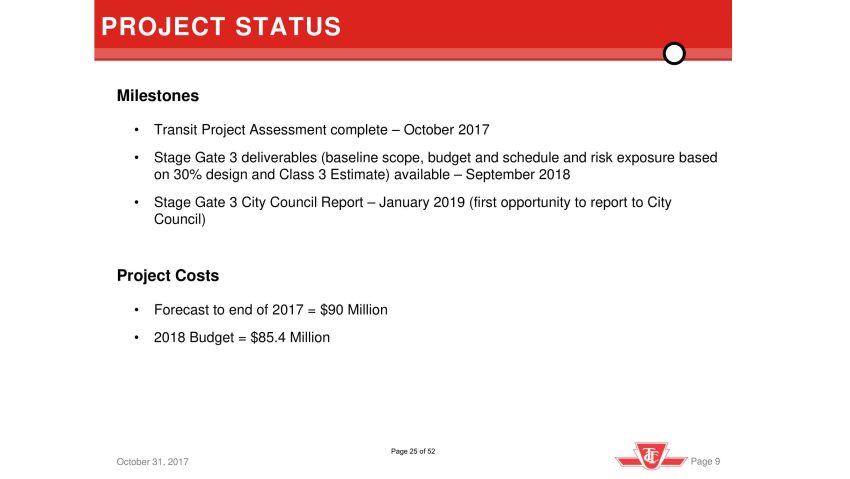
Jennifer Pagliaro in the Star wrote about the result of a Freedom of Information Request that revealed a briefing to Mayor Tory in September 2017. That briefing included a statement that the cost estimate for a Stage 3, 30% design, would be available in September 2018.

Because Council will not meet until 2019, numbers that might have been available before the election would not be released until after the new Council takes office. After the story appeared, City staff replied:

The cost information referenced in page 9 of the October TTC briefing deck refers to the planned timing for initial cost inputs from TTC engineering staff. These are not the full cost estimates necessary for consideration by Council. Further work will be required to appropriately account for financing, procurement model, market assessment and other critical factors. The final cost estimate, subject to the variability ranges noted below, will include these inputs.

This additional work will be undertaken by various TTC staff as well as city officials from corporate finance, financial planning, city planning and other divisions. [Tweet from Jennifer Pagliaro, February 7, 2018]

I wrote to the TTC’s Brad Ross about this conflicting information, and particularly about the question of how an RFP could be issued in 3Q18 when Council would not be approving that the project pass beyond “stage gate 3” until 2019. He replied:

No RFP will be issued until after Council approval. You will note in the Key Issues and Risks section of the scorecard from November reads, “The performance scorecard will continue to report relative to the project’s original scope, budget and schedule, as approved by Council in 2013, until the project is rebaselined at the 30% stage in late 2018.”

To be consistent with the report to Council in March 2017, only the revenue service date was revised in the scorecard (from Q4 2023 to Q2 2026). The TTC recognizes and acknowledges that this has led to confusion. The TTC will be taking steps to ensure greater clarity in its next CEO Report in March 2018. [Email of February 9, 2018]

The February CEO’s report states:

Work continues to progress design towards Stage Gate 3, expected in fall of 2018. At this time, the project will provide initial cost inputs from the TTC team (includes detailed costs for the Scarborough Centre station, tunnel, Kennedy station, systems, property and utilities). Further work is underway by the new Chief Project Manager with key stakeholders within TTC and the City to define the activities, approval process and timelines to arrive at the final Class 3 Cost Estimate, Level 3 Project Schedule, and associated Risk Analysis.

As requested by City Council, a report will be presented at the first opportunity to the Executive Committee, TTC Board and City Council, which is expected to be Q1 of 2019. [pp 15-16]

The debate, as it now stands, is about releasing whatever material will be available in September 2018 so that it can inform the election debates. Additional costs as cited by the city would sit on top of the September numbers, but at least voters and politicians would know whether the SSE’s cost has gone up just for the basic construction, let alone factors related to financing and procurement that would be added later.

Meanwhile, SSE promoter Councillor Glenn De Baeremaeker speaking on CBC’s Metro Morning said:

I don’t think it matters what the costs are.

This has been taken to read that money is no object, and that well may be the political reality in Scarborough – there is no way the many politicians who have so deeply committed to the subway project can back out. De Baeremaeker continued:

Whether the costs go up or the costs go down, people who have tried to sabotage the subway and stop the subway, will continue to try to sabotage it, they’ll continue to try to stop it, and they will never vote for it. So I would challenge the Councillors who say “I want to see the cost”. My response is and if it’s a reasonable cost, will you support the subway? Well, no. [At 3:26 in the linked clip]

What De Baeremaeker does not address is whether he has an upper limit beyond which even his enthusiasm might be dimmed. Also, on the question of a “reasonable cost”, what has been lost here is the fact that the subway “deal” was sold on the basis that the $3.5 billion included the Eglinton LRT extension to UTSC Campus. What had been a $2 billion-plus subway when it was approved as a compromise by Council, quickly grew to $3 billion-plus, and the LRT extension is left to find alternate funding. One could reasonably ask whether the LRT was ever really part of the deal, or was simply there as a sweetener that pulled in wavering supporters who now see just how gullible they were.

A related issue that has not yet surfaced is the question of whether building the SSE for a 2026 opening will require concurrent changes in timing and/or scope for the planned renewal of the Bloor-Danforth subway including a new signalling system and fleet. A report on the renewal is expected in April 2018, although this date has changed a few times over past months. The TTC/City capital budget and ten year plan do not reflect this project, at least with respect to timing, and probably with respect to total cost.

Continue reading →

TTC Streetcars and Buses Swap Routes in February 2018 (Updated Jan. 19, 2017)

The TTC has confirmed the following changes in the allocation of streetcars and buses to various routes effective with the February 18, 2018 schedules:

  • Streetcars will return to 511 Bathurst.
  • The 502 Downtowner bus will continue to operate, but only during peak periods (Bingham Loop to Queen & University).
  • The 503 Kingston Road car, normally a peak only tripper, will operate Monday to Friday peaks and midday (similar to the existing 502). The 503 car will run between Bingham Loop and Charlotte Loop (King & Spadina) to supplement service on King Street.
  • The 505 Dundas and 506 Carlton routes will be converted to bus operation.
  • Updated: The 514 Cherry service will be improved during the off-peak period.

The buses for 505/506 will come from a variety of sources:

  • Existing buses operating on 503 Kingston Road,
  • Tripper buses originally scheduled for 504 King but swapped to 505 Dundas since December, and
  • Buses that have been freed up from construction service and the route reorganization following opening of the Vaughan subway extension.

Both Dundas and Carlton will be affected by planned construction projects this year that would require partial replacement with buses even if there were no streetcar shortage.

  • Main Station construction and Hydro work
  • Broadview Avenue track replacement from south of Dundas to Wolfrey (north end of Riverdale Park) including intersections at Dundas and Gerrard. This will also affect the east end of 504 King.

Updated:

  • The TTC has confirmed that they are reviewing stops on both routes for the need to remove adjacent parking spaces that would prevent vehicles from pulling in fully to the curb. Bus operation will use the same POP rules as on the streetcar routes.
  • At the TTC Board meeting on January 18, Acting CEO Rick Leary stated that although the bus conversion of 505/506 was originally announced for all of 2018, he hopes that with delivery of new streetcars this can be reversed sometime in the fall.

In other news:

  • Roncesvalles Carhouse will close for the remainder of 2018 for maintenance work, and operations will be centralized at Russell and Leslie.
  • 501 Queen service to Humber Loop is planned to return with the schedule changes planned for May 13, 2018.
  • The King-Queen-Roncesvalles intersection replacement, the associated road reconfiguration and the extension of the right-of-way east from Parkside Drive to Roncesvalles remains in the 2019 schedule.

Even if buses were not filling in for streetcars, the TTC has no plans for bus service increases.

The bus replacement service is not preventing us from making bus improvements. In 2018, we do not have any budget for new improvements. Any improvements we make will be through reallocation. [Email from Stuart Green at the TTC]

More information is expected at the TTC Board Meeting on January 18, 2018. Also, the detailed memo of service changes for February should be out soon, and I will publish the usual condensed version when it is available.

Thanks to Stuart Green at the TTC for the information.

Early Days of the CLRVs (Updated)

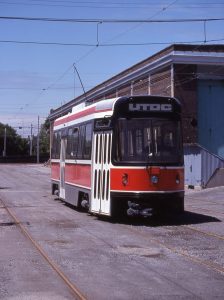
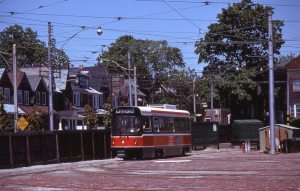
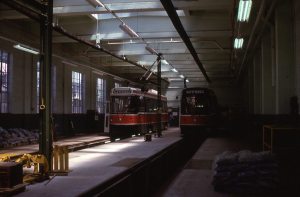
With the demise today of car 4000, the first of the Canadian Light Rail Vehicles, a look back on the prototypes when they were brand new.

The photos here were taken on June 4 1978 at St. Clair Carhouse. I don’t know which fleet numbers the cars shown here wound up with, but I’m sure there is a reader who knows these details and will supply feedback.

Updated December 25, 2017 John Bromley has provided additional information about the prototype CLRVs:

The car in the photos you posted is 4003 II.  The photo op was June 4 1978, I was there and have a few photos.  Perhaps the July date is the processing date on the slides?

Steve: Thanks for the correct date. I had neglected to write it on the slides at the time.

Below pic shows 4000 II from the rear June 29 1977 at SIG, taken from inside the unfinished carbody of 4003 II.  Even then 4000 II had the all-white top on front rather than the black just visible in 4001 II behind it.  Do I need to mention the pantograph?

Sorry for the delay in sending, we’ve been in Europe for three weeks.

TTC Board Meeting October 16, 2017 (Updated)

The TTC Board will meet on October 16. Among items of interest on the agenda are:

Continue reading →

Pantographs Up On Harbourfront

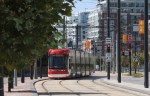
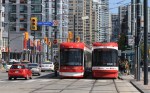
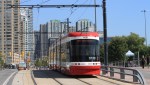
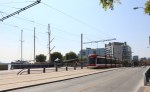
On Tuesday, September 12, 2017, the TTC began operation of its new Flexity streetcars with pantograph power collection on the 509 Harbourfront route. This is a short, comparatively isolated route running entirely with Flexitys where problems, if any, can be ironed out on a small piece of the network. Any off route moves including carhouse trips are done with trolley poles, and the normal changeover point between modes is at Exhibition Loop.

Here is a small set of photos of the route.

Is A TTC Bus Technology Gerrymander In The Works?

At its September 5, 2017, Board Meeting, the TTC considered a report recommending the purchase of 440 “clean diesel” buses from Nova Bus, a division of Volvo. This sort of thing would normally sail through because the Board has considered and approved future bus plans at previous meetings. In this particular case, one important aspect of the order is that 325 of the vehicles would be delivered before the deadline for federal PTIF (Public Transit Infrastructure Fund) grants that end on March 31, 2019. A further 115 buses would be procured with the “standard” arrangement for TTC capital financing, but no federal contribution.

This procurement went through a common pattern with an RFI (Request for Information) in October 2016 and an RFP (Request for Proposal) in April 2017. Two proposals were received, one from Nova and the other from Flyer Industries, and both met the technical requirements. The decision to award to Nova Bus was based on pricing (Nova’s bid was $300.5 million while Flyer’s was $345.0 million).

In an unusual move, the Board entertained a last-minute addition to the deputations list, two representatives of a builder of battery buses, BYD. This is a Chinese manufacturer with an office in Los Angeles and, more recently, representatives in Canada. BYD did not bid on this RFP because it specified clean diesel technology which they do not supply.

Their presentation and associated Q&A went on at some length, far moreso than public deputations are normally allowed, and it was quite clear that this was a sales pitch for their product. In any other Board meeting, this would have been stopped as an abuse of process, but this situation was under the charmed support of Deputy Mayor Minnan-Wong who is a member of the TTC Board.

Many claims were made for BYD technology and for the scope of the battery bus industry that went largely unchallenged.

In response, TTC management advised that they would be issuing an RFI for alternative technology buses to four supplies, including Nova and Flyer, later in the week, and that they planned to bring back an overview report to the Board in November.

The situation became more interesting with a motion proposed by Minnan-Wong and eventually approved by the Board with only two votes against that would reduce the contract award to Nova to 325 vehicles and pursue the remaining 115 as a potential for a different propulsion technology.

Another wrinkle was added by Chair Colle (one of the two “no” votes on Minnan-Wong’s proposal). The PTIF funds allocated to Toronto were split between the TTC and the City, and the TTC has found projects that can qualify for this funding. However, the City is unable to spend all of its available funding and is looking for projects that could soak up the shortfall. Colle proposes that TTC management report on what projects might be brought forward for this purpose.

During the discussion, there were comments pro and con the TTC’s becoming embroiled in yet another new transit technology. They have already been burned by the Hybrid Bus fiasco, ironically a scheme they were forced into by a combination of environmental enthusiasm at Council and federal subsidies that were only available for “green” technology. A good deal of that federal money went not to additional buses, but to paying the extra cost of the hybrid vehicles. The BYD reps proposed exactly the same thing for their products – yes, they were more expensive than regular buses, but the feds would pay and the TTC could save money in the long run on operating costs. Of course this approach would negate the ability to buy more transit infrastructure with the federal funding, and of course would not apply to any buses bought outside of the PTIF envelope.

TTC management including CEO Andy Byford made the point strongly that it is staff’s job to get service out onto the road, and the 440 bus order was to allow retirement of the oldest and least reliable vehicles. Battery bus technology is evolving quickly, but beyond some large fleets in China, cannot be said to be well-established in North America or Europe.

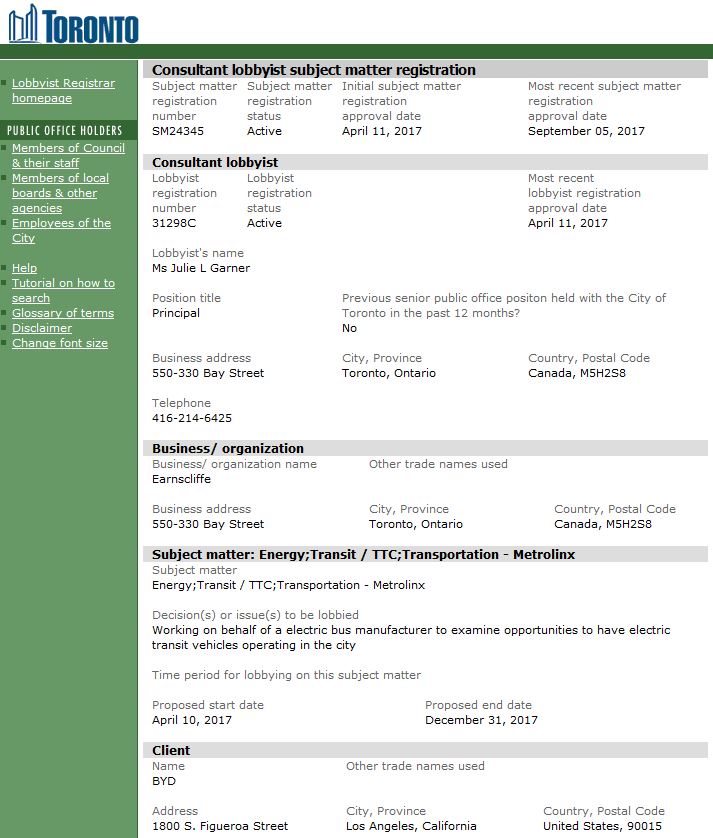
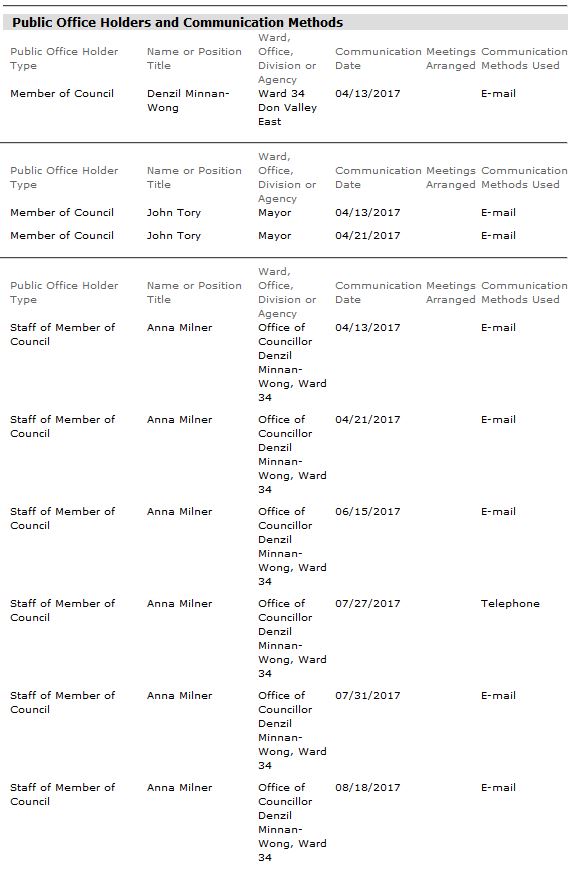
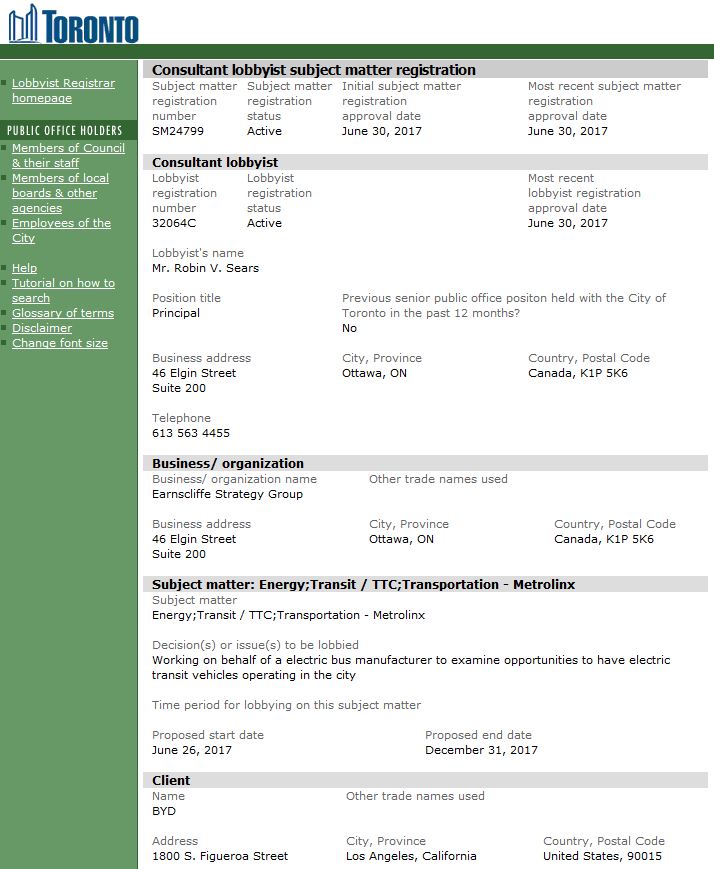
It is quite clear that there has been lobbying behind the scenes, primarily to the Deputy Mayor, for several months. Below are snapshots from the City of Toronto’s Lobbyist Registry. (Click to enlarge.)

The lobbyist company, Earnscliffe, is well-known. The initial contact by them corresponds to the point at which the TTC issued its RFP for diesel buses in April 2017.

Any company is free to lobby, but it is quite unusual for this to result in a direct presentation to a Board meeting where a contract award is up for approval. We have learned recently how political meddling has influenced advice and decisions at both Metrolinx and the City of Toronto, and this continues a disturbing trend.

Worst of all, the TTC staff report on alternative technology buses will now be under a cloud. Will it be a technically honest report, or will it be spun to suit the position of a well-connected member of the Board? By giving credibility to BYD’s presentation, has the Board placed TTC staff in the unenviable position of debunking claims made by one would-be vendor? Will there be another round of vendor presentations attacking whatever staff brings forward?

Members of the TTC Board just love to think of themselves as progressive, forward thinkers who will embrace potential transit improvements. One Board member, Councillor De Baeaemaeker, even launched into an attack on “clean diesel” by reference to all of the pollution created by exploration, extraction and refining, while carefully avoiding the fact that a great deal of Ontario’s base electrical load comes from nuclear power. That is where overnight charging would come from, but this delicate point was not part of his thesis.

If the TTC invests in electric buses, regardless of the manufacturer, this will require a garage with very different capabilities from any they now own. A substantial power supply will be needed for all of the overnight charging, and repair facilities will have to be attuned to electric, not diesel, vehicles. The TTC does not have any increase in garage capacity in the pipeline beyond McNicoll Garage, already under construction, and it will easily be the early 2020s before there is a garage where a new fleet could be based, assuming that it is a net addition and not simply a replacement for existing buses. (McNicoll, although a new garage, will simply take the pressure off all of the existing garages which are badly overcrowded.)

The irony here is not lost on those of us who followed the TTC through its abandonment of electric buses a few decades ago when beautiful, clean compressed natural gas was a panacea to solve both our diesel woes and TTC management’s distaste for trolley buses.

Battery buses may well have a future in Toronto and in world transit generally, but the way this has been introduced at the TTC leaves a foul taste, a sense that the fix is already in. Toronto’s transit technology choices have been gerrymandered more than once in the past to suit politicians and businesses looking to cash in on new technology. We have had enough of this, thank you.

TTC Service Changes Effective September 3, 2017

The September 2017 schedule changes primarily involve the reversal of summer service cuts to many routes with only minimal service improvements. This continues the TTC’s policy for 2017 of constraining service growth in the face of lower than budgeted ridership, as well as the shortage of vehicles.

Construction projects continue to affect route 501 Queen and will do so for many months to come:

  • Streetcar service is restored between Russell Carhouse (at Connaught) and Sunnyside Loop.
    • This will be affected in October when the intersection of McCaul and Queen is rebuilt requiring a diversion.
  • A bus shuttle will operate from River to Neville Park due to the reconstruction of the intersection at Coxwell and Queen.
    • This will also require the continued operation of buses on the 502/503 services on Kingston Road.
    • Through streetcar service to Neville Park will resume with the October schedules.
  • A bus shuttle to Long Branch will operate from Dufferin Loop, and Marine Parade will be served by its own local shuttle to Windermere.
    • Construction on The Queensway will prevent streetcars from operating to Humber Loop until the end of the year.
    • Streetcars will not operate west of Humber Loop to Long Branch until mid-2018.

With the return of ALRVs to the Queen route, 504 King will operate primarily with CLRVs, and the peak period trippers will mainly be buses, not streetcars. The effective capacity of the route will fall because of the lower capacity of CLRVs and buses versus the streetcars that have been used over the summer of 2017. This will be minimally offset by a small reduction in headways during all operating periods thanks to trimming of the running time. King cars now enjoy extended layovers leading to queues of vehicles at terminals thanks to an overly-generous schedule. The number of streetcars in service remains the same, but on slightly shorter headways.

New low-floor Flexity streetcars will be deployed on 512 St. Clair starting in September, subject to availability. The schedule will be based on CLRVs until new car deliveries reach the point where the line can be scheduled as a Flexity route.

The TTC plans to begin using Flexitys on 504 King late in 2017 subject to availability.

Between them, the King and St. Clair routes require about 60 CLRVs at peak. Allowing for some capacity growth with Flexitys, this translates to about 45 of the new cars, plus spares. It will be some time before both routes are converted, assuming Bombardier achieves their ramped up delivery rate in fall 2017. They are already slightly behind schedule with only two of three planned cars for July 2017 out the door in Thunder Bay, and they have not yet implemented the additional shifts/workforce to produce cars at a higher rate effective October 2017.

The northbound stop at Broadview & Danforth will be removed allegedly in the aid of transit priority signalling. In fact, this is a location where the substantial green time afforded to east-west traffic on Danforth makes the idea of “priority” for transit movements difficult to swallow. There is already an advanced green northbound for left turning motor traffic. Given the layovers now enjoyed by streetcars at Broadview Station, it is not clear just what this priority will achieve, but removing the stop will annoy the many riders who now use it. The southbound stop remains in service.

Other construction projects include:

  • 54 Lawrence East: Water main construction west of Victoria Park has completed.
  • Renforth Station opens: 32 Eglinton West and 112 West Mall are rerouted into the new regional terminal.
  • Kennedy Station: The schedule change to accommodate Crosstown construction is implemented for weekend service on 86 Scarborough.
  • Long Branch Loop: All buses will loop via the streetcar loop during reconstruction of the bus roadway.
  • 123 Shorncliffe: Additional running time to accommodate a City paving project.
  • 506 Carlton: The only remaining construction area/diversion is on College between Bathurst and Lansdowne. This will end in October.
  • 505 Dundas: The diversion between Bay and Church will end in late September or early October depending on progress of the road works east of Yonge.

The 400 Lawrence Manor and 404 East York Community Bus services will be extended. For details, see the TTC’s July 2017 update on these services.

2017.09.03_Service_Changes