Toronto Polls Residents on Transportation Issues

The City of Toronto recently polled residents on a variety of issues related to transportation, notably the effect of and attitudes toward construction activities, as well as the top issues facing the city. A summary of the results appeared in a press release on June 26, 2015. Although the survey focuses on road work, it also picks up an interesting view of transit users and of travel choices.

As the Globe’s Oliver Moore first pointed out on Twitter, the headline on the release misleadingly states:

Congestion and gridlock remain top concern for Toronto residents, according to City of Toronto survey

There is a fundamental problem with this claim.

Better transit actually appears under three separate responses: Poor transportation/transit (22%), Poor TTC (4%) and Building subway transit network (3%). This is not to dispute that congestion and gridlock are important, but that this response ranks well behind, collectively, transit-related responses.

P13_MostImportantIssues

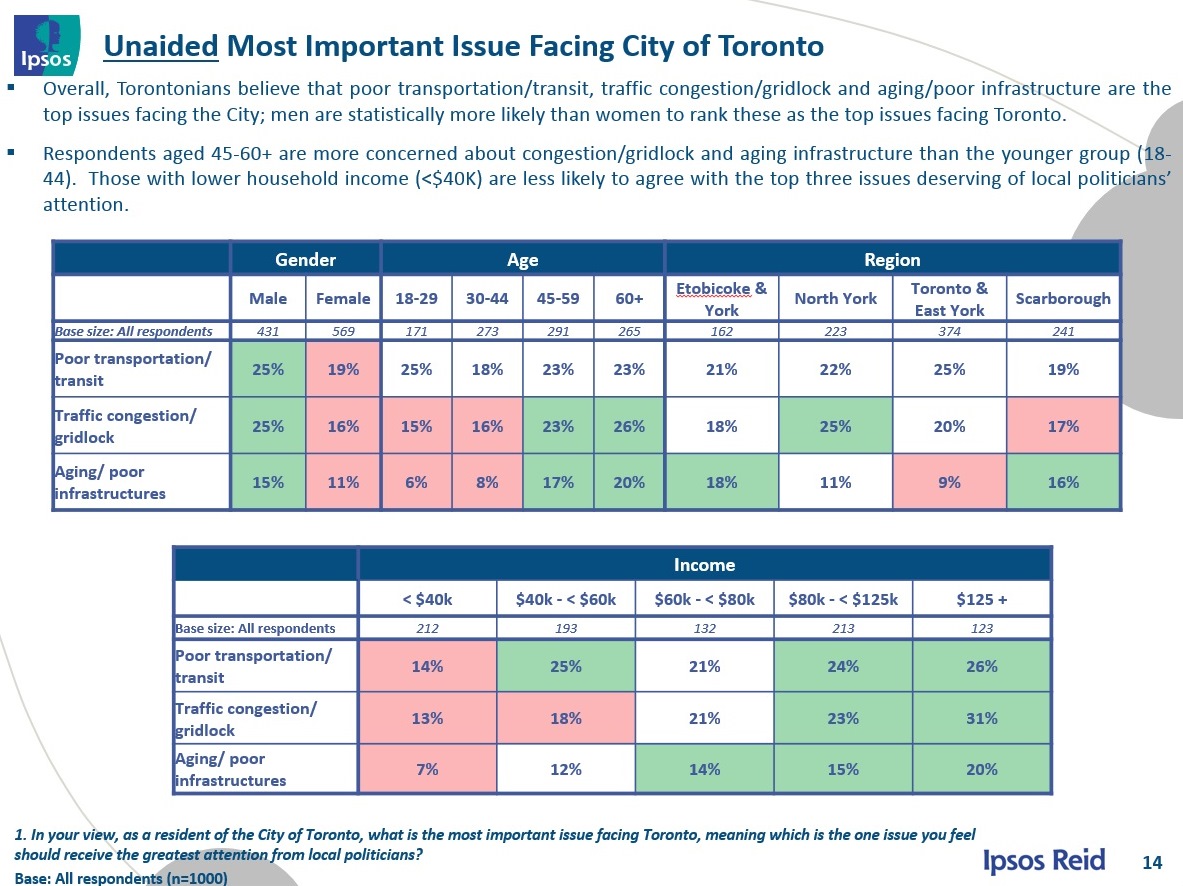
In the detailed breakdown, only the top three responses remain, and there is some disparity between the rankings. What is unfortunate, quite obviously, is that the category “poor transportation/transit” does not distinguish between modes. We do not know what type of “transportation” most concerns each type of respondent.

P14_MostImportantIssues_Breakdown

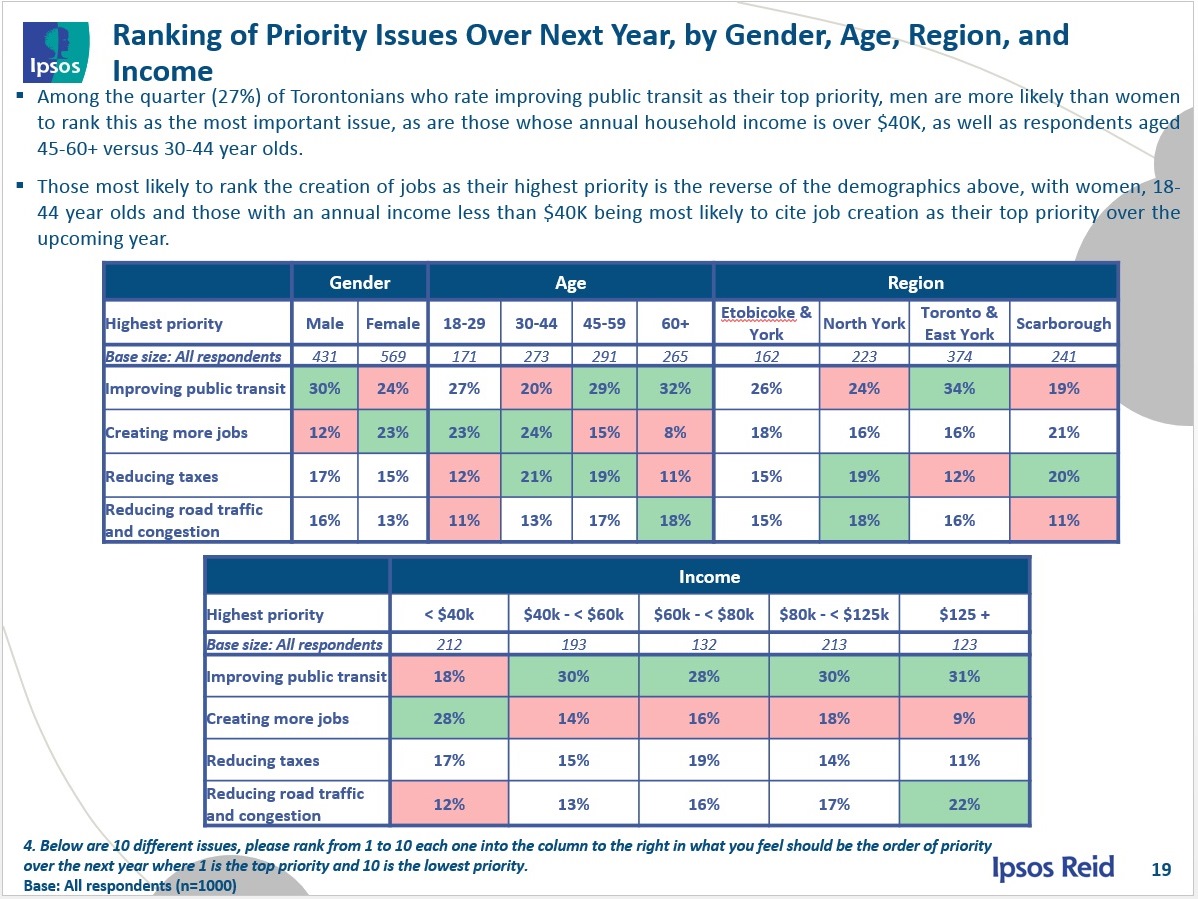
When the survey turns to the question of where Toronto should focus its efforts, transit comes out quite clearly on top as the number one pick of 27%, and in the top three for 61%.

P18_PriorityIssues

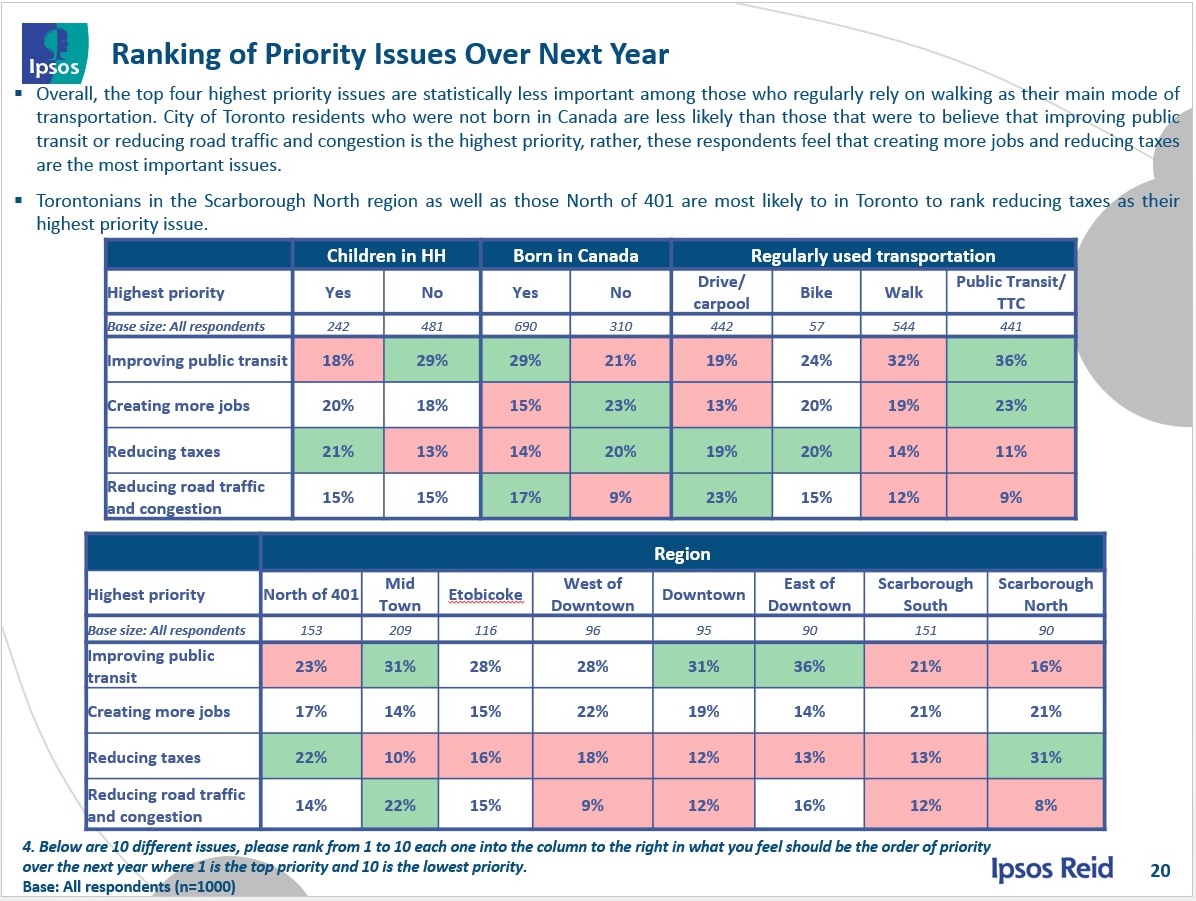
The breakdown is revealing because it shows that there is much stronger support for better transit among those living in more central areas, and this support falls off  notably in Scarborough, especially north of Highway 401. This begs a “chicken and egg” question: does improved transit get more support in areas where service is already relatively good and transit usage is higher, and can transit spending be politically competitive further from the core where it does not have as strong a presence?

P19_PriorityIssues_Breakdown_1

P20_PriorityIssues_Breakdown_2

Continue reading

The Gardiner, SmartTrack and the Scarborough Subway

Three major projects face approvals at Toronto Council and Queen’s Park in coming months.

  • Should we replace the Gardiner Expressway with an at-grade boulevard between Jarvis and the Don River?
  • Should “SmartTrack”, John Tory’s signature campaign plank, form a U-shaped line from Markham to Pearson Airport providing both regional and local service in parallel with GO Transit?
  • Should the Bloor-Danforth subway be extended through Scarborough in place of the once-proposed LRT network, via which route and at what cost?

None of these is a simple problem, and they are linked by a combination of forces: polarized political views of what Toronto’s future transportation network should look like, very substantial present and future capital and operating costs, and competing claims of transportation planning models regarding the behaviour of a new network.

On the political front, Mayor Tory is playing for a trifecta against considerable odds. Winning on all three would cement his influence at Council, but it is far from clear that he will win on any of them. Council is split on the expressway options, SmartTrack has already sprouted an alternative western alignment, and the Scarborough Subway fights for its life with alternative route proposals and the threat of demand canibalized by the Mayor’s own SmartTrack plans.

Continue reading

New Fares and Service Improvements Coming to the TTC (Updated)

On January 19, 2015, Mayor John Tory, TTC Chair Josh Colle and TTC CEO Andy Byford held a press conference to announce major changes for TTC riders in 2015.

  • Adult fares will rise by 10 cents (from $2.70 to $2.80, or 3.7%) with proportionate increases for passes, senior and student fares.
    • Children under 12 will ride free (the current fare is $0.75 cash or a ticket for $0.60).
    • The cash fare will remain at $3.00.
  • All day, every day services that were cut in 2011 will be restored.
  • A network of key bus and streetcar routes will have 10 minute service except overnight (after 1:00 am).
  • Crowding and wait times off peak will be reduced by modifying the loading standards.
  • Proof-of-payment and all-door loading will be extended throughout the streetcar network.
  • Twelve new Blue Night routes will be added to the 22 now in operation.
  • Fifty new buses will be acquired for service improvements.
    • Crowding and wait times during the peak periods for 21 busy routes will be improved.
    • Four new express bus routes will be added.
    • The pool of buses available for maintenance will be increased.
    • Temporary storage will be obtained to house the buses pending new garage construction.
  • Trains on the YUS and BD subways that are now held on standby for emergencies will be scheduled into the regular service.
  • Route management will be improved for streetcar routes to provide more reliable service and better utilize the capacity of vehicles in service.
  • The reliability of signals, track and communication systems will be improved with more resources for maintenance.

Updated Jan. 19, 2015 at 4:00 pm: One sour note in the announcement is the fact that the Metropass multiple will go up from 49 to 50 giving a new price of $141.50 vs the existing $133.75, an increase of 5.8%. In the midst of an otherwise upbeat, positive set of recommendations, it was a poor choice not to mention that frequent users would pay a higher increase for TTC fares. This continues TTC management’s desire to bump the pass pricing up on the basis that frequent users are getting too high a subsidy. If that’s the official position of the Mayor and TTC Chair, they should have said so in the press release.

FareIncrease2015

Much of this program arose from the August 2014 “Opportunities” report from TTC management.

At the time, then-candidate Tory argued against these proposals on the grounds that they were unfunded, and behind the scenes, the Tory camp complained that the TTC was supporting another candidate’s platform. To his credit, now-Mayor Tory recognizes the importance of better transit service that can be delivered in the short term, and he has embraced advice from Andy Byford wholeheartedly. Among the lessons he learned was that TTC’s off-peak ridership is higher and growing faster then peak demand, and that investments in off-peak service will benefit a very large number of riders throughout the city. This is an important change from a focus just on peak period, core-oriented capacity.

Tory has reluctantly dropped his proposed fare freeze saying that Toronto cannot do this and get on with improving transit. He now argues that fares will go up a bit more, but that riders will get a lot more service.

During the press conference, the Mayor made pointed, repeated references to “my predecessor” and “the previous administration” saying that the policy of service cuts and subsidy freezes was wrong. One can be gleeful seeing the Ford era openly criticized by the new Mayor, but that’s not the important point. Simply by making the statement, Tory puts allies inherited from the ancien régime on notice. Better TTC funding is not simply a predictable request from the usual activists and left-wing Councillors, but part of the Mayor’s program.

The financial proposal is that the TTC’s budgeted subsidy from Toronto will rise from $440.1-million in 2014 to nearly $479m in 2015. The fare increase plus added ridership (projected at 545m in 2015, up 10m from 2014) will bring in $43m more, net of the elimination of children’s fares ($7m). (The subsidy includes approximately $90m in provincial gas tax revenue which is paid to the City. This amount has not changed in many years.)

Further details will be revealed in the City Budget Launch on January 20, and at the TTC Board’s own budget meeting on February 2. Implementation of this plan is contingent on Council approval, although the new fares (which can be approved by the TTC itself) will take effect March 1. Service changes require lead time for planning, staffing, and in the case of the new buses, acquisition of vehicles and a storage yard. In practice, the changes will likely roll out beginning later this spring with the majority of service improvements coming in September or later. This will also limit the cost of new services to a smaller part of the year, although full-year costs will have to be absorbed in 2016.

The maps in the Opportunties report (linked above) show the range of routes that will likely be affected by the various proposals. I checked with TTC officials at the press conference, and although there may be minor changes, these maps give substantially a good idea of where the improvements will be.

Of the many opportunities proposed in August, the one which is notable by its absence is the two-hour fare. There is only so much money to spend on a new fare structure, and rebuilding service takes priority this year. However, the need for a simpler “transfer” mechanism on the TTC will be forced by the Presto implementation which Andy Byford is pressing Metrolinx to complete by the end of 2016. This will more-or-less force the question as part of next year’s budget planning.

During the scrum, the inevitable question to Mayor Tory was “how will you pay for all of this”. Tory demurred saying all would be revealed at the Budget Launch. An important point, however, is that he plans to keep tax increases to inflation, but the Scarborough Subway tax will be outside of that “inflationary” envelope.

This is a very good start for the Tory/Colle era of TTC policy-making. Rather than cherry-picking a handful of improvements that might benefit only a small segment of Toronto, they have opted for a variety of changes addressing many submarkets within the TTC’s ridership. If this continues in future years, by the time the TTC and Metrolinx open new rapid transit lines, Toronto will have a much improved surface network linking riders to new and improved trunk routes.

Looking Back: Bloor-Danforth Shuttles

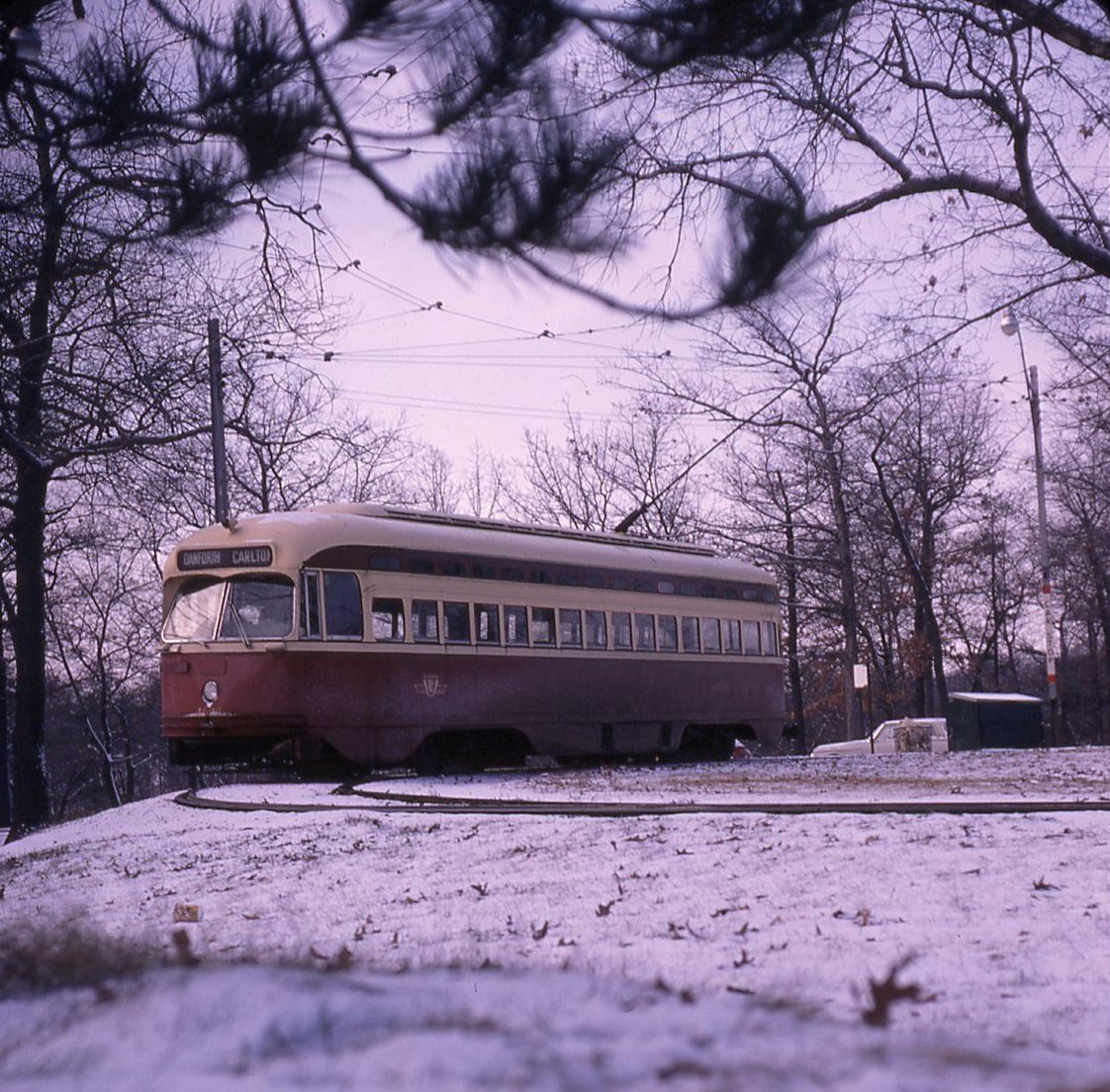
From February 1966 when the original Bloor-Danforth subway opened between Keele and Woodbine, and May 1968 when the extensions to Islington and Warden were added, two streetcar shuttles served the remaining outer part of the Bloor carline.

Looking at the old streetscapes, much remains familiar, but much has been lost especially to cheap rebuilds and infill developments.  Very much a vanished breed from this era are the car lots, gas stations, furniture stores and, in a few cases, houses.

Continue reading

Bloor-Danforth Streetcar Shuttles: Demand Without Density

A frequent part of debates about technology choices and network planning is the premise that to succeed, rapid transit must be surrounded by high density development. This is an odd claim given the counter-examples available on Toronto.

The situation is more subtle, and “demand” turns not just on density adjacent to the line, but on its ability to act as a corridor drawing on feeder services to concentrate demand. Whether such concentration is “good” is another matter. Higher demand requires more infrastructure in the corridor and in a worst-case scenario, a line can run out of room. Two good examples in Toronto are the Yonge subway and Highway 401.

Focus on a single corridor can also distort travel patterns and network design. As a non-driver, I have often been amused by motorists who will go miles out of their way to use an expressway, only to find themselve trapped in a traffic jam. For transit riders, the need to force-feed rapid transit can interfere with travel that is not oriented to the primary trip pattern. Try getting around Scarborough if you are not bound for Kennedy or STC stations.

Recently, I was scanning another batch of old phographs and they reminded me of an even older example of high demand in a low density area: the streetcar shuttles on Bloor-Danforth that operated between the opening of the original Keele-Woodbine service, and the extensions a few years later to Islington-Warden. Neither Bloor West nor the Danforth — particularly in the late 1960s — were forests of high rise apartments. All the same, the shuttles had service, capacity and demand beyond that we see on any streetcar line today.

The Bloor West shuttle from Keele Station to Jane Loop operated with 17 cars at peak over a distance of only 2.1km at a headway of 1’07”. That’s 53.7 cars/hour for a design capacity of about 4,000/hr (based on about 75 riders per car) with headroom for peaks at a higher level.

The Danforth shuttle from Woodbine Station to Luttrell Loop operated with 12 cars on a 1.6km line at a headway of 1’30”. At 40 cars/hour this gave a design capacity of about 3,000/hr.

An important point about these shuttles is that the lion’s share of their traffic was bound to or from the subway, and local traffic was comparatively light. Many riders boarded inbound at the Jane and Luttrell terminals, and the streetcars were not attempting to serve very heavy demand from on-street stops. That demand depended on feeder bus services from what we now call “the inner suburbs”.

Moreover, the level of service on the outer ends of the old Bloor-Danforth streetcar route shows how considerable the demand was for these segments, even allowing for some added demand due to the subway’s presence.

The moral of this short article is that a transit network and its routes cannot be thought of with a simplistic model of transit stations surrounded by development. The larger context includes the diversity or concentration of demand patterns and the degree to which the network serves them.

In the next article, a look at Bloor West and The Danforth as they once were.

Correction January 6, 2015: In the original version of this article, I cited the number of cars/hour as the actual assignment of vehicles to each route. Thanks to John F. Bromley for catching this howling error.

The Dubious Planning Behind SmartTrack (Part III)

In the first part of this series, I discussed The New Geography of Office Location, 2011, and then in the second part, its successor A Region in Transition, 2013. Now, I will turn to The Business Case for the Regional Relief Line, October 2013. All three papers were produced by SRRA (Strategic Regional Research Associates).

Only a 17 page summary version of the Relief Line report is available online, compared to the full versions of the first two. Considering the clear influence this series of reports has had on transit policy and the recent election campaign, the idea that

Detailed research is available to Investment Partners of SRRA [Page 1]

leaves a big hole in the range for public comment and review. I hope that Metrolinx will rectify this situation as part of whatever studies might take place.

My thanks to those of you who slogged through the first two articles.

Continue reading

The Dubious Planning Behind SmartTrack (Part II)

In the first article of this series, I examined a 2011 report about the shifting location of office development in the GTHA. Here I will turn to a follow-up report, A Region in Transition, from January 2013.

These reports provided the underpinning for the SmartTrack campaign proposal from Mayor John Tory. It is important that we understand just where this scheme came from and what it was  intended to accomplish by authors who, in some cases, lent their support to the Tory campaign and the SmartTrack brand.

Continue reading