Southbound 510 Spadina bus operations changed on July 8. Between 3 and 7pm on weekdays, buses do not operate south to Queens Quay, but instead loop east on Front, then south and west on Blue Jays Way to Spadina.
The charts presented here were generated by Darwin O’Connor’s TransSee website. Basic functions of that site are available free, and some chargeable features are free for Toronto streetcar routes. O’Connor uses the NextBus data feed as his source on a real time basis whereas the analyses I publish here use a monthly data extract provided to me by the TTC from their Vision system.
This article will be updated from time to time to show the evolution of travel times on the 510 Spadina replacement bus operation.
There are two locations of interest where congestion occurs:
Southbound approaching Front Street
Northbound approaching Bloor Street
Updated July 16 at 6:50am: Data for July 15 added.
With the June 23, 2024 schedule change, streetcars were replaced with buses running from Spadina Station at Bloor to Queens Quay. Buses operated in the regular traffic lanes, not on the streetcar right-of-way.
To no surprise, during periods when Spadina Avenue is congested, primarily with traffic queued for the westbound Gardiner Expressway ramp at Lake Shore, the buses made glacial progress. This was not, however, the only place where buses were delayed by traffic.
The TTC has announced that it will change the south end loop in an attempt to speed service during the PM peak. No buses will operate between Blue Jays Way and Queens Quay, but instead they will loop via Front eastbound, then south and west via Blue Jays Way to Spadina. Traffic Wardens will assist with the turn at Front Street.
However, the congestion on the south end of Spadina can extend north to King and sometimes beyond Queen Street. It is not clear whether the new loop will address much of the problem. Buses will not be using the streetcar right-of-way, even though it has no centre poles north of Bremner Blvd. to bypass the traffic jam.
The TTC advises that this is an interim arrangement, and that they are working with the City on further, unspecified, changes to the bus operation.
It’s Not Just the Gardiner
An effect unexpected by some, I am sure, was that at uncongested parts and times, the buses make faster trips than the streetcars had only a week before the changeover. Anyone who rides the 510 Spadina car will know of their glacial progress through intersections thanks to the system wide slow order on all special trackwork. Spadina has many intersections. This type of pervasive delay is seen all over the streetcar system, but is worst on rights-of-way where one would expect streetcars to operate as quickly as possible.
Buses have a further advantage in that they are stopping nearside, and therefore can serve stops while awaiting a green signal, and then leave without a second farside stop.
The absence of priority with extended green phases for Spadina transit service affects the modes differently because an extended green would allow streetcars to reach their stops before a signal turns against them. Even if bus is caught on the nearside of an intersection, it will be stopping to serve passengers.
The left turn phase for auto traffic that blocks streetcars also blocks buses, and so this particular delay is common to both modes.
In addition to congestion at the south end of the route, buses also encounter problems during some periods approaching Bloor Street northbound.
The remainder of this article reviews travel times and service reliability on the main part of the 510 Spadina route over June 2024. (There is a companion article about the return of streetcars replacing buses on 512 St. Clair.)
Updated June 13, 2024 at 8:00 am: A table comparing scheduled service levels on Queens Quay has been added.
Updated June 13, 2024 at 2:00 pm: A table comparing scheduled service levels on the 510 streetcar with proposed bus service has been added.
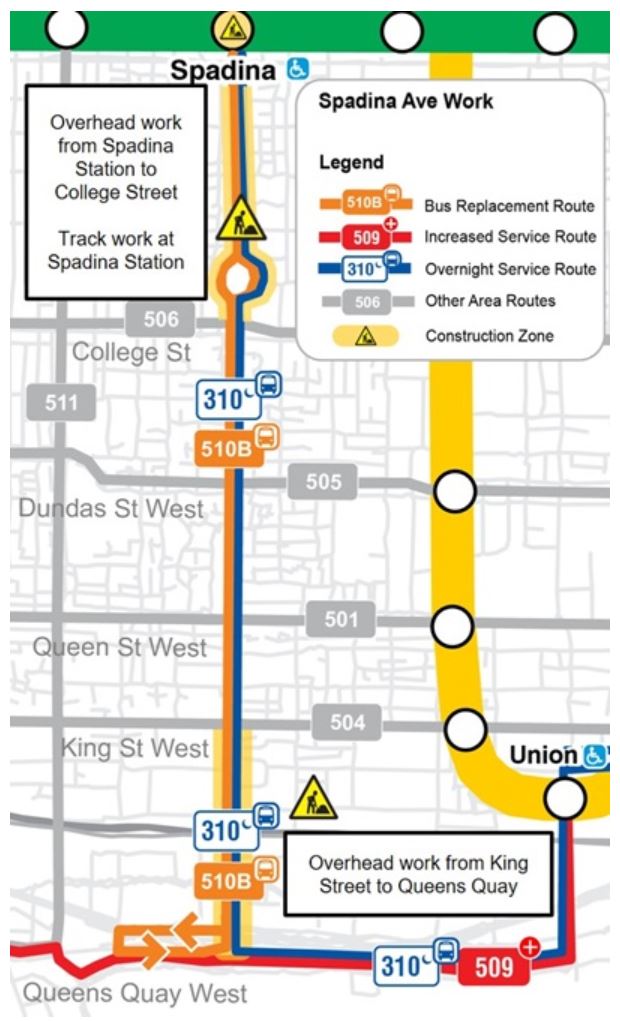
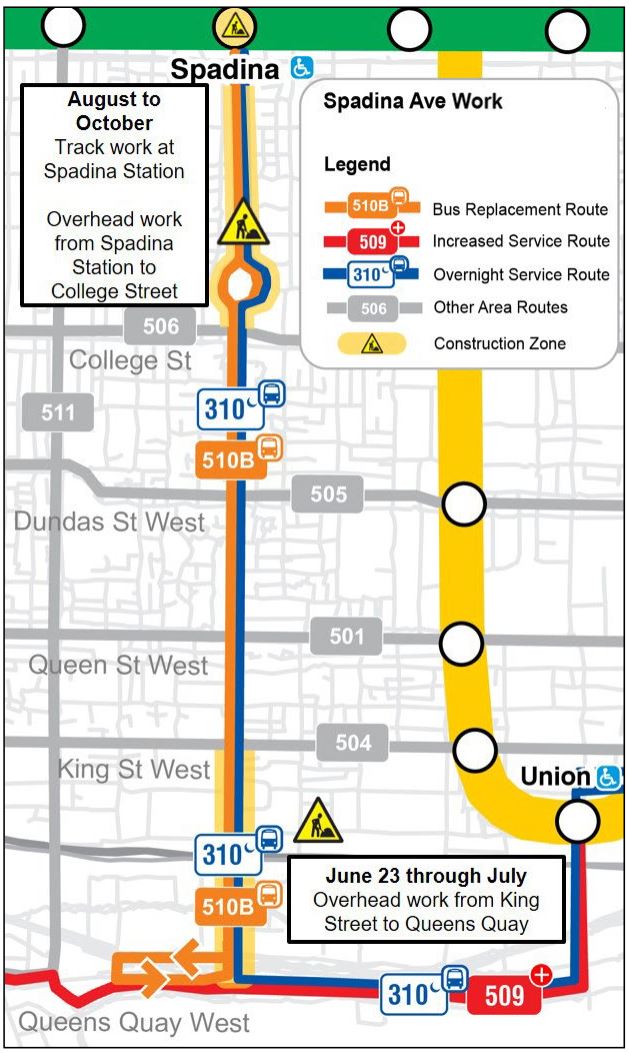
In April, I reported TTC plans to replace 510 Spadina Streetcars with buses from June 23 through the summer and fall. The TTC has now updated the announcement and extended the program from October into December. Here are the April (left) and June (right) versions of the maps for comparison.
Enabling works for Spadina Station Loop expansion. Condo construction east of the station will expose part of its structure, and the TTC will make provision for extending the streetcar loading platform.
Overhead reconstruction from Spadina Station to College Street, and from King to Queens Quay.
There is no information about the segment from College to King which was omitted due to resource limitations according to the TTC. It is unclear whether there will be another shutdown in 2025 to finish the work. I await clarification on that issue from the TTC.
Buses will operate in mixed traffic, not on the streetcar right-of-way. According to the Transit Notice:
The City will be deploying traffic wardens to assist bus operations on Spadina Avenue.
Narrow lane width and centre overhead poles in certain sections preclude bus service on the streetcar right-of-way.
Overhead crews will be actively working in the right-of-way in different sections of Spadina Avenue.
Operating in both the streetcar right-of-way and in mixed traffic lanes would require new signals and limit any travel time benefits.
Some of this does not entirely make sense. There are centre overhead poles only south of Front Street. No work is planned between College and King. It is not clear that completely new signals would be needed for buses to shift between the streetcar right-of-way and curb lanes, especially at College and at King where there are already priority signals for streetcar turns northbound and southbound. Some reprogramming would be necessary.
As for traffic wardens, they will be little use on lower Spadina where traffic is regularly backed up from the Gardiner Expressway. I would not be surprised to see many buses short turn at Adelaide rather than attempting the trip south to Queens Quay.
Service on 509 Harbourfront will be improved, but the details have not yet been published.
I will update this article as more information is available.
Comparison of Service Levels on Queens Quay
The table below shows the existing scheduled service on Queens Quay until June 22 with the 509 Harbourfront and 510 Spadina cars, and from June 23 with the revised 509 service. It is quite clear that there will be less service on Queens Quay from June 23 onward.
The values shown below are headways in minutes and seconds, and vehicles/hour e.g. “10′ (6)”.
509 Harbourfront to June 22
510 Spadina to June 22
Combined 509/510 to June 22
509 Harbourfront effective June 23
Percent Change
Weekdays
AM Peak
7’15” (8.4)
10′ (6)
4’10” (14.4)
6′ (10)
-31%
Midday
9’30” (6.3)
10′ (6)
4’53” (12.3)
7′ (8.6)
-30%
PM Peak
9’30” (6.3)
10′ (6)
4’53” (12.3)
6′ (10)
-19%
Early Evening
9’15” (6.5)
10′ (6)
4’48” (12.5)
7′ (8.6)
-31%
Late Evening
10′ (6)
9’30” (6.3)
4’53” (12.3)
8′ (7.5)
-31%
Saturdays
Early Morning
8’30” (7.1)
9’30” (6.3)
4’49” (13.4)
8’30” (7.1)
-47%
Late Morning
9’15″(6.5)
8’30” (7.1)
4.25 (13.6)
7′ (8.6)
-37%
Afternoon
8’15” (7.3)
7’45” (7.7)
4′ (15)
4′ (15)
Nil
Early Evening
9’15” (6.5)
5’15” (11.4)
3’21” (17.9)
7′ (8.6)
-52%
Late Evening
10′ (6)
9’30” (6.3)
4’53” (12.3)
8′ (7.5)
-39%
Sundays
Early Morning
15′ (4)
15′ (4)
7’30” (8)
10′ (6)
-25%
Late Morning
8’45” (6.9)
9’45” (6.2)
4’35” (13.1)
7’30” (8)
-39%
Afternoon
8’15” (7.3)
9′ (6.7)
4’17” (14)
5′ (12)
-14%
Early Evening
9’15” (6.5)
6’15” (9.6)
3’44” (16.1)
7′ (8.6)
-46%
Late Evening
10′ (6)
9’30” (6.3)
4’53” (12.3)
8′ (7.5)
-39%
Comparison of Service Levels on Spadina
The table below compares the existing streetcar service on 510 Spadina between Spadina Station and Queens Quay with the proposed level of bus service. Note that streetcars carry two to three times the load of a standard bus. Values are shown in minutes and seconds, with vehicles per hour in brackets.
The TTC has announced plans for construction projects that will require replacement of streetcars by buses on 510 Spadina starting June 23 until October 2024.
In June and July, overhead will be rebuilt between King and Queens Quay. This will not affect route 509 Harbourfront, and service on that route will be increased to offset the missing 510 Spadina cars on Queens Quay.
In August through October, overhead work will shift to the section from College to Spadina Station.
At Spadina Station, track will be replaced and other work will be done in preparation for a platform extension that will be enabled by excavation for a nearby condo.
There is no word on plans for the overhead between College and King, or whether another shutdown will be required for that segment.
Both the 510 daytime and 310 night buses will operate in mixed traffic stopping curbside along their route. Buses will use the surface loop at Spadina Station.
At its November 2023 meeting, Council passed a motion proposed by Councillor Chris Moise whose ward covers the east side of downtown, and who also sits on the TTC Board:
1. City Council direct the General Manager, Transportation Services, in consultation with the Toronto Transit Commission, the Toronto Police Service, and the City Solicitor to review and report back to the Executive Committee in the second quarter of 2024, including: a. an update on streetcar performance over the last five years; b. suggested improvements to the public realm along King Street until the permanent capital project can be delivered; and c. the feasibility of implementing automated traffic enforcement on the King Street Transit Priority Corridor, including details on what legislative amendments would be required to provincial legislation including, but not limited to, the Ontario Highway Traffic Act.
This article addresses point “a” with a review of streetcar lines over the past five years. It is important to go back to 2019 before the pandemic fundamentally shifted traffic and transit patterns downtown as a point of reference.
From time to time, there are calls to expand a “King Street” redesign to other parts of the network, but there are two “cart before the horse” issues to address first:
Figure out how to make King Street operate as it was intended and return at least to its pre-pandemic behaviour, if not better, as a model.
Understand how other streets operate including where and when problems for transit performance exist.
An update on transit priority will come to Council in February 2024, although this will look more widely at the city, not just downtown. In previous articles I have reviewed the growing problem of transit travel times as traffic builds on the proposed RapidTO corridors, some of which exceeded pre-pandemic levels some time ago. In future articles I will refresh these analyses with data through to the end of 2023.
An important distinction between most RapidTO bus corridors and the downtown streetcar system is the design of suburban vs downtown streets. In the suburbs, the streets are mostly wide, have relatively few points of access (e.g. driveways) or pedestrian oriented uses (e.g. shops), and travel distances tend to be longer. In the core, streets are narrow, mostly four lanes with no possibility of widening, access points are more frequent, there is a strong pedestrian orientation, and trips tend to be short. Even if buses were running, express operations would be almost impossible and would save very little time on the downtown routes.
There are exceptions such as some older parts of the inner suburbs that bring physical challenges for transit priority, but also the political challenge that the transit share of road use is lower as one moves outward from the core. King Street is a very different place from Steeles, and Dufferin is somewhere in between depending on which section one considers.
An important message in all of this is that “congestion” (put in quotes because it is so often cited as a get-out-of-jail-free excuse for all transit woes) varies from place to place and time to time. Simply putting transit priority everywhere will not solve all problems and could even be overkill (even assuming that it is true “priority” and not a sham to keep transit vehicles out of motorists’ way). It is simple to colour a bunch of key routes end-to-end on a map, but much harder to identify changes that will actually make a difference. Meanwhile, a focus on “priority” could divert attention from badly-needed improvements in headway reliability and more reliable wait times.
This article begins with a comparison of scheduled travel speed on each route, and then turns to actual travel speeds by route segment. In the interest of length, I will leave a discussion of headway reliability to future articles. This is an important component of total travel time, especially for short trips or trip segments.
I have also included tables showing the constant change in route configurations on the four major east-west corridors thanks to a never-ending procession of track and water main work, rapid transit construction, and overhead changes for pantograph operation. Some of this work was accelerated to take advantage of lighter traffic conditions during the pandemic, and some to bring forward work to keep staff employed.
However, the rate of route changes persisted well beyond the heart of the pandemic and threatens the credibility of transit service on major corridors leaving riders constantly wondering where their streetcar or replacement bus might be. Some changes occurred without the planned work actually taking place, or work started and ended later than announced (sometimes much later as in the never-ending KQQR project).
An important change over recent years, separate from the pandemic, has been the move to larger streetcars on wider headways. What might have been a tolerable unevenness in service when streetcars arrived every 4 or 5 minutes simply does not work for scheduled headways of 10 minutes with much wider swings. Bunching when it occurs leaves much bigger gaps between vehicles. A laissez faire attitude to route management, and especially the assumption that routes under construction cannot be managed, has led both to unreliable service and basic questions of how or if the TTC can recover the quality riders expect.
For all the talk of project co-ordination, the last people who seem to count are the riders. Simply studying raw travel times be they scheduled or actual does not capture the frustration, delay and despair from the ever-changing and unreliable services, be they by streetcar or bus.
Detailed Design Review (100%) for the Spadina Station – Streetcar Platform Extension is underway and expected to be completed by Q3 2023.
Nearby redevelopment planned to occur in the near future will provide access to the tunnel structure for platform expansion.
Regular riders of the 510 Spadina will be familiar with long, sometimes very long, intervals spent waiting in the tunnel outside of Spadina Station just for their car to move onto the platform and discharge passengers.
This is the compound effect of several factors:
The Flexity streetcars are too long for two of them to be on the platform at once (as the former CLRV cars could be) with one loading and the other unloading.
The Flexitys cannot selectively open doors, except for the very front one, to serve riders while only partly on the platform.
A common situation at this station is for a car to wait on the platform while the operator takes a bathroom break or waits for a relief crew to show up.
The running times on the 510 schedule are generous enough that there is usually time to sit at Spadina Station rather than leaving immediately.
During some periods, service that would normally operate to Union Station is cut back to Queens Quay or Charlotte Loop giving cars even more surplus running time.
When service on Spadina is bunched and a parade of cars reaches Spadina Station, only one car can use the platform while those behind wait in the tunnel.
This situation cries out for better line management and scheduling, including shifting away from a strict adherence to “on time” cars and a move to dispatching on a regular headway to avoid backlogs. Step back crews would be essential in allowing cars to leave as quickly as possible while operators had their breaks. (Note that breaks are generally not taken at Union because it is a busy station serving two routes.)
As things are, much of the benefit for riders of a reserved lane on Spadina can be undone by the operation at Spadina Station.
During the month of August 2023, 510 Spadina service to Union did not operate on the following days so that all service at Union could be provided by 509 Harbourfront cars to Exhibition Loop:
Saturday, August 5 from about 8am to 8pm during the Caribbean Carnival.
Friday, August 18 onward from about 10am to 8pm during the CNE.
In an attempt to see just how bad this problem was, I built a fine-grained “map” of Spadina Station Loop for my usual route analysis programs. This includes screenlines at:
The loop entrance where the north and southbound tracks divide
The east end of the station platform
The west end of the station platform
This allows plotting of how long cars spent queued in the tunnel, and how long they sat on the platform. Unfortunately, it is not possible to resolve the difference between cars sitting at the loading area at the west end of the platform and those almost, but not quite, on the platform to unload.
(The reason for this is that the TTC’s “Vision” tracking system does not accurately map car positions inside the station. Indeed, cars sometimes appear to reverse within the station according to the GPS data. This is likely due to the problem of getting accurate GPS info underground.)
This is a route that should have more reliable service given its operation entirely in reserved lanes, and it certainly should not make riders wait five minutes or more just for a car to reach the platform at Spadina Station.
The TTC’s Real Estate Investment Plan includes an item for expansion of the platform at Spadina Station, but it is not clear that this applies to the streetcar platform. With the current tight budget it is hard to see this sitting near the top of the pile for funding.
The full list of closures begins on p 13 of the report. There is a variety of full weekend, early closing and late opening events (check the legend to the chart).
There are fewer Line 1 closures in 2023 due to ATC (Automatic Train Control) than in 2022 because the main work is complete. However, there is a follow-up phase that will require some weekend closures for testing and implementation. Other work affecting Line 1 includes repair of station finishes on the University subway, elevator installation at Lawrence, various track replacements, and preliminary work at Finch for the Yonge North Subway Extension.
On Line 2, there will be work at Kipling to add a new storage track, preparatory work at Kennedy for Scarborough Subway Extension, preparatory work on the east end of the line for ATC installation, and some track replacement work. As usual there will be several late openings of service on Sundays for beam replacement on the Prince Edward Viaduct.
Many closures involve only an early shutdown of subway service to give a longer overnight maintenance window than would be possible with normal hours of service.
Streetcar
There is a long list of events for the streetcar system, but many of them are short interruptions of overnight/weekend work for inspections or minor repairs.
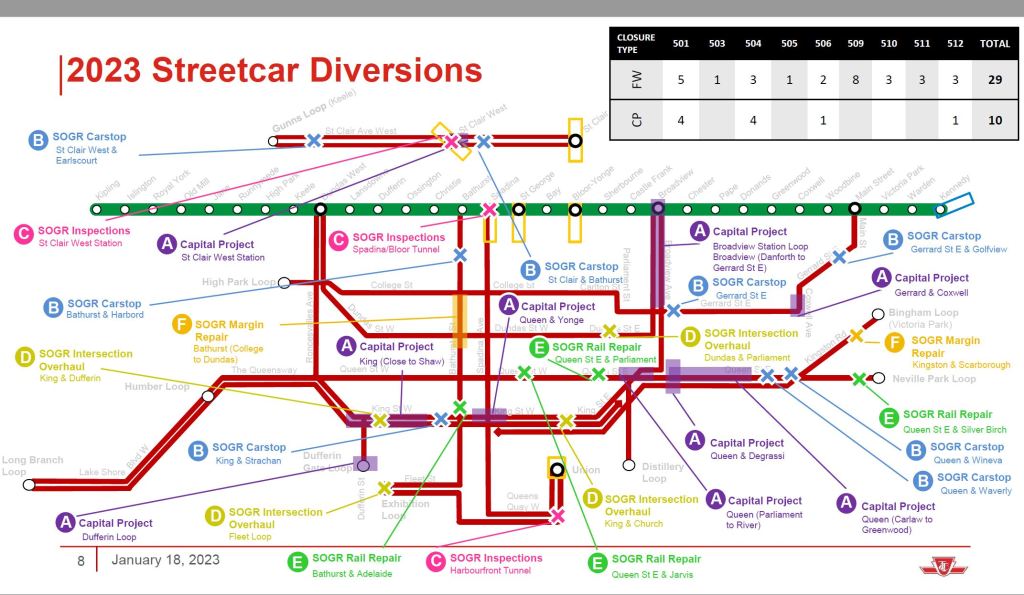
The major trackwork planned in 2023 is listed both in the report (starting on p 19) and on the TOInview map of City construction projects. The schedule implies that a good chunk of the streetcar system will be shut down at various times during the year. The Ontario Line contributes some of this to the Queen car, but the long-suffering riders on King do not get a break either after years of work at King-Queen-Roncesvalles. Note that Adelaide from York to Victoria is a Metrolinx project and so does not appear in this list.
Some of the dates in the TTC list do not align with info on TOInview. This is very common.
Parts of the schedule simply do not make sense. Some projects have far more time reserved than they should take based on past experience. Some projects will block the routes from carhouses in the east end to the rest of the network either via Queen Street or via Coxwell and Gerrard Streets, and times for these overlap.
Update: The TTC confirms that planned work on Gerrard Street will not occur at the same time as projects on Queen will block access to Leslie Barns and Russell Carhouse. See the map at the end of this section for a graphic view of the planned work.
Details of the Broadview Station Loop expansion are not yet available, nor is it confirmed whether this will actually occur.
I hope to get clarification of what is going on from the TTC.
Feb 27-Mar 26: King Street West from Close to Strachan
Mar 10-Oct 29: Dufferin Loop
Mar 24-Nov 28: Queen Street East from Carlaw to Leslie & Leslie to Greenwood
Mar 31-Apr 7: Intersection of King & Church
May 1-Nov 29: York from Queen to Adelaide (Ontario Line diversion)
May 6-July 8: Intersection of Lower Gerrard & Coxwell
May 6-Nov 21: Russell Yard
May 14-Nov 8: Broadview from Gerrard to Broadview Station
June 18-July 29: Intersection of King & Parliament
July 30-Nov 18: Metrolinx work at Queen/Degrassi overpass
Sept 3-Oct 2: Broadview Station Loop
Sept 7-Oct 29: Queen from Parliament to River & Davies to Broadview
Oct 8-Dec 16: Oakwood Loop
Oct 16-Feb12: St. Clair West Station Loop
The report does not list specifics for 2024, but info already appears on the TOInview map. It is not clear how some of this work will interact with Metrolinx Ontario Line construction at King & Bathurst. There is a proposed track and lane realignment at Bathurst & Fleet, but it is not clear whether this will actually occur, or if the planned work is simply replacement of existing special work as is. Details of the Spadina Station streetcar loop expansion are not yet available.
St. Clair & Yonge
St. Clair & Bathurst
Queen St. W from O’Hara to Triller
King St. W from Strachan to Spadina
King & Queen (Don Bridge)
Bathurst St. from Queen to Front
Bathurst & Queen
Bathurst & Fleet
College St. from Bay to Yonge
Main & Gerrard
Russell Yard (continuing from 2023)
Expansion of the streetcar platform at Spadina Station Loop
Update: The following map was included in the staff presentation to the Board on January 19, 2023.
This map contains several geographic errors:
The project labelled Queen & Yonge points at King & Spadina.
The project for St. Clair & Bathurst is shown east of St. Clair West Station rather than west of it.
The project for St. Clair & Earlscourt is shown well west of Lansdowne rather than east of it.
Carstops on Queen East at Wineva and at Waverley are shown as west of Kingston Road rather than east of it.
The project for Queen & Jarvis is shown well west of Yonge.
The project for Fleet Loop actually points to Exhibition Loop.
There are a few more, but my point in cataloguing them is that this is sloppy work and it speaks to the quality of information presented to the Board by management.
Pantograph Conversion
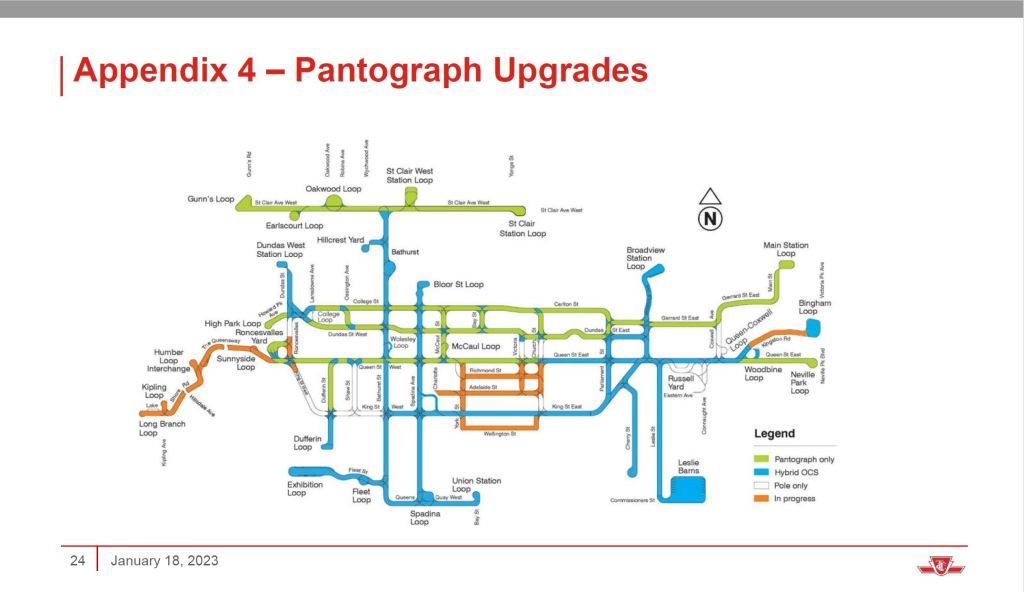
Gradually, and several years behind the original target date, the TTC has converted overhead wiring designed for trolley poles first to a hybrid pole/pantograph configuration, and then to pure pantograph style. A map of the current status was included in the staff presentation.
There are some problems with this map which is based off of a track plan that is itself out of date. “Wrong way” track has been removed from the one-way streets downtown, although it still appears here. Also, some work is underway on King West even this is not shown with the orange “in progress” colour. The intersection of King & Shaw had already been converted to Hybrid format when I visited it a month ago. (There are other errors in the map, but please don’t bother commenting with fixes.)
One amusing relic is the legend “Hillsdale Ave” on Lake Shore Blvd West. This was the site of a long-removed wye, the last in the system, and the street is called “Hillside Ave”. “Hillsdale” is in North Toronto.
Again, this is an unfortunate example of how the “official” records of the system are out of sync with actual conditions in the field.
The TTC will modify many routes on January 8, 2023, although most of the changes are small tweaks rather than a significant overhaul of service. Current changes are achieved mainly by reallocation of vehicles, modification of running times and headway adjustments.
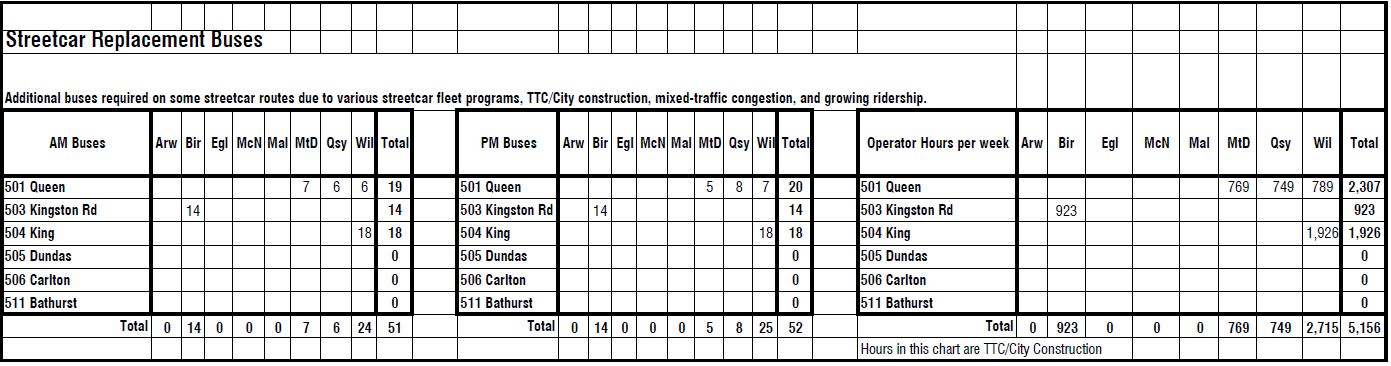
Updated January 3, 2023 at 4:35pm: A table showing the number of replacement buses on streetcar routes has been added.
In the January schedule period, the planned weekly service is down from November 2022 levels. That is the appropriate comparison because the “December” schedules only cover the holiday period when service is reduced. All of these reductions have been reversed in the January schedules, and some school trips have been added beyond the November level.
Service in the latter part of 2022 ran below budget because riding had not rebounded as quickly as originally hoped across the system. January 2023 continues at a similar level, and a service budget has not yet been published, let alone approved.
Hours/Week
Regular Service
Construction Service
Total
Nov 2022 Budget
182,016
4,492
186,508
Nov 2022 Planned
173,249
4,187
177,436
Dec 2022 Planned
170,708
3,779
174,387
Jan 2023 Planned
171,802
5,175
176,977
Source: TTC Service Change Memos for November/December 2022 and January 2023
Subway Service
There is no change in subway service for January 2023.
Streetcar Service
506 Carlton will return to its normal route over its entire length after an extended sojourn on Dundas Street. The 306 night service will return to streetcar operation. Construction of streetscape changes on College Street is not yet complete, but this will not require a diversion in 2023.
Some streetcar routes will have new schedules:
509 Harbourfront and 510 Spadina will be modified to reduce layover conflicts at Union and Spadina Stations.
Service on 509 Harbourfront will be reduced to match demand in some periods.
Sunday early evening service on 510 Spadina will be changed so that all cars operate as 510A to Union rather than a split service with 510B turning back at Queens Quay. This matches the Saturday service pattern.
512 St. Clair service will be reduced to match demand during some periods.
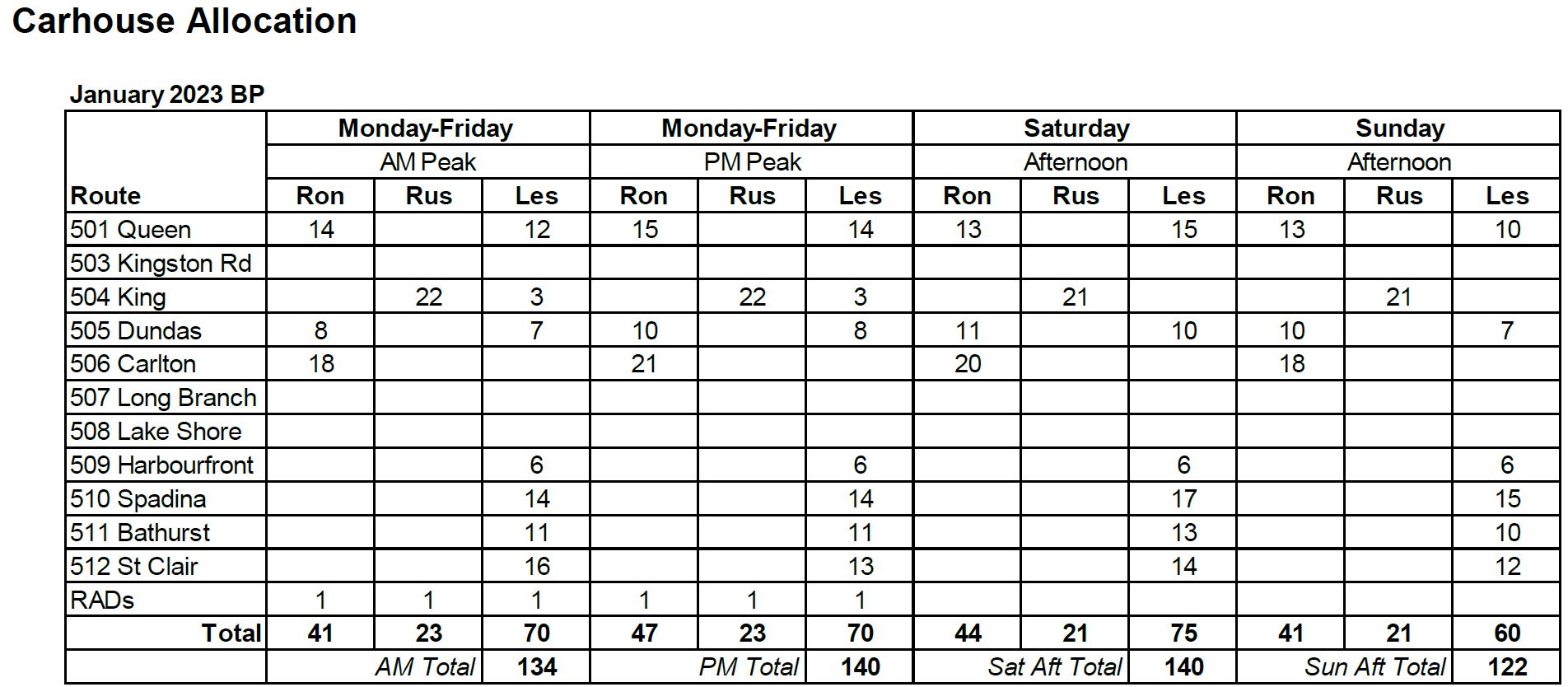
The allocation of routes to carhouses will change slightly to balance resources. The table below includes a long absent route “507 Long Branch” and the temporarily suspended “508 Lake Shore”, but not the “502 Downtowner”. Make of that what you will.
The number of buses operating on streetcar routes for construction projects is shown in the table below.
Bus Service
Routing Changes
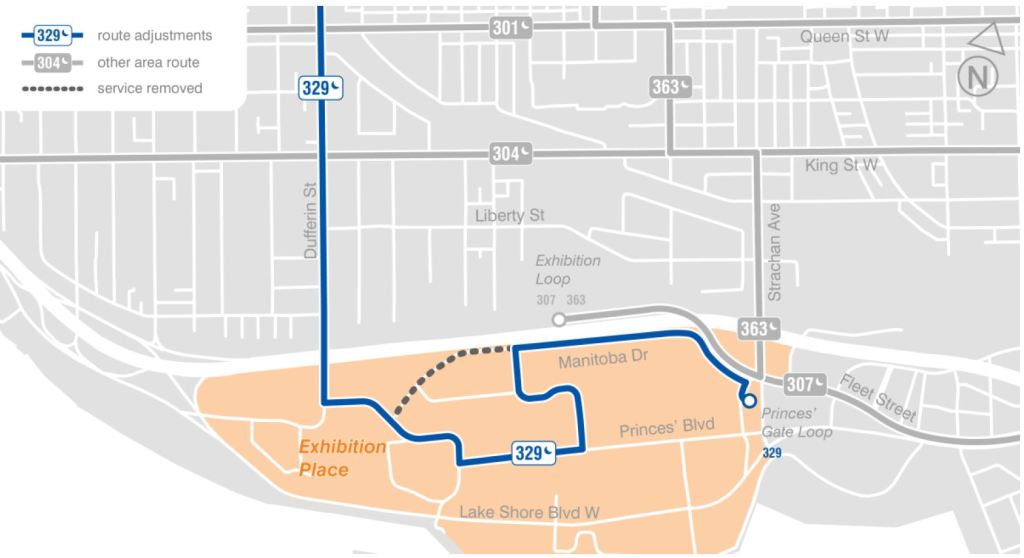
29/329 Dufferin
Due to construction for the Ontario Line’s Exhibition Station, the 29 and 329 Dufferin services will be rerouted as shown in the maps below.
43B Kennedy and 985A Sheppard STC Services
These routes will be modified to access Scarborough Town Centre via a different path in order to provide connecting stops with the temporary GO bus terminal.
95C York Mills and 996 Wilson Express Service to Ellesmere Station
The 95C York Mils branch will be dropped, and in its place the 996 Wilson Express will be extended east to Ellesmere Station.
The levels of service in the “before” and “after” configurations are compared below.
Buses/Hour
AM Pk Pre
AM Pk Post
Midday Pre
Midday Post
PM Pk Pre
PM Pk Post
95A Pt Union
7.5
6
3.3
6
5.5
6
95C Ellesmere Stn
7.5
3.3
5.5
995 UTSC
5.5
5
3.8
3.8
5.5
5
996 Ellesmere Stn
6.7
4.8
6
Total to Ellesmere Stn
20.5
17.7
10.4
14.6
16.5
17
Total to UTSC
13
11
7.1
10.8
11
11
Other affected bus routes
600 Run As Directed: The number of scheduled RAD buses is deeply reduced with only 6 weekday crews and none on weekends. Divisions will assign buses locally depending on operator availability.
19 Bay: An AM peak tripper to handle demand to the waterfront will be created by diverting one 503 Kingston Road bus to run eastbound as a Bay bus to Dockside Drive and Queens Quay, then deadhead to Broadview and Queen to resume service on the 503.
20 Cliffside and 113 Danforth: Headways will be standardized so that an evenly blended service can operate from Main Station on these overlapped routes.
25 Don Mills: The split branch structure north and south of Don Mills Station will be extended into the early evening on weekdays.
925 Don Mills Express: Trips added during peak periods to match demand.
939 Finch Express: Midday and PM peak service improved, evening service reduced.
41 Keele: Service reduced to match demand.
44/944 Kipling South: Some early express trips will be replaced with local buses. Two school trips from 44 Kipling South will interline with 76 Royal York South school trips.
945 Kipling Express: AM peak service improved.
48 Rathburn and 112 West Mall: PM school trips serving Michael Power Saint Joseph HS will be changed to match dismissal times.
52 Lawrence West: A new trip will be added from Westwood Mall at 6:52am to accommodate demand. A new trip will be added between Lawrence and Lawrence West Stations in the early PM peak. This is a hook-up with an existing school trip.
57 Midland: Service reductions to match demand.
60C/960 Steeles West: Service between Pioneer Village Station and Kipling on the 60C branch will be reduced in peak periods to match demand. This will be offset by improvement to the express service.
960 Steeles West Express: Early evening service reduced.
63 Ossington: Service modified for resiliency and to match demand (mainly reductions).
68/968 Warden: Schedules adjusted for reliability with less frequent service during many periods.
79 Scarlett Road: Service reduction weekdays in peak and midday periods.
86 Scarborough: Zoo shuttle will operate only on Saturday to serve Terra Lumina. Sunday service dropped.
95/995 York Mills an 96/996 Wilson: 996 Express service extended to Ellesmere Station replacing the 95C local service (see map above). Service changes during many periods to improve reliability with a mix of frequency changes.
102/902 Markham Road: New trips to serve school demand to R.H. King Academy and Centennial College.
116 Morningside: New PM school trips from Morningside & Ellesmere to serve Jack Milner PS and Sir Wilfrid Laurier CI.
122 Graydon Hall: All trips will now enter service eastbound at Don Mills.
130 Middlefield: New school trips to serve Henry Kelsey Senior PS.
165 Weston Road: Service reliability changes primarily through longer running times and additional buses.
168 Symington: Service reduced to match demand.
Peak bus service
The Details
Details of these changes are in the spreadsheet linked below.
This article was originally going to be a very long reply to a comment left in the Spadina vs Bathurst thread, but I have moved it to its own article for better exposure.
I received the following comment from someone whose identity I will keep to myself. You know who you are.
Steve, I am a political strategist at the municipal level here in Toronto. I have a meeting with some new inner city Councillors next week (+ the Mayor) who are interested in this issue of streetcar speed and reliability (as am I as a fervent reader of your blog!).
Putting aside cost and political barriers for the moment: from a purely technical perspective, what measures would you recommend implementing on the Spadina and St. Clair streetcar routes to speed them up without losing ridership?
For instance:
Are there any stops on the Spadina line, near or far side, that could be eliminated while still retaining the riders who use those stops via other stops?
What kind of TSP [Transit Signal Priority] extension would yield the best results if having to choose between the two: extending the seconds of green light extension OR maintaining the green light extension window while simultaneously allowing for more active TSP (ie rather than just if it’s late)?
How much time would be saved if all far side stops were eliminated on Spadina and St Clair?
How much delay does the lack of grade separation for the final/first leg of the St Clair route (ie when it’s entering or leaving the station and having to wait for cars and pedestrians) cause? Would installing a signal system for that unprotected stretch that prioritizes the streetcar result in any substantial gains?
Open to all thoughts and suggestions – many thanks 🙂
I am replying to this in public because (a) the comment was left in the public thread rather than sent in a private email, and (b) my answers will be of interest to other readers.
Back in August 2021, I published an article about running times on the 510 Spadina streetcar including comparisons with the nearby 511 Bathurst car. Despite being on its own right-of-way, the Spadina car is almost always slower than the Bathurst car.
There are various reasons for this including double stops at signalled intersections and longer stop service times due to the demand level on Spadina.
That article used May 2021 data which reflected mid-pandemic traffic conditions. With demand and traffic rising in past months, I return to the subject using October 2022 data.
The situation has not changed much in the intervening year and a half. 511 Bathurst cars still win the race during most time periods, although on a few occasions the 510 Spadina cars take the prize.
Comparing Travel Times
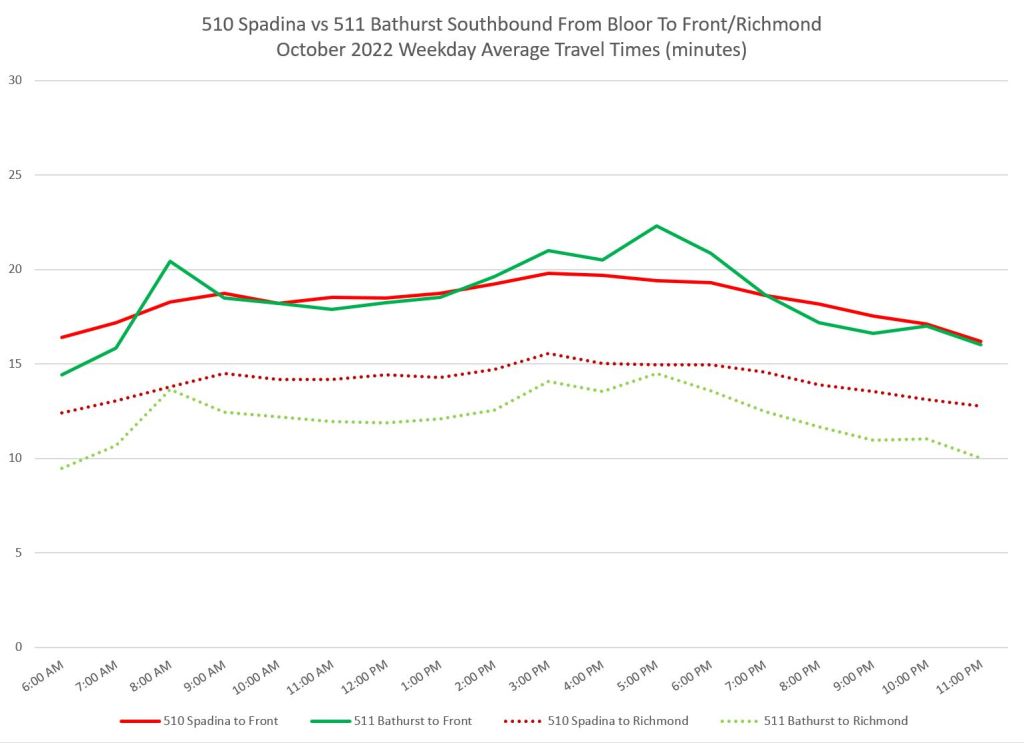
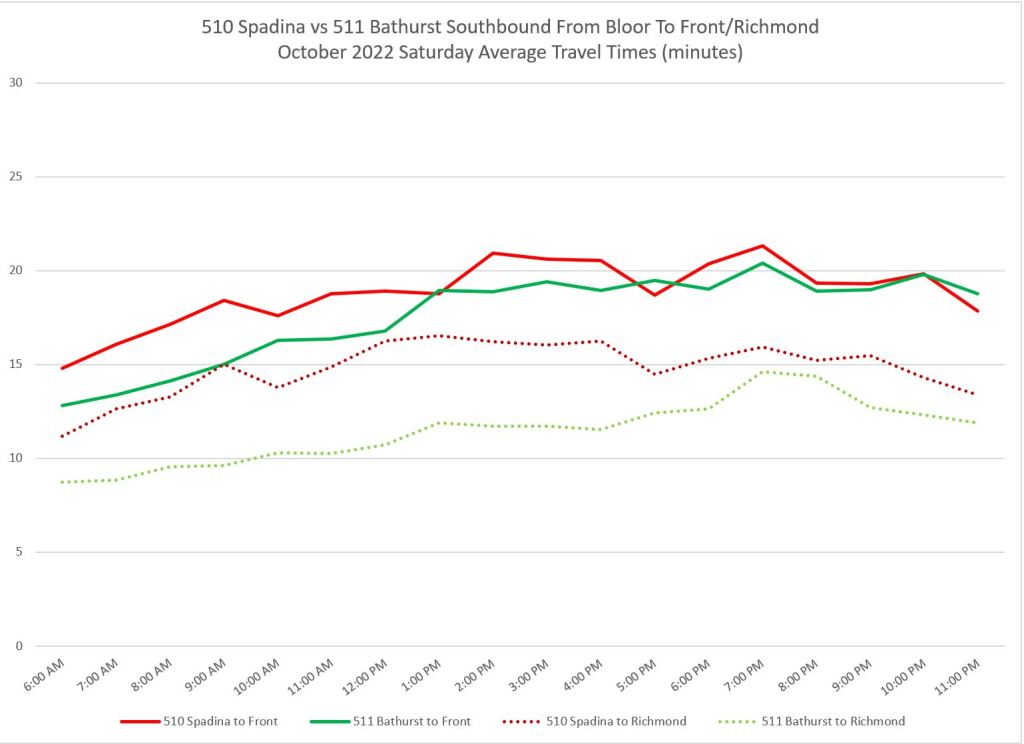
Here are comparative running time averages for October weekdays on the two routes. Two sets of values are shown here:
The solid lines show average travel times between Bloor and Front each way.
The dotted lines show the average travel times between Bloor and Richmond each way avoiding problems with congestion and enroute layovers at the south end of these lines.
Throughout these charts, data for Spadina are plotted in red while data for Bathurst are in green.
During most weekday periods, Bathurst cars have the lower average travel time between Richmond and Bloor, but the results are mixed between Front and Bloor.
Here are the comparable charts for Saturdays and Sundays. Bathurst almost always wins out.
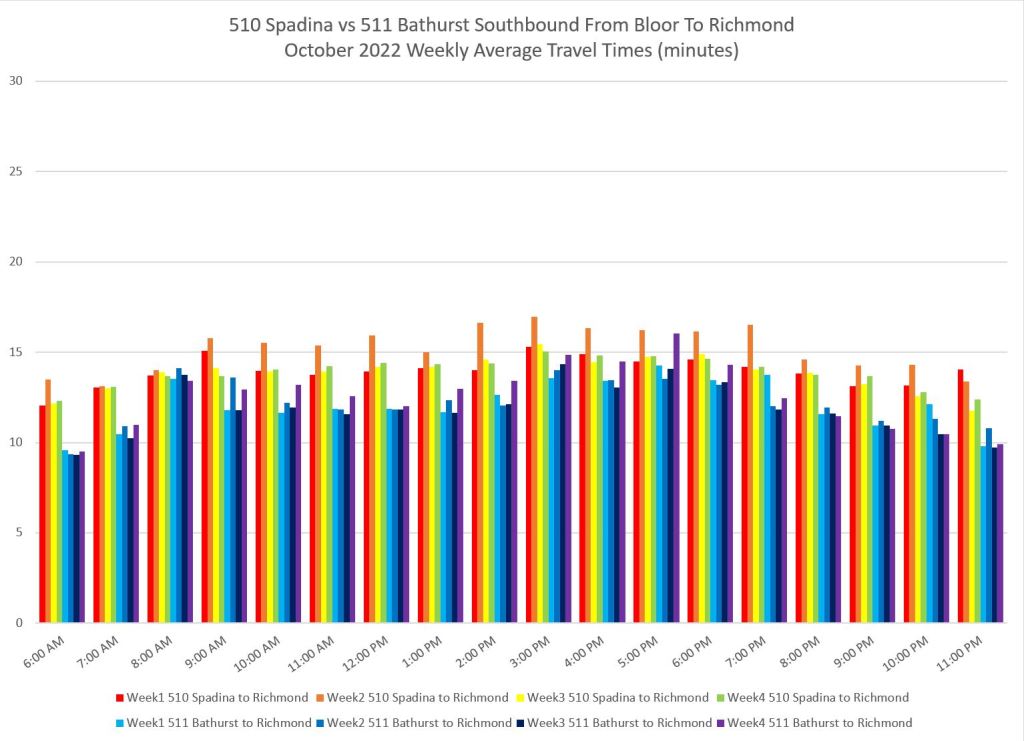
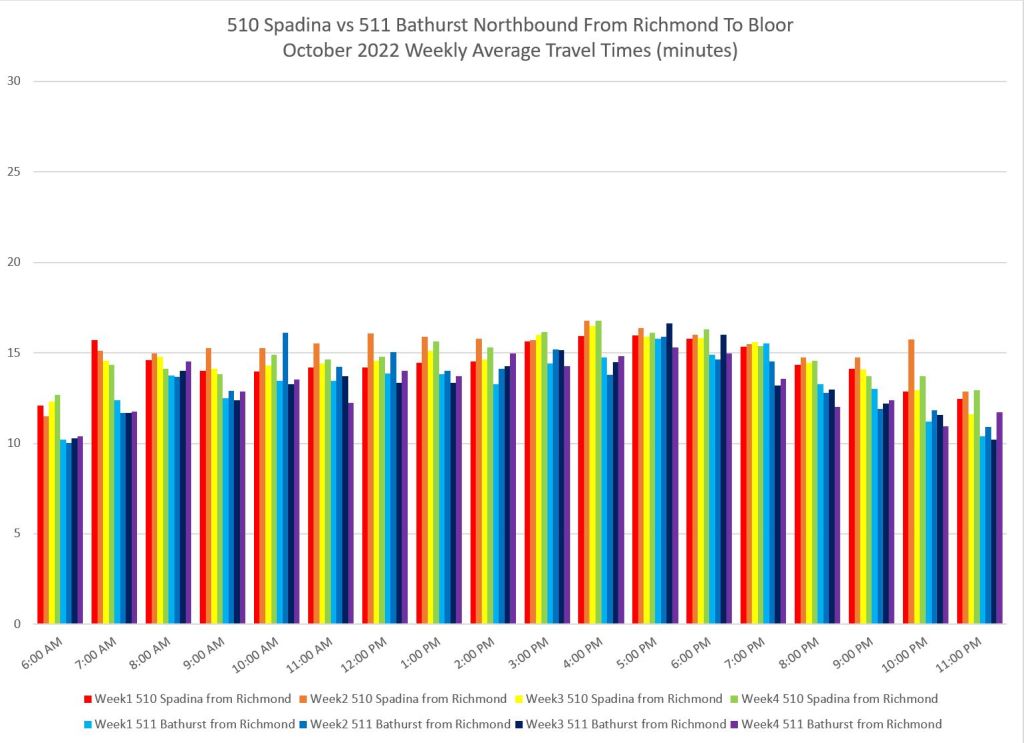
The charts below subdivide the weekday data by week to show that the numbers are not always exactly the same. There is even more variation on a day-to-day basis. I include these to illustrate the importance of not taking averages over long periods at face value because this can hide variations.
In these charts, the warmer colours (red through light green) show data for the Spadina car while the cooler colours (blues and purple) show the Bathurst car.
These charts show the general shape of average data, but more a more detailed view is needed to compare the routes’ behaviour.