Dundas & Victoria Reconstruction (Updated July 25, 2017)

The TTC and the City of Toronto have a joint road and watermain reconstruction project underway on Dundas between Yonge and Church. For a few months, 505 Dundas cars have diverted around the workarea via Bay and College/Carlton, and they are currently returning south via Church. The service is so well established that it has streetcar stops on Church where there has not been regular transit service for decades.

Church and Gould looking S 2017.06.07

The intersection at Dundas, Dundas Square and Victoria is unusual in that it is triangular, the result of a jog elimination at Yonge Street in 1923.

This post documents the track reconstruction as it progresses.

Last updated July 25, 2017.

Continue reading

TTC Service Changes Effective Sunday July 30, 2017

Almost all of the service changes at the end of July are connected with construction projects.

At Kennedy Station, construction of 5 Eglinton Crosstown will shift several routes into a temporary terminal in the main parking lot. Extra running time has been added to the schedules to compensate, and service levels on the affected routes will return to fall levels now rather than in September.

At Wilson Station, construction on the upper level of the bus terminal will cause a rearrangement of routes including the use of a temporary terminal in the parking lot. There are no changes in service levels or running time.

For both projects, the temporary terminals will be part of the paid area.

At Coxwell & Queen, water main construction will cause services on Coxwell and on Queen to divert around the intersection. Coxwell-Queen Loop remains operational and will be the eastern terminus for 506 Carlton during construction on the east end of this route.

The 503 Kingston Road Tripper changes back to bus operation, and it will use the standard downtown loop via Wellington and York Streets.

2017.07.30 Service Changes

Travel Time on King Street: January to June 2017

With Toronto Council’s approval of a pilot project to give more priority to transit on King Street, it is worthwhile to understand how travel times behave today, and what a “best case” improvement might look like.

This article reviews TTC vehicle tracking data for the first half of 2017 on King to illustrate the variation in travel times for the Jarvis-to-Bathurst pilot area, smaller segments within the pilot, and the segments beyond. Advocates for transit priority on King routinely cite congestion and longer travel times as major issues that the pilot can deal with, and indeed journey time reduction is one of the goals of the project. However, the 504 King service operates in a more complex environment than just a congested central section, and that context must be understood in evaluating the benefits any change will bring.

In brief:

  • Travel times vary substantially depending on the time, location, direction and day of the week. Under some combinations of these, transit vehicles move quite freely on King Street today.
  • Variation in times is not always predictable. Shaving the peaks off of these variations and restoring reliability is an important part of making transit “run faster”.
  • The problem is not confined to the central part of King Street, but the pattern of delays is different than downtown.

Riders complain that the King car can be challenging to use, but the transit experience entails more than just the in-vehicle time from point “A” to “B”. First, one must walk to a stop and await a streetcar’s arrival. Then one must hope that there is room on the car to board. Finally one speeds (or not) along the route. Transit studies regularly find that of these factors, the time spent in motion on board is the least critical in terms of perceived trip length because, finally, the rider is “on the way”. Time spent waiting, let alone being passed up by a full vehicle (or kicked off one that short turns), weighs more heavily in the “why am I still taking the TTC” question unless the in-vehicle time is a substantial portion of the trip overall.

Any scheme to improve King that looks only at travel time, but ignores service reliability and capacity, will miss out on important components of what makes service more attractive, and in doing so risks limiting the potential for increased demand.

In previous articles, I have reviewed the reliability and capacity of service on King Street.

The TTC has no plans to add service to 504 King during the pilot, although they will begin to replace shorter cars (CLRVs) with longer ones (new Flexitys) in December. This will gradually add to capacity of the route, if not service frequency. At this point, the service design for September when streetcars will return to Queen Street has not been announced, and the degree to which buses will operate on King at least in the early days of the pilot is unknown. The bus trippers claimed by the TTC to be “supplementary” service in fact replace streetcars, generally at a lower capacity.

As for reliability, reduced and more regular travel times through the core will be a benefit to the King service provided that the TTC actually manages headways. There is an ongoing problem with irregular service during the AM peak when there is little congestion as an excuse, and this irregularity plagues riders, especially in Parkdale, Liberty Village and Bathurst/Niagara.

Continue reading

King Street Pilot Approved and Amended By Council

The King Street Pilot transit priority scheme was approved, with amendments, by Council on July 6, 2017. Changes to the street will begin to appear in early fall (once the shutdown for the film festival is out of the way), and they will last, with changes likely along the way, for at least a year with an evaluation report back to Council after the 2018 election.

This article is not intended to revisit the design (see King Street Redesign Goes to TTC/City for Approval), but as a commentary on the debate at Council.

Among the more bizarre positions taken by some Councillors was the concept that public consultation for this change should have explicitly reached out to suburban residents. In response to a question from Cllr Karygiannis, Chief Planner Jennifer Keesmaat advised that about half of the responses to the study came from the core and half from surrounding areas. This is a bit of a fudge because, of course, a good deal of the catchment area of the King car is not in the core, per se, but is still in the old City of Toronto, not Karygiannis’ home turf of northern Scarborough. Although we know that a majority of Scarborough residents either commute downtown by transit, or do not work in the core, the restriction of auto traffic on King was portrayed as a burden deserving of consultation in northern Scarborough.

Much later in the meeting, Cllr Layton joked that he would hold a meeting in his ward to consult on the McNicoll bus garage project (which is in Karygiannis’ territory).

Cllr Holyday, from Etobicoke, spoke about the mix of trips now taken on King Street noting that 60% of road users are from outside of downtown. Again the issue of just what “outside downtown” means here was never clarified. Keesmaat and others observed that many who live within the pilot area already walk, cycle or take transit, and so the proportion of auto trips by “outsiders” will automatically be high.

TTC CEO Andy Byford noted that the King corridor is at 124% of capacity today, although no additional service is planned for the route. Some improvement, he expects, will come from better service once the pilot is operating, and some from the introduction of larger vehicles (the new Flexitys) on King starting in December 2017.

Cllr Bailão asked about the times when problems occur on King, and about the safety of bar patrons who might be seeking taxis late at night. Keesmaat replied that there is activity throughout the day and evening, and that pedestrian volumes on King are higher than in other parts of the city. Bailão asked whether the City’s General Manager of Transportation Services, Barbara Gray, would support allowing taxis to drive through the pilot area at night. Gray replied that this is a “transit first” project and its main goal is to improve transit. Andy Byford argued that it was his job to advocate for TTC customers, and he prefers to maintain the “purity” of the trial as proposed with no exemptions.

Cllr Pasternak complained about the high cost of the pilot, $1.5 million, and about its funding from City and Federal monies. He asked whether this would more appropriately be paid for with charges against developments along the area, especially considering that these developments must provide a transportation study to review their effects. Keesmaat replied that these charges are mainly for improvements at each development site, and there was never an assumption or intent that these payments would cover large scale capital projects. She further observed that King Street is “regional” infrastructure serving the core, whereas the buildings on King in the pilot area do not generally contribute to the transportation problems. It is growth outside the area that add traffic both to the road and the transit network.

Cllr Mihevc asked whether the scope from Bathurst to Jarvis is “bold enough” and whether the pilot should be extended further. Gray replied that the City might look at other corridors, but the pilot area is a good place to start. The evaluation report will also include analysis of extending the changes east and west on King, and to other downtown routes. Not mentioned, but quite important, is the fact that the pilot area has multiple parallel routes to which auto traffic can shift, and this is not true of either the western part of King nor of other east-west streetcar routes.

Cllr Kelly asked whether planners have looked at the effect on parallel streets. Gray replied that, yes, this has been taken into account and detailed modelling of the network is underway. By year end, the City will have a “more robust” model of travel downtown. Kelly asked whether there will be measurements in place to determine if the pilot is untenable. Gray replied that staff will be looking at trend lines such as travel times on King and parallel routes, and that the TTC Board has asked that concrete metrics be in place before the pilot is launched. There is a draft “dashboard” for reporting the pilot’s status included in the report.

Cllr Grimes asked whether data from the pilot will feed into the Waterfront West LRT study. The implication here is that parts of a future WWLRT might include creation of new reserved streetcar lanes, and that the King Street experience might inform proposals elsewhere. Byford replied that, yes, this would be done. (In fact, the “Waterfront Reset” study now underway will actually report to Council in fall 2017 when the pilot has barely started, but King Street’s experience could affect later discussions.)

Cllr De Baeremaeker asked if there is constant frequency of streetcars throughout 24 hours, or if this varies through the day. Byford replied that service is more intense in the peak periods, but is “pretty intense” throughout the day. Taxis are 25-33% of traffic during the day rising to 38% in the evening. Jacqueline Darwood, TTC’s Head of Strategy and Service Planning, noted that the AM and PM peak periods extend beyond the usual 7-9 and 4-6 windows. Barbara Gray noted that the midday period from 10-4 is as busy as the AM peak, and that King is a consistently busy street.

Here are the service levels scheduled as of May 7, 2017 (click to enlarge):

These schedules correspond to the point where bus trippers were removed from King with the conversion of 501 Queen to all-bus operation for summer 2017. As I have mentioned in previous articles, TTC claims that buses “supplemented” streetcar service on King are false. The bus trippers replaced streetcars (at lower capacity) to compensate for the streetcar shortage. They did not provide additional service. This is a fiction oft repeated by TTC management.

Cllr Campbell asked about improvements the TTC might have seen on the three right-of-way routes now in operation. Byford replied with the following:

  • Queens Quay: Implemented 1990; ridership up from 2.5k to 15k per day (Note that this was a replacement of infrequent Spadina bus service by a frequent streetcar.)
  • Spadina: Implemented 1997; ridership up from 26k to 40k
  • St. Clair: Implemented 2010; ridership up from 28k to 37k

Campbell and Byford agreed that St. Clair was probably the most appropriate comparator for the King Street pilot, although of course King will receive a less exclusive “priority” treatment, and over only a portion of the route.

An important point worth mentioning here is that 504 King and its sister route, 514 Cherry, are unusual because of the mix of neighbourhoods they serve. There are 65k riders per day on this corridor, but unlike some routes, they serve multiple employment and academic districts and enjoy strong counter-peak demand. This allows a high number of riders to be carried relative to the level of service. Combined with the entertainment district and the growing residential density, there are multiple sources of demand travelling over different parts of the route throughout the day.

A common observation is that would-be riders can walk faster than taking the streetcar. That statement does not necessarily mean that the streetcar moves at less than walking pace, but that the combined delays inherent in waiting for one to show up and to have space to board add substantially to trip times. (Overcrowded cars also take longer to serve stops, and irregular or inadequate service capacity can compound travel times growth.) If streetcars arrived regularly and with capacity for would-be riders, travel times would be reduced even if actual travel speeds did not change much. Moreover, riders would have greater certainty about when or if they would reach their destinations.

The goal of a transit priority scheme is not just to make streetcars move more swiftly, but to show up frequently and predictably, not in randomly spaced bunches, and with room for all who wish to board.

Mayor Tory proposed that the staff recommendations be amended:

1.  City Council direct the General Manager, Transportation Services to implement a late-night exemption from 10:00 p.m. to 5:00 a.m. for licensed taxicabs from through-movement prohibitions in the King Street Transit Pilot area to aid in safely and effectively dissipating people from nightlife activity on King Street West.

2.  City Council direct the General Manager, Transportation Services to, as part of the detailed design process, work in consultation with the taxi industry to identify and implement approximately double the number of existing taxi stand spaces throughout the length of the pilot project.

3. City Council request the appropriate City officials to complete a review of all side streets in the area bound by Niagara Street, Queen Street West in the East, Front Street West and The Esplanade (East of Yonge Street to Lower Sherbourne Street), and Sherbourne Street to consider appropriate locations for on-street paid parking in association with the implementation of the proposed King Street Transit Pilot between Bathurst Street and Jarvis Street, and report to Toronto and East York Community Council with any proposed amendments.

4. City Council request the Toronto Police Services Board to request the Chief of Police to work with the General Manager, Transportation Services on a strategy for education and enforcement of the King Street Transit Pilot.

Tory argued that this pilot will “move greatest number of people in best way possible”. With respect to concerns about capacity on parallel roads, he claimed that there are no plans for work on parallel streets in 2018. (Both Tory and other City staff appear unaware that the eastern part of the Wellington reconstruction between Yonge and Church has been delayed to 2018 thanks to work planned by Toronto Hydro in fall 2017.) Tory observed that the City has allowed massive development west of downtown and must address the problems this creates. It is “something a 21st century city must do”.

Cllr Karygiannis asked whether Tory felt the taxi industry had been consulted properly, and Tory replied that the City “didn’t do as good a job as we should have”. Karygiannis moved an amendment to Tory’s motion that the start time for taxi exemptions be changed from 10 to 9 pm “for people catching dinner or a show”. For the record, shows in the entertainment district start at 8 pm or earlier, and people generally dine before. There is a separate demand to the club district primarily on Thursday through Saturday, and this traffic picks up mid-evening. Tory did not accept this as a friendly amendment arguing that the best balance between competing interests is a 10 pm start time. (Karygiannis’ amendment lost.)

In the discussion of available cab stand space, nobody mentioned how many existing spaces are actually designated. They are:

  • North side
    • between Yonge and Bay: 7
    • west of Bay: 8
    • east of York: 6
    • east of Peter (at the hotel): 4
  • South side
    • between York and Bay: 8

Doubling the number of official cab stands may not make much difference relative to the space taxis now occupy, but it is likely that the total number of spaces will be spread over a wider area than they are today. This decision will also affect available space for other curb lane uses such as pedestrian and loading zones. Until the detailed design is available later this year, we will not know just how this arrangement will look, or what effect the pro-taxi decision will have on the original goals for street redesign.

Cllr Holyday argued for “the guy from central Etobicoke” that there should be more provisions for left turns and for routes through the network using both a map of downtown and a chart of the human heart to illustrate his case.

Holyday proposed that City Transportation be asked to study a means of aiding these turns, but his motion was voted down.

(a) City Council direct the General Manager, Transportation Services to develop a plan for timed left turn prohibitions which will improve streetcar and general traffic flow along King Street within the study area, and report to the Public Works and Infrastructure Committee. (Lost)

Holyday also argued for a traffic bypass around King using Front Street.

(b) If motion a by Councillor Holyday fails, that City Council define Front Street as the motorist bypass for the King Street Pilot Study area and City Council direct the General Manager, Transportation Services, to take steps to optimize Front Street and the Bathurst Street road linkage between King Street and Front Street to reduce motorist encumbrances including signal timing and design, turn prohibitions, pedestrian signals and parking regulations. (Lost)

The Councillor appeared to be unaware that Front Street narrows between York and Bay Streets in front of Union Station where it has already been redesigned primarily for pedestrian and taxi use. Moreover, Front can be badly congested whenever there is an event at the Rogers Centre. It is hardly an arterial bypass of the sort he seeks.

Cllr Pasternak observed that there is always a concern when parking spaces are lost that there will be a decline in parking revenue. This begs the obvious question of whether the need for such revenue should preempt improvements in the design and usage of road space. In any event, the Toronto Parking Authority has already reported on this issue, and will propose that a number of currently free spaces on adjacent streets be converted to paid parking.

Cllr Ford thanked staff for their detailed reports, but is not convinced of the merit of this pilot from the perspective of residents of northwest Etobicoke where his ward is located. He bemoaned the added congestion brought on by the demolition of the York Street off ramp from the Gardiner Expressway, but appeared unaware that this capacity will be replaced by a new Harbour Street off ramp that has not yet been built.

Cllr Perks, responding to Holyday’s illustrated lecture, gave a short talk on the relationship between parking and prosperity noting that cities which have much parking (and by implication a lot of auto-based commuting) tend to have lower prosperity.

Cllr Wong-Tam urged that Council be “bold and ambitious – this is King Street”. She felt that over the years, Council has asked planners to “be meek”, but that there is a new generation who are not meek. Wong-Tam wants Council to support this ambition, including for the next big project downtown on Yonge Street, not be “meek with modest adjustments”.

Cllr Layton talked about people waiting for the streetcar, and how the City has not done much to improve their lot by addressing the capacity issue and bunching. He also mention the Waterfront LRT as an example of the City not doing what it could, of not increasing capacity to keep pace with population growth.

TTC Chair Colle wants Toronto to be “bold”, and felt that with streetcars operating at 13 km/h, the city is playing catch-up to its citizens’ desire for better transit. In fact, the scheduled speed of the King car over its entire route, never mind just the core area, is less than 13 km/h during many operating periods. The challenge will be to maintain consistency of running times and service.

In a future article, I will review actual travel time experiences on 504 King and in particular the variation in their behaviour by time of day and season. A related issue is the the pilot covers only part of the route, and there are service management, capacity and congestion issues outside of the pilot area. The Bathurst-to-Jarvis trial will be useful not just to show what can be done in that segment, but what remains to be done (and not necessarily through lane reservations) elsewhere on the route.

514 Cherry Update re King & Sumach Noise

At a community meeting on June 27, 2017, the TTC presented updated information about their work on reducing the noise level from streetcars at King & Sumach. In response to complaints after the 514 Cherry route began operating in 2016, the TTC changed the 514 so that late evenings and early mornings it operates to Broadview & Queen (looping back via Dundas and Parliament just like a short turning 504 King car). During these periods, a Wheel Trans bus provided a shuttle service on Sumach and Cherry to Distillery Loop.

The TTC presented updated noise readings for this location showing the combined improvement of the full changeover to Flexity cars from CLRVs and of changes to the rail profile that were made to complement slower operation around the curves.

The chart above shows results for the tightest curve at King & Sumach, the east to south. The data plotted here summarize readings taken over a four-hour period, and so they reflect the contribution of whatever type of vehicles showed up. For the most recent reading on May 4, 2017, when the service should have been largely or completely run with Flexitys, the levels from the middle to the high end of the spectrum are markedly lower than they were in the fall.

From the vehicle tracking data for 514 Cherry, I can confirm that the vehicles in service on that date were:

  • CLRV 4071 from 8:28 to 9:55 am
  • CLRV 4049 from 2:56 to 5:45 pm
  • Flexitys 4402, 4404, 4406, 4409, 4412, 4414, 4423, 4425, 4428 and 4432

Depending on when the measurements were taken, there was at most one CLRV in service on the route, and none for most of the day.

By contrast, on Aug. 10, 2016, all but one car on the route was a CLRV with only a single Flexity in service, 4418, between 5:30 am and 2:07 am the following day.

For the north to west turn, the data show less of an improvement. Oddly, the readings for the gentler left turn curve are higher than for the eastbound right turn, but this could be a factor of the measurement location which is closer to the westbound turn.

As a matter of comparison, the TTC also presented readings from two intersections with comparable curve radii, Queen & Broadview and Bathurst & Fleet.

Note that this chart presents maximum values rather than a four hour average. The higher values for the comparator intersections are almost certainly due to the noise caused by CLRVs or ALRVs which have (a) inherently more squeal and (b) less car design factors to limit noise transmission.

Bathurst & Fleet would have had service only on 509 Harbourfront on May 4 as this predates the return of streetcars to 511 Bathurst. I do not have the tracking data for the 509 on that date, and so cannot comment on the proportion of service provided by each vehicle type. Harbourfront is supposed to be all Flexity, but routinely has a few CLRVs on it. It would take only one noisy CLRV to set the maximum values shown above.

The chart is also unclear about which turn was measured at each location, only that this was done from 8 metres away.

Future work of this type should be more careful in identification of the vehicle type and location specifics for any readings and charts. If nothing else, this will improve credibility with members of the public by showing the improvements new cars bring.

Based on the improvements recorded at King & Sumach, the TTC plans to return full streetcar service to Distillery Loop on a date to be announced in July.

This decision provoked something of a pitched battle between residents at various locations on the route. The high points (if they can be called that) included:

  • Wheel squeal at King and Sumach prevented some nearby residents from getting a full night’s sleep, and the respite with no cars making turns was 3 to 3.5 hours. (It was unclear whether the residents have ever had a Flexity-only late night or early morning service as a reference point because service was cut last November before the route conversion was completed.)
  • Squeal is worst after rain because the normal film of grease on the track (both from natural causes and from wheel greasers) washes away. Wet track actually is very quiet because the water acts as a lubricant, but track that is drying out can be extremely noisy. This also happens during periods of high humidity. The TTC was criticized for taking noise measurements only under ideal conditions.
  • Residents at King/Sumach who predate the installation of the intersection were used to quieter streetcar operation, and enjoyed a long period of no streetcars at all while the King leg of the Don Bridge was closed.
  • The Wheel Trans shuttle bus is utterly unreliable running on a schedule unknown to riders and with unpredictable headways that can be considerably longer than the round trip route would imply. Operators often bypass waiting passengers. There are safety issues for the large number of disabled transit users living in this neighbourhood if they are forced to make a transfer to an unreliable, infrequent service.
  • Residents along the Cherry Street portion of the route complained that they effectively lost service because the bus was so unreliable, and in any event, its wide headways and forced transfer at King Street added to travel times. They also noted that the change was implemented without notice to the wider community. (There were also complaints about poor publicity for the June 27 meeting.)
  • Aggrieved King/Sumach residents proposed that the 514 Cherry route be completely converted to bus operation during the hours when the shuttle runs now to eliminate the transfer connection and improve service to the Distillery. This option was rejected by the TTC and by some users of the 514 who noted that streetcars can be very crowded at late evenings downtown where the route is supposed to provide supplementary service on King.
  • Early morning trips from Leslie Barns to Distillery Loop make the west to south turn for which no automatic greasing is provided.
  • Not all who attended from King/Sumach objected to the streetcars, but as this was a small meeting, it is not clear what the balance of opinion in the neighbourhood might be.
  • Notable by its absence from any comments were complaints about noise from eastbound streetcars clattering through the trailing switch of the north to east curve. The slow order at this location appears to have dealt with this issue.

In addition to operating the 514 Cherry route with only Flexitys, the TTC is working on a design of a noise absorbing ring that will damp the high frequency vibrations. Wheel sets for two cars are now being manufactured, and they will be installed on test cars in the fall.

Further noise readings will be taken through the summer and fall to track conditions as they evolve, and the level of grease application will be increased. (There is a trackside greaser southbound at Distillery Loop, and the Flexitys have on board greasers that are triggered by GPS information to activate where lubrication is required.)

In a separate article, I will turn to the general unreliability of service at Distillery Loop on the 514 streetcars. The TTC puts this down to the usual problems of mixed traffic operation on King, but there are also issues with uneven headways departing from both the Distillery and Dufferin terminals following layovers that can be fairly long. Line management, as elsewhere on the system, is a problem for this service.

What Is The Scheduled Service Capacity on Queen Street?

This article is a follow-up to my previous piece on 501 Queen Capacity and the staff response to a query at the TTC Board Meeting of June 15, 2017.

At that meeting, Commissioner Joe Mihevc asked whether the capacity operated by buses on Queen Street was the same at all hours as the streetcars that had been replaced. Staff, after a bit of hesitation, replied that it was. The exchange is available on YouTube.

My reaction to this gets into the territory of “unparliamentary language”, but at the time I tweeted:

The term “porkies” will be familiar to Andy Byford and any of his team from across the pond. I moderated this later on to suggest that staff were “badly advised”, the standard political excuse when a Minister is attempting to extricate him/herself from accusations of misleading the House.

Unfortunately, the actual schedule data do not back up staff claims. In the table below, note that the vehicle capacities are taken from the TTC’s Crowding Standards.

In graphic form, the scheduled capacities are:

In almost all cases, and certainly during all periods when the route is busiest, the scheduled capacity of bus service is less than that of the streetcar service.

An explanation of the February to March change in streetcar capacity is in order here. For the March schedules, the TTC planned on a service diversion that did not actually take place. Because they have no spare cars, they make up the extra running time by stretching the headway between vehicles thereby reducing the line’s scheduled capacity. In some off=peak periods, spare vehicles are added to compensate, but not during the peaks.

On a vehicles/hour basis, the buses come much more often than the streetcars because more of them are needed to provide the same service. If the buses can maintain an even spacing (which they don’t as demonstrated in my previous analyses), the shorter wait time contributes to riders’ impressions of better service when in fact there is less capacity on the route.

The one caveat I will make with respect to scheduled capacity is that the TTC is chronically unable to run ALRVs where they are scheduled. This has been a long-standing problem going back to well before any issues with vehicle shortages. Service Planning schedules a capacity based on larger cars, while Operations sends out shorter ones that are overloaded. This is no excuse for perpetuating the under-capacity situation with the replacement bus service.

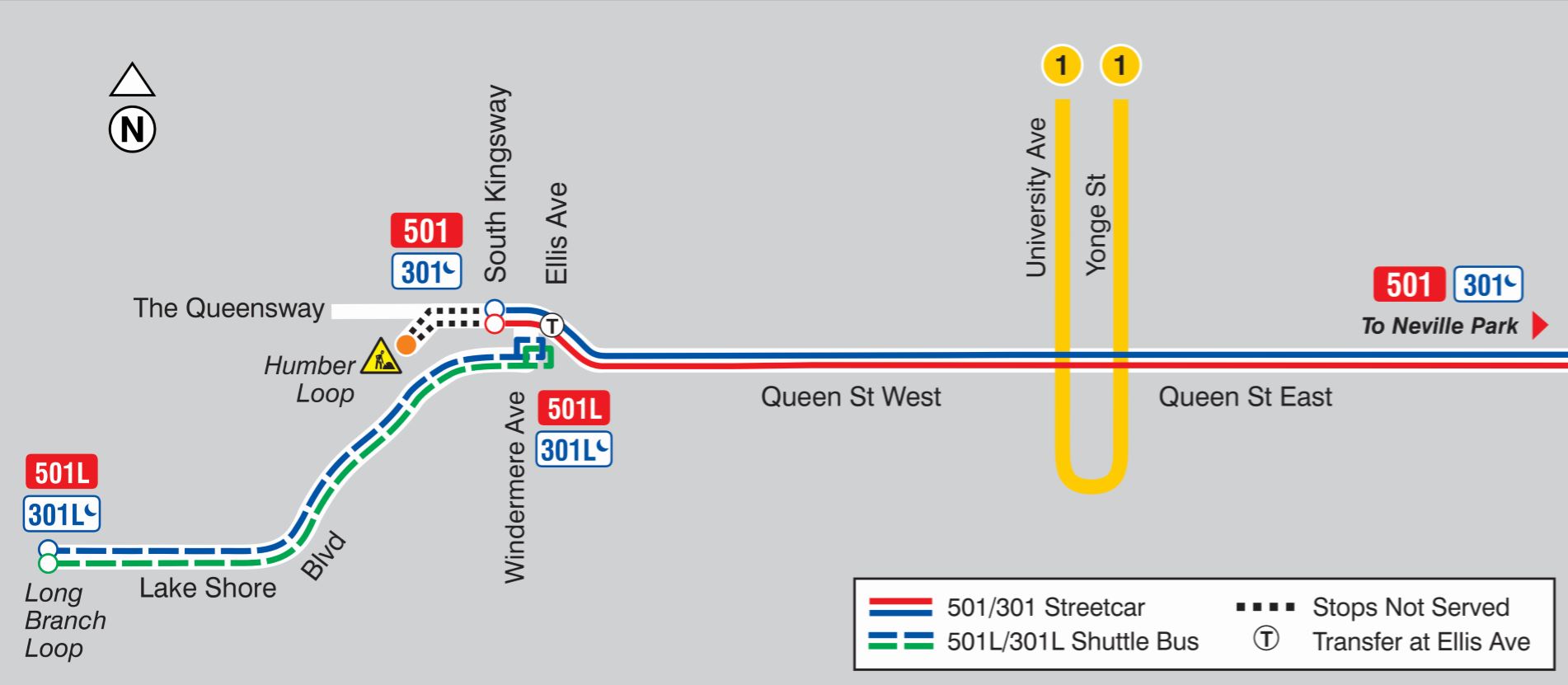
In coming weeks, some of the currently surplus running time in the bus schedules will be eaten up by construction on Queen west of Spadina, and on Lake Shore west of Humber Loop. The surfeit of vehicles we now see on Queen at its terminals and salted away in places like Wolseley Loop will likely vanish.

As for TTC Staff, I asked for an on the record comment from Brad Ross, Executive Director of Corporate Communications. His responses were:

Thanks for your comments.

followed by

We will review, we just don’t have time today.

The charts above are intended to detail my claim that the scheduled service has declined based on the TTC’s own schedules to save TTC staff the difficult work of looking this up themselves.

As for the actual capacity provided on the street, there are charts covering the peak periods in my earlier article. These are based on TTC vehicle tracking data and reflect the actual mix of vehicles and headways on a day-to-day basis.

When a reply arrives from the TTC, I will update this article.

The Evolution of Streetcar Service from 1980 to 2016

Transit service on many of Toronto’s streetcar lines has declined over past decades and, with it, riders’ faith in and love for this mode. Unreliable, crowded service is considered the norm for streetcar routes, and this leads to calls to “improve” service with buses.

The historical context for this decline is worth repeating in the context of current debates over how Toronto should provide transit service to the growing population in its dense “old” city where most of the streetcar lines run.

When the TTC decided in late 1972, at the urging of City Council, to reverse its long-standing plans to eliminate streetcars by 1980 (when the Queen Subway would take over as the trunk route through the core), the level of service on streetcar lines was substantially better than it is on most routes today. Any comparison of streetcars versus buses faced the prospect of a very large fleet of buses on very frequent headways roaring back and forth on all major streets.

Service in 1980 (when the system was originally planned for conversion) was substantially the same as in 1972, and for the purpose of this article, that date is our starting point.

Ten years later, in 1990, little had changed, but the City’s transit demand was about to fall off a cliff thanks to a recession. During this period, TTC lost much riding on its network including the subway with annual travel dropping by 20% overall. It would take a decade to climb back from that, but various factors permanently “reset” the quality of service on streetcar routes:

  • During the recession, service was cut across the board, and this led to a reduction in the size of fleet required to serve the network.
  • In anticipation of the 510 Spadina line opening, the TTC had rebuilt a group of PCC streetcars, but these were not actually needed for the 509/510 Harbourfront/Spadina services by the time Spadina opened. “Surplus” cars thanks to the recession-era service cuts were available to operate the new routes.
  • Since 1996, any service changes have been  made within the available fleet, a situation compounded by declining reliability of the old cars and the anticipation of a new fleet “soon”.
  • By 2016, the fleet was not large enough to serve all routes, and bus substitutions became common.

Some of the decline in demand on streetcar routes came from changing demographics and shifting job locations. Old industrial areas transformed into residential clusters, and the traffic formerly attracted to them by jobs disappeared. Meanwhile, the city’s population density fell in areas where gentrification brought smaller families to the houses.

The city’s population is now growing again, although the rate is not equal for all areas. Liberty Village and the St. Lawrence neighbourhood are well known, visible growth areas, but growth is now spreading out from both the King Street corridor and moving further away from the subway lines. This creates pressure on the surface routes in what the City’s Planners call the “shoulders” of downtown.

As the population and transit demand have rebounded, the TTC has not kept pace.

The changes in service levels are summarized in the following spreadsheet:

Streetcar_Services_1980_To_2016 [pdf]

510 Bathurst: In 1980, this route had 24 cars/hour during the AM peak period, but by 2006 this had dropped by 50% to 12. In November 2016, with buses on the route, there were 20 vehicles per hour, and with the recent reintroduction of streetcars, the peak service was 10.6 ALRVs/hour, equivalent to about 16 CLRVs. Current service is about 1/3 less than it was in 1980.

506 Carlton: In 1980, this route  had 20 streetcars/hour at peak, but by 2016 this was down to 13.8.

505 Dundas: In 1980, service on this route had two branches, one of which terminated at Church after City Hall Loop was replaced by the Eaton Centre. On the western portion of the route, there were 27 cars per hour, while to the east there were 15 (services on the two branches were not at the same level). By 2016, this was down to 10.3. [Corrected]

504 King: This route, thanks to the developments along its length, has managed to retain its service over the years at the expense of other routes. In 1980, there were 25.2 cars per hour over the full route between Broadview and Dundas West Stations with a few trippers that came east only to Church Street. Despite budget cuts in 1996 that reduced service to 16.4 cars/hour at peak, the route came back to 30 cars/hour by 2006. Service is now provided by a mixture of King cars on the full route (15/hour), 514 Cherry cars between Sumach and Dufferin (7.5/hour), and some trippers between Roncesvalles and Broadview. Some 504 King runs operate with ALRVs and most 514 Cherry cars are Flexitys.

501 Queen/507 Long Branch: In 1980, the Queen and Long Branch services operated separately with 24.5 cars/hour on Queen and 8.9 cars/hour on Long Branch at peak. By 1990, the Queen service had been converted to operate with ALRVs and a peak service of 16.1 cars/hour, roughly an equivalent scheduled capacity to the CLRV service in 1980. By 1996, Queen service was down to 12 ALRVs/hour of which 6/hour ran through to Long Branch. Headways have stayed roughly at that level ever since. The Long Branch route was split off from Queen to save on ALRVs, and as of November 2016 6.3 CLRVs/hour ran on this part of the route. Bus replacement services are operating in 2017 due to many construction projects conflicting with streetcar operation.

502 Downtowner/503 Kingston Road Tripper: In 1980, these routes provided 15.6 cars/hour, but by 2016 this had declined to 10/hour.

512 St. Clair: In 1980, the St. Clair car operated with a scheduled short turn at Earlscourt Loop. East of Lansdowne, there were 33.3 cars/hour on St. Clair. By 1996 this was down to 20.6 cars/hour. The next decade saw an extended period of reconstruction for the streetcar right-of-way, and service during this period was irregular, to be generous. By 2016, the service has improved to 21.2 cars/hour, but this is still well below the level of 1980.

What is quite clear here is that the budget and service cuts of the early 1990s substantially reduced the level of service on streetcar routes, and even as the city recovered, the TTC was slow to restore service, if at all. The unknown question with current service levels is the degree to which demand was lost to demographic changes and to what extent the poor service fundamentally weakened the attractiveness of transit on these routes. The TTC has stated that some routes today are operating over capacity, but even those numbers are limited by the difference between crowding standards (which dictate design capacity) and the actual number of riders who can fit on the available service. It is much harder to count those who never board.

In a fiscal environment where any service improvement is viewed negatively because it will increase operating costs, the challenge is to turn around Council’s attitude to transit service. This is an issue across the city and many suburban bus routes suffer from capacity challenge and vehicle shortages just like the streetcar routes downtown.

The bus fleet remains constrained by actions of Mayor Ford in delaying construction of the McNicoll Garage with the result that that the TTC has no place to store and maintain a larger fleet even if they were given the money to buy and operate it. Years of making do with what we have and concentrating expansion funding on a few rapid transit projects has boxed in the TTC throughout its network.

Transit will not be “the better way” again until there are substantial investments in surface fleets and much-improved service.

514 Cherry: Update on Noise & Vibration at King & Sumach Streets

Since late 2016, the TTC has suspended streetcar service on Sumach and Cherry Streets south to Distillery Loop during late evenings and early mornings. The reason for this was that some residents near the junction at King & Sumach complained about noise and vibration from turning streetcars. In a related change, the TTC also imposed a 10km/h speed restriction on the intersection.

During the periods when the 514 Cherry cars divert east to Broadview, a Wheel Trans shuttle bus operates over this route segment on a somewhat unpredictable schedule, and many would-be riders simply walk rather than wait for it.

At the community meeting of November 16, 2016, the TTC advised that additional noise and vibration readings would be taken after the 514 Cherry route was converted to operation with Flexity cars which are quieter than the CLRVs, a change that has now more or less completed. (The occasional CLRV can be found on the route, but officially it is all Flexity.)

On Tuesday, June 27, 2017, there will be a public meeting to provide an update on the situation.

Time: 6:30 p.m. to 8:30 p.m.
Location: Toronto Cooper Koo Family Cherry Street YMCA Centre – 2nd floor, 461 Cherry Street, Toronto

I will update this post following the meeting.

A related issue is the service reliability to Distillery Loop which can be very spotty at times. This will be the subject of a separate article coming soon.

The Cost of Running the Queen Car

Update: Minor changes were made to add some details to the costings presented here at about 10:10 am on June 14.]

The debate over which type of transit vehicle should operate on Queen Street, and by implication on the wider streetcar network, will inevitably get into the question of the cost of streetcar operations. The TTC has cited large ongoing costs of the bus operation:

This summer, the TTC is spending an extra $1 million per month to run buses on the route, according to TTC spokesperson Brad Ross. It also takes 60 buses to provide similar service to the 501 Queen’s usual 45 streetcars.

“Queen is a good example of a route where streetcars make good sense because of the capacity that they offer you in the downtown to reduce congestion,” Ross said, adding that Toronto’s streetcars produce lower emissions than buses.

[From CBC News Toronto]

The ratio of buses to streetcars in this quotation is somewhat misleading for a few reasons:

  • The bus service is scheduled with extra running time in anticipation of construction delays, although the actual construction has not yet begun. This is responsible both for the accumulation of large numbers of buses at terminals.
  • The replacement ratio of 1.3:1 is well below values the TTC normally uses in comparing transit modes, and in their own crowding standards. The design capacities of vehicles for service planning is 51 for a standard bus, 74 for a standard-length streetcar (CLRV), 108 for a two-section articulated streetcar (ALRV) and 130 for the new low floor Flexitys. This implies a replacement ratio of 1.45:1 for CLRVs, 2.12 for ALRVs and 2.55 for Flexitys. These numbers would be adjusted downward to compensate for faster operating speeds with buses, if any, although that adjustment would vary by time of day and route segment as shown in my analyses of operations on the route.
  • The capacity of scheduled bus service is less than the scheduled capacity of streetcars at the beginning of 2017. Service for 501 Queen is based on the capacity of ALRVs.
  • The actual streetcar service on Queen before buses began taking over was scheduled to use 33 ALRVs and 7 CLRVs (November 2016 service). The CLRVs were dedicated to the service between Humber and Long Branch Loops.

The TTC’s methodology for allocating operating costs to routes is based on three variables:

  • Vehicle hours (primarily the cost of drivers and related management and overhead costs)
  • Vehicle kilometres (part of the day-to-day cost of running and maintaining buses including fuel)
  • Vehicles (part of day-to-day costs for work such as dispatching, routine inspections and maintenance, cleaning)

The cost of routine streetcar track maintenance is included in the vehicle kilometre cost. This does not include major projects such as the replacement of track which are funded from the Capital Budget.

The factors for the two modes as of 2015 were:

                   Per Hour      Per Km        Per Vehicle
                                                 per Day
     Buses         $ 92.30       $  1.88       $  150
     Streetcars    $ 95.40       $  3.42       $  515

     [Source: TTC Service Planning via Stuart Green in TTC Media Relations]

As 2015 costs, these numbers contain almost no contribution from the new Flexity fleet, but they will be influenced by the cost of maintaining decades old CLRVs and ALRVs. The hourly component of streetcar costs is probably influenced by the relatively higher level of route supervision on that network than on the suburban bus routes.

The TTC’s most recently published detailed statistics for their network date from 2014. (The lack of timely data on route performance is an ongoing issue, but one that is separate from this article.) For 501 Queen, the daily factors for 2014 operation were:

     Vehicle Hours    595
     Vehicle Km     9,100
     Vehicles          36

The number of vehicles listed is lower than the peak requirement, and this will affect the calculated cost as discussed below.

When the streetcar costs are applied to these factors, the daily cost of the Queen car comes out to just over $100k (2015).

     Hourly costs     $ 56,763  53.3%
     Kilometre costs    31,122  29.2%
     Vehicle costs      18,540  17.4%
     Total            $106,425

Adjusting this for the higher number of streetcars actually shown in the schedules would add 4 vehicles (40 vs 36) at a daily cost of $2,060.

On an annual basis (taking one year as equivalent to 305 weekdays, the factor used by the TTC to account for lower demand on weekends and holidays), the Queen car costs about $32.5 million (2015) to operate.

Update: This does not include the cost of the 502 Downtowner nor the 503 Kingston Road Tripper cars. Annualizing the premium for bus service quoted by the TTC to $12m/year puts the relative cost by their estimation in context.

The important point here is that the hourly costs account for about half of the total, and so any calculation is most sensitive to the number of operators required to provide service. Larger vehicles have a strong advantage over smaller ones. Also, larger vehicles mean lower costs for vehicle distance travelled and per vehicle costs, but it is not certain that for a large-scale change in fleet composition that these cost factors would remain stable depending on just which cost components are allocated to each category. For example, a carhouse costs the same amount to operate whether it has 200 small cars or 100 large ones in it. Extrapolation to an all-Flexity environment should be done with care.

In the case of a bus operation, provided that the average speed could be increased during peak periods, this would reduce the total vehicle requirement and bus hours, but it would not change the bus kilometres in comparison to buses scheduled at the same speed as streetcars. (Fewer vehicles travelling at a higher speed run up the same mileage.) The big difference would come in vehicle (operator) hours because of the lower capacity of buses.

The problem of projecting a replacement cost then becomes one of “twirling the dials” of various factors to determine what the replacement service might look like. One obvious starting point is that this must be based on normal route conditions, not on the non-standard schedules now in use for the construction period. Possibilities include:

  • Using an ALRV:Bus replacement ratio of 2:1
  • Using a lower replacement ratio such as 1.5:1 (a sensitivity test to determine how costs would change with larger buses)
  • Using the 2:1 capacity ratio, but assuming a higher average speed for buses
  • Using the higher capacity of Flexitys

The results from these assumptions should be taken with considerable caution because it is far from certain that the cost factors can actually be relied upon across the different vehicle types and usage patterns.

  • On a 2:1 replacement ratio, the cost of bus operation is about 50% higher than for ALRVs. Costs allocated per vehicle are lower, even though there are more buses, but this is more than offset by higher costs for the hourly and mileage components.
  • On a 1.5:1 replacement ratio, the cost of buses is about 10% higher than for ALRVs.
  • On a 2:1 replacement ratio, but with a 10% increase in average speed, bus costs go down about 8%, but are still about 1/3 higher than the cost for ALRVs.
  • For Flexity operations, assuming cost factors are unchanged (valid for hourly costs, but mileage and vehicle costs are another matter), the replacement bus service would cost about 75% more than the streetcar service.
  • Flexity costs fall by 1/6 relative to ALRVs because of the larger Flexity design capacity. This is a comparatively small saving on Queen because the route is already scheduled (if not actually operated) as if it had the larger ALRVs on it. If we were looking at 504 King, for example, the schedule is based on CLRVs and so the replacement by buses would require many more vehicles proportionately than for the Queen route, and replacement by Flexitys would require many fewer vehicles to provide the same scheduled capacity.

[Note: I have deliberately not published exact numbers here because this is only a rough estimate subject to alteration as and when the TTC refines its cost base and the assumptions behind a comparative service design. Also, it is based on 2015 cost data and 2014 schedules.]

These costs do no include major capital projects including ongoing renovation of streetcar track, and one-time costs to bring infrastructure (notably the overhead power distribution system) up to modern standards.

The annual cost of surface track and special work (intersections) varies from year to year based on the scheduled work plans. The average for tangent track over 2017-26 is about $21 million/year although the amounts for 2017 and 2018 are particularly high due to the extent of planned work in those years. From the point where the TTC decided to retain streetcars in late 1972 until 1993, their track construction was not of a standard required for the long life expected of rail assets. Track was not welded, untreated wooden ties were used, and there was no mechanical isolation for vibration between the track and the concrete slab in which it was  laid. The result was that roadbeds fell apart quickly and the lifespan of the infrastructure was about 15 years.

Beginning in 1993, the TTC changed to a much more robust track structure using a new concrete base slab, steel ties, welded rail and rubber sleeves to isolate the track from the concrete around it. The structure is designed so that when track does need to be replaced, only the top layer, the depth of the track itself, needs to be removed. New track can be attached to the steel ties that are already in place. Conversion to this standard across the entire system is almost completed, and track reconstruction costs will drop due both to longer lifespan and simplified renewal work.

The average for special work over 2017-26 is about $14 million/year. Starting in 2003, the complex castings were set in a vibration-absorbent coating. Construction techniques have also advanced so that intersections are pre-assembled and welded off-site and then trucked to street locations for installation in large panels. The most recent intersection, Dundas and Parliament, went from initial demolition of the existing track to full assembly of the new intersection in one week. (Further work was required to complete other road upgrades, and new intersections are typically allowed to cure for a few weeks so that the concrete does not suffer vibration before it has properly set.) With a roughly 30-year cycle for special work replacement, the TTC is only about half way through rebuilding all of its intersections to the new standard.

Update: The Queen route represents about 28% of the track in the streetcar system, and so is responsible for about $10m of the annual capital work averaged over its lifetime. This is a relatively high proportion for one route, especially in relation to the amount of service operated there. 504 King, for example, is much shorter and has considerably more service than 501 Queen.

The cost of track replacement is essentially a fixed value that varies little with the level of transit service, although some of the lighter routes could turn out to have greater lifespans. This capital cost, therefore, represents an investment in the future of the streetcar system and the ridership growth that it could accommodate if only the TTC ran enough service. (The frequency of many routes is very much lower today than it was a few decades ago, and there is a lot of room for growth as residential density builds up along these routes.)

I will review the TTC’s Capital Budget for streetcar infrastructure in the next article in this series.

Any examination of streetcar replacement with buses must consider a variety of factors, but most importantly must look not at the streetcar system as it is today with service levels essentially frozen at or below the levels of two decades ago, but at what it can become as the backbone of travel in the growing “old” City.