Evolution of Bus Route Travel Times, 2020-2023, Part I

This post reviews travel times on bus routes, primarily those that either have or are planned to get RapidTO red lanes for all-day transit priority. This continues from earlier examinations of the effects of changing traffic conditions on travel times over the course of the pandemic.

These articles will be the last in which I will present data for multiple routes to track post-pandemic recovery of traffic levels. I will continue to collect data, but will publish updates only if a specific route is actively under discussion for RapidTO treatment.

This article deals with routes west of Yonge Street: Dufferin, Keele, Jane, Steeles West and Lawrence West. In Part II I will turn to routes east of Yonge.

Note that an analysis of 35/935 Jane is in a separate, more extensive pair of articles in light of the current review of that corridor for RapidTO red lanes.

The format of charts used here is different from previous articles which summarized data on a weekly or monthly basis, subdivided by hour of the day. As the number of data points grew, these charts were no longer workable. Here I have adopted the style used in, among other things, my tracking of travel times on King Street which include day-by-day data, but only for a single hour of the day on each chart.

The values shown are the 50th and 85th percentiles. The 50th is the median value within a set of points where half of the trips took longer, and half of them a shorter time. The 85th is a value which captures the higher values but discards outliers that might only represent one trip within a group.

For the most part, these charts cover the period from March 2020 to May 2023, with some additional data from earlier months where I have it. My purpose in collecting the data was to monitor travel time changes with reduced traffic congestion and stop service times of the pandemic era.

Although there is no way to definitively prove this without actual implementation of red lanes, my premise is that conditions during the worst months of the pandemic show the most that is likely to be achieved by getting traffic out of the way. Additional changes such as traffic signal priority or selective elimination of stops is not specifically a red lane gain, but might be implemented concurrently. Those are beyond the scope of comparisons here.

As a general note, the onset of the pandemic travel restrictions in mid-March 2020 is quite clear in the data, as are other events such as changes in lockdown severity. Also quite clear is the effect of the mid-January 2022 and February 2023 snow storms, and on some routes, a lengthy return to then-normal travel times probably due to inadequate snow clearing.

Each set of charts is presented with data for the same period but opposite directions side by side. These charts can be quite different reflecting both geographic differences and loading patterns by direction. Charts are shown for the hours beginning at 8am (am peak), 1pm (midday), 5pm (pm peak), 8pm (early evening) and 10pm (late evening).

Where local and express routes operate together, the stats for the two services are shown separately, and a comparative set of charts shows the median values for each service.

In all cases, the Y-axis starts at 20 minutes, not zero, because data values are higher than 20 and this tactic gives charts more “elbow room”. In some cases the values drop to zero because there are no data for a specific date. This was particularly noticeable in November 2021 after the cyber attack on TTC systems.

Conclusions

  • Based on the drop in travel time in March 2020 and other subsequent covid-related changes in road traffic and transit demand, the potential for reduced travel times through transit priority varies considerably from route to route, by time and by direction. The amount of improvement through red lanes will not be uniform over each route.
  • Many trip times recovered to pre-pandemic levels or higher well before the city as a whole was “open”, and some times are now higher than they were three years ago. This accentuates the need for transit priority because longer trip times affect:
    • the cost of providing service (more buses to provide the same service),
    • frequency of service (the same buses running further apart), and
    • rider wait and travel times.
  • Express services, when they operate, offer a relatively small change in travel time versus the corresponding local services based on median travel times.
  • By analogy to the King Street pilot, the reduction in variability of travel times is at least as important in improving service reliability as any absolute reduction in the time required for trips.
  • Any proposal for transit priority should take these factors into account both for selective versus blanket implementation, and to ensure that the potential benefits are not oversold.

For those who want the details (and a lot of charts), read on.

Continue reading
Charting Service Frequency (2)

In a previous article, I presented a proposed way to display service frequency on a route in a manner that, I hoped, would convey the pervasiveness of irregular service, be clear to casual readers, and in a consistent format. Several readers commented on this either on Twitter or via email, and I thank all for their contributions.

One immediate change, which I included in an addendum to the article, was to replace the vehicles/hour counts (which indicated how many buses or streetcars passed a point each hour) with an average wait time for a would-be rider. That time was calculated on a weighted basis to penalize long gaps in service.

The average wait time stat has other uses which I will explore later in this article.

My intent in developing this new type of chart is to add to the repertoire of charts I publish when reviewing a route’s performance and to show how, or if, changes the TTC makes to schedules affect service riders actually encounter.

For those interested in the details, read on. Again, comments are welcome. I would like to nail down the format before launching into a series of route reviews.

Continue reading

Charting Service Frequency: A Request for Comment (Updated)

Updated May 26, 2023 at 5pm: In response to a reader’s suggestion, I have added a sample chart that includes average wait times for would-be riders in place of the count of vehicles. To jump directly to this update, click here.

In the many articles I have published trying to review service quality on the TTC, one topic has eluded presentation: how to chart service quality over a long period while preserving the hour-by-hour, day-by-day character of the data? That question has several dimensions because a quality metric is not simply a matter of pooling stats and saying that overall things are not too bad, or even worse that service meets some sort of standard on average.

In the past I have published charts showing headways, and others showing how organized (or not) service on a particular day might be, but it has been more difficult to condense months of data for multiple times and locations.

The TTC standard for surface routes is:

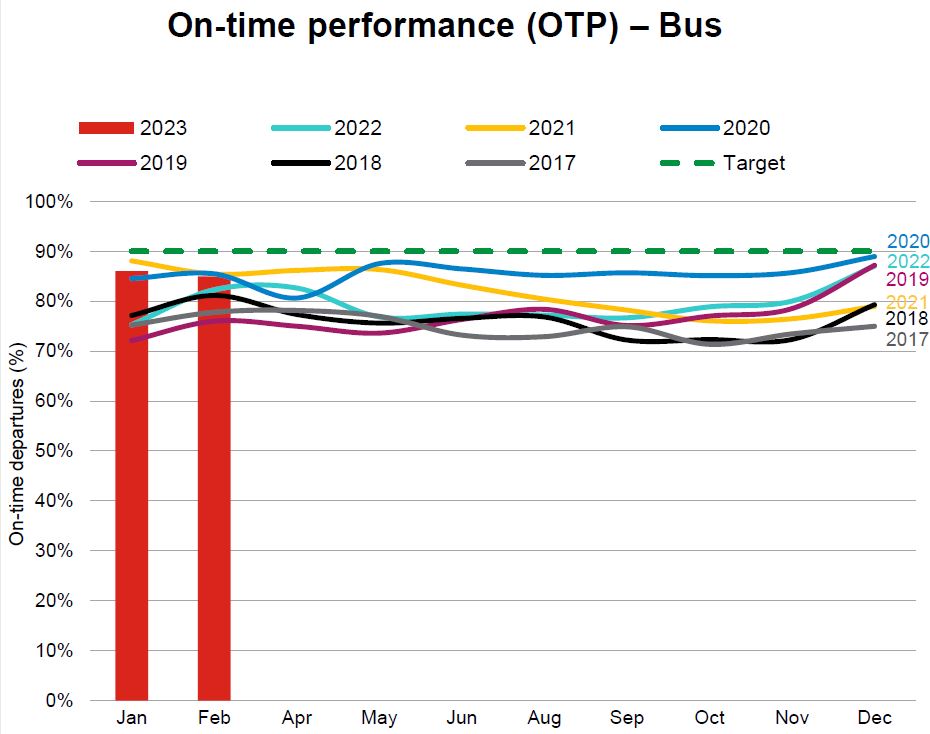
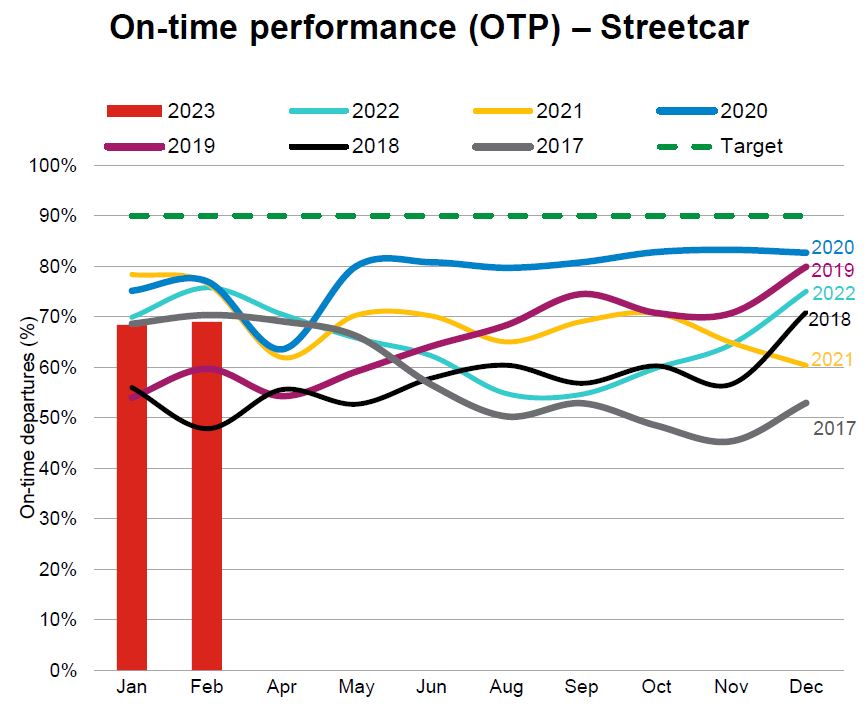
On-time performance measures vehicle departures from end terminals. Vehicles are considered on time if they depart within 59 seconds earlier or five minutes later than their scheduled departure time. (-1 to +5)

CEO’s Report, May 2023, p. 18

The intent is to hit this target 90% of the time, but the TTC does not achieve this with values typically falling in the 70-to-85 per cent range. At an individual route level results can be considerably worse. Streetcar routes fared worse with a 50-to-85 per cent range, and the higher end was achieved during the pandemic era when traffic and demand were light. The numbers have fallen since then.

The TTC’s metrics have big credibility problems because they bear little relation to what riders actually experience.

There are three major reasons:

  • Quality is measured on an all day basis, or worse on longer periods such as months. Variation by day and time is completely obscured by this approach. Reliable service at 10 pm is cold comfort to a rider whose bus has not shown up for 15 minutes in the peak period.
  • Quality is measured only at terminals, not along routes where various factors can degrade service that might begin well, but quickly deteriorates with bunching and gaps.
  • Service is measured relative to schedule on the assumption that “on time” performance will automatically be reliable. However, there is considerable leeway in that standard allowing irregular service to be considered “on time”, and the TTC does not even hit their target levels in many cases.

The CEO’s Report tries to work around the limitations of the metric by noting that some routes do farly well while others encounter a variety of problems. With respect to the bus network, the report notes:

Network performance was negatively impacted by the inclement weather the weeks of February 20 to March 10, where over 60 centimetres of snow fell on the city during this time. Weekday On-time performance was 88% for Weeks 7, 11 and 12. During weekends for the period, OTP was 82%. During February, 32 of 159 weekday routes were impacted by construction for at least three weeks of the period. Overall weekday OTP was 88% for the 127 routes not affected by construction:

  • 48 routes were “On-Time” (90% OTP or better).
  • 53 routes were “On the Cusp” (85-90%).
  • 26 routes were “Not On-time” with OTP less than 85%. In summary, 80% of the routes not affected by construction scored 85% or better.

This still does not address reliability issues at the level riders experience. Moreover, for frequent service, riders do not care if a bus is “on time”, only that service is reliable. TTC assumes that on time service will, by definition, produce reliable service, but they don’t actually operate on schedule and fail to measure service as riders see it.

Irregular service also affects crowding because passenger loads are not evenly distributed. If most riders are on full buses, the following half empty vehicles are not part of their experience (except possibly their frustration with a long wait for the advertised “frequent” service). Average crowding stats do not reveal typical riding conditions. (Analysis of crowding is complicated by the limited availability of automatic passenger counter data outside the TTC. I have tried for a few years to obtain this without success.)

The charts show that bunching (headways of two minutes or less) and large gaps (20 minutes or more) are common, and that they exist across the four months of data here. They are not occasional effects, but a basic feature of TTC service. The stats at terminals, where the TTC takes its on time performance measurements, are less than ideal, but the service degrades as buses and streetcars move along their routes. Most riders do not board at terminals.

This article presents a proposed method of charting service quality on routes to provide both the detail of day-by-day, hour-by-hour conditions and a broader overview. The charts are an experiment in condensing a lot of data into a manageable size, but I am not wedded to the format. Comments are welcome. Regular readers will recognize the format from a previous attempt, but I hope this is an improvement.

The goal is to produce something that can track the quality of service over time so that the decline or recovery of TTC routes is clearly visible along with the effectiveness (or not) of any changes to schedules, transit priority or route management.

There are a lot of charts in this article, and it is a long read for those who are interested. Feedback on this method of presentation is most welcome.

Continue reading

Why Do The 506 Carlton Cars Short Turn At Broadview?

Among various problems that became evident with the many route changes on May 7 was the deep mismatch between advertised and delivered service.

Both the 501 to Neville and the 505 to Bingham Loop were often missing in action short turning usually at Woodbine Loop (Kingston Road & Queen, named after the former racetrack).

Aside from the scenic tour the 501 Queen car takes via McCaul, Dundas and Broadview, plus the usual congestion on Dundas Street, another congested location was Broadview northbound between Queen and Dundas.

In that segment, three services, 501 Queen, 505 Dundas and 506 Carlton, were all queuing for the left turn at Dundas, compounded by 504/505 buses attempting to serve the northbound stop while blocking both lanes of traffic.

Under these conditions, it was impossible for any of these services to stay on time. The situation has been partly remedied by using traffic wardens to manage the intersection, but even that depends on ensuring that streetcars get priority all of the time despite the signal setup there.

As the week of May 7 wore on, I noticed that a lot of 506 Carlton cars were not getting east of Broadview. Riders complained about cars going out of service, and I received a tip from a reader about scheduled travel time changes.

This sent me into the electronic versions of TTC schedules which are published for use by trip planning apps and which also are the source for info on their own website. These files give a stop-by-stop schedule for each vehicle on a route and allow very fine-grained examination of the schedule design. What I found was quite surprising.

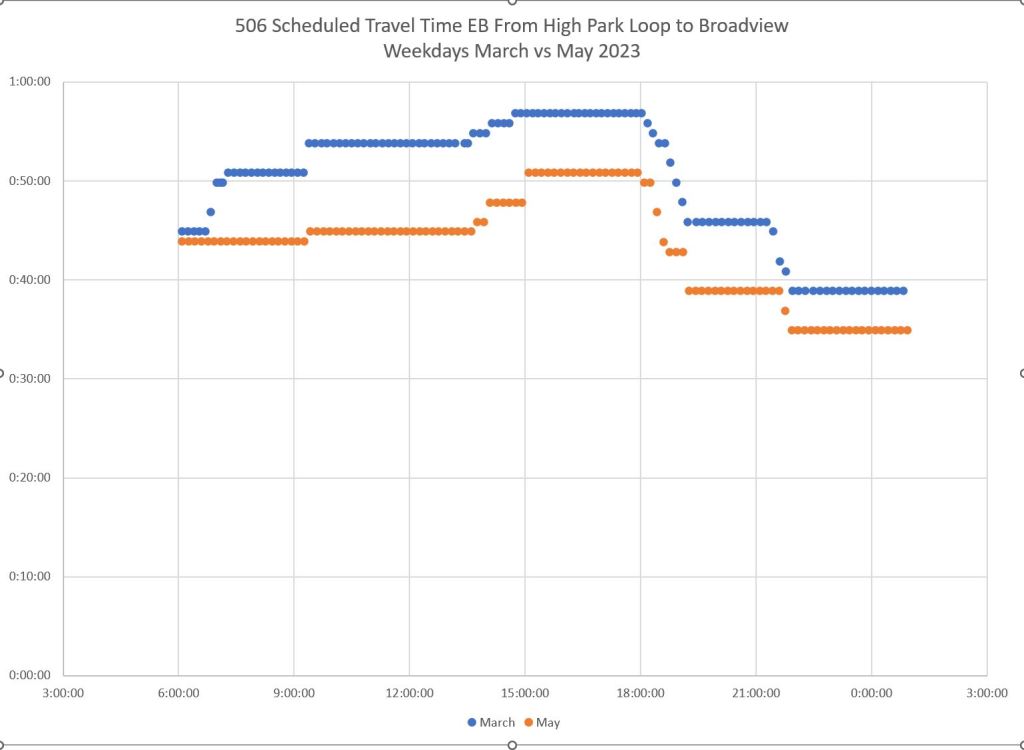
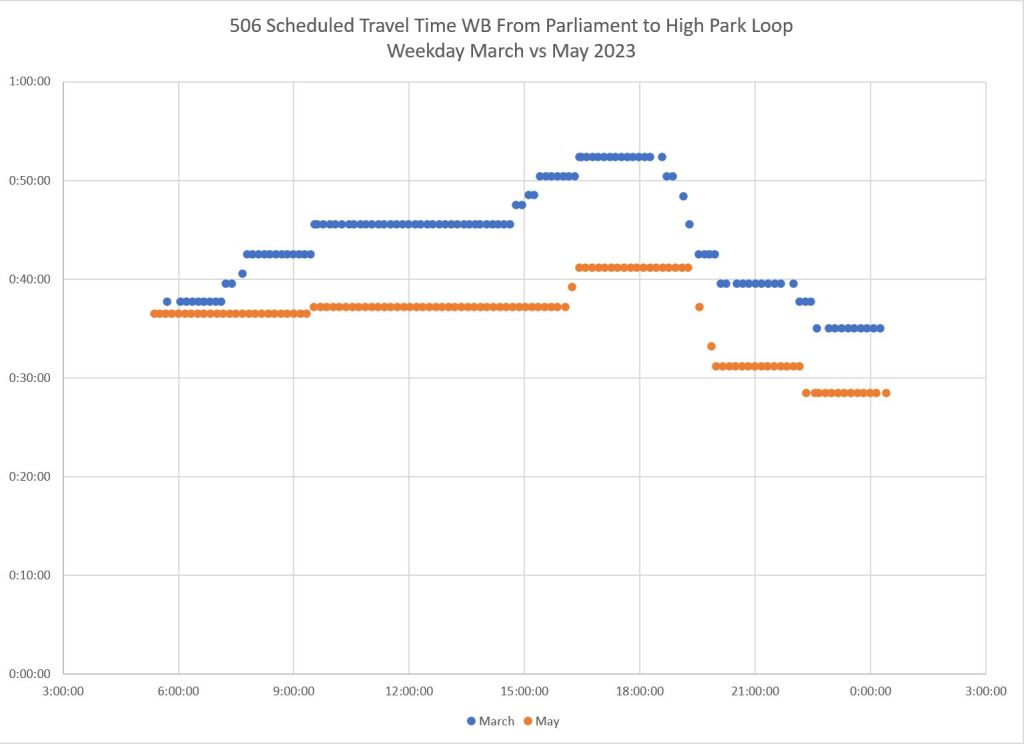
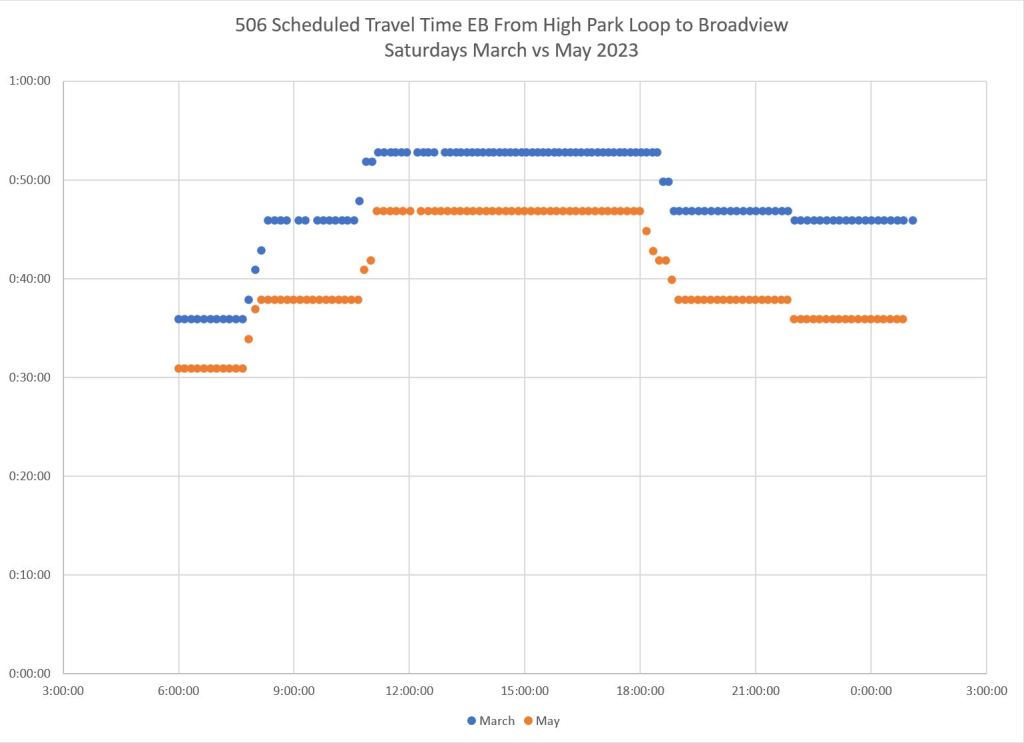
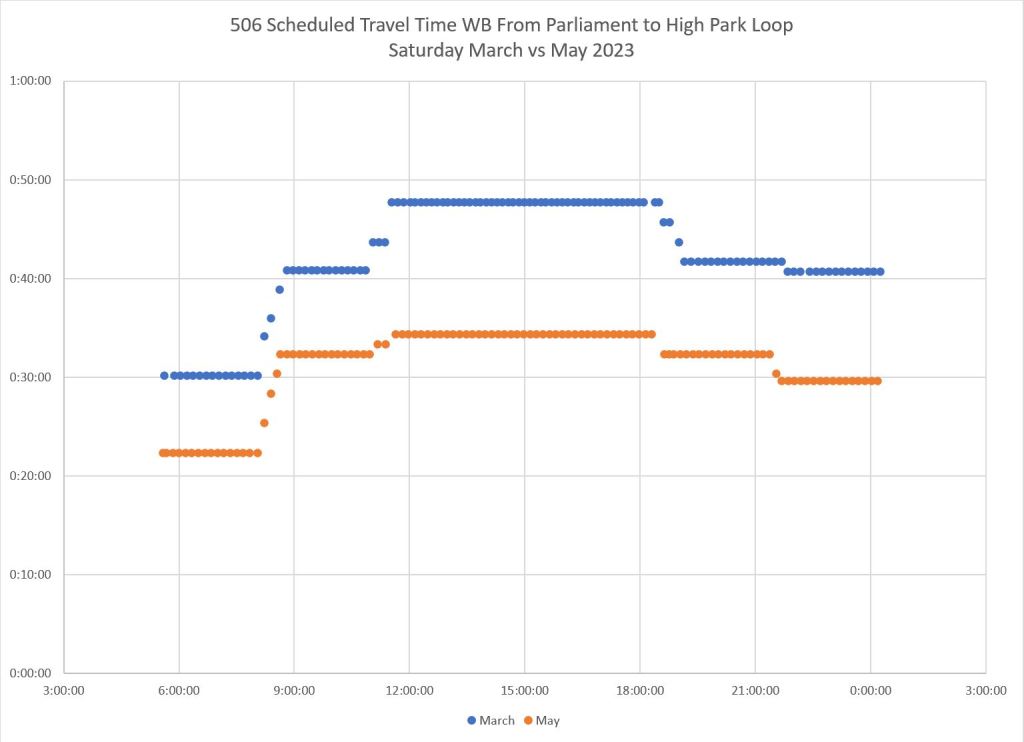
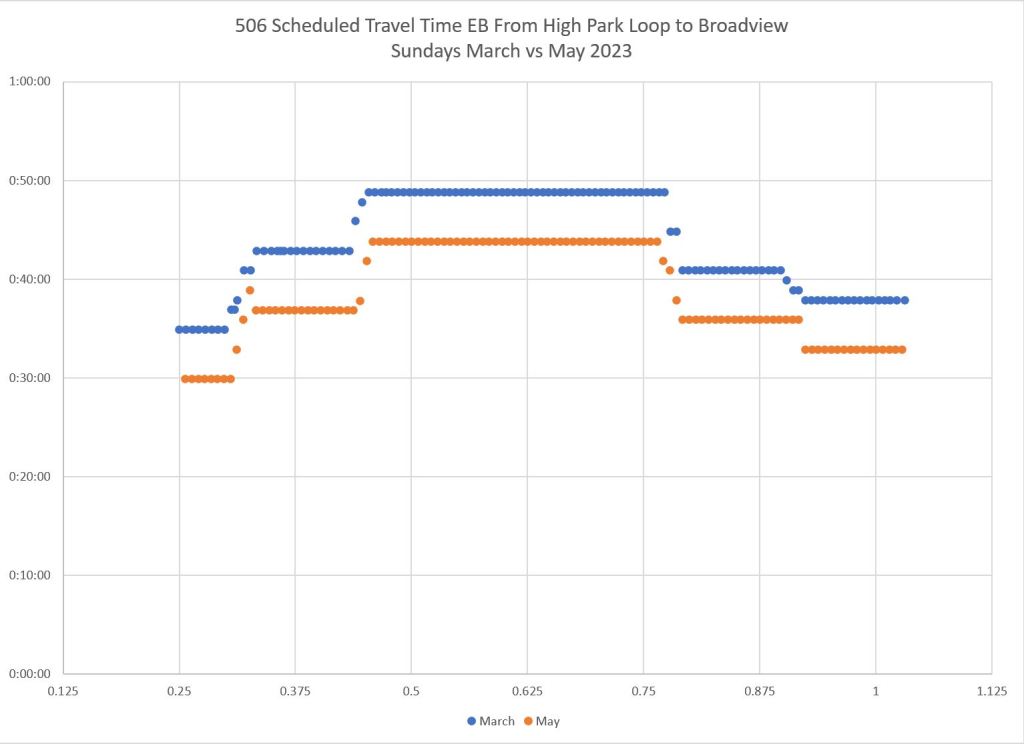
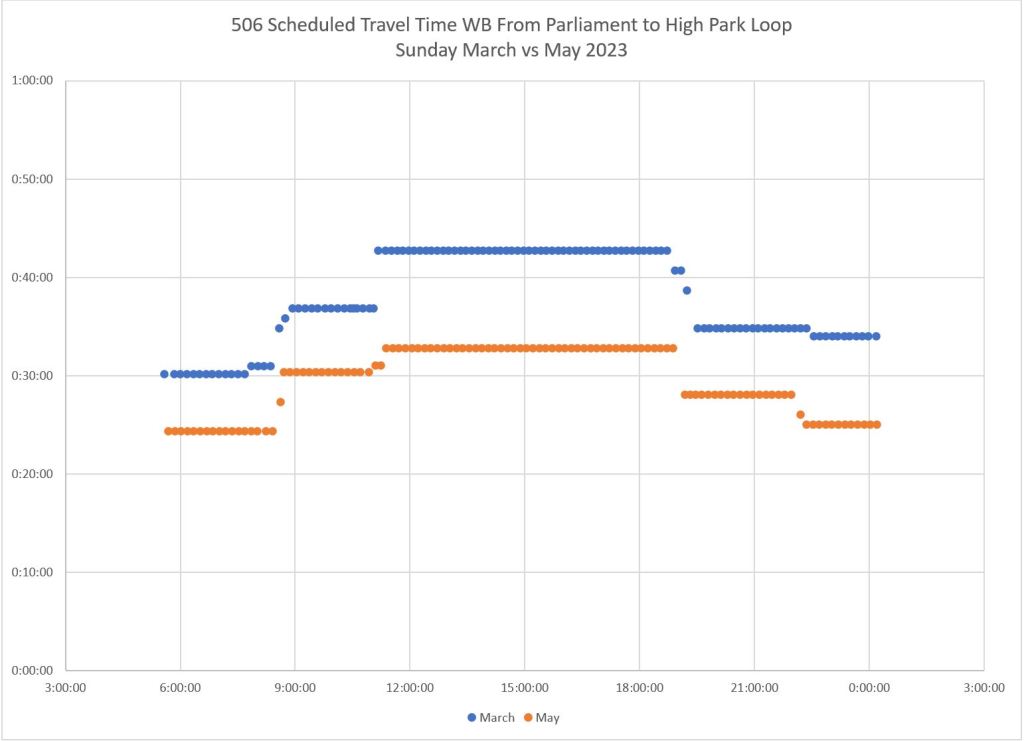
Over the portion of 506 Carlton common to the March 2023 schedules when all streetcars ran through to Main Station and the May 2023 versions with service diverting to Queen Street East, the running times were substantially shorter in May than in March. The schedule as designed could not be operated, and it has become common practice to turn most of the service back westward from Broadview. Here are charts comparing the scheduled travel times.

The eastbound comparison on the left covers the route from High Park to Broadview where streetcars turn off of their usual route. The westbound comparison covers the route from Parliament, where cars rejoin the route, to High Park. Each dot is one scheduled trip plotted with the departure time on the X-axis (horizontal) and the trip length on the Y-axis (vertical). Values move up and down over the day based on expected conditions on the route.

In almost every case the March travel time is longer than the May time. It is no surprise that streetcars have to be short-turned when the schedules work against them. How the schedules came to be designed this way is a mystery, but it creates big problems for riders.

This sort of thing cannot be corrected overnight, but in the meantime the TTC should formalize the route change and post notices everywhere so that riders know how the route will actually operate. New schedules will come in late July when Metrolinx closes Queen at Degrassi for preparatory work for GO corridor expansion and the Ontario Line, and all of the streetcar routes will shift north to Gerrard. With luck, they will reflect actual travel time requirements.

Shifting the westbound Carlton cars off of Broadview at Dundas reduces the number of turns that the intersection must handle per hour. A related issue will be the degree to which traffic wardens intervene to move transit vehicles through this choke point in the network. Both of these changes improve travel times for 501 Queen and 505 Dundas cars and could contribute to more reliable service east of Queen and Kingston Road to the two terminals. I will be monitoring this over coming weeks.

Footnote:

For the benefit of readers who don’t know the whole context, the 506 Carlton car normally operates to Main Station via Gerrard. During construction at Coxwell, it has been diverted via Broadview and Queen eastbound to Woodbine Loop. The westbound diversion runs via Queen, Broadview, Dundas and Parliament including a north-to-west left turn at Dundas because there is no track for a left turn northbound at Gerrard. (The TTC was planning to add one, but the message was lost somewhere in planning when the intersection was rebuilt.)

This is part of a larger set of diversions for construction projects that will evolve over coming months.

A Travel Time Comparison From TransSee

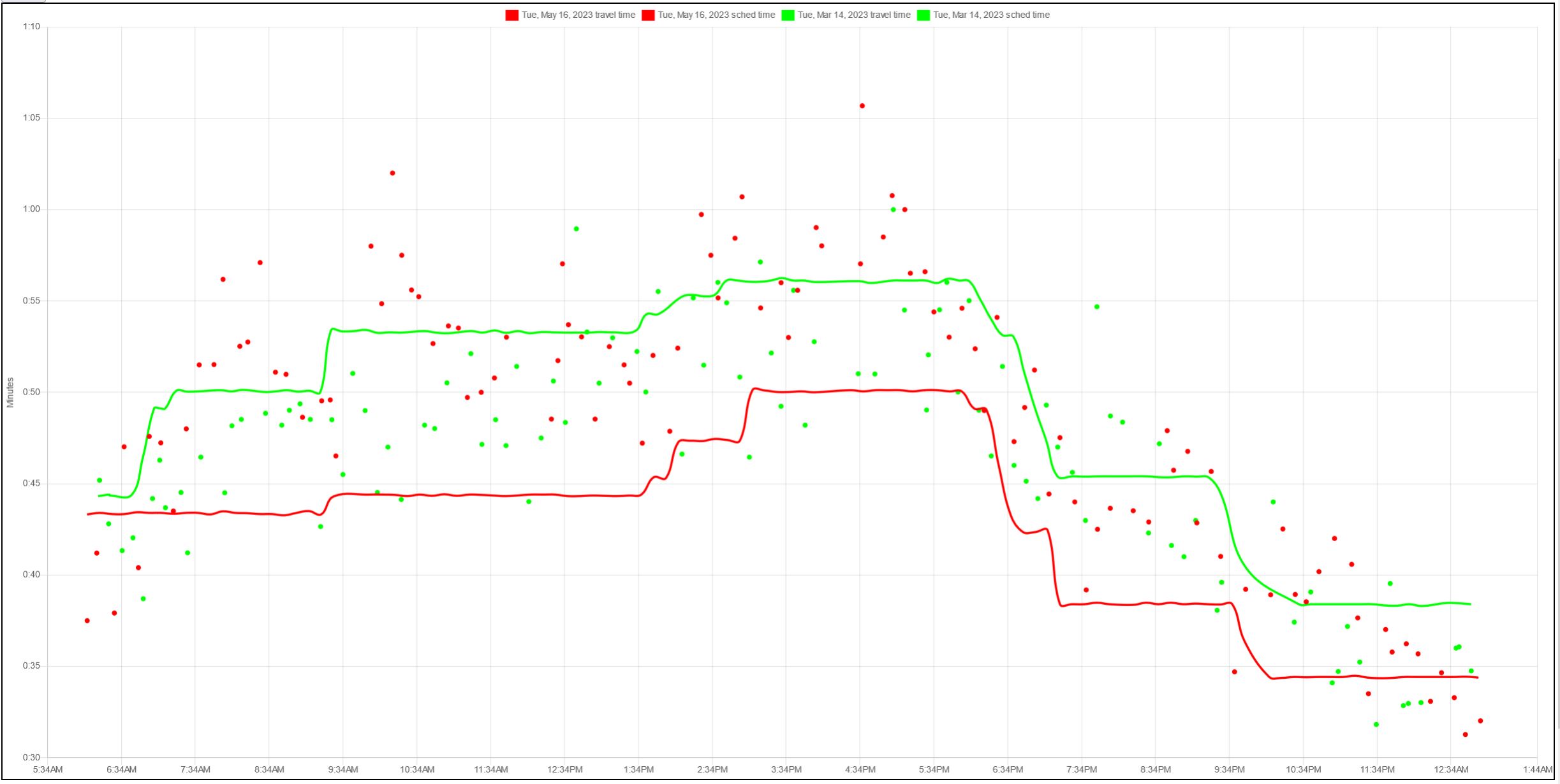
Darwin O’Connor has left a comment noting that you can get comparisons of scheduled and actual running times from his site TransSee.ca. Here is a chart comparing the situation for eastbound travel from High Park to Broadview in March (green) and May 2023 (red). The dots show actual travel times while the lines show the scheduled values.

Note that the green dots (March) are almost all below the green line, while the red dots (May) are almost all above the red line showing that with the new schedule cars would always be late, sometimes by a wide margin.

O’Connor notes that this type of analysis chart is available on his site free for the Toronto streetcar routes.

905 Eglinton East Express March-April 2023

The 905 Eglinton East Express operates from Kennedy Station to the University of Toronto Scarborough Campus with service also via Ellesmere east to Conlins Road on weekdays. This article primarily reviews the service during March and April 2023.

Major differences in the service after March 26, 2023 include:

  • Articulated buses replaced standard sized vehicles.
  • Scheduled service ran less frequently to compensate for the larger vehicles.
  • Scheduled travel times were lengthened.
  • A stated goal of the new service design was to improve reliability. This was only partially achieved.
  • Although the route officially operates with 18.5m articulated buses, standard sized 12m buses can be found regularly as extras both on weekdays and weekends. This suggests that even before the new service began operating, the TTC realized that they might have cut too deeply. The number of extras varies from zero to three, day by day.
    • These are extras that were reported in the tracking data. Whether there was even more unscheduled service is impossible to tell.
  • Travel times during the weekday daytime between Ellesmere and Kennedy Station, both ways, increased by 10-15% with the new schedule and larger buses.
Continue reading

King Streetcars Return to King Street

The TTC has announced that the 504 King streetcar is now actually running on King Street!

For the period from May 1-6, the 504B streetcar service from Broadview Station to Dufferin Loop will operate over the normal route. The west end 504C bus from Dundas West Station to the Distillery, and 504D from Broadview/Gerrard to Exhibition via Strachan will continue to operate until May 6.

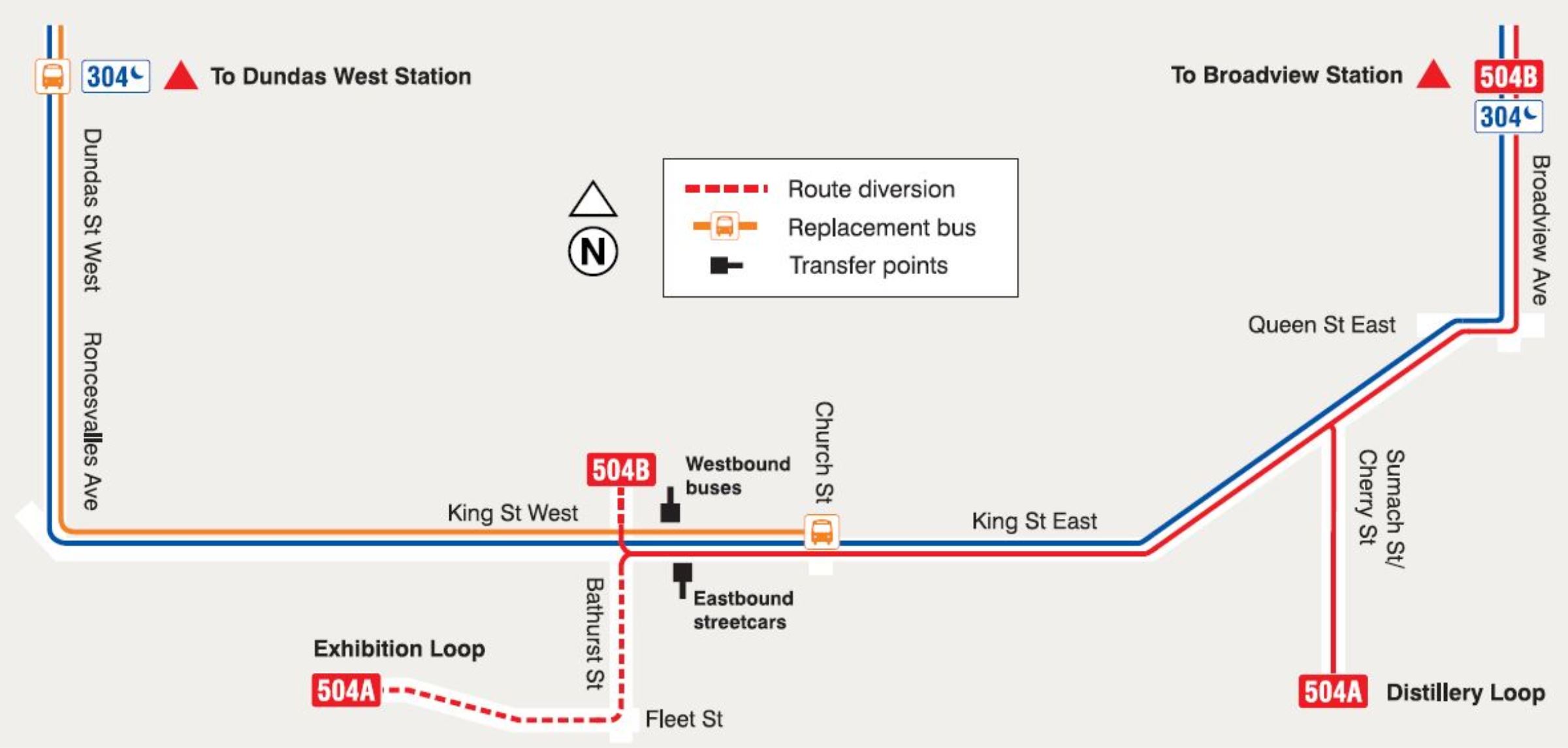
Effective May 7, streetcar service will resume all the way to Dundas West Station, but all cars will operate to Distillery Loop because the Don Bridge on Queen will be under repair for a few months. The east end of the line will operate as a shuttle bus from Parliament & King to Broadview Station. West end service will be the standard combination of 504A cars to Dundas West and 504B cars to Dufferin.

This will change again on June 18 when major construction begins on Broadview Avenue and TTC service between Gerrard and Danforth will be suspended. For further details, see my article on this summer’s construction projects.

As I write this, the routes as defined to NextBus (which supplies most data to prediction apps) have not been updated for 504 King or 501 Queen (which starts its own major diversion around Ontario Line construction). This means that predictions for stops are going to be a mess probably for the coming week until the main update with the May 7 service changes is implemented.

Au Revoir to Queen Street

With the shutdown of Queen Street for Ontario Line construction between Victoria and Bay, we will not see streetcars there for many years. The last cars will run just before midnight on April 30, 2023.

Until early 2024, the absence will be over a longer stretch from Broadview to McCaul until new diversion track via York and Adelaide is finished. In turn, that depends on relocating nine utility vaults under the new Adelaide trackage.

It is possible that the TTC will revise the diversion pattern once the Don Bridge reopens to streetcars later in 2023 (it will close for maintenance on May 7), but nothing has been decided yet.

Here are photos of various generations of streetcars on the central section of Queen as a memento while we await their return.

Note that this is a large gallery, and it will take a while to load after you first click on a photo.

Continue reading

Construction on Broadview, Gerrard/Coxwell, Main Station and Queen East

Updated June 13, 2023 at 2:50pm: The proposed expansion of Broadview Station Loop has been deferred to an unspecified date. Street trackage at the loop will be replaced this year as planned. The planned removal of most bus service from Broadview Station will not occur. Routes 8 Broadview and 62 Mortimer will continue to serve the station. Route 100 Flemingdon Park will be rerouted to Pape Station where it will interline with 72A Pape to King and Parliament.

Other changes have been made in future plans and this article should be used only for historical reference to the original plans. See also:

Continue reading

Buses and Streetcars Return to Dufferin Loop on April 1, 2023

No. This is not supposed to be an early April Fool’s joke.

TTC Customer Service has announced that the 504 King streetcar service western terminus will change on April 1 to its regularly scheduled location at Dufferin Loop. At the same time, the 29/929 Dufferin buses will also return to that loop.

Looking at tracking data (thanks to TransSee), it appears that some but not all 329 Night buses have already resumed their normal route south on Dufferin into Exhibition Place.

Currently, King cars loop from Queen south via Shaw to King, west to Dufferin and north to Queen without serving Dufferin Loop. In the revised routing, cars will operate both ways via Shaw, King and Dufferin to Dufferin Loop as shown below.

Because these are the routes published in the electronic version of schedules (GTFS), tracking apps should correctly predict behaviour of streetcars and buses in this area.

Roncesvalles Finally Reopens!

The TTC and City of Toronto have announced that Roncesvalles Avenue will reopen to traffic including the 504C King bus with the beginning of service on Tuesday, March 14.

Work is still in progress to adapt the passenger islands on Roncesvalles for the Flexity ramps, but traffic will swerve around work as it proceeds. Why this wasn’t done sometime in past months is one of those mysteries of construction staging.

Streetcar service on the 504 to Dundas West Station will resume in May, although an exact date has not been announced.

Meanwhile, the 504A Distillery and 504B Broadview Station services will turn back at Bathurst using Exhibition and Wolseley Loops respectively, although many cars in fact only get as far as Spadina and loop back via Charlotte Street. The 504C King bus loops via Church, Wellington and York.

Coming in May will be the removal of streetcar service on Broadview north of Gerrard for track construction, and for the redesign of Broadview Station Loop so that both the King and Dundas platforms will be able to hold two cars at once. Currently there is room for only one car on the Dundas platform.

Streetcar service on the west end of the Queen route beyond Sunnyside Loop is expected to resume in the summer, but again there is no specific date announced for this.