
Request for Comment: Charting Crowding vs Location and Time (Updated)

Updated Oct. 29 at 2:35pm: The service chart showing crowding levels has been revised with adjusted colouring, and to give emphasis to lines so that they stand out better. See the end of the article for a sample.

Updated Oct. 27 at 8:45pm: Sample charts have been added at the end incorporating some suggested changes.

This article continues my search for clear ways to display vehicle crowding data that I now receive as part of my data feed from TTC. In previous articles, I have shown vehicle tracking charts colour coded for the crowding index.

These charts show the regularity (or not) of service, locations of delays, bunches and gaps, and the resulting crowding pattern. This is useful for fine-grained analysis, but one must look at many charts to see the overall patterns.

In an attempt to “zoom out”, I developed a new chart format that shows the proportion of service at each crowding level seen at screenlines along a route by time of day. This article presents the results for the routes already published, but I wanted to nail down the format before publishing more. (I have many more in the wings including 25/925 Don Mills, 29/929 Dufferin, 36 Finch West, 39/939 Finch East, 41/941 Keele, 52/952 Lawrence, 53/953 Steeles East, 60/960 Steeles West, 85/985 Sheppard East, 86/986 Scarborough, 89/989 Weston, 116 Morningside, 129 McCowan North, 903 STC Express, and 905 Eglinton East Express).

Regular readers will know that I abhor the TTC’s practice of reporting service stats on monthly averages with every trip combined to give an overall picture. This hides a lot of things, notably the variations by hour and location, not to mention variations between routes. The chart format proposed here attempts to strike a balance between a hyper-detailed view and one where readers can see how routes behave at a level they can relate to their own journeys.

Does the new format shown here work for readers? Please let me know in the comments. I can do a lot of preparatory work on the other routes, and then drop their stats into whatever the final chart template looks like.

Many thanks to those who have sent suggestions regarding other charts I have published.

Continue reading
Analysis of 54/954 Lawrence East: September 2024

This post reviews operation of TTC service on the 54 Lawrence East bus and its express equivalent, 954, for September 2024. It continues on the work of building new charts including crowding data that began in the previous article on 35/935 Jane.

In response to suggestions, there are a few changes in the charts here.

  • The shade of red used for crowded buses has been darkened.
    • A reader suggested using a colour palette with a common base such as a light, medium and dark taupe. I experimented with it, but found the contrast for fine lines against a white background did not work well, especially on small displays.
  • New charts showing the distribution of headways along the route and over time have been added.
    • The scheme used is intended to give comparable information to a histogram, but on a more compact basis that makes changes along routes easy to see.

Summary of the 54/954 Lawrence East bus review:

  • Service on 54 Lawrence is unreliable with much bunching and gapping during many periods, especially toward the eastern end of the line.
  • Bunching caused by unregulated “blending” of the two branches (54A to Starspray and 54B to Morningside) is chronic. (This is a common problem on branching routes.)
  • Crowding during off-peak periods generally occurs on buses that are running in a gap.
  • Groups of buses commonly stay together for extended periods, including terminal departures, rather than being spaced apart to minimize gaps.
  • Late evening service on the eastern end of the route is quite erratic, and there was a repeated wide gap on most days in the period reviewed here.
  • The 954 express service has relative little crowding and much more reliable headways than the local service.
  • This route is a textbook example of abdication of route management. The tracking data shows little sign of congestion compared to some other routes, and bunching is a common operating practice.
Continue reading

Service Reliability on the Scarborough RT Corridor (Part 2)

This is the second part of a review of headway reliability on the routes serving the former SRT corridor.

Routes included here are:

  • 903 Kennedy-STC Express
  • 939 Finch Express
  • 954 Lawrence East Express
  • 985 Sheppard East Express

For other routes, and an introduction, see Part 1 of this article.

The common thread through these reviews is that although there is transit priority in place between Kennedy Station and Ellesmere on Midland and on Kennedy, these routes have reliability problems. The red lanes benefit riders once they are on a bus, but their wait for a vehicle could delay their trip.

I do not expect that most readers will take a brief look at routes they use. However, some with an absolute passion for Scarborough bus service and lots of time might dive into details for every route.

Continue reading

Service Reliability on the Scarborough RT Corridor (Part 1)

When the Scarborough RT closed, it was replaced by a bus shuttle, 903 Kennedy-Scarborough Express, running frequent service over streets paralleling the former SRT route. In previous articles, I reviewed actual travel times to determine how much traffic interference and transit priority contributed to speedy travel. See:

Since mid-November 2023, service between Scarborough Town Centre and Kennedy Station has been provided by many routes with the intention of eliminating transfer delays at STC. The following routes were extended south to Kennedy Station following the same route as the 903 Express. At the same time, service on the 903 was reduced as buses were redeployed to the other routes.

  • 38 Highland Creek
  • 129 McCowan North
  • 131 Nugget
  • 133 Neilson
  • 938 Highland Creek Express
  • 939A/B Finch Express
  • 954 Lawrence East Express
  • 985A Sheppard East Express

Debate over the planned busway in the former SRT corridor focuses on travel time savings using a private road from Eglinton to Ellesmere, but an important aspect for any rider is the wait time for their bus. The benefit of a faster ride can be undone by an unpredictable wait. This series of articles reviews service reliability on the extended routes as well as the remaining 903 Express operation between mid-November 2023 and the end of February 2024.

With all the focus on the shared route between Scarborough Town Centre and Kennedy Station, there remains the much longer portion of routes that have been extended. While the red lanes, and later the BRT roadway, should minimize further sources of irregularity, this does not change the fact that some of these routes have service issues east and north of STC.

This is part of a more general issue across the bus network that improvements are needed that will not come quickly or easily simply with a few transit priority projects. Moreover, riders need to see improvements now, not in the indefinite future after studies, priority lists and endless debates about who “deserves” better transit.

Included in Part 1 are routes 38, 938, 129, 131 and 133. The remaining express routes are in Part 2.

Updated Mar. 16, 2024: Route map added.

Continue reading

Travel Times on RapidTO Corridors – December 2023 Update – Part I

This article updates tracking charts of travel times on three proposed RapidTO bus corridors with data to the end of 2023. The routes covered are:

  • 29/929 Dufferin from King to Wilson
  • 35/935 Jane from Eglinton to Pioneer Village Station
  • 39/939 Finch East from Victoria Park to McCowan
  • 54 Lawrence East from Victoria Park to PortUnion

I will turn to other RapidTO corridors including the existing Eglinton-Kingston red lanes in Part II of this series.

Without going into a lot of interpretive detail, the purpose of these charts is:

  • To show the travel times under “best case” conditions of low road traffic in Spring 2020 (the covid pandemic onset), and the changes since that time.
  • To show the variation in travel times day-by-day and at varying times of the day.

If RapidTO can flatten out variations in travel times and get the typical time to a consistently lower level, bus service should not only be faster but more reliable. That was the goal on King Street which, for a time, achieved it’s purpose of improving transit.

The focus of too much transit politics is on saving time getting from point “A” to “B” and not enough on ensuring that this time is consistent from day-to-day, hour-to-hour. This includes both on-vehicle travel time and reliability of the interval between buses, a frequent topic on this site.

Toronto’s Executive Committee will consider a report RapidTO: Surface Transit Network Plan at its meeting on January 30, 2024. I will report on the full document after their discussion and additional information, if any, from the meeting.

Continue reading

TTC Service Changes Effective Sunday, September 3, 2023 (Preliminary)

This is a preliminary version based on GTFS data (the standard format for transit schedules used by online services) and some Service Advisories on the TTC site. I expect to receive the full list of September service changes early in the week of August 28 and will update this article accordingly including the usual detailed comparison of service levels.

Updated August 26 at 9:15 pm: 512 St. Clair updated to reflect complete bus replacement for work at various locations on the line.

Updated August 27 at 4:30 pm: At 10:30 am on August 28, the Mayor, TTC Chair and CEO will hold a press conference at STC Station to “outline how the TTC will increase service beginning September and into the fall.”

Updated August 29 at 5:30 pm: Due to changes in the Metrolinx schedule for work on the Lake Shore East Queen Street bridge, there has been a further revision of planned service. Please see this post for details.

Continue reading

Evolution of Bus Route Travel Times, 2020-2023, Part II

This article is the second half of a review of the change in travel times for a selection of major bus routes, many of which are part of the RapidTO “red lane” proposal, from 2020 to May 2023.

See also: Evolution of Bus Route Travel Times, 2020-2023, Part I

My purpose is to show the drop in travel times in March 2020 co-incident with the pandemic lockdown, and the gradual recovery over the past three years. The minimum times seen in 2020 establish what we would see in the absence of road traffic, not to mention a lower passenger demand, and probably show the best case for improvement with transit priority.

Depending on when I began to track various routes, there are cases when I have some pre-pandemic data from 2018 or 2019.

The situation varies from route to route and by time of day. In many cases, travel times have returned to pre-pandemic levels or higher, and some uptick is particularly notable in 2023. An important characteristic of these routes is that they do not serve the core area, but run in Toronto’s suburbs where bus ridership is strong and work-from-home had considerably less effect on demand than it does downtown.

Routes in this article include 86 Scarborough, 116 Morningside and 905 Eglinton East Express which already run on the Eglinton-Kingston-Morningside red lanes, as well as 39/939 Finch East, 54/954 Lawrence East and 25/925 Don Mills.

Note that the charts here track travel times, not service reliability. I will turn to that issue in future articles.

Continue reading

TTC Service Changes Effective September 4, 2022

Updated:

  • The spreadsheet detailing all of the changes has been added at the end of this post.
  • The number of the Mimico GO shuttle has been corrected to 176.
  • Transfer arrangements at Queen & Dufferin for the 501 bus and streetcar services have been clarified.
  • Transfer arrangements at Queen & Roncesvalles for the 501 and 504 bus services have been added.

Updated September 5, 2022:

  • The spreadsheet listing all of the changes has been corrected for route 504 King. The original version included a description of the route carried over from the August version. This has been changed to reflect the September arrangements.

The TTC will make many changes to its scheduled service on September 4, 2022 with restorations of previous service levels on many routes. This will not get the system back to 100% of pre-pandemic levels.

An important distinction is between three values:

  • The amount of service scheduled before Spring 2020
  • The amount of service budgeted for 2022
  • The amount of service scheduled for 2022

The TTC plans to be back to 97% of budgeted service for bus, 84% for streetcar and 92% for subway. The overall numbers are compared below.

Hours/WeekRegularConstructionTotal
January 2020 Scheduled185,8257,068192,893
September 2022 Budgeted186,3796,398192,777
September 2022 Scheduled177,9304,965182,895

In the original 2022 service budget, the TTC planned to be back to roughly the same level of service as in January 2020 by September 2022. However, slower ridership recovery coupled with staffing constraints produced a lower scheduled service expressed as hours/week.

There are further caveats:

  • The distribution of hours by time of day might not be the same in 2022 as in 2020 because of changing demand patterns.
  • Changes in running times to deal with congestion or service reliability can mean that the same service hours are stretched over wider headways. Not all vehicle hours are created equal.

All that said, there are many changes in service levels, and with the bus network being back to 97%, the schedules for September 2022 are often based on old versions before service cuts were implemented. Another change for this month is the reintroduction of school trips on many routes.

Continue reading

Evolution of Travel Times on RapidTO Bus Routes 2020-2022 (Part 1)

This article and one to follow is an update of an earlier review of the effect of pandemic-induced changes in traffic levels on the running time of buses. The target routes are those that already have “red lanes”, exclusive lanes for buses at all hours, and on the first group where red lanes were proposed.

Originally, the list of possible routes was shorter, and it is those routes whose vehicle tracking data I have collected over the past years:

  • Eglinton-Kingston-Morningside (implemented fall 2020)
  • Lawrence East
  • Finch East
  • Steeles West
  • Dufferin
  • Jane

A City study is underway to prioritize routes for detailed study and implementation under the RapidTO program.

An important premise behind RapidTO and bus priority is that service can be improved both because travel times are shorter and because they are more reliable leading to more regularly spaced and predictable service. Indeed, on the King Street transit project, the benefit was far more that variation in travel was reduced and reliability was increased, as opposed to reducing the average speed of travel under day-to-day conditions.

Too often, “priority” has been sold on the basis that it would reduce operating costs when the real goal should be to improve service with resources already in place, and to ensure that any additional buses or streetcars do not simply disappear into a “black hole” of unreliable service.

With the pandemic, we have an unexpected chance to see how much time is saved when traffic is, for a period, reduced from normal levels. This gives an indication of what we might expect from red lanes, or putting it another way, the best we are likely to achieve.

Continue reading

Service Analysis of 54/954 Lawrence East, October-December 2021

This article continues a series reviewing major east-west routes in Scarborough. Previous articles are:

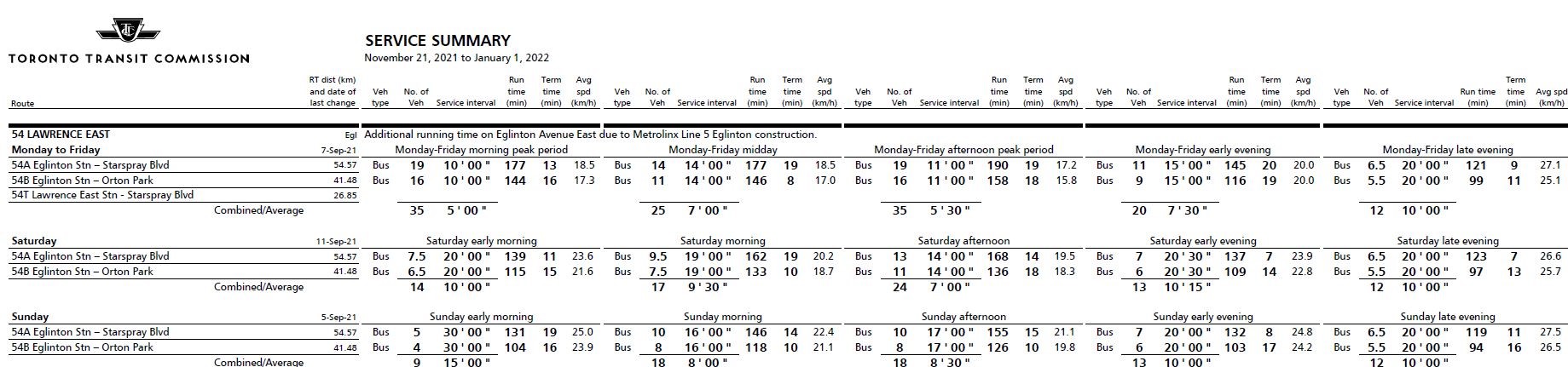
Service on Lawrence East is provided by two routes:

  • 54 Lawrence East local service operates from Eglinton Station east via Eglinton and Leslie to Lawrence, then east to two destinations:
    • 54A runs to Starspray Loop near the eastern boundary of Toronto.
    • 54B runs to an on-street loop via Scarborough Golf Club Road, Brimorton Drive and Orton Park Road. The direction of this loop reverses after 3pm.
  • 954 Lawrence East express service operates during peak periods between Lawrence East Station and Starspray Loop.

As part of a proposed route reorganization in Scarborough, the TTC proposed splitting off a separate Brimorton service, but this scheme is on hold.

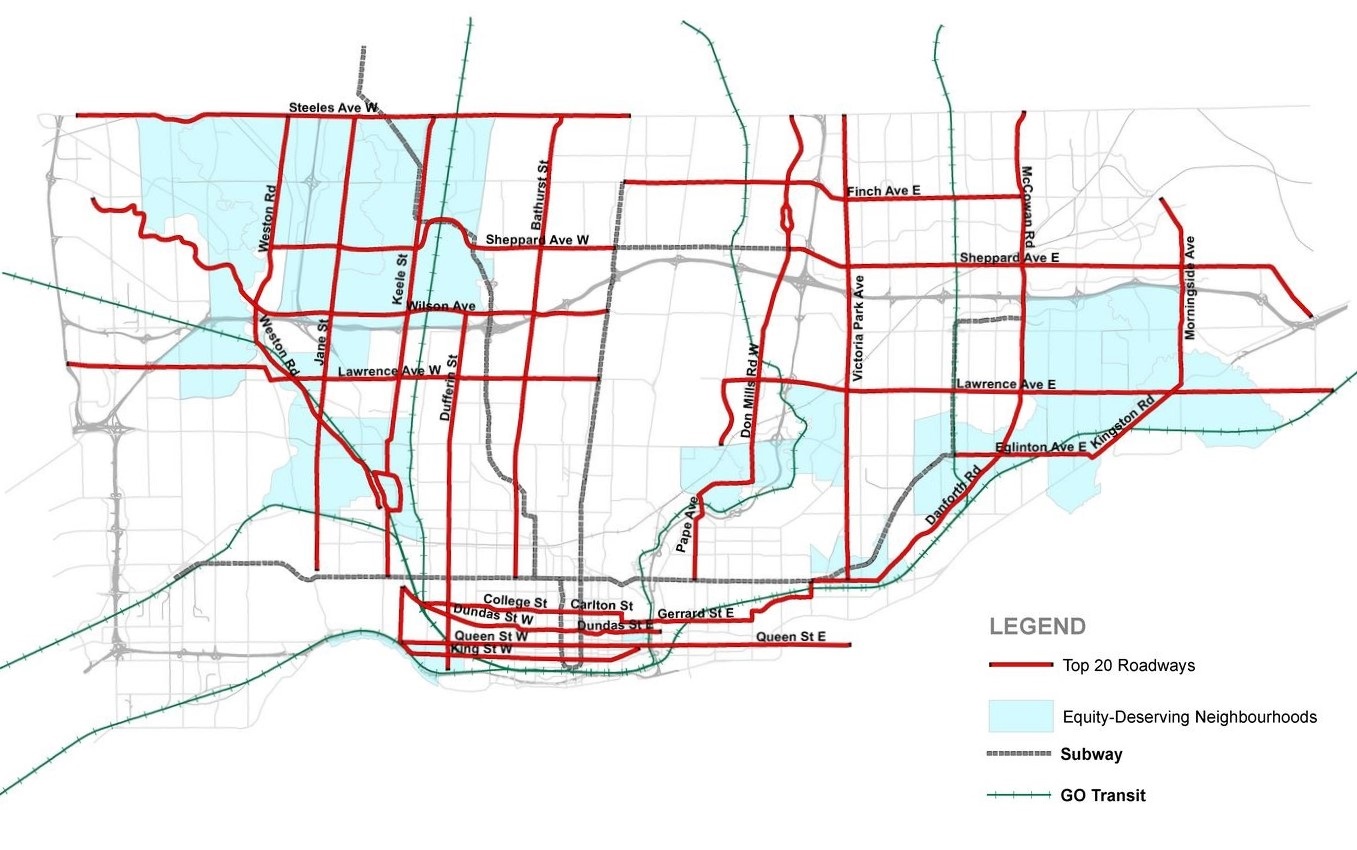
Following opening of Line 5 Crosstown, the 54 and 954 services will be rerouted to Science Centre Station at Don Mills & Eglinton. As part of the RapidTO scheme, red lanes are proposed on Lawrence between Don Mills and Starspray Loop. This article reviews running service quality and travel times on three segments of the route:

  • Port Union to Midland: Port Union is used as a screen line at the east end of the route because buses lay over at various places and in both directions making measurements right at Starspray Loop unreliable. Midland is the western screen line because it is just east of Lawrence East Station where buses might layover for various periods unrelated to traffic conditions.
  • Kennedy to Victoria Park: Kennedy is the eastern screen line because it lies just west of Lawrence East Station. Victoria Park is the western screen line because this was the originally proposed western end of the red lanes.
  • Don Mills to VictoriaPark: This section was added to the red lane proposals.

The schedules for both the local and express services are unchanged since September 2021.

Note that as in previous articles, data are missing for some days at the end of October and through November due to the cyber-attack on TTC systems.

In Brief

  • As on other routes reviewed in this series, the distribution of actual headways is well beyond what is contemplated in schedules or even in the TTC’s Service Standards which aim to keep most service within a six-minute wide band of “on time” performance.
  • Bunching and wide gaps are very common, even on comparatively “quiet” days like weekends and holidays.
  • Severe congestion effects appear rarely and typically show up as bulges in average travel times for specific weeks and days pulling them away from normal levels.
  • Headways on the express service 954 can be quite variable and the range of values exceeds the typical 5-minute difference in travel times between local and express operation between Port Union and Midland.
  • Some improvement in service is possible with reserved transit lanes to make travel times more reliable, but this must be accompanied by dispatching service so that buses are regularly spaced.
Continue reading