What Causes Subway Delays?

The TTC’s Andy Byford recently committed to a major reduction in subway delays by 2019 thanks in large measure to the introduction of a new signal system on Line 1 Yonge-University-Spadina.

Can this level of reduction actually be achieved? To get a sense of this, we must look at the actual delay reports from the TTC to see the location and type of service interruption. If a problem only account for one quarter of all delays, then a three-quarter reduction in delays cannot possibly be achieved simply by eliminating this class of problem. Similarly, if half of the delays are on one line, and a new technology is implemented on another, then nothing has been done to address delays on the untouched part of the system.

The TTC reports overall reliability statistics in the CEO’s report, but these are (a) not subdivided by cause and (b) use a measure of service “reliability” that would give a perfect score even if a large proportion of the service were missing. As long as trains are close enough to each other, even if there is one gap leading the pack or all of the trains crawl along the line, they do not count against the metric the TTC used for years to report service quality.

The counts below were calculated by reviewing all of the TTC eAlerts for service interruptions on the four rapid transit lines for January 2016. Anyone who reads these alerts and rides the system regularly knows that some delays never make it to an alert, but this is the best we have for published information.

Type of Delay                    Line 1    Line 2    Line 3    Line 4

Passenger Alarm                   6  16%   14  23%    2  18%
Signals                          11  30%   11  18%              3  60%
Mechanical                        1   3%    4   7%    8  73%    1  20%
Track                                       3   5%
Switching                                   1   2%
Security                          5  14%    6  10%              1  20%
Police Investigation              3   8%    4   7%
Fire Investigation                3   8%    8  13%    1   9%
Medical                           3   8%    4   7%
Power Off                         4  11%    3   5%
Unauthorized at Track Level                 1   2%
Late Clearing Work Zone           1   3%    1   2%
Unspecified                       0         1   2%

Total                            37        61        11         5

The details of the incidents are in the following table.

201601_SubwayDelayStats

This is only a one month sample, and there are bound to be somewhat different numbers for other periods, but this gives the flavour of the situation.

Signal problems, annoying though they may be, account for only 30% of the delay incidents on the Yonge line, and 18% on the Bloor line for January 2016. That said, these tend to be the most long-lasting incidents and so their effect is greatly out of proportion to their number. Moreover, the incident count is higher on the Bloor-Danforth line by a wide margin. The new signals on Yonge-University will certainly improve conditions on that route, but delays overall will not be a thing of the past.

If the TTC is going to shoot for improvements, then they must start reporting their delay statistics at a more granular level so the a link will be visible between the type of “fix” undertaken and the location and type of delay whose stats go up or down. This would be a much more useful measure both of service quality and of the effects of management programs to improve the quality of transit service.

GO Transit Electrification Study Public Meetings

Metrolinx has announced a series of meetings for public participation in the TPAP (streamlined Environmental Assessment for Transit Projects) for their GO Rail Network Electrification Study.

Four of these overlap with sessions previously announced by City Planning for other projects under review:

  • Tuesday February 16: John Vanier school in Scarborough
  • Wednesday February 24: Metro Toronto Convention Centre in downtown Toronto
  • Wednesday March 9: Lakeshore Collegiate in Etobicoke
  • Tuesday March 22: Nelson Mandela Park school in Toronto

The area of this study covers only the trackage already owned by Ontario through Metrolinx.

Memo to John Tory: Where’s The $50 Million? (Updated)

The Mayor and other worthies showed up for a press conference and photo op today at Davisville Shops to trumpet all the new money the TTC will be getting in 2016.

Quoting the TTC’s Media Release:

In 2015, the TTC received an unprecedented $95 million increase to its budget and is set to receive over $50 million in new, annualized funding in 2016 to improve service on buses, streetcars and subways that serve the 555 million riders who use the TTC each year.

…

“Through two budget cycles, we have made significant service enhancements and continue to improve the experience for our customers” said TTC Chair Josh Colle, “As TTC Chair, I will continue to push for further investments to enhance service, and make the TTC less crowded and more reliable for our customers.”

Those are stirring words, but let’s have a look under the covers. Here is the TTC Budget as presented by the City Budget Analyst going into debates at Budget Committee.

PrelimANotes_OpsBudgetByCategory

The important line here is “Total Net Expenditures” which is another way to say “subsidy from the City of Toronto”. The actual increase from 2014 actual to 2015 projected is only about $77 million ($393m to $470m). The projected bump to 2016 is a further $25.6m, and that looks good only because it is relative to the 2015 actual, not budget.

On a budget to budget basis, the change is only about $21.5m ($473.7m to $495.2m). Even that may overstate the real increase because the “change from 2015 approved” budget shows growth of only $11.1m. This is probably due to in-year amendments to the 2015 budget.

(The inconsistencies in budget reporting at the City and TTC are an ongoing challenge, and there is usually just enough information missing to cloud any analysis.)

Note that these numbers include the effect of the fare increase, but do not include the TTC Board’s proposed enhancements.

There was a lot of fine tuning at the Budget Committee, but at the end of the day only the following changes were approved:

  • POP Inspectors: $1.7m
  • Streetcar service reliability: $1.2m
  • Early Sunday surface (surface routes): $0.6m
  • Discretionary spending : $5m reduction

That’s right – the cut in discretionary spending (paperclips, conferences, and other accounts the TTC has already pillaged to find “efficiencies”) is bigger than the approved additions to the budget. This is in a budget where there is already an across the board $10m reduction to reflect savings based on actual spending patterns vs budget in 2015.

The key phrase in the release above is “new, annualized funding” which is takes the improvements approved for 2015 and operates them for the full year. No real “new” investment for 2016. Worth remembering are the items that were not approved by the TTC Board and/or the Budget Committee:

  • Reliability Centred Maintenance (Pro-active vs Re-active): $7.7m
  • Track Safety (Flag Persons): $1.8m
  • Training: $1.8m
  • Bus Service Reliability: $2.0m
  • Express Bus Services: $1.6m
  • Subway Service Reliability: $0.6m
  • Line 1 3-minute service: $2.8m
  • Cherry Street streetcar service: $0.8m

When the TTC turns into a publicity machine for the Mayor, and so much that was touted as part of the 2016 Budget doesn’t make it past the sharp knives at Budget Committee, press conferences about “improvement” and “investment” ring rather hollow.

So, please Mayor Tory, stop using our subway trains as publicity props, and start being straight with Toronto about what you are really spending on transit service. As anyone who reads the budget can tell, the big increase in TTC “funding” comes from the paying customer, the riders who pay higher fares, not from the penny-pinching City Council and a Mayor who cares more about looking like he is pro-transit than actually paying for the honour.

Updated:

The TTC’s Brad Ross explains the $50m figure thus:

There’s $20M in additional subsidy over 2015. The balance of $30M is annualized for the new and enhanced services begun, primarily, in the fall that now apply to all of 2016. That’s in addition to POP, early Sunday service, streetcar reliability and the 5 express routes that start in March.

I hate to point this out, but the basic numbers show that the City has very little on the table in this game, and the riders are paying the freight for a lot of the new services carried into 2016 from 2015. As for new services in 2016, don’t hold your breath.

The Lord Mayor’s new transit clothes are rather tattered.

Updated:

The section about year-to-year budget comparisons has been clarified.

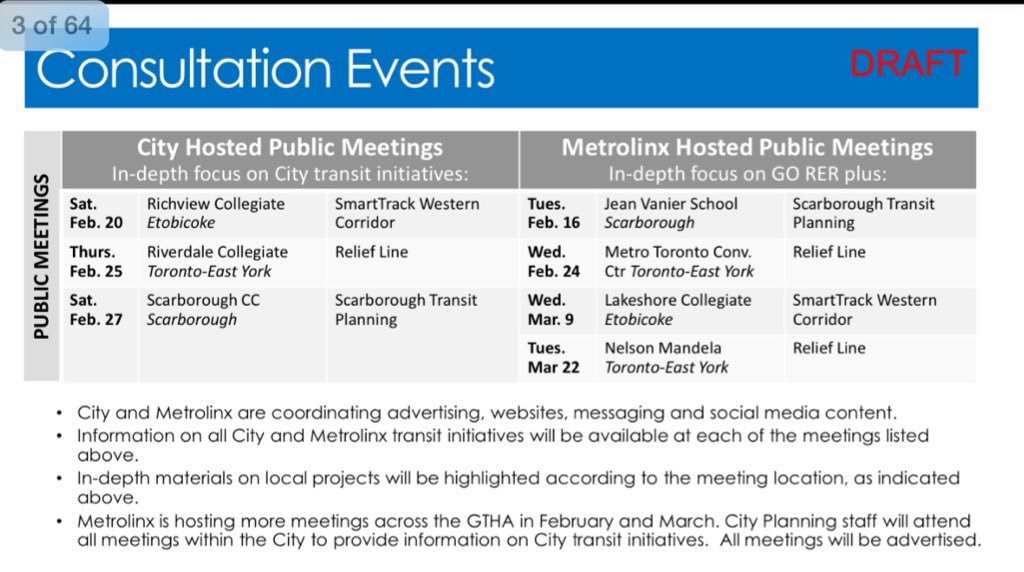
Relief Line, SmartTrack, GO/RER, Scarborough Subway Consultations

Toronto City Planning has released a draft list of upcoming public consultations on various transit plans including:

  • The Relief Line
  • The Scarborough Transit Plan (Subway, SmartTrack, Crosstown East LRT)
  • The Western SmartTrack Plan (SmartTrack, Crosstown West LRT)

2016_ConsultationCalendar

Additional meetings and information about Metrolinx plans (GO Regional Express Rail) will be organized by that agency.

Even more information will be available in March 2016 when the City releases a compendium report on all transit initiatives currently under study. These will include items listed above as well as the “Waterfront Reset” study, TTC Fare Integration proposals and a review of how (or if) Tax Increment Financing can contribute to the many transit projects under review. The intent is that this report will form the basis for public consultation and debate leading to recommendations at Council in June 2016. This is a very aggressive schedule, and there is no indication how consensus will actually be achieved in so short a time, especially with the usually-secretive Metrolinx as an essential player. At least the discussion will be at a network level, not ward-by-ward with a “relief” line for every member of Council, and there will be some filtering of various schemes based on engineering and operational realities.

What is sadly missing from all of this is a discussion of day-to-day transit operations and the backlog in the state-of-good-repair budget. We can blithely discuss billions worth of subway building to Scarborough and a Relief line, but Council won’t fund the basics of running a transit system.

TTC Service Changes Effective Sunday February 14, 2016

The TTC will implement several service changes for its February-March schedules primarily to improve peak service on some overcrowded bus routes. This is a sign that the available bus fleet is expanding and more peak service can be offered.

A few routes have new schedules to reflect actual operating conditions.

The 66 Prince Edward bus will be revised so that the same level of service is provided to Lake Shore (Humber Bay) and Humber Loop at all times.

2016.02.14_Service_Changes

Toronto Relief Line Alliance Launched

The recently-formed Toronto Relief Line Alliance has  just launched a campaign to showcase the benefits of a new subway line from downtown Toronto to Don Mills & Sheppard. Unlike the less-than-arms-length SmartTrack advocates, FAST, the Relief Line Alliance isn’t trying to make any politicians look good or prop up the remnants of an ill-considered election platform.

Of particular interest on their site is a map where readers can see travel time savings possible for various trips to downtown. All of the numbers they use are based on published reports notably Metrolinx’ own evaluation of such a route from June 2015.

Now that Toronto can finally discuss something other than John Tory’s signature project, the new Alliance can provide a voice and a forum for a much-needed part of our transit system.

City Hall and Queen’s Park must get their heads out of the sand and make the Relief Line an integral part of medium term, “see it in our lifetime” plans. The time for transit plans pandering to pet projects and political egos is over.

The Scarborough-Malvern LRT May Live Again

So much has been going on with the gradual disintegration of the SmartTrack plan and its replacement, at least in part, with elements from the Transit City network that it has been hard to keep up. I will write about this in more detail as reports and other information become available.

Meanwhile, there has been an interest on Twitter in the original EA documents for Scarborough-Malvern which vanished from view years ago in the anti-Transit City years.

I have created a repository for these files on my site.

Happy reading!

TTC Board Meeting January 21, 2016

The TTC Board will meet on January 21, 2016. Unlike most meetings, the public session will begin at 10:00 am, although they may go into camera to discuss details of item 3 on the agenda, the cost overrun on the Spadina subway extension.

Items of note include:

This article has been updated with details on these subjects.

Continue reading →

SmartTrack: Now You See It, Now You Don’t!

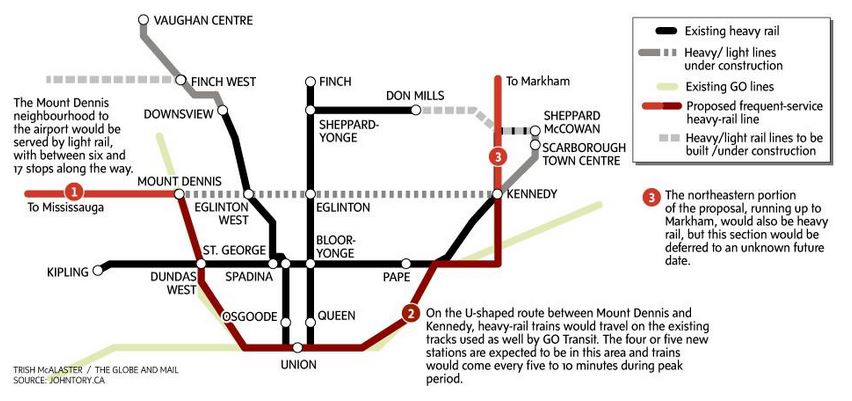
Oliver Moore in the Globe and Mail reports that there have been major changes to the SmartTrack plan, to wit:

  • The western branch of the service to the Airport district will be provided by the western extension of the Eglinton-Crosstown LRT as originally proposed.
  • “SmartTrack” per se will operate as a heavy rail service overlaid on GO Transit with the initial phase running from Mount Dennis to Kennedy Stations.
  • The northern extension of “SmartTrack” to Markham will be a separate phase of the project.

The map from the Globe & Mail is reproduced below.

GlobeSTLRTMap_20160114

According to Moore, the cost of adding SmartTrack to GO under this configuration would be much, much less than the originally quoted figure for the entire line. In turn, this would free up substantial capital spending headroom in City plans for other projects.

SmartTrack service at 15 minutes (the level proposed in Tory’s campaign) is far too infrequent to attract much riding, and especially to make a dent in demand on the existing subway interchange at Bloor-Yonge. We saw this in the June 2015 Metrolinx demand projections that were far more favourable to a Relief Line operating north to Sheppard and Don Mills. However, getting SmartTrack service down to as close a headway as every 5 minutes will be challenging for Metrolinx and for the corridors through which this would operate. There are no details yet on how this would be achieved.

The Eglinton West LRT has always been the superior way of serving this corridor compared to the heavy rail SmartTrack scheme. ST foundered on major problems with constructibility and neighbourhood effects, issues that were dismissed in a stunning display of cavalier “expert” knowledge during the campaign. Planning by Google Maps from an office in the UK has its limitations, but Tory’s campaign relied on this “expertise”. One shameless professor even rated ST with an “A+” in the CBC Metro Morning interview.

Keeping the first phase of ST confined south of Eglinton on both branches limits the operating costs the City must bear if this to be truly a “Toronto” project with “Toronto” fares, and it avoids the complexities of building into the 905.

Indeed, SmartTrack began as a real estate development scheme to make commercial property near the Airport and in Markham more accessible from downtown in a series of studies that actually claimed the market for downtown office space was static and falling. Yet another expert should be eating crow pie from his perch on the Metrolinx board. It was never clear why Toronto should shell out billions to improve property values in the 905, and this task now falls clearly to Metrolinx where it belongs.

The eastern leg of SmartTrack, north from Kennedy, obviously competes with the Scarborough Subway Extension, and there is no need for two routes serving the same demand, especially when GO already plans substantially improved service in the rail corridor. The long-standing issue of SSE demand may be clarified by the absence of SmartTrack as a competing service.

It is no secret that my own position would be to revert to the LRT plan in Scarborough, but that train has probably left the station, especially if the City can “save” a small fortune by scaling back on SmartTrack.

These changes could also foreshadow a revised schedule for the LRT projects at a time when “shovel ready” projects are in demand to soak up new federal spending. Eglinton West’s LRT extension is relatively easy to build, and it could be started soon enough to complete concurrently with the main Crosstown route. There is also the matter of the Sheppard East LRT including its proposed service linking to UofT Scarborough campus.

Coming weeks may bring many sputtering denials, or possibly, much improved clarity and acceptance of an – at last – realistic plan.