Waterfront East Design Update

The Design Review Panel at Waterfront Toronto recently considered the proposed design for the surface portion of the Waterfront East LRT and Queens Quay reconfiguration now that it has reached the 60% level.

Updated June 6 at 4:10pm:

The presentation decks from the meeting will not be posted on Waterfront’s site, but I have set up a page on this site where those interested can access them. There is far more information about the designs in the presentation decks than I have included here.

This article focuses on aspects of the design affecting the Waterfront East LRT project (WELRT), one of several major City of Toronto priorities that is not yet funded. Toronto hopes to see money for this in the Federal government’s collection of key infrastructure projects, but nothing is certain.

How much of this design will survive the inevitable “value engineering” and reduce acres of green to boring concrete remains to be seen.

Responsibility for this project is split:

  • The segment from Union south to Queens Quay is a TTC project, but work on that has stopped at 30% design pending certainty about funding.
  • The segments on Queens Quay East, Cherry and Commissioners are split between the Port Lands Flood Protection project (funded) and the WELRT (not funded). Waterfront Toronto is responsible for design of these segments.

Two early works, shown in light blue in the map above, are the reconfiguration of the Yonge Street Slip and the extension of Queens Quay east from Small Street (where it now veers north) to Cherry Street. Readers may recall the overblown Sidewalk Labs proposal for the land around Parliament Slip and south onto Ookwemin Minising (formerly Villiers Island). This design round is far more in keeping with the style and scale of Queens Quay West’s renewal.

In its initial implementation, the WELRT will go as far as the Commissioners Street crossing of the new Don River. Tracks on Cherry will be extended south from Distillery Loop through a new portal under the rail corridor to connect with the line on Queens Quay east from Bay Street. Future expansion in various ways is possible, but how soon this might occur is anyone’s guess given the state of transit funding and the uncertainty of land development schemes. Options include:

  • Southern extension via Cherry to Polson Street
  • Eastern extension to a planned Broadview extension and thus to:
    • Leslie Barns via Commissioners
    • East Harbour Station on the Ontario Line and beyond to existing trackage on Broadview at Queen Street

This was a design presentation, and issues of constructability and eventual implementation of the WELRT are beyond its scope.

Continue reading

Ontario’s 2025 Budget and Transit

Ontario unveiled its 2025 budget on May 15. Although it speaks of “Approximately $61 billion over 10 years for public transit”, by far the lion’s share of this spending is for projects already underway in the construction and design stages.

All of this is for capital expansion and renewal, and nothing has been announced for day-to-day improvement of transit service.

GO Transit

The budget cites:

  • The Hamilton-Niagara through service connection at West Harbour Station which is already in service.
  • The proposed Bowmanville extension which has been announced before, but is only barely underway at the “early works” stage. This extension has physical alignment issues.
  • GO 2.0 includes “delivering all-day, two-way service to Kitchener and Milton, building new GO stations across the region and advancing planning to unlock potential new rail corridors through midtown Toronto, Etobicoke, York Region and Bolton.” There are no dates attached, and some of these have been on maps for a very long time. Notable by its absence is any mention of electrification.
  • A total of $850 million to refurbish GO Transit rail coaches at the Thunder Bay Alstom the North Bay ONR facility. This work is already announced. The cars may receive convenience upgrades such as “charging plug ports, cup holders and improved Wi-Fi”, but the long-term retention of these cars indicates that the operating model for GO electrification, if and when it occurs, will have a large component of locomotive-hauled trains rather than electric multiple units.

Subways

Subway projects in the budget are:

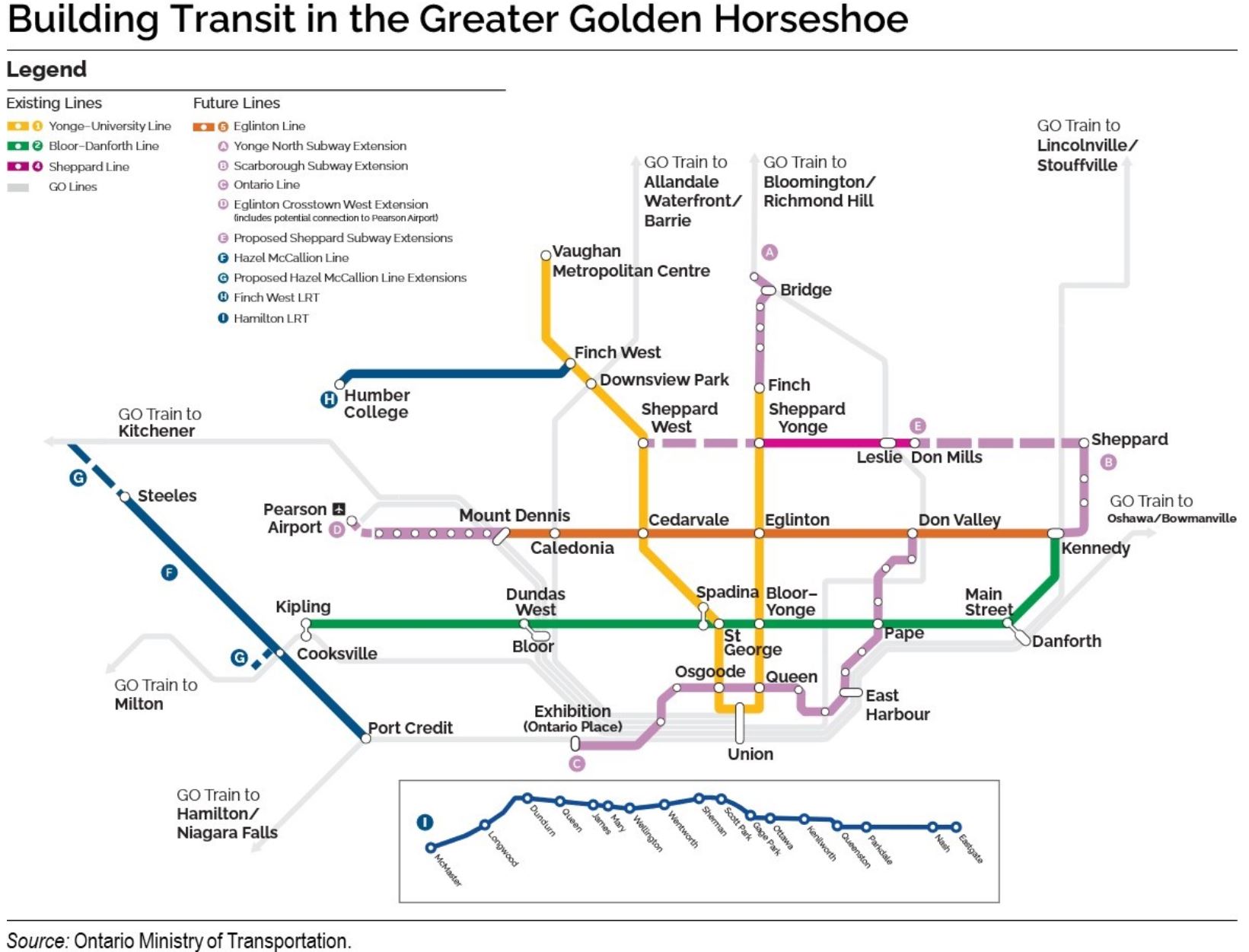
  • Ontario Line (under construction).
  • Eglinton-Crosstown Western Extension (under construction).
  • Yonge North to Richmond Hill (procurement underway).
  • Sheppard Subway Extension (planning, consultation and business case preparation underway). Notable in the map below is the absence of a line east of McCowan where there is a conflict with the City’s Eglinton East LRT project and with maintenance yard property requirements.
  • New subway cars for Line 2. Provincial funding for these trains has been in place for some time. What is not yet funded are trains for service expansion beyond pre-covid 2019 levels. Trains for the Yonge North and Scarborough extensions are included in those projects. The TTC is in the Request for Proposals process for new trains, but this has been skewed by provincial statements that the work should go to Alstom’s Thunder Bay plant.

Yes, they seem to have forgotten the Scarborough Subway Extension (now under construction) in the text although it is included in the map below..

East Harbour Transit Hub

The hub at East Harbour Station, near the point where the Lakeshore East GO line crosses the Don River, will eventually serve GO Transit, the Ontario Line, and the local streetcar/LRT system via the Broadview Avenue Extension and a link west via Commissioners Street.

A substantial portion of this project is funded by the City of Toronto as a remnant of John Tory’s “SmartTrack” plan.

Light Rail Projects

  • Hamilton LRT: This is in early states with procurement underway for Civil Works and Utilities.
  • Hazel McCallion (Mississauga) LRT: Construction is well underway for the initial phase of this project, and the Province is studying whether the extension into downtown Brampton should be tunneled.
  • Ottawa LRT: The Province is studying a potential upload of the Ottawa LRT “to help reduce costs for Ottawa taxpayers”. What implications this might have for future network operation and expansion is not clear.
  • Eglinton Crosstown and Finch West LRTs: “Major construction for both projects is now complete. Metrolinx continues to focus on safety and operational readiness testing, as the projects advance toward revenue service.” There is still no commitment to opening dates, and we are getting close to the three-month lead-time required for a go/no-go decision for an early fall 2025 start of service. Meanwhile, TTC has begun the process to update subway train announcements and maps to reflect the new lines.’
  • There is no mention of the Eglinton East or Waterfront East projects. In a recent letter, Mayor Chow asked the Federal government to contribute 1/3 to these schemes, but there is no indication of support in the Provincial budget.

Queens Quay East Bus Lane Proposal

Updated Feb 18, 2025 at 12:55pm: A TTC report with more extensive information about the proposal was posted today as part of the Board’s agenda for February 24. Information from that report has been merged into this article.

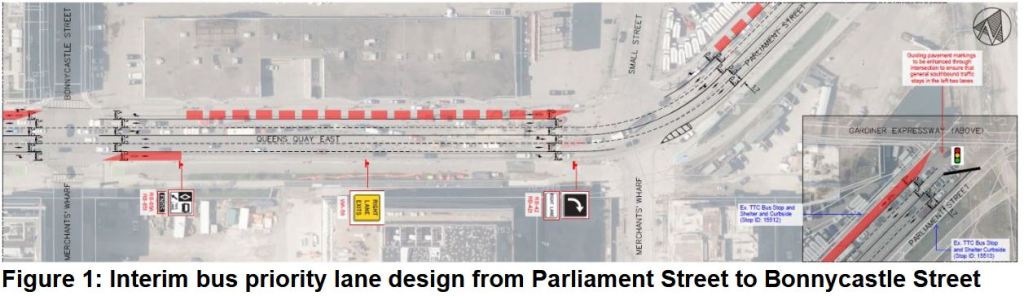
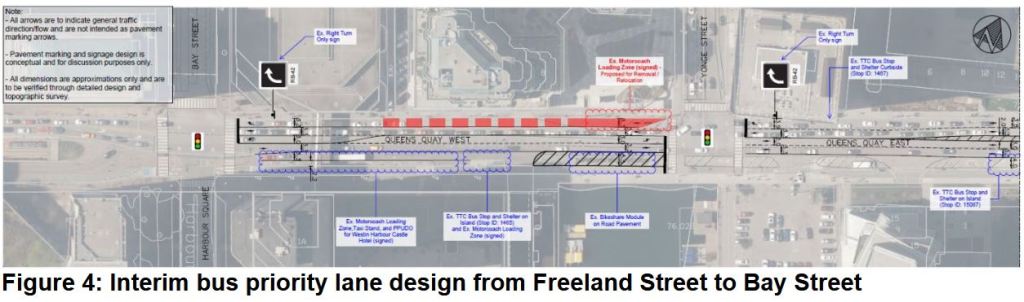
In the long wait for any kind of transit improvement for the eastern waterfront, the City of Toronto and TTC now plan to install reserved bus lanes on Queens Quay between Bay and Parliament Streets. A short stretch is also proposed for Front Street between Bay and Yonge Streets eastbound.

The proposal would add red lanes:

  • eastbound on Queens Quay from Jarvis to Parliament,
  • westbound on Queens Quay from Parliament to Bay, and
  • eastbound on Front from Bay to Yonge.

The Martin Goodman Trail (cycling) will not be affected. A new westbound right turn lane will be added on Queens Quay at Jarvis. Parking spaces will be removed on Front east of Bay Street.

Updated Feb. 18, 2025: Maps of the proposed changes to Queens Quay and to Front Street are included in the TTC report.

There is more reservation westbound on Queens Quay than eastbound, and that is the direction with the worst congestion problems. The south side offers less space for creation of a bus lane, and in some cases there might be lane narrowing to free up space for the north side.

The reserved lane westbound is generally in the curb lane, but between Sherbourne and Jarvis it will be the second from the curb. The curb lane will be dedicated to right turns given the high demand for this at Jarvis. With this change, the westbound stop at Richardson Street will be removed. The lane disappears between Cooper and Yonge Streets due to space constraints, but reappears west of Yonge in an area now used for Motorcoach loading.

On Front Street, although this is a “red lane”, the intent is for storage of up to five buses, not for speedy travel. Moreover, the bus stop will be shifted further east adding to the walking distance for riders to Union Station.

The accessible loading zone will shift west behind the bus layby. The layby area is now occupied by ten parking spaces which will be removed. This area will be shared by 114 Queens Quay, 19 Bay and 202 Cherry Beach.

For further details on the proposal, please see the TTC Report at pp 12-15.

[End of Feb. 18 update]

The area is now served, albeit infrequently, by a mix of routes that can often be snarled in traffic. The intent is to save up to five minutes travel time between Bay and Parliament. The reserved lanes will also host future improved service to developments on the eastern waterfront pending construction of the planned, but long-delayed Waterfront East LRT.

  • In May 2024, 114 Queens Quay replaced the southern end of 19 Bay which now terminates at Front Street. From a loop via Front, Yonge, Wellington and Bay it runs south on Bay then east on Queens Quay into the Port Lands. The 114 operates every 10 minutes in peak periods, 12-15 minutes at other times. This is the primary route serving waterfront developments.
  • 202 Cherry Beach (summer months only) runs from the same downtown loop as the 119 and follows its route as far as Parliament where it shifts north to serve the Distillery District. The 202 then turns south via Cherry Street to a loop at Cherry Beach. In summer 2024, this route operated every 20-30 minutes with no service in the AM peak.
  • 75 Sherbourne has a south end loop via Sherbourne, Queens Quay, Jarvis and The Esplanade. It operates every 6-8 minutes during weekday daytime, and 20 minutes or more during most other periods.
  • 65 Parliament loops at the George Brown Campus on Queens Quay. (This loop was the former eastern terminus of 19 Bay). It operates every 8-9 minutes during peak periods, 13-15 minutes at other times. Overnight service is provided every half hour by 365 Parliament.

The service between Union Station and the waterfront on 114 Queens Quay is not on a par with other routes that have dedicated lanes, and real improvement in accessibility of the waterfront will only come with much better service and eventually the LRT link via the Bay Street tunnel. A recommendation and decision on staging of the LRT should come to Council and the TTC later in 2025, but the project is not funded.

Public consultation will be held via a survey that is active until Thursday, February 20, and via three sessions:

  • Tuesday, February 18, 2025, 7:00 – 8:30 p.m. This session was held via webex.
  • Wednesday, February 19, 2025 at the George Brown Waterfront Campus:
    • 3 – 5 p.m. A pop-up event will occur in the main lobby.
    • 7:00 – 8:30 p.m. An in person session in the 2nd floor main auditorium, room 237.

This page will be updated when more information is available.

TTC Board Meeting: July 17, 2024

The July 17 Board meeting was extraordinarily long thanks to three in camera items, plus extended discussions of the CEO’s Report and of use of buses as homeless shelters during the winter.

The confidential session dealt with:

  • A collective bargaining update for two small groups of customer service and operations supervisor employees.
  • An update on advice from External Counsel. On a recorded vote, this was adopted with all Board members except Councillor Saxe in favour. As of the publication of this article (July 28), there have been no leaks about the subject of this report.
  • An update on the fare modernization program including the status of the Presto contract. The report was also discussed briefly in the public session later in the meeting.

The public meeting included:

  • The July 16 storm, flooding and hardening of infrastructure against climate change.
  • New subway trains and federal funding announced earlier the same day (July 17).
  • Prioritization of State of Good Repair projects. This item received scant attention although the report contains much interesting background on capital plans.
  • Safety on the TTC.
  • Use of shelter buses.
  • Transit network expansion update.
  • Fare Compliance Action Plan: See the updated version of my previous article on this report which includes the debate at the Board meeting.

Not discussed was the issue of hydraulic fluid leaks from subway work cars of which one quarter are still out of service. A report is supposed to be coming to the Board soon. It is not clear how much this situation is affecting the TTC’s ability to stay on top of track maintenance issues and the growing list of slow orders for track that cannot be safely operated at full speed.

Continue reading

Waterfront East Update: October 2023

Work on the Waterfront East LRT crept forward with the approval by Toronto’s Executive Committee of funding to continue design work, and of a tentative project plan. This must be endorsed by Council at its meeting of November 8-10, 2023.

For the previous update on this project, please see my April 2023 article.

Updated: Shortly after this article was published, the City of Toronto replied to questions I had posed about their report. The replies are integrated with the text of the article.

A combination of several factors push the completion date of this project, assuming that it receives full funding from provincial and/or federal sources, out into the 2030s. There is a danger that a so-called transit first community will actually see much of its redevelopment occur before adequate transit is in place to support it. Conversely, absent the transit service, some planned projects may simply sit as empty lots because they are not viable without it.

The current round of reports includes:

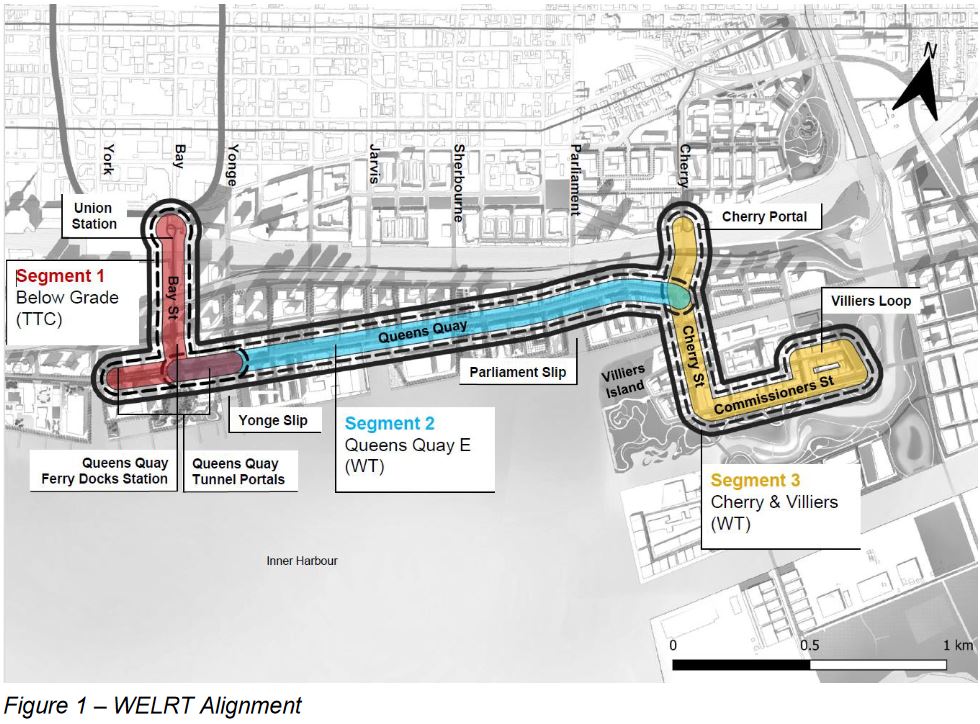
The WELRT has been divided into three segments.

  • Segment 1 (red) contains the Bay Street tunnel and the portals at Queens Quay where streetcars will surface. The existing west portal will be renovated and the new east portal added. Plans for decorative canopies have been dropped from the plan as a cost saving measure. This segment is under the TTC’s control for design and construction.
  • Segment 2 (blue) consists of the surface running on Queens Quay East to a revised intersection at Cherry Street which is realigned to the west. This segment primarily involved the reconfiguration of Queens Quay East similar to what already exists on Queens Quay West. (For details please refer to previous articles.)
  • Segment 3 (yellow) includes the southerly extension of trackage from Distillery Loop under the GO corridor, along a realigned Cherry Street, and east on Commissioners St to Villiers Loop (which is actually an around-the-block terminus, not an off street loop).

There are impediments to the work on segments 1 and 3 that dictate the timing of various works. The many delays in actually launching the WELRT project put other works in the same area in conflict that might otherwise be avoided notably the Ontario Line and the Gardiner/DVP realignment. The Bay Street tunnel has become more complex due to updated fire codes and the need to serve many more passengers than the Union Station Loop does today. Still outstanding is the redesign and expansion of Queens Quay Station and a link to the Island Ferry Docks which has been dropped from the project, as of the last update in April 2023.

The recommendations approved by Executive Committee are that:

  1. Council approve the alignment shown in the report.
  2. Council approve advancing design for the entire project, except segment 1 (underground), to 60%.
  3. Council approve
    • completion of environmental approvals,
    • undertaking of a traffic management plan to address interfacing the WELRT an other projects’ construction, and
    • design and coordination of the scope for the WELRT at the Cherry Lake Shore realignment, the Inner Harbour Tunnel at Jarvis, and the Hydro One relocation project at Cherry Portal.
  4. Council authorize an increase to the Transit Expansion Division’s Capital plan of $63.6 million in 2024-2026.
  5. Council direct the Executive Director of the Transit Expansion Division to report back at some point, unspecified, in 2024 with an update.

The estimated cost of the full project is $2.57 billion over a ten-year period assuming that full funding comes in Q1 2024, and the design work proposed in this report starts immediately. Any delay is a notable concern in an era when construction material and labour costs are rising quickly. It is not clear whether the figure cited is in current 2023 dollars, or includes inflation to the point the money is actually spent. I await clarification on this from the City.

Updated: The City of Toronto advises that:

The City is using as-spent dollars with future escalation included to the anticipated year of the expenditure. The cost estimate relies upon timely funding to meet the implementation schedule which is used as the basis for these inflation numbers.

Email from City of Toronto Media Relations, Nov. 2/23

The reason that the underground segment is excluded from approved design in recommendation 2 above is that this segment is proposed to be executed with a design-build contract where the detailed design will be undertaken by a contractor who is familiar with work in an underground environment.

Updated: This also keeps the design cost off of the City’s expenses for the moment. The City of Toronto advises that:

As noted in the staff report, staff are not recommending advancing the design of Segment 1 to 60% due to the City’s current financial pressures.

Email from City of Toronto Media Relations, Nov. 2/23

The project is subdivided into three parts:

  1. Union Station Loop, $932 million.
  2. Remainder of project except Cherry North, $1.3 billion. Includes East and West portals on Queens Quay, Queens Quay Station, Yonge Slip infill, Queens Quay East track from Bay to Cherry, Cherry Street south, Commissioners Street and Villiers Loop.
  3. Cherry North connection to Distillery District, $337 million, to be completed as a separate future phase.

The scope of work planned at Queens Quay Station is unclear because at the last update, much of this work had been dropped (platform expansion, link to adjacent building, link to ferry docks). I have asked the City for clarification of this.

Updated: The City of Toronto advises that:

The current scope for Queens Quay Ferry Docks Station is related to the station access upgrades (upgrade of the west entrance to improve accessibility) and it is part of the Segment 1 scope.

Email from City of Toronto Media Relations, Nov. 2/23

For the benefit of latecomers to the Waterfront East project, I have included a history at the end of the article. The idea goes back at least to the 2003 Central Waterfront Plan, and has languished without strong political support ever since the Ford era when all focus shifted to subways.

The greatest challenge was and remains that waterfront transit is not “important enough” to many on Council and lacked key leadership from the Mayor’s office through the John Tory era. Under Mayor Chow, it will compete with many other projects for priority and funding both for transit and in the wider context of City projects.

Three decades after the Central Waterfront Plan and a 2011 target opening date, we might still not have good service to our “transit first” neighbourhood by 2032.

Continue reading

Waterfront East LRT Update: April 2023

The City of Toronto, Waterfront Toronto and the TTC held an online open house on April 5 to present the current status of the Waterfront East LRT project.

The presentation video and slide deck are be available on the project website. All illustrations here are taken from that deck.

Updated April 9 at 8:15 am: There is also a FAQ addressing many questions about this project.

Because this session fell on the first day of Passover, there will be a second Q&A session on April 11, 2023.

There is an online survey available to provide feedback on the project. Please note that although members of the project team almost certainly read this blog, comments left here will not be part of the formal record and might be missed by the team. Do not treat the comments section here as an alternative to using the survey.

The WELRT project has taken an extraordinary amount of time to reach this point, and only part of that can be put down to the pandemic. Indeed the last public session was conducted in 2021. The biggest problem is that the waterfront is nobody’s top priority. Even former Mayor Tory, who talked a good line about waterfront development, did not push the project until quite recently, and his momentum, such as it might have been, has now vanished.

Recently, many on Council and in the wider community have worried that residential developments along Queens Quay East and on Villiers Island (the new island to be created as part of the Don River rerouting work now in progress) would all be for high-end buyers or investors, and would not address Toronto’s housing needs. With a move to increase planned densities in the eastern waterfront, there is an even stronger need for much better transit. The area is now served by the Bay, Sherbourne, Parliament and Pape buses, but service can be quite unpredictable.

For the record, the AM peak service planned for schedules coming into effect May 7, 2023, is:

  • every 20 minutes on 19 Bay,
  • every 7 minutes on 75 Sherbourne,
  • every 7 minutes on 65 Parliament, and
  • every 19 minutes on 72 Pape.

Each route serves a portion of the waterfront and, depending on your destination, not all of them might be useful. Notably the two which link to Union Station are infrequent and unreliable. This is hardly a “transit oriented” neighbourhood.

In spite of the poor transit service, the eastern waterfront is hardly at a standstill. Many condos as well as commercial and academic space have appeared, and much more is planned. How a projected 50,000 workers/students and 100,000 residents will get around for the next decade is a mystery.

This project has been underway for a very, very long time as the chart below shows.

The current study is subdivided into three segments, plus future extensions into the Port Lands east of the Don River (dotted blue lines below).

  • Segment 1 (red) includes the Bay Street tunnel and the portal area on Queens Quay.
  • Segment 2 (turquoise) runs from Bay Street to New Cherry Street (which will open later this year).
  • Segment three includes the link via Cherry from the Distillery District south to Commissioners Street and east to an around-the-block loop just west of the realigned river (yellow).
Continue reading

TTC Transit Network Expansion: February 2023 Update

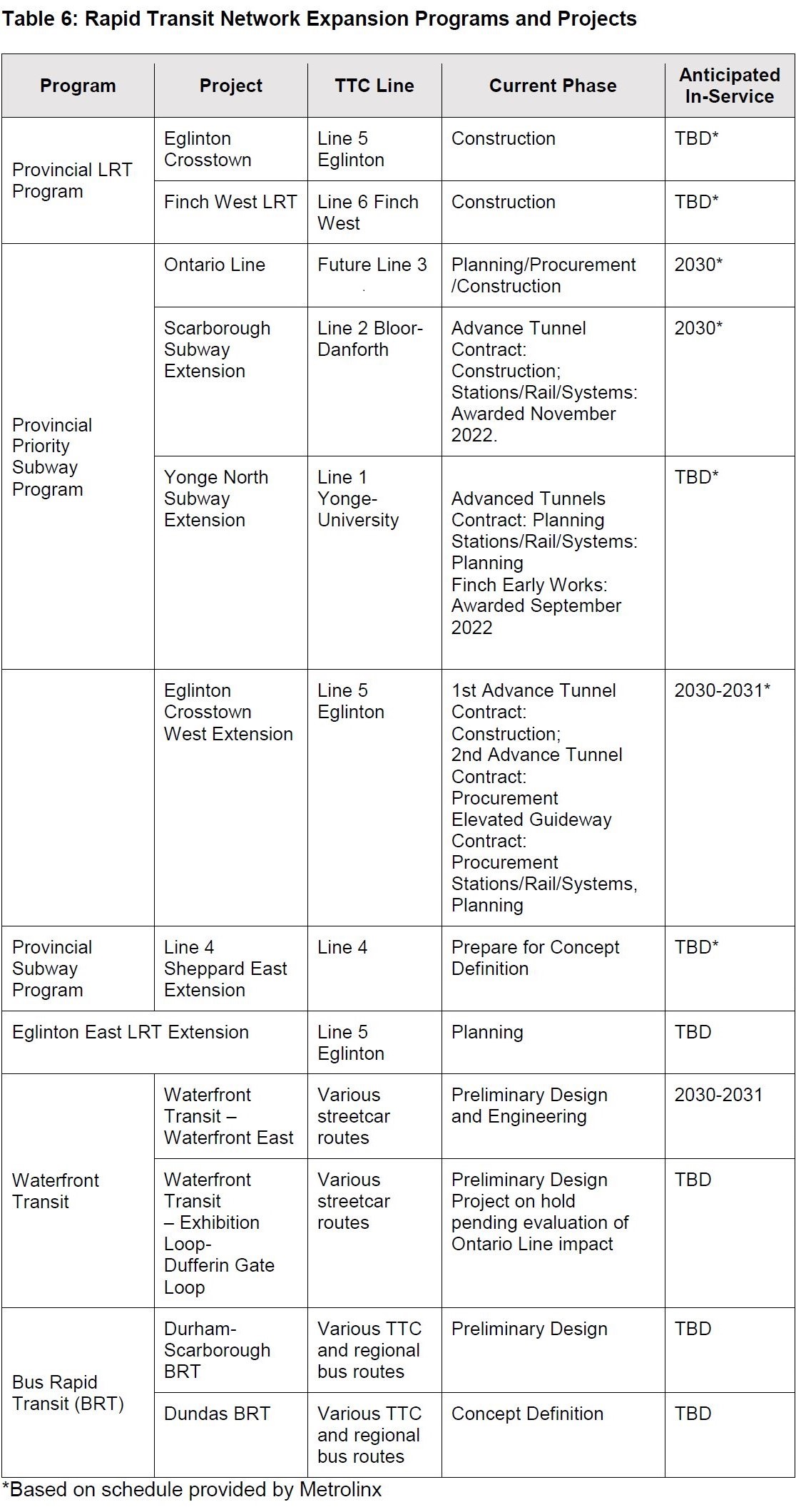
At its meeting on February 28, the TTC Board will receive a report summarizing the status of most of the rapid transit plans in Toronto. This article condenses the TTC report and reorders some sections to group related items together.

Dominant among many projects are, of course, the “big four” provincial projects: Ontario Line, Scarborough Subway, Yonge North Subway, and Eglinton West LRT extension.

Project Status Overview

The effect of major projects elbowing everything else aside is clear in the table below. Some projects do not have in service dates because they are not funded, and the timing of that (when and if it occurs) will determine when various lines can open.

Not shown in this table are several major projects that pop up from time to time:

  • Bloor-Yonge Station Expansion
  • Waterfront West LRT from Dufferin to The Queensway
  • Bloor West subway extension
  • New Line 2 fleet and yard at Kipling (Obico yard property)
  • Sheppard East subway extension
  • Platform Edge Doors

Of these, only the Bloor-Yonge project has funding, and some are only a glimmer in various politicians’ eyes.

Continue reading

Toronto’s Board of Trade Contemplates Transportation

Prologue: When I started to write this story, John Tory was still Mayor of Toronto and the dynamics of City-Province relations assumed he was in charge. The context for these discussions was soon to change.

The Toronto Region Board of Trade holds a yearly “transportation summit”, and on February 8, 2023, this focused on the Greater Toronto Area’s transit, plans for the future, and the aftermath of the covid pandemic.

The TRBoT is no wild-eyed radical institution. The regional economy and businesses are at the heart of causes it advocates.

Both in the introductory remarks and in comments by speakers sprinkled through the day, the economic effect of traffic congestion was a mantra. This sets the framework for the importance of both transit and road projects, depending on who is speaking. The latest factoid describing Toronto’s problems is that we have the third worst congestion in North America and the seventh worst in the world.

CBC: Toronto ranks 3rd most congested city in North America. Here are the city’s worst traffic spots

A problem with this hand-wringing is that there is little acknowledgement that some particularly bad locations are related to major infrastructure projects such as the Gardiner Expressway rebuild and various rapid transit lines. Moreover, goods movement has severe problems in areas that historically have poor transit and show little chance of seeing any in the near future. No single project will solve the problem of many-to-many trips patterns that now depend almost totally on roads and private vehicles.

Continue reading

Waterfront East LRT Villiers Island Loop Proposal

Design of the Waterfront East LRT is still underway by Waterfront Toronto and the TTC. Whether this project will be funded in the near future and built remains to be seen, but one issue is now settled, pending public feedback and formal approval.

The question has always been “where will the line end”, at least in the interim configuration before the full buildout of trackage in the Port Lands.

Here is an overview map of the area. Note that it shows the configuration the rerouted Don River, and the new alignments of Cherry Street and of Queens Quay.

  • Starting at Union Station, the segment in red south and east along Queens Quay to the portal west of Yonge is a TTC design task that is now underway.
  • The blue segment along Queens Quay east to Cherry is a Waterfront Toronto design project. Note that it crosses a partly filled Parliament Slip (purple) rather than dodging north to Lake Shore Boulevard as Queens Quay does today.
  • The yellow segment is on New Cherry Street and Commissioners Street. It will include an extension of the streetcar network south from Distillery Loop and east via Commissioners Street. For those who are familiar with the area, New Cherry and the transit right-of-way will cross the Keating Channel on two new bridges (the red ones for those who know them).
  • Various extensions (dotted black lines) are proposed:
    • South via Cherry to Polson Street. This will take the line over the new Don River and will require twinning the existing yellow bridge where New Cherry makes the transition into Old Cherry as it crosses the new Don River.
    • East via Commissioners to Leslie Barns making a second connection to this major TTC site and a possible service through the eastern Port Lands. This will require twinning the double-span orange bridge which will carry Commissioners Street over the new Don River.
    • North via an extended Broadview Avenue to connect with GO and the Ontario Line at East Harbour Station and thence north to Queen Street.
Continue reading

A Walk On New Cherry Street

Out of sight of most in Toronto, the mouth of the Don River has been transformed by Waterfront Toronto with earth moving and landscaping on a scale rarely seen in these parts. The work will shift the Don River’s course and provide floodproofing for a large area to be developed under the name “Villiers Island” after a street in the northern edge of the district.

Cherry Street will shift to the west the equivalent of a short city block, and the New Cherry will eventually have a branch of the Waterfront East streetcar service if the City ever gets around to financing and building it.

Three new bridges were built in Nova Scotia by Cherubini Metal Works. Waterfront Toronto has an article about the design process and, of course, many articles and photos of the overall project. The map below shows the positioning of the three bridges.

The bridges share a common design, but each is unique in its own way.

  • The Cherry Street North bridges, one for road traffic and one for transit, will connect the New Cherry Street across the Keating Channel to a reconfigured Cherry and Queens Quay intersection. Eventually, there will be streetcars on a realigned Queens Quay East as well as south from Distillery Loop connecting to New Cherry. These bridges are red.
  • The Cherry Street South Bridge is a road bridge over the future river connecting New Cherry to the existing road at Polson Street. This bridge is yellow. Depending on the route taken by the new streetcar service, there could be a loop somewhere north of the Ship Channel. If so, the Cherry South bridge will gain a transit twin like the north bridge.
  • The Commissioners Street bridge carries Commissioners Street over the future path of the river. Because of its length, it is a double span. This bridge is orange. Like the Cherry South bridge, it could gain a twin set of spans for transit if trackage is ever extended east from New Cherry either to an extended Broadview Avenue or further east to Leslie Barns at Commissioners & Leslie.

The new river is not yet flooded and so there is water in the old Polson Slip west of the Cherry South Bridge, but the riverbed east and north of there is completely dry as work to prepare it continues.

Continue reading