Waterfront LRT Update, June 2022

This is the second article in a series of transit project updates. See also:

Toronto’s Executive Committee will consider reports updating the status of various projects at its meeting of June 8, 2022 including:

The section of this report covering the Waterfront projects is a tad on the threadbare side compared to previous iterations such as the presentation almost a year ago. With luck there will be more detail in presentation materials at the meeting.

The report text implies that there have been design changes but does not go into details. One might hope for additional information when staff presents the report.
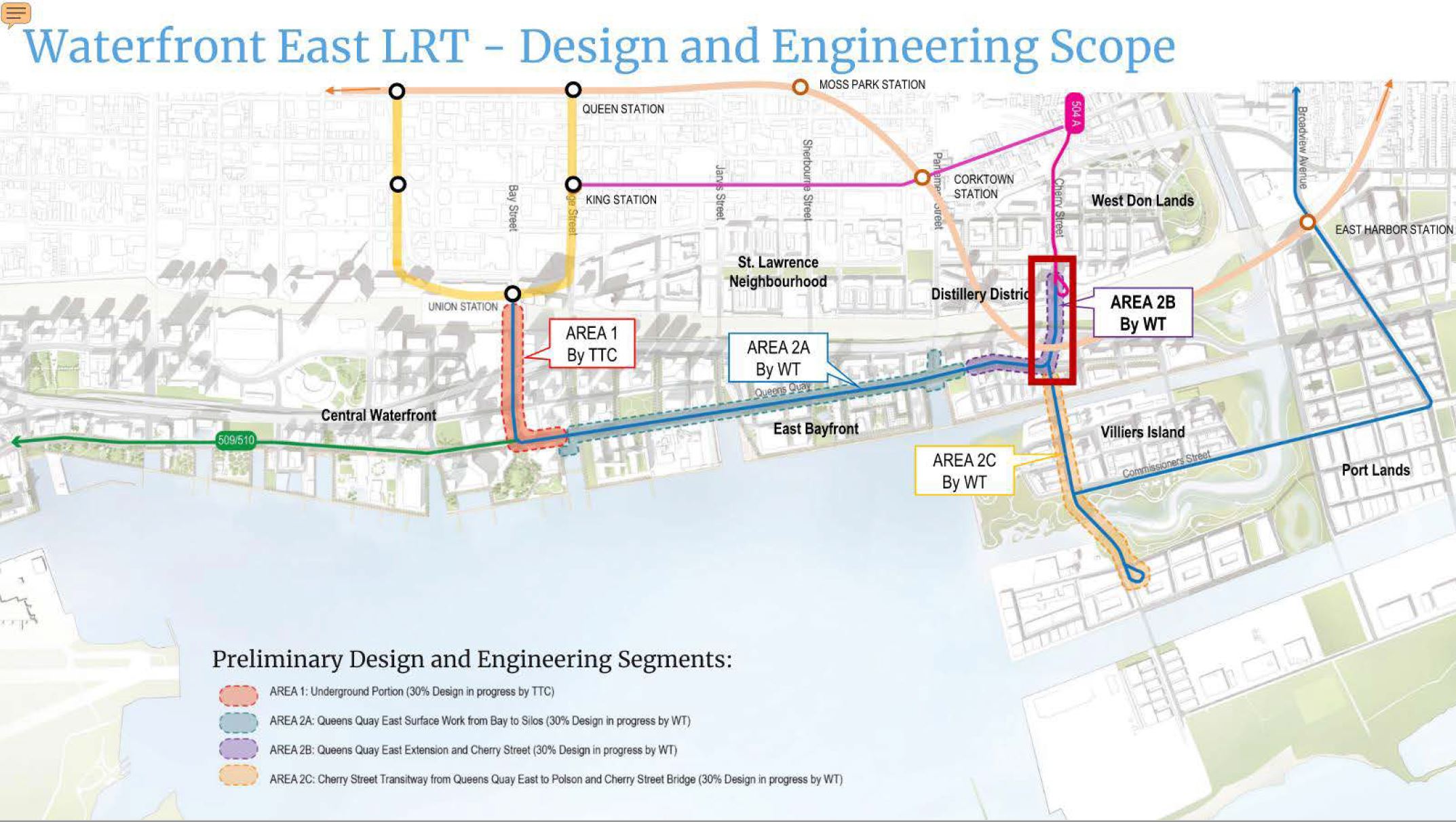
Cherry Street

At the eastern end, the Waterfront line is projected to end on Cherry somewhere on Villiers Island. It is not clear whether the southern terminus of the WELRT on Cherry will be north or south of the new river. Some reports and drawings talk of the line going south of Villiers Island to the ship channel, but the current report talks of a new loop within Villiers Island itself (i.e. north of the new river). Note that the map above includes an arrow showing a potential extension south over the new river as well as east on Commissioners.

Wherever the new loop is, it will replace the existing Distillery Loop which conflicts with the new alignment for the streetcar tracks and underpass at the GO corridor. The old Cherry Street signal tower, a remnant of the days when the rail corridor was operated with manual switchgear, will be shifted east from its current location south of Distillery Loop to accommodate the new tracks.

For those unfamiliar with the area, Cherry Street will have three water crossings. From north to south on the map above:

  1. At the Keating Channel, a pair of new bridges (one for road traffic, one for LRT) are located west of the existing Cherry Street crossing. The LRT bridge is in place, and the road bridge immediately to the west will soon follow.
  2. The new outlet of the Don River is under construction, but still dry. If the WELRT goes south to the ship channel, there will have to be an LRT span here just as at the Keating Channel. The road bridge is in place waiting for New Cherry Street to be completed to connect with it.
  3. At the Ship Channel, Cherry Street will veer east back to its current alignment and use the existing bascule bridge. There is no intention for the LRT line to cross this channel.

A two-span bridge takes Commissioners Street over the future Don River (outside of the map above). Today, there is only a road span in place, high and dry over the new riverbed. When and if the Broadview streetcar extension to Commissioners is built along with an east-west link from Cherry to Broadview (and maybe beyond to Leslie Barns), then a transit bridge will be added.

There is a video on Waterfront Toronto’s media site with a May 2022 flyover of the project.

The new alignment for Cherry Street is now under construction.

Cost Containment

The currently projected cost for the WELRT is over $2-billion 2021$. Various design options for both the underground and surface portion of the line are under review, but there are few details of this work in the report.

A value engineering exercise is underway by the TTC which includes consideration of scope refinements, such as a refined 4-platform solution at Union Station and some improvements to the Ferry Terminal Station at Queens Quay. [p. 14]

Queens Quay East

There are still plans to fill part of the Yonge Street slip, and the report mentions a future park east of the skip. However, it is silent on the scheme to reorient the entrance of the Harbour Castle hotel to face east toward the slip.

Parliament Slip will also be partly filled and this will allow the WELRT to continue straight east on the new alignment of Queens Quay to reach New Cherry Street. This is intended to become a major destination in the eastern harbour.

Construction Phasing and Co-ordination

The WELRT be built in an area that already is a major construction site for projects including the Ontario Line, the GO corridor expansion, and the realignment of the Gardiner/DVP connection.

Still outstanding is the question of building and opening the new streetcar route across Queens Quay first so that it can operate independently of the Bay Street tunnel and the planned extended closure for reconstruction at Union and Queens Quay Stations.

The Next Round

A Stakeholders’ meeting is planned for June 20, and these usually precede a wider public consultation round. There are many questions to be answered about just which options are now on the table.

The next major report by the project will be to the new Council in the second quarter of 2023 as part of a wider review of Waterfront revitalization. By that time, design work will be at the 30% level for whatever option staff will recommend.

One obvious challenge for this and many other projects is that funding to build them is not in place, and they will compete with other priorities for attention.
Eglinton East LRT Update, June 2022 (Revised)

Revised June 9, 2022: A section has been added at the end of the article based on the discussion at the Executive Committee meeting.

Two reports are on Toronto’s Executive Committee Agenda for June 8, 2022. Between them, they provide updates for various rapid transit projects around the city.

Rather than attempting a single, omnibus article covering all of the projects, I will break the review apart on a line-by-line basis. This is the first in a series of articles.

I will update this article if any further details come out in the Executive Committee meeting.

A Scarborough Network

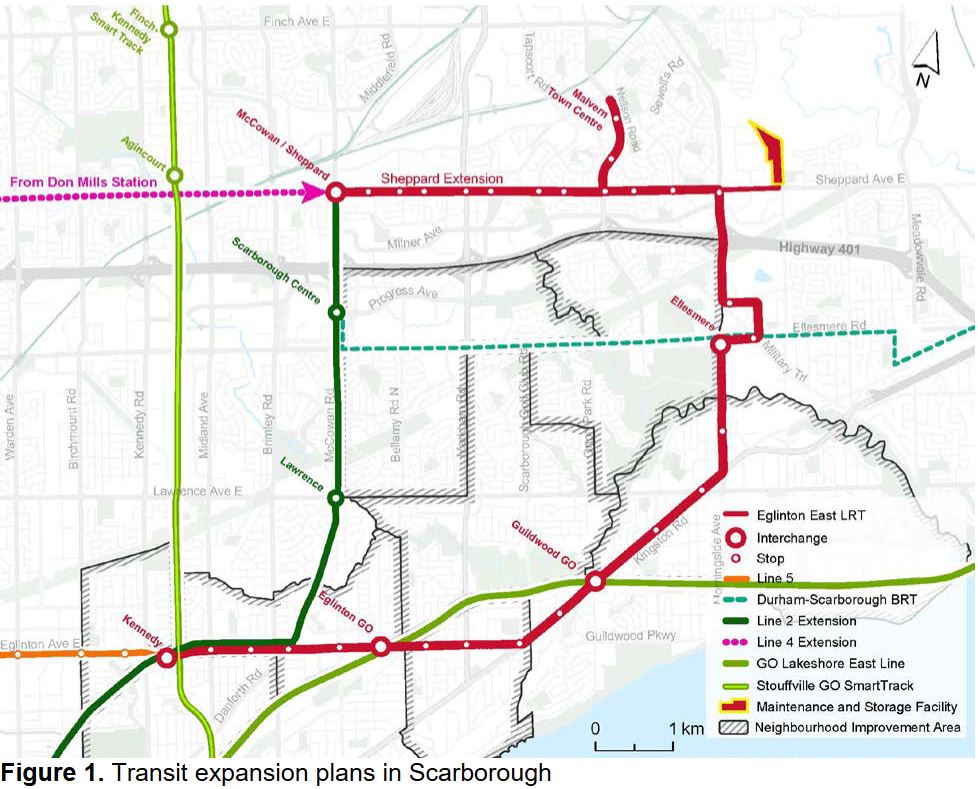
Several projects over coming decades will change the transit map in Scarborough including the Line 2 Danforth Subway extension to Sheppard, the Line 4 Sheppard Subway extension to McCowan, the Durham-Scarborough BRT, GO service expansion on the Lakeshore East and Stouffville corridors, and the Eglinton East LRT.

Continue reading

The Cost of Running Line 5 Crosstown

At its meeting on April 14, 2022, the TTC Board will consider a report about the arrangements with Metrolinx for operation of Line 5 Crosstown. This line, at least from a budgetary standpoint, is expected to open late in 2022.

There is a long agreement between Toronto and Metrolinx about how the costs are shared and who does what, and a much longer Project Agreement between the province and Crosslinx, the private consortium that built and is responsible for maintenance of the infrastructure and equipment.

Within the TTC report, these two documents are referred to as the “TOFA” and the “PA”.

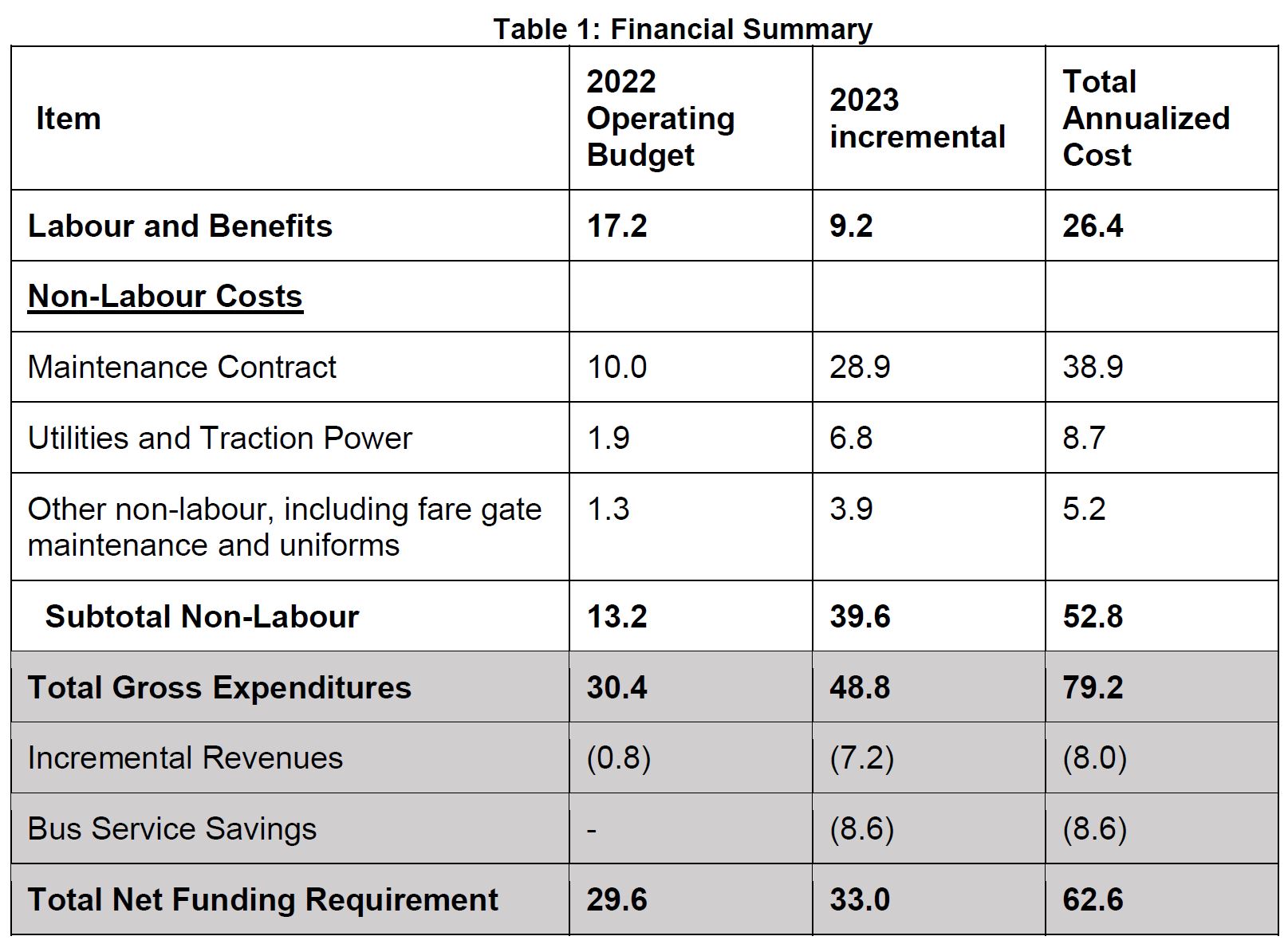
Even with Toronto keeping any revenue the line generates, the net result will be an increase in the TTC’s costs. On an annualized basis, the net new cost to Toronto is $62.6 million annually. This is not surprising, but a fascinating point about this table is that the maintenance contract and other non-labour costs total $52.8 million while the labour and benefits for TTC staff (station, on-train, supervision) amounts to only $26.4 million.

This illustrates the substantial cost of owning and maintaining infrastructure as opposed to running the trains.

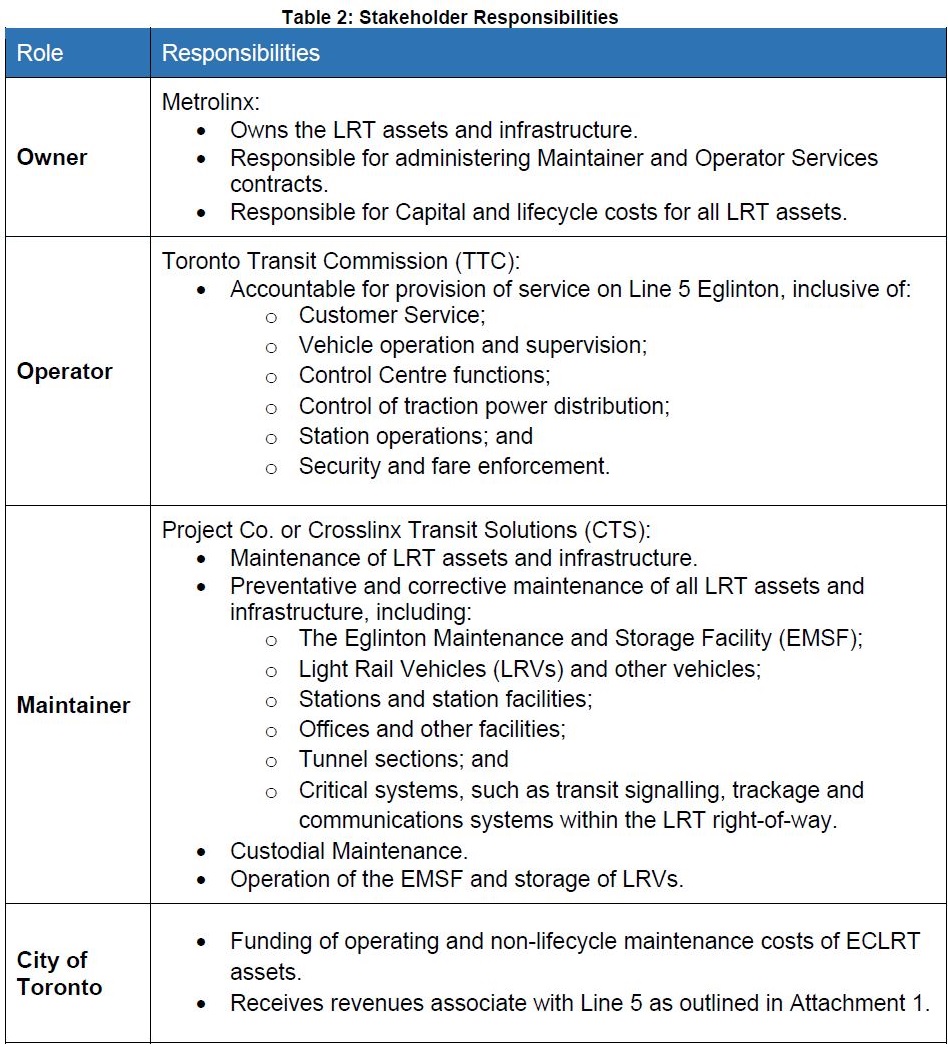
Responsibility for aspects of the route are divided among the parties as shown below.

Continue reading

A New Vision for Cherry Street

Last June, I posted a long article about plans for the Waterfront East LRT and the designs as they were then proposed. See Waterfront East LRT: June 2021 Update.

Although the next full project update will not come to Toronto’s Executive Committee until the end of March 2022, a revised proposal for the treatment of Cherry Street was presented to Waterfront Toronto’s Design Review Panel on February 23. I have only included a selection of illustrations from the presentation deck in this article, and I recommend that interested readers browse the full set.

As described in the June 2021 update, the link from the existing Cherry Street trackage under the rail corridor to New Cherry Street will be made through a new tunnel through the rail berm east of the existing Cherry Street underpass. However, the original plans for the area involved a small forest of, yes, cherry trees and this has proved impractical. The water table is very high and the underpass is a low point in the surrounding terrain. Any high water event would flood the area.

The new design starts from the premise that the water should be controlled and included as part of the landscape with a marsh around the new transit corridor as the proposed solution.

The illustration above shows the area where Distillery Loop is today. The Cherry Street signal tower is a landmark that, in the proposed alignment, would be shifted east. An alternative scheme leaves the tower where it is and the streetcar tracks swing east around it.

To put this in a wider context, here is a map of the overall waterfront area showing various projects. Only the area outlined in red is the subject of the current report.

Continue reading

Infrastructure Ontario January 2022 Update

Infrastructure Ontario has issued its quarterly update of projects that are in the planning and procurement stages. This affects several parts of the Ontario government, but my focus here is on transit projects.

The spreadsheet linked below tracks the past and current updates to show how the projects have evolved. There are two sections: one for active projects and one for projects with no currently reported info (typically for projects that are now in construction or completed, or that have been withdrawn).

Where a cell is coloured yellow, there is a change from the October 2021 report. Several cells are coloured light yellow. There is new text, but the only real change is to say “Jan-Mar” instead of “Winter”, and similarly for other seasons. This eliminates a point of confusion in past reports.

The substantial changes in this round are:

  • The Ontario Line North Civil, Tunnels and Stations contract dates have slipped by one quarter, and the contract type has changed from DBF (Design, Build, Finance) to TBD (To Be Determined). This covers the OL infrastructure work from East Harbour to Science Centre Station.
  • The Yonge North subway extension has been split into two projects: one for the tunnel and the other for the stations, rail and systems. The projected dates for the tunnel contract are unchanged, but for the stations project they are TBD.
  • A new line has been added for the Eglinton West LRT tunnel between Jane and Mount Dennis.
  • All of the GO expansion projects have slipped into 2022 for contract execution, but with dates early in the year. This implies an imminent flurry of announcements just in time for the coming election. These projects are running a few years behind their originally planned dates.
  • The contract type for the GO OnCorr project which includes future operation and maintenance of the system has changed from DBOM (Design, Build, Operate, Maintain) to “Progressive DBOM” which appears to provide earlier design input from prospective builders as well as a better (from the bidders’ point of view) allocation of risk between Metrolinx and the P3.
  • The Milton GO Station project has not been updated since October 2021. It is possible that this work is paused pending a resolution of issues between Metrolinx and CPR about all-day operation on this line.

TTC 2022 Capital Budget

The TTC’s 2022 Capital Budget report has been published as part of the December 20, 2021 TTC Board meeting agenda. This includes three components:

  • A 15-year capital investment plan giving an outlook on all projects, funded or otherwise, to 2036.
  • A 10-year capital budget for funded projects.
  • A real estate investment plan that ties property needs into capital planning. This is a new component in TTC capital planning.

For political reasons, the capital plans before 2019 were low-balled to stay within available funding, but this hid necessary projects that appeared as a surprise to the TTC Board and Council. One way this was done was to class them as “below the line” (not in the funded list), but more commonly to push their supposed delivery dates beyond the 10-year capital budget window. This made the City’s exposure to future spending appear lower than it was in fact.

A particularly bad case was the collection of projects and contracts for ATC implementation on Line 1. In order to “sell” this badly needed project politically, it was subdivided and some resulting contracts used mutually incompatible technology. The original chunk was simply a plan to replace the existing block signals used from Eglinton to Union and dating from the subway’s opening in 1954. One by one, other pieces were added, but the disorganization was such that ATC was actually an “add-on” to the Spadina extension because it had not been included in the base project.

The situation was further complicated by awards to multiple vendors with incompatible technologies on the premise that each piece could be tendered separately without regard for what was already underway. A major project reorganization during Andy Byford’s tenure as CEO untangled this situation, and provided a “lesson learned” for the Line 2 ATC project.

In 2019, the TTC changed tack and published a full list of its needs and extended the outlook five more years. This came as a huge shock to politicians and city management when the capital needs shot up from $9 billion to well over $30 billion.

Continue reading

TTC Major Projects Overview: September 2021

The agenda for the TTC Board’s meeting on September 15, 2021, contains three related reports about the status of capital projects:

Among the projects discussed are several that relate collectively to the Bloor-Danforth Modernization Project (Line 2) that was originally proposed when Andy Byford was CEO. It was always a report that was “coming soon” to the Board, but after Byford’s departure, references to it vanished without a trace. I will return to the collection of BD Modernization projects later in this article.

A major problem for decades with TTC capital planning was that many vital projects simply were not included in the project list, or were given dates so far in the future that they did not affect the 10-year spending projections. This produced the familiar “iceberg” in City capital planning where the bulk of needed work was invisible.

The problem with invisibility is that when debates about transit funding start, projects that are not flagged as important are not even on the table for discussion. New, high-profile projects like subway extensions appear to be “affordable”.

There is a danger that at some point governments will decide that the cupboard is bare, and spending on any new transit projects will have to wait for better financial times. This will be compounded by financing schemes, notably “public-private partnerships” where future operating costs are buried in overall project numbers. These costs will compete with subsidies for transit operations in general. Construction projects might be underway all over the city, but this activity could mask a future crisis.

Please, Sir, I Want Some More!

The current election campaign includes a call from Mayor Tory for added Federal transit funding including support for the Eglinton East and Waterfront East LRT lines, not to mention new vehicles of which the most important are a fleet for Line 2.

The Waterfront East project has bumbled along for years, and is now actually close to the point where Council will be presented with a preferred option and asked to fund more detailed design quite soon. This is an area that was going to be “Transit First”, although visitors might be forgiven for mistaking the 72 Pape bus as the kind of transit condo builders had in mind as they redeveloped lands from Yonge east to Parliament. Some developers have complained about the lack of transit, and the further east one goes, the greater a problem this becomes.

The Eglinton East extension to UTSC was part of a Scarborough transit plan that saw Council endorse a Line 2 extension with the clear understanding that money was available for the LRT line too. Generously speaking, that was wishful thinking at the time, and Eglinton East languishes as an unfunded project.

For many years, the TTC has know it would need a new fleet for Line 2 BD. The T1 trains on that line were delivered between 1995 and 2001, and their 30-year design lifespan will soon end. As of the 2021 version of the 15 year capital plan, the replacement trains were an “unfunded” project, and the project timetable stretched into the mid 2030s.

City budget pressures were accommodated a few years ago by deleting the T1 replacement project from capital plans. Instead the TTC proposed rebuilding these cars for an additional decade of service. This would stave off spending both on a new fleet and on a new carhouse, at the cost of assuming the trains would actually last that long. The TTC has found out the hard way just what the effect of keeping vehicles past their proper lifetime might be, and that is not a fate Toronto can afford on one of the two major subway lines. The T1 replacement project is back in the list, but there is no money to pay for it.

Finally, a signature John Tory project is SmartTrack which has dwindled to a handful of GO stations, some of which Metrolinx should be paying for, not the City (East Harbour is a prime example). If we did not have to keep the fiction of SmartTrack alive, money could have gone to other more pressing transit needs.

When politicians cry to the feds that they need more money, they should first contemplate the spending room they gave up by ignoring parts of the network and by putting most if not all of their financial nest-egg into politically driven works. It does not really matter if Ontario has taken over responsibility for projects like the Scarborough Subway because one way or another the federal contribution will not be available to fund other Toronto priorities. The same is true of the Eglinton West LRT subway.

Any national party could reasonably say “we already helped to pay for the projects you, Toronto, said were your priorities”, but now you want more? A related issue for any federal government is that funding schemes must be fitted to a national scale, and other cities might reasonably complain if Toronto gets special treatment.

A Long Project List

  • Bloor-Yonge Capacity Improvements
  • Line 5
    • Eglinton Crosstown LRT
    • Eglinton Crosstown West Extension
    • Eglinton Crosstown East East Extension
  • Line 6 Finch LRT
  • Line 1 Extension to Richmond Hill
  • Line 2 Extension to Sheppard/McCowan
  • Line 3 Ontario
  • Waterfront Transit Network
    • East LRT and station expansions
    • West LRT from Exhibition to Dufferin
  • BRT Projects
    • Durham-Scarborough
    • Dundas West
  • Line 4 Sheppard Extension
  • Transit Control Integration
  • Subway Fleet Replacement (T1) and Expansion
  • Fleet Storage
  • Automatic Train Control
  • Platform Doors
  • Easier Access Plan
  • Purchase of New Buses and Electrification
Continue reading

Have Your Say on the TTC’s Plan for Lawrence and Leslie Bus Services

Updated Aug 21/21 at 5:00 am: Link to survey corrected.

Updated Aug 22/21 at 12:05 pm: For some unknown technical reason, the survey closed sooner than it should have done. The TTC is working with their vendor to get this fixed.

Updated Aug 22/21 at 10:00 pm: The survey is available once again.

The TTC plans to restructure the 54 Lawrence East, 954 Lawrence East Express and 51 Leslie routes as part of the changes for introduction of Line 5 Crosstown late in 2022. They are conducting a survey of rider opinions on their proposals that is open until August 30.

Route 54 now operates between Eglinton Station and Orton Park / Starspray via Eglinton, Leslie and Lawrence. The proposed new route will begin at Science Centre Station (Don Mills & Eglinton) and will run north on Don Mills, then east on Lawrence. Note that there is a separate proposal as part of a Scarborough route reorganization to split off the Orton Park service as a separate route.

Route 954 now operates during peak periods express between Starspray Loop and Lawrence East Station. The proposed route will be extended to Science Centre Station over the same route as the local 54 Lawrence East service. There is no word on whether hours of service will be expanded beyond the peak period. Note also that after mid-2023 when the SRT shuts down, there will not be an RT service from Lawrence East Station to Kennedy Station, although plans are now underway in a separate study for reconfiguration of routes after the RT closes.

Route 51 Leslie now operates between Eglinton Station and Leslie/Steeles via Eglinton and Leslie. Route 56 Leaside now operates between Eglinton and Donlands Stations via Eglinton, Laird, Millwood and Donlands. The proposed route would combine 51 Leslie with 56 Leaside to provide one route from Donlands Station to Leslie/Steeles. (A peak period short turn would duplicate the existing Leaside via Brentcliffe service, and only about half of the 51 Leslie buses would run north of Eglinton.)

The combined effect of these changes would remove routes 51, 54 and 56 from Eglinton between Yonge Street and Don Mills (except for the short jog between Leslie and Laird by the combined 51 route). Only the 34 Eglinton bus would remain.

Also, service on Lawrence between Leslie and Don Mills would be provided only by the infrequent 162 Lawrence-Donway bus which does not directly serve the intersection at Don Mills.

For further info on the 2022 service plan, please see TTC 2022 Service Plan Consultation.

TTC 2022 Service Plan Consultation

Updated June 28, 2021 at 6:10 pm:

The TTC has filled in some of the details on 51 Leslie, 88 South Leaside and 354 Lawrence East Night. See the individual sections of this article for details.

The TTC has launched public consultations for its 2022 Service Plan. This will be a difficult year in which ridership is expected, at best, to climb back to 75 per cent of pre-pandemic levels. Budgets will be tight because the transit system plans to be operating close to 100 per cent of is former service (building up gradually on the buses for January 2022, then streetcars and finally the subway) even though fare revenue will be at a lower level. The TTC recognizes that it needs to provide good service to attract riders back to the system.

For the week of June 4-11, boardings on each of the TTC’s networks by vehicle type are still below 50 per cent of January 2020 values:

  • Bus: 40%
  • Streetcar: 27%
  • Subway: 23%
  • Overall: 31%

Trip occupancy for buses is generally below the target level.

  • 4% of trips are over 50% full
  • 0.6% of trips are over 70% full
  • 0.3% of trips are over 80% full

An important distinction about crowding measurements is that as ridership recovers, a the definition of a “full” bus will rise from 25 riders today, to 35 and then to the “standard” full load of 51. Service levels and crowding in 2022 will be measured and allocated against this shifting target. In the short term, service will be provided at a crowding level below pre-pandemic times.

Crowding levels reported now are all day, all route, all week values, and they hide problem areas in the system. The TTC still does not break out reports on crowding or service quality by route, location or time of day. Their “On Time Departure Report” has not been updated in several years, and although there is still a link to it from the Customer Service page, the link is dead.

The 2018 Customer Charter is still linked and it includes a commitment, carried forward from the 2013 Charter:

Posting the performance of all surface routes on our website so you know how your route is performing.

One might ask why Rick Leary, the man Andy Byford hired to improve service, is incapable of producing reports of service quality beyond the extremely superficial level found in his monthly CEO’s Report. The TTC have detailed crowding data and use them internally, but do not publish them. As for on time performance or headway reliability, I have written extensively about problems with service quality and these metrics. Even though service is the top of riders’ desires, it is not reported by the TTC probably because the numbers would be too embarrassing.

This is a gaping hole in TTC Service – the absence of meaningful reporting and measurement of service quality as experienced by riders.

Although the TTC plans to return to 100 per cent service, this does not mean that the service patterns will match those of early 2020. Demand patterns have changed both in daily patterns (peaks or their absence) and location (heavier demand to suburban jobs in sectors where work from home is impossible). To the extent that peaks are smaller or non-existent, this works in the TTC’s favour by allowing a higher ratio of service hours to driving hours (buses spend less time, proportionately, going to and from garages). This also, of course, spreads out demand and can reduce crowding.

A new phenomenon is the early morning peak caused by commutes to jobs outside the core. This produces crowding even on some Blue Night Routes, and the TTC is looking at how this can be resolved.

There is a page on the TTC’s site including a link to a survey about planned changes including some new and revised routes, as well as the plan for route restructuring to accompany the opening of Line 5 Eglinton Crosstown. Tentatively, that line is expected to begin running on July 31, 2022 according to the TTC, but that is simply a planning target, not a hard date.

In this article, I have grouped the planned changes geographically to pull together information on related routes rather than numerically as they appear on the TTC’s site. I have also included information on some changes planned for later in 2021 to put the proposed 2022 route structure in context.

There is a separate consultation process launching soon regarding the future service design for the period between the shutdown of Line 3 Scarborough RT in mid 2023 and the opening of the Line 2 Scarborough extension in fall 2030.

There are three major components in the 2022 plan:

  • Optimize the network to match capacity with demand.
  • Restructure the network for the opening of 5 Eglinton Crosstown.
  • Modify the network to respond to customer requests, evolving demand patterns and new developments.

All maps in this article are from the TTC’s website.

Continue reading

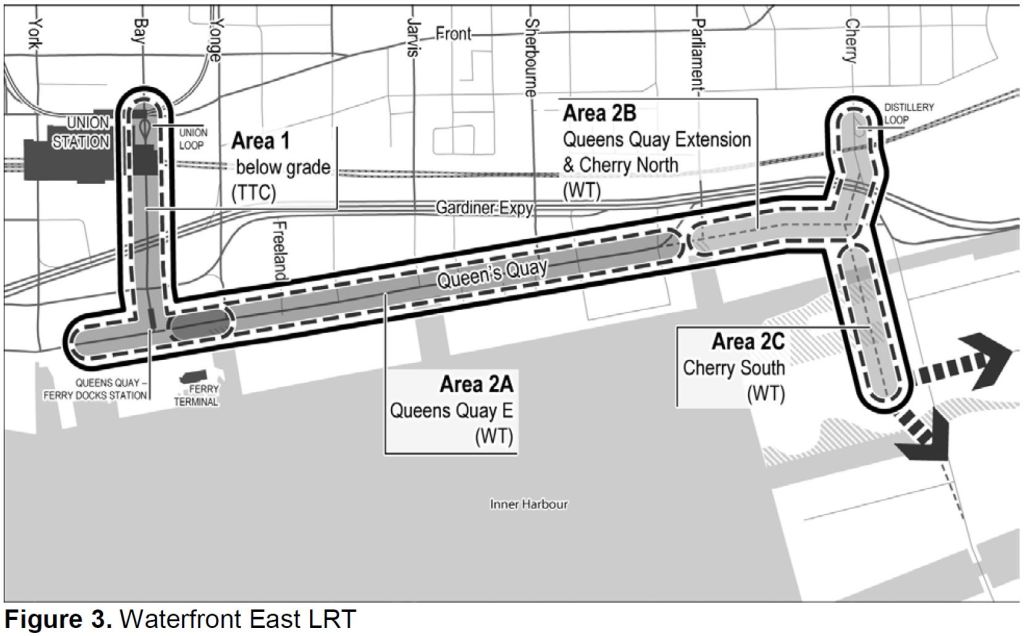
Waterfront East LRT: June 2021 Update

Various projects for transit in the waterfront are working their way through a Waterfront Reset process. On July 7, 2021, there will be an update to Toronto’s Executive Committee on the status of transit projects including the Waterfront East LRT. Staff hope to take an updated Business Case based on the preliminary design to Council in Fall 2021.

The City of Toronto, Waterfront Toronto and the TTC held an online update and consultation session for the Waterfront East project on June 21, 2021. This covered several points and included significant changes in scope and design.

  • The new Union Station Loop will be fully built in one stage rather than a half-now, half-later approach. The full capacity of the new loop will be required to serve development underway and planned in the waterfront.
  • The new Queens Quay Station will include connections (some provisional) to adjacent buildings and to a tunnel under Queens Quay to the Ferry Docks.
  • The eastern portal location will be west of Yonge Street in front of the Harbour Castle Hotel. The hotel’s entrance will be relocated to the eastern face of the building at a new entryway to be constructed by extending Yonge Street southwards over what is now the Yonge Street Slip.
  • The western portal will receive an architectural treatment that will echo the new east portal.
  • The work will be staged so that through streetcar service could operate to the eastern waterfront from existing trackage on Queens Quay West while the Bay Street tunnel is closed for reconstruction of the stations.
  • Queens Quay East will continue a street design similar to that on the portion west of Bay with modifications to better clarify the pedestrian and cycling areas.
  • As previously planned, the Parliament Slip will be partly filled to allow extension of Queens Quay directly east to meet a realigned Cherry Street. This design is no longer entangled with plans advanced by Sidewalk Labs.
  • The first phase of streetcar service will extend east to Cherry and south to a new loop at Polson Street.
  • There are four options for the connection north via Cherry to Distillery Loop one of which would require relocation of the existing (but inactive) Cherry Street Tower in the rail corridor which is now immediately south of the loop. The most likely of these is a new portal for the streetcars east of the tower.
  • Following construction work on Bay Street, the surface level will be redesigned to improve its appearance and provide more room for pedestrians and cyclists.

The City’s presentation deck is arranged slightly differently from the sequence in this article because they focused on design exercises for each segment of the line. Here I have tried to pull some related matters together.

Continue reading