
TTC Contemplates Fare Option Principles

Updated on September 24, 2015 at 1:45 pm: The TTC has clarified a few points about its table of fare policies. The text of this article was updated to reflect this.

At its meeting on September 28, 2015, the TTC Board will receive a staff presentation on the principles to be used for evaluation of possible fare systems. At this point, specific changes to fares are not up for debate, but staff seek direction from the Board on where to focus their analytical efforts.

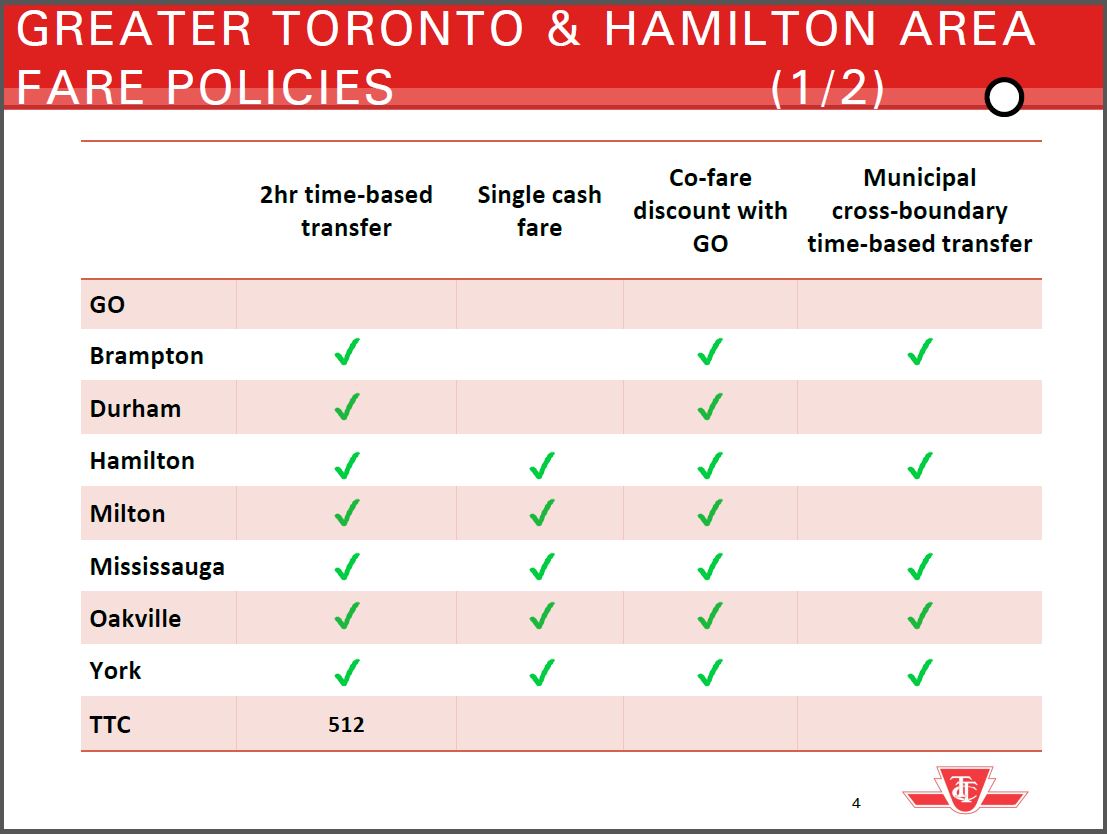
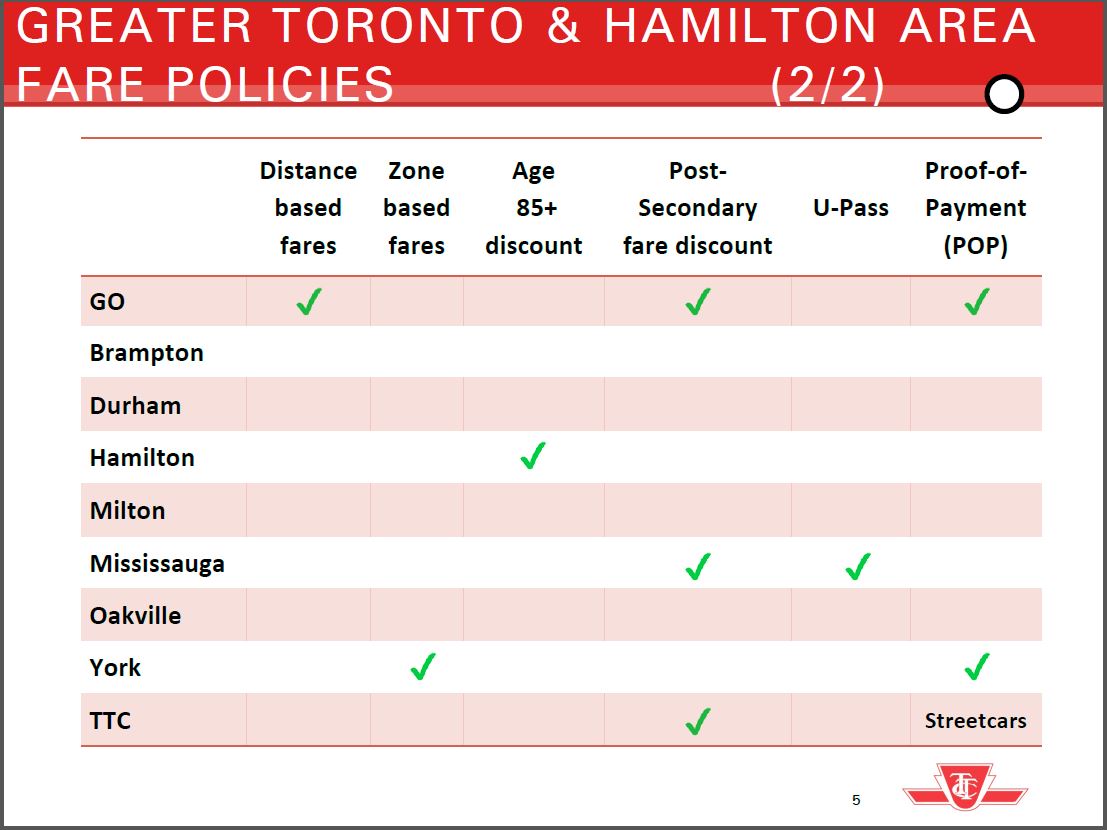
An important table comparing fare options across the GTHA is included in the report. Pass-based fares including the monthly discount program fall into a separate category of “loyalty programs”.
GTHAPolicies1 GTHAPolicies2

This chart drives home the fact that 2 hour time-based transfers are common in the GTHA while distance-based or zone-based fares are comparatively rare. Such a chart should have been part of the recent Metrolinx Fare Integration report, but it was not, potentially misleading the Metrolinx Board about the relative prevalence of GO’s world-view on fare structures.

Within Toronto, the TTC flags three challenges for any fare system:

  • Demand exceeds peak period capacity on some routes. By implication any fare structure that drives up demand will only worsen this situation.
  • Revenue control. The TTC does not entirely trust that any new fare system will yield the same revenue.
  • Complex fare and transfer rules. Within Toronto, the transfer rules make integration with other fare systems difficult if not impossible.

However, these may be offset somewhat through other improvements such as system-wide proof-of-payment and Presto rollout.

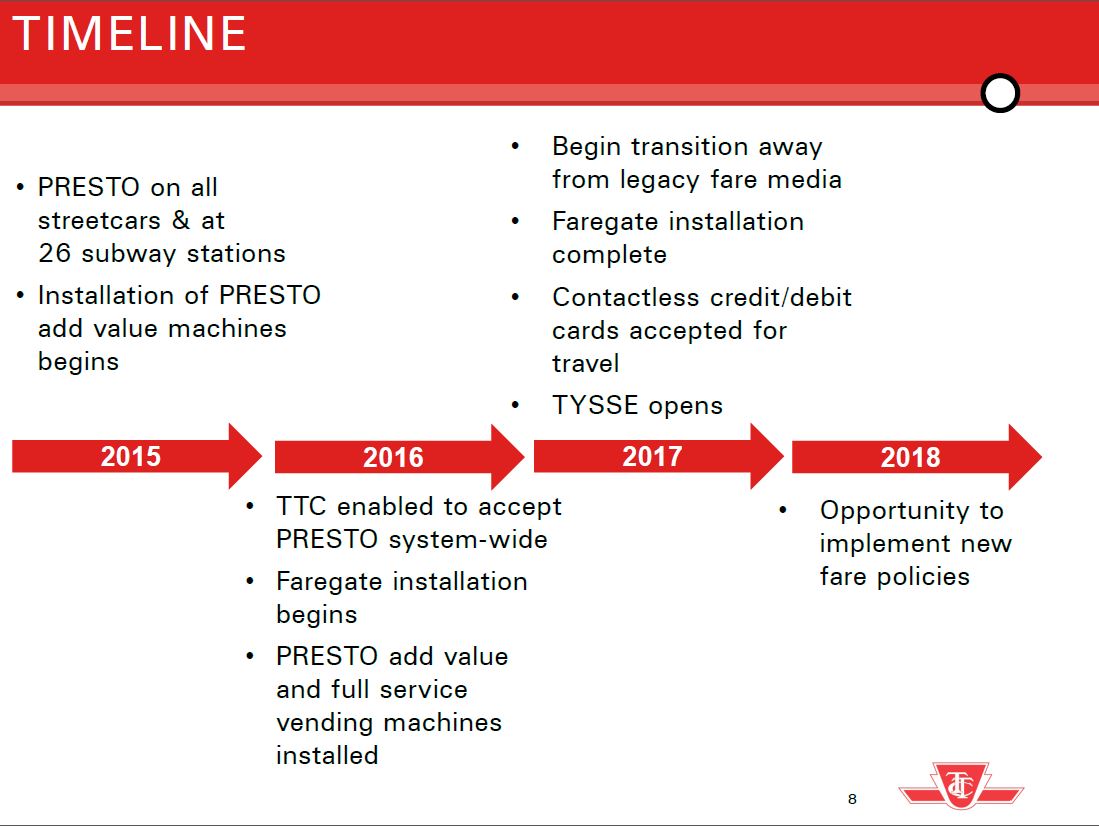
A timeline shows how various features of a new fare system would be implemented.
Timeline

Note that a move to support a wider range of cards beyond Presto is timed for 2017. This date is part of the Presto plans, as reported at the recent Metrolinx Board meeting. An essential change in the Presto model is that all of the fare handling logic moves to the “back end” of the system and the card (or some equivalent such as a SmartPhone app) merely provides a rider’s “credential” saying “this is me” to the system. Such a change makes possible a much richer set of fare integration and loyalty programs because a rider’s travel can be accumulated over time (much as a phone bill is) and the appropriate rates and discounts applied after the fact based on usage.

Underlying the analysis will be the assumption that new fare policies would not be implemented until 2018 when the technology underpinning would be in place. There is an expectation that the price gap between cash fares and Presto would widen relative to current practice as this is already the case in other parts of the GTHA.

There are seven principles proposed for the analysis:

  1. Improve the customer experience
  2. Meet the needs of our different customer groups
  3. Increase ridership
  4. Optimize TTC fare revenue
  5. Optimize TTC operations
  6. Embrace new technology to modernize our fare offering
  7. Support fare integration initiatives across the Greater Toronto and Hamilton Area

The analysis will review:

  1. Cash fares and single ride options
  2. Loyalty programs
  3. Peak and off-peak fares
  4. 2hr time-based transfers
  5. Fare by distance/zone
  6. All-door boarding on buses
  7. Proof-of-Payment (POP) system wide including buses and subway
  8. “Tap on” to all buses and streetcars
  9. “Tap on and off” at all subway stations

Notable by their absence in this list is a discussion of service classes such as premium express fares and any scheme in which the “rapid transit” network would be a separate fare tier.

Also included on a regional basis will be considerations of low income discounts and fare equity as well as co-fares.

The analysis will come back for debate and endorsement by the TTC Board at its December meeting.

Metrolinx Fare Integration Study: Heading to a Foregone Conclusion?

Updated September 22, 2015 at 8:00 pm:

A few issues raised in this article were addressed during the presentation and debate on the Metrolinx report.

  • The dismissal of “time based fares” refers only to fares that are calculated by the length of a journey measured in hours rather than kilometres or zones. Times based transfer privileges (in effect, limited time passes) are still part of the mix of fares under discussion.
  • Although the initial goal of the study is to produce a revenue-neutral model, Metrolinx will also expand the scope to look at adjustments to reduce the effect of bringing about that “neutrality”, in effect to offset unwanted side-effects of balancing who pays for what. This is an important consideration so that all interested parties can debate whether we want more subsidy, or higher fares, or some combination of these in aid of the greater good of an integrated and “fair” regional system. Just telling everyone “this is how it will be” is a recipe for political disaster, especially considering any reorganization of regional fares is likely to occur just in time for the next round of elections.
  • Integration is a big issue for Metrolinx because the distinction between “local” and “regional” travel is vanishing. This is actually more important than the off-cited cross-border double fare, and the RER service concept cannot operate without close integration of local fares and service to whatever Metrolinx runs.
  • Still unanswered is the question of just what service classes Metrolinx will propose, and the effect of making rail services like subway and LRT lines a separate fare class when they were designed, for the most part, to be integrated with local systems as replacements for existing bus routes.
  • Metrolinx plans to publish the background papers for this study including a review of the fare structures now in use by the GTHA’s transit systems.

The original article follows below:

The Metrolinx Board will receive an update on the status of its regional fare integration study at its meeting of September 22, 2015. To no great surprise, the study is pointing strongly toward fare by distance as the preferred scheme, no matter how much the entire exercise wants to give the impression of an unbiased approach and of “consultation” with municipal transit operators and the public. For some time, the Metrolinx review has the air of “any colour you like as long as it’s black”, and this update does little to change the impression.

The fundamental problem is that Metrolinx is a regional commuter system where any kind of flat fare simply won’t work, although their pretensions to being truly fare-by-distance fall apart the longer a trip gets. As the role of Metrolinx changes, both with the construction by Ontario of urban lines, and with the evolution of its market beyond the hinterland-to-downtown model, a one-size-fits-all fare system simply won’t work. Things get even more complicated where there is a mix of GO and local services serving the same territory whether these be rail or bus operations.

An “integrated fare system” has long been the goal for regional planners, although just what this means has varied over the years. For a long time, “integration” meant little more than having one farecard (Presto, of course) that would work everywhere while the actual fare structures were unchanged. The farecard would simply eliminate the pesky business of having different fare media – tickets, tokens, passes, cash, transfers – for different systems. Now that completion of Presto’s rollout is within sight, the question turns to the matter of fare boundaries and “fairness” in fare structures.

Continue reading

TTC Budget 2016: Confused Priorities Make For A Confusing Budget (Part II)

In my first article reviewing the TTC’s budget updates of September 15, 2015, I looked at the Capital Budget for 2016 and the ten-year plan out to 2025. This installment looks at the Operating Budget including proposals for fare increases and service improvements.

The reports discussed here are:

Updated September 21, 2015 at 10:05 pm:

The TTC has responded to questions I posed to clarify some issues raised by this article regarding: ridership, revenues and costs for Pan Am Games operation; treatment of capital-from-current related to bus purchases in 2015 and 2016; contract service changes for York Region; and diesel fuel hedging savings. See the end of the article for details.

Continue reading

TTC Budget 2016: Confused Priorities Make For A Confusing Budget (Part I)

Updated Sept. 17, 2015 at 12:35 am: The official text of motions made at the Committee Meeting came in by email just after I posted the original article. They have been appended with comments.

The TTC’s Budget Committee met on September 15, 2015, to consider the ongoing state of the 2016 Operating and 2016-25 Capital Budgets. The reports included:

Rob Ford may not be Mayor of Toronto, but his era left a hangover from which transit (and much else in the city) has yet to recover in the attitude that almost any spending is an affront to taxpayers, and that the first goal of any budget should be to spend as little as possible. That makes for good political showmanship and sound bites, but it is not a truly businesslike managerial approach we should expect from Mayor Tory. What is missing, of course, is any sense of what transit, what Toronto should be, or of the investments the city needs.

The TTC wrestles with a regime that rewards frugality with the possible exception of proposals that provide photo ops for otherwise miserly politicians.

  • The proposed operating subsidy for the TTC in 2016 is flat-lined at its 2015 level of $474-million even though inflation, population growth and full-year operation of 2015 service improvements will add to ongoing costs.
  • Tax-averse politicians love to freeze fares, and even run on this in election campaigns, but are slow to pay the bills when fares don’t make up the needed revenue.
  • The City’s headroom for borrowing will max out against its own debt target that no more than 15% of tax revenue should go to debt costs. This will choke off a significant source of capital funding for routine TTC maintenance which already suffers from low support at the provincial and federal levels.
  • TTC budgets underplay the true need for capital funding by placing projects “below the line” (for which there are now at least three sub-classes of project) in an attempt to make the City’s future borrowing exposure look healthier.

This article discusses the Capital Budget for 2016-25. I will turn to the Operating Budget and related reports in a separate post.

Continue reading

TTC Service Changes Effective September 6, 2015

September 2015 brings a long list of service changes that will begin the restoration and expansion of TTC service promised earlier this year. A few changes were slipped through in earlier schedules, but the bulk of the changes will come now. These include:

  • The “Ten Minute Network”: Scheduling a network of major routes so that they will always operate at least every 10 minutes (except for overnight service). For most affected routes, this only means adding a bit of service around the edges (notably weekend evenings), but for a few, this is a major change.
  • The “All Day Every Day” services: In the early Ford/Stintz days, service was hacked away on routes with less ridership, although the actual dollar savings were small. Much of what was cut has now been restored.
  • Reduced off-peak crowding: Off peak crowding standards on routes with frequent service have been restored to Ridership Growth Strategy (a David Miller era initiative) levels triggering service improvements on many routes.
  • Expanded and restructured Blue Night network: Some new routes, and the restructuring of others, will take place over the September and October schedule changes (see my previous article for details).

Concurrently, the basic service levels move back from “summer” to “winter” levels, and all of the remaining temporary changes for the Pan Am Games end.

Seasonal services also end including:

  • Weekday service on 101 Downsview Park
  • Weekend service into High Park by 30 Lambton
  • Weekday evening service to Cherry Beach by 172 Cherry
  • Extended hours to the Zoo on 86 Scarborough and 85 Sheppard East

The “temporary” extra service and running time added to 510 Spadina and 509 Harbourfront for the reconstruction of Queens Quay has been left in place.

Although the Front Street reconstruction has finished, the TTC has not yet decided whether or how to recombine 72 Pape with 172 Cherry.

Some routes, notably 506 Carlton and 505 Dundas, are getting new schedules with extra running time to match actual conditions on the route in the hope that this will reduce short turns and improve reliability.

The new crowding standards for off-peak surface routes are based on a seated load regardless of the scheduled headway. Previously, routes operating every 10 minutes or better used the seated load plus 25% as the standard. This made the busiest routes operate with near-peak period standards most of the time.

Note that these standards are based on the average load over the peak hour at the peak point. Individual vehicles will vary with more or fewer riders, but the intent is to design service at this level.

201509_CrowdingStandards

The table linked below details the changes for September. It does not include the list of summer service cuts that are to be reversed (see June 2015 changes for the list).

Updated August 11, 2015 at 11:30 am: A service cut on 75 Sherbourne that was part of the June changes was inadvertently carried over into the original version of this table. It has been deleted.

Updated August 23, 2015 at 9:30 pm: The number of vehicles for the 315 Evans night bus has been corrected from 1 to 2.

2015.09.06_ServiceChanges

Blue Night Service Expansion: Fall 2015

The overnight “Blue Night” network will see many changes and additions this fall. These will be rolled out in two waves: first with the September/October schedules on Labour Day weekend, and the remainder with the October/November schedules at Thanksgiving.

This is part of a more extensive expansion of service beginning in September that relates to the Ten Minute Network, All Day Every Day service, and improved crowding standards on routes with frequent service. Those and other changes will be described in a separate article.

Here are maps of the network as it exists now, and with the two stages of additions:

BlueNightMap_201507

BlueNightMap_201509_Delta

BlueNightMap_201510_Delta

Several of the routes will be renumbered so that the night services match the daytime routes except for the using “300” series. In the case of the King and Spadina night services, they will run, at least initially, with the daytime route numbers because there are no roll signs for “304 King” or “317 Spadina” in the CLRV/ALRV fleet. This problem will vanish as the routes convert to Flexity cars with programmable signs.

All services will operate on 30 minute headways.

This implementation is a work-in-progress, and Service Planning does not expect to turn to the question of timing points until the routes are in place. This is a vital piece of work for a network with wide headways where TTC performance stats show that headway (and, by implication, schedule) adherence is very weak. Riders of these routes should be able to depend on vehicles appearing at expected times and connections to work in a predictable way. This is as important a part of the new service as simply putting the buses and streetcars on the road. If service is not predictable in the middle of the night, riders cannot be expected to use it especially for trips that are time-sensitive such as early morning work shifts.

Continue reading

Preliminary TTC 2016 Operating Budget (Updated July 30, 2015)

Updated July 30, 2015: Comments on the discussion at today’s meeting have been added.

The Budget Committee met today and received the presentation linked from the main article. There was considerable debate, a welcome change from the Stintz/Ford years at the TTC where detailed knowledge of the budget was not of much interest to politicians. Now there actually is a Budget Committee, and its members take their job seriously. The idea is that by the time the budget hits Council, there will be a group of informed advocates beyond the senior staff who, in past years, have been left to fend as best they could as proponents of better transit in a hostile environment.

Among the topics that came up were:

  • the question of the “average fare” and the role of a monthly pass in the fare mix;
  • the future role of and arrangements for fare collection with Presto;
  • the implications of various possible fare schemes, including increases, and the resulting effect on the TTC budget and subsidy requirement;
  • the provision of improved service, its cost and its beneficiaries;
  • the staffing of TTC and especially the numbers of new staff and their cost for various functions.

Continue reading

TTC Board Meeting July 29, 2015 (Updated August 3, 2015)

The TTC Board will meet on July 29, 2015, and various items of interest are on the agenda. These include:

  • The monthly CEO’s Report (Updated August 2, 2015)
  • A presentation by Toronto’s Chief Planner Jennifer Keesmaat (Updated August 3, 2015)
  • Faregates for PRESTO implementation
  • Purchase of new buses and implications for service growth (Updated August 1, 2015)
  • Improved service standards for off peak service on “frequent” routes
  • Proposed split operation of 504 King during TIFF opening weekend (Updated August 2, 2015)
  • An update on Leslie Barns
  • Excluding Bombardier from eligibility for future contracts (Deferred to September Board meeting)
  • Council requests related to Lake Shore West streetcar service (Referred to TTC Budget Committee)

Continue reading

Coming Soon: July 2015

Since that blizzard of articles about TTC budgets and fares, it’s been rather quiet in here. Fear not! I actually have works in progress to tide us over the relatively quiet summer months until the political season heats up in the fall.

There will be a series of articles about the operation of the downtown streetcar lines looking at their behaviour over time, and reviewing how changes that have been made (or are planned) affected them. These include:

  • 501 Queen (including the effect of split operation with a bus shuttle on Lake Shore to Long Branch)
  • 502/503 Downtowner & Kingston Road (including the recent move to a 10-minute off-peak headway on 502)
  • 504 King (including the effect of additional running time on service levels and terminal operations)
  • 505 Dundas
  • 506 Carlton (including a look at the effects of the College/Spadina construction diversion)
  • 509 Harbourfront (including a review of the changes on Queens Quay)
  • 510 Spadina

The TTC plans additional meetings of its Budget Committee and these will, no doubt, produce more details about plans and options for 2016 and beyond. I will cover this material as it becomes available.