TTC Proposes Service Improvements for Fall 2018 (Updated)

Updated May 9, 2018: Information about the planned changes has been updated based on the staff presentation at the May 8 Board meeting.

Contrary to the penny-pinching approach urged on the TTC by budget hawks, where only routes that were 30% above standard would be improved, the changes will bring all bus routes that are above the Board-approved loading standards below the approved maximum. This will be achieved through a combination of better availability in the bus fleet and reallocation of service from routes and periods which are below the standard. The sequence of implementation will likely be:

  • September: Express routes
  • October and November: Peak and Off-Peak improvements

The staff proposals were amended by a Board motion directing that one additional gap train be provided on 1 Yonge-University-Spadina in both peak periods starting in September. This will bring the total to 4 AM and 1 PM gap trains.

The TTC Board will consider proposals to improve service on their network at its meeting on May 8, 2018. No doubt, there will be many cries of  “Huzzah” and tub-thumping pre-election speeches about how Toronto continues to improve its transit service.

There is not much new here for those who have been following the 2018 budget process. This is merely the implementation stage of changes that were included in the Council-approved budget earlier this year.

Previous articles/items on this topic:

There are four groups of improvements:

  1. Improve service reliability on Line 1
  2. Relieve peak crowding on bus routes
  3. Relieve off-peak crowding on bus routes
  4. Implement new express bus services

The changes will be implemented, for the most part, in fall 2018, and therefore have only a four-month effect on the budget. The costs are projected to be $5 million in 2018 and $15.5m in 2019, offset by revenue from new riding of $2m in 2019. For the 2018 budget year, $3m comes from a Council-approved bump in the TTC’s subsidy, and the remaining $2m from spending redirected from other, unspecified, areas within the TTC.

The new riding generated by the changes is projected to be 848,000 in 2019, of which over 60% would come from the new express services. By 2021, this is expected to rise to 1.1 million rides that the TTC would not have seen without the improvements. Many more riders will benefit from less crowded service, at least assuming that the TTC, with adequate funding, stays on top of crowding problems.

Stirring all that together means that the net new requirement for funding in the 2019 budget will be $8.5 million.This implies that the “redirection” of funding in the TTC budget is a permanent change, not a one time efficiency or deferral.

It is important to contrast this with the cost of opening the Vaughan subway extension ($30m annually) or the fare freeze (a comparable amount). The TTC has used its vehicle shortage as a convenient excuse to avoid service improvements with the argument “even if you gave us the money, we couldn’t run the service” response. In fact, what money the TTC does manage to scrape together is going to underwrite service on the subway extension and politically motivated fare policies.

Although there is an intent to reduce crowding, this will only occur on the most badly-overcrowded of routes, and in effect the TTC has made its “standards” worse by only addressing problems on the most badly crowded parts of their system.

Moreover, there is still no ongoing reporting mechanism to allow tracking of crowding by route and time period so that the degree to which the TTC fails to achieve its standards is clear for all to see.

Continue reading

TTC Service Changes Effective Sunday, May 13, 2018

The May 2018 service changes bring:

  • Addition of two AM peak “gap trains” on 1 Yonge-University-Spadina and other operational improvements.
  • An update to the schedules for service on the King Street Pilot to reflect the improved travel time on the street and to reduce vehicle queues at terminals.
  • Changes to all routes serving Main Station during construction that will close the loop to transit vehicles.
  • Diversions of the Parliament and Carlton routes around track construction at Gerrard & Parliament.
  • Changes to Don Mills bus schedules to reflect actual operating conditions and Crosstown construction effects.
  • Seasonal changes to reflect declining ridership to post-secondary institutions during the summer.
  • Summer improvements including extension of 121 Fort York Esplanade to Cherry Beach during all operating periods, improved weekend service on 92 Woodbine South, and later service to the Zoo.
  • There is a new summer route 175 Bluffers Park on weekends between Kennedy Station and the park’s parking lot.
  • Service cuts and running time reductions on 6 Bay.
  • Weekend reliability improvements on 96 Wilson and 165 Weston Road North.
  • Weekday reliability improvements on 199 Finch Rocket.

2018.05.13_Service_Changes

Here are the highlights:

1 Yonge-University-Spadina

Two “gap trains” will be added to the morning peak schedule to provide additional service as needed southbound on Yonge. One train will be stationed in Eglinton pocket track, and the other on the hostler track at Davisville.

Trains leaving service in the evening to Wilson Yard will now do so southbound from Vaughan rather than northbound at Wilson. This avoids conflicts between the yard movements and southbound service.

King Street Pilot

Running times on 504 King will be reduced during almost all operating periods, and the saving will be converted into slightly shorter scheduled headways with no change in total vehicles. The four peak period ALRV trippers will be replaced by six CLRV trippers. Flexity cars will now be formally scheduled to cover part of the service with priority going to runs that stay out all day.

514 Cherry service will be improved during the AM peak, weekday early evening, Saturday afternoon and Saturday early evening periods by the addition of one or more cars.

Peak period crewing practices will be changed to step back operation to reduce terminal delays.

Main Station

Main Station Loop will be closed until September 2018 for construction. During this time routes serving the station will be reorganized:

  • 20 Cliffside and 62 Mortimer will be interlined as a single route from Broadview to Kennedy Station.
  • 23 Dawes will be extended west to Woodbine Station.
  • 64 Main will be extended north to Eastdale.
  • 87 Cosburn will loop on street via Danforth and Chisholm.
  • 113 Danforth and 135 Gerrard will be cut back from Main to Victoria Park Station.
  • 506 Carlton will be extended east to Victoria Park Station via Gerrard covering the mileage of the shortened 135 Gerrard route.

Parliament & Gerrard

During the reconstruction of this intersection, buses will divert:

  • 65 Parliament will divert via Sherbourne between Dundas and Carlton.
  • 506 Carlton will divert via Dundas between Sherbourne and River.

Bay Bus

Service on 6 Bay will be reduced by the elimination of one or two buses during most operating periods, and headways will be widened as a result.

This route suffers from excessive running time as shown in a previous analysis I published, and I will be updating this with current data in May.

Who Will Pay For SmartTrack?

Toronto’s Executive Committee will consider a series of reports on the proposed SmartTrack project and related matters at its meeting on Tuesday, April 17, 2018.

These reports set in motion several aspects of the GO/RER/ST program, although the primary focus is the funding the the new SmartTrack stations which is a city responsibility. This article deals with the main report and the first two attachments.

Attachment 3 is a compilation of the information on the proposed new stations that has already been discussed in my previous articles on the public meetings.

Attachment 4 explains the link between SmartTrack and plans for significant changes to the road network in the St. Clair, Keele, Old Weston Road area including widening of St. Clair through the railway underpass and extensions of various roads to fill gaps and provide additional paths for traffic flow. The new station at St. Clair and Old Weston/Keele would be constructed based on the new layout, and work on these projects will be co-ordinated.

Attachment 5 was prepared by Metrolinx. It sets out the status of the many changes to various rail corridors that are within the City of Toronto.

Attachment 6 illustrates the planned new south platforms and concourse at Union Station, an expansion project separate from the renovation of the existing station now underway. Of note in the design is the replacement of four tracks by two making room for a pair of much wider platforms than in the older part of the station. From a service design point of view, these tracks and platforms will likely be the new home for the Lakeshore services as this will allow them to operate along the south side of the rail corridors free of interference with traffic from the more northerly corridors like Milton/Kitchener/Barrie to the west and Richmond Hill/Stouffville to the east.

(Metrolinx has already talked about the need to consolidate trackage and platforms in the old part of the station to improve capacity both for train service and for passengers, but that is beyond the scope of the city reports.)

The current report deals only with the SmartTrack stations. Specifically it does not address:

  • The Eglinton West LRT which, having replaced a part of the original SmartTrack scheme, is still bound up with ST as part of the total budget number for this project.
  • Operating and maintenance costs for GO/ST service.
  • The cost to the city of “fare integration” or even exactly what this will mean.

A further problem, as I discussed in a recent article, is that recent changes in the Metrolinx/GO service design for various corridors has changed the mix of local and express trains on which the SmartTrack scheme rests. Metrolinx has still not explained how they will operate the number of trains the city report claims will stop at all of the “local” SmartTrack stations, and they are quite testy on the matter when pressed. For its part, the city assumes a service level (and hence attractiveness of service) greater than what Metrolinx has, so far, committed to operating.

The works that are included in the report are:

  • Six new GO/SmartTrack stations at Finch, Lawrence East, Gerrard/Carlaw, East Harbour, Liberty Village and St. Clair/Old Weston.
  • Additional city requirements for station facilities that are not strictly required for operation of the transit service.

Continue reading

Queen’s Park’s Long Overdue Move on Fare Integration

The recently-announced Ontario Budget includes a lot of spending on transportation that transit riders in the GTHA can only hope to see delivered by whoever is in charge at Queen’s Park after the June 2018 election. Even though the budget is as much about vote-getting as about actual governance, it is worth looking at what the promised fare changes would bring if they are implemented.

From the press release:

  • Beginning in early 2019, the province is reducing the cost of GO Transit trips to just $3 for PRESTO users who are travelling under 10 kilometres anywhere on the GO network
  • All GO Transit and Union-Pearson Express trips anywhere within the City of Toronto will be reduced to $3
  • With proceeds from Ontario’s cap on pollution, the province will also provide fare integration discounts of up to $1.50 per ride for anyone who travels between the York, Durham, Brampton and Mississauga transit networks and the Toronto Transit Commission (TTC), saving regular commuters up to $720 every year
  • PRESTO card users travelling on GO Transit between Union Station and stations near Toronto, such as Port Credit, Malton, Pickering, Ajax or Markham will see fare reductions.

As with any announcement, “the devil is in the details”, and I fired off a series of questions to clarify how this might all work. Responses came back from Metrolinx.

Q1: Regular GO Transit riders now enjoy a monthly cap of 40 fares on their travel. The 36-40th trips are at a discount, and from 41 onward, they are free. Will this apply to the new $3 fare? In other words, is there an upper limit of 40 x $3 = $120 to a rider’s cost of using GO within the 416, or is it open ended like TTC fares where there is no cap unless one buys a pass?

A: Details on this will be worked out as part of our implementation planning and work.

Q2: There are now co-fare arrangements between the 905 systems and GO, as well as between GO and TTC. If someone makes, for example, a YRT-GO-TTC trip, what discounts apply? Are the cofares cumulative?

A: YRT-GO Co-Fare, GO-TTC DDF. Yes, cumulative.

Q3: By analogy to Q1, if a rider makes a three-legged trip regularly, thereby becoming entitled to free rides for the GO segment after 40 trips, what happens to the co-fares? Do they still apply, or does the rider pay full 905 plus TTC fare in this case? The potential savings are “up to $720 per year”. Is this simply a calculation based on 20 commutes for 12 months, or will it be a capped saving?

A: Details on this will be worked out as part of implementation planning and work.

Q4: If someone has a Metropass (or its Presto equivalent), they are not entitled to the TTC-GO co-fare. Is it correct to say that their monthly cost would be the cost of the pass plus $3 times the number of GO trips taken within Toronto?

A: For adults, yes.

Q5: For clarity, is the $3 fare a flat rate even if riders transfer from one GO service to another, such as from Lake Shore to UPX, but stays within Toronto for their trip?

A: Yes as long as [the] individual uses the GO readers for their UP Express trip.

Q5a: If part of their trip is inside Toronto, but a second leg goes outside, does the $3 apply to the “inside Toronto” portion? Example: Rough Hill to Union to Weston is all inside Toronto, but Rouge Hill to Union to Airport is not.

A: Fares for any trips to and from Toronto Pearson Airport remain unchanged.

Q6: The co-fare for GO-TTC is relative to an assumed $1.50 per full adult fare with lower co-fares for those getting discounts like Seniors. Will the same apply to the 905-416 co-fare?

A: Details on this will be worked out in conjunction with the transit agencies.

In brief, the only thing that is nailed down so far is that discounts between each leg of a trip are cumulative so that, for example, a Miway rider travelling to a station within the $3 GO tariff zone and thence to a TTC route will get the Miway co-fare discount, the new low GO transit fare and the GO-TTC discount. Also, transfers between GO services do not attract another fare provided that the trip stays within the city.

Every thing else is to be “worked out”.

There are a variety of scenarios one can construct including the combined effects of bulk fares (passes) on 905 systems, the existing GO Transit monthly fare caps, and whatever co-fare/discount arrangements will exist. Anyone trying to work out the permutations has my sympathy. From the Metrolinx point of view:

The reason these changes will only be introduced in early 2019, is because Metrolinx needs time to work with our transit partners to ensure the various scenarios and all fare rules are in place. This budget provided Metrolinx with direction to move forward on fare integration. [Metrolinx email]

Leaving aside the question of whether the government in place for the 2019-20 budget will support whatever fare scheme Metrolinx comes up with, there are also obvious questions about the implications for service crowding and for possible changes needed in local route networks, mainly on the TTC, to provide better connections with GO stations. The lower fares may look attractive, but actually using the service could be challenging within Toronto.

  • On Lakeshore West, most inbound trains run express from Clarkson to Union with local trains only every half hour in the AM peak. The same arrangement applies outbound on the PM peak.
  • On Lakeshore East, there is a similar pattern with express trains skipping all stops from Rouge Hill to Union, and local trains running roughly twice/hour in the peak, albeit on an irregular headway. Some additional service is provided at Danforth (Main) and Scarborough stations by the Stouffville line’s trains.
    • TTC services in southern Etobicoke and Scarborough focus on the Bloor-Danforth subway, and actually reaching the GO stations (or using the TTC as a connecting service from them) is not easy.
  • On the Milton corridor, trains operate only in the peak period, peak direction although for someone at Kipling Station, the all-local service now operated would actually be better than what is provided at, say, Mimico on the Lakeshore West corridor.
  • The Barrie corridor and the Vaughan subway extension are in direct competition with each other, although service is far more frequent, especially during the off-peak, on the subway than on the hourly GO train, and the GO stations within Toronto are not well-served by the TTC network (other than the connection point at Downsview Park station).
  • The Richmond Hill corridor, like Milton, has only peak service, and its stations within Toronto are poorly served by the TTC.
  • The Stouffville corridor has all-day service with stations that potentially could connect with TTC feeder routes at Steeles (Milliken), Sheppard (Agincourt) and Eglinton (Kennedy). As on Lakeshore, the tradeoff will be for a faster trip bypassing the subway.
  • The Weston corridor is a special case because it hosts not only the GO Kitchener service but also the Union Pearson Express (UPX) trains which provide the most frequent of GO services within Toronto.

The fare reductions for trips from the near-Toronto stations in the 905 could shift some travel away from the subway, although few of the stations are well-located for this purpose. The Richmond Hill corridor is the most obvious of these, but the limited service there does not offer a lot to diverting demand.

As a follow-up question, I asked Metrolinx whether they had any demand studies to show travel patterns with the new fares, to the degree that these are known. Their reply is pending, and I will update this article when I receive further info.

It is well-known that the demand models are sensitive to three factors: trip speed, service frequency and fare level. This came out quite clearly in the background studies for SmartTrack and the Scarborough Subway where ST would succeed in drawing significant riding only if it operated frequently and cheaply, as originally touted in John Tory’s campaign. Just how many riders the lower GO fares, by themselves, will attract remains to be seen. A related problem, of course, is the question of train capacity if many actually shift to GO.

Not to be forgotten in all of this are the cross-border travellers between the 905 and 416 (in both directions) for whom a discounted fare will be a benefit. However, if this is only available to riders paying the full adult fare in each jurisdiction, this could undo the benefit now enjoyed by pass users who will not get any further discount. This would be particularly important if a pass holder took many “local” trips on the TTC in addition to cross-border trips into the 905.

In general, riders who already enjoy some sort of discount like seniors and students will benefit far less from the new tariff.

Whether any of this will come to pass is purely speculative at this point given the tenuous status of the current government and the well-known, vague bluster of their principal opposition.

Metrolinx (and by implication its political masters) have wasted years on pursuit of “fare integration” schemes that began with the premise of revenue neutrality to limit the government’s cost through added subsidies, and with the underlying view that distance-based fares were the end state at which they would aim. Had the option of added subsidy and reduction of short-haul GO fares been part of the mix a few years ago, the entire debate over fare integration could have taken a completely different path and a new tariff would already be in place.

Transit policy should arise from reasoned, open evaluation of alternatives, including those that may require an “investment” to make them work, not from a deathbed change of heart by an unpopular government facing defeat at the polls.

A Detailed Review of King Street Travel Times

The purpose of this article is to delve into the data on the behaviour of King Street transit at an even more finely-grained detail than in past articles. The presentation here focuses on:

  • Hourly variations in travel times.
  • Daily variations based on the day of the week, including weekends.

The data are the same as those used for previous articles, but with changes in presentation to bring out different aspects of the “story” that they tell. In particular, it is important to examine the data at a level of detail sufficient to see where variations exist and where they do not. Averages over several days and over multi-hour periods simply do not reflect the way the line behaves.

A fundamental purpose of the King Street Pilot is to “shave off” the worst of the transit delays caused by congestion. For periods when traffic is free-flowing, there will be little or no change because nothing was “in the way” to begin with. Expectations of large savings in travel time can really only apply to periods when service was likely to be disrupted. This can vary from hour to hour, by day of week, due to special events, weather, and other factors. The whole point is that if the worst of the disruptions are eliminated, service will more reliably be at close to “best case” conditions.

The source data for this and all other studies of transit operations I have published come from the TTC’s vehicle tracking system. Subject to the caveat that some data must be discarded thanks to wonky GPS readings of vehicle location, this represents as close to a 100% sample as one is likely to achieve. The data are from January 2016 to February 2018, except for February 2016 which I do not have.

There are several sets of charts here, and this article is intended to take the reader through progressively more detailed views.

Complete chart sets are provided in linked PDFs, and only a few of these are presented as illustrations in the body of the article to save on space.

I leave exploration of the charts to readers with the hope that this shows the kind of detail that is available, and that a closer look is needed to see how the route behaves under various conditions. As the year goes on, I will update these charts periodically with additional data to examine whether better weather, more activity and special events disrupt what has been, so far, a clear improvement in transit’s performance on King Street.

Continue reading

PTIF Phase 2: The Lottery Win Is Not As Big As It Seems (Updated)

Updated March 16, 2018 at 5:15 pm: The Fire Ventillation Project which includes second exits from several stations was omitted from the list of major projects in the original version of this post. It has been added.

Updated March 16, 2018 at 3:25 pm: The Ontario Ministry of Infrastructure has clarified that the Ontario funding for the Scarborough Subway is separate from the $4 billion in matching dollars shown in the table below.

On March 14, 2018, the Federal and Provincial governments announced the scale of the second phase of the Public Transit Infrastructure Fund (PTIF) to be spent over the next decade. Some of the details are in a backgrounder.

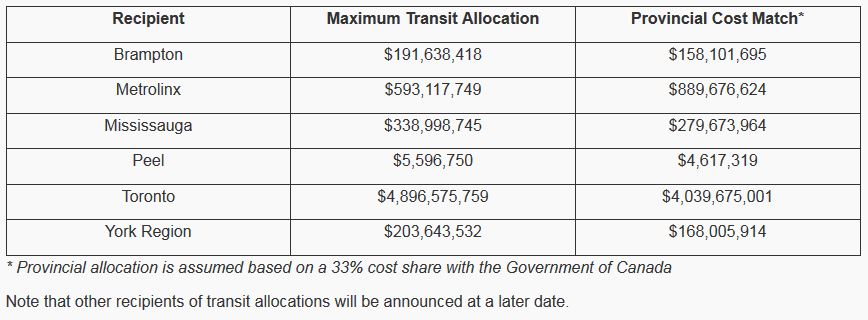
Funding allocations for the Toronto area are summarized in the table below. The amounts are based on transit ridership, not on population, and so Toronto gets by far the largest share of the pie.

Source: Infrastructure Canada Backgrounder

If one believed the ecstatic response of politicians and some media, one might think that all our transit prayers have been answered.

Not quite.

An additional $9 billion is not exactly small change, but Toronto has a huge appetite for transit spending and a daunting project backlog. The new money will help, but with it comes the requirement that Toronto pony up about $3 billion for projects that are not in the city’s long-term budget.

Capital planning for many years understated the infrastructure deficit by hiding projects “below the line” outside of the budget, and even more by leaving important work off of the list completely. The infrastructure deficit is much larger than the TTC reports and city financial plans indicate.

That, in turn, affects the city’s financial planning, subject of a recent report from the City Manager. Despite assurances from city staff that all known TTC costs have been included in their projections, there is a long history of the TTC leaving significant projects out of funding lists to keep their total “ask” down to a politically acceptable number.

Much needed work is not the sexy, photo-op rich stuff of subway extensions, but the mundane business of buying new equipment to replace old cars and buses, and to increase system capacity.

The new plan is to run for ten years. The money will not all land in Toronto’s hands this year, but will be parceled out as projects are approved and actual spending occurs. There is no guarantee that a future government will stick to any commitments especially if the “funded” projects are not the subject of a binding agreement. Toronto has its share of cancelled projects including the Sheppard Subway, cut back to Don Mills, and the Eglinton West Subway (both victims of Mike Harris), not to mention Transit City and the pliable attitude of various governments to the worth of a subway in Scarborough.

Updated March 16, 2018 at 3:25 pm:

Before we even start into the possible projects to be funded, some money is lopped off the top based on a past commitment.

  • Ottawa will provide “up to $660 million for the Scarborough Subway extension project, pending submission and approval”.
  • It is unclear how much of the provincial commitment to the SSE of nearly $2 billion is included in the $4 billion under the new program.

This brings the available federal funding down to about $4.237 billion.

Whether the total available from Queen’s Park is $6 billion ($4b new plus $2b for the Scarborough Subway), we do no know. I have a question in to the Ontario Ministry of Infrastructure to clarify this. They have acknowledged the question, but have not replied as of 11:45 am, March 16.

Update: The Ministry of Infrastructure has clarified how the previous SSE funding fits with the newly announced program:

Ontario is committed to cost-matching federal funding for municipal projects at 33 percent. This equates to $4 billion from the province to match the City of Toronto’s $4.9 billion federal allocation. No previously committed funding for Toronto projects is included in this allocation.

Ontario’s commitment to match this new federal funding at a 33 per cent share is separate from and above the province’s previous commitment of $1.48 billion in 2010 to the Scarborough Subway. [Email from Alex Benac, Press Secretary to the Minister]

Continue reading

A Few Questions For Metrolinx

The recent publication of updates to the New Stations review together with information at two public SmartTrack station meetings raises several questions about Metrolinx plans and their methodology in evaluation of the worth of new facilities.

In attempting to dig through the contradictions, I asked Metrolinx for the detailed background reports for their updated “business cases” for new stations, and was advised that there are no reports beyond the technical paper that is part of the board’s agenda for their March 8, 2018 meeting.

This is not a credible statement.

The evaluation of new stations depends heavily on the projected demand at each location. This demand depends on several factors:

  • The frequency and capacity of service provided at the station
  • The travel time to destinations for trips served by the station
  • The cost of a trip
  • Feeder services for riders including connecting transit routes and parking lots

Land use patterns around the station are also a factor, but they are secondary in two senses. First, demand projections are generally run against a fixed land use model while changing other factors such as service frequency and cost. Second, land use is not under the direct control of a transit agency while service and fare factors are, and they can have a much more immediate effect on demand.

The newly modelled demand for stations follows on from the Initial Business Cases (IBCs) of 2016:

The overall methodology and approach to modelling used in carrying out the business case analysis is consistent with the approach used in undertaking the 2016 IBC’s and has been independently peer-reviewed and validated. In particular, the current business case analysis measures and captures the same key benefits (e.g. new station users benefit from the station) and impacts (e.g. delays to upstream riders due to the station). The current business case analysis for new stations take advantage of updated input information, including GO rail service assumptions, land use, connecting rapid transit infrastructure, and a refined approach to ridership forecasting and modelling.

The economic and financial cases for each new station depend on forecasts of how travellers will respond to the presence of a new station. Stations can support increased system ridership by providing a new access opportunity that may be closer to household locations and employment, school, or other travel destinations. Individuals who use the new station benefit by saving time relative to their previous travel option – travelling farther to another GO station, or using a different transport mode such as subway, bus, or auto. Existing GO passengers that do not use the station, on the other hand, can be delayed if they travel on a train that now stops at the new station. Examining travel time savings, delays, and modal shifts is the focal point of the business case analysis. [p 7]

Metrolinx is all about “transparency”, and in that spirit here are several questions about their models and plans.

Continue reading

TTC Service Changes Effective Sunday, April 1, 2018

April 2018 brings several adjustments to TTC schedules, but nothing like the upheaval of February’s streetcar/bus changeovers or the subway opening of December 2017.

After a long absence, streetcars will return to The Queensway subject to construction at Humber Loop reaching a point where this is physically possible. Schedules on the 66 Prince Edward and 80 Queensway buses will revert to the pre-construction route configurations with the following effects:

  • 66A Prince Edward buses will terminate at Humber Loop rather than running east to the on street Ellis/Windermere loop.
  • 80B Queensway buses will terminate at Humber Loop rather then at Keele Station late weekday evenings and on Sundays.

The TTC’s service memo does not set out the arrangements for the 501L buses to Long Branch connecting with the 501 streetcars, or where the east end of the bus shuttle will be. Details of the bus operations will be announced closer to the start of the new schedules.

Through 501 Queen streetcar service to Long Branch will be scheduled for the May 13, 2018 board period.

The 512 St. Clair streetcar will become an officially low-floor route with all off-peak service designated to receive Flexity cars. Peak period extras will become fully low-floor as new cars are available. The service frequencies are almost identical to the current schedules.

As approved in November 2017, two routes will lose late evening service because their ridership is below the 10 riders per bus hour standard. These are:

  • 5 Avenue Road all days
  • 169 Huntingwood weekends

The 73B Royal York to La Rose Avenue branch will lose its weekend late evening service at the end of 2018 when construction at Royal York Station and the current interline between the two Royal York routes (73/76) ends.

The 94 Wellesley bus will lose its direct subway access at Wellesley Station during elevator construction. The 94B service which normally terminates at this station will be extended to loop around Queen’s Park as 94C. On street stops at Yonge and Wellesley will require transfers for token/ticket/cash users as at other stations where surface routes do not have a closed connection to the subway. This arrangement is expected to last until December 2018.

Minor changes in routes serving Pioneer Village station will ensure that last buses provide a connection with the last northbound subway train.

Several routes have minor changes in service levels and/or running times for construction (Metrolinx projects), adjustments to demand and correction of timings to match actual conditions.

2018.04.01 Service Changes

TTC 2018 Capital Budget: (1) Fleet Plans

The TTC’s detailed version of the Capital Budget is known as the “Blue Books” because they are issued in two large blue binders. They are not available online. Over coming weeks, I will post highlights from this material beginning with the fleet plans.

These plans were drawn up in late 2017 as the budget was finalized, and there have actually been changes since that are not reflected here. I will note these where appropriate.

For starters, a review of how all of these capital projects are paid for.

Financing and Funding the Capital Budget

The TTC’s budget process at times looks like a game of Three Card Monte where one is certain that one card is the Queen of Diamonds, but never quite sure where she is. This shows up in various ways:

  • There is a “base program” consisting of projects that have Council approval for inclusion in the ten-year plan. The estimated cost of this program is $9.240 billion, but there is funding shortfall of $2.702 billion.
  • There is an “unfunded list” of projects making up the shortfall. These will migrate to funded status as and when money becomes available.
  • The City requires that the TTC make provision for “capacity to spend” reductions in its projects based on the premise that all of the money in the budgets will not actually be used. This offsets $427 million of the shortfall, although one can argue that this is a polite fiction meant to convey the idea that the funding hole is not quite as deep as it seems. The premise is that not all projects will be spent to their full budgets, and an across-the-board provision will soak up the underspending. In practice, some of this “shortfall” is a question of timing – project slippage that shifts spending to other years – not a question of budgeting too high.
  • Some projects have their own, dedicated funding streams and appear separately from the base program. At present, these are the subway extensions to Vaughan and to Scarborough.
  • Some projects in the base program have funding directed specifically to them. The provincial 1/3 share of the new streetcars is an example. This is separate from provincial money that flows to Toronto from the gas tax.
  • Some projects have timelines associated with the structure of funding programs. Ottawa’s Public Transit Infrastructure Fund (PTIF) Phase 1 requires that projects be completed by March 31, 2019 so that the subsidy is expensed, federally, by the end of the 2018-19 fiscal year. PTIF phase 2 has not yet been announced either as to amount or to the timeframe in which spending will occur. These constraints prevent many projects from receiving PTIF money because they do not fit within the prescribed window for spending.
  • Metrolinx projects do not appear on the TTC’s books, but in some cases they can trigger payments from the TTC and/or the City of Toronto. Examples are Presto and SmartTrack.
  • Some transit proposals are not even in the base program, but wait in readiness as “nice to haves”.

“Funding” is the process of paying for projects, while “Financing” is the mechanism by which that money is raised. A “funded” project is associated with revenue from “financing” sources that the City can depend on such as property taxes and committed monies from other governments. Where there is a shortfall, someone has to step up with new money, however they might raise it, or something must be removed (or at least reduced in scope) from the list of funded projects.

City of Toronto contributions to capital come primarily from current taxes (“capital from current” and development charges) and from borrowing. The amount of borrowing available to the TTC each year is dictated by the City’s self-imposed 15% cap on the ratio of debt service costs to property tax revenue. A few major projects in the near future, notably the Gardiner Expressway rebuild, are crowding the debt ceiling, and there are years when little new debt will be issued on the TTC’s behalf. In turn, this affects spending plans at the TTC, and projects are shifted into future years with more borrowing room to get around this.

Other constraints can arise from a program like PTIF which, because it has a sunset date, requires that spending that might otherwise occur some years in the future must actually happen sooner than planned. This, in turn, requires matching funds from the City in years where they might otherwise have been spent on other projects.

Continue reading

Toronto’s Transit Capacity Crisis

In recent days, Mayor Tory has announced, twice, a ten point program to address crowding on the TTC. The effectiveness of this program is limited by years of bad political decisions, and the hole Toronto has dug itself into is not one from which it will quickly escape.

This article is a compendium of information about the three major portions of the “conventional” (non-Wheel-Trans) system: subway, bus and streetcar. Some of this material has appeared in other articles, but the intent here is to pull current information for the entire system together.

Amendment February 15, 2018 at 5:30 pm: This article has been modified in respect to SmartTrack costs to reflect the fact that over half of the cost shown as “SmartTrack” in the City Manager’s budget presentation is actually due to the Eglinton West LRT extension which replaced the proposed ST service to the commercial district south of the airport. A report on SmartTrack station costs will come to City Council in April 2018. Eglinton LRT costs will take a bit longer because Council has asked staff to look at other options for this route, notably undergrounding some or all of it.

Continue reading