TTC Updates Junction Area Route Study (Corrected, With Map)

In May 2018, I reported on a proposed set of route changes in the Junction area. TTC management has revised their proposals and plans to take a report to the Board in spring 2019 aiming for a fall implementation.

They are seeking a final round of input on their new scheme through a survey.

Updated: The original version of this post included some incorrect routing information because of the absence of a visible map on the TTC’s website. Thanks to Sean Marshall who pointed out that the map was “there”, but hiding in a file format that did not display in a browser session. A .jpg version is included below.

The updated proposal includes these changes:

  • Route 40 Junction, which now operates between Dundas West Station and Runnymede Loop via Dundas would be renamed 40 Dundas West. It would have two branches: 40B would terminate at Jane looping via Jane, St. Clair and Runnymede, and 40A would run to Kipling Station replacing service now provided by 30 Lambton.
  • Route 71 Runnymede now operates with two branches: 71B operates north to Mount Dennis, and 71A east on St. Clair to Gunn’s Loop. The branch to Mount Dennis would remain, but the service on St. Clair would be replaced.
  • A new 189 Stockyards route would operate from High Park Station east to Keele, then north and west to Scarlett Road via St. Clair. This would replace the 71A St. Clair branch of Runnymede.
  • The 30 Lambton bus would operate only to Runnymede Loop instead of to Kipling, and it would retain its summer-only extension south into High Park.

Route 79 Scarlett Road is not affected.

TTC Service Changes Effective February 17, 2019

The TTC service changes for mid-February 2019 include few major revisions to service, but much tweaking of vehicle allocations and headways. Where there are small improvements, these are usually offset by small cuts in a process the TTC describes as “rebalancing” so that vehicle hours are allocated where and when they are needed on routes.

The major revision in streetcar service that was expected in February for the King-Queen-Roncesvalles project will not be implemented until the end of March.

Items of note in the February changes include:

  • One PM peak gap train will be added on Line 1 Yonge-University-Spadina for a total of two trains.
  • 7 Bathurst will switch from articulated to standard bus operation on weekdays to free up vehicles for a capital repair program on the artic bus fleet. The replacement standard-sized bus service will provide less capacity than the service now operating. At the same time, running times will be increased to compensate for expected delays and diversions at Forest Hill Station (Bathurst & Eglinton) construction which will also affect 33 Forest Hill.
  • 32 Eglinton West will have longer scheduled running times and wider weekday headways to compensate for construction delays along Eglinton.
  • 512 St. Clair will have wider headways and a substantial increase in recovery time. This is an odd situation considering that St. Clair operates entirely on protected lanes. The new recovery times are longer than those allowed on any of the mixed-traffic streetcar routes most of which are longer than the 512. I will review the operation of the St. Clair route on a before-and-after basis later this year.

2019.02.17_Service_Changes_v3

TTC Board Meeting: January 10, 2019

The January 10 meeting of the TTC Board was primarily an organizational one with introduction of new members, plus a few management presentations on Board responsibilities and an overview of the system today.

Alan Heisey was re-elected as Vice-Chair of the Board continuing a role he has held ever since May 2015. This position is earmarked for so-called “citizen members” who are not also Councillors.

Most Board members, speaking of why they wanted to be at the TTC, cited an interest in transit and its role, but one, Councillor Karygiannis, was quite brief in saying “Sheppard Subway”. It will be ironic if Premier Ford is successful in taking over subway planning and construction because this project will no longer be one for the TTC or City Council to approve or build. Subway parochialism is alive and well at the TTC.

The Board discussed revisions to its meeting procedure including a proposal from the Vice-Chair that public deputations be limited. Anyone wishing to speak on multiple agenda items would get only five minutes in total, not five minutes per item. The idea has been referred to staff for review. Because any change in the meeting procedure would amend a bylaw that must obtain Council approval, this cannot take effect immediately.

The idea arises from frustration with a few regular deputants who address multiple reports, sometimes contentiously. However, it would be a short step from this scheme to one in which organized groups were only given five minutes in total rather than for each member wishing to address the Board.

A related procedural problem is that some reports where debate and action should be the order of the day, notably the CEO’s regular update, are classified as “Information” items. This hogties not just public deputations who can speak only to reports where the Board will approve some action, but even Board members who cannot make motions. The very report which should be the focus of each month’s review of operations and plans is insulated from substantive debate, criticism and action by the Board which is supposed to provide strategic guidance and policy.

At a time when “transparency” is the watchword and the sense that governments and their agencies should listen more, not less, to the public, this is a counterproductive proposal. If TTC Board  members don’t want to hear deputations, they should get themselves appointed to the Metrolinx Board where self-congratulation is the primary order of business and pesky members of the public sit quietly in the gallery if they bother attending at all.

CEO Rick Leary presented a system overview “Advancing to the Next Level”. This goal will be a real challenge for the TTC where just making do with existing resources has hamstrung real growth and improvement on the transit system. This presentation contains substantial errors of fact about the degree to which service has improved from 2017 to 2018. As an introduction for the new Board, it implies that the past year has been better than actual experience. TTC management spends too much time “polishing their halos” and this gets in the way of substantive discussion about real system needs.

Continue reading

Challenges Ahead For The 2019 TTC Board

January 10, 2019 brings the first meeting of a new TTC Board with a new crop of Councillors and a new Chair while, for now, three non-Council or “citizen” members carry over from 2018.

Jaye Robinson, formerly Chair of Toronto’s Public Works and Infrastructure, was appointed as the new Chair of the TTC replacing Josh Colle who did not stand for re-election. She will be joined by Councillors Brad Bradford, Shelley Carroll, Jim Karygiannis, Jennifer McKelvie, and Deputy Mayor Denzil Minnan-Wong. Of these, only Carroll and Minnan-Wong have sat on the TTC Board before, and two members, Bradford and McKelvie, are new to Council in this term. The geographic distribution of members is unusual in that none of them represents a ward west of Yonge Street.

Three citizen members remain pending a review of these appointments by Council: Alan Heisey (who was Vice-Chair in the previous term), Joanne De Laurentiis and Ron Lalonde.

The first meeting includes housekeeping activities of selecting a Vice-Chair (who must be picked from the citizen members) and setting up the Audit & Risk Management Committee. Two previous committees will be disbanded in the interest of reducing the call on Councillors’ time:

  • Human Resources and Labour Relations: The TTC is at the beginning of a four year labour contract and does not foresee the need for a standing committee to deal with these matters. Any related matters would be brought either to the full Board, or to a committee struck for the purpose.
  • Budget: Although the TTC had a Budget Committee in the past term, it hardly ever met. For the new term a two-member “Working Group” is proposed, and this means that any budget meetings will take place in private except when the finished product comes to the Board for approval.

Also on the agenda for January 10 are:

  • “Richard J. Leary, CEO will give a presentation to the Board about the TTC, its accomplishments, challenges, vision and next steps.” [This presentation is not yet online.]
  • “Brian M. Leck, TTC General Counsel and John O’Grady, Chief Safety Officer will give a presentation to the Board about Member Legal, Safety & Environmental Responsibilities.”

The legal background emphasizes the Board’s role in providing oversight, general direction and strategy, as opposed to micromanagement of the system. However, this does not make for a completely hands-off arrangement as the Board has specific responsibilities and liabilities under legislation notably relating to worker safety and the environment.

Sadly, there is no legislative requirement to ensure high quality transit service.

The Board will meet again on January 24 with a meatier agenda including the Capital and Operating budgets. They are both huge documents, and the Board is unlikely to understand how their components fit together.

With the increased workload for members of the 2019 Council, moves are afoot to trim agendas and shift decisions to lower levels. In the case of the TTC:

In order to manage the number of items being presented to the Board for consideration while simultaneously seeking opportunities to improve decision making efficiency, it is recommended that staff begin to review options where delegated authority from the Board to staff is feasible. [TTC Board Governance at p. 5]

Staff will report on this in the next few months, but it is important that changes do not stifle public debate and that new “policy” does not appear out of thin air from a delegated responsibility.

Important Board roles are strategic planning and oversight of management. For the past two terms, TTC Boards have been less than engaged with overall strategy and the potential future of transit in Toronto. There are the inevitable debates about a few subway lines, but the larger question of the TTC’s purpose goes unanswered. One might argue that Council (or at least the Mayor and his allies) don’t want ideas that will add to costs getting a full airing at the TTC.

The political direction might well be to limit growth in fares and subsidies, but this should not prevent the Board from engaging in “what if” discussions to gauge the possibilities and implications for service levels, fare structures and technology, and large scale planning for system growth and maintenance.

One past example of TTC advocacy was the August 2014 “Opportunities” report produced by former CEO Andy Byford and staff. It contained many proposals including the Two Hour Fare which has only recently been implemented. The 2018 Ridership Growth Strategy contains many principles, but is lighter on specifics.

We cannot, as a city, understand what transit might do if the agency and Board charged with this are content to avoid discussions of what transit could be if only we had the will to pursue a more aggressive outlook on system improvement. The Board needs to actually do its job – be informed and make strategic plans for transit even if, in the short term, we cannot “afford” some options.

This will be a difficult term for the TTC Board who must wrestle with the proposed provincial takeover of the subway system, but this should not divert attention from several major issues affecting the transit system.

Continue reading

Goodbye to Metropass

In May 1980, the TTC introduced the Metropass giving riders the option of paying a flat fare for one month of unlimited travel. Management had resisted the idea of a pass with the classic “it won’t work here” argument. Toronto was finally embarrassed into implementing a pass when Hamilton (a working-class burg at the west end of Lake Ontario always seen as inferior to Toronto) brought in a pass. The idea that passes were some sort of unintelligible, unenforceable foreign scheme collapsed under its own stupidity.

The TTC was really fighting the idea that riders should get a discount for using transit more. For decades afterward Metropasses became the workhorse of TTC fares, the idea persisted that passholders were freeloaders on the system. This attitude continues to infect debates over flat fares versus distance or zone-based ones when the real issue is to get more people out of cars and onto transit. “Paying your fair share” rarely includes the avoided cost of building and operating a road network, let alone the economic benefits of a mobile population.

It is ironic that GO Transit, founded in 1967, was established on the premise that carrying people on trains avoided massive expressway construction as well as the personal cost and time of driving into the city. This was a rare time when the cost of providing transit was seen as a way of avoiding the much higher cost (in dollars, physical upheaval and the inevitable future congestion) of continued road-building. Debates over transit funding, fares and service have rarely been this enlightened.

The Metropass now becomes part of TTC fare history with its replacement by Presto.

Metrolinx should have begun the migration years ago to “open payment” (accepting any media), but the government and management of the day preferred to hobble along with their existing structure and attempt to fit new functionalities into a “next generation” of Presto. They are now experimenting with a smart phone app providing equivalent functions to their card, and talk openly of a move away from a proprietary card to the use of any identification system such as a credit card or app. This will require a complete rethink of Presto’s “back office” functions, but will bring much more flexibility in fare plans and billing if the political will ever exists to implement this.

The problem of pricing and of fares generally is much more than a technology issue although both the limitations and potential of electronic fare collection have been used to argue for and against various schemes. Incentives and barriers to transit use exist in the tariff region-wide, but changes have much more to do with the eternal question “who pays” rather than the fare technology. Years ago, Toronto abolished its two-zone fare structure valuing the ability to travel anywhere for one price over the premise that riders between the suburbs and the core should pay more because they “used” more of the transit system. More recently, the move to the “two hour transfer” on Presto recognizes that a transit “trip” legitimately may be broken up in small segments and riders should not be penalized for hop-on, hop-off travel as they have been for over a century.

This post includes a selection of Metropasses over the years. Recently, the Star ran a piece on Nathan Ng who is working on a site to present all of the passes from May 1980 to December 2018 drawing on my own and others’ collections. (He is missing three years in the mid-90s when I was buying annual passes.) Ng’s other sites include Station Fixation which details every station on the TTC system, Historical Maps of Toronto and the invaluable Goad’s Atlas of Toronto — Online! in which one can quickly become lost for hours exploring the city as it once was.

At its debut, the monthly pass was priced at the equivalent of 52 token fares which gave us a $26 pass. This price quickly escalated as the TTC’s fares and finances faced the stresses of the early 1980s. This was a period which saw the first Gulf Oil crisis, and the economic downturn brought an end to a long period of effortless growth of ridership on the TTC. Management had never dealt with a system where riders stopped showing up, and this brought the onset of “adjusting service to meet demand”, a polite way of saying “cutting service to the level we can afford”.

Despite repeated fare freezes as well as shifts in the “multiple” for pass pricing (the number of token fares represented by a pass), the actual price has risen over four decades at a quite uniform rate as the chart below shows. Fast growth in pass prices in the first decade follow the same overall trend through pricing right up to 2018. Each freeze has been followed by a jump in pricing that returns the line to the same slope it has been on since 1980. The price today, at $146.25, is 5.63 times the 1980 price of $26.

Continue reading

TTC Service Changes Effective January 6, 2019

Correction: In the list of new express services, I included 25 Don Mills when this should have been 86 Scarborough. Don Mills is part of the Pape Avenue water main project.

The TTC plans several service changes in January 2019, but most of these are minor and involve slight adjustments in running times and headways while keeping vehicle assignments the same as in the fall 2018 schedules.

The rebranding of Express Bus routes continues with 45/945 Kipling, 53/953 Steeles East and 86/986 Scarborough. In most cases the new schedules are identical to the old ones with only a renumbering of former “E” and “F” branches into the 900 series. Afternoon peak headways on 953 Steeles East Express will be widened slightly to provide more running time with the same number of buses.

Water main construction on Pape north of Danforth will affect the 25/925 Don Mills and 81 Thorncliffe Park services. In some cases, the only schedule change will be to shift recovery time to scheduled driving time. In others, there will be minor changes to headways.

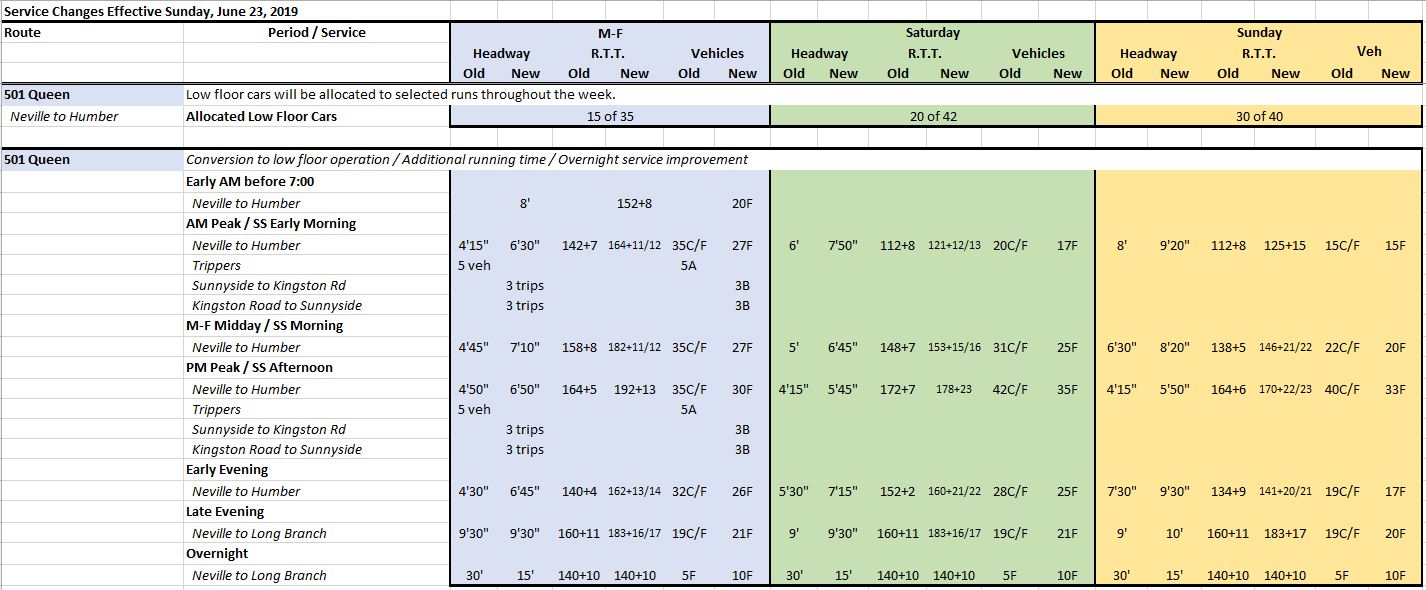
The 501 Queen car will begin to see Flexity low floor cars in weekday service depending on availability. The only scheduled ALRVs will be five peak period trippers, three of which will restore the direct-to-downtown trips to/from Long Branch arriving/leaving Yonge Street in the peak period. (Details in the file linked below.)

The 503 Kingston Road Tripper service, which has been operating to the Charlotte Loop at Spadina due to construction on Wellington, will switch to bus operation and will resume its Church-Wellington-York loop downtown. An end date for this change has not been set.

The 510 Spadina service will be revised so that the official recovery point for the 510A service to Union Station is near the south end of Spadina, not at the route termini. Internal schedules will be adjusted so that they reflect the scheduled location of cars properly. This, in turn, will allow vehicle arrival predictions to be more accurately calculated by NextBus and related apps.

The 511 Bathurst service will remain a bus operation pending availability of streetcars later in 2019.

The 512 St. Clair car will return to Roncesvalles Carhouse as its base of operations as construction has progressed to the point that part of the yard is available for vehicle storage. Trips to/from the route will be via King and Bathurst for the January-February period, but will shift to Roncesvalles, Howard Park, Dundas and Bathurst in mid-February when reconstruction of the King-Queen-Roncesvalles intersection begins. That project will trigger bus shuttle operations on the west end of 501 Queen and 504 King and the restoration of streetcars elsewhere on the network. Details have not yet been announced.

2019.01.06_Service_Changes

Superlinx: A Big Solution or A Big Con? (Updated)

Updated November 7, 2018 at 1 am: Details of the Environics poll conducted for the Toronto Region Board of Trade have been added to the end of the article. The content does not change my argument here, namely that the specifics of a new agency, its potential benefits or problems, were not presented in detail. The poll only measures a response to a generic scheme for provincial control to the extent that respondents might know about it. Of particular note, the Superlinx proposal came out in fall 2017 and had little media coverage in the period preceding the poll conducted almost a year later.

The Toronto Region Board of Trade published a proposal in November 2017 for the amalgamation of all transit agencies and operations in the “Toronto Corridor”. Ostensibly, this was written as input to the updated Metrolinx Regional Transportation Plan aka “The Big Move”. However, the guiding policy framework is clear in the first paragraph of “The Board’s Vision”:

The Toronto Region Board of Trade (the Board) has a vision for a modern transit authority that is best in class globally. This regional transit authority would plan and oversee a system that pays for new lines and superior service enhancements substantially through commercialized transit related assets—not new taxes. This modern transit authority would quickly deploy smart technologies and service features systemwide, thanks to its unified planning and operations platform. It would ensure public transit land is maximized to meet housing and commercial needs. It would plan and fast‐track the delivery of a super regional transit network to meet the needs of Canada’s most populous and economically active region—the Toronto‐Waterloo Corridor (the Corridor). [p. 3]

The key point here is that transit improvements, both capital and operating, would not require new taxes. This is a political holy grail, the “something for nothing” of political dreams in any portfolio. However, at no point does the Board of Trade actually run the numbers to show that this would actually work, that the money available from “commercialized transit assets” would actually pay “substantially” for the transit the Toronto region so desperately needs.

The Board speaks of the “Corridor” with an emphasis on the Toronto-Waterloo axis, but this simply restyles a region made up of what we now call the GTHA into a larger unit, and it includes substantial areas that remain rural where transportation needs and planning policy options are very different from those of the urbanized parts of southern Ontario.

At the time, I did not comment on the scheme, but with the change in government at Queen’s Park and the arrival of dogma as the central driver of policy choices, another look is in order.

On October 31, 2018, the Board of Trade published the result of a survey which claims to show overwhelming support for complete amalgamation of transit systems. Their press release is entitled “Greater Toronto and Waterloo region voters support Superlinx concept”. However, it is by no means clear that their panel is made up of actual voters, only adults. The spin begins before we even get into the substance of the release.

This was duly covered by the media, including The Star and The Globe and Mail.

The Environics poll of 1,000 adults in southern Ontario claims:

The concept of a single regional transit agency funded by the provincial government received support from 79 percent of regional respondents and 74 percent of Toronto respondents.

It is worth noting that the article on Environics’ site, identical to the Board of Trade’s press release except for the title, is not a detailed analysis of the results. It does not include the context in which questions were placed, and so it is impossible to know exactly what people thought they were “supporting”. No margin of error is cited because of the poll methodology, according to Environics. With only 1,000 responses that are further subdivided among seven municipalities, the sample for any one of them will be quite small. The sample size and demographics for each municipality are not included, nor is there any indication of transit usage patterns among the respondents, only car ownership. With the relatively low transit usage outside of Toronto, one can reasonably assume that the poll overwhelmingly reflects the opinion of people who do not use transit as their primary or only means of travel.

Among the measures polled was “satisfaction with the local transit system”, and this ranked second lowest at 59% in Toronto with York Region, at 55%, bringing up the rear. The high, at 71%, was in Peel Region. Ironically, Toronto and York also have the lowest agreement that the “commute has worsened in the past 12 months”. There is widespread support for the concept that “regional transportation systems require a significant overhaul”, but there is no sense of what this might entail. The Superlinx scheme also has strong support, but again we do not know how it was described to respondents.

Continue reading

TTC Service Changes Effective November 18, 2018 and December 23, 2018

The TTC will only make a few changes to its schedules for the November and December board periods.

November 18, 2018

Express Service Rebranding

Five routes will be rebranded into the new 900-series of Express routes. In all cases there is no increase in service, only a change in the route number.

  • 41E Keele express becomes 941
  • 95E York Mills express becomes 995
  • 131E Nugget express becomes 903, and will interline with 131 “local” service between STC and Old Finch.
  • 188 Kipling Rocket becomes 944 Kipling South Express.
  • 192 Airport Rocket becomes 900.

It will be interesting to see how long the 192 route number will live on in TTC maps to confuse the tourists.

Construction Changes

Work at Bathurst Station will be complete and the bus routes will resume their normal platform assignments.

Work at Kennedy Station will be complete to the point that routes normally on the north side of the bus terminal can use their regular bays.

Service Changes

One additional gap train will be scheduled on 1 Yonge University during each of the peak periods to fill service gaps.

Service on 505 Dundas (still operating as a bus route) will be rescheduled to remove some of the excessive running time with reduction of scheduled vehicles in some cases, and service improvements in others, notably Saturday evenings.

Service on 511 Bathurst (also still operating as a bus route) will return to the split version with a short turn at Front Street.

81 Thorncliffe Park will be changed so that it circles Thorncliffe counterclockwise at all operating hours rather than changing direction at 3 pm. The official “end of the line” will be moved out of the loop to Thorncliffe and Overlea so that passengers do not sit part way around the loop while the bus waits for its time. This will improve transfer connections with other routes on Overlea.

Weekday Run As Directed service will be reallocated as weekend Standby and Service Relief for the November-December shopping season including Sunday, December 23 (which is technically part of the next schedule period).

Other minor changes are listed in the details linked below.

December 23, 2018

For the two week holiday period, the usual arrangements will apply with many routes reverting to summer schedules.

No subway construction buses will be scheduled as there are no planned shutdowns during the holidays.

Late night service will be operated on most routes on New Year’s Eve. There has not yet been announcement about a sponsor for free service.

[The table linked here was corrected at:

  • 11:15 pm on October 20, 2018 to reflect that the Keele express buses terminate at Finch West, not at Pioneer Village, and at
  • 10:00 pm on October 21, 2018 to specify (a) articulated buses on the 41 Keele local service and (b) to include “before” figures that had been omitted.]

2018.11.18_Service_Changes

Where Have All The Riders Gone?

TTC ridership has been static for the past few years, as set out in the October 2018 CEO’s Report. Year-to-date ridership is down 3.2% compared to budget and 2.0% compared to 2017.

This is attributed to several factors:

Ridership has flatlined since 2014 due to various factors, including congestion, changes in customer mobility, and growth in digital ride-hailing services.

Another important factor that has adversely impacted ridership is the ongoing decrease in Metropass sales, which currently generate approximately 40% of total ridership. Specifically, there were 163,000 (-7%) fewer passes sold between January and August 2018, compared with the corresponding months in 2017. Although some of these lost sales have likely been offset by an increase in PRESTO e-purse transactions, the declining Metropass sales continue to have a significant impact on overall ridership trends. [p. 19]

The statements here present many factors, but do not attempt an analysis. One vital and missing component in the list is the question of service quality and capacity. If people cannot get on their bus, streetcar or subway train, or if the service is unpredictable enough, they will use transit as a matter of last resort, not as a first choice.

The entire concept of a monthly pass was to remove the incremental cost of taking another trip, something which (at least back in the late 1970s when the debate raged over whether Toronto could have monthly passes) was an important factor. Fares are still an issue, but service is a troubling component too.

The note about declining Metropass sales requires some explanation. The TTC, through user surveys, estimates the number of trips taken by the typical passholder in a month, and this sits at about 74. For every 100,000 passes they sell, they count 7.4 million trips. Obviously, the number of trips each passholder takes will vary, but things will average out. For example, in the first week of July when, by chance, I was part of the survey sample, I took 27 trips (and that’s counting a “trip” by the transfer rules then in effect). That translates to over 100 trips/month. The trips/day varied from a low of 2 to a high of 7. It was a busy week, and I made one or two round trips from home, plus a few stopovers, on the busiest days. If I had counted on the basis of the two-hour transfer, the “trip” count would have been close to 20 factoring out the stopovers and a few quick there-and-back-again round trips.

Because each Metropass sale translates to so many trips in the stats, the loss of a sale has a big effect on the total TTC numbers. However, the people who “fall off” the Metropass group are likely to be those whose usage was borderline break-even and for whom convenience of a flash-and-go card had a value in its own right. Presto eliminates that value, and it would be no surprise to see many passholders switch over. The actual trips lost to the TTC are, for these riders, fewer than the average Metropass usage.

The trips/pass for the remaining sales should go up if the low end of the market shifts to Presto, but it is not clear whether the TTC adjusts their multiplier frequently. The “lost” riding could be as much an effect of overcounting the lost pass sales (and associated trips), as it is a real decline in system usage. This problem will become even trickier with the two-hour pass available through Presto where trips that used to count as two (or more) fares will now only count as one.

Meanwhile, in response to the falling numbers, the TTC has plans:

To re-establish sustained ridership growth, a new Ridership Growth Strategy (RGS) is being implemented. RGS initiatives include implementing a two-hour transfer on PRESTO and relieving overcrowding on surface routes.

Research is also underway to analyze the changes in monthly Metropass sales and corresponding ridership impact. [p. 19]

If one goal of RGS is to relieve overcrowding, then it is clear that at least part of the system needs more service to handle demand even while official “ridership” is not growing. There may be routes with falling ridership, but even they must be viewed with caution lest the fall be the result of irregular or even reduced service.

Indeed, if there are overcrowded routes, why does the TTC not publish a list of routes, periods and locations where crowding is a problem that cannot be addressed without more capacity? Toronto cannot begin to talk about attracting new riders if it does not provide enough service to carry those who are already trying to use the system, or even understand the scope of the current system’s shortfall.

The two-hour fare will accentuate the split between the trend in “fares” (considered equivalent to “ridership”) and boardings on vehicles. (A “boarding” is one passenger getting on one vehicle, and each transfer counts as a new boarding, except on the subway which is considered one route for this purpose in TTC stats.) This will add to the confusion between apparently falling “ridership” and system crowding.

It is no secret that the TTC is capacity constrained. Although the bus fleet is now more reliable than ever thanks to better maintenance and the retirement of old clunkers, the actual size of the fleet is not growing because there is no place to put any more vehicles. Expansion plans are limited, as I have written before, and this is a major problem for the TTC’s future. On the streetcar fleet, new cars are gradually replacing old ones, and on close to a one-for-one basis bringing greater capacity to King Street this year, and to Queen in 2019. Subway capacity will not improve until early 2020 at best on Line 1 YUS, and 2026 or later on Line 2 BD.

Even the new Express Bus network has limited benefit because so much of it simply rebrands service that already exists rather than making a real improvement in what riders experience. Of the changes to date, the most striking has come on 29 Dufferin, but on many routes the service is identical to, or only a slight improvement on, the old “E” branches that are now 900-series routes.

The TTC has research underway on the effect of pass sales on ridership numbers, but this potential effect of the Presto migration was hardly unknown. If anything, the TTC has been derelict in placing so much focus on “ridership” while ignoring the basic question of service quantity and quality.

Former CEO Andy Byford set a management goal for a reduction of short turns and an improvement in on-time performance. This triggered various responses:

  • On some routes, scheduled running times were inadequate to actual conditions, and short-turning was inevitable. Running times were lengthened (and service was often scheduled less often to stretch available vehicles to match longer trips). However, in some cases the padding has been excessive leading to dawdling vehicles enroute and queues of buses and streetcars that arrive early at terminals.
  • When even padded schedules didn’t eliminate short-turns, the edict went out “thou shalt not short turn”. This can be counterproductive because there are cases where short turns are needed, but simply are not done and vehicles remain in a pack following a long gap.

The matter of “on time performance” is a blatant case of cooking the metrics to make management look good.

  • Previously, the TTC measured “on time performance” at various locations along routes. The results were not pretty.
  • The metric was changed to look only at terminal locations on the premise that service which is on time at the start of its trip will remain so as it moves across the city. Alas that is not so.

As we will see in a series of articles I will start publishing in coming days, there is a common problem on many routes that service may begin with vehicle spacing that is close to “on time”, but it takes only a short distance along a route for vehicles to catch up to each other and run in pairs or triplets. A further issue is that the TTC considers a bus or streetcar “on time” within a six-minute window, and this is meaningless for the frequent service on major routes. Because the service quality goal is only measured at the terminal, the actual reliability seen by most riders (who board elsewhere) is considerably worse than the values management reports.

For its part, Council looks at ridership numbers, sees a system that is not growing and says “why should we give you more money”? When added subsidy does come, it is as likely to go into fare reductions as to service growth, but lower fares are cold comfort if a rider cannot rely on transit for a timely and comfortable journey.

TTC Modifies Transition to Presto Annual Pass

Because of potential disruption in Canada Post services, the TTC has announced that it will end the mailing of Metropasses to Monthly Discount Plan (MDP) customers effective immediately. For the months of November and December 2018, the TTC will credit accounts of customers who would receive these passes with the equivalent of the discount.

This will allow those still receiving MDP passes to purchase a regular Metropass while having a net cost equal to the MDP value.

The TTC is also encouraging MDP customers to shift to Presto cards and will provide a $6 credit to MDP users on November 1 to cover the cost of purchasing a new card.

The use of physical Metropasses as we know them will end on December 31, 2018, and only the Presto equivalents will continue.

Tickets and tokens will remain available until the start of August 2019, and will be honoured for an as-yet unspecified time thereafter.