TTC Service Changes Effective January 2, 2022

The TTC has announced the service changes it plans to implement on January 2, 2022 as well as budgeted service levels through the year.

Originally, it was thought that the November 21, 2021 cuts would be restored in January, but this will be a gradual process beginning in mid-February.

Changes for January include:

501 Queen and 503 Kingston Road Services

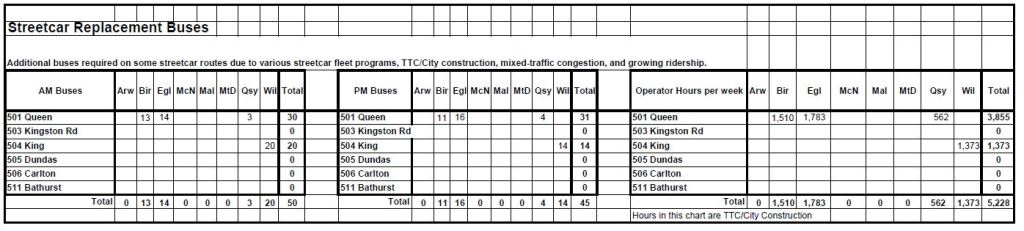
  • Streetcar service on 501 Queen will be extended to Bathurst Street but will remain on King because of construction issues at Charlotte Loop (see below). The division allocation will be changed to Leslie as this route now operates with pantographs while Russell is still using trolley poles pending reconstruction of that yard.
  • 503 Kingston Road service will become slightly less frequent to remove the blending with 501 Queen (a scheme that did not work very well in any event) and to reduce the amount of layover space required on Charlotte Street. The 503 cars will continue to operate with trolley poles and will run from Russell Carhouse.

At Charlotte Loop, construction at King Street will partly block the road and this will reduce layover space available. With only the 503 service using the loop, it will be able to lay over south of Adelaide while the 501 cars travel west to Bathurst and then north to Wolseley Loop.

Streetcar service via Queen to Bathurst will be restored in the mid-February schedules.

The 501 Queen service has operated through to Neville Loop since December 6, 2021, replacing the 501N Coxwell-Neville shuttle bus.

The 501L and 501H west end bus service schedules will not change in January, but in February they will be modified to remove excess running time and long terminal dwells.

At Broadview, the 501 buses have been (mostly) running north to Broadview Station since December 10, 2021. This burns up some of the excess running time and supplements the bus service on Broadview Avenue (water main construction there has still not finished). Southbound trips operate via Gerrard and River from Broadview.

Wilson Terminal

Construction at Wilson Terminal requires a reallocation of bus loading bays including space in the parking lot. The new arrangement is shown below. There are no changes in service levels.

Other Bus Route Changes

  • All routes at York Mills Station will resume using the regular terminal on December 24, 2021.
  • 21 Brimley will be shifted from McNicoll Division to Malvern Division to balance workforce requirements.
  • 25 Don Mills gained trippers in the AM peak (3) and PM peak (6) in the November 2021 service changed. The PM trippers will be removed in January, and the AM trippers in February.
  • The 75 Sherbourne construction diversion for water main construction will end, temporarily, for the Winter season, but will resume in early Spring. The weekend evening interline with 82 Rosedale will also resume until construction starts again.
    • Updated December 23, 2021 at 11:10am: The construction diversion ended on December 22, but the interline will not be restored until January when new schedules go into effect.
  • The route 600 Run-As-Directed buses will be partly restored as shown in the table below. Note that there is a total of 61 weekday crews, but the number of buses in service varies through the day with 25 in the AM peak, 47 at midday, 36 in the PM peak, 34 in the early evening, 12 late evening, and 2 ovenight. There is only one weekend RAD bus.

Service Budget

The service budget shows the planned level of service for budgeting purposes. As we saw in 2021, not all of the budget headroom was actually used. Here is the plan for 2022.

There is headroom to expand service in February and March to close to the pre-pandemic level (about 186,000 hours/week). This level will be achieved, if the TTC uses all of its budget room, in September 2022.

Note the decline in the budget for construction service late in the year on the assumption that Line 5 Crosstown will finally open and extra service provided to compensate for its construction will not be required.

Details of the Changes

Although there are few changes this month, the revised schedules are shown in the spreadsheet linked below.

TTC Holiday Period Services 2021-2022

The TTC will operate holiday schedules for the period around Christmas and New Year’s Day.

  • Until Sunday, December 19, the regular level of service (equivalent to earlier weeks in December) will operate.
  • Monday to Friday, December 20-24, the regular weekday schedule will operate, but without any school trips.
  • Christmas Day, December 25, will operate a holiday schedule. Service on the subway and most routes begins at 8 am.
  • Boxing Day, December 26, will operate a Sunday schedule. Service on the subway and most routes begins at 8 am.
  • Monday, December 27, will operate a holiday schedule. Service on the subway and most routes begins at 6 am.
  • Tuesday to Thursday, December 28-30, the regular weekday schedule will operate, but without any school trips.
  • Friday, December 31 will operate a weekday schedule supplemented by 600-RAD crews on the subway and limited additional bus service.
  • New Year’s Day, January 1, will operate a holiday schedule. Service on the subway and most routes begins at 8 am.
  • From Sunday, January 2, the regular service will operate. A small number of service changes are described in a separate article. Service continues at the level of the November 2021 schedules.

TTC 2022 Operating Budget: Board Meeting Follow-Up

Updated December 22, 2021 at 6:00 pm: The TTC has published the budgeted service hours through to December 2022. This information has been added to the section “When Will Full Service Resume?”

This article is a continuation from TTC 2022 Operating Budget picking up additional information from the Board meeting of December 20, 2021.

In recent years, budget development has been shaped by two factors: the constantly shifting outlook on the city’s economy in a pandemic environment combined with a Board that is predisposed to leave all policy development and analytical work to management. There is little or no advance discussion of budget policy and the entire package lands in the Board’s (and public’s) lap just before the holiday season and at a point where it must be approved to fit into the overall budget process at City Council. In 2022, the situation will be repeated because of the municipal election, and a new TTC Board will find one of its first major decisions will be to approve the 2023 budget.

When Will Full Service Resume?

For some time, TTC policy has been that full service would be provided once ridership hits 50 per cent of pre-pandemic levels. The system is already at 49 per cent overall, with the proportion varying by mode as shown below.

In these charts, the red line corresponds to the point of fare payment (the location where fare was first charged) while the gray line tracks “boardings” (transfer connections and other trips within the two hour window of fare payment). Note that these are percentages of pre-pandemic values, not absolute values.

The bus network overall is now at 60 per cent, streetcars and subways at about 40. This reflects the difference in areas served and the degree to which employment in bus-served areas does not lend itself to work-from-home arrangements.

More important, however, is that a 60 per cent average will mask times and locations where the value is much higher and much lower. The bus network, if considered on its own, already deserves “full service”, but was the victim of the November 2021 cutbacks and of the staff shortages that already existed. The disconnect between the real world of rider experience and management reports is that service is reduced system-wide even though the ridership loss is driven mainly by the subway. (The streetcar network has comparable percentages to the subway, but a much smaller ridership base.)

Statements about what would trigger a return to full service vary in subtle but important ways.

  • TTC policy says that a 50 per cent overall return of ridership should trigger 100 per cent service levels.
  • Actual staffing makes it impossible for this to occur before Q2 2022 even though ridership is likely to hit the 50 per cent mark in Q1.
  • In the 2022 Budget Highlights, the TTC states that the budget “Restores Pre-Pandemic Service Capacity in Q2 2022”. The operative word here is “capacity”.
  • In various places, the terms “in” and “by” have been used interchangeably, but they could imply “sometime within the quarter” as opposed to “by the beginning of the quarter”.
  • The commitment was further qualified by CEO Rick Leary’s statement during the Board meeting that a decision to resume full service would depend on ridership.
  • Later in the TTC’s press release, Chair Jaye Robinson is quoted: “The 2022 budget approved today gives us the flexibility to increase service up to pre-pandemic levels, in response to demand, while funding key sustainability and service improvement initiatives – all without raising fares for our riders.” This does not even commit to a Q2 return to full service, only that the budget headroom will exist for more service as and when the TTC decides to operate it.

An important caveat is that “full service” does not mean “identical service” because the pre-pandemic schedules no longer reflect today’s riding patterns in locations and times of demand together with a desire for some degree of distancing on vehicles.

As I write this, the planning memo detailing service changes for January 2022 has not been issued, and it is not yet known whether the TTC will even begin to restore some of the November 2021 cuts, a move that only a few weeks ago management claimed would occur.

Updated December 22, 2021: The budgeted hours for the 2022 schedule periods have now been published. See the table below. Note that service that is included in the budget is not necessarily operated as we saw through 2021. By September 2022, the budgeted regular service will be back to the same level as in January 2021 (186k hours/week).

How Much Service Do We Get Today?

CEO Rick Leary was happy to announce that despite the staffing problems, the TTC is fielding 90 per cent of scheduled service. On some days, they manage to hit 95 per cent. However, this is based on a reduced schedule effective November 21. Here are the numbers for the planned regular weekly service hours (excluding additions to cope with construction projects):

  • November 21, 2021: 165,859
  • October 10, 2021: 177,798
  • January 3, 2021: 179,130
  • January 5, 2020: 185,896

The difference between November 2021 and January 2020 is 11 per cent. However, the TTC is only operating 90 per cent of that scheduled service, and so what is on the street is 149,000 hours per week or 20 per cent below January 2020. Their ability to achieve service looks better when reported against a diminished schedule.

This is not to say that there are no fiscal problems with transit and the City’s ability to pay for better service. However, transparency requires that statistics be clearly reported, not spun to put the best possible light on the system’s performance.

A direct result of schedule cuts due to staff shortages, together with randomly cancelled services, is erratic service including the missing bus problem I have documented in many recent service analyses. Sadly, there was no discussion at all about problems of service reliability at the Board meeting even though the provision of “Safe, Seamless & Reliable Transit Service” is first on the list of 2022 service objectives.

“Customer satisfaction” and “Fiscal sustainability” are two key objectives, but these inevitably collide because service is provided based on available funding, not to hit a quality objective to please riders.

CEO Rick Leary routinely talks about “Run as Directed” buses, or RADs, as his solution to shortfalls in service capacity. He regularly overplays the effect that these have on the system.

  • A routine claim is that there are 140 RAD buses available to fill in on crowded routes. In fact there were 140 8-hour crews in three shifts with a maximum of about 60 buses at one time.
  • The RAD buses double as subway shuttles and vanish when part of the subway is not running.
  • The RAD buses are not trackable through transit smartphone apps, and riders cannot anticipate their arrival.
  • The RAD crews were cancelled in the November 21 cuts as a workforce reduction measure.

Updated December 22 at 6:00 pm: RAD crews will be partly restored in January 2022. There will be 61 weekday crews in all, but the maximum number of RAD buses at any one time will be 47 (weekday midday). There is only one weekend RAD bus on Saturdays and Sundays.

Continue reading

TTC 2022 Capital Budget

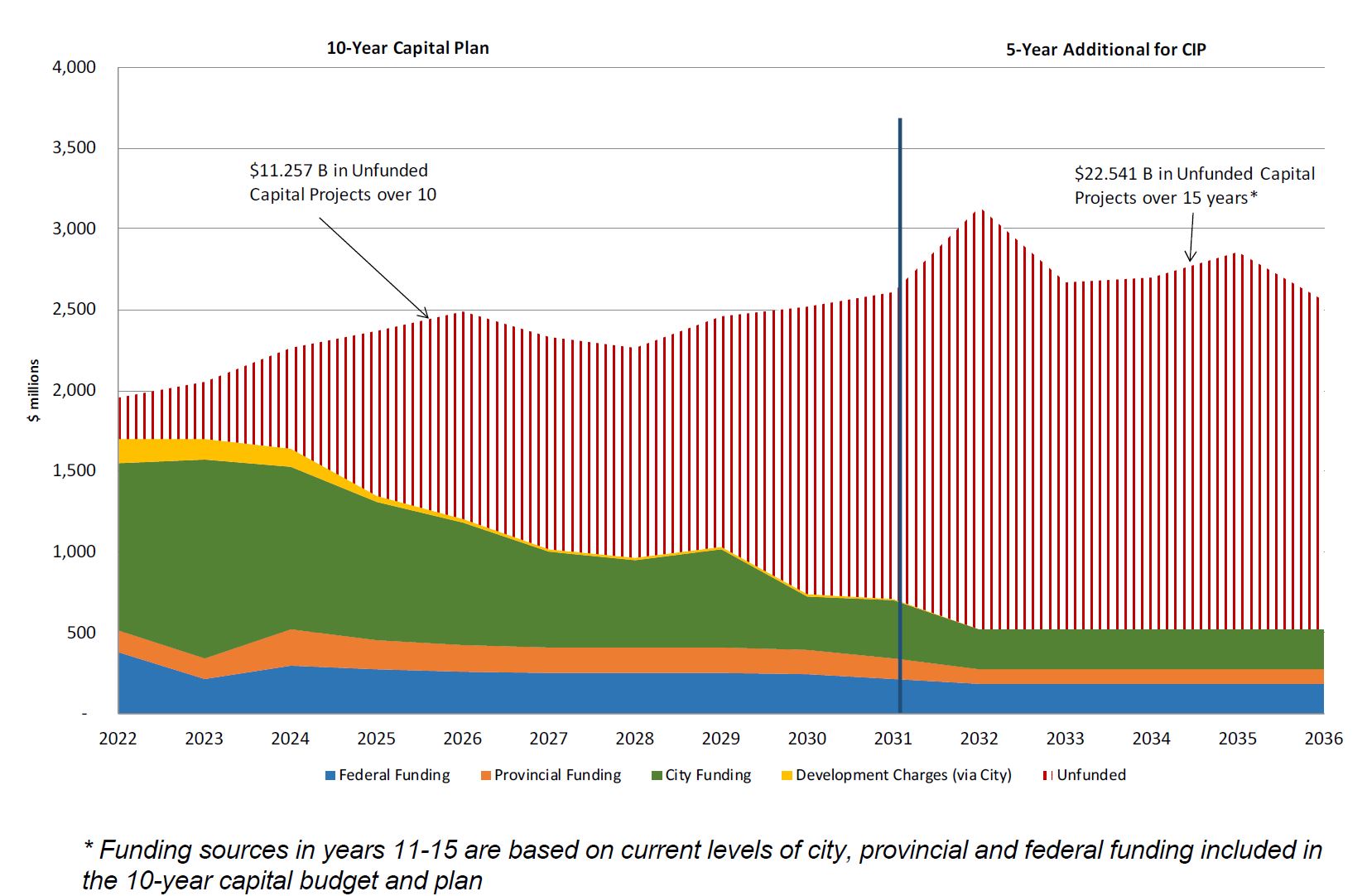
The TTC’s 2022 Capital Budget report has been published as part of the December 20, 2021 TTC Board meeting agenda. This includes three components:

  • A 15-year capital investment plan giving an outlook on all projects, funded or otherwise, to 2036.
  • A 10-year capital budget for funded projects.
  • A real estate investment plan that ties property needs into capital planning. This is a new component in TTC capital planning.

For political reasons, the capital plans before 2019 were low-balled to stay within available funding, but this hid necessary projects that appeared as a surprise to the TTC Board and Council. One way this was done was to class them as “below the line” (not in the funded list), but more commonly to push their supposed delivery dates beyond the 10-year capital budget window. This made the City’s exposure to future spending appear lower than it was in fact.

A particularly bad case was the collection of projects and contracts for ATC implementation on Line 1. In order to “sell” this badly needed project politically, it was subdivided and some resulting contracts used mutually incompatible technology. The original chunk was simply a plan to replace the existing block signals used from Eglinton to Union and dating from the subway’s opening in 1954. One by one, other pieces were added, but the disorganization was such that ATC was actually an “add-on” to the Spadina extension because it had not been included in the base project.

The situation was further complicated by awards to multiple vendors with incompatible technologies on the premise that each piece could be tendered separately without regard for what was already underway. A major project reorganization during Andy Byford’s tenure as CEO untangled this situation, and provided a “lesson learned” for the Line 2 ATC project.

In 2019, the TTC changed tack and published a full list of its needs and extended the outlook five more years. This came as a huge shock to politicians and city management when the capital needs shot up from $9 billion to well over $30 billion.

Continue reading

TTC 2022 Operating Budget

The TTC Board will consider its Operating and Capital Budgets at its meeting of December 20, 2021. This piece deals with the Operating Budget, and I will turn to the Capital Budget in a second article.

The Operating Budget is rather straightforward and the major points are summarized here:

  • No fare increase for 2022.
    • There is no discussion of change in the “Fare Pass” pricing or eligibility because that decision is made by Toronto Council as part of its budget process, not by the TTC who only implement whatever the City mandates.
  • Some of the service cuts of November 2021 will be restored in 1Q 2022, but full restoration to “normal” levels will come by 2Q 2022. The word “by” is important as it implies something that will happen at the outset of the quarter rather than on June 30.
    • There is almost no discussion of service quality as opposed to quantity measured in crew hours.
    • Ridership is not expected to return to pre-pandemic levels until late 2024.
  • A substantial shortfall remains between the standard level of subsidy available from the City of Toronto (i.e. the pre-pandemic subsidy level) and the total budget, although the gap is smaller than in 2021. Filling that gap depends on the generosity of the provincial and federal governments.
    • There is no discussion of a “Plan B” should this not materialize or what the effects on service might be
  • Some costs, such as the operation of Line 5 Crosstown, are net new and are unavoidable. Line 5 is described as opening in “Late 2022”.
  • Costs for the handful of service initiatives will be covered from internal “efficiencies”, reallocations and “second sourcing” of some functions.
  • The budget does not contain any provision for wage increases because the old contract expired in early 2021 and the new contract is in negotiation/arbitration. This is standard practice for all City budgets and adjustments are made after the fact to deal with costs from any labour settlements.

Note: All illustrations and tables in this article are taken from the TTC 2022 Operating Budget Report.

Continue reading

How Much Bus Service Could The TTC Run?

At a time when TTC ridership is sitting at just under 50 per cent of pre-pandemic levels, this may not seem the time to ask a question like this article’s title. However, the service effects of an operator shortage are felt across the system and may not disappear soon.

The TTC puts recent service cuts down to vaccine hesitancy among a small group of staff. Leaving aside the internal union politics and the constant skirmishes between ATU and TTC management, there is more going on here.

At its meeting on November 29, the TTC Board received a third quarter financial update, and there was considerable praise for how management has “contained” costs shifting the year-end outlook to one where the TTC will not actually use all of subsidy monies available. In fact, $36 million will go into the City’s transit reserve where original budget projections forecast a draw, not a deposit. That’s money not being spent on transit, and moreover, it sets the bar lower for a starting point in 2022.

A big contribution to that saving is that the TTC is not scheduling as much service as it budgeted, and even then is not staffing at a level where all scheduled service actually gets onto the street. Cancelled runs and missing buses are common, and this problem continues even on the reduced schedules of November 21.

This situation is a complete reversal from past years when anyone who said “give us more service” received a stock two-part reply: we have no buses, and even if we bought more, there is no garage space.

The problem today is not buses – it is operators to drive them.

In this article, I turn the question around and ask how much service the TTC could provide if only they hired enough staff.

In Brief

The TTC has always owned substantially more buses than it requires to operate service. This is perfectly normal for any transit system, but the gap between what the TTC owns and what it operates widened over the past decade.

The proportion of the fleet that is “spare” (a word embracing many factors) has grown for two related reasons. Buses are more complex than they were a few decades back, and that affects maintenance work. Historically, the TTC aimed for a 18-year bus life cycle, but they are working toward a 12-year cycle to advance retirement of lower-reliability old buses and avoid the cost of major overhauls to keep them running. They have not yet reached that goal, and currently planned bus purchases do not fully achieve this.

One might argue that it says something about the robust nature of older buses compared to what we see today. To some extent, a shorter lifespan target can be a self-fulfilling prophecy when maintenance plans assume that a 12 year old bus will be discarded, and buses in what was once a middle age of 8-10 years are now seen as elderly.

There was a time when a ratio of buses in service to those held aside as spares was between 7:1 and 6:1, or a spare factor close to 15 per cent. By about a decade ago, this ratio fell to 5:1 or a 20 percent spare allowance. Since then, as a deliberate policy, the TTC has allowed it to fall to 4:1. There is no sign yet of a return to a better ratio. Two factors – a younger bus fleet and the benefits of electrification (partial or complete) – are yet to be reflected in the provision for spares. This affects not just capital costs – more buses are needed to provide a given level of service – but also the need for garage space.

In the pandemic era, the number of spares has risen considerably and the ratio is in striking distance of 2:1 thanks to recent service cuts.

If the ongoing cost of operating the TTC falls because of cutbacks, then the challenge to restore funding faces the double hurdles of cost inflation and a return to historic service levels both for operations and maintenance.

Turning back the clock can be difficult if a generous spare ratio becomes a “new normal” and buses can simply be sidelined rather than repaired. Even worse, if capital to buy new buses is plentiful, but operating funds to maintain the fleet are not, garages can fill up with vehicles that are tempting spare parts stores. This happened decades ago in Boston from which TTC CEO Rick Leary hails (but not on his watch).

Unpopular though this could be in some political circles, the TTC should ask the question: what service could we operate with the existing fleet if only we had enough money to hire drivers for all of the buses? Don’t tell Toronto what we “can’t afford”, tell us what would be possible and how much this would cost. This is a perennial problem with the TTC: a failure to advocate for the best we could have.

Continue reading

TTC Ridership, Finances and Service as of November 2021

The agenda for the Toronto Transit Commission board meeting on November 29, 2021, is rather thin considering that the board has not met for some time, and there are major policy issues worth discussing about the system’s future.

Two major reports are:

Ridership

TTC ridership continues to run below budget projections, although it has been growing. Recently it has been tracking near budgetary projections, but shortfalls during stay-at-home periods earlier in 2021 have kept the year-to-date total below expectations. Although we are now almost at the end of November, only data to the end of September are reported here.

Another view of ridership is based on “boardings” where each transfer (except between subway lines) counts as a new boarding. In transit parlance, these are “unlinked trips” as opposed to the “linked trips” that have traditionally been associated with individual fares paid. Even that gets tricky with passes including the two-hour transfer.

Relative to pre-pandemic demand, the bus network is at 55%, streetcars are at 42% and the subway is at 38%. Updated data showing recent experience would obviously be useful here to see whether riding has plateaued, or if it continues to grow, especially in light of recent service cuts.

Demand on Wheel-Trans is down substantially compared both to pre-pandemic times and to budget projections.

Bus occupancy has grown steadily over the year. An important point about the chart below is that it is measured trip-by-trip rather than being averaged over all trips on the system. What we do not know, however, is how many of these trips have high loads because the affected bus is running in a gap, and how many are because the service overall has less capacity than required for demand. Also, of course, we do not see the distribution of crowded trips by route or time-of-day.

An important issue here is that as overall demand recovers, the TTC plans to set its crowding targets progressively higher until they reach historical pre-pandemic levels. If service, and hence crowding, are irregular, then some buses will operate well beyond comfortable or attractive levels even as (and if) riders get more used to being in crowds.

Overcrowding was a constant complaint in pre-pandemic times, and Toronto should not aim simply to return to an overstuffed system. However, more service costs money and that is in short supply, even for politicians who are truly pro-transit at budget time.

Continue reading

TTC November 2021 Service Changes Update

This article follows on from TTC Announces Widespread Service Cuts Effective November 21, 2021. When that article was written, the TTC had published an overview of the service changes, but many specifics were omitted.

Since the article appeared, more details have been released both through the TTC’s standard memo describing service changes, and by the detailed schedules available on NextBus. Another source, the GTFS version of schedules used by many apps, has not yet been updated on the City’s Open Data website as of 7:30am on November 22. The TTC’s Scheduled Service Summary usually appears on their Planning page a few weeks after a schedule change, and it is not yet available.

Using the available information, I have updated the spreadsheet of changes (below). Because there is so much detail showing existing and planned service, as well as data for periods where there is no change, the cells with new headways (the time between vehicles) or new vehicle assignments are shown in bold italics.

Types of Schedule Changes

The TTC has described these changes as an effect of their staff shortage accentuated by Covid vaccine mandate.

As a result of operator workforce shortages, Line 2 Bloor-Danforth, one streetcar route, and 57 bus routes will experience temporary service reductions and/or period of service suspensions.

There is definitely a reduction in total scheduled level of service as shown in the table below.

Source: TTC Board Period Service Memo for November 21, 2021

For most of 2021, the regular service has operated at 3-4 percent below the planned level, although this is partly offset by a requirement for more construction-related service than planned. In November, the regular service will be about 11 percent below the planned level with a small offset in construction service. The reduction in the holiday schedules (“December” in the chart) is lower because there would normally be less service then.

In past months, the TTC was already short-staffed and cancelled some crews rather than filling them using overtime.

A change that reduces operator needs but does not affect service levels is that One Person Train Operation (“OPTO”) which will be introduced on Line 1 Yonge between Vaughan Centre and St. George Stations. This has been used as a trial since August 2021 on Sundays, and this will expand to 7 days/week.

Bus – The bus service hours include 190 open crews that will be assigned on overtime.

Subway – In the November 2021 board period, on Line 1, one-person train operation will be implemented on weekdays and Saturday in addition to Sundays which was implemented in the August board period. The reduction in service hours represents a reduction in operator requirements. There is no change to service levels on Line 1. This service change was budgeted to be implemented in the December 2021 board period.

Source: TTC Board Period Service Memo for November 21, 2021

Another change is that the “Run As Directed” crews which required about 100 operators per day have been cancelled.

Some schedule changes do not involve a reduction in the number of vehicles (and hence operators) assigned to routes, but are due to schedule revisions that would normally be described as “reliability” updates.

In those cases, scheduled travel times are adjusted, usually increased, to reflect on street conditions. When this occurs with no change in vehicle assignments, headways get longer. For example, if a route were served by 10 buses on a round trip of 50 minutes, the headway would be every 5 minutes (12 per hour). If the round trip is changed to 60 minutes with no additional vehicles, the buses would come every 6 minutes (10 per hour), but with no change in staffing.

In some cases, the previously scheduled travel times were too long causing vehicles to bunch at terminals, and new schedules trim back the running time usually with a reduction in vehicles, but not necessarily a reduction in service level.

Changes to running times would not be backed out when the TTC restores service levels.

A related issue is that traffic congestion is building on major routes and this will require longer scheduled travel times and more vehicles over the coming year, in addition to whatever service is needed to cope with return of demand to pre-pandemic levels. This is an added pressure on the need for operators, but not (yet) vehicles as the TTC has a surplus of equipment in all modes going into 2022.

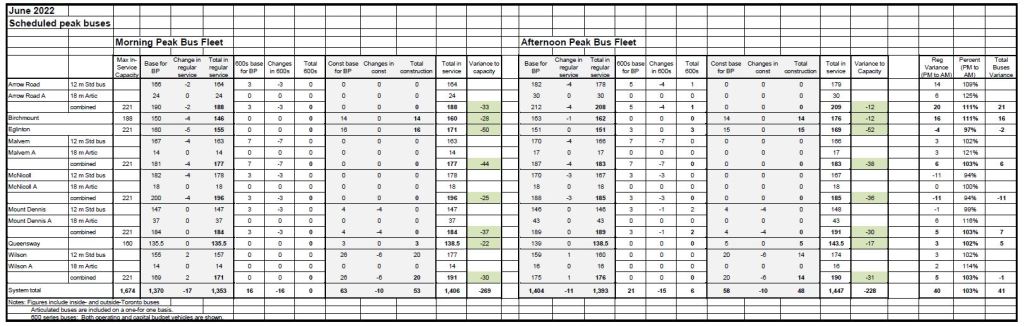
The total number of buses in service will drop with the November schedules as shown below. Note that the “Max In-Service Capacity” reflects garage capacity and the fleet is actually over 2,000 vehicles. The TTC is only using about two-thirds of its fleet and has a wide range for service growth without buying any new buses. The real problem for some time has been a shortage of operators.

Source: TTC Board Period Service Memo for November 21, 2021

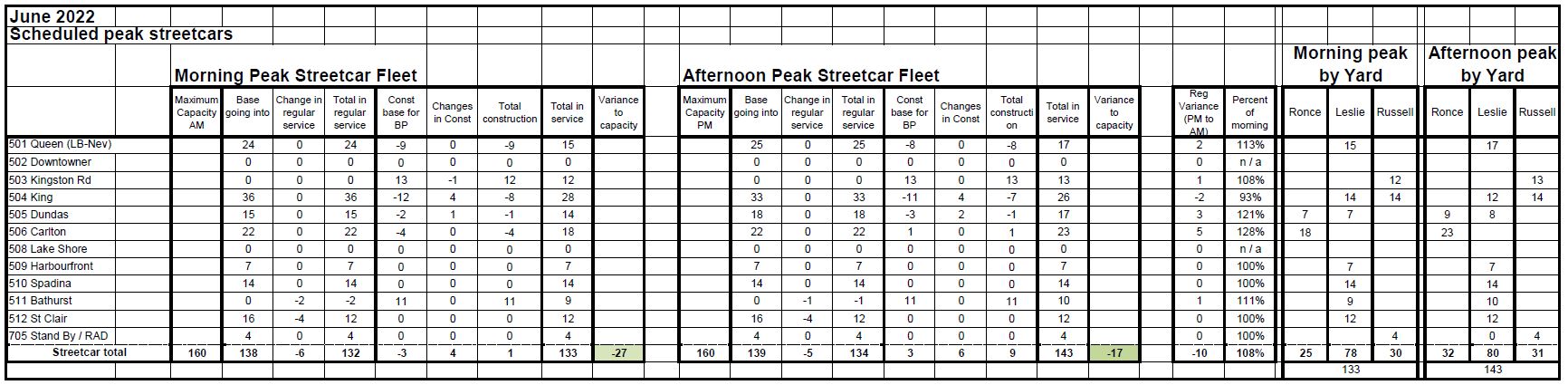
For the streetcar fleet, peak requirements remain at 140 vehicles out of 204. By sometime in 2022, the major repair project for the Flexitys will complete, and the TTC will be able to operate more of its streetcar network with streetcars. Delivery of an additional 60 cars on order from Alstom will not begin until 2023.

The remainder of this article gives a route-by-route overview of the service changes, and the fine details are in the spreadsheet linked below:

Continue reading

TTC Announces Widespread Service Cuts Effective November 21, 2021

With no fanfare at all, the list of planned service changes for November 21, 2021 has appeared on the TTC’s website.

As a result of operator workforce shortages, Line 2 Bloor-Danforth, one streetcar route, and 57 bus routes will experience temporary service reductions and/or period of service suspensions. Provisions have been made to protect service on the busiest corridors in the system during the busiest periods. November schedules will continue into December, with some minor adjustments.

TTC Service Change Notice for November 21, 2021

As I have recently documented in a series about service reliability on short routes, the TTC has already been missing buses regularly on its service, and there would be problems even without the ongoing issue of service reliability and an abdication of headway management.

I do not yet have the detailed memo explaining service changes thanks to the TTC’s email system outage, and can only report at this time on the information in the TTC’s post. When I do get the memo, I will produce the usual detailed spreadsheet showing all of the changes.

Changes Unrelated to Service Cuts

A few changes are due to factors other than the need to cut back on service.

  • In September, the 60 Steeles West bus was cut back to Pioneer Village Station and the 960 Steeles West Express took over the western portion of the route during most periods. The service level west of Pioneer Village has proven too low, and the 60 Steeles will provide a 15 minute service west to Kipling on top of the 960 during weekday daytimes.
  • The 953 Steeles Express will now stop at Leslie Street both ways.

Construction Changes

  • 75 Sherbourne will divert via Jarvis street between King and Dundas Streets due to water main construction until late December.
  • 501 Queen, 504 King, 505 Dundas and 506 Carlton (together with related night services) are affected by various projects. Details are in a separate article.

Service Cuts

Service on many routes has been trimmed, and some express operations have been dropped. The details, to the extent that they have been published, are shown in the spreadsheet linked below.

In many cases, I have simply put “Reduced” against a time period until I know the specifics of the changes. This spreadsheet will act as a template to accumulate information as it becomes available.

TTC Plans Service Trimming in November 2021

The TTC has announced that for the schedules coming into effect on November 21, 2021, service will be trimmed in response to the reduction in staff available due to the Covid vaccination mandate.

The plans are focused on protecting and maintaining scheduled service on the busiest routes

TTC Media Release, October 27, 2021

The TTC will give priority to the busiest routes in the system and the busiest times of the day, particularly bus routes where ridership has returned more strongly than on other parts of the network. The announcement cited “Wilson, Jane, Eglinton, Finch and Lawrence East, among others”.

Changes on other routes are described as similar to seasonal adjustment for summer and Christmas/New Years. The hours of service will not change. The level of service will be based on TTC Service Standards.

Operators will be made available for service in several ways:

  • Capital projects will be temporarily deferred and weekend/night-time closures will be cancelled so that shuttle bus operators are available for regular service.
  • New operator hiring will continue over “the next several months”.
  • Operators now used for moving vehicles between divisions will be redeployed to regular service.
  • Recently retired operators will be invited to return to work on a temporary basis.

Employees who are unvaccinated or have not shared their status by the end of the day on Nov. 20 will be placed on unpaid leave until they receive all their required vaccine doses, or Dec. 31, whichever comes first.

These measures do not apply to employees with an approved Ontario Human Rights Code exemption.

As of today, 88 per cent of the agency’s 15,090 active employees have shared their COVID-19 vaccination status. In total, close to 86 per cent of unionized, and 94 per cent of non-unionized employees have shared their status with the vast majority already fully vaccinated.

TTC Media Release, October 27, 2021

When I receive the detailed memo of planned service changes, I will produce the usual breakdown for readers.

Although I am sympathetic to the labour-management strain of this situation, there are a few home truths for either side.

Operators are in an essential, public-facing role. Both their vaccination and disclosure to the TTC should not be up for debate. This should not be a matter either on the basis of one’s political preference or as a side-effect of the contentious labour-management relationship.

A major problem today with service quality is that route supervision is sorely lacking, especially at evenings and weekends, as my ongoing series of route-based reviews shows. Operators who habitually run nose-to-tail with other vehicles, and supervisors who do not break up such bunching, are equally to blame.

A further problem exists in a shortage of operators for the scheduled service today. Buses vanish from service when relief operators fail to appear to take over vehicles. The missing buses compound other service reliability issues.

As for management, statistics purporting to show that good service is provided tell more about the pursuit of gold stars on their report cards, than of a real care for service quality. At the political level, the TTC Board seems utterly unwilling to demand that the organization provide reliable service and that metrics truly reflecting what riders see are used to monitor quality.

The TTC claims that they have run-as-directed buses to fill gaps. However, the prevalence of gaps on the few routes I have already reviewed in detail implies that the number of RAD buses is far fewer needed for this task. The generally laissez-faire attitude to route management suggests nobody even notices or cares when service is out of whack, much less dispatches RADs to fill in. The TTC produces no report showing how these vehicles were used, and they are difficult to track with the vehicle location data feeds. There is also a basic question of how these vehicles can fill gaps when they are also used for subway shuttles.

These will be difficult months for riders just at a time when demand on the system builds up again. The TTC refers to its Service Standards, but riders on any busy route will recount tales of overcrowded vehicles and pass-ups of waiting passengers. With erratic service it is impossible to know which of these situations are due to route overcrowding and which to poorly regulated vehicle spacing.

The TTC tells riders that service meets “standards”, but those are based on averages and have wide margins for missing targets. The effect is something like a guarantee that the sun will shine and weather will be good “on average”.

I hope that drivers who have not disclosed do so and are able to return to work as soon as possible. This is not a case of “individual rights” but of workplace and public safety. As for those who have no legitimate reason to go unvaccinated, let them find work elsewhere if anyone will hire them.

As for TTC management, it is time to acknowledge problems of bunching and gapping, and to actively work against them. The TTC Board should demand this as a basic management goal. If management is unwilling or unable, then find new management.

TTC service is only as good as the TTC makes it, and recovery, even without staffing challenges, depends on doing the best possible for riders.