TTC Board Meeting December 8, 2022

The inaugural meeting of the TTC Board for the new term of Council met on December 8. As is common for the first meeting, the agenda was light, and the event was more ceremonial than substantive.

Councillor John Burnside is the Board’s Chair, replacing Councillor Jaye Robinson who was not re-appointed.

Joanne De Laurentiis, who acted as Vice-Chair in the past term, was re-elected to the position. Note that terms of citizen members are not coterminous with the Council term, and so she remained on the Board through the recent election.

CEO’s Report

The Board received a presentation from staff as background to the CEO’s Report. A chunk of this was introductory giving some background on the TTC and its recent accomplishments. It included a short section on ridership and plans under the the title “Key Focus on Service and Customer Experience”.

CEO Rick Leary talked about the benefits of the move to Automatic Train Control on all of Line 1 and the implementation of One Person Train Operation. He cited a recent case where the TTC achieved a throughput of 32 trains/hour at Bloor Station between 8 and 9am, an increase over the typical pre-pandemic level of 24 to 26.

Note that this would have occurred after a gap with a backlog of trains, not as a routine level of service. The AM peak scheduled level sits at 21 trains/hour plus a few gap trains if needed. One advantage of ATC is that it provides a faster throughput of bunched trains after a delay at choke points like Bloor where platform dwell times are long.

Ridership continues to recover on the system, although only modest growth is expected for 2023 due to the effect of work-from-home. The bus network, which serves proportionately more trips that are not amenable to WFH, continues to show the best performance carrying 77% of pre-pandemic demand.

Weekday ridership sits at about 70%, while weekends do better at 80%.

Trips on the TTC occur for many reasons. Note that in the chart below, the percentages for October 2022 are on a ridership base about one third lower than the pre-covid values. The category “Professional and General Office Commutes” has not only fallen from a 28% to 22% share, but on a smaller base. Some percentages increase because their category is now measured against that base. For example, “Market Trips” went from 7% to 9%, but this still represents fewer trips.

This chart is important because it shows how many transit trips are not traditional office commutes, and that the wide variety of demands do not necessarily fit a system organized only to handle office workers.

Customer satisfaction is a softer metric than trip counts, but the general trend in 2022 has been downward, notably in October with the increased crowding levels associated with stronger ridership.

This is echoed by both crowding and wait time being two areas of dissatisfaction, especially wait time. TTC staff noted that customer pride ranks higher with frequent riders, while satisfaction ranks higher among infrequent riders.

Continue reading

TTC Service Changes: Holiday Period 2022/23

As is usually the case, the TTC will implement modified schedules during the two-week holiday period which, because of the lie of the calendar, runs from December 25 to January 6 this year.

Several routes will revert to June 2022 summer schedules for the weekdays within this period. No changes are planned for Saturday and Sunday schedules. Many of the summer schedules have the same service frequency, but with fewer buses and shorter travel times reflecting reduced passenger and road traffic.

No school trippers are operated during the holiday period, and service is reduced on some routes serving post secondary campuses.

Late night New Year’s Eve service will operate until about 3am on most routes including all rapid transit lines.

Service will operate free of charge from 7pm on December 31 to 8am on January 1.

Details are in the spreadsheet linked below.

So You Want To Be A TTC Commissioner (2023 Edition)

Our brand new City Council meets this week. After the requisite speechifying and back-patting typical of the inaugural gathering, they will get into the business of appointing members of various Committees and Boards, including the one that runs the Toronto Transit Commission.

There are two sets of Board members: Councillors and citizens, a.k.a. civilians who (in theory) are not politicians. Only the first group will be appointed at this meeting, and the citizen members will come up for review in the new year once the City goes through the motions of soliciting applications.

The choice of a TTC Chair is up to Council, although it’s hard to believe that a nod from the Mayor, even without any new powers, would be ignored.

On the past Board, the Council members were: Jaye Robinson (chair), Brad Bradford, Shelley Carroll, Cynthia Lai, Jennifer McKelvie and Denzil Minnan-Wong. Of these, Councillor Lai died just before the election, and Minnan-Wong chose not to run. The Chair’s job should go to someone with experience and a strong commitment both to transit and to making something of the position, not just being a seat warmer.

Oddly enough, none of the existing Councillor/Commissioners has asked to be reappointed. This could lead to turnover (good, maybe) but also the loss of institutional memory at the Board level. That works to management’s advantage, but an organization as large as the TTC needs experience at the top for policy and oversight, not just ribbon cutting.

The new Board, to be confirmed by Council today, will have Councillor Burnside as Chair, with Councillors Mantas, Holyday, Moise and Ainslie as members. The citizen positions will be filled separately in the new year, and current members remain in office until that occurs. I cannot say that I am enthusiastic abouy Burnside as Chair, and do not expect much advocacy from that quarter beyond a knife aimed at the budget, and hence the quality of transit service.

The new Board will face very, very serious problems affecting transit’s future in Toronto. As pandemic-era financial supports wind down, the TTC will simply not be able to afford to operate service without new revenues through fares or subsidies. Moreover, their capital plans vastly exceed available resources.

Since 2020, the struggle has been to just get past the crisis, but the TTC faced a bleak outlook even before the pandemic. I have no crystal ball or magical insights, but offer this article as advice to the new Board.

Continue reading

What Should Be Done With Spadina and St. Clair?

This article was originally going to be a very long reply to a comment left in the Spadina vs Bathurst thread, but I have moved it to its own article for better exposure.

I received the following comment from someone whose identity I will keep to myself. You know who you are.

Steve, I am a political strategist at the municipal level here in Toronto. I have a meeting with some new inner city Councillors next week (+ the Mayor) who are interested in this issue of streetcar speed and reliability (as am I as a fervent reader of your blog!).

Putting aside cost and political barriers for the moment: from a purely technical perspective, what measures would you recommend implementing on the Spadina and St. Clair streetcar routes to speed them up without losing ridership?

For instance:

  • Are there any stops on the Spadina line, near or far side, that could be eliminated while still retaining the riders who use those stops via other stops?
  • What kind of TSP [Transit Signal Priority] extension would yield the best results if having to choose between the two: extending the seconds of green light extension OR maintaining the green light extension window while simultaneously allowing for more active TSP (ie rather than just if it’s late)?
  • How much time would be saved if all far side stops were eliminated on Spadina and St Clair?
  • How much delay does the lack of grade separation for the final/first leg of the St Clair route (ie when it’s entering or leaving the station and having to wait for cars and pedestrians) cause? Would installing a signal system for that unprotected stretch that prioritizes the streetcar result in any substantial gains?

Open to all thoughts and suggestions – many thanks 🙂

I am replying to this in public because (a) the comment was left in the public thread rather than sent in a private email, and (b) my answers will be of interest to other readers.

Continue reading

TTC Demand Bounces Up In September 2022

The October 2022 CEO’s Report has been posted on the TTC’s website. Although most of the charts in this edition run only to the end of August, the ridership and crowding chart data extends to the end of September. The two charts below show how strongly ridership improved between the summer and fall periods.

At the end of September, bus demand on weekdays rose to 75 per cent of pre-pandemic levels, while streetcars sat at 55 percent and the subway at 63. The difference reflects the weak return of demand in the core area which is served by streetcars and the subway.

The TTC reports that in pre-pandemic times, post-secondary students and office workers represented 22 and 38 per cent, respectively, of total demand. Downtown offices were about one-third full in mid-September.

In the chart below, note that although the streetcar portion (green, hiding behind the boxes with values) has not widened very much and sits roughly at summer levels. The green stripe sits higher because the bus (red) and subway (blue) portions of the bars have grown.

How long this will persist is difficult to project. Anecdotal observations from my own travels on streetcars give the sense that demand was up in October, but the actual stats will not be out for another month.

Another factor whose effect is hard to judge is the many construction projects that remove streetcar service, or interrupt it with bus replacements. Some trips might never be taken, or might travel via a different route served by buses. The streetcar system will not be back to “normal” until early 2023, and there is always a lag between loss of ridership and recovery as would-be users discover that service has improved. Although the TTC plans a campaign to lure riders back, there has to be something worth riding.

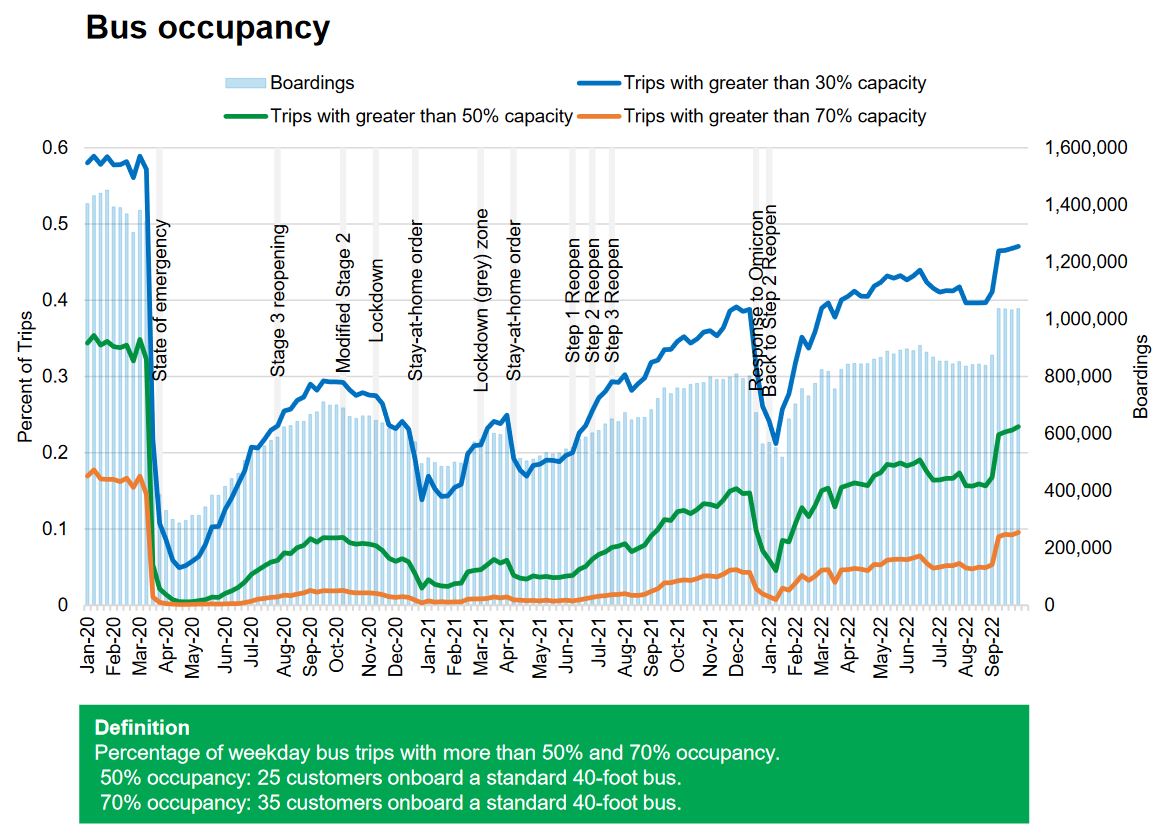
Another measure of demand is the rate of bus occupancy at various levels. This is measured with Automatic Passenger Counter data. The streetcar fleet does not yet have APCs installed on all vehicles, and so comparable stats for the streetcar routes are not available. (Note that this chart goes back to January 2020 whereas the chart of boardings above only begins in April 2022. Earlier boarding figures are available in older CEO reports.)

An overall observation here is that in the absence of a major new wave triggering reduction in travel, the chart shows a consistent growth. Even the dip in mid-2022 is a typical seasonal decline and the September data continue the trajectory of Spring 2022 numbers. This is for the bus network, and a comparable trajectory does not necessarily apply to other modes as shown in the boarding counts above. Crowding numbers can also be affected by service levels, although there has not been a major jump in service that would dilute the occupancy numbers.

Particularly striking here is the big jump in trips above 70% capacity which are now about 10% of total trips, and a similar large jump in trips above 50% capacity to about 23% of total trips. This reflects a demand growth that is greater than the rate of capacity growth.

The TTC observes:

While crowding has increased in line with boardings demand heading into September, the continued growth in high-occupancy bus trips suggests demand is growing more concentrated around a number of key trips.

TTC CEO’s Report, October 2022, p. 27

As the busy routes become more crowded, more riders will see a crowded bus even though the majority of trips will still be uncrowded. The perception of crowding will be greater than the overall average value. This is an inevitable situation on a transit system where demand is not evenly spread in time or place on the network.

However, if the stats are misinterpreted or misrepresented by those looking for “efficiency”, the problem is that the capacity from emptier trips cannot always be reallocated. Some routes have strongly directional demand, and will always be lightly loaded in the counter-peak direction. Those trips, however, are an integral part of the route even though they can pull the “average” load down.

In an extreme example, if a bus is at 100% capacity travelling east and 0% going west, the “average” says that only half of the one-way trips are crowded. Obviously one cannot have the eastbound trips without the westbound returns. Real routes are more complex, but this shows how simplistic analysis can lead to dubious conclusions.

Some routes have lighter demand, but still meet the TTC’s Service Standards for boardings per bus hour. They might never accumulate a full load and therefore appear to be targets for service cuts. However, in the process the service becomes less attractive and ridership can fall further.

A critical factor will be service reliability which, as I have documented at length elsewhere, leaves much to be desired notwithstanding TTC metrics that purport otherwise. Some crowding is a direct result of bunched and missing vehicles which create gaps and heavier loads than evenly spaced service would.

The City faces a large operating deficit both for 2022 and projected for 2023. To what extent this will result in limits on TTC service and a move to improve “efficiency” with more riders per bus remains to be seen.

TTC 2023 Annual Service Plan, Round 2

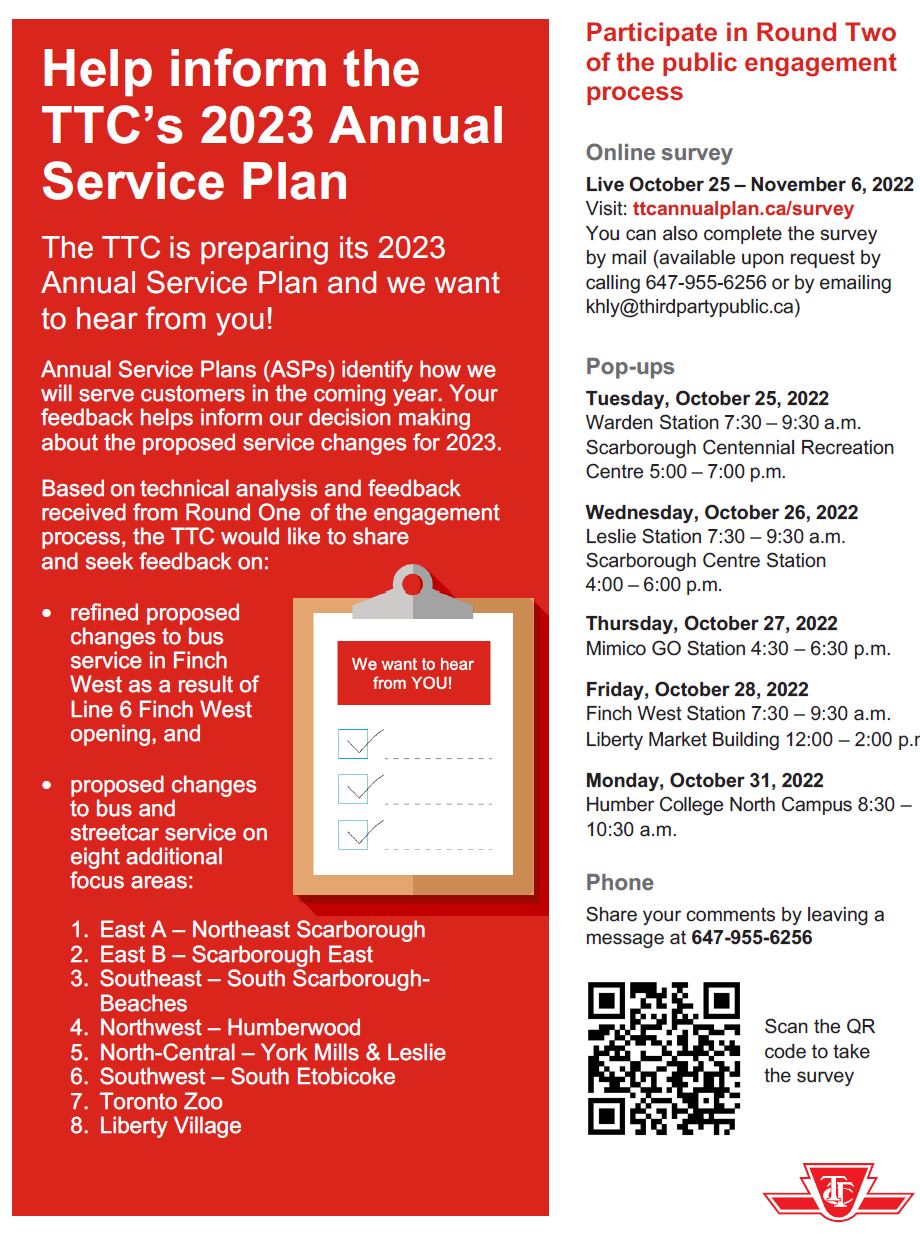
The TTC recently launched public consultation for its 2023 Annual Service Plan (ASP).

This is the second round following preliminary sessions in June-July. The planners reviewed overall goals in light of changing demand patterns and system-wide rerouting associated with the closing of Line 3 SRT and opening of Line 6 Finch West. (The network changes for Line 5 Eglinton Crosstown were dealt with in the 2022 ASP, although there has been slight tweaking.)

Some of the 2022 Plan’s proposals have not yet been implemented, although they remain on the books as “approved”:

  • 8 Broadview: Extension south from O’Connor to Coxwell Station
  • 118 Thistle Down: Extension northwest to Claireport Crescent
  • 150 Eastern: A new route from downtown to Woodbine Loop (on hold due to potential construction disruptions)

See also:

In 2023, there are considerably more proposed changes than in 2022, and for the purpose of consultation the TTC broke the system into segments. Each of these is detailed later in this article.

Consultation is now underway with the following planned schedule:

  • October-November: Public consultation. (See schedule above.)
  • Late 2022/Early 2023: Councillor briefings
  • February 2023: Final report to the TTC Board
  • Spring 2023: Implementation begins
  • Through 2023: Five Year Service Plan “reset” continues

The 2023 Annual Service Plan web page includes a deck of panels that will be used for the consultations. In this article, some maps are taken from that deck, and some from presentations to community groups.

An online consultation is available from October 25 to November 6.

One key point we will not know until late 2022 or even early 2023 will be the TTC’s budget target. How will this shape service changes, be they additions, re-allocations or cuts? Mayor Tory talks about supporting transit, but we will see just what this means when he tables the City’s 2023 budget.

Note: I have not included all of the information posted by the TTC here, and I urge readers to review the presentation panels and any other information the TTC publishes as this process goes on.

Although this article is open for comment, is you have specific concerns and wish to participate in the consultation process, be sure to complete the TTC’s survey or otherwise communicate your feelings to the TTC. I am not the TTC Planning Department, and grousing to me, or proposing your own maps here will not feed into the process.

Continue reading

Will Line 2 Renewal Ever Happen?

Those of us who can remember back to days before the pandemic, when Andy Byford was the TTC’s CEO, will know that there were frequent questions at the TTC Board about upgrades to the Bloor-Danforth subway, Line 2. All of the focus seemed to be on the Yonge-University-Spadina Line 1 with new signalling, trains and the Vaughan extension.

Byford confirmed that work on a Line 2 plan was underway, but never presented one in public. However, it does not take a lot to work out what might have been in this plan.

  • Automatic Train Control (ATC) signalling to replace the 1960s-era technology still in use.
  • New trains to replace the existing fleet of T-1 trains that would reach their design life of 30 years in the late-2020s.
  • Additional trains for service increases possible with ATC as well as for the Scarborough extension.
  • Additional/new maintenance facilities for a larger Line 2 fleet, plus provision for the then-planned stabling of Relief Line trains at Greenwood Yard.
  • Storage and maintenance facilities for the growing fleet of subway work cars.
  • Potential integration of a western yard project with an extension of Line 2 beyond Kipling Station.

This plan requires a lot of funding that the TTC still does not have, action to launch procurement of long lead time rolling stock and infrastructure, and a level of project co-ordination for which the TTC is not particularly noted.

That co-ordination issue arises in part from the funding challenge, and the tendency politically to ask for only what is strictly needed for “today’s” work hoping that Santa Claus will arrive in time to fund the rest. This was a direct cause of technical problems with the Line 1 ATC project that was cobbled together over time. It started with a superficially simple desire to replace the then-existing 1950s signals on the original line from Eglinton to Union. The feeling was quite clear: the TTC Board and Council would never commit to a full ATC conversion project because it would be too expensive.

Unfortunately what resulted was a mixed bag of signalling technologies that were incompatible with each other. To rescue the project, Byford recommended ripping out some already-installed equipment so that the line could be standardized. A related decision was that the Vaughan extension would open with ATC in place rather than, as originally planned, a traditional block signal system that would have to be replaced as a separate project.

Continue reading

TTC Track Construction Update October 9, 2022

A Word About Diversion Notices

I have often written here and on Twitter about the proliferation of service change cards and posters as the constant changes in streetcar routes occur. Combined with conflicting and out-of-date online information, it is common to find at least two different versions of notices at the same stop, not to mention “stop not in service” notices in locations where streetcars are actually running.

Without question, the constant shifts in the operating plan are challenging to keep up with, but the lack of attention to removal of out of date information, particularly when new notices go up at the same location, does not serve riders well at all. Operating staff, in good faith, give out incorrect info leading passengers astray, and I have rescued a few lost travellers over past weeks.

This is a very serious issue given the amount of construction that will affect TTC routes (and not just the streetcar network) in coming years. Riders have enough challenges with service quality without having to divine whatever route their service might be taking today. There is a clear fragmentation of responsibility for keeping route information up-to-date and consistent within the TTC. Even in a recently announced reorganization, the responsibility for “closures and diversions” is in a separate branch (Operations and Infrastructure) of the TTC from “service delivery” (Transportation and Vehicles).

The phrase “Beware of the leopard”, for those who know the reference, seems particularly apt for some TTC “communications”.

The TTC needs to figure out how communications about service plans and changes can be centrally accessed and administered so that all notices speak with the same voice and contain current, accurate information.

Updated October 9, 2022 at 11:40pm: It turns out that there are four pages within the TTC website where service information might be found. At last count, the list includes:

There is the parent Service Advisories which links three of the four above. Some but not all of the items in the Updates page are also displayed on the main page under “Latest News”.

Although the same topic might be found through different pages, the text is not always the same indicating that multiple versions of the information have been posted. In this situation it is easy for their content to drift thanks to selective updating.

Continue reading

TTC Service Changes Effective Sunday, October 9, 2022

There are few service changes in the October schedules taking effect on Sunday of Thanksgiving weekend.

Route 501 Queen streetcar service will be extended nominally to Sunnyside Loop, although pending completion of overhead in the loop, cars will circle Roncesvalles Carhouse instead. The last westbound and first eastbound stops will be on the east side of Roncesvalles at Queen. 501L bus service will continue to operate from Dufferin to Long Branch with a small reduction of service in some periods.

Some routes have added trips to serve school trips and other time-of-day specific demands (details in the linked spreadsheet):

  • 9 Bellamy
  • 25 Don Mills
  • 37 Islington
  • 42 Cummer
  • 84 Sheppard West
  • 96 Wilson

New express stops are added on:

  • 905 Eglinton East Express
  • 985 Sheppard East Express

Seasonal changes:

  • 86 Scarborough Saturday late evening service adjusted for earlier Terra Lumina closing time.
  • 172 Cherry Beach weekend service suspended (weekday service will operate until November 18).
  • 175 Bluffer’s Park service suspended.

Miscellaneous:

  • 31B Greenwood to Eastern Ave service end-of-line location shifted west from Minto to Knox and Eastern.
  • 55 Warren Park adjusted to consistently leave Jane Station on the :15 and :45 after the hour.
  • 506 Carlton shifted from Roncesvalles Carhouse to Leslie Barns.
  • 600 Run As Directed crews reduced.

2022.10.09_Service_Changes

Continue reading

Service Standards, Metrics and the CEO’s Report (II)

This article continues a review of what the TTC aims for, at least on paper, in service quality, and how their success (or lack of it) in providing good service is reported for public and political consumption. The framework for this commentary is the CEO’s Report, using the August 2022 version as a reference point.

I deliberately broke this discussion into two parts. The first looked at the various figures related to system performance are presented and how they reveal or hide critical information.

See: Service Standards, Metrics and the CEO’s Report (I)

The TTC Board is notoriously unwilling to get into the weeds on system statistics, operations and finances. Superficial analyses in the CEO report give them nice pictures and charts to look at, but that is not the same as a discussion of key issues and future risk. This is vital in any planning for recovery from a pandemic that will continue to affect the TTC in 2023 and beyond. There is a separate detailed quarterly report that reviews finances and the state of major capital projects, but it does not address many issues notably the cost and capability for growth as ridership returns to the system.

While it may suit those who run the TTC and the City to keep this discussion under wraps, that cannot be done for long as the 2023 budgets will be upon us immediately after the coming municipal election. There is a lot of great talk about the importance of transit, but this does not translate into real understanding and support beyond a few very large construction projects. (That statement applies equally to Metrolinx and GO, but my focus here is on the TTC.)

Key points:

  • Although fare revenue recovery is reported, this is not matched against cost growth. Fares have been frozen through the pandemic. Even at recovery to 100 percent of pre-pandemic ridership, the proportion of costs borne by fares will have fallen and the need for subsidy will be higher. “Full service” will cost more in 2023 than it did in 2020, even without the added cost of improving beyond historic levels.
  • Ridership recovery takes place at a different rate on different routes and modes, not to mention time-of-day.
  • Underutilized fleets provide a reserve for service improvements, provided there are drivers for the vehicles, up to the point where the need for spare buses and streetcars limits service growth. After that point, growth hits a knee in the cost curve as new capital assets must be acquired.
  • Asset reliability is reported as the proportion of scheduled service actually operated, but with no sense of how much reserve exists in the fleet.
  • Fleet reliability is reported in a way that prevents direct comparison between segments, notably various types of buses. Although there is a target for reliability, the degree to which this is exceeded (in effect the headroom for better utilization) is not reported.
  • Service reliability and quality are reported on broad averages across routes and days, with no indication of the variation across the system. Purported “on time” metrics do not reveal actual rider experience.
  • There is no report of:
    • the amount of scheduled service that does not operate because no driver is available;
    • the utilization and effectiveness of Run-As-Directed buses;
    • the amount of bunching and gaps as a proportion of service operated;
    • routes with demand, service levels, crowding and headway reliability issues.

This review does not look at the WheelTrans system and accessibility in general because it has a raft of issues of its own on matters such as adequacy of service, dispatching, the online booking interface, qualification for service and the TTC’s attempt to shift riders at least partly onto the “conventional” system through the “Family of Services” program. An important issue for WheelTrans overall is that it is entirely funded by the City of Toronto with no assistance from other governments. This makes it particularly vulnerable to penny-pinching efforts by those who guard our “precious tax dollars”.

Continue reading