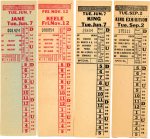
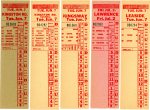
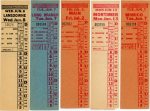
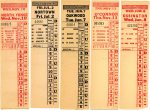
TTC Proposes New Fare Rules for Presto Roll Out

On December 16, 2015, the TTC Board will consider a report from management recommending several changes in the fare collection system. Some of these proposals are straightforward while others are likely to bring confusion and outright complaints from TTC riders.

On December 14, the TTC streetcar system goes to “Proof of Payment” (POP) on all routes and a few days later, Presto will be enabled across the streetcar system. In the short term, paying by Presto will be akin to dropping a token in the farebox on the “old” streetcar fleet. If you need a transfer, board at the front door and get one from the operator. Otherwise, rear door boarding is allowed. Transfers will be required if somewhere in your journey you will encounter a bus that is not Presto equipped. (The TTC is silent on how they will handle a route like 504 King that operates both types of vehicle if a Presto user discovers a non-Presto equipped vehicle is the first thing to show up.)

The roll out of Presto brings the opportunity to revise the fare system, for good or ill, as the TTC migrates away from its conventional model of tickets, tokens and transfers. (It is worth noting that a large number of riders have already made this migration by using Metropasses which are simple, if limited in the fare options they provide.)

The transitional period when both Presto and existing fare payment systems co-exist will be a difficult one. Indeed, there are strong incentives for riders not to shift to Presto until the system is fully functional unless their TTC usage is limited to that part of the network where Presto is active.

Continue reading

TTC Fare Increase For 2016

After a long, rambling, and less-then-well-informed debate, the TTC Board has approved increases in selected fares for 2016 at its meeting of November 23, 2015.

  • Adult cash fares will rise from $3.00 to $3.25.
  • Adult tokens will rise from $2.80 to $2.90.
  • Metropass prices (all classes) will not change.
  • Student and senior fares will not change pending the outcome of a study on Fare Equity that will report early in 2016.

The cash fare last changed in 2010, while the adult token fare, then $2.50, will have gone up $0.40 by 2016.

Freezing the Metropass prices will have the effect of lowering the “trip multiple”, the ratio of the pass price to the token fare from 50.5 in 2015 to 48.8. For monthly discount plan (MDP) subscribers, the ratio will fall to 44.7. The multiple is even lower for those who can claim the transit tax credit pulling it down to 38 for MDP users. This is only available to people with taxable income against which the transit credit can be applied.

This will make the pass more attractive to riders who now feel that it is priced beyond their normal transit usage level, and of course will provide a fare freeze for all existing pass users.

The gap between the adult and senior multiple will now be wider because seniors’ fares have not changed leaving the ratio between passes, tickets and cash fares as they were in 2015.

The unfocused debate can be blamed directly on the TTC’s own Budget Committee and its failure to actually discuss fare policy beyond producing a range of options for consideration by the full Board. Absent a clear idea from Mayor Tory or the City’s own budget process of subsidy that the TTC might receive in 2016, debates about “fares” turn into efforts to minimize the subsidy call against the City where “fighting taxes” takes priority.

When the issue reached the full Board, any idea that the TTC could magically survive without more subsidy had evaporated, but we still don’t know what will actually happen to fares or service if Council fails to deal with the TTC’s shortfall.

By the end of the meeting, there were several overlapping motions on the table, the product of many Board members each cooking up their own version of an appropriate new structure and policy framework.

  • By Vince Crisanti: That student and senior fares be frozen pending the outcome of the Fare Equity report in 2016. Carried.
  • By John Campbell: That a revised fare structure (see below) be implemented including a $0.20 jump in the adult token fare. Defeated 10:1 against.
  • By Shelley Carroll as amended by Glenn De Baeremaeker: That staff report back on a common fare multiple for adult, senior and student passes. Carried.
  • By Alan Heisey: That TTC and City Transportation Services work together on improvements to enhance transit service especially for special events such as subway shutdowns, and report to the Board in six months. Carried.
  • By Joe Mihevc: That all seven options for service enhancements be approved. Defeated 8:3 against.
  • By Joe Mihevc: That the three options not approved by the TTC Budget Committee (Subway service reliability, three minute service on Line 1 YUS, Cherry Streetcar) be referred to the City Budget Committee for consideration. Carried.
  • By Josh Colle: That the TTC and Toronto Parking Authority study means by which parking revenue can be maximized with a report to the Board in 3Q16. Carried.
  • By Josh Colle: That the TTC examine ways to increase non-fare revenue and reduce office space costs through consolidation, and that staff report by 2Q16 on annual and long term revenue targets. Carried.
  • By Ron Lalonde as amended above: That the TTC adopt fare scenario 7 with no Metropass, student or senior fare increase ($0.25 more on adult cash fares, $0.10 more on adult token fares). Carried.

The combined effect of these decisions leaves the TTC with a $41-million gap between its proposed budget and the 2015 subsidy level. Considering that they are not even sure of getting that much when the first cut of the City’s 2016 budget is launched on December 15, 2015, this leaves Council facing an 8.7% increase in the main TTC operating subsidy request and a similar increase (although a smaller dollar amount) for Wheel-Trans.

When the final text of these motions is published by the TTC, I will update this article.

Continue reading

TTC 2016 Operating Budget

On November 23, 2015, the TTC Board will consider its operating budget for 2016 including issues of fares and possible service improvements. The version of the budget before the Board was approved at the TTC’s Budget Committee meeting of November 9, 2015 with some amendments from the original staff proposal. The only recommendation related to fares was that the price of a Metropasses be frozen in 2016, but no other specifics. (I have already commented on the motions passed by the Committee in a previous article.)

The matter is complicated by the fact that the actual subsidy that will be made available to the TTC by City Council will not be set until early in 2016, and the TTC will compete with other agencies for available money.

(The 2016-2025 Capital Budget is also on the November 23 agenda, but it has not changed from the version discussed at Budget Committee.)

Although the Operating Budget report is long, it is better organized than the previous version with more detail, rather than depending on whatever questions might arise from a long PowerPoint slide deck and the skill (or lack thereof) of the presenter.

This budget is always a balancing act between competing forces and interests:

  • A political imperative to “keep taxes down” and limit the growth of the TTC’s call on City subsidies from the property tax base. This often manifests itself in calls for “efficiency” year after year in the hopes that the TTC can do more with less funding in constant dollar terms.
  • A political will to keep riders happy with benefits such as controlling growth in, or even freezing fares while providing more and better service. This includes targeted fare changes to benefit groups who are perceived to be more deserving of support through lower fares.
  • Annual increases in the cost of labour, materials and utilities.
  • The cost of additional service to handle demand from a larger population and a shift to transit from other modes.

In 2015, Council approved an extra $95-million for a number of improvements to service, elimination of the fare for children, and a capital-from-current purchase of 50 new buses to be used for new express routes in 2016. This increase only covered the part-year cost of the changes, many of which came into effect only in recent months, and additional subsidy will be needed in 2016 for the full 12-month cost. Additional improvements are on the table as part of the 2016 budget, and some of these were approved in the Budget Committee. The bottom line here is that improving transit has an ongoing cost and is not something to be done on a one year “feel good” program followed by a return to penny-pinching. Indeed, even that $95m might not have come to the TTC had Council been aware of unexpected costs from changes in Provincial funding arrangements for other programs that came to light after the extra transit money was announced by Mayor Tory and TTC Chair Josh Colle.

Continue reading

Metrolinx Fare Integration Survey

Metrolinx is running a survey of “fare integration”, whatever that might mean to you, until November 30, 2015.

This survey is striking in the way that it reinforces options and viewpoints commonly seen in Metrolinx analysis of fare systems. It is quite 905-centric both in the types of questions and options, and the view of how people might use a transit network.

The survey begins by asking about someone’s “typical trip” to establish an origin-destination pair. Of course, many riders within the city have many regular destinations, especially when their travel (like my own) is not dominated by commute trips to work or to school. After one gets through that section, another comes up asking about non-commute trips but with no attempt to quantify them or ascertain where they might occur.

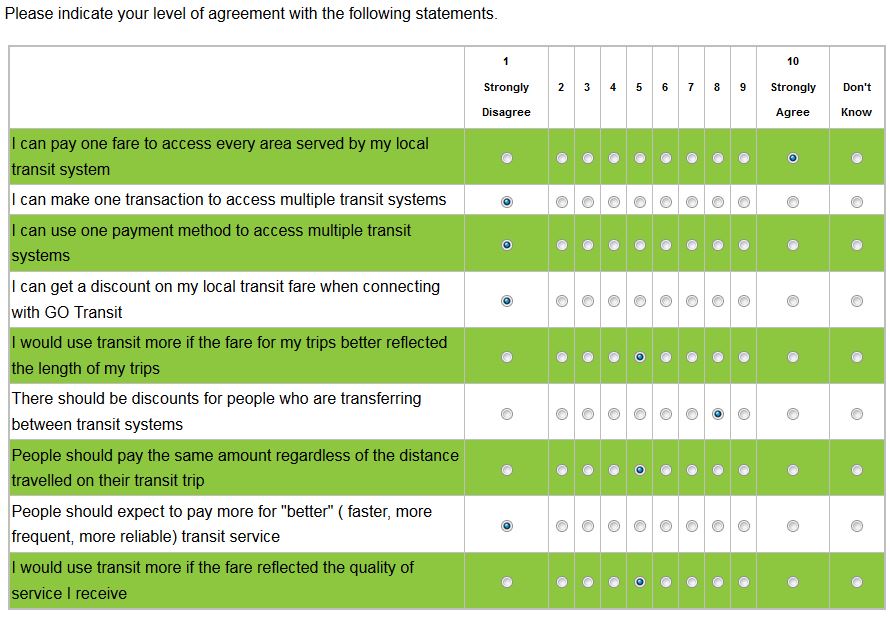
Cross-border and multi-carrier travel figure prominently in the survey, something by which, self-evidently, a regular TTC rider using only that system is not affected. The following list of fare options reappears in different guises elsewhere in the survey. As a piece of design, it fails because some questions are in the “I can …” format while others are “would” or “should” questions. It is unclear how an “I can” question can have anything beyond a “yes” or “no” answer. Does Metrolinx want our opinion on paying one fare for all of a local transit system, or asking if I can already do this?

There is a big problem in that some options interact, but there is no provision for this. Metrolinx is obsessed with the idea of paying more for “better” service which could mean anything from a GO Train or a Highway coach, to a local express bus, the subway or even a new LRT line. One might agree with a premium for the GO train (although that would also relate to distance travelled), but not for other types of service. There is no option to distinguish between these.

20151118_Survey_FareOptions

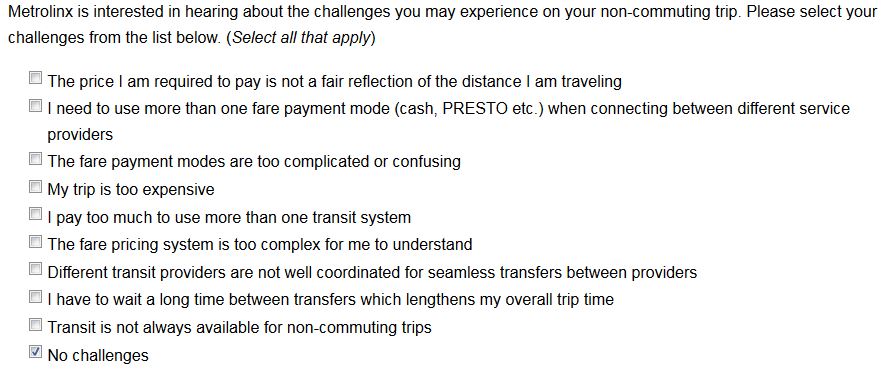
The ideas reappear as a list of challenges to transit travel. For a monthly pass holder, many of these options don’t really apply although one could certainly complain about the cost (high fare multiples) and the fact that on some parts of even the TTC, transfers can be a big headache thanks to unreliable service.

20151118_Survey_Challenges

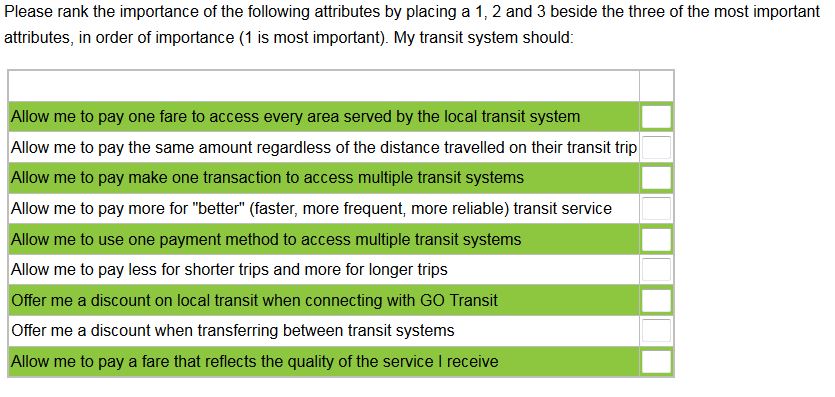
Another set of options requires the choice of a top three issues and ranking them rather than using the 1-to-9 scale for all of them.

20151118_Survey_Wants

Later the survey asks about co-fares between systems including local-to-GO and local-to-local transfers, but is silent on the question of how new co-fares might be funded, indeed on the whole question of regional fare revenue and subsidy sharing. Similarly, questions about distance or zone-based fares give no hint of what the effect might be for different journeys. Time based transfer and return trip privileges are nowhere to be found, typical for Metrolinx that only grudgingly acknowledges them as an option within local systems, not for the network as a whole.

No doubt the results from this survey will be trotted out to support whatever fare scheme Metrolinx comes up with, but it could be strongly biased to “typical” Metrolinx riders who have a very different view of the transit world and fares than their (much more numerous) “local” network cousins. It would be amusing to see what a similar survey carried out for the population within Toronto would yield. The survey includes a request for one’s postal code, and so at least there should be some idea of the distribution of responses across the GTHA.

Metrolinx Fare Integration Backgrounders

About a month ago, I reported on the Metrolinx Fare Integration Study. At the time of that article, the backgrounders to the Board Meeting presentation had not gone online. They went up a short while later, and now I’m getting around to discussing them.

There are three papers:

These make interesting reading if only to give a sense of what this study has been up to, and the direction it seems to be headed. As I wrote before, Metrolinx has shown a preference for distance-based fares because that is what they know. They are a long-distance carrier compared with any of the “local” transit systems in the GTHA, and developed in an environment where paying more for longer trips was a logical way to do things. (The question of how fairly those “distance based” fares are calculated is a separate matter.)

Continue reading

TTC Contemplates Fare Option Principles

Updated on September 24, 2015 at 1:45 pm: The TTC has clarified a few points about its table of fare policies. The text of this article was updated to reflect this.

At its meeting on September 28, 2015, the TTC Board will receive a staff presentation on the principles to be used for evaluation of possible fare systems. At this point, specific changes to fares are not up for debate, but staff seek direction from the Board on where to focus their analytical efforts.

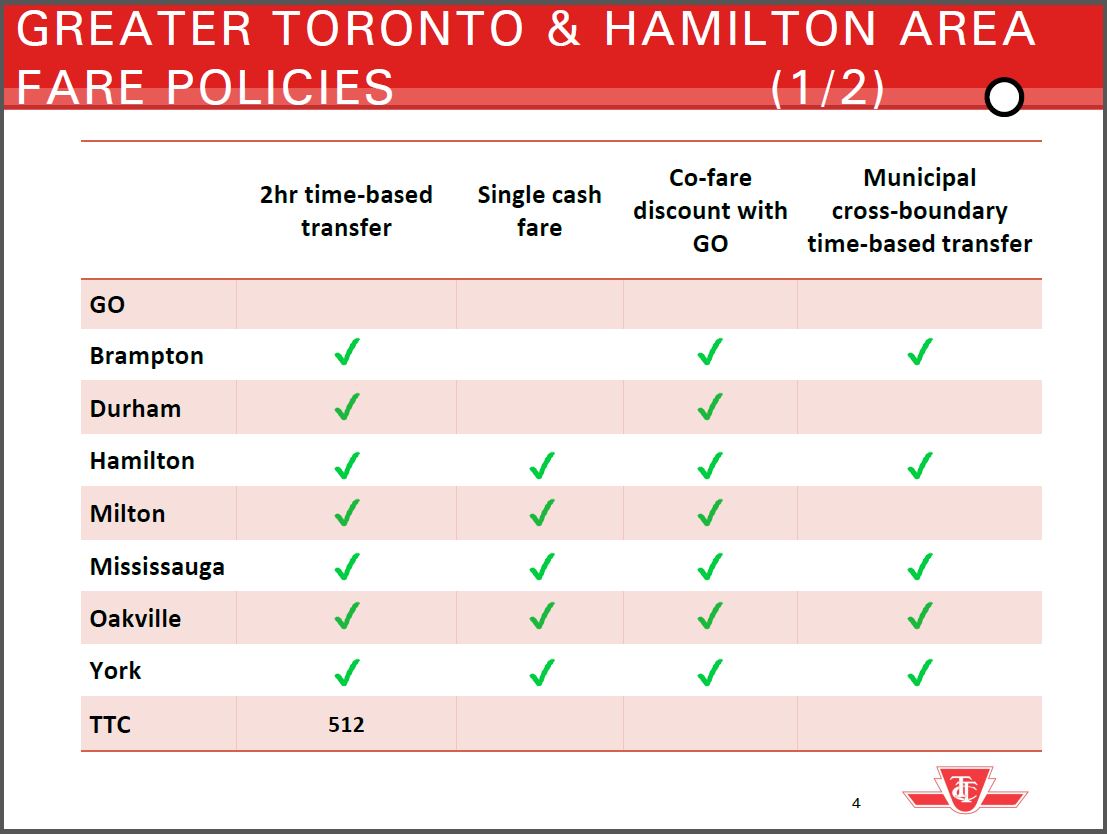
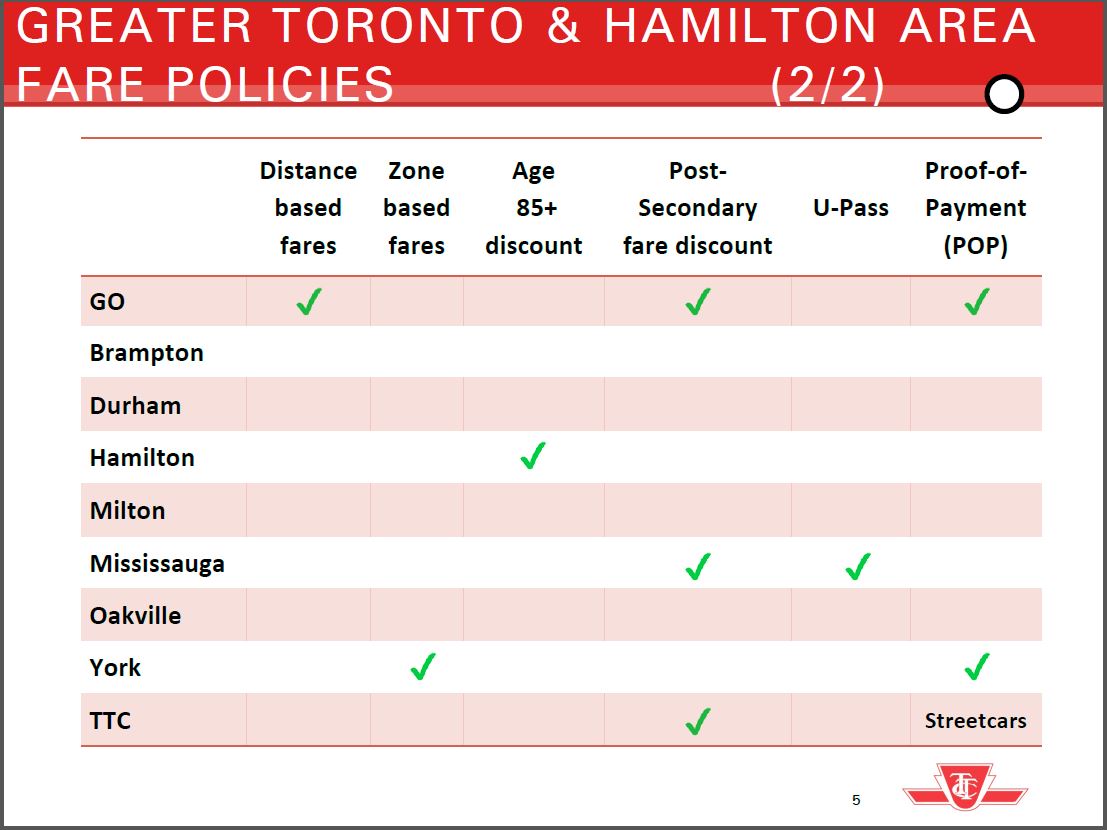
An important table comparing fare options across the GTHA is included in the report. Pass-based fares including the monthly discount program fall into a separate category of “loyalty programs”.

GTHAPolicies1 GTHAPolicies2

This chart drives home the fact that 2 hour time-based transfers are common in the GTHA while distance-based or zone-based fares are comparatively rare. Such a chart should have been part of the recent Metrolinx Fare Integration report, but it was not, potentially misleading the Metrolinx Board about the relative prevalence of GO’s world-view on fare structures.

Within Toronto, the TTC flags three challenges for any fare system:

  • Demand exceeds peak period capacity on some routes. By implication any fare structure that drives up demand will only worsen this situation.
  • Revenue control. The TTC does not entirely trust that any new fare system will yield the same revenue.
  • Complex fare and transfer rules. Within Toronto, the transfer rules make integration with other fare systems difficult if not impossible.

However, these may be offset somewhat through other improvements such as system-wide proof-of-payment and Presto rollout.

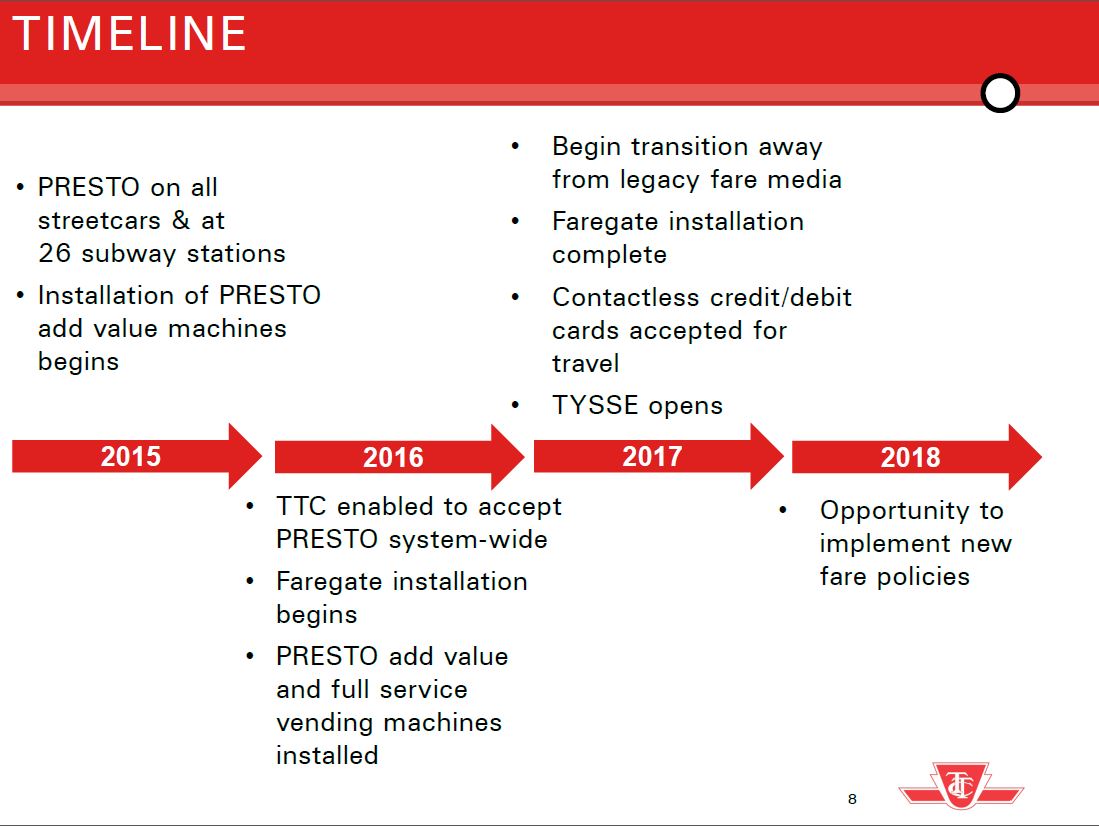
A timeline shows how various features of a new fare system would be implemented.

Timeline

Note that a move to support a wider range of cards beyond Presto is timed for 2017. This date is part of the Presto plans, as reported at the recent Metrolinx Board meeting. An essential change in the Presto model is that all of the fare handling logic moves to the “back end” of the system and the card (or some equivalent such as a SmartPhone app) merely provides a rider’s “credential” saying “this is me” to the system. Such a change makes possible a much richer set of fare integration and loyalty programs because a rider’s travel can be accumulated over time (much as a phone bill is) and the appropriate rates and discounts applied after the fact based on usage.

Underlying the analysis will be the assumption that new fare policies would not be implemented until 2018 when the technology underpinning would be in place. There is an expectation that the price gap between cash fares and Presto would widen relative to current practice as this is already the case in other parts of the GTHA.

There are seven principles proposed for the analysis:

  1. Improve the customer experience
  2. Meet the needs of our different customer groups
  3. Increase ridership
  4. Optimize TTC fare revenue
  5. Optimize TTC operations
  6. Embrace new technology to modernize our fare offering
  7. Support fare integration initiatives across the Greater Toronto and Hamilton Area

The analysis will review:

  1. Cash fares and single ride options
  2. Loyalty programs
  3. Peak and off-peak fares
  4. 2hr time-based transfers
  5. Fare by distance/zone
  6. All-door boarding on buses
  7. Proof-of-Payment (POP) system wide including buses and subway
  8. “Tap on” to all buses and streetcars
  9. “Tap on and off” at all subway stations

Notable by their absence in this list is a discussion of service classes such as premium express fares and any scheme in which the “rapid transit” network would be a separate fare tier.

Also included on a regional basis will be considerations of low income discounts and fare equity as well as co-fares.

The analysis will come back for debate and endorsement by the TTC Board at its December meeting.

Metrolinx Fare Integration Study: Heading to a Foregone Conclusion?

Updated September 22, 2015 at 8:00 pm:

A few issues raised in this article were addressed during the presentation and debate on the Metrolinx report.

  • The dismissal of “time based fares” refers only to fares that are calculated by the length of a journey measured in hours rather than kilometres or zones. Times based transfer privileges (in effect, limited time passes) are still part of the mix of fares under discussion.
  • Although the initial goal of the study is to produce a revenue-neutral model, Metrolinx will also expand the scope to look at adjustments to reduce the effect of bringing about that “neutrality”, in effect to offset unwanted side-effects of balancing who pays for what. This is an important consideration so that all interested parties can debate whether we want more subsidy, or higher fares, or some combination of these in aid of the greater good of an integrated and “fair” regional system. Just telling everyone “this is how it will be” is a recipe for political disaster, especially considering any reorganization of regional fares is likely to occur just in time for the next round of elections.
  • Integration is a big issue for Metrolinx because the distinction between “local” and “regional” travel is vanishing. This is actually more important than the off-cited cross-border double fare, and the RER service concept cannot operate without close integration of local fares and service to whatever Metrolinx runs.
  • Still unanswered is the question of just what service classes Metrolinx will propose, and the effect of making rail services like subway and LRT lines a separate fare class when they were designed, for the most part, to be integrated with local systems as replacements for existing bus routes.
  • Metrolinx plans to publish the background papers for this study including a review of the fare structures now in use by the GTHA’s transit systems.

The original article follows below:

The Metrolinx Board will receive an update on the status of its regional fare integration study at its meeting of September 22, 2015. To no great surprise, the study is pointing strongly toward fare by distance as the preferred scheme, no matter how much the entire exercise wants to give the impression of an unbiased approach and of “consultation” with municipal transit operators and the public. For some time, the Metrolinx review has the air of “any colour you like as long as it’s black”, and this update does little to change the impression.

The fundamental problem is that Metrolinx is a regional commuter system where any kind of flat fare simply won’t work, although their pretensions to being truly fare-by-distance fall apart the longer a trip gets. As the role of Metrolinx changes, both with the construction by Ontario of urban lines, and with the evolution of its market beyond the hinterland-to-downtown model, a one-size-fits-all fare system simply won’t work. Things get even more complicated where there is a mix of GO and local services serving the same territory whether these be rail or bus operations.

An “integrated fare system” has long been the goal for regional planners, although just what this means has varied over the years. For a long time, “integration” meant little more than having one farecard (Presto, of course) that would work everywhere while the actual fare structures were unchanged. The farecard would simply eliminate the pesky business of having different fare media – tickets, tokens, passes, cash, transfers – for different systems. Now that completion of Presto’s rollout is within sight, the question turns to the matter of fare boundaries and “fairness” in fare structures.

Continue reading

TTC Budget 2016: Confused Priorities Make For A Confusing Budget (Part II)

In my first article reviewing the TTC’s budget updates of September 15, 2015, I looked at the Capital Budget for 2016 and the ten-year plan out to 2025. This installment looks at the Operating Budget including proposals for fare increases and service improvements.

The reports discussed here are:

Updated September 21, 2015 at 10:05 pm:

The TTC has responded to questions I posed to clarify some issues raised by this article regarding: ridership, revenues and costs for Pan Am Games operation; treatment of capital-from-current related to bus purchases in 2015 and 2016; contract service changes for York Region; and diesel fuel hedging savings. See the end of the article for details.

Continue reading

TTC Board Meeting July 29, 2015 (Updated August 3, 2015)

The TTC Board will meet on July 29, 2015, and various items of interest are on the agenda. These include:

  • The monthly CEO’s Report (Updated August 2, 2015)
  • A presentation by Toronto’s Chief Planner Jennifer Keesmaat (Updated August 3, 2015)
  • Faregates for PRESTO implementation
  • Purchase of new buses and implications for service growth (Updated August 1, 2015)
  • Improved service standards for off peak service on “frequent” routes
  • Proposed split operation of 504 King during TIFF opening weekend (Updated August 2, 2015)
  • An update on Leslie Barns
  • Excluding Bombardier from eligibility for future contracts (Deferred to September Board meeting)
  • Council requests related to Lake Shore West streetcar service (Referred to TTC Budget Committee)

Continue reading