TTC 2023 Annual Service Plan, Round 2

The TTC recently launched public consultation for its 2023 Annual Service Plan (ASP).

This is the second round following preliminary sessions in June-July. The planners reviewed overall goals in light of changing demand patterns and system-wide rerouting associated with the closing of Line 3 SRT and opening of Line 6 Finch West. (The network changes for Line 5 Eglinton Crosstown were dealt with in the 2022 ASP, although there has been slight tweaking.)

Some of the 2022 Plan’s proposals have not yet been implemented, although they remain on the books as “approved”:

  • 8 Broadview: Extension south from O’Connor to Coxwell Station
  • 118 Thistle Down: Extension northwest to Claireport Crescent
  • 150 Eastern: A new route from downtown to Woodbine Loop (on hold due to potential construction disruptions)

See also:

In 2023, there are considerably more proposed changes than in 2022, and for the purpose of consultation the TTC broke the system into segments. Each of these is detailed later in this article.

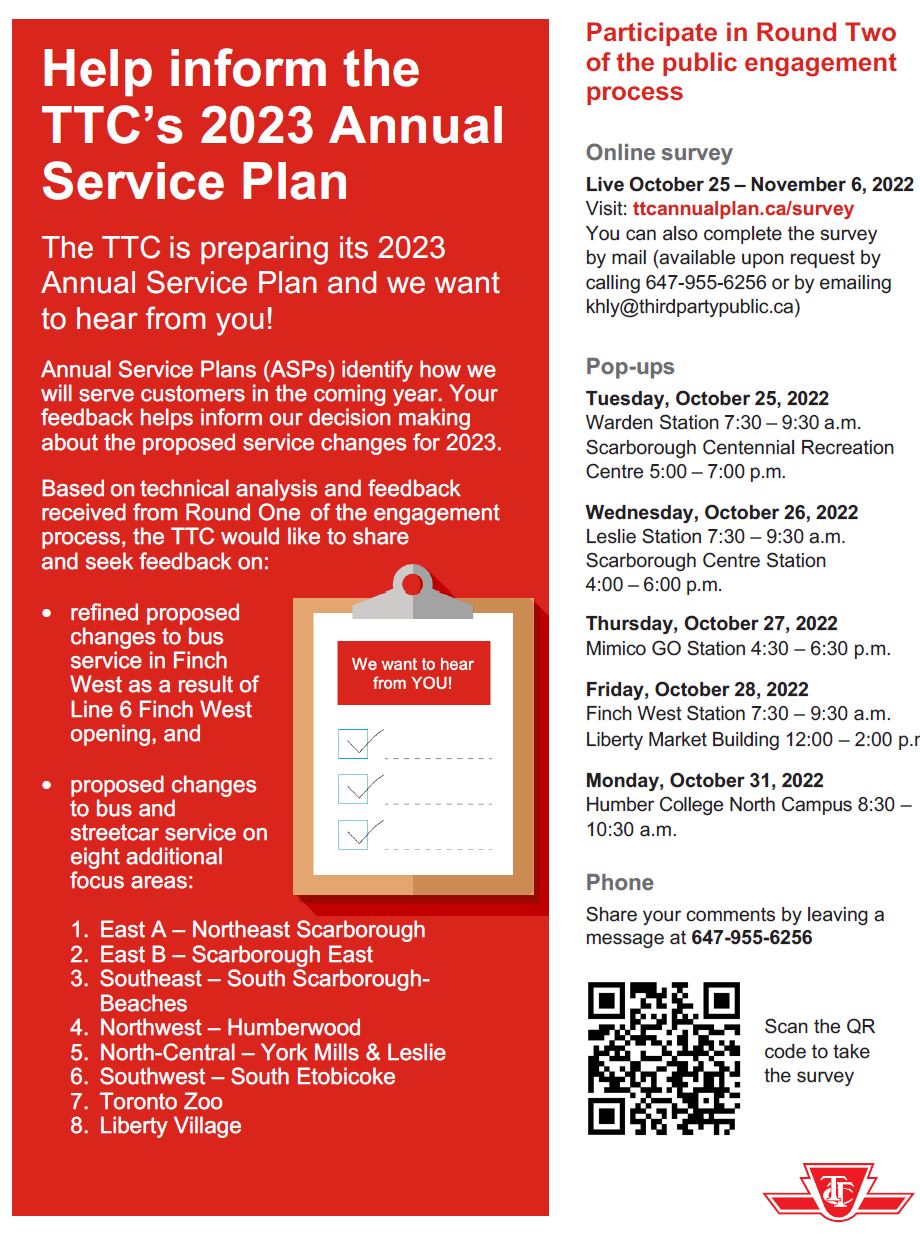
Consultation is now underway with the following planned schedule:

  • October-November: Public consultation. (See schedule above.)
  • Late 2022/Early 2023: Councillor briefings
  • February 2023: Final report to the TTC Board
  • Spring 2023: Implementation begins
  • Through 2023: Five Year Service Plan “reset” continues

The 2023 Annual Service Plan web page includes a deck of panels that will be used for the consultations. In this article, some maps are taken from that deck, and some from presentations to community groups.

An online consultation is available from October 25 to November 6.

One key point we will not know until late 2022 or even early 2023 will be the TTC’s budget target. How will this shape service changes, be they additions, re-allocations or cuts? Mayor Tory talks about supporting transit, but we will see just what this means when he tables the City’s 2023 budget.

Note: I have not included all of the information posted by the TTC here, and I urge readers to review the presentation panels and any other information the TTC publishes as this process goes on.

Although this article is open for comment, is you have specific concerns and wish to participate in the consultation process, be sure to complete the TTC’s survey or otherwise communicate your feelings to the TTC. I am not the TTC Planning Department, and grousing to me, or proposing your own maps here will not feed into the process.

Continue reading

Will Line 2 Renewal Ever Happen?

Those of us who can remember back to days before the pandemic, when Andy Byford was the TTC’s CEO, will know that there were frequent questions at the TTC Board about upgrades to the Bloor-Danforth subway, Line 2. All of the focus seemed to be on the Yonge-University-Spadina Line 1 with new signalling, trains and the Vaughan extension.

Byford confirmed that work on a Line 2 plan was underway, but never presented one in public. However, it does not take a lot to work out what might have been in this plan.

  • Automatic Train Control (ATC) signalling to replace the 1960s-era technology still in use.
  • New trains to replace the existing fleet of T-1 trains that would reach their design life of 30 years in the late-2020s.
  • Additional trains for service increases possible with ATC as well as for the Scarborough extension.
  • Additional/new maintenance facilities for a larger Line 2 fleet, plus provision for the then-planned stabling of Relief Line trains at Greenwood Yard.
  • Storage and maintenance facilities for the growing fleet of subway work cars.
  • Potential integration of a western yard project with an extension of Line 2 beyond Kipling Station.

This plan requires a lot of funding that the TTC still does not have, action to launch procurement of long lead time rolling stock and infrastructure, and a level of project co-ordination for which the TTC is not particularly noted.

That co-ordination issue arises in part from the funding challenge, and the tendency politically to ask for only what is strictly needed for “today’s” work hoping that Santa Claus will arrive in time to fund the rest. This was a direct cause of technical problems with the Line 1 ATC project that was cobbled together over time. It started with a superficially simple desire to replace the then-existing 1950s signals on the original line from Eglinton to Union. The feeling was quite clear: the TTC Board and Council would never commit to a full ATC conversion project because it would be too expensive.

Unfortunately what resulted was a mixed bag of signalling technologies that were incompatible with each other. To rescue the project, Byford recommended ripping out some already-installed equipment so that the line could be standardized. A related decision was that the Vaughan extension would open with ATC in place rather than, as originally planned, a traditional block signal system that would have to be replaced as a separate project.

Continue reading

An Update Re Subway Special Work

There was a conversation recently in comments on this blog about a perceived improvement in the noise (or lack of it) of subway trains on special work (switches and crossovers, also known as “frogs”) at Lawrence and Keele Stations. I postulated a few possible answers, but wrote to the TTC to ask what they had done.

Their response, from Stuart Green, Senior Communications Specialist, confirms what I had expected and provides additional details.

Lawrence Double Cross-Over

  • It is an improved design with different type of heel that eliminates the joint at the heel of the switch.
  • Two turnouts are now flange bearing lift frogs that means continuous rail at the crossing – no jumping over the toe of the frog.
  • Newer rails that have no end battering at the joints
  • New ballast that provides better load transfer and required stiffness/flexibility to track.

Keele Double Cross-Over

  • New double cross-over is of the same design with some improvement in the design to make it smoother. The main reasons for smoother ride are new rails and new frog that do not have any end battering or excessive wear.
  • New ballast that provides better load transfer and required stiffness/flexibility to track.

Toronto Transit Funding and Development Charges

The real estate industry, their acolytes and even the affordable housing advocates went into meltdown when the 2022 update to the Development Charges landed at Toronto’s Executive Committee. This proposal was approved recently by City Council, but with a few carve outs such as exempting certain types of housing (up to 4 dwellings on a lot) from these charges.

The main trigger for the uproar was that the new DCs are much higher than those they replaced. With transit being the primary driver of this increase, it is worth understanding how DCs work and what the new charges will and won’t fund.

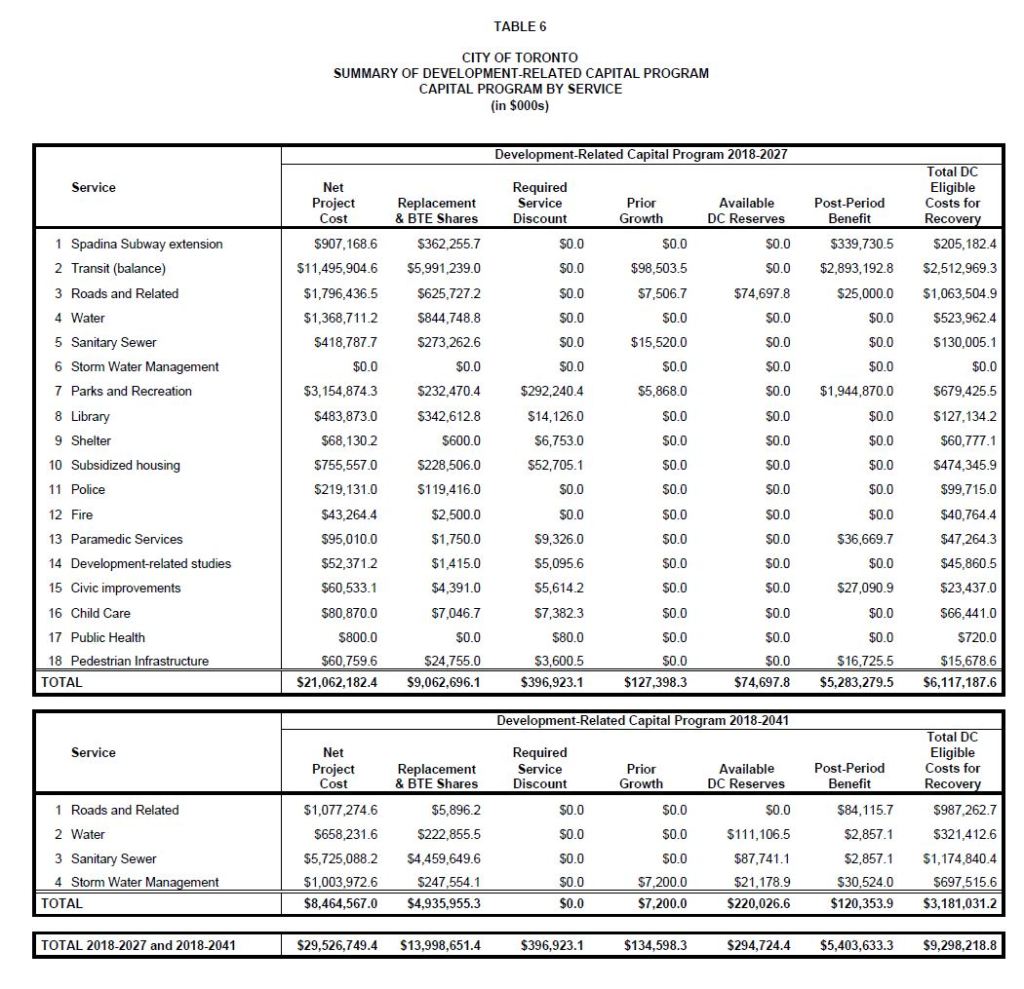
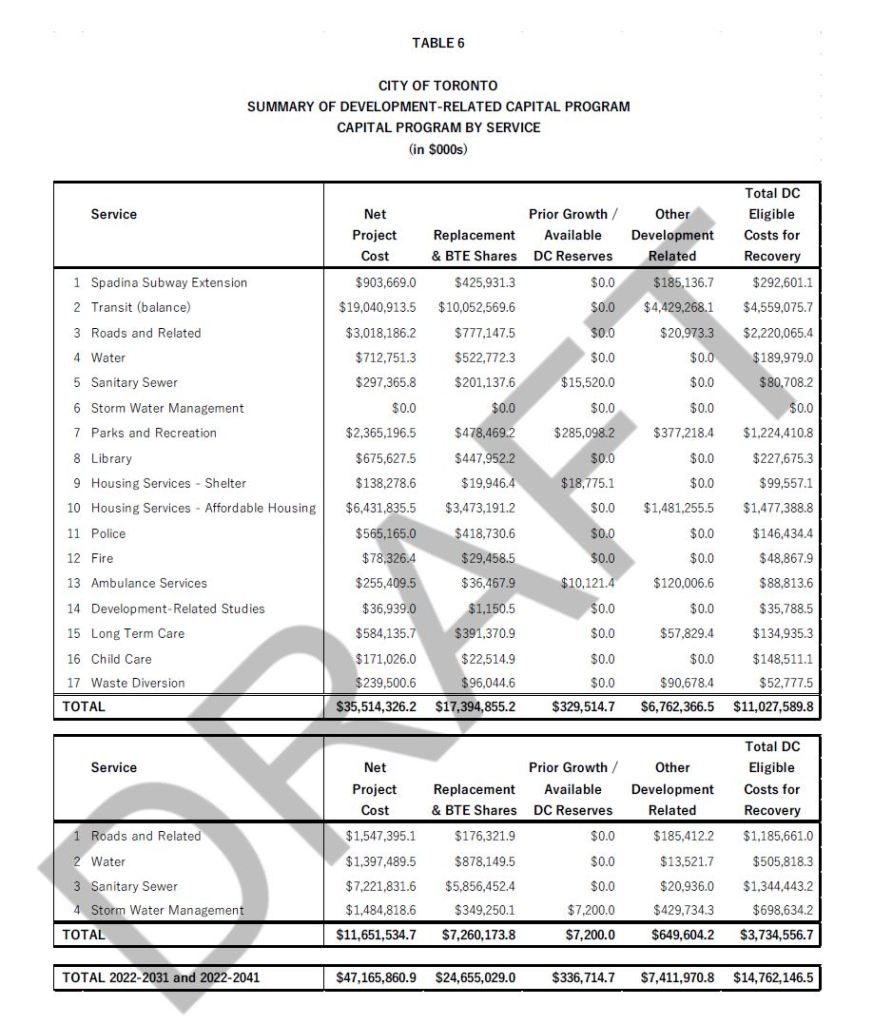
First, a comparison of the base data for the 2018 and 2022 reports. The tables below are in almost the same format making comparison easy.

The important column is on the right end of both charts “Total DC Eligible Costs for Recovery”. The total in 2018 was $9.3 billion while in 2022 it is $14.7 billion.

Yes, we are still paying for the Spadina Subway which gets its very own line in the table, and the Sheppard line shows up in the details under “Transit (Balance)”. Large increases lie in:

  • Transit, about $2 billion
  • Roads, about $1.2 billion
  • Housing Services, about $1 billion
  • Parks & Recreation, about $550 million

Some lines go up by a lot proportionately, but the dollar amount is comparatively low. For example, Pedestrian Infrastructure went from $15.7 million to $52.8 million, over triple, but the actual dollars pale by comparison with transit.

A major difference between 2018 and 2022 is the proportion of total costs recovered from subsidies and contributions from other parties.

In the 2018 DC calculation a grand total of $43.5 billion gross was reduced by $14.1 billion to a net value of $29.4 billion.

In the 2022 DC calculation, a grand total of $66.9 billion gross is reduced by $19.8 billion to a net value of $47.2 billion.

The increase in gross figures, 54 percent, is much higher than the increase in recoveries through subsidies and other revenue, 40 percent. This causes a disproportionate growth in the net of 61 percent.

Where Do Those Numbers Come From?

The background study that recommends new Development Charges starts with a list of every capital project in the City. The TTC has the biggest capital budget, even with some major projects taken over by the province, and it therefore generates the biggest part of the DC tithe.

For each project some costs are included and others are excluded. The headings on the charts above show the breakdown:

  • Net Project Cost: The cost of the project borne by the City after deducting provincial and federal subsidies and contributions by others (for example, York Region’s contribution to the Spadina Subway). (The gross costs for those who are interested are in the detailed tables.)
  • Replacement: Costs to replace existing infrastructure (such as new buses that replace old ones) are not eligible for DCs because this cost does not address growth, only worn out assets.
  • Benefit to Existing (BTE) Share: Demand that would rise if the improvements were already in place determines the portion of the benefit that is not due to new development.
  • DC Reserves: Some groups of projects did not manage to spend all of the money collected for them, and this sits in a carry over reserve offsetting new charges.
  • Other Development Related: Some costs are deferred to future rounds of DCs as reflecting the value of a project like a new subway line well beyond the five year cycle of DC updates.

The BTE share is calculated from existing and projected ridership (see below).

Looking at the 2022 chart above, of the $47.2 billion in net project costs, only $14.8 billion will be recovered in the current period from DCs. (The gross cost, by the way, is $66.9 billion.) This does not include provincial projects like the Ontario Line and Scarborough Subway which are no longer on the TTC’s books. It also does not include much of the Green Bus plan because that is mostly replacing existing buses, not adding to the fleet for ridership growth.

Continue reading

TTC Board Meeting: July 14, 2022

The TTC Board held its last scheduled meeting of the current term on July 14. Barring an emergency requiring a special meeting, the next regular meeting will follow reconstitution of the Board after the municipal election in the Fall.

Some items on the agenda have already been covered in previous articles:

This article covers:

  • The CEO’s Report
  • Outsourcing of non-revenue automotive vehicle and equipment maintenance
  • Automatic Train Control for Line 1 Yonge-University
  • Five and ten year service plans
  • Transit network expansion update

I will review the Green Bus program update in a separate article.

CEO’s Report

The CEO’s Report contains many charts purporting to show the operation of the system. Unfortunately some of these hide as much as they tell by giving a simplistic view of the system.

I have already written about the wide discrepancy between actual short turning of vehicles and the reported number. A distortion this major calls into question the accuracy and honesty of other metrics in the report.

In a future article, I will turn to the appropriateness of various metrics, but here are some key areas:

  • Averages do not represent conditions riders experience. Data that are consolidated across hours, days, locations and routes hide the prevalence of disruptions. Service that is fairly good on average can be terrible for riders who try to use it at the wrong time.
  • Values for some metrics are reported with capped charts that show only that a target is met, but not by how much it was exceeded. This gives no indication of the room to improve the target value, nor of the variation that could make a higher target difficult to achieve consistently.
  • Reliability is shown only for vehicles that actually operate in service, but there is no measure of actual fleet utilization and the headroom for service growth using available buses, streetcars and subway trains.

In discussion of the report, Commissioner Carroll noted that the TTC still has a problem with on time performance for streetcars. CEO Rick Leary replied that there is an On Time Performance team who are looking at details including recognition that there are three types of routes: those that run well, those affected by construction and those with other problems.

Carroll replied that people are quick to complain about King Street and wondering why they are still waiting for the 504. The TTC says that construction is the reason, but do they have a strategy to deal with bunching and communicate with riders. Management replied that they have strategies for keeping riders informed during planned diversions, but for unplanned emergencies there are service alerts. Changes are coming and service should improve.

This discussion was frustrating to hear because, first off, the central part of 504 King between Dufferin and Parliament is not affected by construction. Only the outer ends in Parkdale/Roncesvalles and on Broadview have (or had until recently) bus shuttles. As for keeping riders informed, irregular service plagues all routes in the system as I have documented in articles here many times. The problem is line management, or the absence of it.

On another topic, Carroll noted that the TTC seems to have a lower standard for the condition of stations than it does for vehicles, or at least tracks the latter at more detail. Leary replied that a summer blitz using student workers will scrub down all stations to bring the system back to a better quality for riders returning in the Fall.

Continue reading

Adelaide Street Reconstruction Open House

The City of Toronto will hold an online open house for the Adelaide Street project on Thursday, July 21 from 6:30 to 8:00 pm.

A link to register for this session is on the project page.

Track on Adelaide has been inactive for many years thanks to various cuts for utility projects and the high level of building construction along the street. The TTC contemplated reactivating the track as a bypass for, among other things, the Tiff street fair, but the opportunity did not present itself until now.

The Ontario Line open cut construction at Queen Station will require diversion of streetcar service around Queen and Yonge for several years. Cars will operate westbound via existing track on Church, Richmond and York. Eastbound service will run via York, Adelaide and Church.

This requires reconstruction of the Adelaide Street trackage as well as installation of new tracks southbound on York from Queen to Adelaide. Although only the track east from York is required for the Ontario Line diversion, the TTC will restore the track between Spadina and York making provision for a longer diversion. York will become two-way from Queen to Adelaide.

It is not yet clear which special work will be added at intersections, notably Adelaide and York where a north-to-east curve would be useful, especially if the TTC adds an east-to-north at King and York when this is rebuilt in a pending King Street project. Unfortunately, with the lead time between planning and execution, the TTC has forgotten on occasion (or chosen for budgetary reasons) to include missing curves that would make their operations more flexible notably at Broadview and Gerrard and, this year at Church and Carlton. These opportunities only come along every 25-30 years.

The project also includes water main reconstruction from York to Church, and repaving. Parts of the street are in very bad condition after years of condo construction trucks pounding the pavement.

From Bathurst to Parliament, the bike lane will shift to the north side of the street where there will be less conflict with the streetcars and with vehicles stopped in the eastbound curb lane.

I will update this article with more info after the open house.

Transit Expansion Update, June 2022

This article reviews two reports on City Council’s agenda of June 15, 2022:

The subjects here are primarily the Ontario Line and the Eglinton Crosstown West Extension. The Eglinton East and Waterfront LRTs were discussed in a previous article.

Continue reading

TTC To Operate Single-Track Subway Shuttle on June 4-5/22

The TTC had planned a shutdown of subway service on Line 1 Yonge-University-Spadina to permit track repairs between Wilson and Lawrence West Stations. This plan has changed to replace the usual bus shuttle with a subway shuttle because track work will only occur on the southbound side.

  • Subway trains will operate between Vaughan and Wilson Stations terminating on the southbound platform at Wilson. They will return northbound via a crossover north of the station.
  • A subway shuttle will operate between Wilson and Lawrence West Stations running on the northbound rail in each direction. The train will stop at Yorkdale Station.
  • Service northbound to Lawrence West Station will cross over via the centre track north of Glencairn Station and terminate on the southbound platform at Lawrence West.

Passengers travelling through the affected area will make across-the-platform transfers at Wilson and at Lawrence West Stations.

See the full TTC notice here.

Updated June 5, 2022 at 8:00 pm:

There has been great confusion about just what service the TTC is operating and whether there would be a subway shuttle, or simply alternating use of a single track by through service in each direction.

It is actually possible to see both versions of the TTC’s message at the same time. The main text below is the still-active notice of shuttle operation. However, a popup in the corner of the screen displays live service alerts, and this tells a different story.

The TTC has a big problem with contradictory service notices in various parts of its site because they originate from and are maintained by different groups.

Doors Open Toronto: Lower Bay Station, May 28, 2022 (Updated)

On Saturday, May 28, 2022, between 10am and 5pm, the TTC will open the lower level of Bay Station as part of Toronto’s Doors Open event.

May 28, 2022: Updated with photos from the event.

Bay Station is an inverted version of St. George Station with the Bloor line on the upper level (the currently active station) and the University line on the lower level. Tracks connect to Lower Bay from the junctions north of Museum Station and at the west end of Yonge Station. These are regularly used for equipment moves between the two lines as well as by work trains.

This station has rarely been seen by the train-riding public except for a few construction-related subway diversions. It operated in revenue service for the first six months of the Bloor-Danforth subway during the trial of an integrated service on the Yonge-University and Bloor-Danforth lines. When that ended in September 1966, the station took on various uses including storage, training, testing of platform treatments for wayfinding, and movie shoots.

During the event, trains will be parked on the platforms, and there will be displays from the TTC’s centennial book A Century of Moving Toronto.

Access is only by stairway.

Route Map for Integrated Subway Service 1966

Here is a selection of photos from the event.

Lower Bay Station is taller than most because of the alignment of the tunnel which connects to the University line north of Museum by going under the north-to-west track into St. George Station.

Two trains were set up with photos arranged by decade. The display is adapted from the book TTC100 which is available in hardcover or digital version from the TTCShop.

The streetcar system is a lot smaller than it was in 1949 before any of the subway was built. Streetcar trains with Peter Witt cars served Yonge, and trains of PCCs operated on Bloor-Danforth. Many other parallel routes funnelled riders into downtown.

Lower Bay is a bit worse for wear, not having seen revenue service (at least with stopping trains) since 1966. It has been used, among other things, to test various floor treatments for wayfinding.

Once the Yonge Subway opened in 1954, the major interchange was at Bloor-Yonge with a protected unloading and loading platform in the middle of Bloor Street leading directly to the Bloor Station platforms below. This area will see major reconstruction in coming years as Yonge Station and the link with Bloor Station are expanded to provide a separate eastbound platform for Line 2.

Streetcar traffic to the east end was quite intensive with the combined service Bloor and Danforth trains operating close to once a minute between Bedford Loop (now St. George Station) and Coxwell. The view looks northwest on the Prince Edward Viaduct with the trees of Rosedale in the background.

At the east end of Lower Bay, there is a TTC Lego subway train set up which some lucky soul will win in a draw.

Finally, the station name is “BAY Yorkville”. This is a testimonial to the days when Yorkville was a disreputable neighbourhood full of coffee houses, people with long hair, and smokeables you can now find on any street corner. The station’s original name was to be “Yorkville” after the former town, but this was changed. This is not the only original BD station to get a different name when it was built: “Vincent” became “Dundas West”, and “Willowvale” became “Christie”.

Scarborough RT Express Bus Replacement Plan

After extensive study and public consultation, TTC staff will present a plan for bus replacement of the Scarborough RT to their Board at its April 14, 2022 meeting. Although it is a long report, much of it has appeared before during the consultative process and in an interim report to the Board. Interested readers can browse the full version, and I will only touch on the major points here.

My apologies for the resolution on some of the drawings included here. The versions in the TTC report online are not good, but if better renditions show up in the future, I will replace the originals here.

The Scarborough RT is on its last legs and, frankly, should have been replaced years ago. Let us not get into the whole subway/LRT debate as that train has left the station. However, the constant delay in making any decision has now pushed the opening of any replacement service well beyond the reasonable lifetime of the existing SRT fleet, and even that will require work to keep it operating until bus facilities are ready.

Various dates for the SRT shutdown are proposed, and these depend on completion of alternate bus terminal facilities. Thanksgiving weekend would certainly be an ironic cutover date.

The candidate dates for Q4 2023 would mean the last day of train service could be: Saturday October 14, 2023; or, Saturday November 25, 2023. If construction is complete ahead of schedule, a September closure date could also be possible, on Saturday September 2, 2023.

TTC Report at p. 15

The Recommended Option

When the need to close the SRT before the Scarborough Subway Extension opened became apparent, the first thought was that riders would be consigned to buses plying the roads from Scarborough Town Centre to Kennedy Station for many years.

To no great surprise, there was a better idea that emerged during the consultations: use as much of the existing SRT right-of-way as possible for a bus roadway bypassing local street and intersection congestion and providing a direct access to Kennedy Station. That is the scheme that has been recommended, named in the report “Option 1 Hybrid Line 3 ROW” (Right-of-way).

As shown in the map below, the bus service will operate from STC station to Kennedy on street to Ellesmere Station and then on a new road in the existing SRT right-of-way to Kennedy Station. Stops will roughly match the existing SRT, except for McCowan. A new stop will be added at Tara Avenue, ironically a proposed station location decades ago when the SRT was to be built as a conventional LRT line.

The frequency of service is such that aggressive transit priority measures will be needed for the on-street portion.

Continue reading