Waterfront Transit Reset Phase 2 Update

This article is based on the public presentation held on September 18, 2017 at Harbourfront Centre. A similar presentation will be held in southern Etobicoke on September 26.

The “Waterfront Transit Reset” project was launched by Council at the end of 2015 to review all of the outstanding plans for transit from the Mississauga border to Woodbine Avenue. The first phase of this review reported in July 2016, and that provided the springboard for Phase 2 which will report to Executive Committee on October 24, and thence to Council at its meeting beginning on November 7.

Given the geographic scope, the review has been broken down into segments (and a few sub-segments) to focus on problems particular to locations across the waterfront. The four main segments are:

  • Southern Etobicoke
  • Humber River to Strachan including Parkdale and Exhibition Place
  • Strachan to Parliament including the Central Waterfront and much of East Bayfront
  • Parliament to Woodbine including the Port Lands

The presentation was done west to east, and in a single go without questions. This was something of a marathon for the audience, and I am not sure this was the best approach given the complexity of issues in some areas. As someone who has followed the detail of this study since its inception and participated in consultation sessions, I am quite familiar with the issues and was just getting an update. Those who came to this fresh, as many did, had a lot to take in.

A further problem is that the presentation included no cost estimates, and limited information on issues such as construction effects and complexity that could inform a choice between alternatives. This is particularly true of the review of Union Station. There are no travel time estimates to show what time savings, if any, various options present. Such estimates must exist as they are a critical input to the demand modelling process.

For this article, I will take a different approach and deal with the simpler parts of the study first just to get them out of the way, leaving the knottiest problems to the end.

Updated September 26, 2017 at 5:30 pm:

The presentation file is now available as a PDF. The display boards can be viewed on the project website.

Projected Demand in the Waterfront

The heart of any transportation study is the demand projection for various components under review. The chart below shows the 2041 AM peak hour demands forecast by the City’s planning model.

There is a fundamental difference between the projected demands from the western part of the line and the eastern one. From the west, the demand has the conventional inbound-to-core pattern for the AM peak. At the core and to the east, the peak flow is outbound, south to Queens Quay and east to new office and school developments.

This chart is missing some vital data that would put other parts of the discussion in a better context:

  • It assumes the presence of the Bremner link although this is the least likely to be built beyond an upgraded bus service.
  • There is no screenline west of Bay Street to indicate the demand arriving and leaving to the west right at the portal. With 2,350 going east and 3,700 coming south, this implies a substantial outbound demand to the west. Without the 750 each way on Bremner, these numbers would be higher.
  • The comment about higher demand in the east without the Relief Line does not explain whether the modelled values shown here include that line or not.

It is impossible to evaluate the demand numbers when there is no sense of staging of projects or of networks with some pieces “in” or “out” of the mix.

There is also no sense of the time frame over which the various demands will evolve, only that this is the 2041 end state. Any decision of the order of projects (and indeed their worth relative to other parts of the transit network) must be in the context of changes that are anticipated in the short, medium and long terms. This also begs the question of whether there are changes in the pipeline that will require heroic efforts in building up transit service to avoid short changing growing parts of the city (much as we already see in Liberty Village).

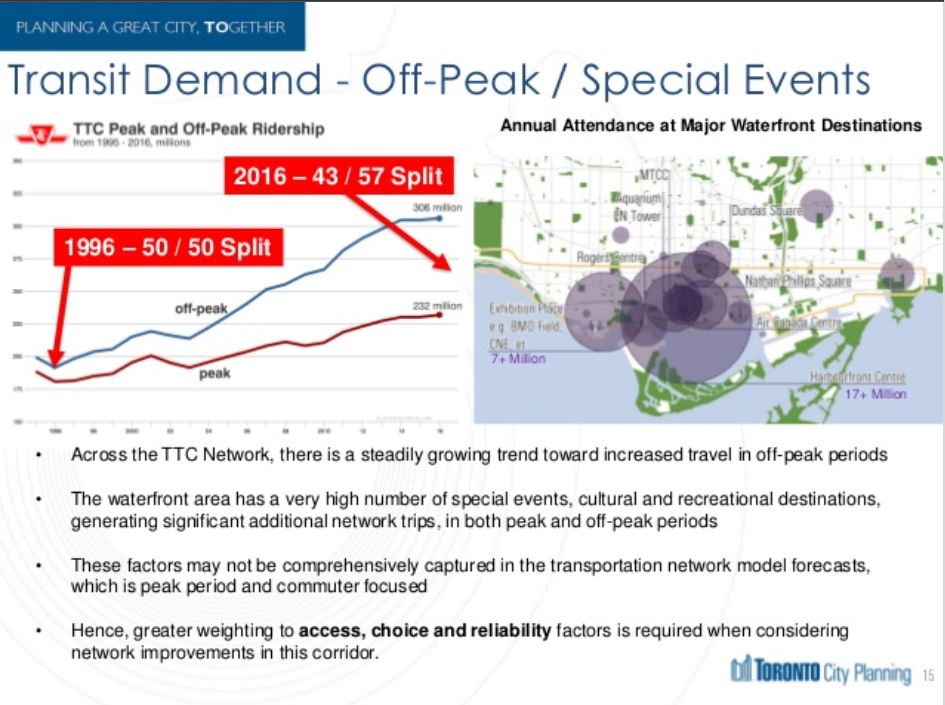
Another factor in any plans for the Waterfront network is the degree to which it serves major entertainment and recreational destinations. This will bring substantially stronger off-peak and seasonal demands that would be found on the transit network as a whole.

Ridership growth on the TTC has been stronger during the off peak period, if only because there has been so little growth in peak service. Strong off-peak demand is good for transit economics because the fixed cost of infrastructure is spread over more hours and riders, but the flip side is that peak riders have more incentive to abandon the TTC.
Continue reading

The Next Big Move: (I) Overview

The Metrolinx Board considered its Draft Regional Transportation Plan for the GTHA on September 14, 2017 and approved its release for comment, subject to some last-minute editorial changes. This is an update of the original “Big Move” plan, and it takes the view of transportation needs and networks out to 2041.

The context for this is summarized in a covering report from Leslie Woo, Chief Planning Officer for Metrolinx:

By 2041, over 10 million people will live in the region. We need to plan for a future characterized not only by continued population and employment growth, but also by changing demographics (including an aging population), the changing nature of work, new transportation technologies and services, and the impacts of climate change. In short, we cannot stop. Our plan for moving forward – the Draft 2041 Regional Transportation Plan – calls for governments to move beyond The Big Move to put people’s needs at the core of planning and operations. This means:

  • Completing delivery of current regional transit projects;
  • Connecting more of the region with frequent rapid transit;
  • Optimizing the transportation system to make the best possible use of existing and future transit and transportation assets;
  • Integrating land use and transportation, and
  • Preparing for an uncertain future.

As the transportation network in the GTHA becomes more extensive and complex, travellers’ expectations will rise and transit infrastructure alone will not be sufficient to meet the needs of a growing region. Transit providers need to broaden the focus to address not just the quantity, but the quality of transit service for travellers. That means making transit more accessible, frequent, reliable, comfortable and convenient. [p 3]

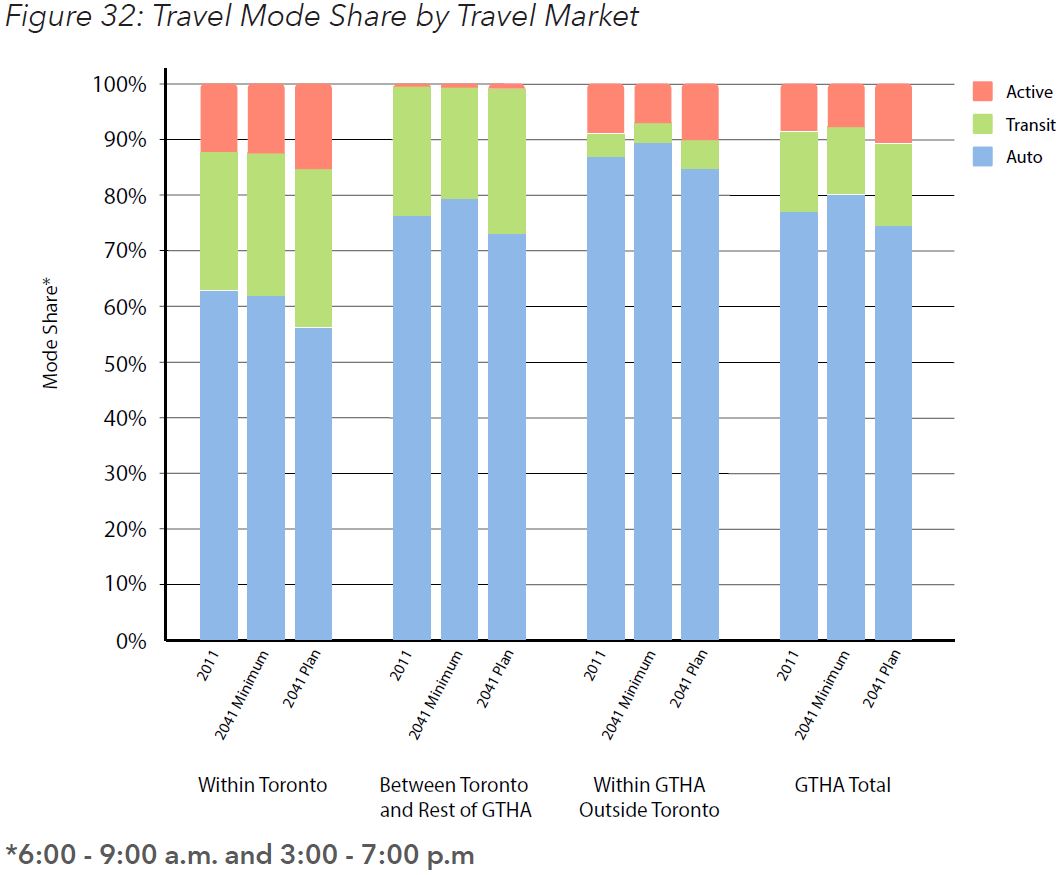
This is a fine, rousing opening statement, but I must say at the outset that for all its many components, the plan falls short in a key element: shifting more travel to public transit. That is not to say that over $40 billion worth of planned investment is without value, but at the end of the next quarter century, transit’s share of the travel market will not have budged much from current levels. Autos with their associated planning focus will remain the dominant mode, especially as one moves further out from major centres such as downtown Toronto.

Just as with the original Big Move, we are running very hard just to stay in the same place. This is a dangerous situation on two counts. First, the political constituency for transit depends on its being valued by a wide cross-section of GTHA citizens. People who don’t use transit regard spending on new construction or operations as something for “them”. They wonder when there will be more roads for “us”. Second, if much of the travel is still not on the transit network, this means that transit has failed to attract its audience. This could be either because one can’t get from “here” to “there”, or because doing so by transit is simply not an acceptable way to make the journey.

There is also a fundamental political and economic problem. Getting agreement that we need better transit, and just what that entails, is hard enough, but governments change, the economy waxes and wanes, and all it takes is one bozo politician with enough clout to bring the whole process to a stop.

This is not simply a case of a streetcar hating mayor, but could be the effect of a “tax fighting” premier who sees his role as making things better for motorists and to hell with transit. Not to mention politicians at all levels playing the electorate for votes by cherry picking transit plans, not by building a network and embracing the need for frequent service beyond their ward or riding. Seeing a proposed new 25-year plan in today’s climate is a real stretch. Should we laugh or cry?

Continue reading

Metrolinx Previews The Next Big Move

Updated August 23, 2017 at 11:15 am: The full deck for the Metrolinx AMO presentation is now online.

On August 14, 2017, Metrolinx attended the Association of Municipalities of Ontario (AMO) conference in Ottawa with a presentation “Connecting the Region”. Although this was not a formal unveiling of the next iteration of the GTHA’s “Big Move” regional transportation plan, it gives a sense of Metrolinx thinking and what might be in the pipeline.

Compared with the original plan in 2008, this iteration is much more about building what is already in the pipeline as opposed to a grand vision with more lines than anyone could ever hope to see. This is an important evolution for Metrolinx from a purely planning agency to construction and, eventually, to operation of a large transit network.

During the past decade since the 2008 plan was developed, the GTHA has evolved in both its population and in the type of development that “growth” implies. Although the original plan foresaw a great deal of new transit, even that ambitious scheme would only barely keep up with growth in travel demand. Even this would be uneven with better transit in some of the “easy” corridors such as the rail lines, but much less to serve region-to-region travel.

That was always an issue with The Big Move – at best it would cap the growth in auto travel provided there was a massive, sustained investment in infrastructure and service, but a real decline in “congestion” and all that entails would be much more challenging. The pols put a brave face on the plan talking of reduced commute times, lower pollution, more time for families, but the benefits are not spread equally through the region, and much work remains to be done. Some of that is comparatively “simple” in the sense of one-shot, big-ticket construction projects like The Crosstown and the GO Transit upgrades for RER. But the more complex issue remains the need for local service to feed the new corridors, and for service in the large areas where there is no new infrastructure.

Continue reading

How Clean Is My Station? (2017 Edition)

Recently, the Toronto Star ran an article with the headline “19 of Toronto’s 20 dirtiest subway stations are on the Bloor-Danforth line”. One could (mis)read that as implying that the BD line is some sort of cesspool of poorly maintained stations, while the YUS is a sparkling beacon. There is also an unfortunate echo of arguments made by some that the BD line gets second class treatment because of the people it serves.

Intrigued to learn what the details of station cleanliness scores actually looked like, I asked for a copy from the TTC, and this was provided by Stuart Green, a sidekick in TTC Communications of the better-known Brad Ross.

Green provided a few comments to flesh out the numbers:

You will see an obvious upward trend globally, notwithstanding a few peaks and valleys.

Andy [Byford] has made station cleanliness a priority and our customers have noticed. Our modernized station management model and the hard work of our frontline janitorial staff are making a tremendous difference.

In a subway environment, the TTC is one of the cleanest systems in the world (just visit NYC). Our customer satisfaction surveys also reflect customer appreciation for just how clean stations – and vehicles – are today over five years ago.

FYI, we are also in the process of procuring new equipment which can blast clean the terrazzo surfaces with much better results (see attached pic).

A few points…

The rating criteria is established by the TTC and provided to our external auditors.

The summary of it as follows:

  • The scoring for each component (glass, metal, platform edge markers, elevators etc) is rated on a low-high scale of 1-5.  The auditors assess the cleanliness of the components based on the criteria listed in the contract and scores it accordingly.
  • The audit report takes the score for each component and averages them together to come up with a station score.
  • Components of the stations are also averaged to see what specific items are problematic in a station.

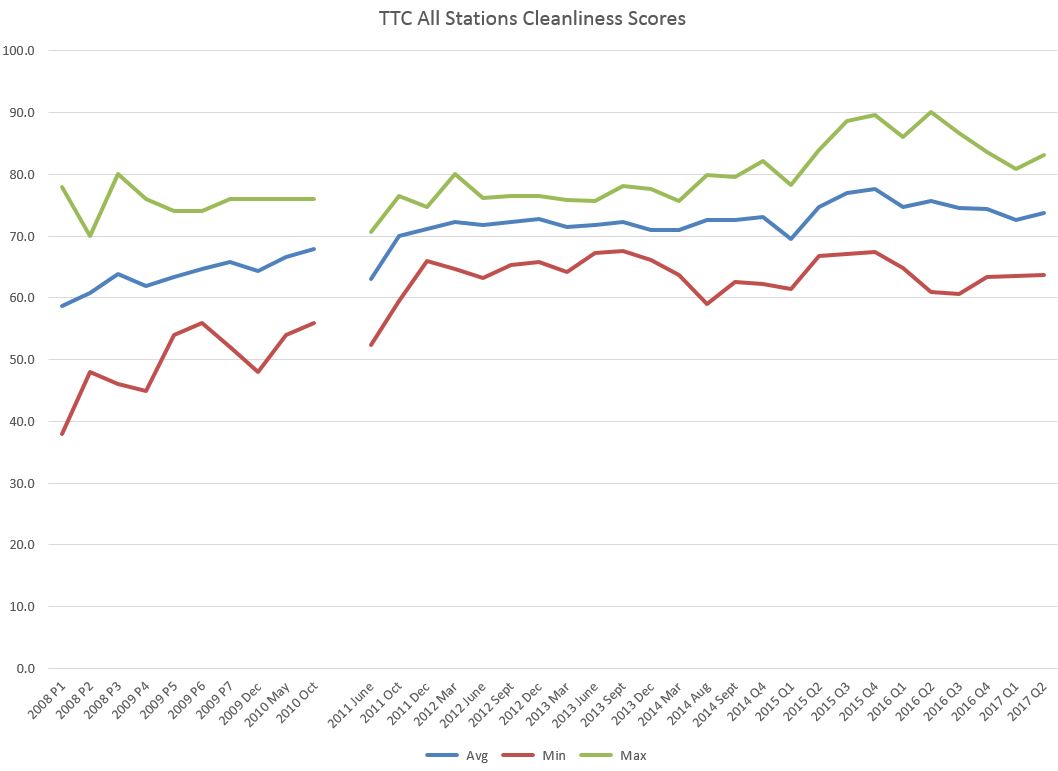
The data are revealing when they are split apart in various ways. First, the system average scores including the maximum and minimum values attained in each survey by individual stations.

As Green notes, there is an upward trend, although it stalled for a considerable period  from 2012-14, and after an improvement in 2015-16, values fell again in 2017. Quite clearly there was a wide range of scores back in 2008 when this process started, but a lot of the improvement over early years was to pull up the bottom performers (thereby increasing both the minimum score and the average). The maximum score did not start to rise substantially until 2015.

There are two obvious points where there are changes in the data:

  • The gap for the first part of 2011 was caused by a change in the contractors doing the condition surveys. It is intriguing that the first results from the new contractor showed a dip in values although this was quickly reset. Whether this was due to a change in TTC practices, or a re-calibration of the survey is hard to know.
  • There is a marked improvement starting in 2015, although more so in the maximum values. Much of this improvement fell away by 2017.

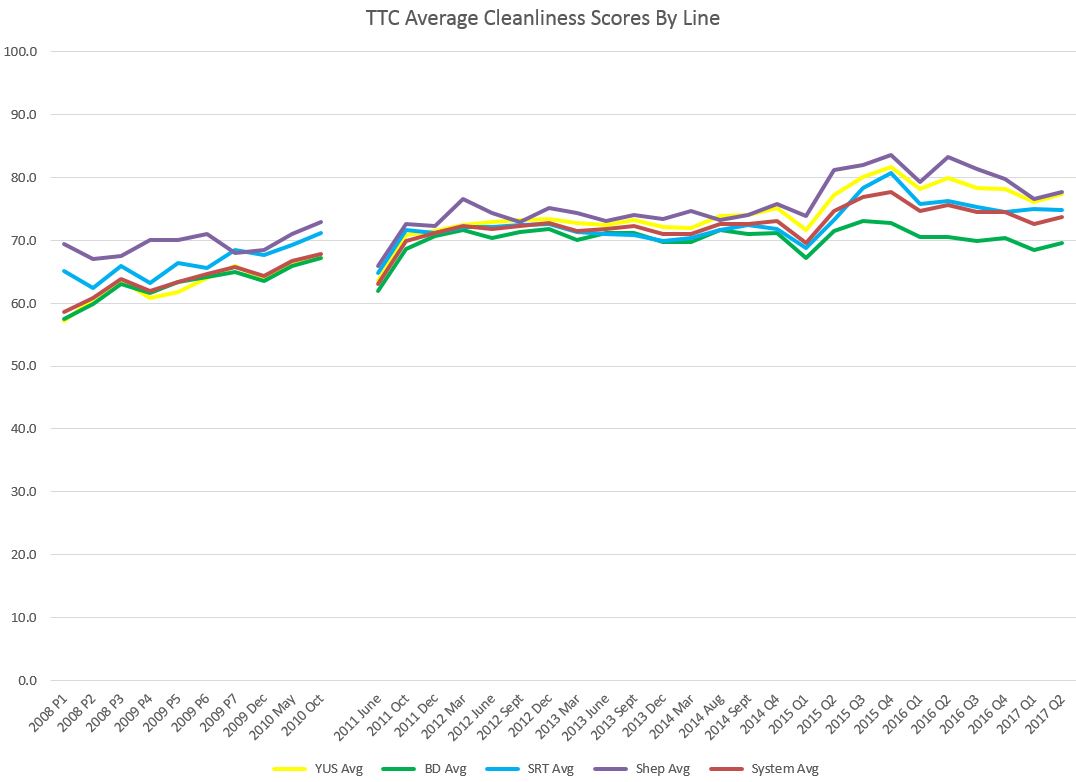
When the data are split apart by route, here is what we see:

The biggest jump for 2015 came on the Sheppard line with Yonge a close second and then the SRT. What is quite striking is that the improvement had little effect on the Bloor-Danforth line.

Another factor that stands out here are dips in Q1 of recent years probably due to winter conditions. This could well be a function of when the surveys were done as past years show data explicitly for December and March, but not for January or February.

Continue reading

TTC Board “Discovers” Cost of Bloor-Danforth Subway Renovation

The TTC Board met on July 11, and the public agenda contained little that prompted extensive debate. The entire meeting was over in 75 minutes, a quite unusual situation reflecting the onset of the summer break at City Hall.

The status of the streetcar order from Bombardier prompted a spin-off discussion of the subway. CEO Andy Byford had noted that reliability on the Yonge line’s fleet of TR (Toronto Rocket) trains has reached a world-class level, and it is quite substantially better than that of the T1 trains operating on Bloor-Danforth, although their performance is reasonable for cars of their age (about 15 years) and technology.

This prompted a question from Vice Chair Alan Heisey who asked when the TTC should be making plans to replace the T1 fleet. Chief Operating Officer Mike Palmer replied that “we probably had to order the cars last week”. (See YouTube video of meeting.) This came as something of a surprise to the Board thanks to the way that planning for the Scarborough Subway Estension (SSE) and Line 2 BD in general have been handled, with information dribbling out bit by bit, and with plans in the TTC Capital Budget not fully reflecting future needs.

I wrote about this in a previous article, but as an update, here is the status of various projects related to the BD line’s future.

Summary

There are four major components to upgrades facing the TTC for subway expansion on Line 2 Bloor Danforth. Here is their status:

  • Replace T1 subway car fleet
    • Estimated cost: $1.737 billion
    • “Below the line” in the City Budget (i.e. not funded)
    • Current replacement schedule is out of step with plans for other projects
  • New subway yard at Kipling
    • Approximate cost: $500 million
    • Only $7m for planning work is included in the Capital Budget, but nothing for construction
    • Carhouse and yard are a prerequisite for the T1 replacement fleet
  • Automatic Train Control
    • Estimated cost: $431 million
    • Only about $250m currently allocated in the City’s approved Capital Budget
    • Current signal system dates from 1966-69 when the BD line was built and it uses obsolete technology
  • Bloor-Yonge Station capacity relief
    • Estimated cost: $1.117 billion
    • Only $6m for planning work is included in the Capital Budget, but nothing for construction
    • Scope of work and feasibility have not been published

This is not simply a matter of TTC management providing a rosy view of capital needs, or of the City choosing to ignore the scope of the problem. When projects of this scale don’t appear in the “to do list”, they are not considered any time another government comes calling with a funding offer. Many projects that will receive money from Ottawa’s infrastructure fund (PTIF) are on that list because they were acknowledged as part of the TTC’s outstanding requirements.

Keeping the full needs of the Bloor-Danforth subway out of view short-changes the TTC system and the riding public, and politicians are surprised to find that the “ask” for transit spending is a lot bigger than they thought. Meanwhile new projects make claims on “spending room” that might exist only because needs of the existing system have been downplayed.

TTC management plans to bring a consolidated report on the renewal of the Bloor-Danforth line to the Board in September 2017.

Continue reading

UPX Ridership Update

Metrolinx has published ridership stats for the Union Pearson Express to the end of March 2017.

These do not break down trips between various points on the line to show what portion of ridership is end-to-end Union-Airport traffic, and what portion travels to or from stations along the way.

In this chart the blue line traces daily counts and these show a regular weekly cycle. The total ridership grows after the fare reduction of early 2016 and peaked in September 2016. Except for that peak, and a winter dip from Christmas 2016 to mid-February 2017, the average number of daily riders (on a weekly rolling average, orange) has remained slightly below 8,000. This appears to be the new stable level of ridership with the current fares and service pattern. A related issue is that with some trips on busy days reporting standees, growth during certain periods will be constrained by available capacity.

The original projection for UPX was that it would reach 5,000 daily riders after a year’s operation. This it would have abjectly failed to achieve but for the revised tariff. The gray line prorates that projection from the opening week to the first anniversary in June 2016, and then continues on the same rate of increase until March 2017.

In the Metrolinx financial statements (to be discussed in a separate post), it is not possible to separate out information for the UPX division, and for management and accounting purposes, this has now been rolled into GO Transit.

A note to anyone at Metrolinx who is reading this: When you publish data like this, make it available as a spreadsheet (as well as PDF for general consumption) so that the numbers can easily be extracted and analysed without the need to “scrape” the PDF.

Maybe Yes, Maybe No, SmartTrack Stations

After a recent Metrolinx Board Meeting (about which more in a separate article), reporters the Star and the Globe peppered Chair Robert Prichard about decisions to approve two future GO stations against original staff recommendations.

Ben Spurr wrote in the Star about the Kirby station in Vaughan that leapt from an initial review to part of GO’s plans thanks to political intervention at Queen’s Park. In between the detailed station reviews and the final recommendations to the Metrolinx Board, a summary report consolidated the detailed reviews. This report, which has not been published by Metrolinx, has different recommendations that those presented to the Board, according to Spurr’s article.

I wrote extensively about the reviews of proposed stations within the City of Toronto in these articles:

Another station that found its way onto the approved list in spite of a negative review was Lawrence East. This station is critical to plans for the Scarborough Subway providing a replacement for service in an area the subway will bypass.

The future of stations that would be added through the SmartTrack scheme is rather cloudy. Even though Lawrence East, for example, is “approved”, this is subject to operational reviews and intensification of land use by the City of Toronto to build demand. Talking of the Kirby station, Spurr reported:

Prichard said the board’s decision was “conditional” and that Metrolinx will continue to update its analysis based on development in Vaughan. If the greater density doesn’t materialize “we can back off,” he said.

For the stations in the City of Toronto, the situation begs more questions. First, Metrolinx required Council to sign on guaranteeing that they would fund added stations for SmartTrack in November 2016. Council was told that Metrolinx was going into design and construction, and that a commitment was needed “now” for this work to stay on schedule. Second, the total cost of the six proposed stations approved by Council was more than twice the cost estimates in the Metrolinx station reviews.

Metrolinx station review cost estimates:

  • Lawrence East: $22.7 million
  • Finch East: $108.9 million
  • Liberty Village: $30.8 million
  • St. Clair: $27.4 million
  • East Harbour (Unilever): $118.9 million
  • Gerrard: $251.7 million
  • Total: $560.4 million

City Council estimate: $1,251.8 million

With total costs much higher than in the original evaluations, the business cases for these stations are even weaker than have been stated. The City is not strictly on the hook for these costs yet, whatever they might be, because there will be a final approval point when more detailed estimates are available prior to tendering the construction work. This point is unlikely to be reached before the municipal election in fall 2018.

Several of the proposed stations pose construction challenges, and it is not clear how well all of them can be fitted into the corridor. Liberty Village station is particularly tight for space.

Lawrence East poses a delicate political problem because it cannot be built while the SRT remains in operation. However, the Scarborough Subway will not open until late 2026 leaving the possibility of an early shutdown of the SRT, or a delay in the provision of a SmartTrack station. Intensification at Lawrence East could be a hard sell given Toronto’s intention to focus substantial development on the Scarborough Town Centre and uncertainty about the type and cost of transit service that would be available.

A related issue came up in discussion of the fall 2017 GO Transit fare increase. This will see fares rise by 3% except those for short-distance trips that will be frozen at $5.65. Metrolinx has recently discovered the importance of short-distance travel on its network as an untapped market after years of deliberately overpricing these trips to discourage demand. Keeping inside-Toronto trips at a fixed cost would allow GO fares to gradually become more attractive to TTC riders, although that would take many, many years. Clearly Metrolinx is rethinking the role of its network both for in-Toronto trips and for shorter trips in the 905 that could become more attractive as service improves.

All of this leaves the question of which stations might be built up in the air subject to future considerations in spite of Toronto Council’s support in 2016.

Honesty in Subway Planning

Toronto Council recently approved further study on both the “Relief” subway line, and the Yonge Subway Extension north to Richmond Hill. This approval came with several caveats about the timing of projects and the sharing of both capital and operating costs for the YSE.

Meanwhile riders who attempt to use the system as it is are expected to take hope from the fact that “Relief” might appear in only 15 years.

The entire debate about subway capacity in Toronto has, for many years, taken place in among incomplete information, policy directions that looked outward from the core to the suburbs, and in some cases blatant misrepresentation of the complexity of problems the City of Toronto faces.

A major issue throughout the debates has been that individual projects, or even components of projects, are discussed as if they are free-standing “solutions” to the problem when they are only one of many necessary components. Costs are low-balled by omission of critical parts of an overall plan, and the pressures on capital spending are understated by artificially planning major projects beyond the 10-year funding window used for City budgets. This gives the impression that money is “available” for other projects within the City’s financial capacity by stealing headroom in future plans to pay for things that, strictly speaking, should have a lower priority.

The situation is not helped one bit by the lack of strategic planning at the TTC and City where serving the political philosophy of the day often takes precedence over taking a wider view. Indeed the TTC Board, at times, almost prefers to be ignorant of the details because this would force a re-examination of cherished political stances. At Council, although Toronto now has its “Feeling Congested” study and an attempt at prioritization of projects, efforts continue to advance schemes near and dear to individual Councillors who simply will not accept that their wards are not the centre of the known universe.

What Toronto desperately needs is a thorough review of its rapid transit plans and the funding needed to achieve them. This must take into account, and modify where needed, the historical reasons we are in the current situation, and examine what can be done for the future, when this can be achieved and at what cost. The cost question must come second, in the sense that determining what the City needs is an essential first step. Only then can we examine possible alternative ways to address the issues, the cost this will bring and the funding mechanisms that might be used.

Continue reading

Inching Ahead on Subway Plans

Toronto’s Executive Committee will consider a report from the City Manager at its meeting of May 15, 2017 regarding the preferred alignment for the southern end of the “Relief Line” subway, as well as the current status of the Yonge Subway Extension to Richmond Hill.

This report has taken on a more political context with Mayor Tory’s recent statements that unless Queen’s Park coughs up financial support for the RL, he will block any further work on the YSE. Needless to say, this stance did not play well in York Region or at Queen’s Park.

The two lines, as they currently are proposed, look like this:

One might cast a though back only a few years to Tory’s election campaign in which he claimed that SmartTrack would eliminate the need for a Relief Line, that it would have frequent service with many new stops, that it would operate with TTC fares, and that it would be self-financing. Most of these claims were demonstrably false or impossible at the time, and the project scope has changed dramatically. Even the question of a “TTC fare” is tangled up in the Metrolinx Fare Integration study which could well bring higher rapid transit fares to the TTC as a way of “integrating” them with regional systems.

Tory’s convoluted evolution into a Relief Line supporter undermines his credibility on many issues not the least of which is an understanding of when money he demands might actually be spent. There is no point in getting a “commitment” from Queen’s Park when the government will be unrecognizable by the time the bills come due. Toronto has far more pressing demands in the short and medium term, and meanwhile there is $150 million of provincial money going into design work for the RL.

As for the YSE, it has been on York Region’s wish list for years, and is more advanced than the Scarborough Subway which is mired in debates about the alignment and number of stations. The problem for Toronto is that there is no capacity for additional riders from an extension on the Yonge line, and indeed it is already over capacity according to a CBC interview with TTC Deputy CEO Chris Upfold on May 10.

Continue reading