What Shall We Do With Don Mills (2)?

When I talk about taking a Downtown Relief Line north to Eglinton, some people, including some at the TTC, look at me as if I had at least two heads.  That’s a shame, considering that the TTC itself did a preliminary design for this 35 years ago.

I offer these tidbits from my archives not to reignite a discussion we have had here extensively before, but to put to rest any claims that this line was only ever intended to stop at the Danforth.

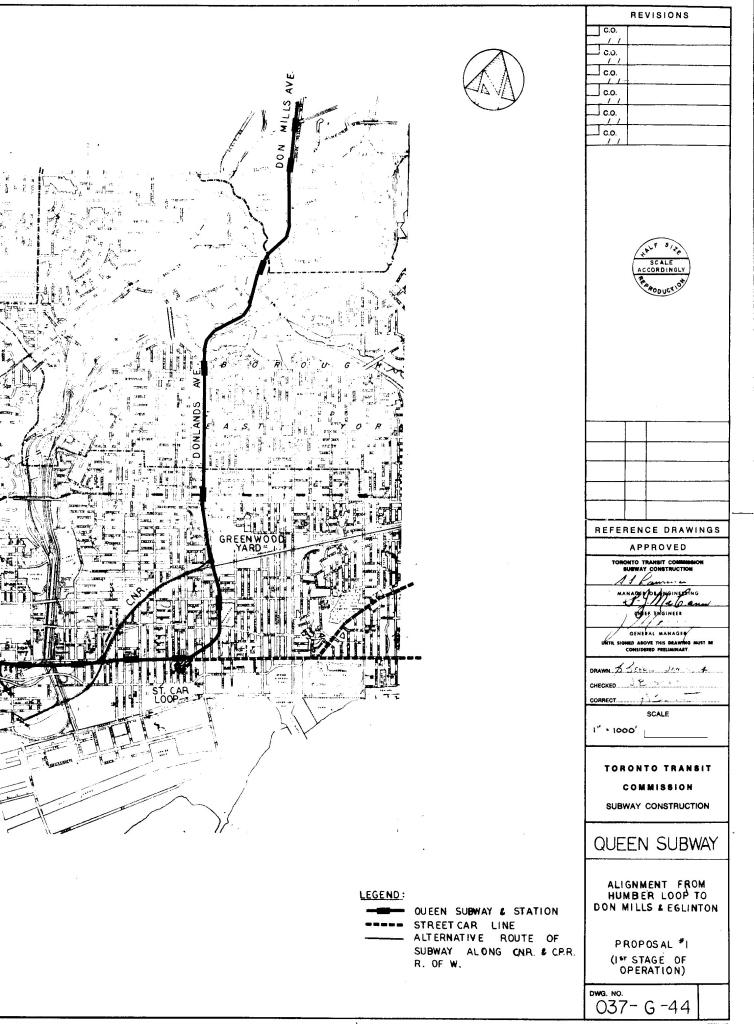
DRLAlignment19740112cBack in October 1974, the TTC was considering various proposals for new rapid transit lines, one of which was the Queen Street subway. This line would have run from Roncesvalles and Queen east to somewhere beyond Broadview, then turned north past Greenwood yard and continued via Donlands to O’Connor. At that point, the line would cross the Don River to serve Thorncliffe and Flemingdon Parks winding up at the CPR crossing north of Eglinton. The map linked here is a bit fuzzy in places because the original is not clear, but it shows the alignment (including an alternative via the CNR corridor) quite clearly.


DRLBrochureCovercTen years later, the TTC was working on the Downtown Rapid Transit Study, and the route had morphed into an ICTS line to Union Station. 


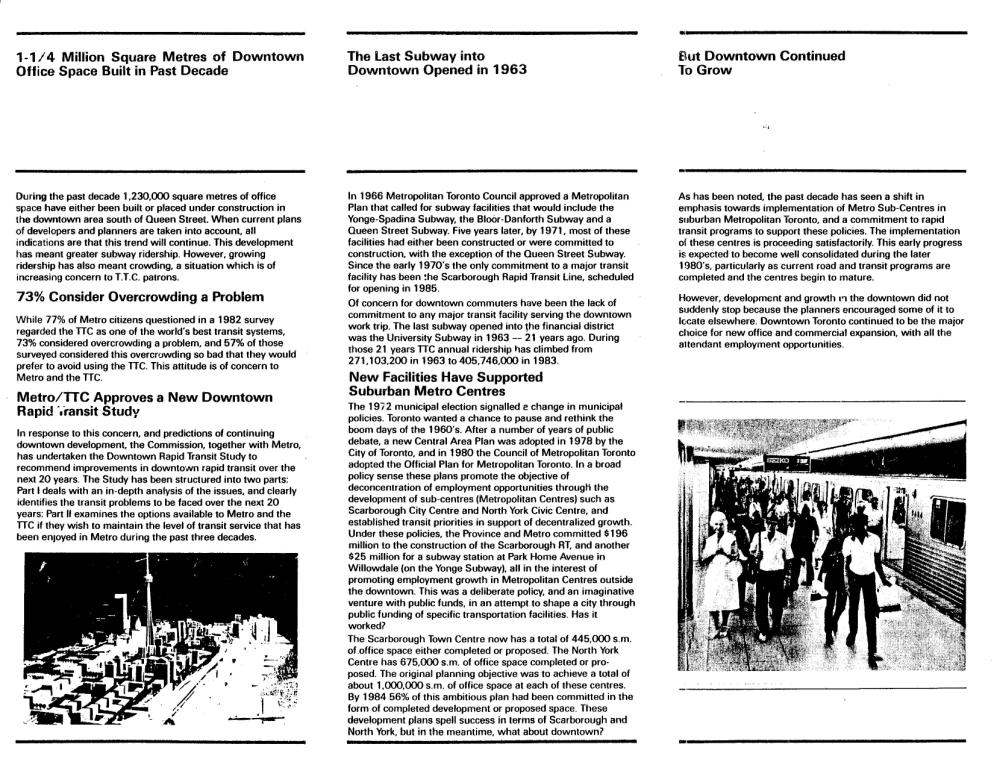
DRLBrochure1cA brochure advertised this study and explained the growing problem of central area subway congestion complete with a suggestion that passengers transfer at St. George rather than Bloor-Yonge.


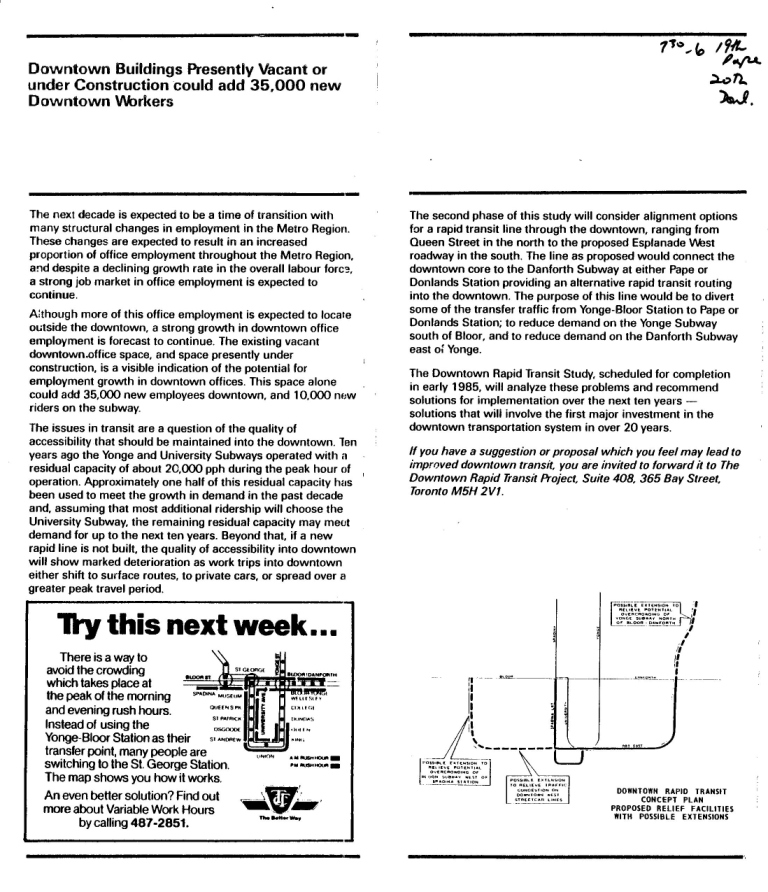
DRLBrochure2cThe DRL was never built because politics of the day favoured suburban projects, and instead we got the Sheppard Subway.

Trolley Coaches for Toronto?

One side effect of retirement is that I am finally dealing with years of accumulated files.  Yes, I admit it, I have more paper than I need (especially now that so much is available in electronic format), and some of those old reports about obscure parts of the system really are not high points of my bedroom reading.

In the course of sorting through things, one always bumps into items that are misfiled, that faded from memory.  One of these was an envelope I had kept because of the postmark dated May 4, 1972.

TTCPostmark4V72c

So much has changed.  Postage is a lot more than eight cents, and the postal code of “Toronto 7” is positively quaint.  The slogan “Ride With Us No Traffic Fuss!” is classic, but the real gem is the trolley coach as the symbol of progressive transit.

Back in 1972, the trolley coaches had a future.  Vehicles soon to be displaced from the 97 Yonge route by the opening of the Yonge Subway to York Mills were destined to replace streetcars on St. Clair (even though there were nowhere near enough of them to actually do that).  The TTC was still committed to electric operation, and the equipment in these coaches would be recycled into new bus bodies from Flyer.  Nobody had heard of Natural Gas Buses.

Today, the TTC resists calls to re-examine trolley coaches on the grounds that pure electric buses without wires are just around the corner.  I remain unconvinced, and look forward to a day when a modern trolley coach will appear in TTC literature.

Metrolinx Reviews the Richmond Hill Subway Extension

On August 7, Metrolinx released the Executive Summary of an Interim Benefits Case Analysis for the Richmond Hill extension of the Yonge Subway.  The most important text appears on the introductory page:

This interim BCA appraisal of the project raised a number of key network related considerations.  Considering this, Metrolinx, in close collaboration with the City of Toronto, TTC and York Region, will undertake additional analysis to more comprehensively understand these matters and how they impact the network and project scope. The analysis will include:

  • Possible adjustments in project scope, timing or phasing;
  • Consideration of the extent to which improved service levels on the parallel GO Richmond Hill rail corridor to off-load some of the demand on Yonge Subway corridor (existing and proposed extension); and
  • The cost impacts of the various options on the subway yards strategy, Yonge-Bloor subway station improvements; and a future Downtown Relief Line to bypass the Yonge-Bloor congestion pinchpoint.

The BCA process for this project has identified a range of development and congestion pressures along the Yonge Subway corridor. In partnership with York Region, TTC and the City of Toronto, Metrolinx will be carrying out the work above and report back to the Metrolinx Board on the resolution of key project issues in late 2009.

This statement is the first official recognition outside of Toronto Council that the Richmond Hill subway must be reviewed in the larger context of network performance and the stress that additional loads will put on the system.  When Toronto gave guarded approval to the subway extension, but with a long list of pre- and co-requisites, many complained that this was just Toronto being obstructionist, the sort of behaviour that led to politicians being kicked off of the Metrolinx board.  Things have changed.

The Benefits Case Analysis clearly had its origin in simpler times when Metrolinx projects were considered in isolation.  Page 1 of the BCA lists only three alternatives for consideration:  two subway versions (differing only in the number of stations) and a BRT scheme.  There is no mention of alternatives such as GO improvements or LRT, but at least the potential for overloading the existing subway system is acknowledged.  Later, the report acknowledges that it is part of a larger collection of studies (as noted in the introductory text above), but this is not reflected in the options that were evaluated.

In a bit of accounting sleight-of-hand, only part of the cost of Bloor-Yonge Station improvements are charged to the extension project on the ground that other factors will increase demand and the cost should not all be charged to the extension.  This misses the basic point that the extension would be the trigger, and indeed has already been used to justify upgrading capacity on the existing subway system.

The options shown on page 2 show that demand in the corridor between Finch and Richmond Hill would place roughly 9,000 peak hour passengers on the subway, about 3/4 of the total travel in this corridor.  Most of the rest would be on an infrequent GO service (every 30 minutes) in this scheme, even though Metrolinx’ own plans call for substantial improvement in service to Richmond Hill.

BRT is rejected as an option because its capacity is only 3,000 per hour, and the demand is well above this level.

Footnote 2 of this table states the obvious, that demand peaks before implementation of Richmond Hill Express Rail service currently planned for the 2021-2031 timeframe.  Why would we spend a fortune on expanding capacity of the existing subway system if the demand will be siphoned off by another future project?

Page 3 tells us that the benefit-cost ratio for the subway options is 0.7.  We have to take this with a grain of salt given the underlying methodology.  The lion’s share of the benefit comes from reduced auto commuting (“Transportation User Benefits” on page 4), but this would also occur with improved GO service.  The benefit of those redirected trips would no longer be available as an offset to the cost of the subway extension, and the benefit-cost ratio for the subway proposals would be much lower.  This is masked by the absence of an option which includes significantly improved GO service to which much of the “user benefits” would be assigned.

One major flaw in the Metrolinx BCA methodology is the inclusion of “economic impacts during construction”, in other words, the job creation of building the line.  This “benefit” can only be assigned to a specific project if the money would not otherwise be spent elsewhere.

However, in any evaluation of network alternatives, we can reasonably assume that we have “X” billion dollars to spend on something, and the real question is where we get the best return for the investment.  Claiming an economic benefit from construction skews the evaluation of projects to those that cost the most and therefore provide the greatest short-term job stimulus.  One could argue in the extreme that not spending billions on public transit would be beneficial because the money would be available for other uses such as reduction of provincial debt or tax relief.

This “analysis” is a farce.  Clearly, Metrolinx sees that an isolated review of the Yonge Subway extension misses the bigger picture.  Oddly enough, they didn’t bother to publish the full analysis, only the summary.  I suspect that the complete report would be far too embarrassing given the superficial work visible here.

We must now await the outcome of several other studies, notably those for improved GO service and for the subway options into downtown.  This work should have been underway long ago, but at least, finally, it is started.  Is the era of “I want a subway” planning finally over?

Union Station Project Approved by Toronto Council

The Union Station Revitalization Project was approved yesterday (August 5) by Toronto Council with only one vote in opposition, the predictable gadfly Councillor Ford.  Media reports claim that a few others might have voted against as well, but they were caught napping in their offices watching the debate via closed circuit TV, and didn’t make it back in time to vote.

Media reports, thanks to the emphasis in the Mayor’s press conference, focus on the new retail space to be created at Union Station, and this was a target for critics who say we shouldn’t be turning the station into a mall.  They haven’t been paying attention.  (For more details about what we are getting, please see my previous article on this subject.)

Of the total project cost, $640-million, the City is on the hook for about $300-million, some of which has already been spent on necessary building repairs.  The City share will be partly covered through payments by the Head Lessee for the commercial space via three payment streams:  an up front one-time charge, an annual base rent, and percentage of sales from the retail space.  We won’t know the exact details until all of the agreements are in place later this year, and at that time we will also learn the identity of the successful bidder for the Head Lease.

Some opponents of City participation in this scheme argue that this should be a GO Transit project and the City has no business being in the railway station business, let alone creating a new shopping mall.  I disagree, strongly, with this position.

First, GO Transit (and its new parent, Metrolinx) has shown repeatedly that it cares only about its own operations as a commuter railway, not about local development.  GO would probably give us a tolerably decent railway station, but little more, and would plead poverty to any requests that it enhance the building.  We know exactly what GO’s idea of “good design” is every time we walk through their existing station, a bargain basement of fast food and the uninspiring underbelly of a former Post Office.

From the City’s point of view, this is both a major interchange with the TTC (still owned by the City) as well as a gateway to new developments south of the rail corridor.  Union Station is the link between the old and new “downtowns”, and is far more than just a train station.

Although I have discussed details of this project before, there are a few diagrams in the Council presentation that warrant comments. Continue reading

An Electrifying Opportunity

Friday’s Globe and Mail included an advertisement (page B15, upper right) for the position of “Project Director — Electrification Study” at Metrolinx.  The text of the ad is currently available on the Metrolinx website.

The ad intrigues (no, I am not applying) for its clear acknowledgement that this will be a highly visible, politically charged role requiring active engagement of all parties and mediation between competing views of what should be recommended.

The acid test will be whether the Project Director will be free to question existing assumptions and public stances taken by Metrolinx, GO and their political masters.

I wrote at some length earlier with advice to the Community Advisory Committee, and I commend that post not just to the new Project Director, but to applicants who might incorporate questions for the interview team.

If there is any disappointment in the ad, it is that “while transportation expertise is an important asset, it is not a condition of the position”.  This can be a double-edged sword in that the old boys’ club of transportation project managers includes many who will avoid rocking the boat, but a new face (at least to transportation) needs to know the difference between solid technical and political advice and self-serving hogwash.

The position commences in September 2009, and I will be fascinated to see who is selected.  That choice will tell us much about how seriously Metrolinx and Queen’s Park take the electrification study.

What Shall We Do With Don Mills?

Recent planning and political activity focussed on the Weston rail corridor studies and the potential effect of substantially increased train service there.  Meanwhile, work is about to start on reviewing one aspect of an eastern corridor, a the so-called “Downtown Relief Line”.

The eastern leg of the DRL has a long history, but in the modern (post WW2) era this began as a Queen Subway proposal.  Before the Bloor-Danforth subway, Queen was regarded as the next logical part of a subway network after the Yonge line, but this status was quickly overtaken by the northward shift of population in the growing suburbs.

One early version of the Queen line would have gone north to Don Mills and Eglinton.  When the Network 2011 Plan was published in 1985, its priority list was

  • the Sheppard Subway from Yonge to Victoria Park (to be completed by 1994)
  • the Downtown Rapid Transit line (using ICTS) from Pape to Spadina (to be completed by 1999)
  • the Eglinton West line from Scarlett Road to Eglinton West Station (to be completed by 2004)

Although the Netwok 2011 background studies showed a DRL would have substantial effects on peak point demands on the existing subway network, this wasn’t enough to save the scheme from a strong political bias against building more subways into downtown.  We all know that the actual priorities became Sheppard and Eglinton West.

In December 2002, the Don Valley Corridor Transportation Master Plan was launched to consider ways of improving travel in the entire corridor from Steeles to the lake, and roughly from Leslie to Victoria Park (swinging further west in the southern section to follow the river’s alignment).  That study arose from a scheme to increase capacity on the Don Valley Parkway, but the study was to consider transit as well as road options.

The study reported in 2005 with a recommendation for BRT on the DVP and various ways to route such a service either to downtown or to the BD subway at Pape, Broadview or Castle Frank.  (The scheme for BRT to Castle Frank prompted an alternative proposal using Swan Boats early in the life of this blog.) 

By 2007, the Transit City scheme had shifted planning focus to Don Mills Road itself and to LRT away from BRT.  However, old studies die hard, and the LRT study persisted in reviewing that same trio of southern destinations for the LRT line.  Major problems include how to thread an “LRT” service through an established neighbourhood on a four-lane street.  We have seen one possible approach with the redesign of Roncesvalles Avenue, but the Don Mills route is quite another matter.

Projected peak demand on the Don Mills LRT is 3,000 per hour, about 35% higher than the current design capacity of the King Streetcar.  Moreover, the 504’s peak point is not on Roncesvalles, and future increases in capacity through Liberty Village will likely be achieved with service entering the line at Sunnyside and possibly by diversion of demand to a Waterfront West line (depending on the path it takes east of Dufferin Street).  There will never be a requirement to operate more frequent service than today on Roncesvalles Avenue.

The total of all bus services to Broadview and Pape Stations from the north is 62 vehicles/hour or a combined design capacity of 3,100 passengers.  Many, but not all, of these would use a Don Mills LRT especially if they had no choice to transfer because of new route structures.  (Broadview — 2, Flemingdon Park — 15, Mortimer — 4, Cosburn — 11, Don Mills — 17, Thorncliffe Park — 13).  However, any existing demand diverted to the LRT plus any new riding would now be placed on one rather than two subway interchanges.  Neither Broadview nor Pape has room for substantially increased traffic and a proper junction would almost certainly have to be underground.  (The 1985 DRL design included an underground interchange at Pape Station.)

All of this is a perfect example of a project with a narrow scope, one that considers only a single problem, not the larger context of the transit network. Continue reading

Union Station Funding Approved

Today, Queen’s Park and Ottawa announced their funding contributions to the Union Station Revitalization project.  Ottawa will spend up to $133-million while Queen’s Park will spend $172-million toward the $640-million total.

At a special Council meeting early in August, Toronto will likely announce the private sector partner who will take the head lease for all of the commercial space in the expanded station, and this lease is expected to contribute a substantial amount to the City’s share of the project.  That partner will be responsible for managing all commercial tenancies.

On other sites that I will not bother to cross-link, there has been an overflowing of bilge on several fronts including the civic workers and VIA strikes, Mayor Miller, spending on “a building that works”, among other arguments.  The level of misinformation, deliberate or otherwise, is staggering.

To refresh everyone’s memory, here is what we are getting for all that money:

  • Restoration of a physical building which has been disintegrating for several years.  Some of this work has already been done or is underway by the City notably the windows in the west wing and the bridge over the Front Street moat.
  • Creation of a completely new two-level concourse area under much of the station.  This will be achieved by digging down so that the lower level is at roughly the same elevation as the existing subway station mezzanine.  The new upper level will handle GO passengers, and will be roughly three times the size of the existing GO area.  The lower level will provide general circulation and shopping.
  • GO improvements and other changes in the station will accomodate a doubling of demand expected at this site over the next decades.  This could not occur without the reconstruction and the provision of greatly expanded pedestrian areas.
  • The lower level of the west wing, now occupied by car rentals and underutilized back-of-house space, will be converted to GO and commercial space.  This work will be completed before work moves to the existing GO space and empty former Post Office areas in the east wing. 
  • Why shopping?  Aside from all the commuters, there will be a large population right outside the soon-to-open south door of Union Station occupying both office towers and condos.  The character of commercial uses in the station should be improved so that it does not appear like an overgrown dollar store.
  • Energy efficiency of the building will be substantially improved, and air conditioning will be provided with deep water cooling from the lake.  Energy is a major operating cost for the station today.
  • The connection to the subway station will be revised to eliminate the stairway between the subway mezzanine and the moat.  The moat will be enclosed so that travellers don’t have to endure the weather, whatever it  may be, to reach the subway and the PATH network beyond.
  • A new northwest PATH connection will be created from Union Station north via York Street to Wellington.  This will divert many commuters from the eastern connection and ease congestion on that side of the station.
  • GO Transit will buy and move into the vacant west wing offices from their leased space at the foot of Bay Street.  These offices will be renovated to modern requirements, but some heritage areas will be retained.
  • Connections between various parts of the building will be improved, and new links will be added to simplify access between sections and to spread out pedestrian traffic.  For example, there will be links to the new GO concourses through the archways in the south wall of the Great Hall now occupied by the Security Office (east) and Harvey’s (west).
  • A new south entrance, built as part of the recent GO Transit platform work, will give passengers direct access to a plaza between the station, the Air Canada Centre and other new developments in the area.  A new taxi stand in this area is intended for use by arriving VIA passengers to separate them from the activity on Front Street.
  • The east entrance via the old Post Office, now Scotiabank, will be reopened and the space on the ground floor will become part of the public area of the railway station.
  • Renovation of the York Street teamways for pedestrian use in a manner similar to what is now in place on Bay Street.
  • This heritage building will be restored, where appropriate, by stripping off more recent additions such as mid-60s ticket counters.
  • GO Transit will rebuild the trainshed substantially in the form it now has but (a) cleaner and brighter, (b) with provision for future electrification and (c) with a glass atrium roof running the length of the shed in the area directly above the VIA concourse (the location is dictated by the location of supporting columns beneath).

Information on this project is available on the Union Station website.

Other projects that will take place in the same timeframe include:

  • TTC’s second platform for Union Subway Station.
  • TTC’s expansion of capacity in the Harbourfront streetcar loop to accommodate the new eastern waterfront streetcar service.
  • The reconfiguration of Front Street from Bay to York to provide additional pedestrian capacity.

It is unfortunate that this announcement comes just as VIA staff go on strike.  However, the project has been in the works for years, and spending on this major work with decades of future benefit is long overdue.  Fortunately, the announcement was not delayed in deference to then-pending strike.  Moreover, the primary beneficiaries of this work will be commuters on GO Transit for whom additional train capacity is constrained by the limits of the station itself.

Some have claimed that there is nothing wrong with Union Station that needs fixing.  They have not looked closely at either the building itself, at the severe congestion problems or at the vast amount of unused space available for expansion, much of this hidden from public view.

This is not a “make work” project, but something Toronto badly needs.  Union Station handles more passengers every year than Pearson Airport on a fraction of the capital budget.  The station doesn’t get to charge an improvement fee to every passenger to fund its ongoing construction and operations.

The reconstruction will be a long project, not without its inconveniences.  We are lucky to have an almost-empty west wing in which to start and create new space for GO so that existing operations can continue during the early phases.  Detailed design will be completed this fall with work in the west wing to begin in early 2010.  The project will complete in 2014.

Why Streetcars?

Tom Jurenka sent in the following note, and it raises questions that deserve a debate.

Hello Steve

As a non-native Torontonian (grew up in Winnipeg, but have lived in Toronto for 24 years now) I have always been puzzled — and often infuriated — by streetcars (and the absolutely terrible traffic light timing in Toronto, but that is another story).

My question is an honest one — WHY? All I can see is the negatives of streetcars:

  • they tear up streets (I’ve lived through Queen Street E, Gerrard, now St. Clair, being torn up utterly to undo the damage of streetcars pounding the rails)
  • they are slow as molasses (as a bicyclist, I routinely pass 5 or 6 streetcars on Queen Street heading from AC Harris to downtown)
  • because of their slowness and immobility they delay traffic all the time, causing snarls and the attendant idling pollution
  • they are super expensive (witness the recent funding mess)

So I’m really curious why streetcars are a better alternative to trolley buses or just plain old buses, which move fast, are mobile, and are less expensive per unit to buy. Would you be able to point me at some links/articles/studies/whatever to help me understand this issue?

Thank you for your time.

Best regards,

Tom Jurenka

This is a far more complex question than just the list above, but I will use this as a jumping off point. Continue reading

Stratford July 2009 Reviews

Last week took me up to Stratford for the first of this year’s visits. Although some may think otherwise, I do not go to Stratford just as an excuse to perform inspection tours of the Georgetown/Kitchener corridor. The trains were on time both ways.

Reviewed here:

Julius Caesar (*)
Ever Yours, Oscar (**½)
Bartholemew Fair (****)
The Three Sisters (**½)
Macbeth (***)

I will return to Stratford in August for another five plays.

Continue reading

Service Changes Effective August 2, 2009

For mid summer, there are only a few schedule changes on the TTC network, and they take effect at the start of August running through to Labour Day weekend.

Changes for September are much more extensive, and I will deal with these in a separate post.

Bingham Loop Reconstruction

Due to the reconstruction of Bingham Loop, routes 502 Downtowner and 503 Kingston Road Tripper will be replaced by buses.  Combined streetcar service of 7’30” will be replaced by bus service of 6’00”.  The off-peak 20’00” headway is unchanged.

Diversions at Bingham Loop will change from time to time as construction progresses.  This also affects the 22A Coxwell, 12 Kingston Road, 322 Coxwell and 324 Victoria Park Night Buses.

Roncesvalles Reconstruction

Running times on the Roncesvalles shuttle bus will be increased at some times to compensate for actual start of construction and the diversion of southbound service via Dundas, Lansdowne and Queen.

501 Queen

The test of a modified step-back crewing operation will end, and normal crewing will resume on this route.

77 Swansea & 71 Runnymede

Running times on these interlined routes will be increased.  In the AM peak and midday, this will be done by reducing recovery times scheduled at terminals.  In the PM peak and evening, headways will be increased.  PM peak headways on the common section of the route will go from 10′ to 11′ with a change from 20′ to 22′ on the Runnymede branches.  A similar change will occur in the early evening, but at that time only half of the service runs south of Bloor.

Caribana

Additional service will operate for the parade on Saturday, August 1 on 511 Bathurst, 509 Harbourfront and 29 Dufferin, as well as express buses from Keele, Dundas West and Lansdowne Stations.  The 329/316 night routes will divert around the CNE grounds as described in the next section.

Additional service on 509 Harbourfront, 510 Spadina and 6 Bay is also planned for the Sunday, August 2 events on Toronto Island.  Whether these will actually occur given that the civic strike has shut down the ferries remains to be seen.  All of the added service is operated “at the divisional level”, meaning that the work is easily cancelled or reassigned if the party ends up at a new location.

Canadian National Exhibition

Additional service will operate on all of the usual routes including 511 Bathurst, 509 Harbourfront, 193 Exhibition Rocket and 29 Dufferin.  Overnight service on interlined routes 329 Dufferin and 316 Ossington will not operate through the CNE grounds, but will connect via Fraser and Liberty.