Weston Community Coalition Slams Metrolinx Corridor Study

The Weston Community Coalition today released an extensive critique of the recently completed Metrolinx study of the Georgetown South corridor.  This document, a letter to the Minister of the Environment, urges the Minister to reject the Metrolinx study, demand a full review and require that the project be designed and operated as an electrified service from the outset.

I will not repeat the WCC’s arguments in detail here, but they include documentation of a long history of misleading and contradictory statements by project proponents, serious concerns about emissions, noise and vibration studies, and an overall sense that the process of public consultation has been window dressing around an already-decided outcome.

In the interests of full disclosure, please note that I have worked with the WCC in preparation of this and other materials, and helped to review and edit this critique.  While there are individual comments with which I may disagree, the overall document is quite good.

This is not, as so often has been claimed, a case of NIMBYs standing in the way of progress, but of government agencies bent on ignoring the effects of their work and thwarting the spirit of “environmental” assessments.

The decision now rests with Queen’s Park.  Will they bravely move into a future of electrified commuter rail on GO Transit, or will they obfuscate issues and avoid real debate?  What record does this government want to have in the history books?

Sometimes Repairs Take Longer Than Expected

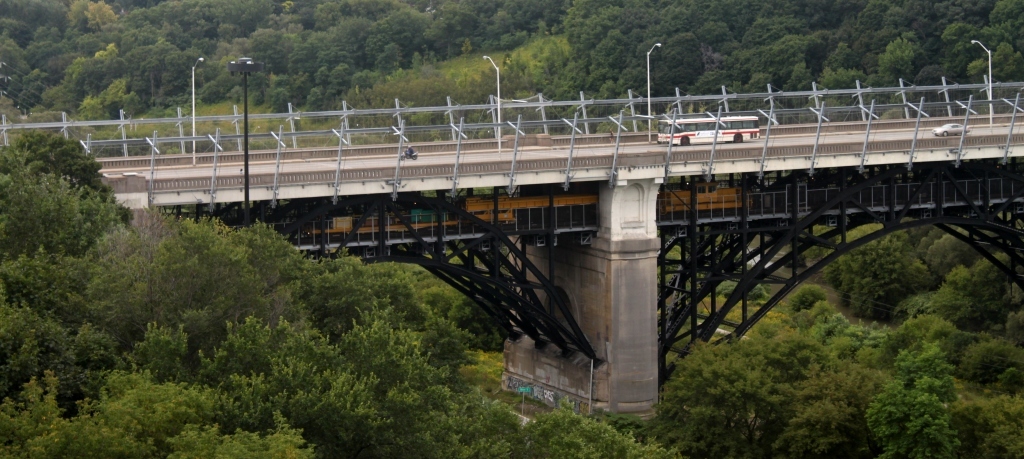
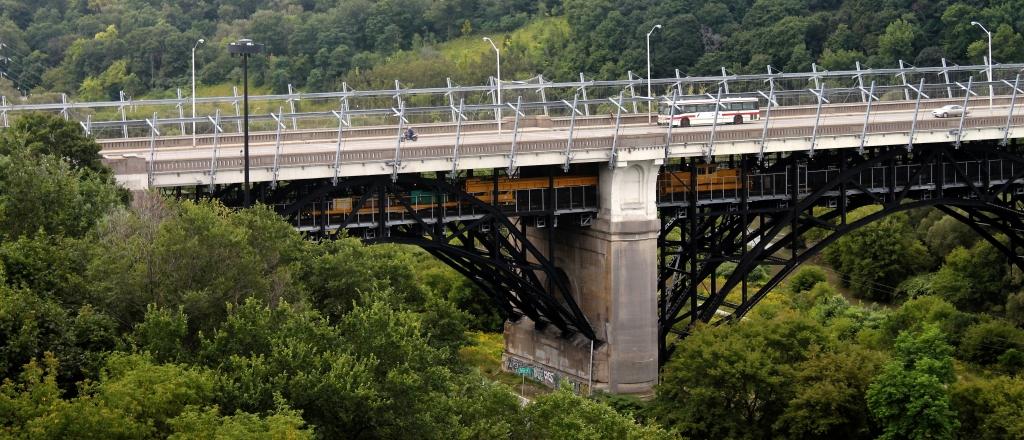
This morning, I was happily working away when what should I hear, but the familiar blast of the horn on the work train that maintains the Prince Edward Viaduct.  One small problem.  It’s 9:50 am and the subway should be running by now.

Was there a service interruption notice?  No.

Memo to Brad Ross at the TTC:  We keep hearing about the new staff and all the wonderful things that will happen with notices regarding service.  When?

IMG_0037E1V3CC

Queen Car Route Split Effective October 19, 2009

Starting on October 19, 2009, the TTC will experiment with splitting the 501 Queen route into two segments on weekdays only.  The intention is to decouple the outer ends of the line from events that occur on the opposite side of the city, and to provide sufficient flexibility that short turns should not interfere with riders’ ability to use the service.

This will be a trial operation lasting only for the October schedule period (roughly six weeks).  Seven cars will be added to the route during peak periods, with between five and eight additional at other times.  Weekend service is not affected, nor is the operation of the 502/503 routes on Kingston Road.

Two separate services will operate:

  • Neville Loop to Dufferin, looping in the west via Shaw, King and Dufferin.
  • Long Branch Loop and Humber Loop to Broadview, looping in the east via Parliament, Dundas and Broadview.

The eastern route will operate from Russell Division, and the western one from Roncesvalles.  This will eliminate crewing complexities with cars and operators switching between divisions.

Overnight service on the 301 Queen car will be split in the same manner, but cars will be scheduled to connect.  This arrangement will result in scheduled pairs of cars on the common section, a rather odd configuration.

The Neville-Dufferin branch will operate with the following headways:

  • AM Peak: 7’15”
  • Midday: 7’30”
  • PM Peak:  7’15”
  • Early Evening: 8’00”
  • Late Evening:  9’30”

The Humber-Broadview branch will operate with the following headways (service to Long Branch in parentheses):

  • AM Peak: 5’30” (11′)
  • Midday:  6’15” (12’30”)
  • PM Peak:  6’30” (13′)
  • Early Evening: 7’30” (15′)
  • Late Evening: 9’30” (19′)

By comparison, scheduled service for September 2009 is:

  • AM Peak: 5’10” (10’20”)
  • Midday: 5’53” (11’45”)
  • PM Peak: 5’40” (11’20”)
  • Early Evening: 6’45” (13’30”)
  • Late Evening: 10′ (20′)

If the new service is closer to schedule than the old one, then service should be improved even though scheduled headways on the outer ends of the route are slightly wider.  

Headways on the two halves of the route are, except for the overnight operation, different and there is no attempt to produce a blended operation in the central part of the route.  It will be interesting to see how many cars run in pairs by coming out of Dufferin or Broadview immediately behind a through car.  This is a challenge for TTC line management, and could defeat the benefit of the overlapped service between Broadview and Dufferin.

The considerable overlap of the two routes provides continuity even if either of them needs to be short turned.  Westbound cars from Neville could short turn at Bathurst or at McCaul while still serving downtown and connecting with the through service to the west end.  Eastbound cars from Humber could short turn at Church.  A shorter overlap would have almost guaranteed that many cars would never serve the major downtown stops or connect with their counterparts for through service.

Although all cars will pass through the congested section between University and Bathurst, short turns will be possible without eliminating connections, and the need for short turns at the outer ends of the line should be reduced.  This will bear watching.

Transit City Bus Plan: Surface Routes Matter (Update 2)

Updated August 28, 2008 at 8:15 pm:

At its meeting on August 26, the TTC adopted the Transit City Bus Plan with a few amendments:

  • There will be a 6-month communication and consultation period  regarding the proposed plan.
  • Staff will report back on criteria for inclusion of routes in the plan so that these can become part of the formal Service Standards policy.
  • Staff will report back on headway-based rather than schedule-based management of routes with frequent service including those in the Plan.

As I was out of town for this meeting, my comments were submitted as a written deputation.

Updated August 23, 2008 at 8:45 am:

I have added information at the end of this article about streetcar and bus route headways illustrating some of the issues raised here.

Original article:

Today, the TTC published its Transit City Bus Plan, the next step in an ongoing attempt to focus attention on the transit system overall, not just the subway projects.

I would like to report wild enthusiasm about this plan, but we will have to drop the “wild” part, and think of enthusiasm tempered by disappointment.  The TTC is headed in the right direction, but with compromises.  In a constrained economy, compromises are necessary, but so are the bolder strokes giving politicians and the public at least the option of moving faster should they wish to.  That was the whole concept of the Ridership Growth Strategy (RGS) to which the bus plan is a successor.

The report linked above contains both an Executive Summary and a detailed set of proposals.  I will skip over the summary and comment on the main report. Continue reading

Why Do We Need Another Bus Terminal?

From time to time, discussions here about Union Station turn to the question of a bus terminal.  A bigger terminal.  A better terminal.  A terminal with seamless connections to the trains.

Why?

GO/Metrolinx has major service expansion plans for its rail network including all-day service to cities now with, at best, peak hour, peak direction trains.  As service frequencies increase and good, all-day service is the norm on GO rail corridors, what do we need the bus routes (and their terminal) for?

A review of the list of all GO scheduled services shows us the future, such as it is, of GO bus operations downtown.

Timetables 01, 09, and 12 are all Lakeshore rail services whose bus components connect with rail terminals at all hours.

Timetable 16 is the Hamiton QEW bus service.  When GO reaches the point of having all day, 30 minute rail service to Hamilton, why run a parallel bus service?

Timetables 21 and 31 are the Milton and Georgetown services, both of which will receive frequent rail service that, like the Lakeshore routes, should be fed by buses at the outer, all-day terminals.

Timetable 32 is the Brampton to Union via Thornhill bus service.  Although this route connects today with the Yonge Subway at Finch and Sheppard Stations, it will eventually connect with the Richmond Hill subway extension.  The  buses do not need to come into downtown.  Updated August 29, 2008.

Timetable 61 is the Richmond Hill service.  Like the other rail corridors, this is scheduled to receive frequent all-day service, as well as a subway extension.

Timetables 65 and 71 are the Barrie and Stouffville services.  All-day train service over part of these lines is included in the 15-year Regional Plan.  Off-peak buses services beyond would feed the trains as on other all-day corridors.  In the same timeframe, the subway will be extended to Vaughan.  Even without all-day train service to Bradford, Vaughan Centre (or York U) is a much more appropriate connection for the bus service than bringing trips all the way into downtown.

Timetables 19, 20, 22, 27, 29, 32, 34, 37, 38, 40, 46, 50, 52, 60, 62, 64, 66, 69, 81, 88, 93, 94, 95 and 96 are all bus services that do not come into downtown.  They either connect with the subway at suburban stations, or they are between points in the GO network outside of Toronto.

Planned expansion of rail service in the Niagara peninsula and northwest from Georgetown will compete with and may replace private bus operations to these areas.

Land near Union Station for bus operations is difficult to find, and the last thing we need is an oversized bus terminal that will have no buses operating from it in less than 20 years.

Metrolinx is studying possibilities for such a terminal, but they need to step back and ask whether such a terminal is even required.  The rail networks of both GO and TTC are expanding at very substantial cost well into the GTAH.  Why spend all this money only to perpetuate limited capacity bus operations running all the way to Union?

Overall, operation of intercity bus routes into downtown Toronto will decline substantially over the next decade and beyond. If we are to have a new bus terminal, it should be planned for the services that will exist, that will survive into the future, not for today’s routes that are soon to be replaced with rail.

Toronto Medical Officer of Health Backs GO Electrification

The Medical Officer of Health (MOH) for the City of Toronto formally objects to the use of diesel propulsion for expanded service in the “Georgetown South” corridor (Parkdale, Weston, Brampton).  Background information is published on the City’s website.

Two things are striking about this position.

First, the MOH worries that any accommodation of diesel, nominally for the short term, may lead to downplay of future pollution concerns and delayed implementation of electric operation throughout the GO network.

Second, and far more seriously, the MOH charges that there is “bias” in the interpretation of the environmental studies forming part of the Environmental Project Report (EPR).  In brief, the background studies are thought to be too conservative, but even their conclusions, some quite serious, are underplayed in the summary reports.  In effect, The MOH implies that Metrolinx hopes people will not read or understand the background studies, and that by trivializing the findings in the summary reports, Metrolinx can make the problems go away.

In my articles, I use the term “bias” with care as it implies deliberate misrepresentation rather than simple incompetence.  My experience with many agencies (public or private) is that sheer stupidity can explain much that appears like Machiavellian intrigue.  I prefer to leave decisions about which might apply in any circumstance to the reader while leaving the hapless technocrat or politician with a Hobson’s choice — are they trying to pull a fast one, or are they simply unqualified to do their job.

Bound up in all of this is the fate of the Air Rail Link.  Every time any activist tried to pull that service into the discussion, the answer was that it was the subject of a separate agreement with Ottawa and with the proposed operator, SNC-Lavalin.  Despite this, Queen’s Park shelled out millions for infrastructure upgrades that the ARL project won’t have to pay for.  We still don’t know whether the proposed spur into the airport is even capable of supporting overhead wiring for electric operation.

GO/Metrolinx chose to bundle the review, design and EA for the ARL with the Georgetown South project, and the ARL is part of their scope whether they like it or not.

A Medical Officer of Health is not a “foamer”, a drooling railfan, or a NIMBY community activist, or a politician-on-the-make — some of the kinder terms folks associated with Metrolinx choose when speaking of their opponents. Dismissing people with that sort of attitude may play in the pages of the Sun or National Post, but it does not invalidate the arguments. Metrolinx and GO have done much damage to their credibility with this sort of tactic.

Now the Minister of the Environment must decide whether to ignore the MOH’s concerns and claim that Metrolinx has better expert advice.

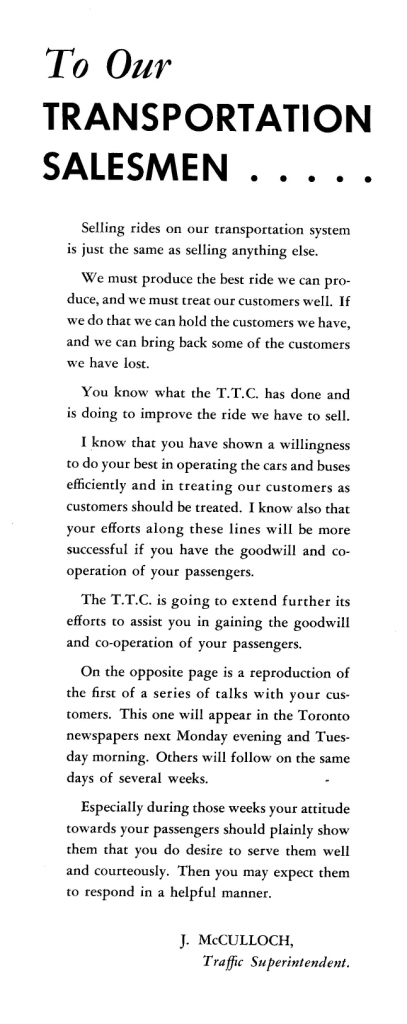
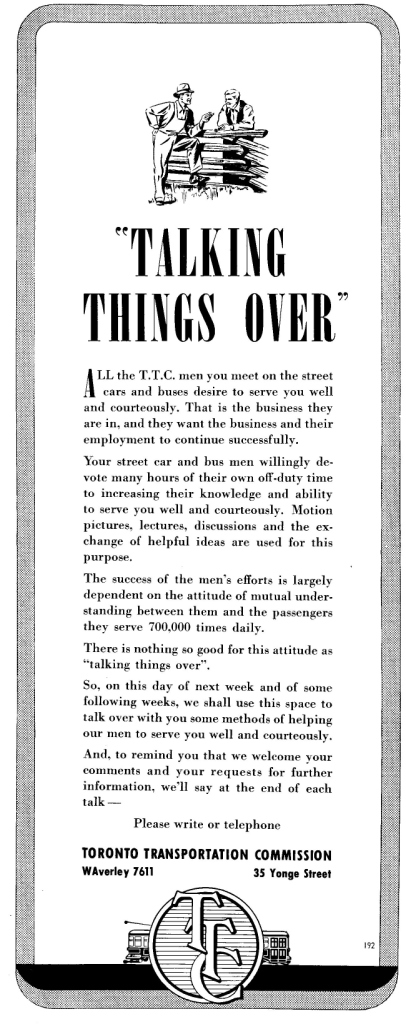
Our Transportation Salesmen

The idea that TTC staff should be friendly to the public, and the public should be friendly in return, has been around for quite a while.

Back in the thirties (there is no date, but it can be inferred from the content), the TTC ran ads to “talk over some of the methods of helping our men to serve you well and courteously”. They even welcomed comments!

TranspSalesmen1c

TranspSalesmen2c

The reference to “our men” and the Peter Witt outline in the logo show this is pre-war, but TTC staff see “motion pictures” as part of their training. Somehow, I suspect they didn’t have the Keystone Cops, and this was the era of “talkies”.

There’s also the old TTC head office address and phone number.

Is Electrification Inevitable For GO Lakeshore Express?

Last Friday, Metrolinx released its Interim Report of the Benefits Case Analysis for the GO Lakeshore Express Rail proposal.  This study is an outgrowth of the “Big Move”, the regional plan which includes very frequent GO service on a number of corridors (Lakeshore East and West, Brampton, Milton and Richmond Hill).

The BCA raises many questions about Metrolinx’ ongoing work, especially its two-year electrification study, as well as their demand projections and the future effect on capacity needs in various corridors and at Union Station.

The introductory letter for the BCA speaks of it as one input to the Electrification Study, but as far as the Lakeshore is concerned, the conclusion is already there.  Diesel operation cannot handle the forecast demand for this corridor, and electrification is the only viable option with electric multiple units (EMUs) being a long-term consideration for the fleet.

What is striking is how much the BCA echoes comments made on this site and others about planning for expansion of GO’s capacity, and how much it undercuts statements made in defence of diesel operation for the Weston corridor.  Indeed, it is clear from the BCA that GO/Metrolinx had already conducted extensive studies of the Lakeshore corridor (recently released as background info for the electrification study) even as they were downplaying the role of electrification for the Weston corridor.

In this post, I will not attempt to cover the entire BCA page by page, but will highlight items of interest and of concern, and leave the full text for review by readers who have the time and inclination.

Executive Summary

The study reviews service and infrastructure options for the Oshawa-Hamilton corridor.  Two options are proposed:

  1. Diesel operation with upgrades as needed until 2015.
  2. Electrified operation in two stages — first to 2015 and then to 2031.

The study drops the diesel option with a simple observation:

It should be noted that meeting the forecast 2031 RTP ridership demands through expanded diesel operations was deemed not to be a feasible option for comparison purposes, and thus only the electrification scenario has been carried forward in Phase 2 of this analysis.  [Page 1]

A summary of the options appears on Page 2.  Note that 10-car trains are assumed, although GO is now operating 12-car trains.  It is unclear whether GO’s plan is to move to more frequent, shorter trains, or if the study is out of step with what GO is already doing. Travel times for electric operation are considerably shorter than for diesel due to better acceleration characteristics of electric trains.

The costs cited for the two phases of the electrification option look rather odd at first glance.  The initial stage would cost $1.89-billion while a further $4.09-billion is needed for the second phase.  Considering that the first phase “eats” the basic cost of electrification and associated changes in infrastructure, the much higher cost of the second phase looks rather odd until one takes into account the complete replacement of the existing fleet that is built into phase 2.

This is not strictly a cost of electrification because either (a) the existing fleet would be worn out and GO would need new cars anyhow or (b) the existing fleet would be redeployed to serve growth elsewhere in the diesel-operated network.  Metrolinx has not published the detailed economic model for the claimed costs.  In a previous note, I commented on flaws in GO’s analysis that did not allow for the large residual capital value of installed plant and trains, and this must be taken into account for proper life-cycle analysis.

Metrolinx and Queen’s Park cite huge cost estimates to downplay the electric option in the Weston corridor, but they have never shown us exactly how their calculations worked.  If the “high costs” include a cycle of equipment replacement that would, to some extent, occur anyhow, then this is not a true cost of electrification.

A press flak for Metrolinx actually replied to the “Stroller Protest” (mothers concerned about pollution from diesel trains) with a comment about the high cost of electrifying Union Station.  Obviously, the Lakeshore BCA, including a strong recommendation to electrify sooner rather than later, was not on this staffer’s required reading list.  If GO electrifies the Lakeshore including at least part of Union Station, then the marginal cost for Weston corridor services would be relatively small.

According to the BCA, the benefit:cost ratio is positive for all options, but this result is highly sensitive to the manner in which benefits are calculated.  This is a fundamental problem with all of the Metrolinx BCAs.  (Details of this issue come later in this article.)  I do not mean to downplay the value of the investments, but it’s annoying to find so suspect and easily critiqued methodology used.  Opponents of public spending would have little challenge in mounting counter-arguments.

One of the most important observations in the analysis is that frequent service will change the Lakeshore corridor into a bidirectional route providing good service between many communities.

Overall, the investment required to electrify the GO Lakeshore corridor will return significant benefits, improving the viability of the GO Transit system as an alternative to the automobile and providing the support and stimulus necessary to improve the connectivity and accessibility between UGCs [Urban Growth Centres] to help manage growth and shape land development patterns.  [Page 6]

Someone should tell the folks at Metrolinx to read their own reports before spending another two years to determine what they already know. Continue reading