
Much discussion in the current election campaign targets TTC fares and proposed changes in 2027. Depending on which candidate you trust, they might go up, selectively, be frozen, or even go down with the effect of future changes to fare capping rules.
Many surveys, including a recent one from Liaison Strategies, show that the key factor in retaining and attracting riders to transit is not fares, but service reliability, frequency, and comfort. This includes many factors, and the “fixes” do not lend themselves to simple campaign slogans.
Drawing lines on maps is a favourite pass-time for politicians and the consultants who feed off their desire for a credible plan. We went through that with John Tory’s ever-vanishing SmartTrack scheme, then later with Doug Ford’s subway plan. They share one thing: nothing needs to be done today, and come tomorrow the plan might shrink thanks to technical challenges and limited financing. The Ford plan survives because of spending (and borrowing) at a level that would never occur without a generous infusion of political ego. Planned spending on the provincial subway plan is on a par with the TTC’s entire state of good repair backlog.
Fare schemes, be they new concession rates, discounts or regional amalgamations, can be quickly implemented at comparatively modest cost, but they do little beyond, possibly, generating added ridership which might, or might not, be translated to added service and capacity. With fare revenue covering only 40% of the operating budget and none of the capital, it is impossible for fare cuts to generate enough new riding and income to pay for service increases.
Toronto has a long-term plan, TransformTO, that seeks “net zero” transportation emissions through complete electrification of transit by 2040. That is comparatively easy to achieve because it is the path the TTC is on already. However, a more ambitious plan originally aimed at a major shift away from autos to transit by 2050, but now has a 2040 target. There is no sense of how Toronto will achieve this.
A technical backgrounder to the 2050 plan proposed, among other things, that Toronto:
- Convert one lane of traffic to exclusive bus lanes on all arterials.
- Increase service frequency on all transit routes:
- bus by 70%, streetcar by 50%, subway off-peak service increased to every 3 mins.
- Tolls of $0.66/km on all arterial roads.
- Free transit. No transit fares.
In the current political climate, it is easy to guess the fate of exclusive bus lanes and road tolls. Free transit would cost over $1-billion annually before accounting for the cost of the additional service.
The TTC Capital Plan includes a long-range, unfunded provision for TransformTO:
- Vehicles (added buses and streetcars): $3.51-billion
- Infrastructure (2 additional garages, upgrades to existing garages and carhouses, expanded terminals to handle higher service levels): $3.82-billion
There is no mention of operating costs for the larger fleets and all of the added service nor is there even an outline of a plan to get from the transit system of 2026 to the hoped-for 2040.
Somewhere in between the aggressive goals of TransformTO and current service levels is likely what riders will actually see. The TTC has not published a detailed analysis of options, and the Board, in spite of having a “Strategic Planning Committee”, has not asked for one.
Any plan to improve transit service must look at the network as a whole, at how routes in many parts of the city can provide better service. This will require decisions about the size of the transit system, growth of the surface bus and streetcar services, and tradeoffs needed in the use of road space.
Toronto’s RapidTO plan, a set of reserved bus lanes, is not progressing quickly in the face of political opposition. Even without that, the pace of change would not bring meaningful improvement to most riders. Shifting travel to transit requires network-wide change that people can see everywhere, not just on a few routes they might not use.
A further problem lies in current service quality. It is one thing to say “make transit more competitive”, but first Toronto must acknowledge transit’s decline and the widening gap between what is offered and what would-be riders will demand. Toronto must acknowledge that gap and acknowledge that just “filling in the hole” would only get us back to the previous decade.
Back in December 2017, TTC staff presented a Ridership Growth Strategy that discussed, among other things, the ridership decline of the mid-2010s and the tactics needed to attract new riders. The first few percent of growth was expected to come from existing riders who would see restored reliability as an incentive. Net new riders would come with aggressive changes including major service upgrades.
Some of this actually happened, but any momentum the plan had was lost with the pandemic era. Substantial change is needed to draw new riders transit, but this message is lost in an era of budget limits and small-scale tweaks to transit service.

This article examines the evolution of transit service, the options and the challenges facing anyone who hopes to improve what the TTC offers.
Subway Service
TransformTO foresees improved subway service only in the off-peak with a boost to trains every 3 minutes. Current off-peak service on Lines 1 and 2 now ranges from every 3’20” to 5’00” depending on the period. There is only a limited capacity to improve peak period service until about 2030 for a variety of reasons, some of which can be traced to poor planning and budget limits in the last decade.
Subway service on each of the three lines is limited by the technology in each case.
In brief, peak improvements on Lines 1 and 2 are constrained by the available fleet. Even though the new ATC signal system allows closer train spacings on Line 1, the TTC does not own the trains needed to improve peak scheduled frequencies over the whole line. Line 2 could see a modest increase but is limited by its signal system. Line 4 could increase peak service from 4 trains to 5, but is limited by its small, dedicated fleet.
Slow orders are a particular problem on Line 1, although they have also affected Line 2. As of October 1, all but 3 of 16 slow orders are on Line 1. Given that many have been in place on and off for a very long time, it is unclear how soon they will be reduced to a much smaller number and how speedily new defects will be repaired. This could provide some headroom for faster operation and more frequent service, but riders have waited a long time to see improvement on that score.
Many types of delay affect subway service. I will turn to these in a separate article.
Bus Service
The peak number of buses in service has floated between 1,500 and 1,600 for over a decade. Although there was some redeployment thanks to the Line 1 Vaughan extension in December 2017, and more recently Lines 6 Finch West and 5 Eglinton, the number of buses in use remained static. Meanwhile the fleet grew substantially without a corresponding increase in service.
In September 2026, the peak scheduled service is 1,580 buses (including 50 running on streetcar routes) out of a fleet of 2,184. That’s a spare factor of 38% (almost 4 spare buses for every 10 scheduled), almost double the industry norm of 20%. Some of those buses have been used as “Run As Directed” extras (or RADs) but the TTC cut back substantially on RADs with the Fall 2026 schedules.
If the spares were reduced to 20%, this would leave 1,820 buses available for peak service, or 240 more than the scheduled peak today. Providing more bus service is not a question of a too-small fleet (a problem common in the early 2000s when growth was limited by vehicle availability), but of under-staffing.
The obvious question is where the buses should be deployed, but that will require the TTC to publish detailed crowding statistics, not the simplistic average values now used. A related question is whether the Service Standards should target a lower crowding level on buses. This is one aspect of a Service Standards review now underway.
There is a catch-22 in reducing what constitutes a “full” bus. Past experience shows that ridership can expand to fill the new capacity, but if the political winds change, crowded buses again become the norm.
The bus surplus could tide us over a period of service improvements near-term, but a long-term plan to expand the fleet is needed, along with the funding to buy and actually operate more buses. The TTC does not even have committed funding for its routine replacement of aging buses, let alone to expand the fleet and build more garages.
Streetcars
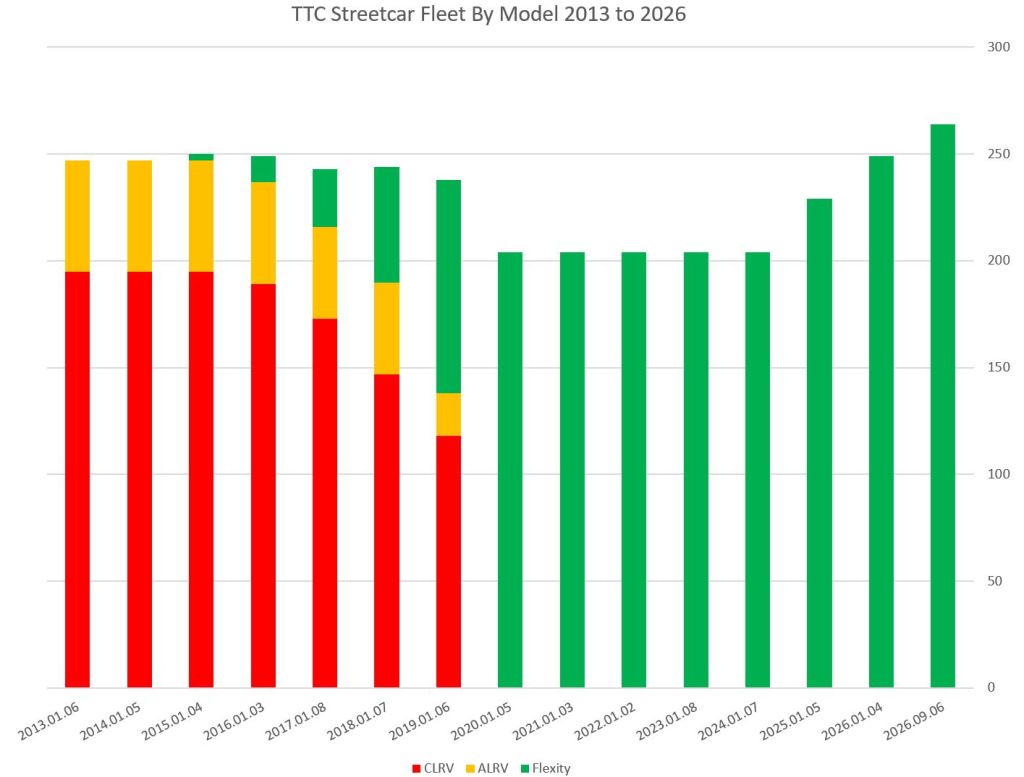
Toronto now has a fleet of 264 Flexity streetcars, bigger than the combined fleet of smaller CLRVs and ALRVs which they replaced. The intent was to improve streetcar service, long constrained by reliability of the old fleets, and provide for system extension with, at least, a Waterfront East line.
Better service is not what riders got. Until recently, most streetcar routes operated with a 10 minute headway, and this was subject to the usual bunching and gaps, but magnified by the wider scheduled space between cars.
In Fall 2025, three routes moved to a 6 minute headway: 505 Dundas, 511 Bathurst and 512 St. Clair. Routes waiting for improvement are 501 Queen and 506 Carlton, the two longest routes in the system, plus 507 Long Branch, 509 Harbourfront and 503 Kingston Road.
(One could argue that the last three might not deserve better service because of route overlaps, but I include them for completeness. 504 King and 510 Spadina already have better than 10′ service.)
The TTC has not published ridership data to show the effect on the three routes with improved service.
A further challenge for streetcar ridership is the frequent service disruptions and diversions thanks to major construction projects. The Ontario Line work at Queen Station is the biggest of these, but a series of road closures for water main and track replacement bedeviled streetcar operations in recent years and with more to come, notably on King and Queen Streets.
The water and sewer upgrades are a special case in that infrastructure over a century old is overdue for renewal. Once the work is done, this scale of upheaval should not recur for a very long time, but getting to that new, stable environment will be painful. This complicates efforts to make streetcar service more attractive even before we talk about service quality and line management, items that are even more critical when routes are disrupted. Projects are planned in 2027 on King Street West, Queen Street East and College Street. (For a detailed view of infrastructure plans, see Toronto’s Infrastructure Viewer.)
Traffic congestion downtown is a major problem for streetcars, although this has seen modest relief with the addition of Traffic Wardens who manage major intersections and minimize “box blocking” that can foul both transit service and general traffic.
Looking at the streetcar system with all routes actually using streetcars (a condition not seen for well over decade), a shift to a six-minute maximum headway on all lines would require about 45 more cars (54 allowing for spares), something that is quite possible within the existing fleet. That is not the 50% increase contemplated by TransformTO, but it is possible with no added infrastructure. Going beyond that line is more challenging.
Service Reliability, Operating Practices and Congestion
In a recent post, I wrote about the TTC’s current review of their Service Standards. They are considering options to improve mid-route performance, but their methodology is flawed before they even begin. First, they assume that vehicles leave terminals “on time”, but this is a very flexible concept allowing erratic service from trip origins. Another possibility is mid-route headway management. This is viable provided there is a location where buses or streetcars can lay over to get back on time.
The basic problem is that TTC metrics are too generous and allow service that riders would consider as bunched to slip within “on time performance” thereby understating the extent of reliability problems. This requires both that the metric be tightened to give a more accurate view of rider experience, and that the TTC accept that some of their operations are not as good as they make out, and work to improve them. Wait time for vehicles is a considerable part of some journeys, especially when transfers are required.
The TTC recognizes that managing the spacing between vehicles on frequent routes might be a better approach than attempting to stay on a schedule, but this is rarely used. They have a bunching and gapping pilot study underway, but it has not yet reported significant benefits or a proposed change in line management practices.
I will not dive into the topic here as reliability problems are examined in other articles in more detail.
Operating practices on the streetcar system lead to slower operation now in 2026 than in years past for various reasons invoked in the name of “safety”. The question, however, is why these became necessary compared to a century of streetcar operations without slow travel through intersections. The TTC is supposed to be studying whether service can be sped up, but they have not yet produced a report.
Traffic congestion is a problem throughout the city, not just on the downtown streetcar system. Partly this could be addressed with more aggressive signal controls favouring transit vehicles, and partly through use of Traffic Wardens to impose order on motorists who prefer to snarl traffic rather than letting intersections work properly.
The big debate, however, is the question about who and what is road space for. Movement or storage? Autos, transit, goods movement, cyclists, pedestrians? This is not easily solved especially on streets where transit service is not frequent and dedication of space and time to the occasional transit vehicle is hard to justify. Moreover, the approach and effects will differ between downtown routes on narrow streets with local parking and suburban routes on wider streets where parking is mainly off-street.
Staffing and Budgets
A common refrain, and not just in Toronto, is that transit operators are hard to find, and once hired, hard to retain. That said, the question for TTC is whether they are trying to grow the pool of operators to run more service, whether they have more operators than scheduled service requires, or if there is a deliberate attempt to cap the workforce.
More workers means higher costs, obviously, but if the unwritten Council and Board direction is to cap costs, that also means capped staffing and with it any flexibility to run more service.
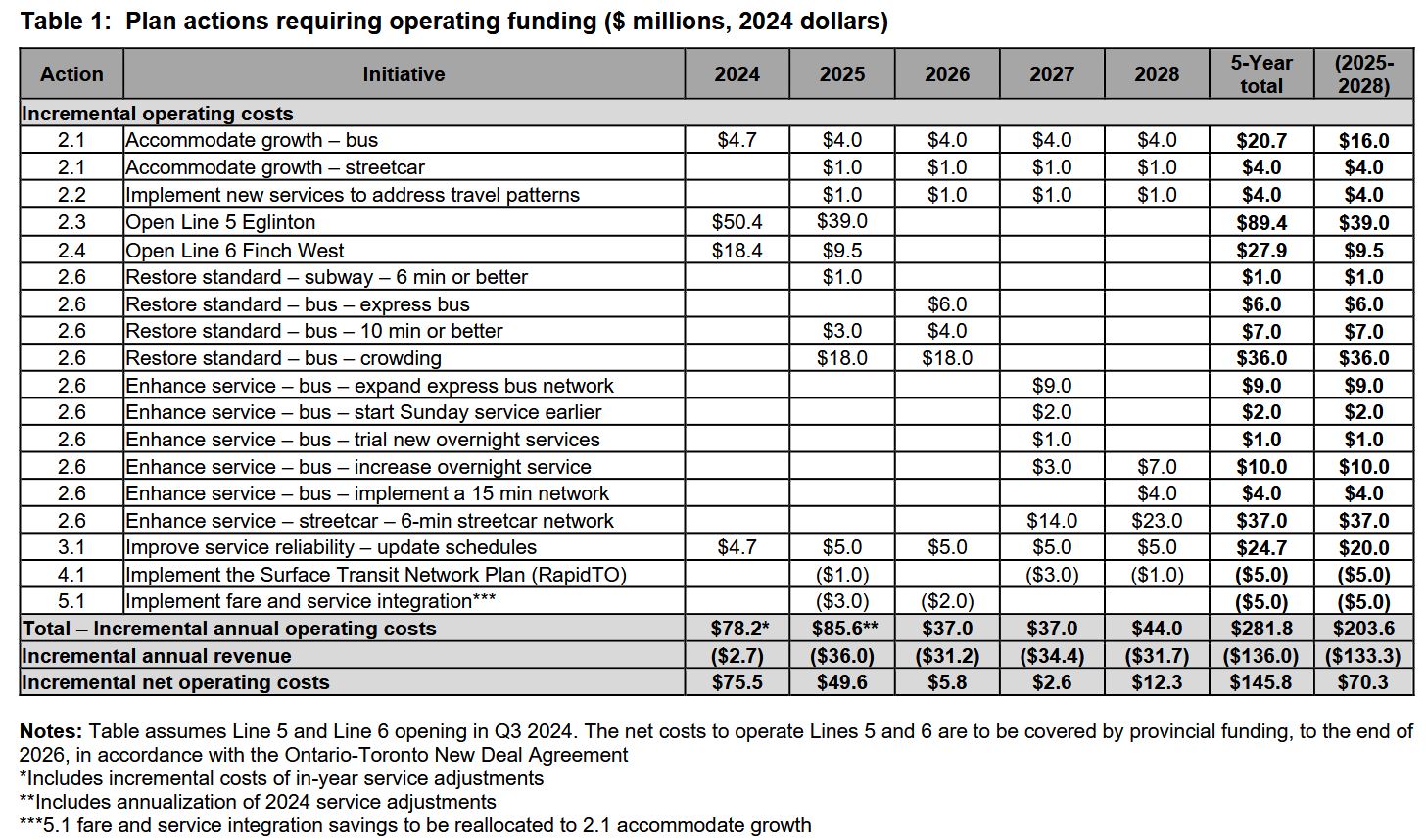
TTC knows that it has problems with crowding, and that it has routes in the “10 minute network” than do not run that frequently. Small provisions exist in the 2024-2028 Five Year Plan address this but with no details.
A major issue for 2027 and beyond is the status of the “New Deal” with Ontario that brought a few years of added operating subsidy to the TTC. It is not clear whether this will be extended, or if a new Mayor, should there be one, even seek the funding.
The Five Year Plan proposes only modest growth. That is official policy, but it is inadequate if transit is to claim a larger share of the travel market. A better, more aggressive plan is needed, even if we are not sure today how we would pay for it. The option for strong growth should be on the table where the City can decide if that is really the future we should pursue.
Further Details
The balance of this article contains greater detail about the three fleets and associated infrastructure for those who are interested in the details.
Subways
Line 1 – Yonge-University-Spadina
Line 1 has the greatest potential for more frequent service as it uses automatic train control (ATC) that allows trains to be more closely-spaced than the prececessor block signals original installed on the line. However, the best possible train frequency is constrained by the size of the fleet, and to some extent by terminal geometry. Current peak service is 150 seconds (2’30”).
The Line 1 fleet comprises 76 6-car train sets of which 63 are scheduled at peak, plus 1 gap train, leaving 12 as spares (19%). If service were improved to the previous peak level of 140 seconds, 69 trains would be needed leaving only 7 spares (10%). The current fleet was sized based on an assumed peak-period short turn at Glencairn that would reduce peak train needs, but result in service every 280 seconds (4’40”) from Lawrence West to Vaughan.
Line 2 Bloor-Danforth
Line 2 is, until ATC goes live there in about 2030, limited by its traditional block signals that make headways below 140 seconds (2’20”) difficult to sustain over the whole line. Current peak service is 150 seconds (2’30”).
The Line 2 fleet comprises 61 6-car trains of which 45 are scheduled at peak plus 4 “gap trains” to fill in for delays, and 12 spares. If service were improved to 140 seconds (the lower limit with existing signals), 48 trains would be required (27% spares).
Line 4 Sheppard
Line 4 has much less service than the other routes with a headway of 330 seconds (5’30”) at all times. It has a dedicated fleet of 6 4-car TR trains of which 4 are scheduled at all times.
A five-train service would operate every 4’24” leaving one train spare.
Future Fleet Plans
Options for added service lie mainly in the future with delivery of additional and replacement trains.
- Line 1: The Richmond Hill extension project includes additional trains, but not beyond the number needed to run current service levels.
- Line 2: The TTC has 55 trains on order to replace existing service, with additional included in the Scarborough extension. As with Line 1, the expanded fleet will provide the current service levels over the extended line, but no more.
- Line 4: There is no plan for additional trains. They would likely be part of a Sheppard extension project if that ever occurs.
Fleet growth requires more storage. A new yard and possible maintenance facility are planned for Richmond Hill, and some storage will be provided on the Scarborough extension. A new carhouse and yard at Kipling is in design, but is unlikely to be built soon. It could be part of a Bloor West extension project, but that is long in the future.
Operational Issues
Terminal operations are affected by close headways and scheduled travel times. TTC policy for many years has been to pad schedules, but this causes terminal bunching when vehicles arrive early. Because subway terminals have space for only two trains at once, queues of trains build up approaching the stations. The situation is even worse if one platform is unavailable with an out-of-service train.
Closely spaced trains require quick crew changeovers so that trains can leave as soon as the track is clear. One person crews complicate this because an operator has to walk the length of a train, in addition to any time needed for a washroom break, in the short time trains are at terminals. The TTC used a “step back” technique so that operators would drop back one or two trains giving them a longer terminal time, but this has recently been dropped or lessened due to staffing constraints.
The most visible problem today is slow orders especially on Line 1. As I write this on October 1, there are 16 slow orders (aka “Restricted Speed Zones” or “RSZs”) in place, 13 on Line 1. It is not clear how much the travel time could be reduced and train frequency improved if there were fewer or no slow orders.
Off peak service improvements do not require any new trains, only more crews to operate them.
Peak service much below 2’20” would trigger both power upgrades (more frequent trains need more power) and station capacity issues.
Bus Fleet Size, Composition and Utilization
This section shows the evolution of the bus fleet from 2013 to 2026 using data from summary tables that are included in the TTC’s Scheduled Service Summaries. Current versions are published on their Planning page, and an archive of them is available on my site.
First, here is the big picture.
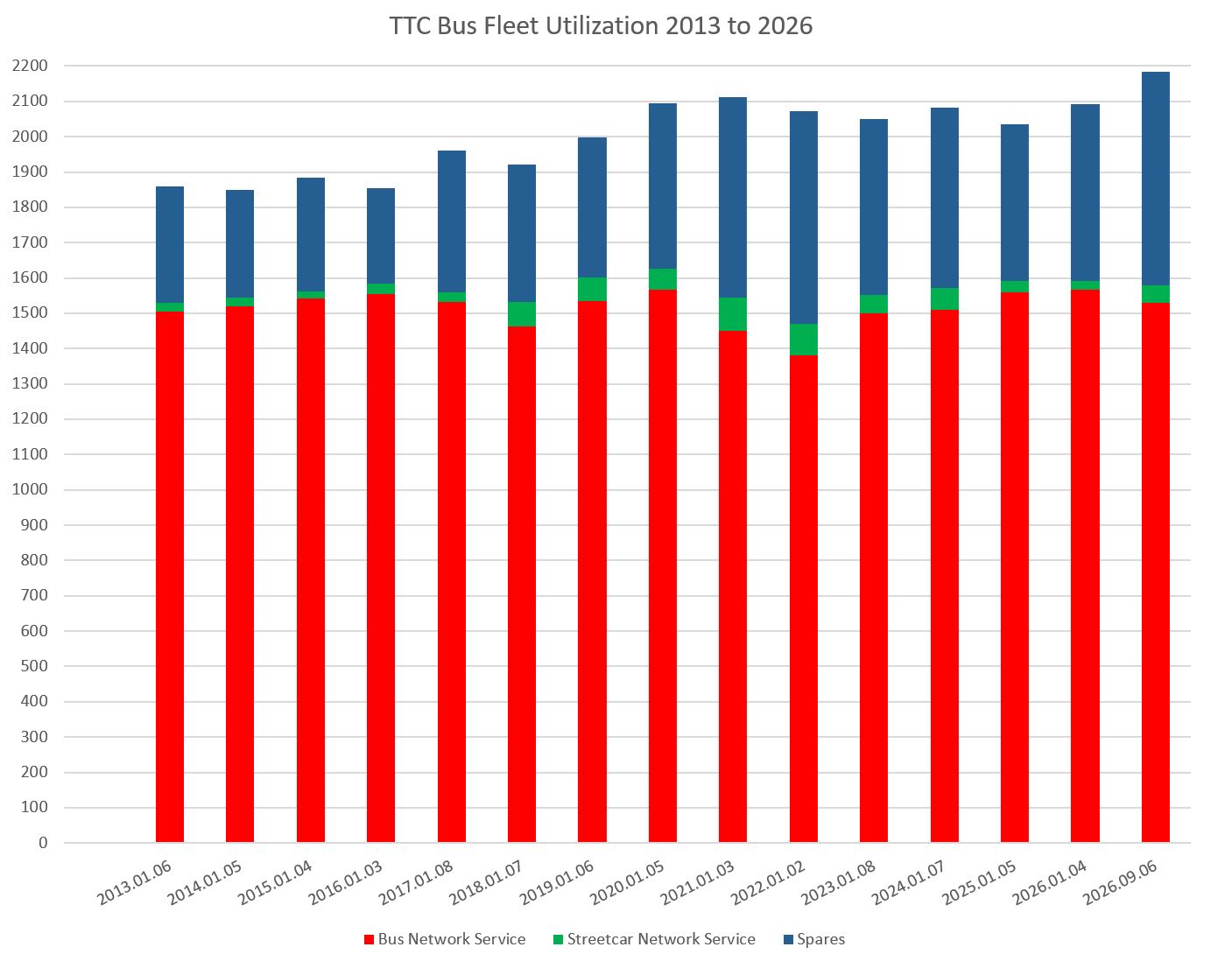
The red section at the bottom shows the peak scheduled service. Note that it has bounced around, particularly in the early pandemic period, but sits resolutely in the 1,500-1,600 vehicle range. There was a drop at the beginning of 2018 corresponding to the Vaughan subway extension opening, and a drop in September 2026 is due in part to the opening of Lines 5 Eglinton and 6 Finch West.
A small additional number of buses (green) operate on streetcar routes for construction projects, and they supplemented the dwindling streetcar fleet before 2020 when the new Flexities completely took over.
The blue bars at the top are the spare vehicles. Industry practice targets 20%, or about 300 buses on top of 1,500 peak scheduled. This was roughly the situation two decades ago. However the spare pool has grown and is now 604 buses on a base of 1,580 peak buses, close to 30%. Moreover, this pool has grown while scheduled service was static or declined.
Those with long memories will remember the mayoral campaign pitting John Tory against Olivia Chow almost a decade ago. Chow argued that more buses were needed for more service, and Tory only relented after his election when he “saw the light” about service shortfalls. 100 new buses were ordered and they arrived in 2017. However, there was little change in scheduled service and these buses simply went into the spare pool.
More recently, technical issues with eBuses have required added spares to offset reliability, especially with the BYD and Proterra test fleets that are now retired. But even with the large spare pool the TTC is not given enough money to operate more service. A recent claim is that service is back to pre-pandemic levels, but that is based on vehicle hours. With slower operation across the system, there are fewer vehicle kilometres of service provided. Some of the added hours simply go to extended terminal recovery times, not to service.
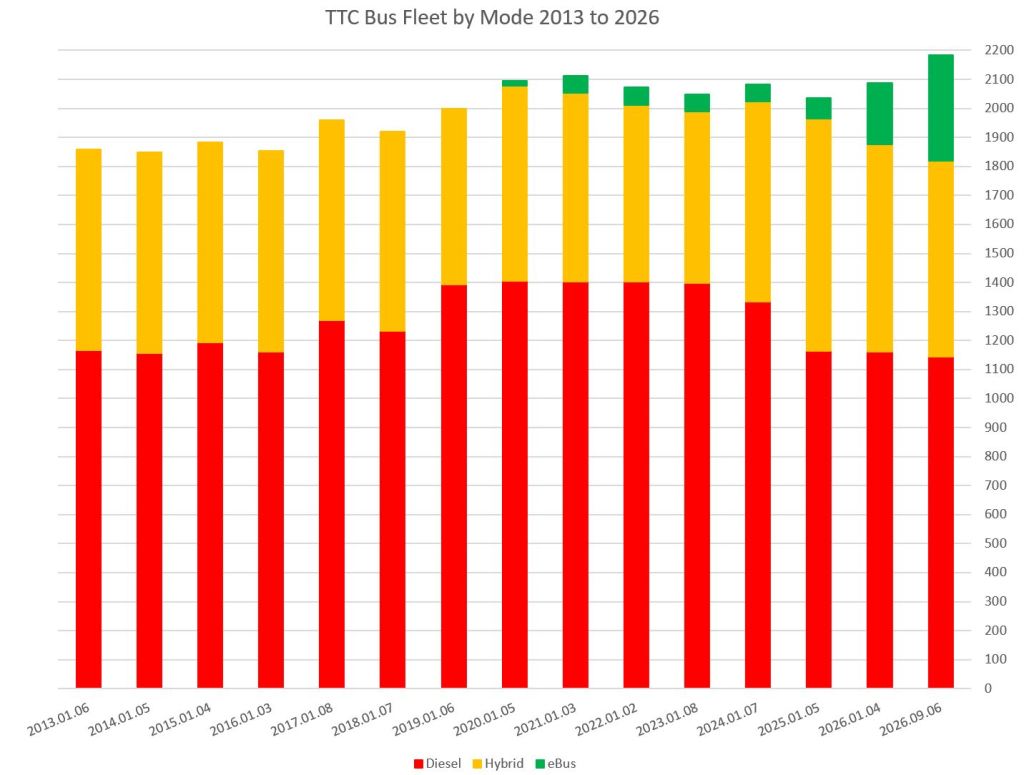
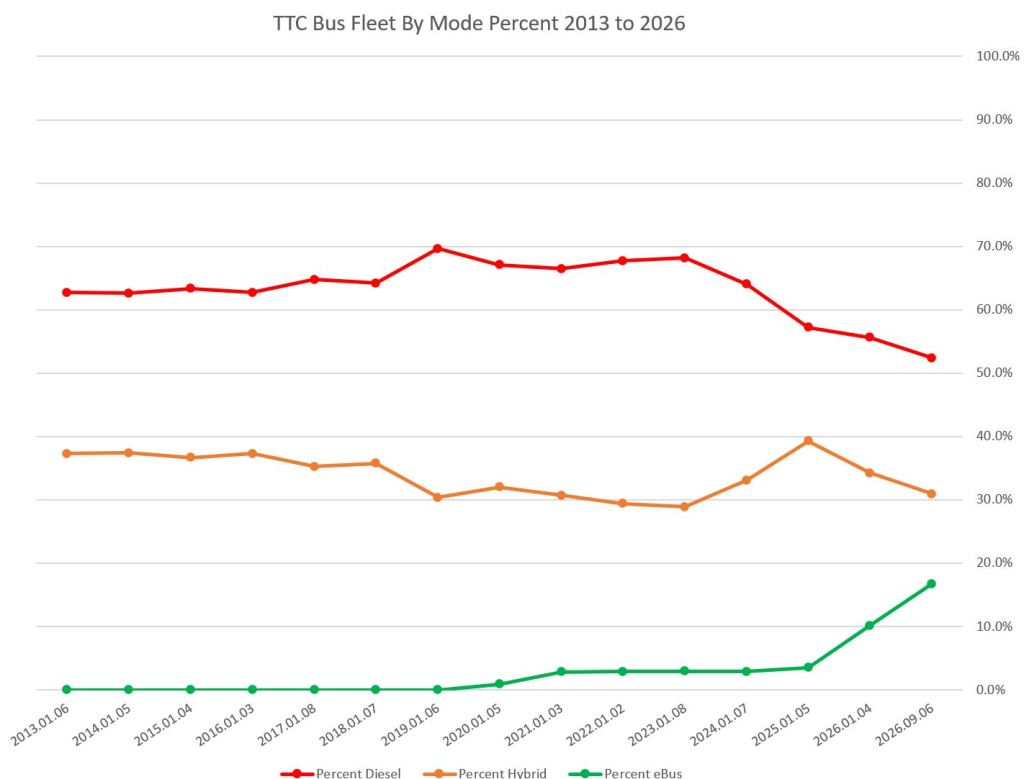
The fleet contained different vehicle types over the years as the TTC moved to “green” its technology. These charts show the numbers (left) and proportion (right) of buses by motive power: diesel (red), hybrid (yellow/orange) and battery electric (green). The jump in diesels in 2019 was due to the TTC backing off from hybrids after reliability problems with early models.
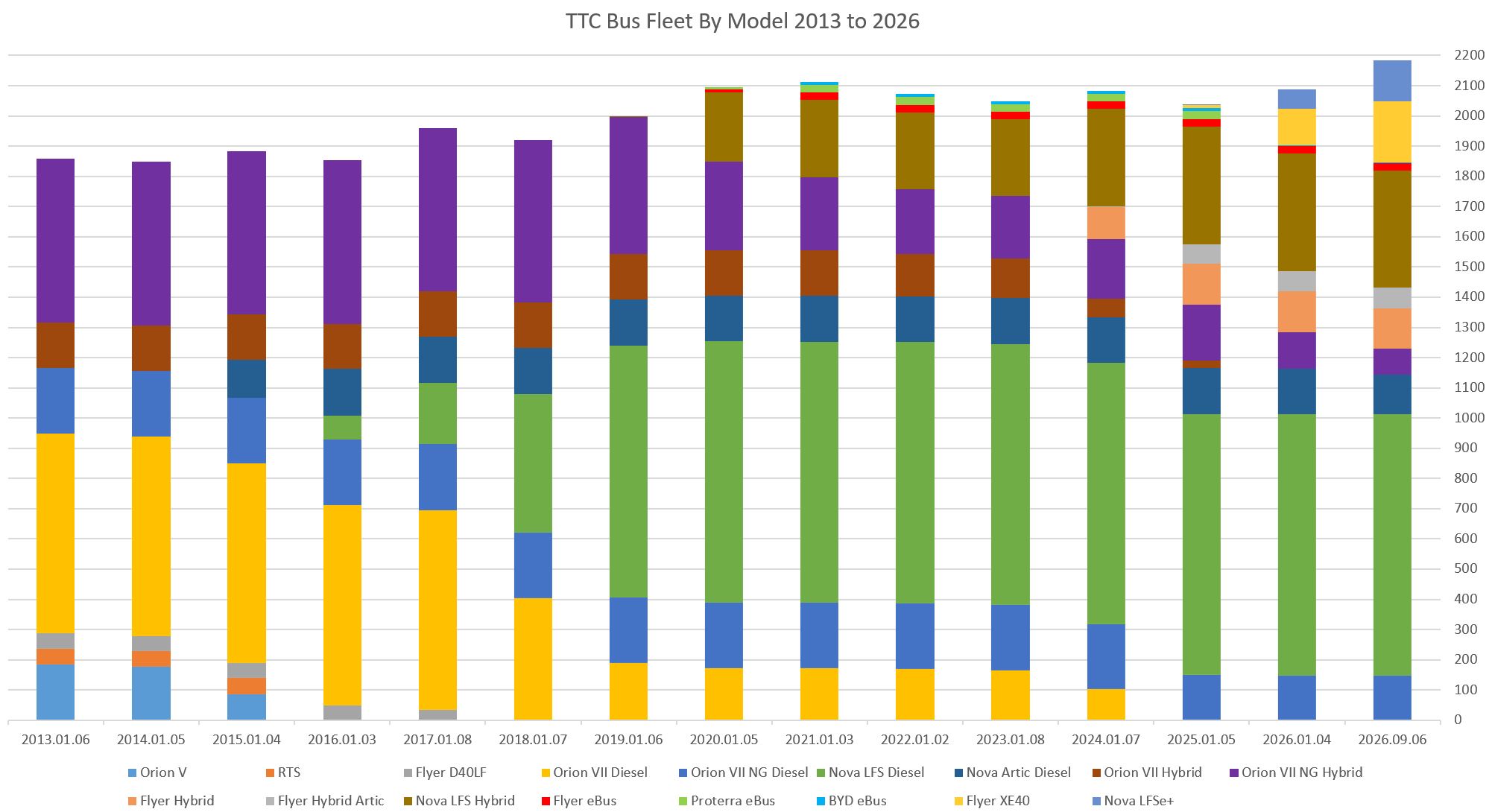
For those who want the gory details of bus models, the chart below breaks down the numbers. The large green block is a fleet of Nova diesel buses that will be due for replacement in roughly 2030. Funding for this replacement, let alone a technology selection, is still uncertain.
Streetcar Fleet Size, Composition and Utilization
Since 2015, the TTC changed from a fleet of CLRVs (Canadian Light Rail Vehicles), ALRVs (Articulated Light Rail Vehicles) to a new fleet of Bombardier, now Alstom, Flexity cars. These cars have different sizes (15m, 23m and 30m respectively) and capacities, and so service levels cannot just be estimated based on vehicle counts, but also line capacity. Full conversion to Flexity operation occurred in 2020. Today’s fleet is only slightly larger by vehicle count, but has substantially more capacity in anticipation both of service improvements and the as-yet unbuilt Waterfront East line.
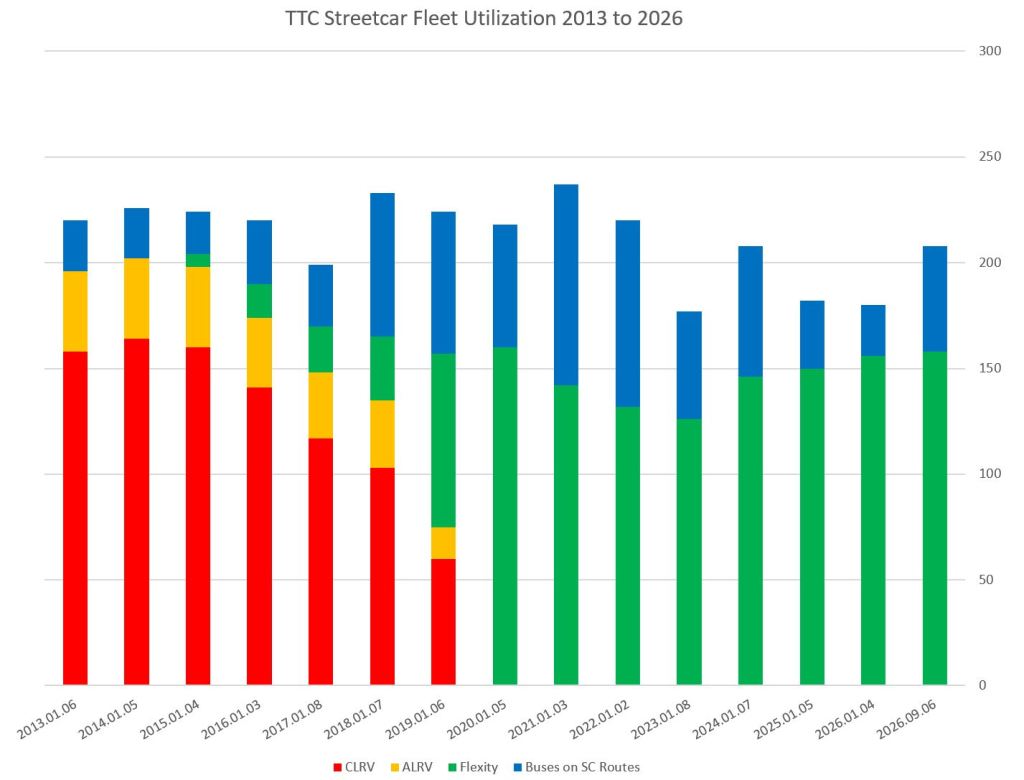
A parallel development has been the increased use of buses on streetcar lines to accommodate construction projects. During the pandemic era with demand below normal, changing the mode was seen as a way to get major projects out of the way. However, the TTC has settled into a common level of 150-160 peak Flexitys in spite of owning 264 cars. That’s a spare factor of about 65%, vastly above the industry average for transit vehicles. The fleet grew, but the utilization has not.
Six Minute Service
Given the large number of spare streetcars, the question is whether the TTC could implement a “six minute network” across the streetcar system. The table below shows the status of each route’s PM peak requirement scaled up to a 6′ headway where service is not yet that frequent. There is no adjustment for reduced travel times through schedule adjustments. (The car allocations and headways are based on streetcar operation without diversions.)
A total service of 209 cars would require 42 spares at 20% for a total of 251. This can be handled by the 264 car fleet with room to spare.
One could argue that some of these routes might be the last to get 6′ service given their overlap with other services (e.g. 503 Kingston Road and 509 Harbourfront), and the total needed could be lower. This gives headroom for improvements to the system generally where better than a new 6′ policy headway is needed.
| Route | Existing Service | Existing Cars | Extra Cars for 6′ Service |
|---|---|---|---|
| 501 Queen | 10′ | 23 | 15 |
| 503 Kingston Road | 10′ | 12 | 8 |
| 504 King | 4′ | 27 | |
| 505 Dundas | 6′ | 25 | |
| 506 Carlton | 10′ | 19 | 13 |
| 507 Long Branch | 10′ | 8 | 5 |
| 508 Lake Shore | 20′ | 5 | |
| 509 Harbourfront | 9’30” | 6 | 4 |
| 510 Spadina | 6′ | 12 | |
| 511 Bathurst | 6′ | 13 | |
| 512 St. Clair | 6′ | 14 | |
| Total | 164 | 45 |
Slow Orders
There are slow orders across the streetcar system at intersections and underpasses arising from the compound effect of various factors:
- unreliable switch controllers that could change a switch’s position under a car,
- track conditions that require slow operation for safety,
- overhead conditions that preclude faster operation.
The third point was a particular problem for trolley poles in low underpasses, but trolley poles are no longer used. The slow orders remain, however.


When the Toronto Transportation Commission became the Toronto Transit Commission in 1954, it faced growth in a growing city which were formally rural farmland. Instead of extending streetcar lines, they extended bus lines. Plans were to replace the old streetcar lines with underground electric lines, like the Queen Subway. The Queen Subway is only now being constructed, with a different name, the Ontario Line.
However, people in Toronto and Ontario got caught in the automobile propaganda that the future was in the automobile, which included buses. The automobile now gets top priority in fighting “traffic congestion”, which is caused by themselves, the single-occupant automobile. Their solution, give them more road space… not the answer..
Want to give buses (or streetcars) priority? Only if they don’t upset the single-occupant in the automobile. Don’t give up road space for the automobile. This will not change until people pull their fingers out of their ears to actually listen to the arguments.
LikeLike
One of the easiest and most straightforward changes the TTC could make is to transition from arrival to departure boards for buses and streetcars at terminal stations.
This is a straightforward change that is extremely easy to explain to folks. Nobody cares if the bus is arriving in 2 minutes if it’s going to sit around for 5…tell me it’s departing in 7…changing this, and requiring drivers to stick to it, would resolve a lot of issues with route management…
Steve: I’m not sure what you’re driving at. The displays at terminals show departure times.
Secondly. The TTC board needs a report log like council has. The number of outstanding and delayed reports is crazy.
Steve: TTC used to have such a report, but dropped it some time back. They also had a bad habit of dropping outstanding requests at the end of each Council/Board term on the premise that the “old” Board’s requests were no longer active. That’s a decision the new Board should have made.
LikeLike
This may not be clear to anyone (including drivers) due to the design and layout and terminology used.
Sitting at Broadview and Castle Frank it’s clear that some drivers follow this, and others do not.
1) there is nothing on the signs that say departure, or leaving in.
2) 1 min is followed by due…which implicates arrival time not departure
I saw two drivers at Castle Frank leave exactly as the sign turned to due.
At Broadview I saw two drivers leave after arriving with time still on the board (5 min and 3 min).
Another hung around for a while after due had disappeared and the screen showed 6 minutes.
Another arrived during due, and then spent about 5 minutes changing drivers…then left with the board showing 10m
If it shows departures:
1) change “due” to “departing”
2) add text above countdown sign saying departures
3) show on the bus as well…this would reduce confusion…
4) factor in crew changes and other delays
None of this is visible in photos or videos I took due to led rolling shutter issues, and I can’t upload them anyways.
Steve: The text is shared with displays along the route where the meaning of “due” is quite clear. If a vehicle is “overdue” (i.e. sitting around) it is eventually dropped and the expected time for the next vehicle is shown. Again, this behaviour makes somewhat more sense at a stop along the line. Crew changes are not supposed to create undue delay, but it happens. In theory there is terminal recover time for most trips when than handover should occur.
As for photos, use a slow shutter speed to get the full display, although this can be tricky if the display has more than one value and you have to catch it while it’s static.
LikeLike
Could you clarify what you mean by the cost is astronomical, and what is this high cost compared to?
Steve: From the 2026 Operating Budget:
Projected ridership for the conventional system was 426.4m, and for WT was 4.4M. These translate to a cost per rider of $6.63 on the conventional system, $45.82 on WT. Net of revenues, this translates to a subsidy of $3.02 per ride on the conventional system, and $43.50 on WT. Note that WT includes a mix of taxi and van services, and the taxi trips are cheaper, while the van services are more costly. “Revenue” includes ancillary sources such as advertising.
And so the subsidy per trip on WT is over 10 times that of one on the regular system. It is most likely that WT trips that might be diverted are now handled by taxis where the subsidy is lower, but will still be in the $20 range based on past reports of comparative costs.
LikeLike
I write this semi-seriously but, owing to the routine and lengthy delays to get into Kipling Station, I often find myself daydreaming about a westbound-only “(New) Etobicoke Civic Centre” outdoor platform, just east of the Kipling Avenue overpass.
The distance is rather short, but I would happily get off there, cross the street, tap in again, and walk directly to the Kipling TTC bus terminal, instead of wasting time stuck on a Line 2 train just short of my destination.
LikeLike
I think due means it is due to arrive right now (because 0 minutes doesn’t make sense)…this is arrival language and makes sense for mid route stations – where there is no expectation of long layovers…it doesn’t make sense at endpoints where there is an expectation of layovers…if they meant overdue they would just write overdue…because due and overdue are different meanings…
It should go – 5,4,3,2,1,”leaving now”…or if there is a problem and it’s not clear the timing it should say “holding”, “tbd” or something similar…
You can verify that there is some sort of confusion here…go to the website and click on a terminal station…it shows arrival times…do they match what is in the station?
Steve: The info in the online schedules is not the same as the info used by the trip prediction system. The predictions are based on where vehicles actually are (most of the time), not on scheduled times. At terminals, the time shown is usually the next scheduled departure. For further amusement, the underlying system is called NVAS for Next Vehicle Arrival System.
LikeLike
Thanks Steve once again for the write up.
Wow. Just wow. There are so many problems with the TTC and it seems that the organization is just indifferent to the problems it faces. Just the arrogant attitude that the TTC presents to the public and the indifference to actually conducting and lack of producing reports speaks for itself. The TTC doesn’t care what the public thinks and nor the Board.
One has to ask, how do we implement change? Are there no punitive measures that can be imposed on the TTC for choosing ignore Board and Council directives? Clearly the TTC chooses to operate however they want and knows that no one can hold them accountable. To that point, what is the purpose of the CEO if they do not know what is happening in the organization overall. Or are they a parrot for the mangers? The CEO should have a spine. The current one doesn’t seem to.
You mentioned that there is an unwritten policy of workforce capping. Who made this decision and does the Board know about this or who approved of it? It is just mind boggling at times how much secretive motives are happening for a public organization.
Steve: Capping exists in two forms. First, in the annual budgeted staffing level. Unless there is direction from the Board (and by implication from the Mayor and Council who will have to fund it), annual staffing levels are based on a modst increase in service. Second, there has been a hiring freeze since roughly the summer due to the poor financial results in the past cold winter and ridership that is below budget. The idea is to come in as close to the budgeted deficit as possible to avoid a year-end call on the City. We will get a sense of how brave they are being when the 2027 budget comes out in December, or maybe January.
Although management is not always helpful, there are times that responsibility rests with the Board to seek thorough advice. Some plans are quite siloed and reflect authorship in Service Planning without a detailed look at equipment, infrastructure and staffing issues as part of the bundle. There is also a lack of ambition born of years of just making do. Why work on a plan for major expansion when you’re not even sure there will be enough money to run basic existing services next year. Politically, it has suited past mayors not to hear too much about what the TTC might do because they would then have to explain why other programs were funded instead.
LikeLike
George is right (mostly). The LCD screens inside the stations (the ones with multiple routes shown at once) do show the predicted departure times. But the dot-matrix LED displays at the actual platforms show the arrival times (which, yes, is not useful at a terminal station at all). It’s more obvious with routes that are less frequent and have long layovers. I made a request to change it to departure times maybe a year ago, but I guess either it went to the big request box in the sky, or someone at TTC legitimately thinks that’s the way it should be.
Steve: Thanks for clarifying this. I believe the two types of display get their data from different sources.
LikeLike
I’ve always heard the rumor that TTC can’t find operators, and when they do they don’t stay on, and eventually quit soon after. How true is that, and is there any data or information to back that up? Why would a bunch of ppl quit TTC, with all the pay and benefits?
It’s hard to believe TTC operators are quitting en mass. I’ve heard of the toxic low morale at TTC and how management treats their employees. But you’ll always find the odd employee at any job with negative views.
I just find it hard to believe that it’s hard to get operators and TTC not being able to retain them. And if facts do show people are quitting TTC, then it’s something specific is doing. The Union endorsed Olivia Chow and Jamaal, yet they can’t create an environment to retain operators?
Steve: This problem has been hinted at at Board meetings, but nothing specific has been published. There is a catch-22 for new operators in that crew selection is by seniority, and so the hours are not great until you’ve been there for a while. But another issue is the public environment where ops take the crap from the public about inadequate service. More generally, there is a problem with management expectations of staff and disciplinary procedures where a sense of proportion is missing. This is not helped by a Board that makes contradictory statements about being supportive of riders, but then demands a “no mercy” attitude on fare evasion.
LikeLike
Just curious, Steve. For future ebus purchases have they decided not to order any new New Flyers buses & go with the more reliable Nova ebuses? Also, when the Nova arctics retire, will 40 footers be taking their place?
Steve: I don’t think there is a decision on eBuses generally because of supply chain issues. The current order is for Hybrids so they can get some new buses reasonably quickly. At this point, there does not appear to be a all-electric artic, and so it’s not clear whether we will get hybrid artics, or more 40-foot buses. Related problems are capital funding and some Board/Council members who have an undue emphasis on all-electic buses whether they work and are cost effective or not.
LikeLike
New Flyer lists an XE60, although range suffers vs. the 40′ model. (Claimed up to 199 miles for the artic, vs. 320 for the 40′. But, presumably, diesel artics have less range, too.)
And, of course, Vancouver, among other systems, has run electric trolley buses for years. In Europe, they even have bi-articulated trolley buses. (You did say all-electric, vs. battery-electric…)
Steve: Yes, Vancouver has a big system and can build off of that. Meanwhile in Toronto, management were anti-trolleybus and latched onto CNG buses as the “clean” alternative. That deal was not exactly clean in other senses of the word, and the buses did not last. But the TBs were gone, and that’s what management wanted. When they started looking at battery buses, they didn’t even know about Vancouver’s study until I told them about it. Now there is passing mention of in motion charging in Toronto, but nothing definite.
LikeLike
Steve, perhaps you know the answer to the question I have regarding line 5.
If demand warranted it and there were enough cars available how frequent a service could be operated on line 5 (beyond the 3’47” service operated now)?
I am just trying to figure out how much additional capacity could be operated on the line if there is a boom in redevelopment along Eglinton in the coming years/decades.
I realize that in addition to more frequent service they could also increase trains to three cars.
Finally, do you have any data or first hand observations on what the demand on the line is at rush hours? Is it towards subway in the morning and outbound in the pm rush or is more of two-way flow?
Steve: Three-car trains are the more likely improvement because this keeps the headway where it is, possibly even widens it. Going much below 4 minutes creates problems for priority signalling at intersections. The real question will be when Metrolinx buys more cars in order to get a decent price.
I don’t know any details of demand patterns as Metrolinx has not published anything. At the September board meeting, CEO Michael Lindsay reported daily ridership of 75-80k, but with no details on OD patterns or time of day demands.
LikeLike
Do you have any proof to support your assertion? You have a bad habit of claiming undue credit where none is deserved.
Steve: Well, I was at the TTC Board meeting where battery buses were introduced by staff and I asked if they knew about the Vancouver study, but they didn’t. I had to send them the URL. As for my claiming credit, trolls like you make up “facts” all of the time. I was there.
LikeLike
I think the bus driver labour shortage is universal across North America. When I watch videos about other transit agencies, many talk about service shortfalls due to staffing issues. I think there’s a societal problem that no one likes to talk about involving education and expectations and class and other uncomfortable issues. The quick fix other industries use is immigration, but I’m not sure they can be used for city jobs. Surely there’s a way to convert all those Uber drivers into bus drivers. A medium fix might involve improved on-boarding by making it easier to get hired and using diversity tactics to expand the pool of job candidates. The long-term fix involves societal changes, which may or may not involve AI. I don’t know. If all of North America has this problem, it’s not clear if the TTC can really make huge headway here.
Steve: This is true, but the underlying issue is what staffing level the TTC aims at. If they aim low, they won’t even try to hire more operators.
LikeLike
It’s not even just North America. Japan has a bus driver shortage, too.
The government introduced stricter hours of service rules for coach drivers a few years ago, meaning a bunch of routes that used to be done by a single driver need a relief driver now. But the coach operators can’t get enough drivers, and have had to cut service.
And local bus operators are having trouble getting enough drivers, too.
Steve: This begs the question of how we can possibly make big gains in transit service if we cannot get people to drive vehicles. But I still suspect part of the problem is simply not budgeting for a big enough head count.
LikeLike
You are right to say that the service is expensive on a per trip basis. The question that I still have is what is the net impact on the rest of the ridership’s experience. Typically as a service tries to serve all people it serves no one well. My concern is that the negative externalities of this service outweigh the cost savings.
Steve: There is no question that some riders resent the time and space required to accommodate scooters and chairs on both buses and streetcars, although baby carriages and shopping buggies are much more numerous. For someone who must use a mobility device, the alternative is WT which is difficult to book, and certainly not available on a whim the way the regular service would be.
We should not judge the worth of a service by whether “regular riders” will be inconvenienced, especially when there’s a double standard for the very young.
LikeLike
What matters is not what we believe, but what is. Your assumption is that all things are equal and that young professionals will accept what you are offering as acceptable, and that the outcome of such an arrangement will be optimal.
I think we should test this assumption.
1) Will the highly skilled young professions accept your offer of substandard services to have a sub optimal life. The research on the matter is a simple no, they have the ability and the will to leave Toronto and Canada if their needs are not met. https://www.ottawasciencepolicynetwork.ca/brain-drain
2) The question then is what will be the impact be of alienating young professionals. The research on the matter is that there will be a decline in economic productivity . https://www.bankofcanada.ca/2024/12/staff-working-paper-2024-49/
3) What is the impact of declining productivity. Well there will be substantially higher levels of poverty, mental illness, and discontent among all levels of society especially the young.
https://www.worldhappiness.report/ed/2024/happiness-of-the-younger-the-older-and-those-in-between/#
https://nationalpost.com/opinion/canada-didnt-become-poorer-than-alabama-out-of-nowhere
Click to access camh-monitor-2025-full-report-final-version_jan072026-pdf.pdf
The reader can judge for themselves if what you have said will benefit society. Is it really worth a few dollars in transit savings if you are actually causing substantial harm to society?
Steve: I am not sure if you are arguing that we should make more parallel transit available to those who are encumbered in some way to make trips faster for everyone else, or if your attitude is that serving that community is something we should not try to afford.
The idea that providing mobility to everyone causes substantial harm to society is really beyond the pale.
LikeLike
My position is that transit should be delivered in a way that actually meets people’s needs. A one size fits all approach to save a few dollars that does not quantify the negative externalities of the decisions implementation will under perform and alienate users, as your work “Are You Riding the TTC More, But If Not, Why Not?” shows.
Providing mobility services in an a way that does not meet the users’ needs causes the jurisdiction in which it operates to become uncompetitive, and as the jurisdiction becomes less competitive it becomes less capable of delivering the services needed. One of the major issues is that the negative externalities of government policies are poorly quantified leading to poor decision making.
Given that Ontario if it were in the United States would be one of the poorest jurisdictions on a per capita basis next to only Mississippi, whose name is synonymous with poverty, it would be wise of the government to focus their limited resources on productive ventures such as getting people to work fast, and making themselves as attractive as possible to retain top talent.
Steve: Strange that we seem to have thriving cities in Ontario. Some other metric than the one you use is clearly at work.
LikeLike
Jon Johnson has An Idea, and all is filtered through this Idea.
I am wondering exactly how the government should “focus their limited resources on productive ventures such as getting to work fast”. Ban all non-productive travel? Give everyone a jet pack to go flying?
I also wonder about all this talk about “top talent” (who seem to be leaving the oh-so-rich USA to come to Canada, I wonder why?). Should we clear the roadways for the exclusive use of this new nomenklatura? Now I would naively suppose that all this “top talent” that could conceivably emigrate to anywhere in the world would be smart enough to live close to their work (if they go in to work at all) and the amenities they crave. And I would suppose that they would be paid well enough to do so.
What worries me is that this obsession to “retain top talent” will throw other workers and, yes, residents of Toronto under the bus (if there still is a bus). The CEO can go away for a week’s exotic vacation and no one will care. If the cleaner and janitor go away from the week, the washrooms will become unusable. I know which I would rather have, clean washrooms or CEO pep talks.
Similar goes for caregivers, retail clerks, garbage workers, etc etc. If Jon Johnson is pining for the techbro utopia of Silicon Valley where no non-techbros can afford to live, you can count me out of that vision.
LikeLike
I suppose it depends on what your definition of the word “thriving” is. I accept that certain subgroups of society are doing well, and if you slice the data a certain way you can make things look great. The question is what are these communities doing to “thrive”. As you sit back this weekend to enjoy your meal take a moment to think about how that food got there and what actions Ontario farming communities have taken to “thrive”. Here is some food for thought from the United Nations on the matter.
Click to access g2412097.pdf
And let us not forget the 1 in 10 Torontonians that are “thriving” as they enjoy their meal provided by the food bank, which came from Ontario farmers and their “thriving” workers.
Click to access DB-WHR-2025-Final_Nov-3_reader.pdf
Happy Thanksgiving Steve.
Steve: On one hand, you are complaining that by making the transit system more accessible, and in the process less speedy, for the less mobile among us (not to mention baby carriages, shopping carts and luggage), we are driving away high income people. And yet your call here is to take a thought for those less fortunate. You cannot have it both ways.
And Happy Thanksgiving to you too!
LikeLike
I’m curious what the definition of thriving is here. Ontario has a significant issue with out-migration, papered over by significant immigration. Basically, people from places less well off than Ontario love to come here. Then people leave, whether to Alberta, their home country, the US, etc. To me, thriving would mean that people can build a life here.
Now, I don’t want to come across as sounding like I support kicking seniors off of the streetcars but I do agree that the bargain young professionals are offered is an awful one. 400 square foot condo, a King car that may or may not come in the next 15 minutes before crawling below walking pace to the financial district? No thanks.
Where Jon and I disagree is that I would leave no stone unturned on transit priority, fixing the tracks/switches, installing platforms to make boarding level, and other similar changes before contemplating a world where wheelchair users aren’t allowed on transit vehicles.
Steve: If we have to design a transit system as the sole way to prevent outmigration, we’re not focusing on the big problems, including that 400 sq ft condo.
LikeLike
Demographic shifts and inmigration and outmigration are driven by many, many, many factors.
* Nature and quantity of immigration (foreign students versus ‘qualified’ immigrants, etc),
* Demographic changes (aging population) — I will note that this is leading to depopulation in Toronto’s 1960s/70s suburbs as the original owners age out. There are a surprising number of vacant homes in these areas. (As well as a surprising number of vacant homes in posh multi-million-dollar mansion areas.)
* Affordability
Anecdotes are just that, but I know someone who was a professor at a community college who got laid off when the program was cancelled due to the cutoff of foreign students, who is now moving to New Brunswick. Also he’s close to retirement age so there’s a demographic element there as well.
I certainly agree with Steve that the speed, or lack of it, of the King car has only an infinitesimal amount to do with any population shifts. People aren’t moving to Moncton because the transit there is better (the headways are not exactly frequent).
There is also the question of perspective. There is more information here than I care to digest with breakfast.
However it’s clear that there are cycles, and while the net flow of people is from Ontario to Alberta and BC, sometimes the flow reverses itself. These flows and reversals have nothing to do with the King car.
LikeLike
Steve says, “On one hand, you are complaining that by making the transit system more accessible, and in the process less speedy, for the less mobile among us (not to mention baby carriages, shopping carts and luggage), we are driving away high income people. And yet your call here is to take a thought for those less fortunate. You cannot have it both ways.”
Just to be clear here I fully support the idea of having accessible public transit for all. My objection is the one size fits all delivery mechanism being applied at the TTC that clearly does not meet anyone’s needs. This is the classic error of failing companies where they try to do too much and accomplish little value. Fundamentally in the TTC’s attempt to save operational costs by providing one standard service for all, it is inflicting substantial costs on society. What I want to make clear is that different groups of people have fundamentally different needs, and that those needs need to be met adequately. If the reader wants to familiarize themselves with the underlying concept professor Michael Eugene Porter wrote extensively on the subject and you can find a public spinet of it here.
Steve: Once upon a time, the political class regarded those with mobility challenges as a small group who could be served by a modest fleet of WT vans. That group is a much, much larger part of society, and growing as demographics shift to seniors. Your argument does not hold water because the separate service for those who need it does not scale, especially if we push people off of the regular system claiming that their presence denies those younger, quicker would-be riders the bullet-fast service they “deserve”.
LikeLike
You ask the question, what does thriving mean. Let me answer that by telling you what it is not.
1) Thriving is not having 1 in 10 people in your society unable to buy for themselves the basic necessities of life, and who would starve without access to the food bank.
Click to access DB-WHR-2025-Final_Nov-3_reader.pdf
2) Thriving is not having the conditions that force a very large portion of society to succumb to mental illness and addiction.
Click to access camh-monitor-2025-full-report-final-version_jan072026-pdf.pdf
3) Thriving is not having the youth in society ranking its experience as some of the worst in the world. See Table 2.2: Ranking of life evaluations by age group, 2021- 2023.
https://www.worldhappiness.report/ed/2024/happiness-of-the-younger-the-older-and-those-in-between/#
4) Thriving is not having a GDP per capita adjusted for purchasing power parity equivalent to states whose names are synonymous with poverty and shame.
https://nationalpost.com/opinion/canada-didnt-become-poorer-than-alabama-out-of-nowhere
5) Thriving is not the condition where your best and brightest professionals are rushing to leave.
https://www.ottawasciencepolicynetwork.ca/brain-drain
6) Thriving is not the condition where the Senior Deputy Governor of the country’s most competent, trust worthy institution, that specializes in the matter of economics, is calling the current conditions an emergency.
https://globalnews.ca/news/10384078/bank-of-canada-productivity-emergency/
https://www.bankofcanada.ca/2024/12/staff-working-paper-2024-49/
7) Thriving is not having labor practices that are internationally condemned.
Click to access g2412097.pdf
Steve: You have made your point over and over. Please note that this is the last comment in this thread I will publish.
LikeLike
Steve,
Could you share a link to the study that you’re referring to when you say “they didn’t even know about Vancouver’s study”
Steve: There is the Low Carbon Fleet Transition Plan from February 2020.
This was part of the Translink Mayors’ Council Agenda for February 27, 2020.
There are of course other reports on the Translink agendas since then, but that’s the one I was referring to. Note that this is a “final report” and the work had been underway for a few years before its February 2020 date. TTC management claimed to be in touch with other cities looking at electric buses, but had no knowledge of Vancouver’s work.
LikeLike