
Liaison Strategies published a poll today, September 9, conducted for their Toronto Pulse Series and the Toronto Star. The questions concern mainly the coming mayoral election, and these have been covered in the mainstream media. However, there are four questions about TTC usage that make interesting reading considering how much transit policies are discussed (or not) in various circles.
The questions are:
- Compared with before the COVID-19 pandemic, do you now choose to take the TTC more often, less often or about as often?
- For those who cite “less often”:
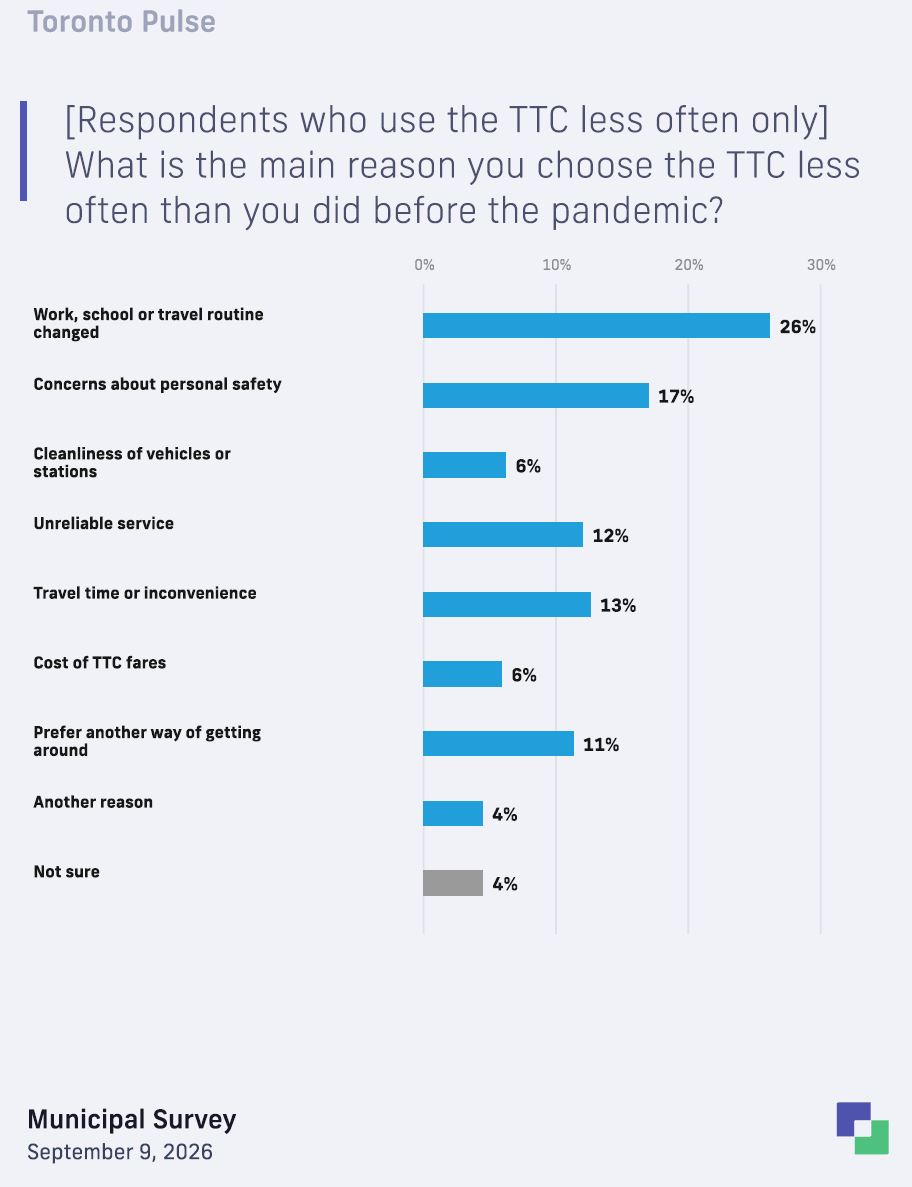
- What is the main reason you choose the TTC less often than you did before the pandemic?
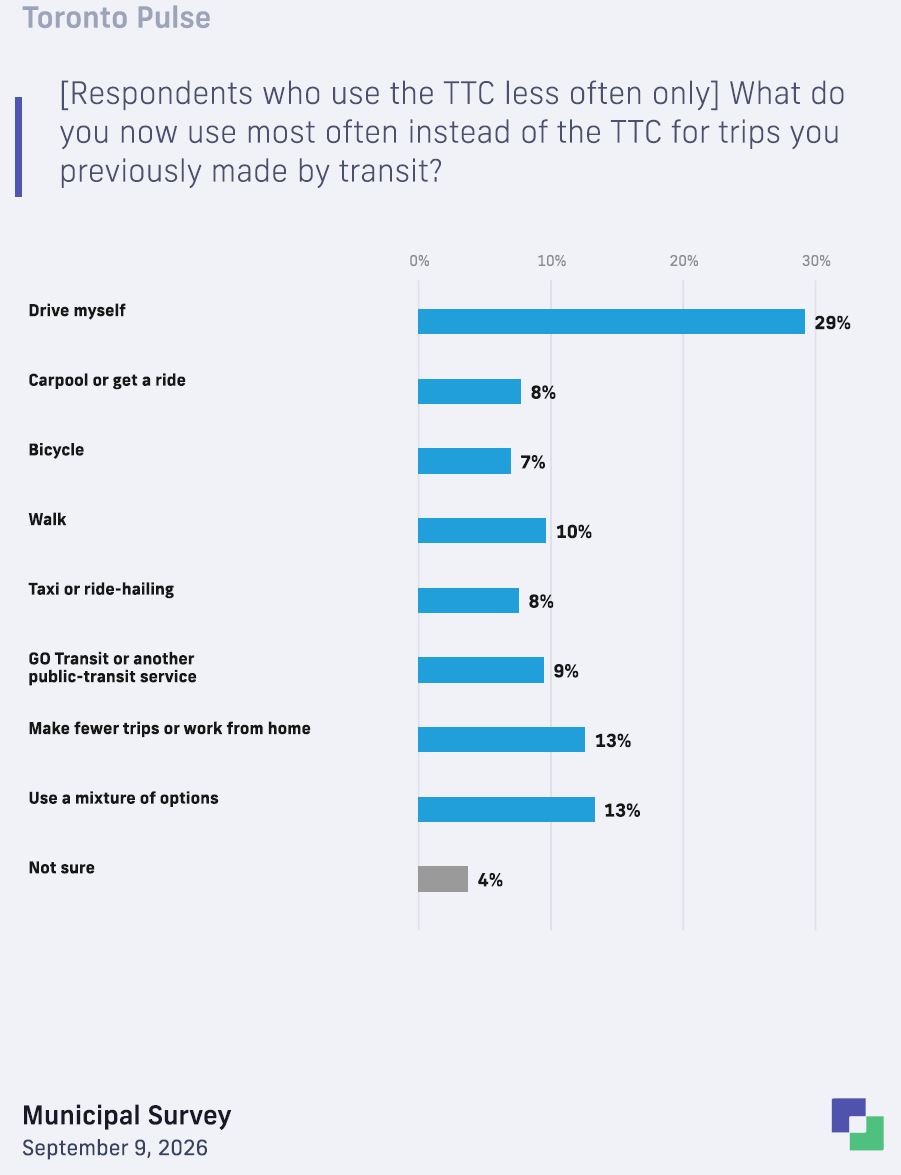
- What do you now use most often instead of the TTC for trips you previously made by transit?
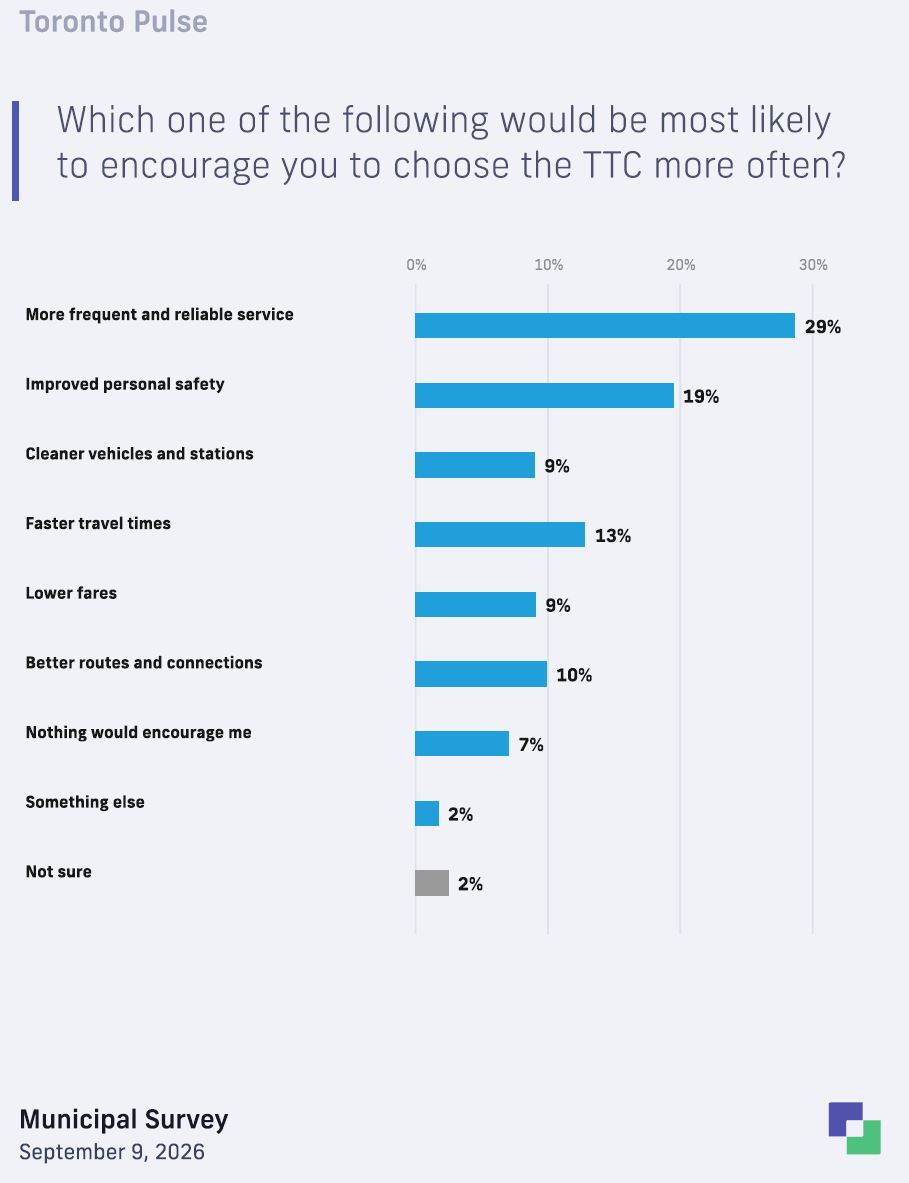
- What one of the following would be most likely to encourage you to choose the TTC more often?
The high level numbers are discouraging for transit advocates. Although 39% ride TTC about the same as before, 29% say less often while only 15% say more often. The remaining 17% are split between non-TTC users and “not sure”.
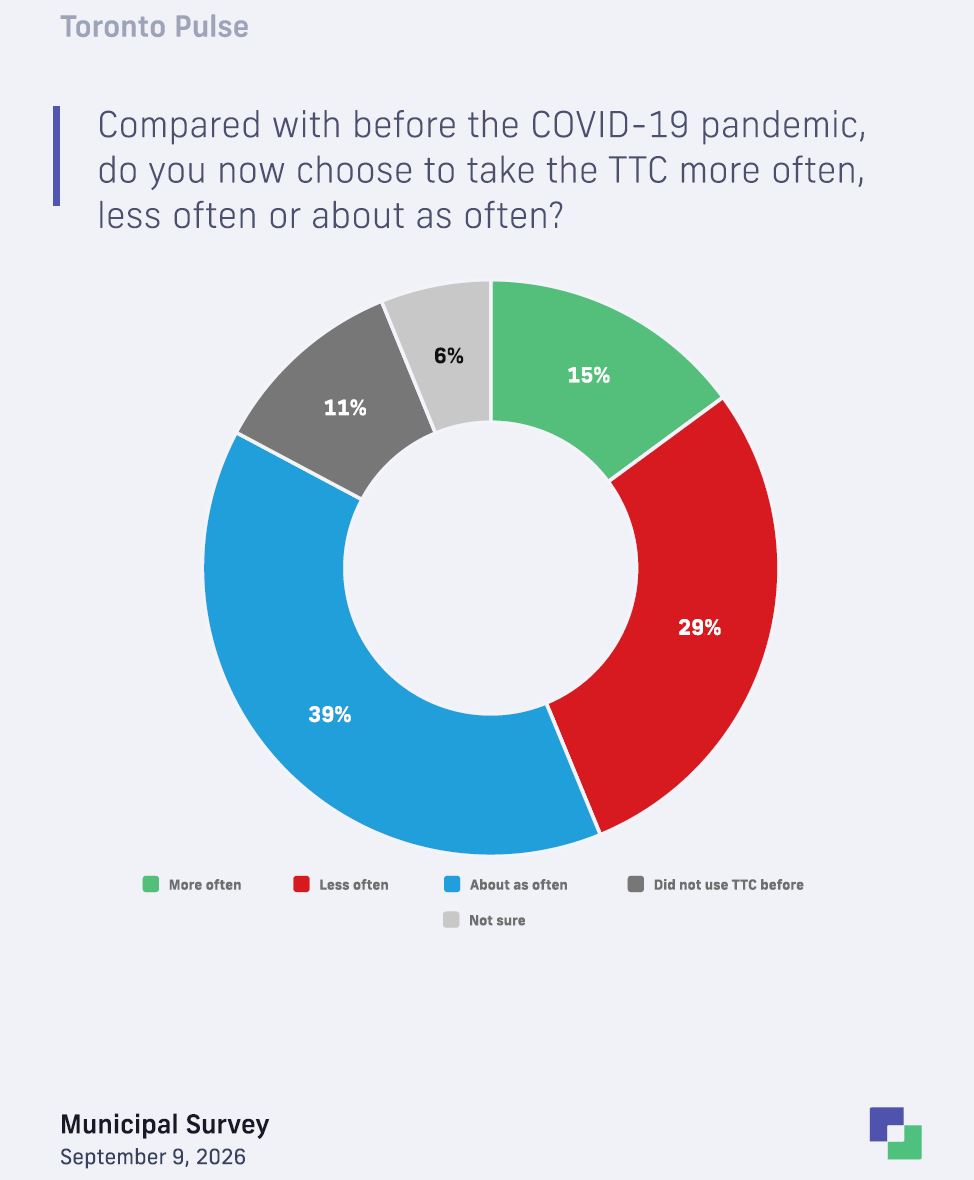
The detailed breakdown of these groups shows interesting differences across the city, but to a much lower extent by age and sex.
Unsurprisingly, the “more often” group is concentrated downtown with 27% of responses coming from there. The numbers drop off in the suburbs with 13% in North York, 11% in Etobicoke, and 9% in Scarborough.
Conversely, the “less often” group is 33% in Scarborough, 29% in North York, 28% in Etobicoke and 24% downtown.
The “About as often” numbers have a smaller range from 36% in Etobicoke to 41% in Scarborough.
The non-TTC-riders pre-pandemic were highest in Etobicoke at 19% and lowest downtown at 6%.
The details of why riders have left the TTC, and how both ex-riders and those still on the system can be encouraged to ride more follow in the long version of this article.
Overwhelmingly, riders (past and present) want better service — a combination of frequency, reliability and speed.
Better service usually means more vehicles and drivers, not to mention line management and a culture that values reliability. Transit priority has to be real, not something at selected locations when enough traffic wardens are free to wrangle motorists, pedestrians and cyclists who make up their own rules.
These cost serious money and step on political toes. Toronto Council has a dream of massively improved transit service, but no sense of how it would be implemented nor any plan for the necessary fleet, infrastructure and staff needed to ramp up service. Meanwhile we celebrate multi-billion dollar lines on maps in media events and election campaigns.
The TTC had a Strategic Planning Committee for the past few years, but it did not spend much time on real “strategy”, certainly not on options that might bring riders back to the TTC. Everyone seems afraid to talk about any policy that has a cost, and some penny-pinchers think every problem can be solved with belt-tightening. Exactly what is needed and possible is never debated nor presented for public discussion. Toronto bumbles from year to year with minimal changes most riders cannot see in their daily travels.
This survey and others like it from past years should be a wake-up call to Toronto that service matters, and Toronto politicians should explain just how much they will fight to improve the TTC beyond the status quo.
Why Do Riders Use The TTC Less?
The primary reason cited for using the TTC less was that rider travel routines changed (26%). This could mean that they simply did not need to travel (e.g. work from home, retired) or that transit no longer suited their regular travel. This item ranked higher downtown and in Scarborough (31%), slightly lower in Etobicoke (27%) and much lower in North York (17%). The values broken down by age and sex lie close to the 26% average.
Personal safety was the next highest topic at 17%. It is highest in Etobicoke at 21% falling off through Toronto (19%), Scarborough (16%) and North York (15%). The rank is higher among older population and women, but only slightly above the average (19%).
Unreliable service, travel time or inconvenience account for 25% between them, although there are differences between parts of the city. The highest numbers are in North York (19% unreliable, 15% travel time or inconvenience), with lower values in downtown (13% and 9%), Scarborough (8% and 14%) and Etobicoke (8% and 10%).
There is only a small difference between men and women in these categories, but moreso by age groups. Of the 18-34 group, 20% cite one of these factors. This rises to 28% for the 35-49 group, and 30% for 50-64. It drops back 21% for the 65+ group.
Vehicle and station cleanliness account for only 6% although the highest value is in North York at 12% and the lowest downtown at 2%.
Fares also come in at 6%, but with Scarborough citing 9% and other areas 4-5%. The highest age groups at 9% citing this factor are 18-34 and 65+.
Preference for another mode of travel was highest downtown at 15%, lowest in Etobicoke at 6%, with North York (12%) and Scarborough (11%) in the middle of the pack. Values vary by age with 15% of the 18-34 group dropping to 9% of the 65+.
It is important to remember that the survey asked for “the main reason” someone used the TTC less, and several issues could have contributed to the decision.
What Alternative to the TTC Do You Use Now?
For those who use the TTC less now than in 2019, driving was the primary alternative at 29% with a further 8% car pooling or getting a ride, and another 8% moving to taxis or ride-hailing. Active transportation took 7% for cycling and 10% for walking. Some trips shifted to GO or another transit agency (9%). Some former riders used a mix of options (13%), and a similar proportion either made fewer trips of work from home.
The driving option was highest downtown and in Scarborough at 35% with noticeably lower values in Etobicoke (25%) and North York (20%). This was lowest among the 65+ group at 21%.
Car pooling was higher among women (10% vs 5% for men) and seniors (10%), and was most common in North York (11%) vs downtown (4%).
Taxis and ride hailing were cited most downtown (10%), with lower values in North York (9%), Scarborough (7%) and Etobicoke (4%).
Cycling was cited as an alternative the least downtown (2%) with higher numbers in both North York and Scarborough (9%). Walking was most common downtown (15%) and least in Etobicoke and Scarborough (6%).
Another transit service, to no surprise, was cited more in North York (10%) and Scarborough (14%), much less so elsewhere.
Reduced travel and work from home averaged 13% with a range from 11-15% among various groups.
The standouts among the “mix of options” group are in Etobicoke (25%) and Scarborough (7%).
It is important to remember that when the overall responses are subdivided, the number in each group is smaller and the potential variation from a larger sample is greater.
What Would Encourage More Riding?
The table below should be no surprise to anyone familiar with transit passenger surveys. Service related issues – frequent and reliable service, faster travel times, better routes and connections – account for 58% of the responses. Personal safety and system cleanliness count for another 28%. Only 9% say they would ride more if fares were lower.
This is not to say that fares are unimportant, especially for frequent users and those on low incomes, but fares alone will not make up for service quality and a sense of security. By analogy, a store with big “SALE” sign in the window, but half-empty shelves of outdated goods will not attract customers. Even worse, the dreaded phrase “shuttle buses are running” is the equivalent of a supermarket setting up a few barrow-boys in the parking lot.
Toronto has seen a string of fare freezes and now monthly capping that brings its fare policies more in line with other cities, but this alone will not get people using transit more, especially if they have already given up hope.
Both TTC and Metrolinx have a lot to answer for with a mixture of infrastructure and vehicle problems that guarantee a miserable journey for regular riders often enough that they will cite them to friends, colleagues and survey takers.
Fare policy, especially as the proportion of revenue coming from riders has dropped over the years (from 70% to under 40%), is comparatively cheap. Service is quite another matter.
Better frequency and reliability has an average score of 29%, and the breakdowns across sex, age and location are close to this value. Faster travel times similarly with an average of 13% show only small differences across all groups. Better routes and connection average 10% with a lower score downtown (7%) where there is a dense, frequent network and higher especially in Scarborough (12%).
Lower fares at an average of 9% has a higher rank (14%) in the 18-34 group.
Again, remember that the survey asked for one response from a list, and many factors could influence riders. They were asked to name only one.
Methodology
Liaison surveyed a random sample of 1,000 Toronto residents from September 4 to September 5, 2026, using Interactive Voice Recording (IVR) technology. Participants were reached through random digit dialling (RDD) across both landline and cellular phone networks. The resulting data was weighted to match targets based on the 2021 Census. For the total sample, the margin of error is +/- 3.1 percentage points, 19 times out of 20. The margin is higher for sub-samples. Totals may not add up to 100% due to rounding. [Source: Liaison Strategies article]


I mostly use transit less because I’m full-time work-from-home since March 2020, but even then I cycled as often as possible. I still need to go downtown sometimes though, even if only to go out with friends.
I used to be able to get downtown in an hour or less from the west end if I caught the 508. Then the Flexities arrived, speed went down, the line was permanently split at Humber Loop… Now an hour and a half is about as good as it will get, so if I need to go downtown I’ll drive, or head west and catch the GO from Longbranch. At least when GO is late it’s normally on the order of 5 minutes, not 30-40.
LikeLiked by 1 person
I avoided rideshare for a long time, but the TTC situation to travel from where I live east of downtown to where I need to go has gotten ridiculous, while at the same time Rideshare prices have not gone up. Oh yes, it’s still more expensive, probably costs 4x the TTC for a regular trip I make, but 4X $3.30 is not really that much considering the convenience of direct pickup and drop off.
At the building I work in a regular food court meal now costs $15, a fancy one costs $20, which by the way I usually don’t bother with and make a simple lunch at home, but where I am going with this is I think the TTC has lost the young middle class downtown, permanently in many ways.
These aren’t “the rich” but people who make high five-figure salaries who don’t flinch at paying for this convenience when they stop on the way into the office to pay $7 for a coffee, even though their office provides coffee for free. Also, especially those who are paying $3,000/month for rent are thinking “what’s a few more dollars compared to that?” You can say that’s not sound financial planning, but it doesn’t change the fact that this is actually happening, and the TTC needs to confront why.
The TTC seems like it is stuck in 2005 and thinks they add value to middle class downtown resident’s lives now simply by existing, but they don’t care about what really matters, reliability. I need to get to work on time, but the TTC makes me assume there will be some massive delay. This was a problem with GO Transit in the dark days of the early 2000’s where they were 90% on time, but that means you will be late at least once a week on average if you make five round trips.
But the proof is right there, with countless hundreds of rideshare pickups and drop offs every hour at rush hour in the financial district to and from places that would have been easy marks for the streetcars 20 years ago.
There’s been a generational change, and the TTC is stuck far behind it. Winning those riders back will be very difficult. Hell, they still can’t even get King Street done right.
LikeLiked by 1 person
The city only has itself to blame for the loss of riders. The degradation of service is visible and felt by every single rider so those numbers are unsurprising to say the least.
The apathy and poor operational decisions from the TTC management towards riders and the reliability of the service is also a huge factor.
I live on the east side of Toronto and there’s barely a day when there’s either issues, deviations, buses full during peak hours with people not able to board, streetcars not showing up or short turning
LikeLiked by 1 person
Thank you very much Steve for your analysis. We can pray that some one with the clout reads this and can make some improvements.
Overall, as a regular TTC patron, a senior, I think that service really has improved over the past two years, mainly on the subways. Though, incidents happen regularly. Yesterday morning 8:00 am I was stuck on a train southbound at St. George because there was a “medical emergency” (oh, sure, that’s what they always say!) at Queen’s Park, we had at least a 20 minutes wait. Simultaneously, there was an emergency at TMU northbound. The TTC is blameless; it is the city we live in. My point is, the many incidents makes a transit trip unpredictable, but I can say the same for auto trips.
Wife and I have a Cabbagetown apartment, so we mainly use Wellesley, Sherbourne, and Parliament buses. Service here is decent, except Sherbourne could use more buses in the daytime, the buses are usually crush. Now, the Carlton car is another story! Yesterday morning 9:15 am waited 20+ minutes at Elizabeth eastbound when finally a replacement bus arrived. Construction on College diverts the car down Bay to Dundas but I actually did want the Carlton car because I was going to Dundas & Yonge. I am not exaggerating the length of the wait, as I was watching the clock. And a couple of weeks ago I reported here on this blog a 30 minute wait for a Carlton car on a Saturday, and a crowd waiting.
I see that Carlton diverts up and down Parliament instead of Church because the curves are missing at Church.
St. Clair was very good Tuesday evening and so was the subway.
The survey indicated riders needing more frequent, reliable, and speedier service. A ten-minute wait versus a 20-minute wait means an average ride is 10 minutes quicker. All three requests solved at once!
It is no good when two or three vehicles show up together. It leaves a big gap.
In the outer city I would recommend an absolute maximum wait of 20 minutes on any route any service hour.
And while the majority of ex-transit users migrated to automobiles, that only clogged the streets more and delayed transit even further.
There are a lot more nuances to this problem.
Steve: Alas, I had to work within the limits of the questions Liaison Strategies asked.
LikeLike
About removing stops to make transit faster. No, it doesn’t. The bus is faster but the time to get to the stop is multiples of that, especially if you are not that mobile.
Line 5 missing stop at Credit Union Drive, terrible for seniors.
Steve: There is a problem with stopping on the grade.
You people advocating for removing stops – go take a hike!
LikeLiked by 1 person
The TTC’s configuration – tiny subway system, lots of buses and trams, lines that more or less follow the street grid – guarantees a large number of trips will involve multiple transfers. Unless your trip starts at one subway station and terminates at another, the TTC will generally only be the better way if you place zero or negative value on your time. I’m not sure what can be done about this. I get that the TTC isn’t great operationally, and it’s getting worse, but a lot of the problem is the infrastructure we didn’t build over the past 50 years. And maybe some that we did. Given the astronomical cost of tunnelled heavy rail, I doubt that we’ll build much more of that. And anybody who routinely takes a streetcar knows how slow and unreliable they are, but somehow we’re wedded to them. So…assuming the city’s population starts growing again, mobility will just get worse and worse.
Steve: The decision to go with a grid network, given Toronto’s street layout, was made a long time ago as an integral part of the suburban network expansion through the 60s and 70s to avoid a spiderweb of routes serving neighbourhoods as they developed.
LikeLike
I have no choice but to use it as I cannot afford to drive. I use it daily. Luckily I never go downtown and my commute is decent as it involves the frequent SRT replacement service and line 2 only. If I do go downtown, it involves an Uber and GO.
People who used to use TTC or who could but choose not to tell me they are turned off of TTC because of the declining service over the recent years and also the unfortunate reality of homelessness/mental health, cleanliness and safety issues on transit. I took TTC since I was a kid and I don’t remember the subways crawling at 5 km an hour and stopping multiple times in the tunnels unannounced. This has become a norm now on Line 1. This was not the case a decade ago. It’s so frustrating and TTC’s communication is basically non existent. Maybe impossible but a crazy idea is to just shut down line 1 for multiple days and do a bunch of mass repairs rather than daily unannounced slow zones resulting in miserable commutes?! Also that fake “barrier” they spent so much to put up at Dundas/TMU Stn was useless and performative – it had people all over social media laughing as it won’t do anything.
I was in Montreal and was impressed with how fast the subways are – no long dwell times, doors open and close fast and the train is fast. No long wait times either. The REM LRT was impressive with the platform doors and fast grade separated travel.
Here, we have slow dirty streetcars (it’s faster to just bike or walk) and slow subways crawling at a snails pace, including the LRTs that are not “rapid” despite having that in their name. They seem to always be shut down or have delays almost everyday (thanks Metrolinx/their contractors). Multiple times I’ve taken line 5 – the 34 was faster compared to the surface section as it would often crawl and then dwell at stations. Often I would have long waits for the LRT too and no way of tracking it. Almost a year later for both LRTs and we still have no full signal priority measures, just half-assed “signal priority” which is a shame. The train should not ever have to wait on a red light.
I’m nervous for the busway to open as TTC might find a way to slow that down too – I hope I am wrong! Their operational practices of slowing everything down makes everyone suffer.
TTC is an embarrassment and I hope the municipal politicians really do something about this for the upcoming election. Management needs a complete overhaul. It’s such a shame and it doesn’t have to be this way for such a vital service. More people will choose to drive, resulting in more congestion and pollution which is ultimately worse for everyone. The TTC board and management should not be ignoring these realities.
LikeLike
the streetcrawls are slower than my jogging speed and i cant get from main to sherbourne without line 2 halting at least once, and on top of all that, i spend more time waiting for the bus than travelling on the bus. LRT(larp rail transit) lines 5 and 6 stop at every red light and are often slower than their bus counter-parts above ground. crappy service is a bigger turn off for using the ttc than any other factor, yet the ttc wastes their money on fare enforcement instead… very dissapointing
LikeLike
MetroMan said:
If you want to understand the problem with the TTC you need to address the paradigms that underpin the TTC’s strategy, which quickly stated is to be all things to all people. As is shown in competitiveness theory, and the actual experience of the TTC riders this strategy delivers mediocre results where very few users of the service actually get want they need out of it.
If the TTC wants to move forward it fundamentally has to reassess its strategic purpose, instead of dumping a bunch of money on projects like the Finch LRT that no one wants to use.
LikeLiked by 1 person
Many years ago I made the decision to prioritize living in a walkable area with good transit, even if there might be cheaper options farther out. I’ve never owned a car. For many of those years, I had the displeasure to have to commute to the ass-end of nowhere (90 minutes to two hours each way) due to work. Never thought about moving to the ass-end of nowhere because I figured work would some day change. Finally went full WFH in 2018. As a downtown liberal elite, I have little need to leave downtown. I rarely travel east of the Don, west of Bathurst, or north of College. There are some errands and appointments that take me farther out, but they aren’t that frequent. If I can walk, I do. If the weather is bad or it’s a bit too far for me on a given day, I will take the TTC, but, except for the subway, transit in downtown is garbage. More trouble than it’s worth, given that every streetcar line is diverted, torn up, or running random replacement buses. Used to enjoy being able to hop on a streetcar to take me across my domain, but that’s now a pain. Frankly, this is a pretty good way to live if one can manage it. I get exercise and reduce TTC crowding by not riding. Two-hour transfer is nice, allowing the odd TTC-based errand to be made on one fare.
From my experience commuting, which took me out to the car-focused inner suburbs, the main frustration as a TTC rider is crowding, delays, and long trip times. Those all stem from political and management decisions to trying a cost-cut-to-success strategy combined with the city’s (and now province’s) fetishizing and prioritizing cars over transit vehicles (and other non-car modes). The number of times I stood ram-packed on a bus creeping along, stuck behind a line of single-occupant cars was too many to count. And then when they built Finch LRT and Eglinton Crossstown, they hobbled them by prioritizing cars.
LikeLike
My family stopped taking the TTC for the following reasons:-
(1) Don’t feel safe – too many sexual assaults against females and sexual harassment against males in washrooms, also lots of violent robberies and assaults.
(2) Vehicles are too crowded.
(3) Vehicles don’t come on time and when they do come, they come in bunches.
(4) A lot of TTC bus drivers don’t stop for customers waiting at bus stops instead preferring to speed away and even running red lights especially at night.
(5) Streetcars are a safety hazard as many drivers don’t stop for streetcar passengers on curb lanes.
LikeLike
Speed and travel duration are huge factors that determine whether people will take transit. Travelling to and from the suburbs this is crucial in attracting riders. If the TTC can’t reasonable compete with alternatives then people will turn their backs to transit.
In addition, the TTC needs to get rid of their fetish for slow operations. We know that they favour slow operations as it drives down the usage of resources; less operation hours and less drivers needed which leads to better finances. Readers and politicians on here need to be reminded that the TTC is a conservative organization that is resistant to making changes that favour riders.
It’s time to clean house and put management to the fire. The continuation of the status quo will likely lead to a continuous death cycle if the TTC isn’t already there.
On a tangent, those rider surveys that the TTC conducts seem highly suspect and useless. There is no peer evaluation or third party review. How can we the public or politicians be certain that the TTC does not concoct results that are favourable to management’s decisions?
Steve, once again thank you for your time and dedication to holding the TTC accountable. Without your detailed discussions and analysis we wouldn’t know what is rotting away within the organization or how it is shortchanging the public.
Steve: One correction I should make here: Slower operation actually adds to cost because more vehicles and operators are needed to provide the same level of service. Of course the TTC is not above trimming service to fit the slower speeds.
And, you’re very welcome!
LikeLike
Jess said,
This concept of time value is of critical importance and needs to be understood as a core principle governing public policy, and goes well beyond the constraints of transit. The Bank of Canada has warned of a “productivity emergency” impacting the country and its prosperity. All the research I have seen point to the country’s inability to retain top talent as the core factor causing this emergency. When you dig into the causes of this talent retention problem, and reduce them to their core elements the most dominant issue that emerges is respect for people’s time. When you respect people’s time you not only respect their talent and skill you respect their life itself.
LikeLike
When we have so many people driving Uber, picking up and delivering fast food, and doing others’ grocery shopping for them, it’s no big surprise that labour productivity is low. It’s nothing to do with time value of money and everything to do with these jobs are what’s available.
I fail to see the productivity hand-wringers suggest any convincing solutions. The Uber driver does this because that’s the gig job they can get.
Also, it’s funny how when I look around the GO train car, TTC bus or streetcar or subway, or even at other pedestrians walking along the sidewalk, the majority of them are staring at the phone in their hands.
Maybe the idea is that if they get home quicker, they will put down the phone and do something useful. I kind of doubt that. So if all you’re doing is scrolling your feeds, does it matter how long or short your transit ride is?
LikeLike
First, here is the research from the Bank of Canada establishing that the productivity crisis is real and in large part due to the loss of top talent.
Second, here is the Ottawa Science Policy Network research on the retention of top students in Canada which highlights some of the issues, and shows that about two thirds of graduate students intend to leave the country.
You will find that the core issues impacting people’s intentions to stay and work in the country are an expression of time.
1) Compensation- How much do you receive for the TIME you invest with an employer.
2) Tax- How much of the value of the TIME you invested with an employer do you keep.
3) Capital Investment in productive equipment- Do you have the tools available to do the most possible with the TIME you have.
4) Free Time- After all else is done how much TIME do you have to live your life.
Number four is most relevant to this forum. A transit system that is structured in a way where it takes an individual 30% or more of their free time to commute to work or school is not a competitive system, and and inferior way for someone to live their life. If the city has an intention of retaining highly skilled professionals it needs to fundamentally overhaul its public policy to respect people’s TIME in all its forms.
LikeLike
Reading this on the 511 right now as it crawls through every intersection at a snail’s pace and frankly, will choose not to clear the intersection even with time to spare. The TTC does not care about people’s time.
If it dies a slow death, so be it. We can all drown in car traffic.
LikeLike
DailyRider said,
Well lets test your hypothesis. The question is, do the TTC’s most recent projects respect people’s time? I challenge the reader to go to Google Maps and ask it for transit directions from Kennedy Station to Mount Dennis going from end to end of Line 5. Given that this is a new construction and the most direct route one would think that this should naturally be the best option. However, depending on when you check for directions the best option is usually to take GO transit first to Union Station and then to Mount Dennis, the second best option is to take Line 2 and then the bus. Sadly Line 5 goes a much shorter distance in much more time. So given that Line 5 went years and billions of dollars over budget to provide a service that is worse than what already existed I would say to DailyRider, yes you are right, the TTC does not care about people’s time.
Steve: I just performed the same check. The trip from Kennedy to Mount Dennis is shown as taking 57 minutes, three minutes more than a trip via GO train, but this includes a nine minute walk out of the station at the destination end. The trips via GO depend on service on the Stouffville GO line and the UPX, and the former is not exactly frequent. You can make a faster trip that way if all the connections work, but not by just showing up at a random time.
This brings up the issues of access, wait and transfer times that are an important component of any journey. People do not start their journey at Kennedy Station, but somewhere else either nearby or a bus ride away in Scarborough. Similarly, Mount Dennis Station is not a destination in its own right. Travel time comparisons have to include all factors, not just the speed of the buses or trains enroute.
I agree that Line 5 should be faster, but you cannot blame this entirely on the TTC, but also their so-called partners at Metrolinx and Toronto’s Transportation Services Department.
Speaking of services that already existed: The 34 Eglinton East bus had a scheduled on-way travel time from Kennedy to Yonge of 49 minutes AM peak, 55 minutes PM peak. Then there was a transfer to the 32 Eglinton West which added another half hour to the journey. People whose origins and destinations are not close to the Line 5 terminals were faced with using these services, and would consume extra time just to reach the GO/UPX alternative you propose.
LikeLike
TTC added a reduced speed zone from King to College adding 10 minutes northbound on the most busiest stretch of subway.
I guess it’s things like this that turn away a lot of riders from relying on TTC service if they don’t get to their destination on the time expected.
Steve: Yes, the state of subway slow zones desperately needs a detailed, public review to understand what is going on and how it can be fixed permanently.
LikeLike
I personally use transit less often because Bike share Toronto’s network has grown considerably in the last few years … even though I had the yearly pass for some time, the last 2-3 years is when I have really started to use the network more often, specially in time sensitive situations like mornings where I have to get to work at a certain time. It also saves me money.
LikeLike
Steve said,
I accept the value of these however the current mix is not working for many people and the existing higher order transit in many cases is much too slow and does not serve its primary purpose. To the reader who remembers when Line 5 was once called the Cross Town, if you actually try to take it cross town now you better pack a lunch.
Gary Francis Monteiro said,
This is all too common. People are doing whatever it takes to avoid the TTC to get back as much time as possible so they can actually live their lives.
LikeLike