
This article continues a series reviewing the operating speeds of streetcar lines in detail looking at:
- Evolution of travel times on 504 King from January 2020 to June 2026 by route segment.
- Detailed profiles of operating speeds over the full route for the same months.
- Dwell time profiles showing locations where streetcars are held by traffic signals, stop service and congestion.
The analysis covers the main route from Broadview Station to Dundas West Station, but does not include the two stubs south of King to Distillery Loop and Dufferin Loop.
Like many other routes, service on 504 King is slower in 2026 than it was in 2020 in parts of the route, although the degree of change varies by route segment, direction and time of day. The lack of meaningful transit priority is evident at intersections, including those with traffic signals but no associated transit stop.
Reductions in travel speed occurred across the operating day and were not confined to periods when passenger and road traffic volumes would typically be heavier. The common excuse of “increased congestion” cannot be used to explain away the changes.
Methodology
For a description of the methodology behind these charts, please refer to the Overview.
Service Designs
June 2026:

January 2020:

Note that the 508 Lake Shore cars which were part of the service on King Street in 2020 are not included in this analysis.
Comparative Travel Speed by Route Segment
These charts show travel speeds over segments of 504 King comparing 2026 data (solid lines) to 2020 (dotted). To reduce clutter, the route is broken into east, central and western portions. Westbound data are on the left, and eastbound on the right.
Areas of considerable change include:
- Westbound from River to Jarvis
- Eastbound from University to Yonge
- Approaching Spadina in both directions (westbound from John, eastbound from Bathurst)
- Approaching Jameson in both directions (westbound from Dufferin, eastbound from The Queensway)


Detailed Speed Profiles
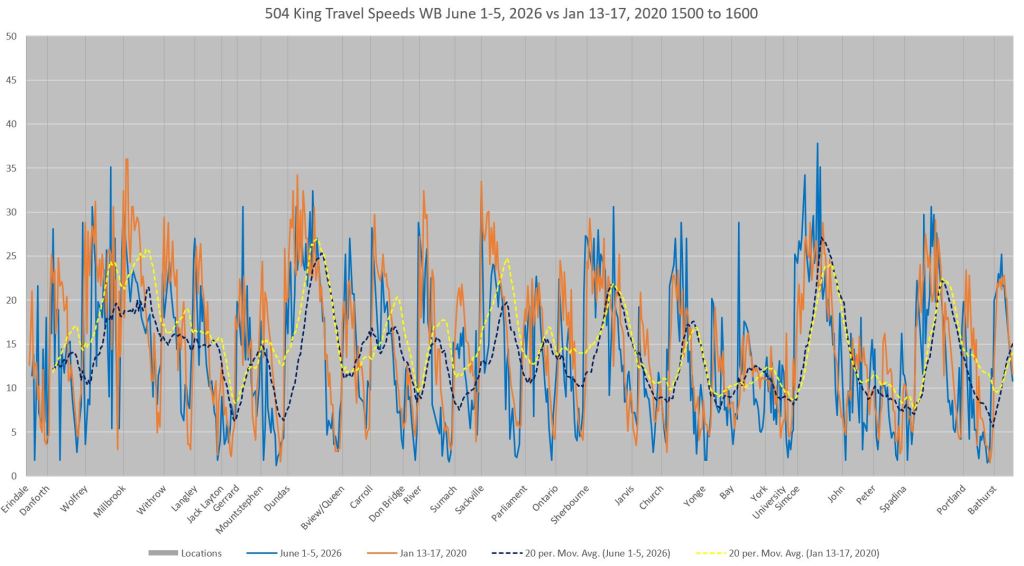
The charts below show average operating speeds along 504 King measured at 10m increments along the route in solid lines (blue for 2026, orange for 2020). Moving averages show the overall shape of the data in dashed lines (dark blue for 2026, yellow for 2020). The route is split into two overlapping charts with Broadview Station to Bathurst on the left, and Spadina to Dundas West Station on the right.
In some areas, the 2026 data show slower speeds but not over the full route. The charts show travel speeds in much more detail than the segment charts above. Westbound charts are read from left-to-right, and eastbound from right-to-left.
Westbound
Areas of particular note include:
- Southbound on Broadview from Gerrard to Dundas. Although this area includes two closely-spaced stops (Jack Layton and Mountstephen) that often come in for criticism, the major problem here is congestion approaching the main intersections, and long east-west green time at Dundas. Service here can be very frequent especially when diversions add Queen or Carlton cars to the regular King and Dundas routes. There is no transit priority for most turns (scheduled or otherwise) at Gerrard, Dundas or Queen.
- Westbound at the Don Bridge and again at Sumach. In the latter case, the traffic signals can delay streetcars and priority is provided only for turns to and from Sumach (the Distillery branch).
- Through the core there is no priority signalling at most major intersections, and cars move slowly except for a burst of speed west of University. Congestion approaching Spadina slows service throughout the day.
- Slower operation in 2026 on the eastern part of the route is particularly striking in the evening (8pm to 9pm, 11pm to midnight).
- Travel speed approaching Jameson is slower in the afternoon and evening in 2026, especially in the 11pm to midnight period due to special event traffic headed for the Gardiner Expressway.
- Speeds pick up briefly west of Jameson to The Queensway, but the drop east of that intersection shows the backlog of traffic waiting to turn west and its affect on streetcars.
- Northbound on Dundas to Bloor, streetcars are slowed by a combination of left turning autos (evenings only) and backlogs of streetcars waiting to enter Dundas West Station.




Eastbound
On these charts, travel is from right (Dundas West) to left (Broadview).
- The approach to Bloor southbound can be slowed by left turning traffic. Although non-transit lefts are banned through the daytime, there are enough buses making this turn at all hours with no transit priority signal that streetcars are held waiting for them.
- The Queensway and Roncesvalles is a complex intersection with three-phase traffic signals, and it is also a crew change point.
- Streetcars run quickly from Roncesvalles east, but by Dowling they are caught in the backup for Jameson and traffic headed to the Gardiner Expressway.
- Traffic regularly backs up from Bathurst particularly in peak periods because many autos turn left here to avoid the transit priority zone. This is seen in slow streetcar speeds extending back to the previous stop at Tecumseth. The eastbound car stop at Bathurst is farside and so there is an extra stop here to serve riders.
- A similar problem occurs at Spadina where there is a combination of congestion west of the intersection and a farside stop east of it. Traffic in this area is also affected by the Entertainment District late in the evening.
- The University Avenue stop connecting with the subway is actually farside at York Street.
- The intersection at Sumach (leading to Cherry) is slow because of three-phase operation and transit priority only for turning streetcars. Queues of transit vehicles waiting for the signal eastbound are common.
- Backlogs of traffic are common approaching both Gerrard and Danforth northbound, compounded in the latter case by queued streetcars waiting to enter Broadview Station.


Dwell Times
Westbound
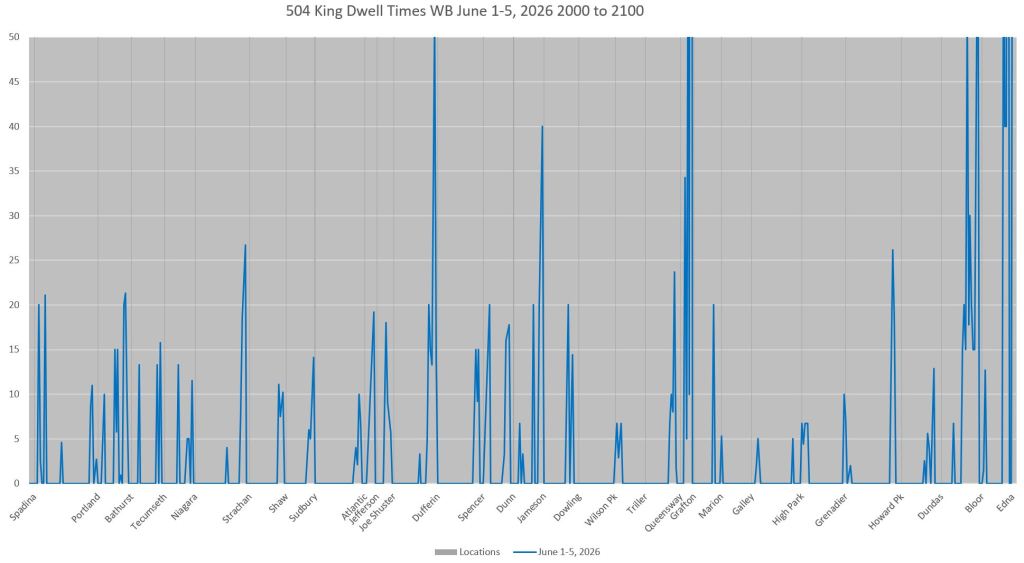
Dwell times along the route mirror the speed profiles. A spike in these charts shows a location where streetcars are able to directly pull up to and stop at the designated location. However, traffic conditions often prevent this and the dwell times are spread out to adjacent 10m segments on the approach. Notable locations include:
- Southbound on Broadview approaching Gerrard and Dundas Streets
- Westbound on King approaching Sumach, Sumach, Parliament, Sherbourne, Jarvis Spadina and Bathurst.
- Double stop locations across the core where there are farside stops
- In the west end, cars are held approaching Dufferin, Jameson, the Queensway and through the stretch from Dundas north to Bloor.




Eastbound
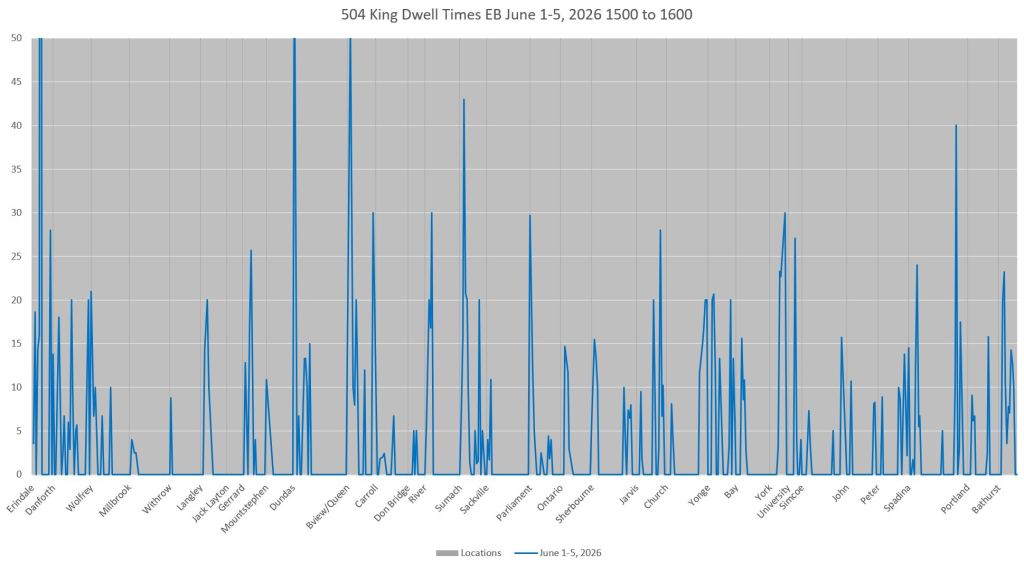
These charts are read from right (Dundas West) to left (Broadview). Large dwells are evident at many locations:
- Southbound on Roncesvalles at The Queensway
- Eastbound at Jameson and Dufferin, particularly in the AM peak
- Eastbound from Tecumseth to Bathurst, and approaching Spadina
- Double stopping at far side stops across the business district
- Eastbound from Sackville to Sumach as noted in the travel speed section
- Approaching interections at Broadview and Queen, Dundas and Gerrard
- Northbound on Broadview between Wolfrey and Danforth during most periods




When hostile signals on the road combine with bad company policy developed by idiots in management we get what we see above.
Green time can be very short at intersections like Dundas and Sumach but throw in stupid TTC “safety” policy (i.e. forbid two streetcars in the intersection, 10km/h speed restrictions, and slow door operations) and the results show in the charts; massive of wastes of time for everybody.
There appears to be some green time extension in place at some intersections (e.g. Berkeley, Broadview, Jarvis) but it’s only active during some periods of the day and other minor streets like George get nothing and routinely hold transit vehicles.
The Gerrard intersection has an extended all red phase for all directions inserted in between phases. It’s not seen in very many places and I’ve never understood it.
Steve: This is for the leading pedestrian phase. The “walking man” comes on before the green time starts for other traffic. This is in place in many locations.
If someone wanted to document all of this site-by-site failure they’d have a lot of work ahead of them.
LikeLike