
This article continues a series reviewing the operating speeds of streetcar lines in detail looking at:
- Evolution of travel times on 501 Queen and 507 Long Branch from January 2020 to June 2026 by route segment.
- Detailed profiles of operating speeds over the full route for the same months.
- Locations of long dwell times showing poor/missing transit signal priority, congested areas and times, and delays that are not associated with stop service.
The two intervals compared here are:
- June 1-5, 2026: This was just before the upheavals of the World Cup period, but without any construction diversions that would distort the data (other than the Ontario Line diversion in the core). Service to Long Branch was provided by 507 streetcars until about 10pm, and thereafter by an extended 501 Queen. Data from both routes are presented here
- January 13-17, 2020: During this period, service to Long Branch was provided all day by an extended route 501 Queen.
Service Designs:
January 2026:
The service designs in effect at the beginning of June 2026 are shown below.


The 507 Long Branch car has the highest scheduled speed in the streetcar system ranging from 13.3km/hr in the AM peak to 20.6km/hr early Sunday mornings. Even the lumbering 501 Queen car is scheduled at over 14km/hr late evenings over the full Neville-Long Branch route, and obviously makes better time on that segment than in the core. It is not impossible for streetcars to operate at higher speeds than we see downtown, but in practice this is rare.
January 2020:

Methodology
See the Overview article for details of how the vehicle tracking data are presented here.
Comparative Travel Speed by Route Segment
501 Queen
In these charts, the travel times for various route segments are shown for 2026 (solid lines) and 2020 (dotted lines) data. Lines for each segment have the same colour to allow easy comparison. In most cases, the solid line (2026) lies at a lower value showing that streetcars today run more slowly than in early 2020, although the differences vary. The route is broken into three sections to reduce clutter from too many overlapping lines.
Note that for many segments, there is little change in the travel speed through the day with the higher speeds seen in the early morning and late evening. There is always some hour-to-hour variation in travel times, and these charts consolidate data from five weekdays, Monday to Friday. Some route segments have off-peak traffic patterns such as congestion late in the week in areas with evening entertainment, but these are smoothed out by averaging several days. (Some examples of this can be found in other route-level analyses on this site.)
The section of the route from Jarvis to University is not charted here because of the Ontario Line diversion from Church to York.
The fastest section of the route is, of course, on The Queensway where streetcars have a private right-of-way, stops are further apart and passenger demand is lower than downtown.


507 Long Branch
Service west of Humber Loop is noticeably faster than on the main 501 Queen route. However, in spite of the wider, less-congested street, there have been some notable drops in speed from 2019 to 2026.


Detailed Speed Profiles
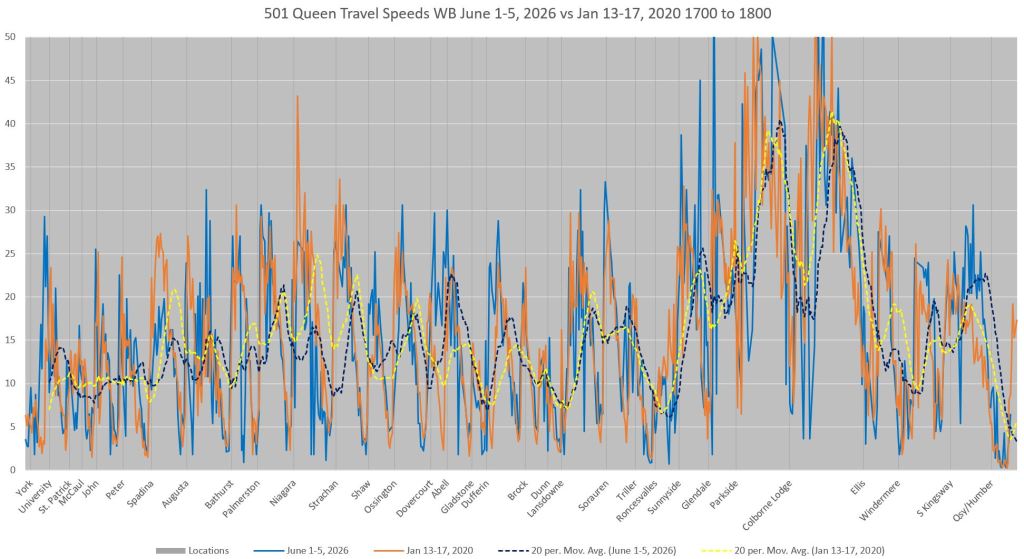
These charts show the average speed of vehicles along the route. Four values are plotted:
- June 2026: Light blue line
- June 2026 moving average: Dark blue dashed line
- January 2020: Orange line
- January 2020 moving average: Yellow dashed lin
The charts on the left show the east end of the route from Neville to Church, and those on the right show the west end from York to Humber Loop.
501 Queen Westbound
In these charts, the direction of travel is left-to-right.
Note the much higher speeds even during peak periods between Roncesvalles and Humber, but also the very slow operation westbound from Roncesvalles to Sunnyside thanks to the slow order on the intersection and on a series of facing point switches leading to the carhouse and to Sunnyside Loop. There is a similar dip for the switches at Russell Carhouse (Connaught to Greenwood), but it is not as severe.
On some parts of the route, the 2026 data show a slower speed than in 2020, but in others the reverse is true. Speed on The Queensway is slower in 2026 even though the TTC relaxed some restrictions on that section in late May that should have sped up streetcar service.
The effect of eliminating the stops at Abell (between Dovercourt and Gladstone) can be seen in the higher speed at that location in 2026 data, but this is not a major contribution to overall speed.




501 Queen Eastbound
In these charts, the direction of travel is right-to-left.


507 Long Branch
Speeds on Long Branch vary by time and location with 2026 sometimes slower, sometimes faster than 2019.
Charts on the left show westbound service and should be read left-to-right, while those on the right show eastbound service and are read right-to-left.
This route does not have a private right-of-way, but runs on a wide street with less congestion than other routes downtown.


Dwell Times
The dwell time charts show a common pattern for mix traffic routes where longer dwell times occur at a cluster of locations near a stop or intersection, rather than at a single point corresponding to a stop platform. This is evident a busy locations such as Church westbound where streetcars can queue for the left turn, and approaching Bathurst and Roncesvalles (among others). Lansdowne westbound is particularly bad in the PM peak thanks to traffic turning south onto Jameson to reach the Gardiner Expressway.
Double stops are evident on The Queensway where the nearside wait for a green traffic signal can rack up a longer dwell time that the actual stop service farside.
The absence of signal priority across the route, or at least priority that would reduce dwell times substantially, is clear. This can be seen in the long dwells even in the 11pm to midnight data where traffic and passenger demand should be lighter.
Problems with terminal queuing can be seen eastbound to Neville where the stopping location for streetcars extends well back from the loop.
Westbound


Eastbound


Long Branch
Long Branch cars pause at many locations and this begs the question of how much time is wasted waiting for green signals. Traffic backlogs are evident at some locations such as Kipling westbound, and through Mimico.
A long-standing issue is the signal at the access to the underpass from Lake Shore Blvd. into Humber Loop where streetcars are routinely held both ways, particularly eastbound. This is supposed to be a “transit priority signal”, but its usual function is to delay streetcars.
Park Lawn is a farside stop westbound, and streetcars spend more time at the nearside approach than actually serving the stop.


Transit signals were installed at the entrance to Long Branch loop some time in late 2021 or early 2022.
These activate — if a streetcar is either entering or leaving the loop — once per signal cycle. As the cycle is at least a minute long, if not longer, then that will account for a fair amount of delay in either direction.
The transit signals currently only activate after the Brown’s Line green signal and before the east-west Lake Shore signal. In theory, a “priority” signal should be able to also activate after the Lake Shore signal and before the Brown’s Line green.
Unlike the lights at the Humber loop end, the signals at Brown’s Line cycle automatically and not on-demand. I suppose that might make them a little less onerous. (If you miss the countdown for an on-demand signal, it clears and you have to go through the entire waiting phase again. It’s a problem with the implementation and I don’t know how easily it can be solved.)
However the cycle is not really amenable to speeding up, particularly because the east-west pedestrian crossing (on the north side only) is a long one that has to make it across the Long Branch loop tracks, the Brown’s Line westbound slip lane, and the Brown’s Line eastbound left turn lane.
LikeLike