
This article continues a series reviewing the operating speeds of streetcar lines in detail. Although other routes were compared between 2019/20 and 2026, the analysis for Dundas uses 2023 as the “before” data. For an extended period, 505 Dundas operated with buses due to a shortage of streetcars, and there are no data with Flexity cars on Dundas to use as a 2019/20 comparison.
April 2023 saw Flexity operation over the normal 505 Dundas route with no diversions or extensions. This month also predates transit priority changes made in 2024 and 2025.
- Evolution of travel times from April 2023 to June 2026 by route segment.
- Detailed profiles of operating speeds over the full route for the same months.
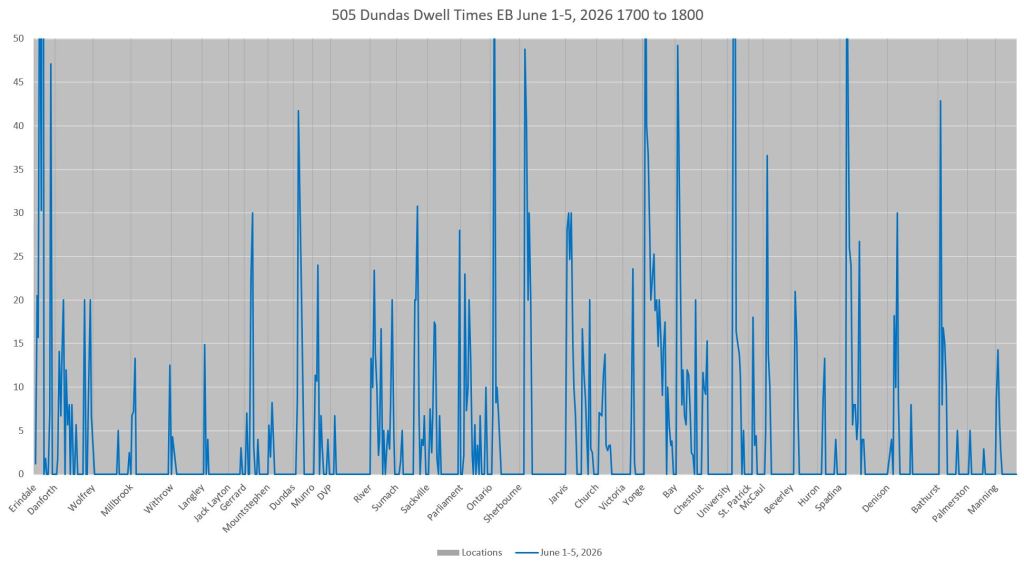
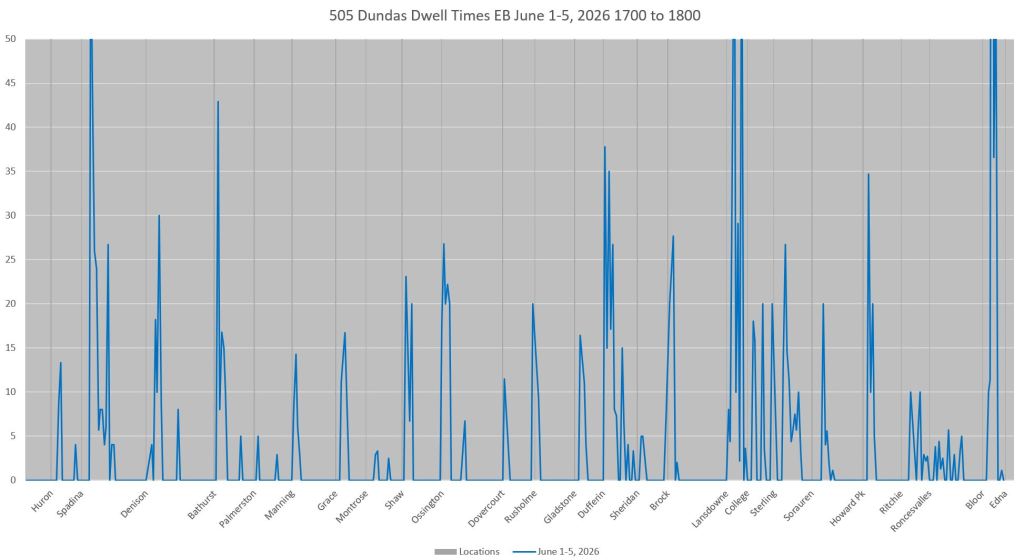
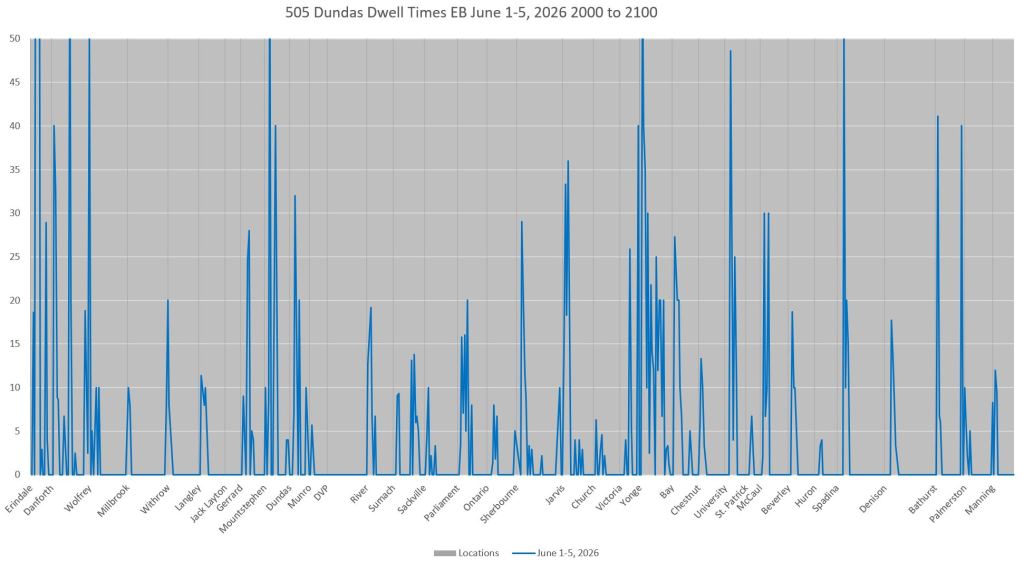
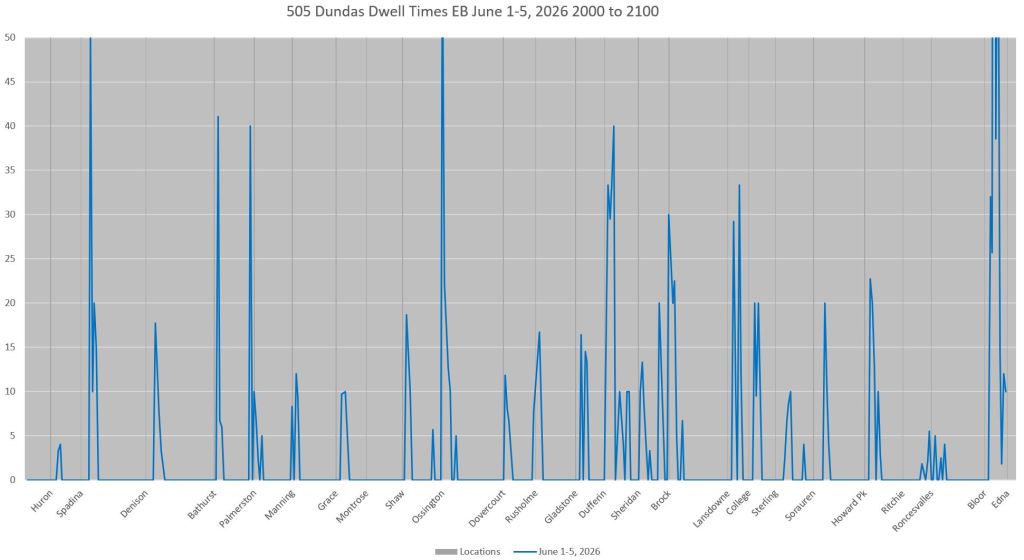
- A review of dwell times in June 2026 showing where streetcars are most likely to spend excessive time in the AM and PM peak periods.
Service Designs
June 2026:

April 2023:

Methodology
For a description of the methodology behind these charts, please refer to the Overview.
Comparative Travel Speed by Route Segment
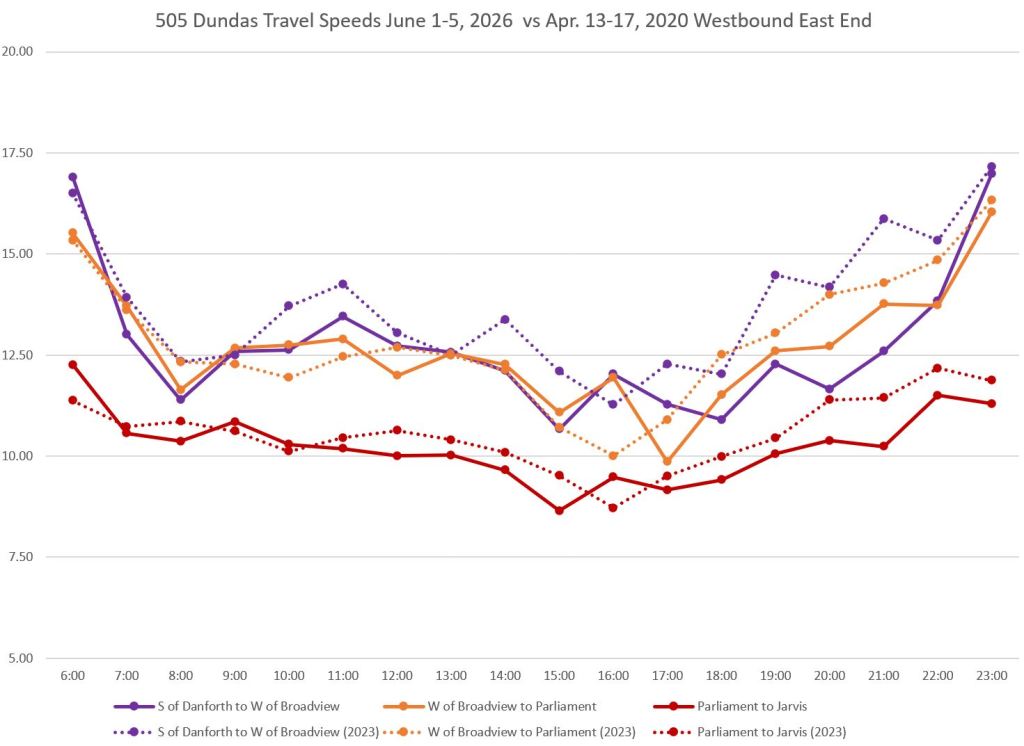
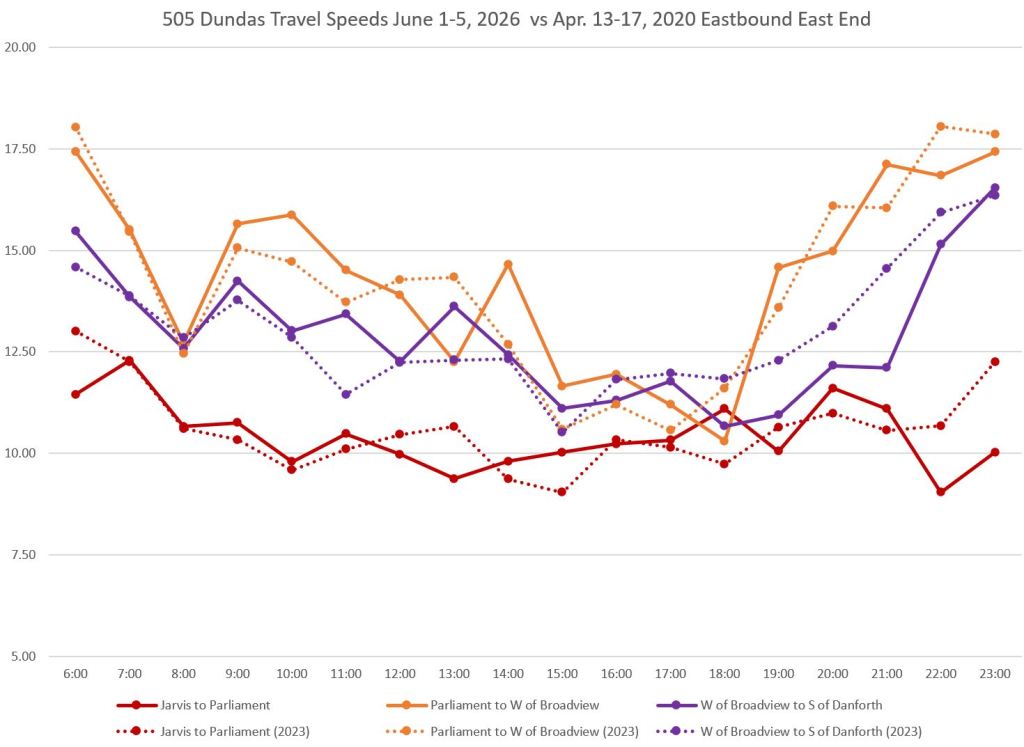
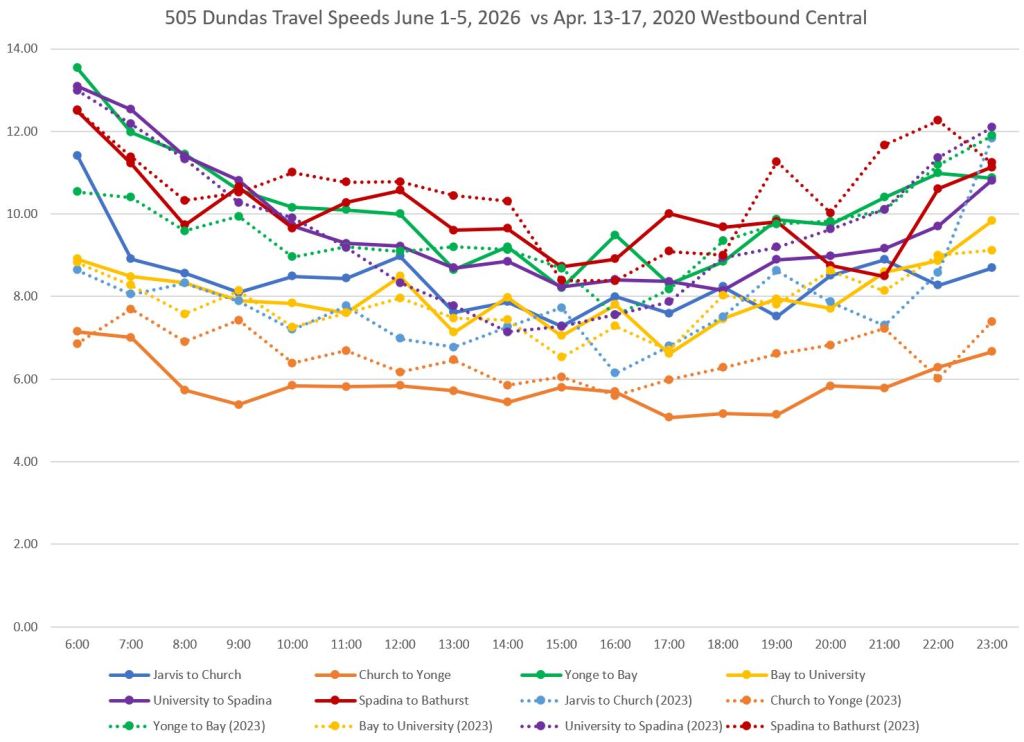
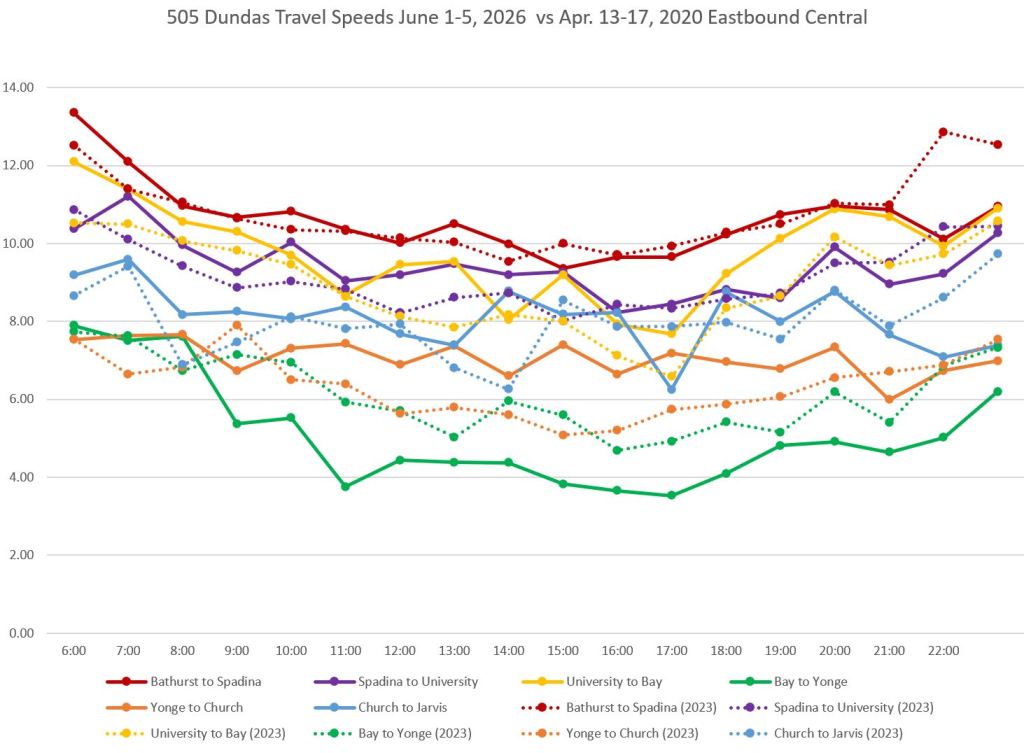
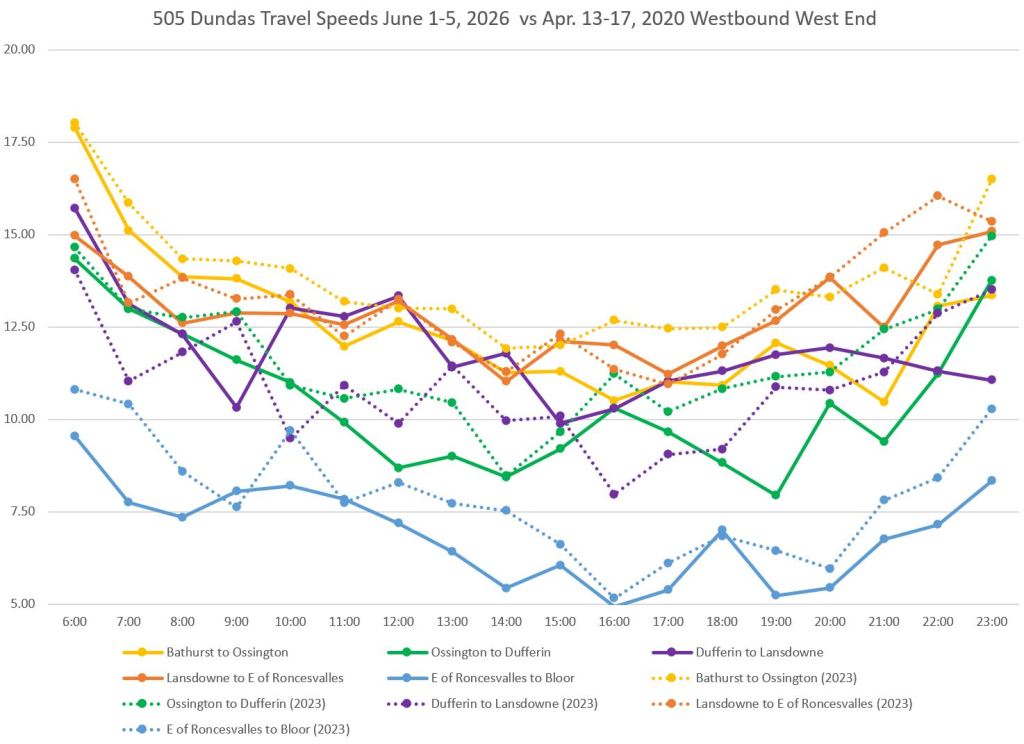
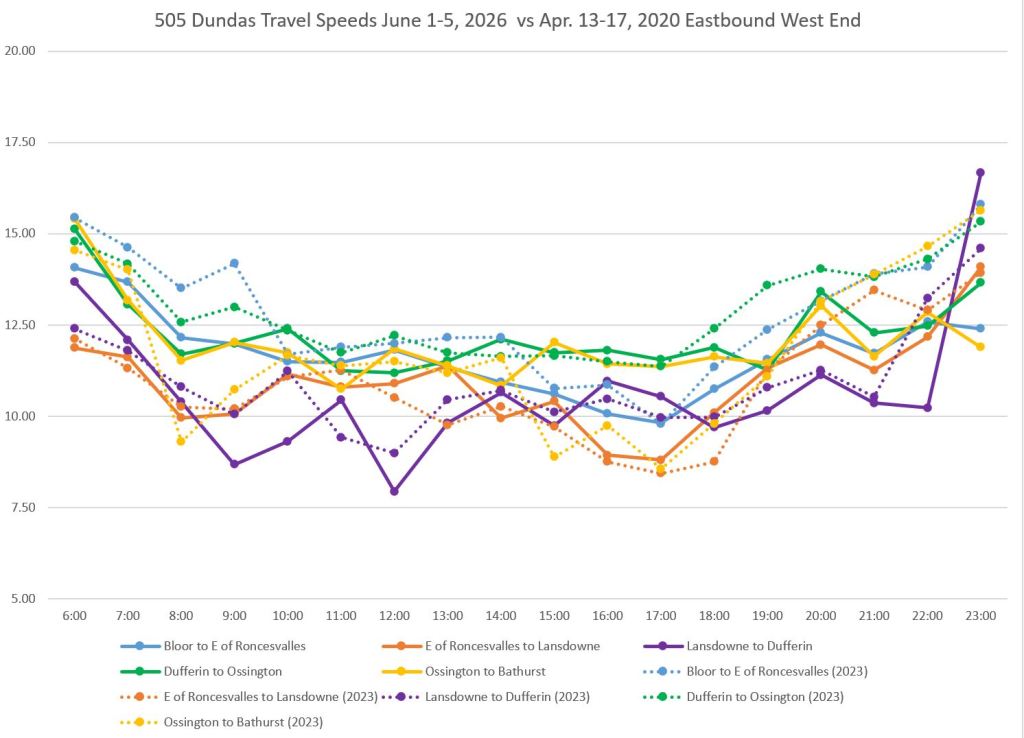
Unlike the 2019/20 to 2026 comparisons for other routes, there is no clear difference for 2023 vs 2026 on 505 Dundas. The nature of real travel time and speed data is such that they will never match even from day to day, but the general shape of weekly averages stays roughly the same in the absence of external changes.
The charts here show three sections of the route from Danforth to Jarvis, Jarvis to Bathurst, and Bathurst to Bloor/Dundas. The y-axis the outer sections runs from 5 to 20km/hr to spread out the lines somewhat, and in the central section from 0 to 14km/hr. In all other articles, the range for these charts is from 0 to 25km/hr.
Travel speeds are markedly different for each direction in some parts of the route. Some areas of note:
- Westbound from Church to Yonge (orange, middle chart in the left column), and eastbound from Bay to Yonge (green, middle chart in the right column) . Operating speeds either side of Yonge street are very slow thanks to the pedestrian scramble at Yonge and the presence of parked/stopped vehicles.
- Westbound from Roncesvalles to Bloor (blue, lower left chart). Slow travel times here arise both from backlogs from left turning autos at Bloor as well as streetcars queued north of Bloor to enter Dundas West Station.
- Westbound from Ossington to Dufferin (green, lower left chart), and eastbound from Lansdowne to Dufferin (purple, lower right chart) . There is some improvement in the 2026 data vs 2023 in these areas in the midday
Deleted Stops
Between 2023 and 2026, several closely-spaced stops were removed from 505 Dundas. In some cases, these locations still see delays to the lack of transit priority at signals. The stop removals at Munro, Huron and Sheridan improved travel speeds somewhat over short distances, although not in all time periods.
- Westbound: Erindale, Munro, Huron and Sheridan
- Eastbound: Sheridan, Huron, and Munro
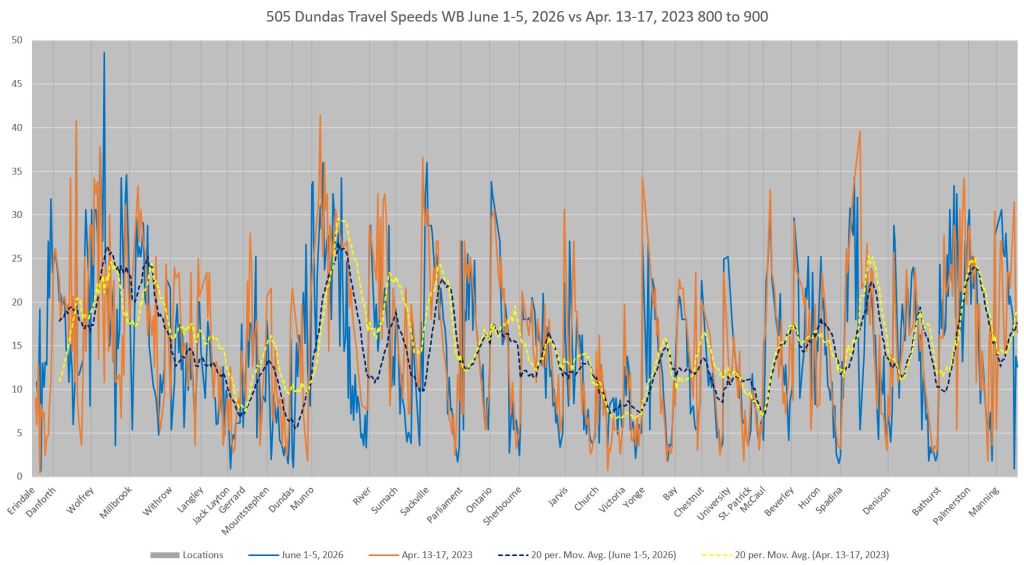
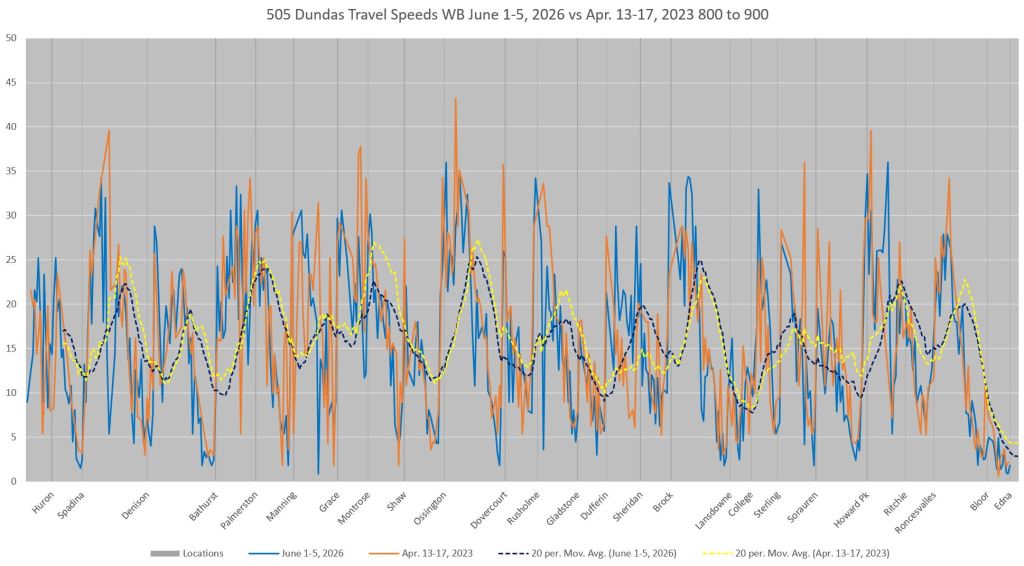
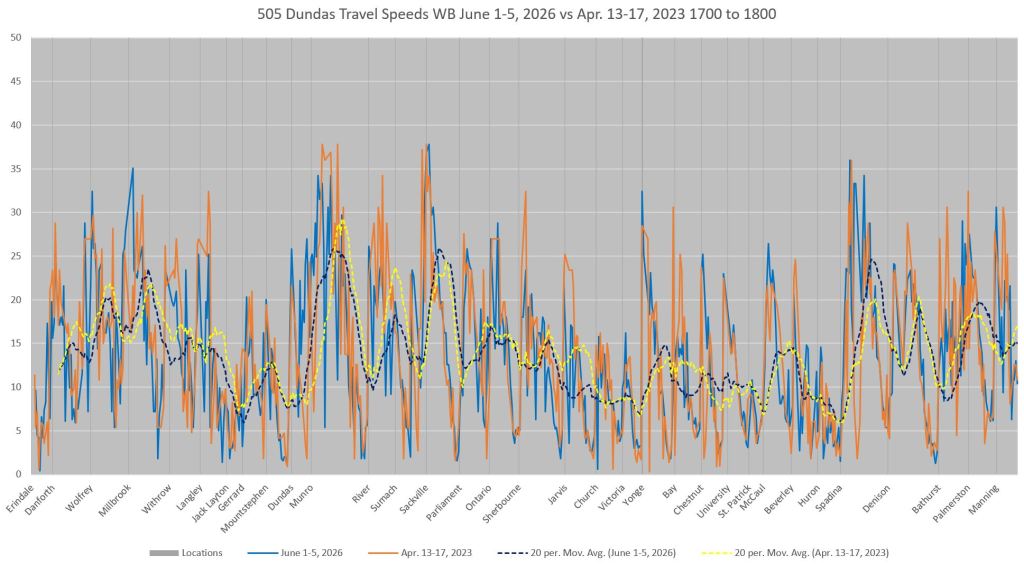
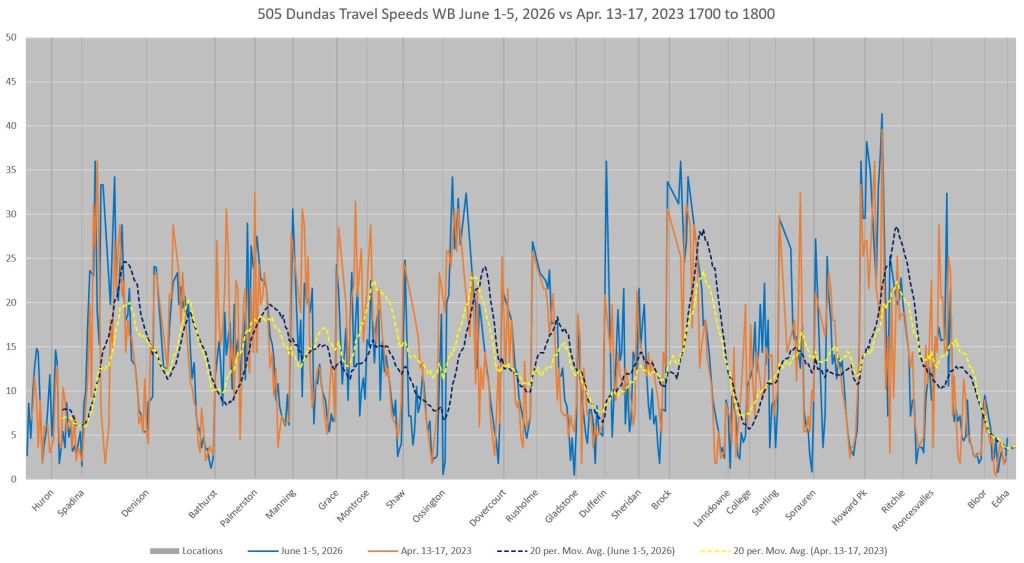
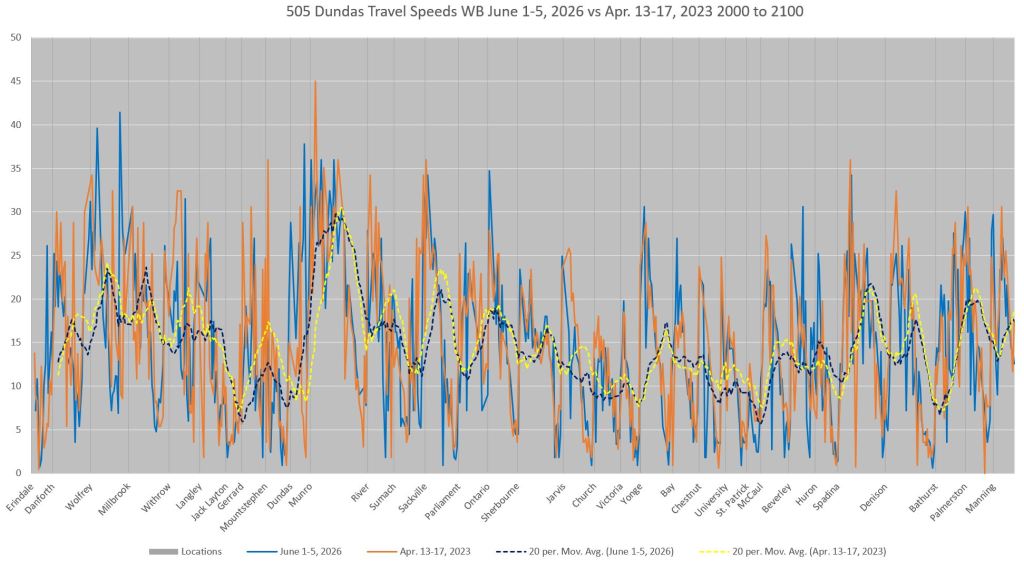
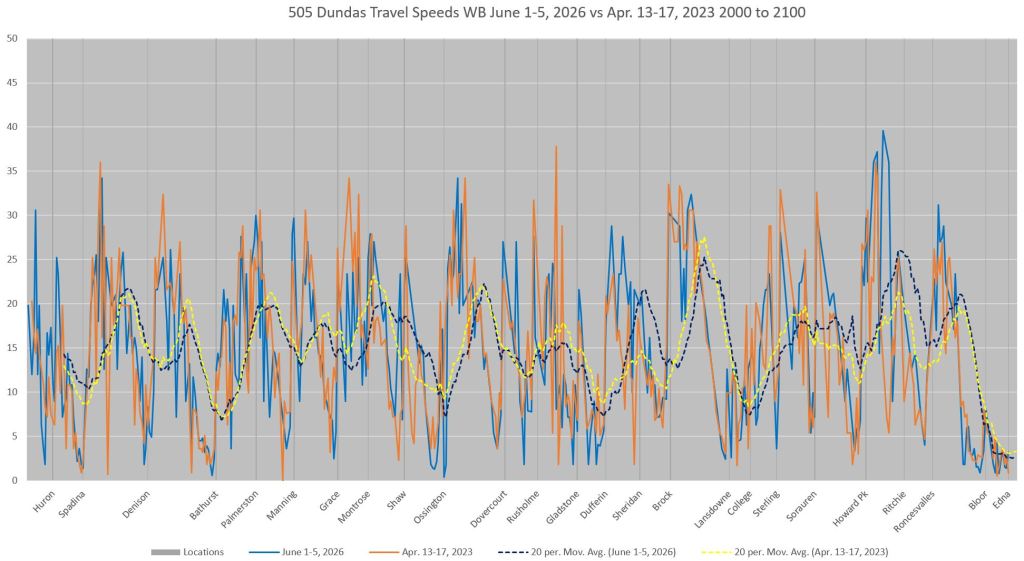
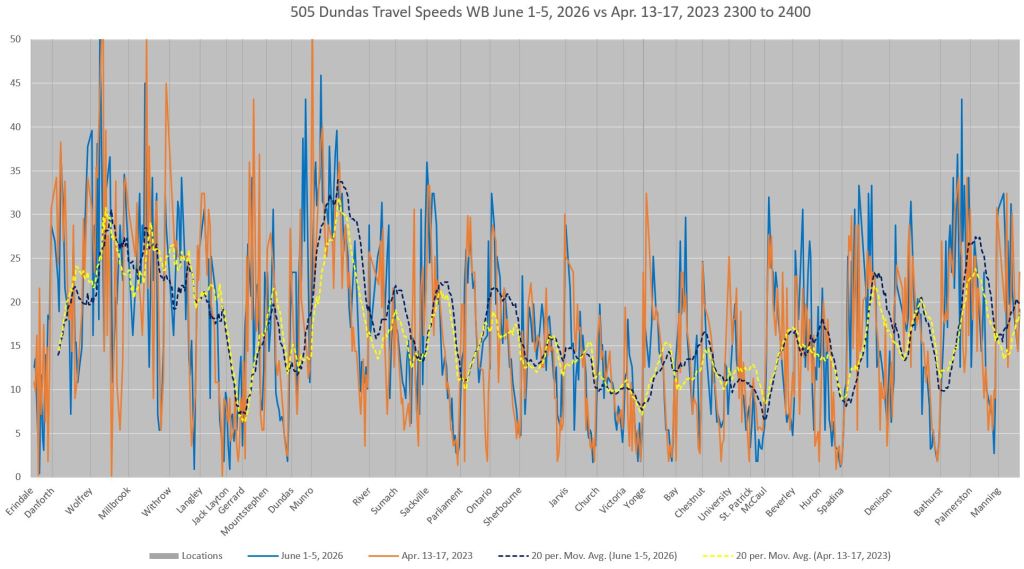
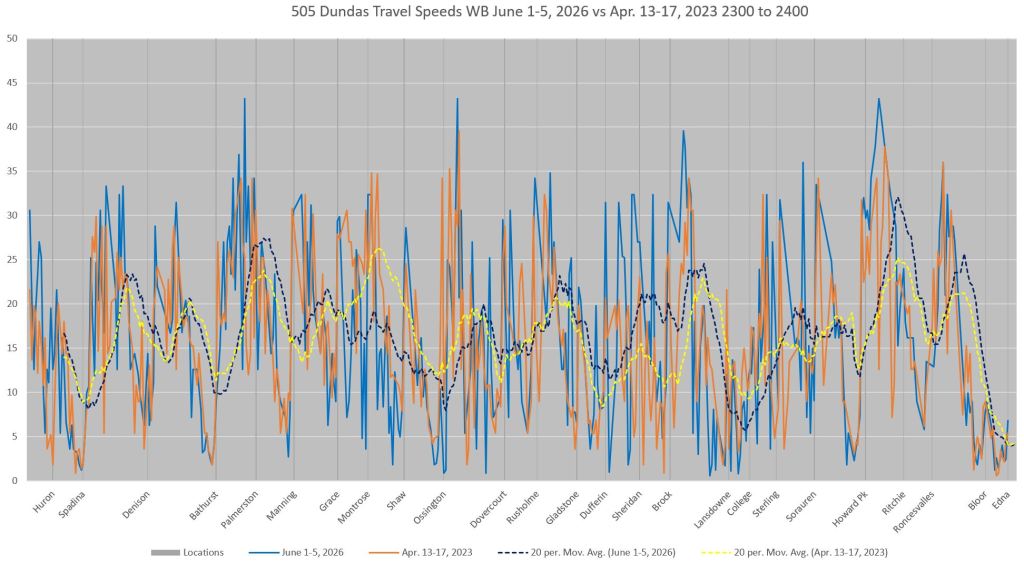
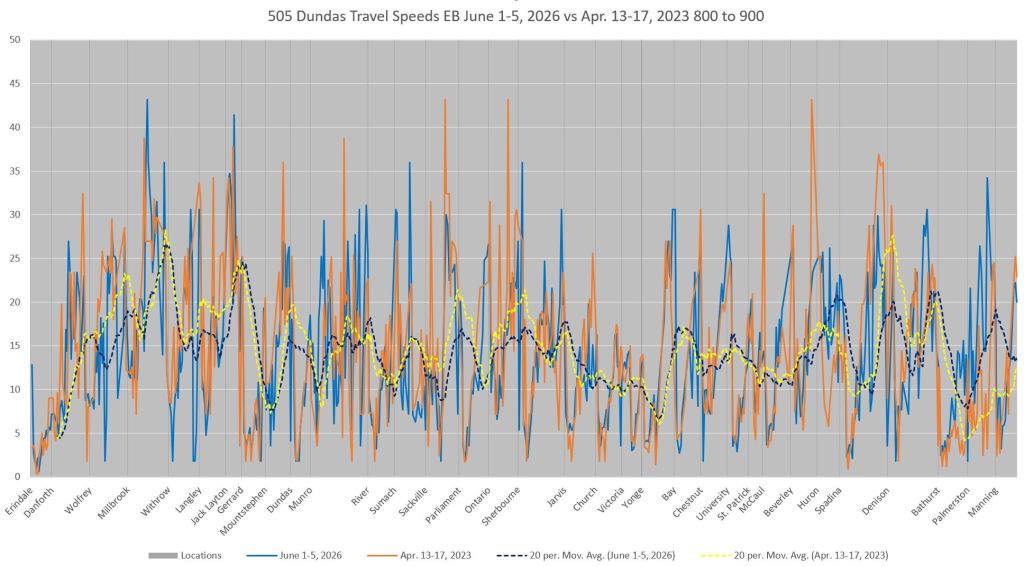
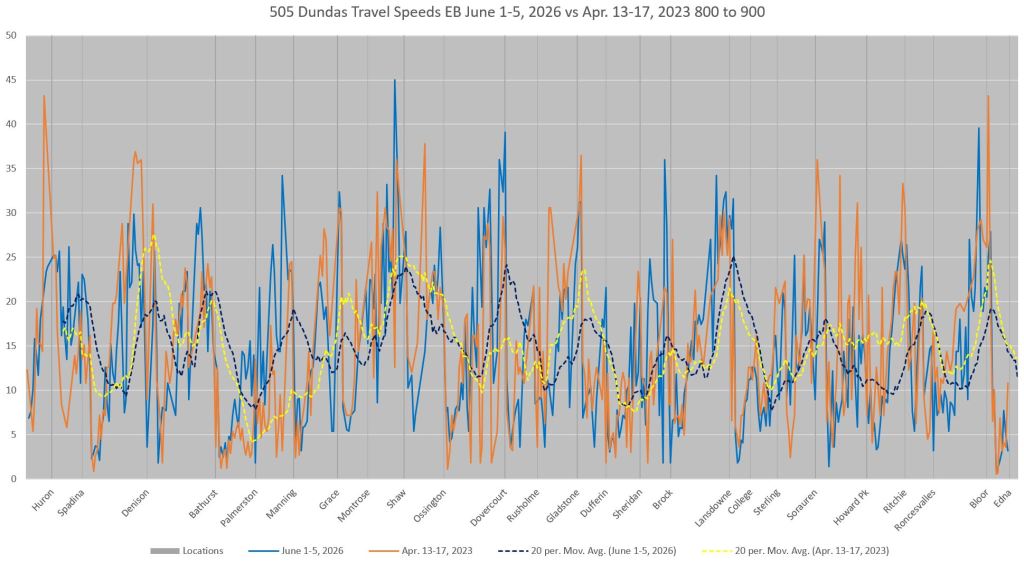
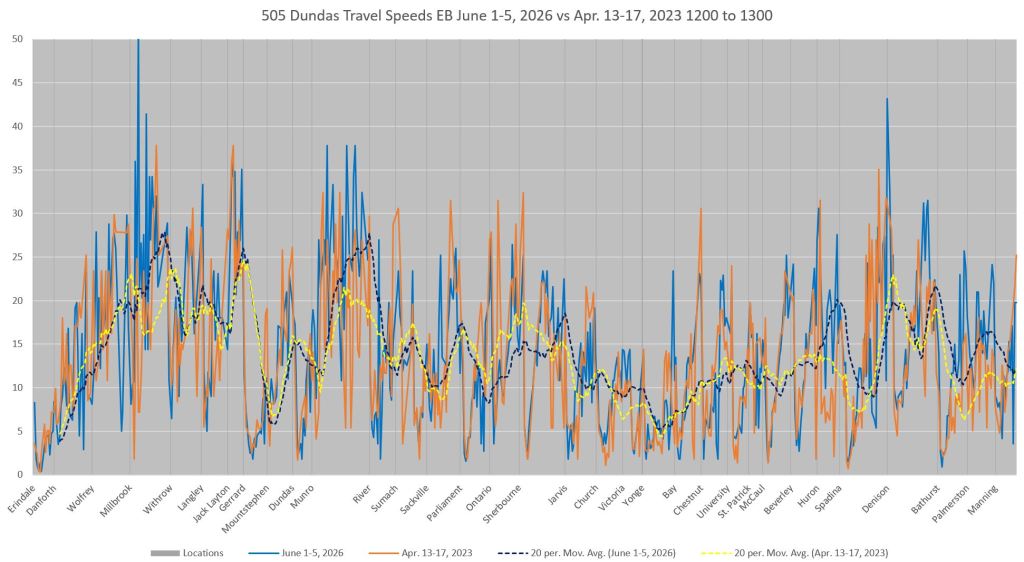
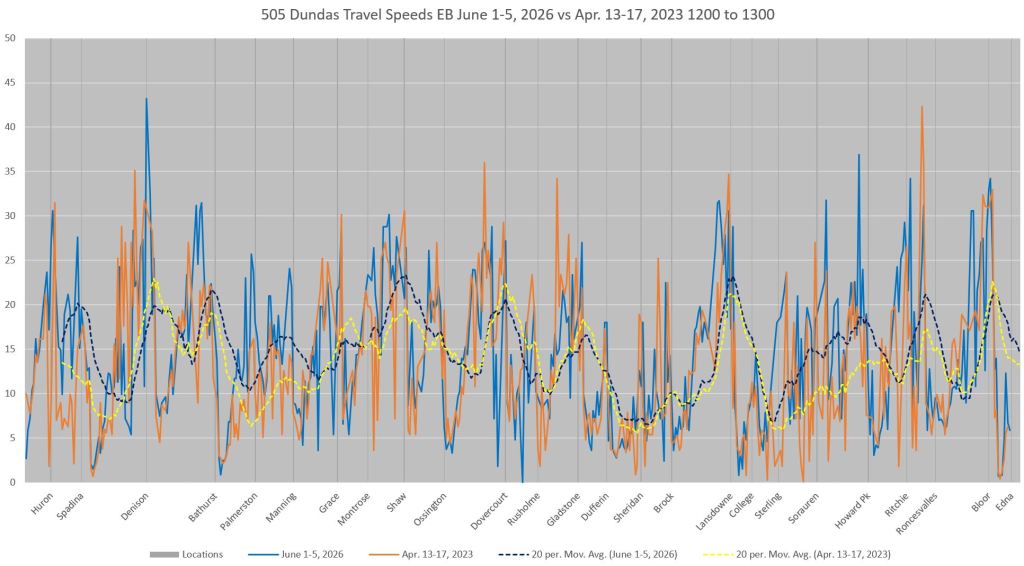
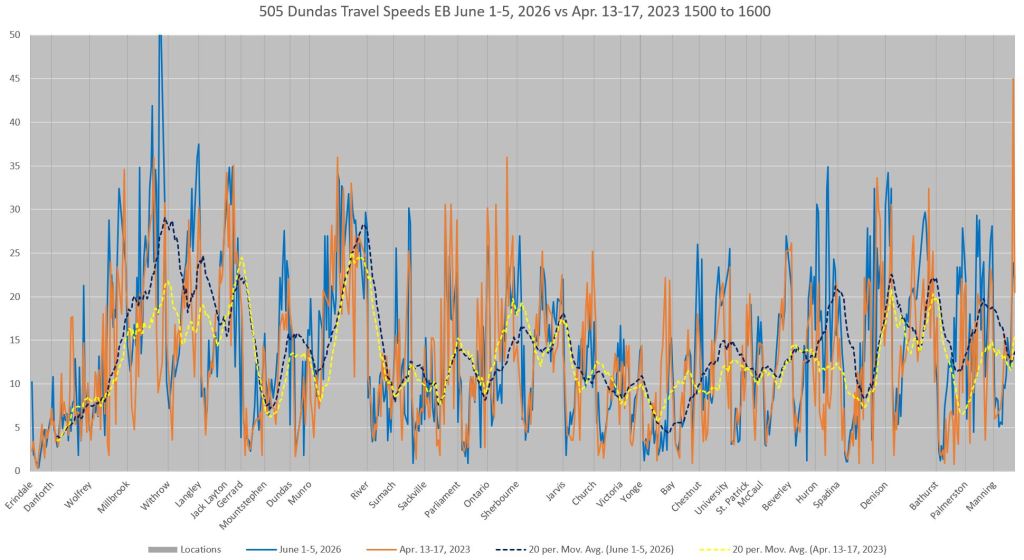
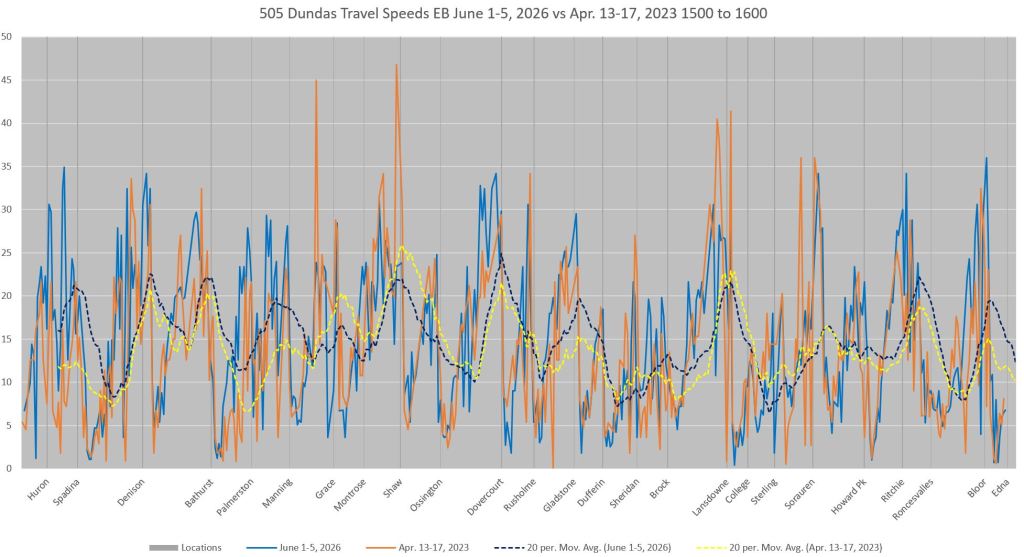
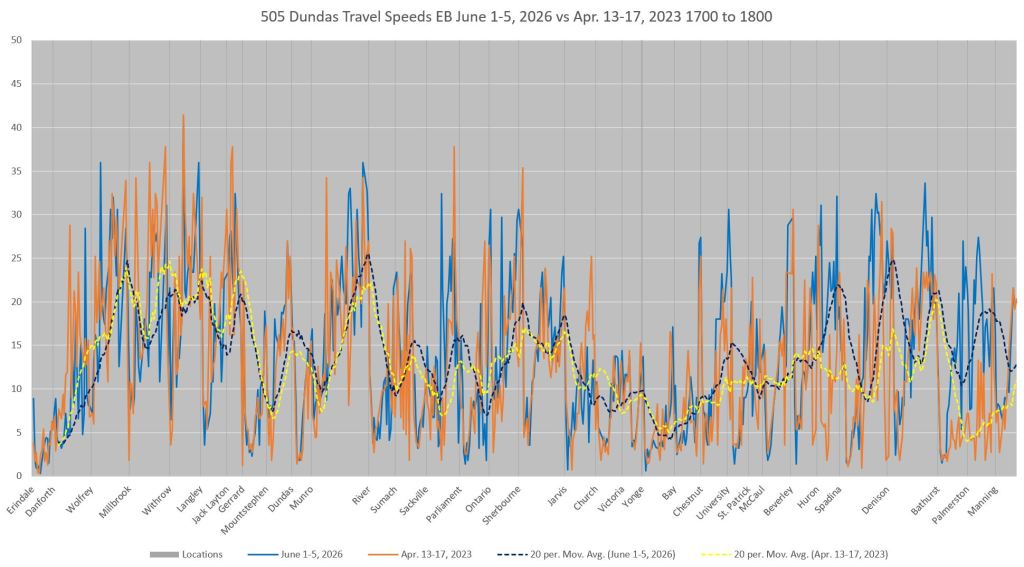
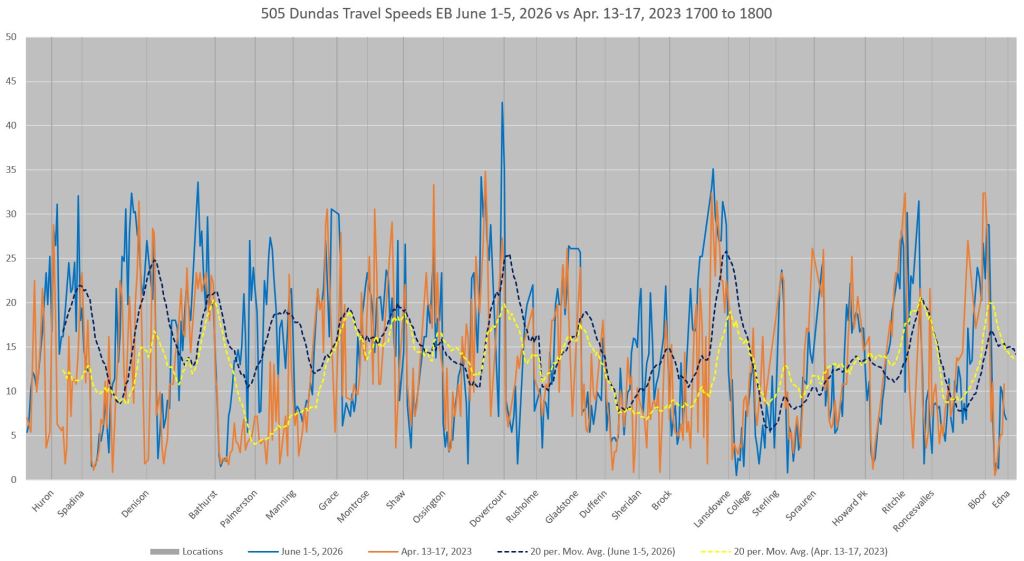
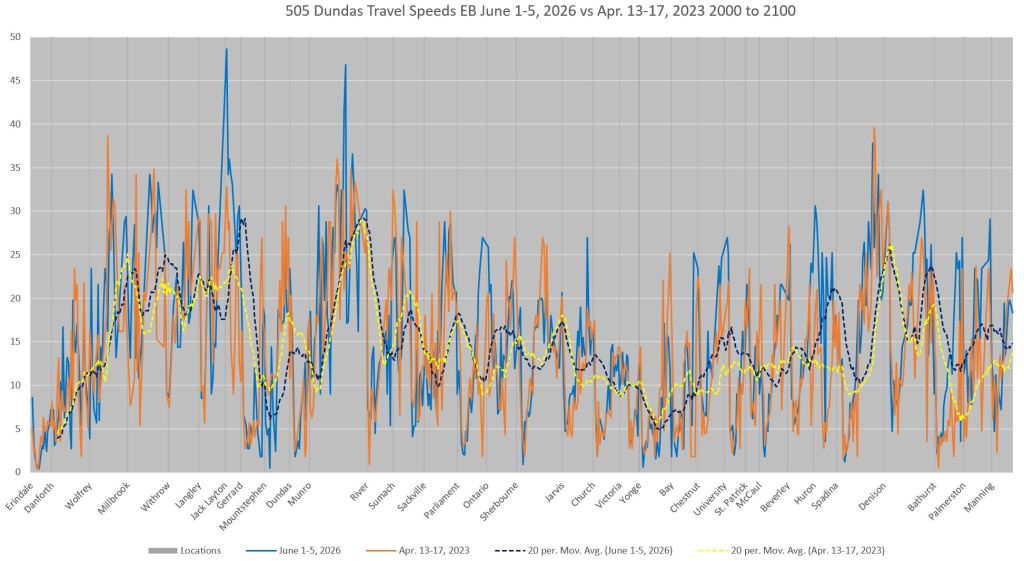
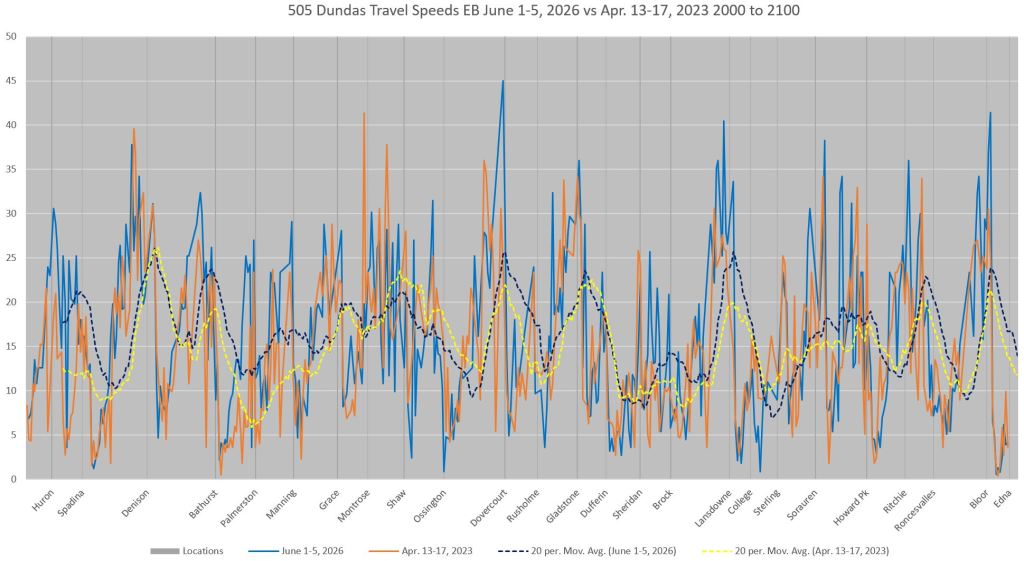
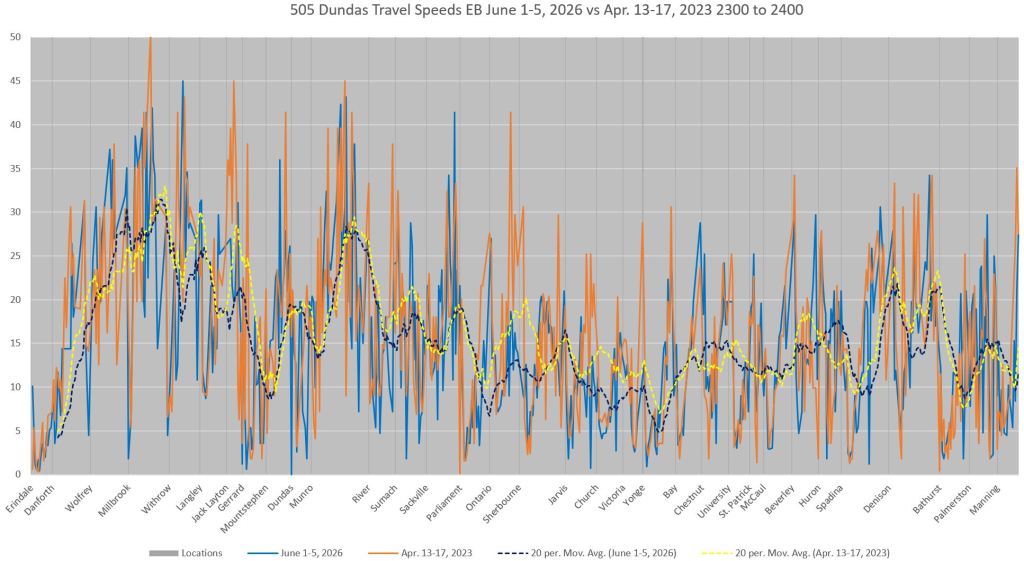
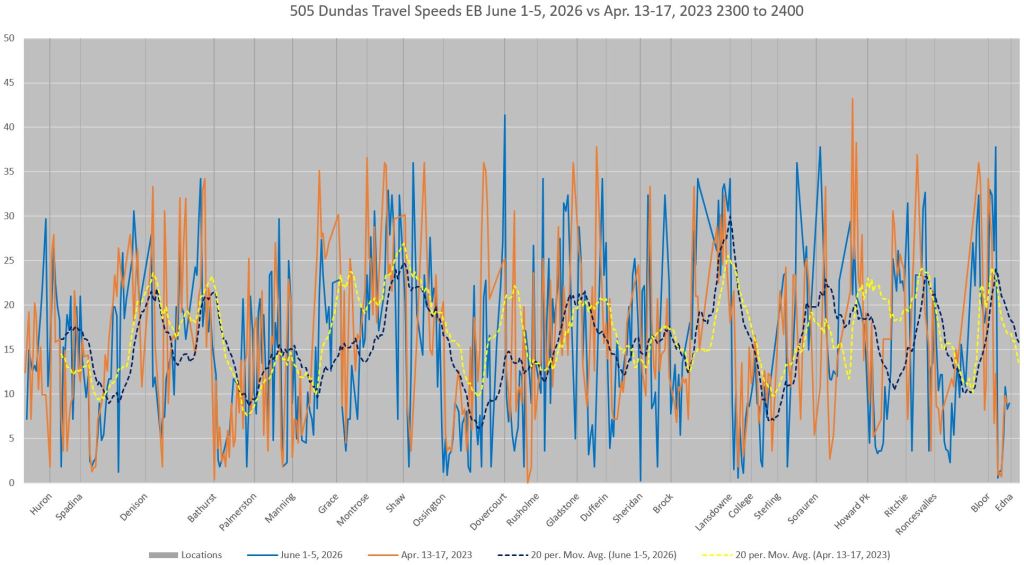
Detailed Speed Profiles
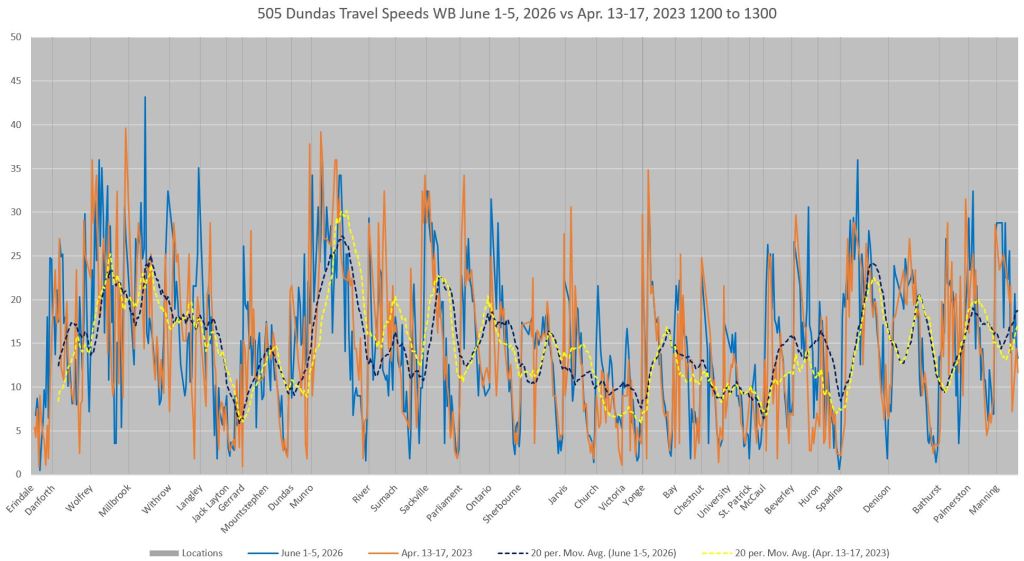
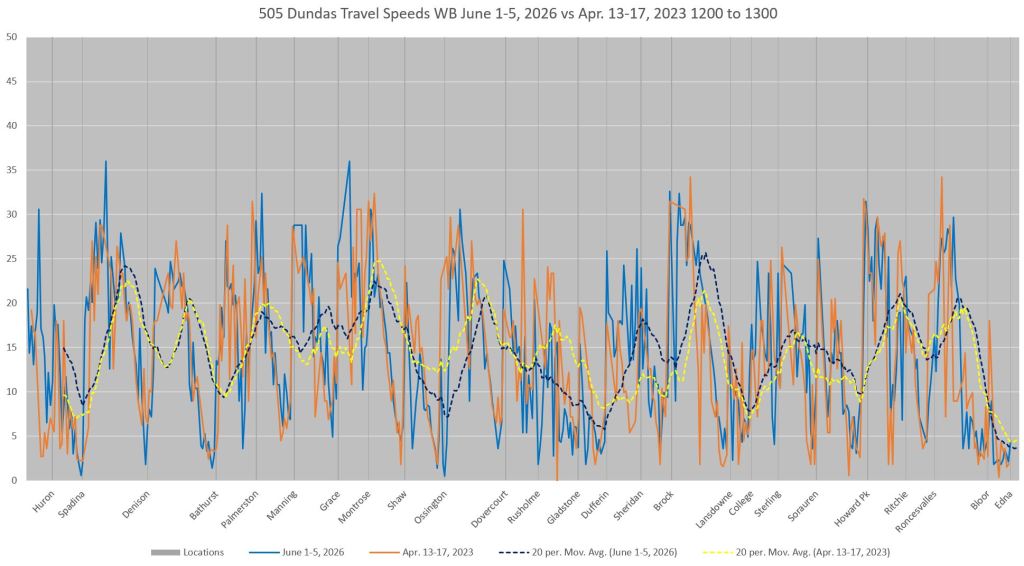
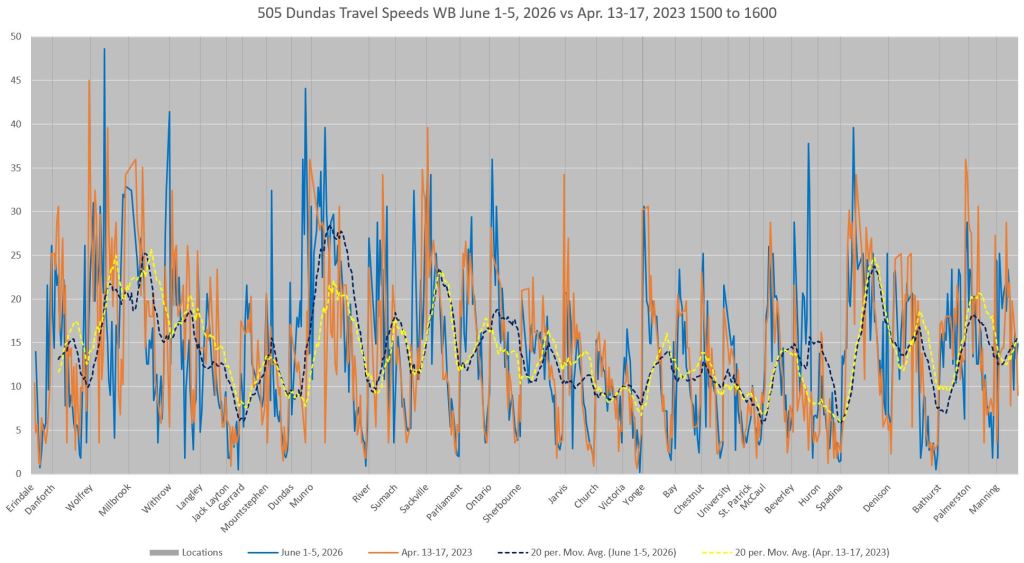
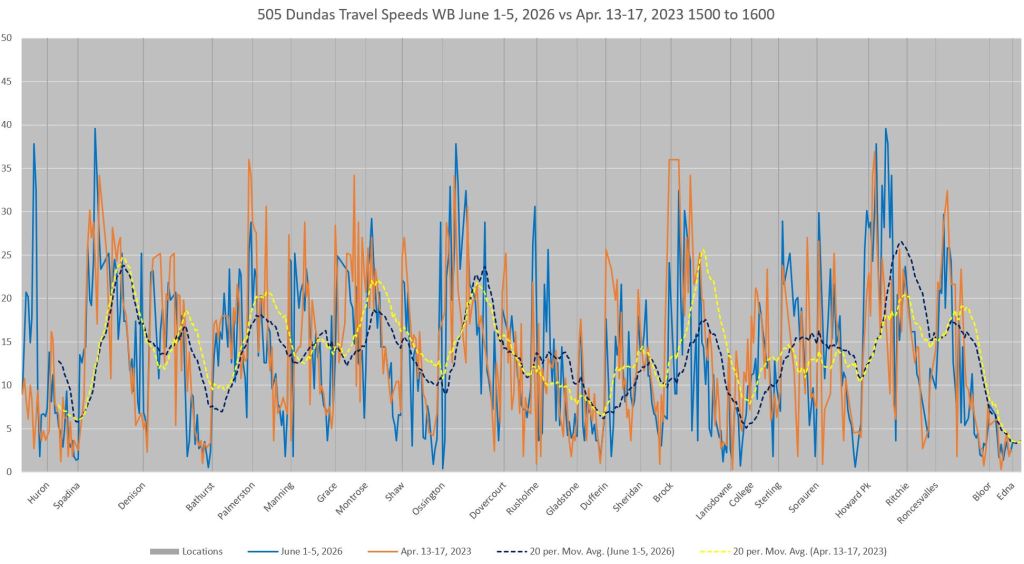
- Across the 505 Dundas route the travel speeds are sometimes higher in 2023, sometimes higher in 2026.
- Dundas has a strong commercial and entertainment district west of Bathurst, and transit delays are not limited to peak periods.
Westbound
- As on 504 King, the trip south on Broadview from Danforth is fairly quick, but there are delays at Gerrard and at Dundas. From personal observation these are caused by congestion at Gerrard (including various temporary bus routes looping south to west here), and by traffic queues at Dundas where green time primarily serves east-west traffic.
- West of the Don River speeds stay higher until Parliament, and then there is a steep drop between Church and Yonge thanks to congestion and unhelpful traffic signals including at Victoria where there is no longer a stop, but streetcars can be held by red signals.
- There is a double dip westbound at St. Patrick and McCaul thanks to the traffic signals.
- As on 506 Carlton, congestion delays cars westbound approaching Lansdowne.
Eastbound
(Read these charts right-to-left.)
- The delay at College/Dundas/Lansdowne occurs eastbound to the signal where College and Dundas diverge.
- Congestion west of Bathurst is severe, although speeds are faster in 2026 than in 2023.
- The speed approaching Yonge from the west is very slow, extending at times past Bay Street.
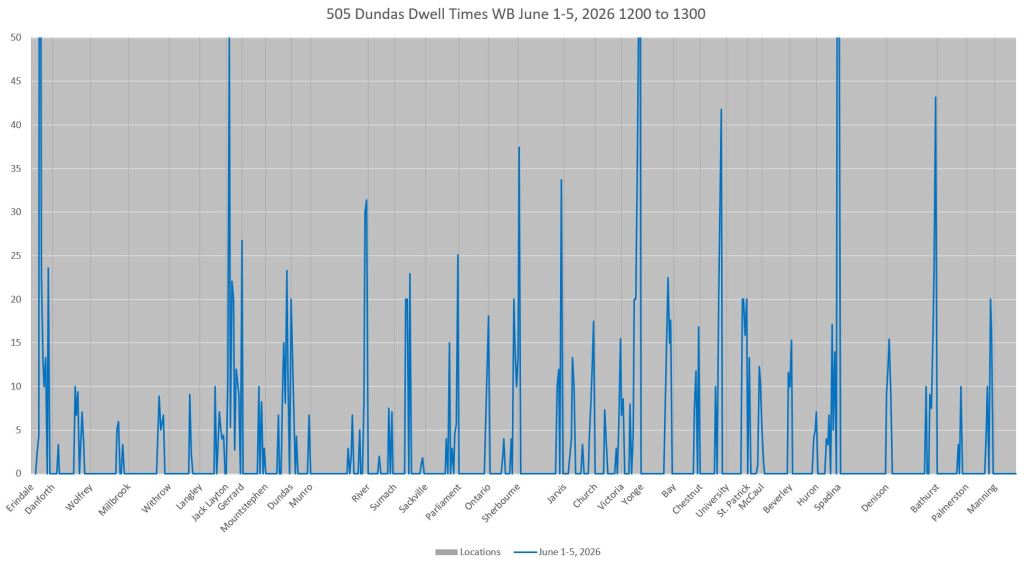
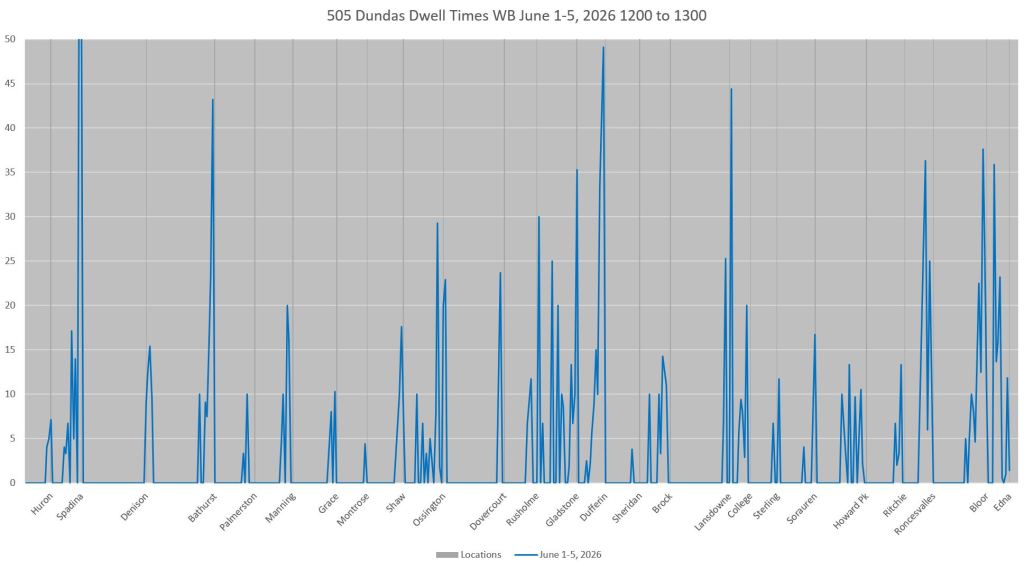
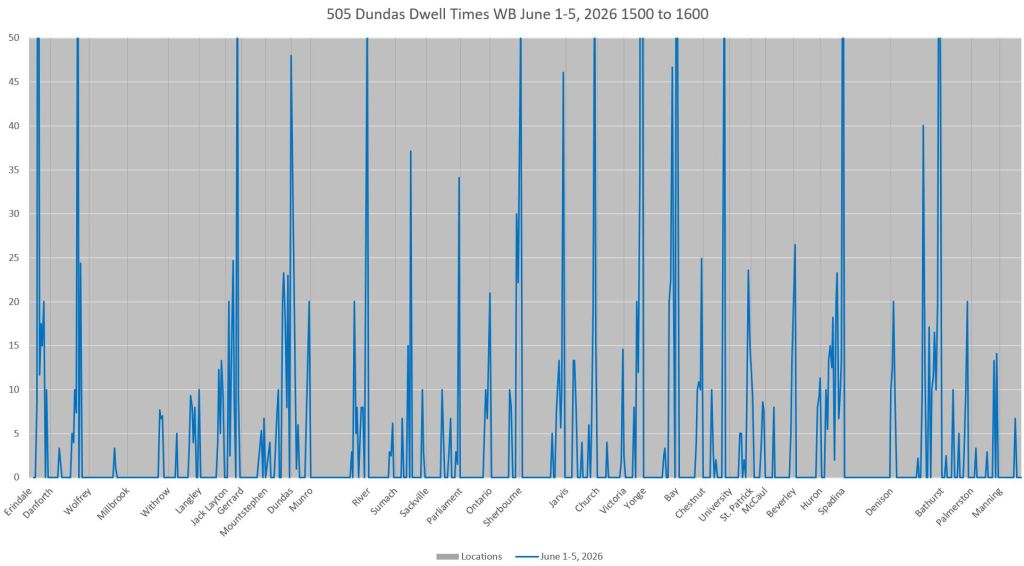
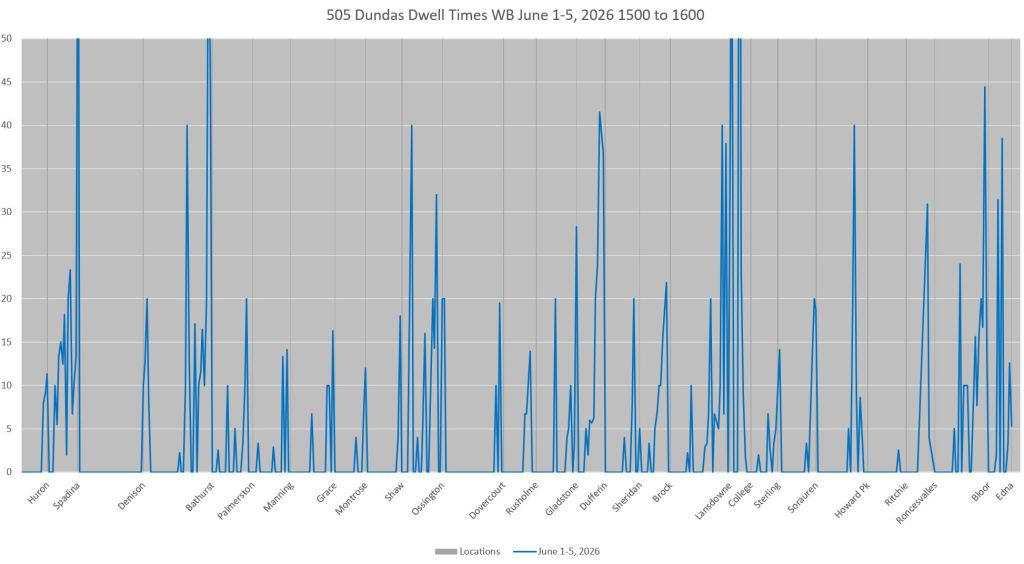
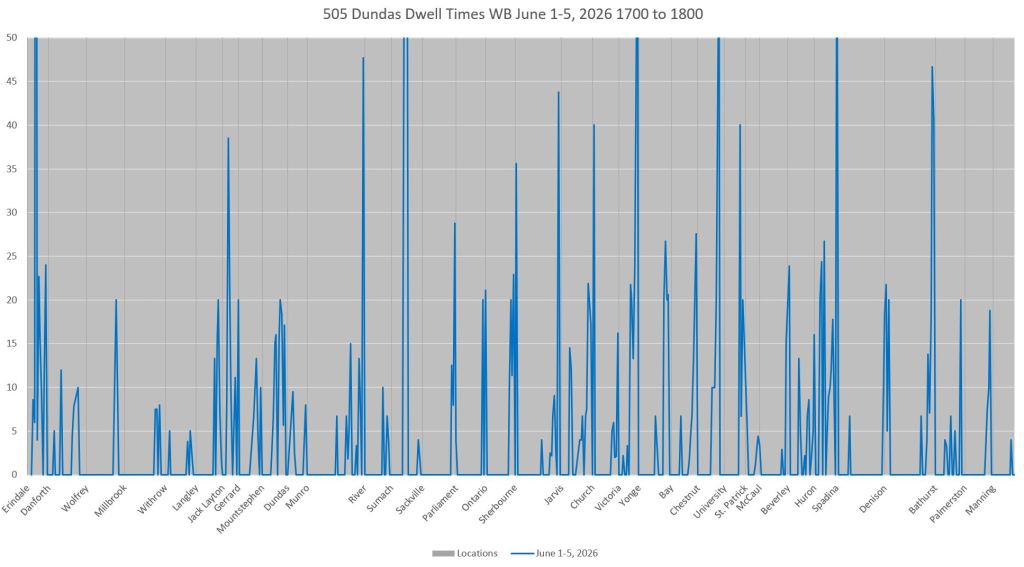
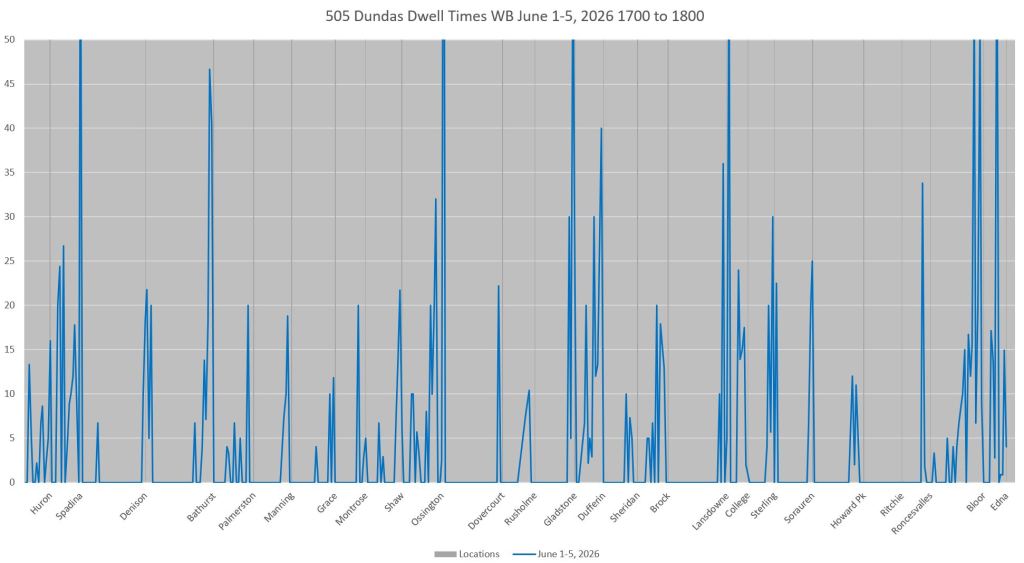
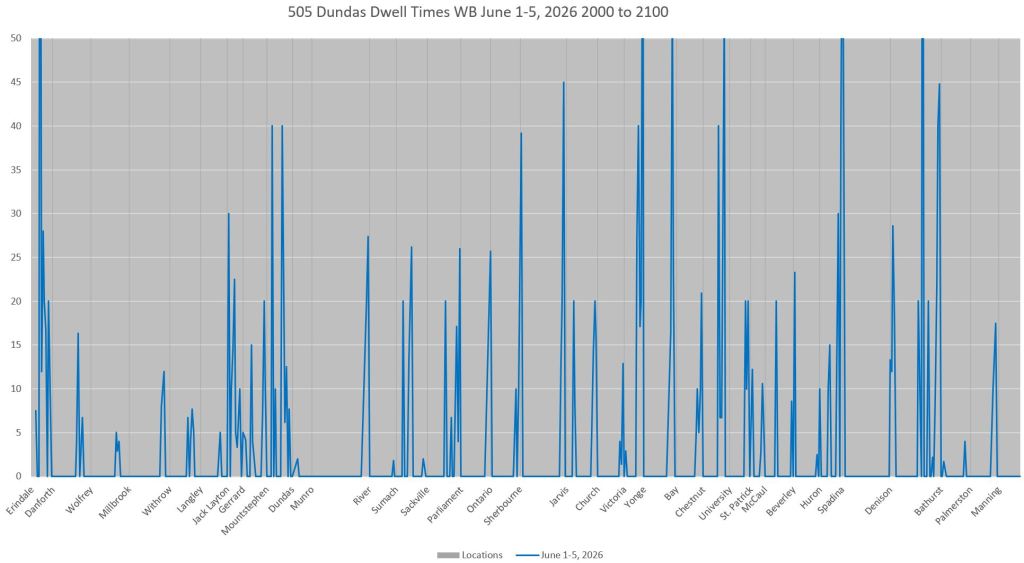
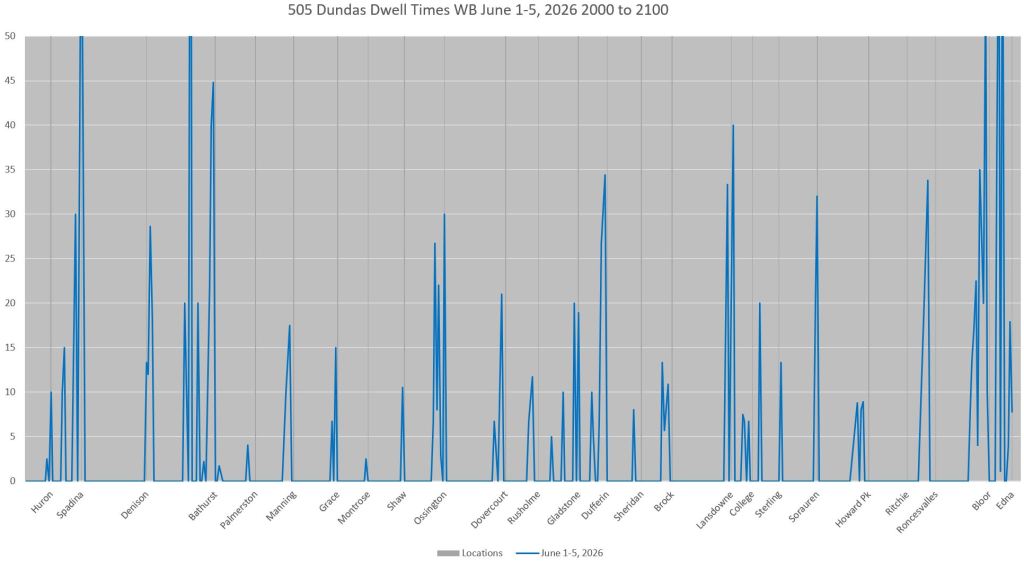
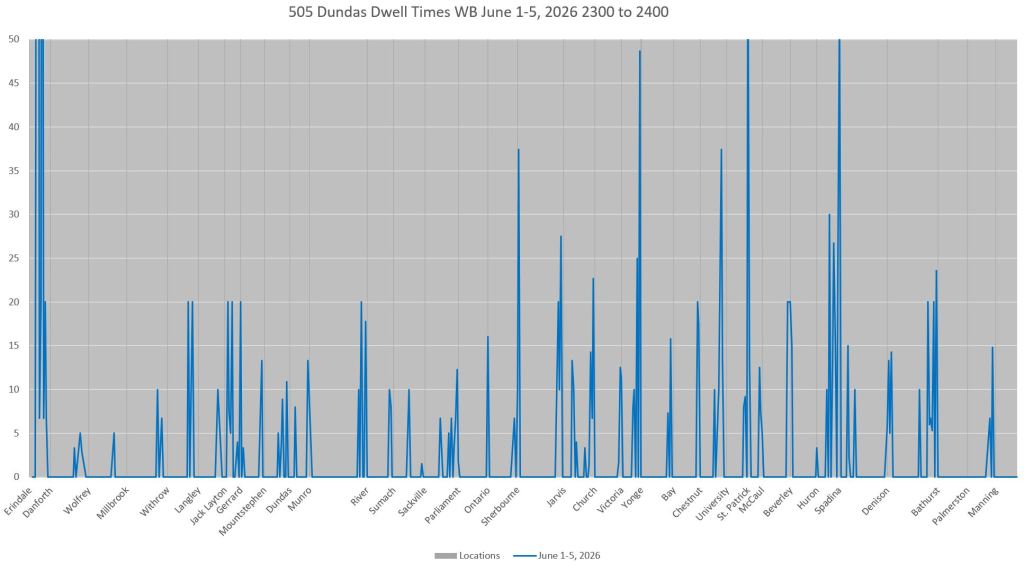
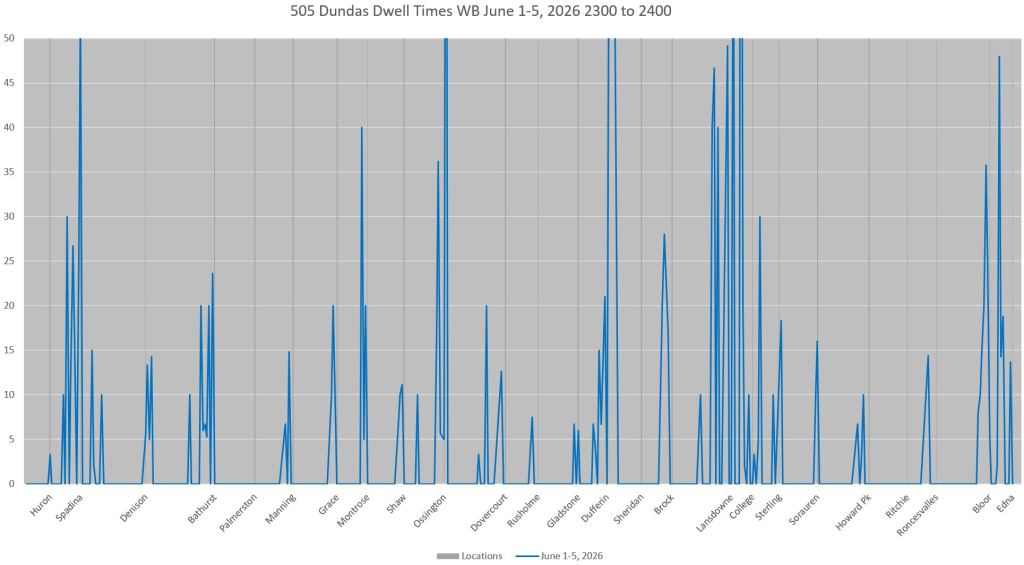
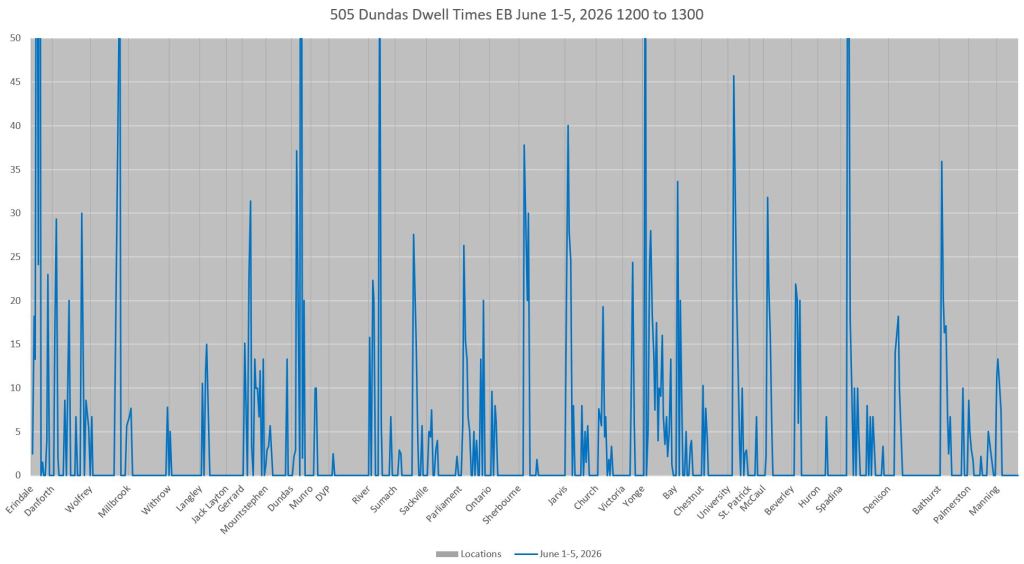
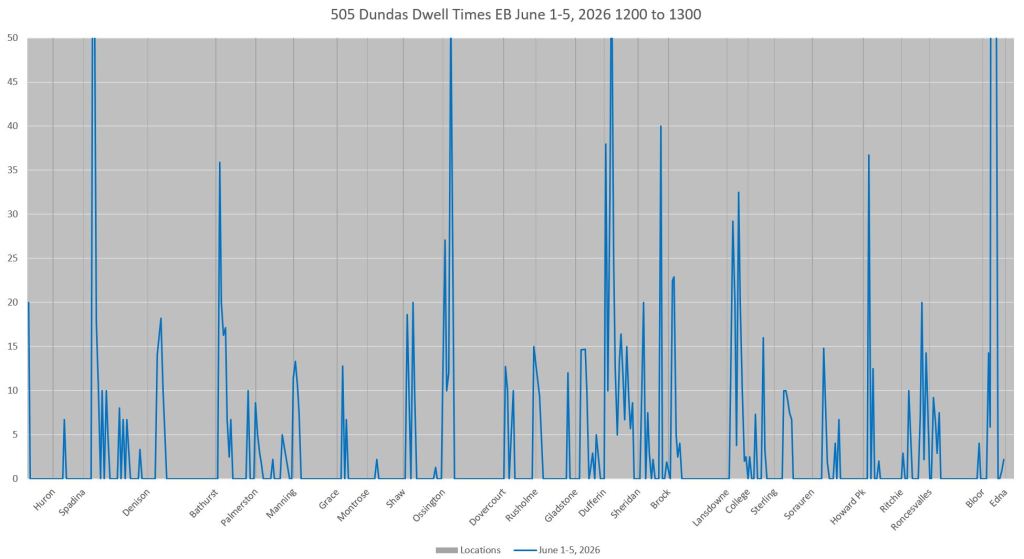
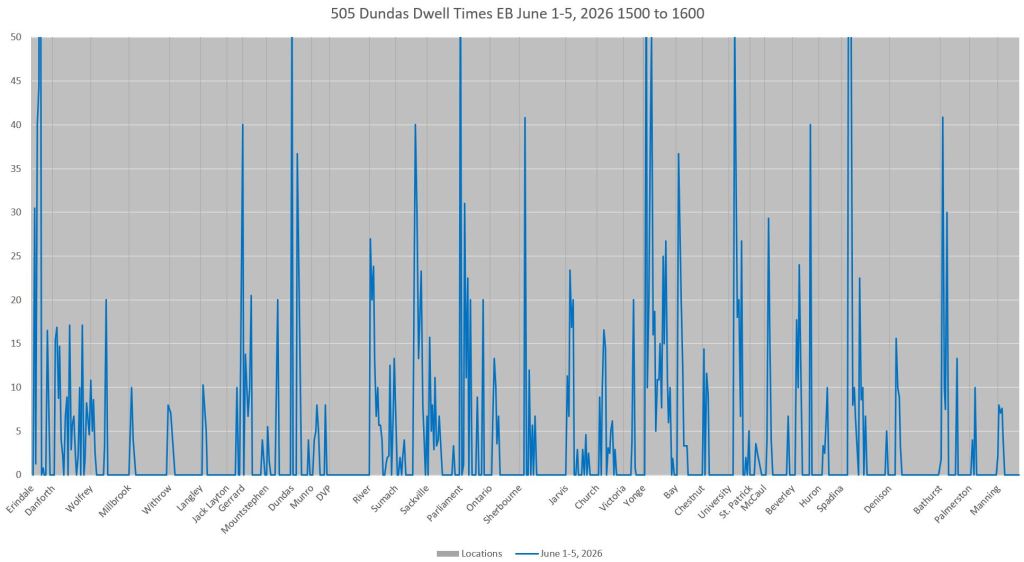
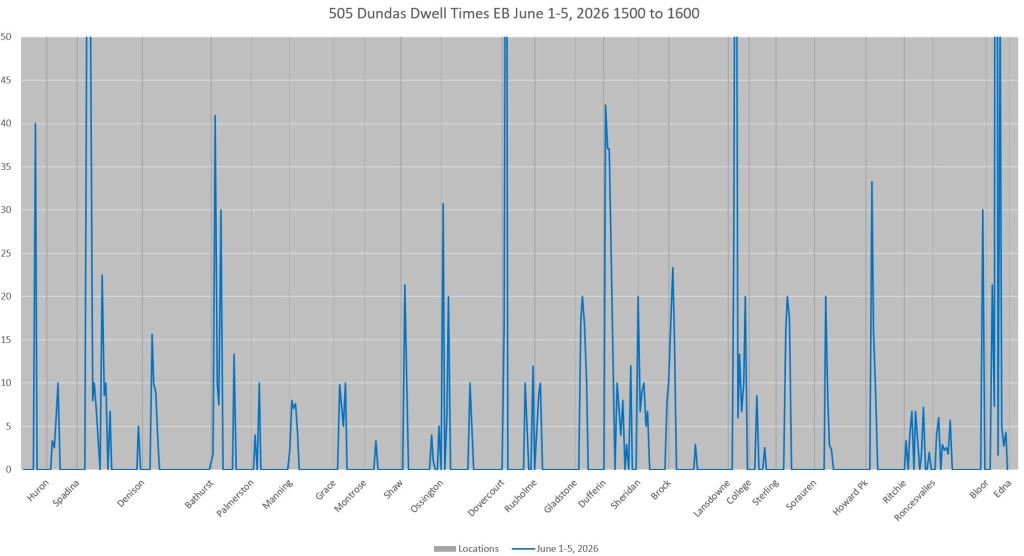
Dwell Times
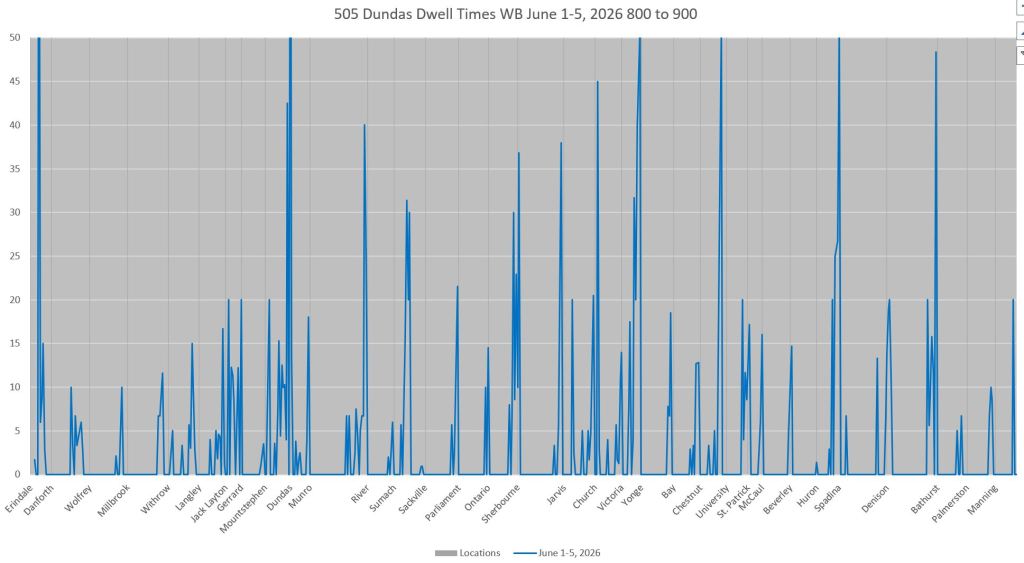
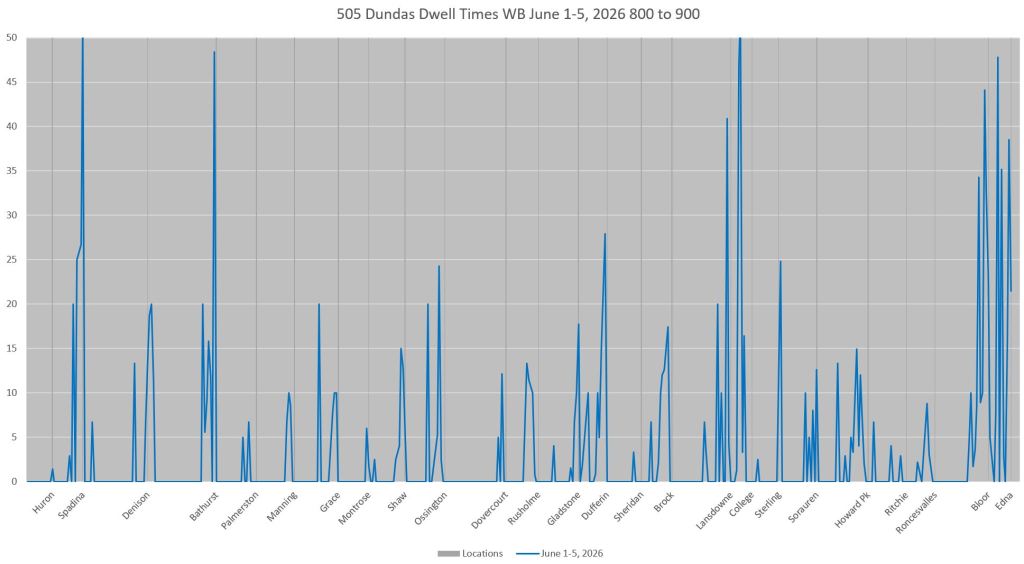
Westbound
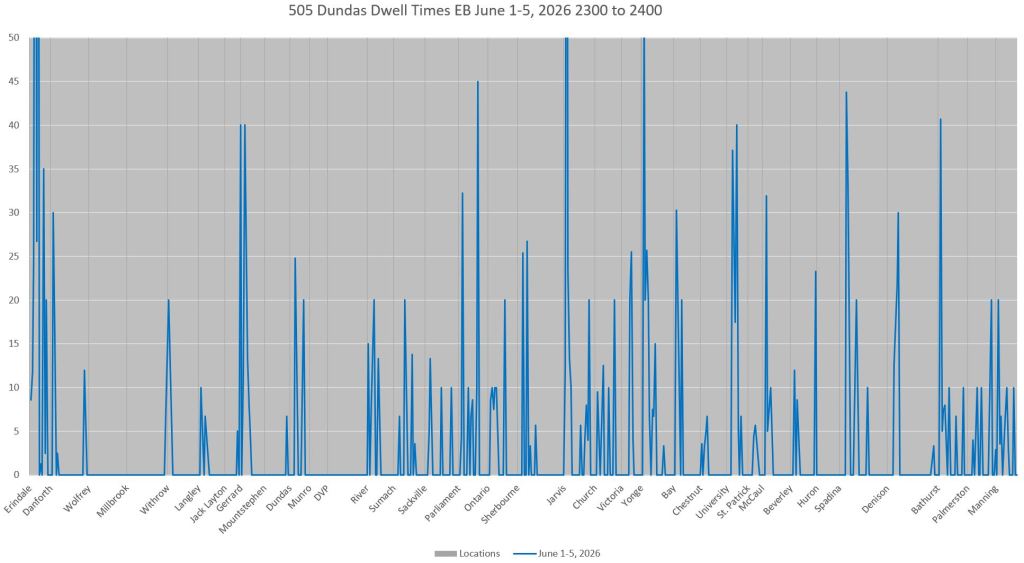
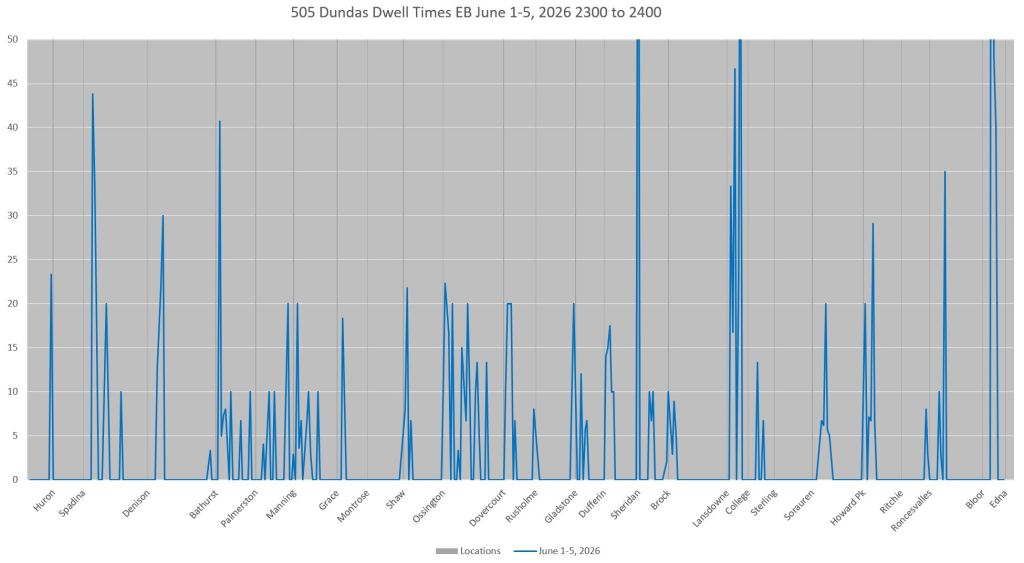
- Dwell times peak at many locations along 505 Dundas, but with more severe effects, including traffic backlogs at stops, in the afternoon and PM peak
- The dwell time charts show the delays on Broadview at Gerrard and especially at Dundas southbound.
- The approach to Yonge shows multiple extended peaks stretching back to Jarvis Street.
- The approach to Spadina shows delays reaching back east to Huron with the worst conditions in the PM peak.
- Long dwells including congestion on the approach are evident at Bathurst, Ossington, Dufferin and Lansdowne, although the effect varies through the day.
- 505 Dundas shares the congested condition south of Dundas West Station with 504 King. At times this is due to a queue of streetcars waiting to enter the station.
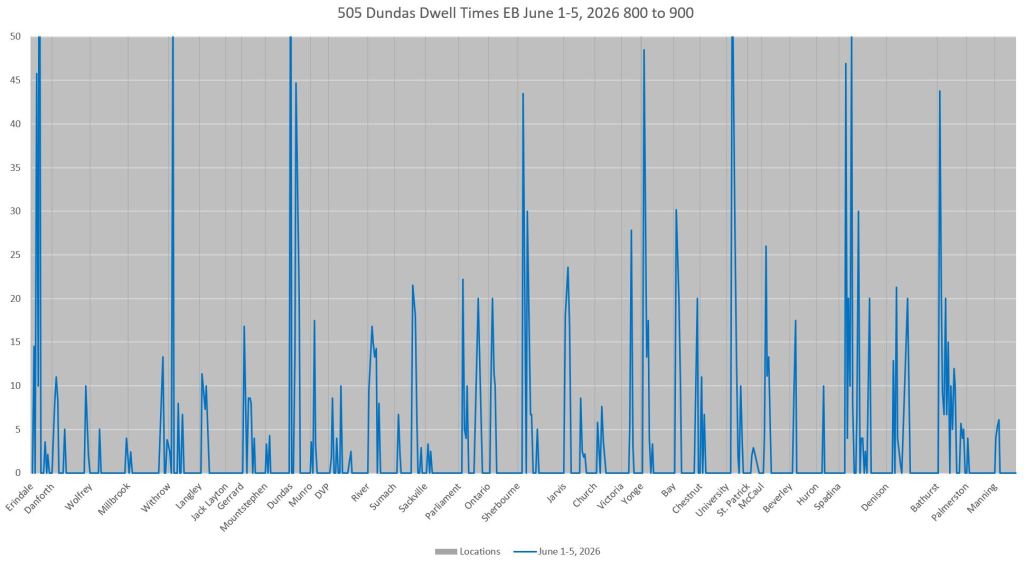
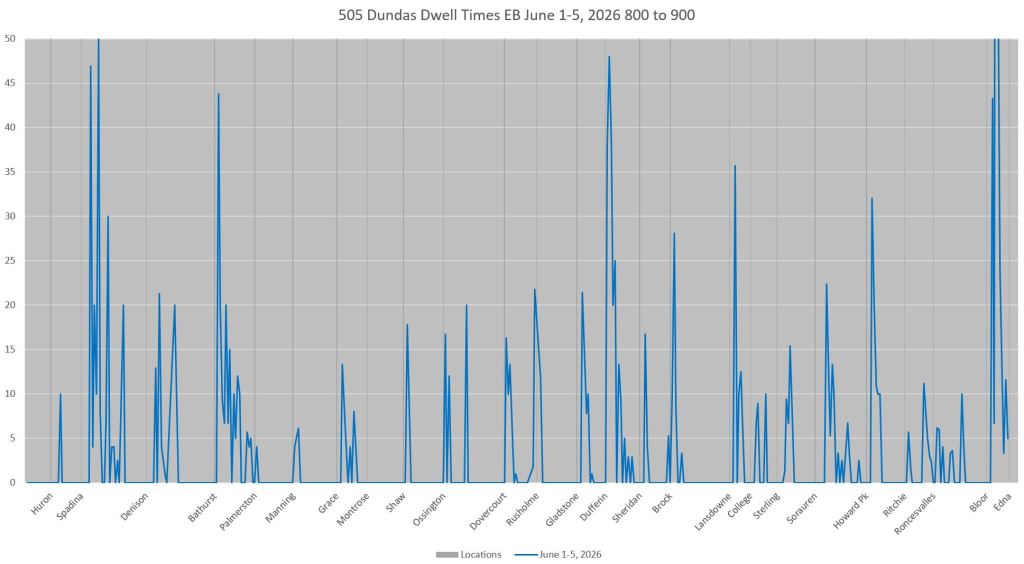
Eastbound
(Read these charts right-to-left.)
- Congestion queues are evident approaching Lansdowne, Dufferin, Ossington, Bathurst and Spadina, although their severity varies through the day.
- The queue eastbound to Yonge is relatively small in the AM peak, but grows through the day extending at times west of Bay Street.
- Long dwells and queuing occur eastbound at Broadview, approaching Gerrard and south of Danforth as with 504 King.


When two 504 cars meet at Dundas/Broadview and only one can make it through during a single green cycle, a queue forms, and can delay turning 505 cars for several minutes.
This is a textbook example of how dumb TTC policy compounds with other stupid TTC policy (with a dash of special city policy) and the end result is the world’s slowest streetcar service.
LikeLike