
The TTC Board will meet on June 3 with several items on the agenda.
The morning portion of the meeting will deal with various confidential items, and the meeting will move into public session in the afternoon, time to be announced.
Some items are forwarded from the Audit, Finance and Risk Management Committee meeting of May 26 How much debate they will get in the full Board’s public session remains to be seen.
Items of interest include:
- CEO’s Report
- Advancing Safety on the TTC: 2026 Focus Areas
- Bloor-Yonge Capacity Improvements Project – Platform Edge Doors and Net Zero
- Financial and Major Projects Update for the Period Ended April 26, 2026
- Toronto Transit Commission – 2026 Follow-up – Status of Previous Auditor General’s Recommendations
- Draft Consolidated Financial Statements of Toronto Transit Commission for the Year Ended December 31, 2025
Four items are administrative inquiries, or member motions including one forwarded from the recent Council meeting:
- An inquiry about the usage and cost of Community Bus Routes from Chair Jamaal Myers
- [From Council]: Safer Subways: Making Public Safety a Priority and Restoring Confidence to Toronto Transit Commission Riders Across Toronto
- Review of Subway Capacity Constraints and Infrastructure Readiness for Protected/Major Transit Station Areas Compliance and Provincial Densification Mandates – by Commissioner Liane Kim, seconded by Commissioner Josh Matlow
- Requesting a 7 Bathurst Express Bus – by Commissioner Josh Matlow, seconded by Commissioner Dianne Saxe
In this article I have grouped related items together.
CEO’s Report and Updated Subway KPIs
The CEO’s Report continues in its frustrating new format of reporting in detail on only one of four modes (subway, bus, streetcar, Wheel-Trans) in each report. This breaks the previous format where ongoing performance across the system was trackable, and also limits the frequency with which any part of the system gets detailed examination. Given the frequency of Board meetings, the cycle does not repeat regularly. Subway operations have been reported three times in the new format:
- September 2025 (data to July 2025)
- February 2026 (data to November 2025)
- May 2026 (data to March 2026)
Notable by its absence from the current report is any discussion of the ongoing issue with Reduced Speed Zones. Once upon a time, the TTC hoped to substantially eliminate these in advance of the FIFA games, but they persist and reappear regularly. As of May 28, there are 7 RSZs on Line 1 with most target dates to repair in early to mid June. The perennial slow order southbound from Eglinton to Davisville still has “TBA” as its target. Line 2 has no RSZs. How long this lasts remains to be seen.
A related issue is the condition and availability of subway work cars due to hydraulic leaks and other reliability issues. There has been no discussion of plans to refresh and expand this fleet although capital budget data do show that some planned spending has been redirected from repair to new vehicle purchase. When this will actually bring the fleet into better shape, and whether the planned spending is adequate to actual needs, we do not know.
The CEO claims that subway fleet reliability is much improved:
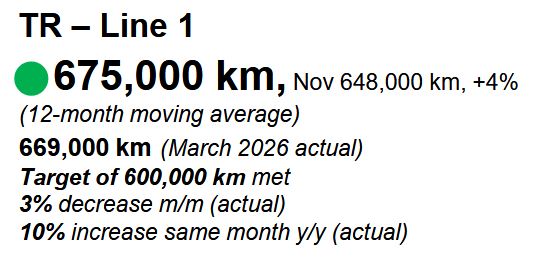
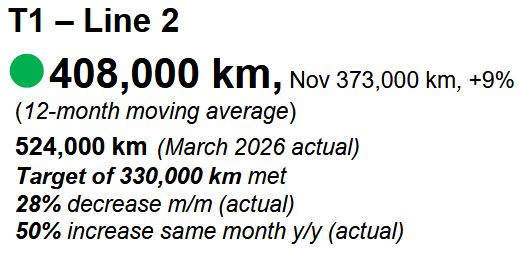
TR trains on Line 1 achieved 675,000 kilometres mean distance between failures (MDBF), a 10% improvement year-over-year. The older T1 fleet on Line 2 achieved a 50% year-over-year improvement, reaching 408,000 kilometres MDBF.
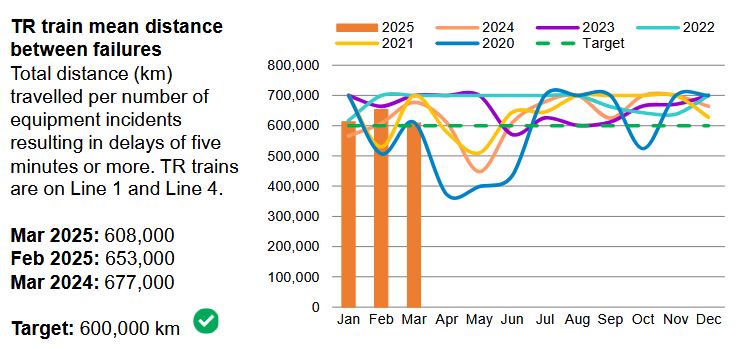
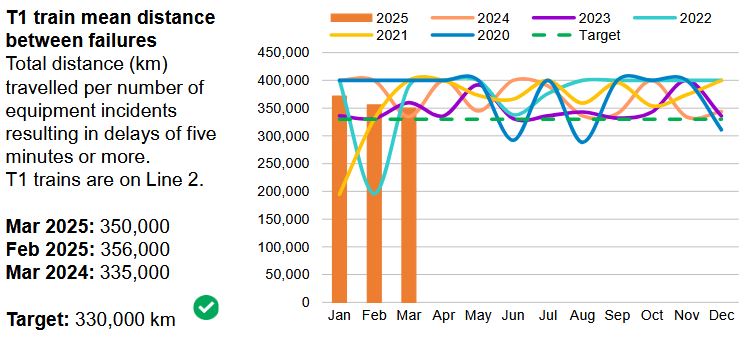
However, the actual numbers reported a year ago were 608,000km for the TRs and 350,000km for the T1s. The current T1 figures are not a 50% increase, only 17%. The problem lies in cherry-picking the monthly value for March 2026 vs March 2025 and trumpeting a big improvement without considering monthly fluctuations or the long term trend. The March 2026 figure is actually down 28% from February 2026.
Because the new format CEO report publishes mode-specific stats only sporadically, we no longer have a continuous data series showing what is actually going on. The top row below shows the numbers cited in the May 2026 CEO Report. The bottom row shows corresponding data from a year ago.
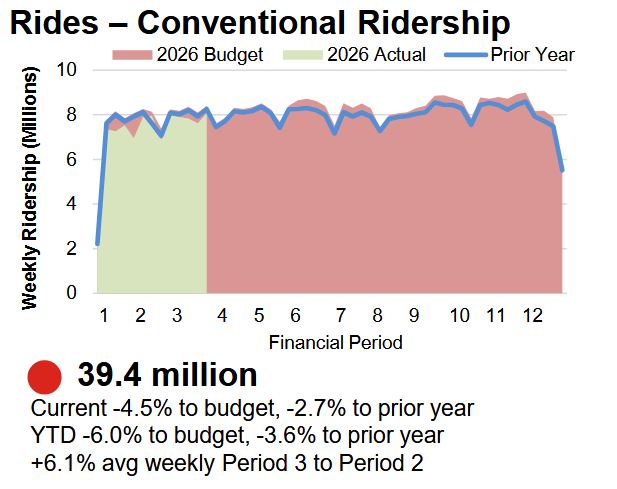
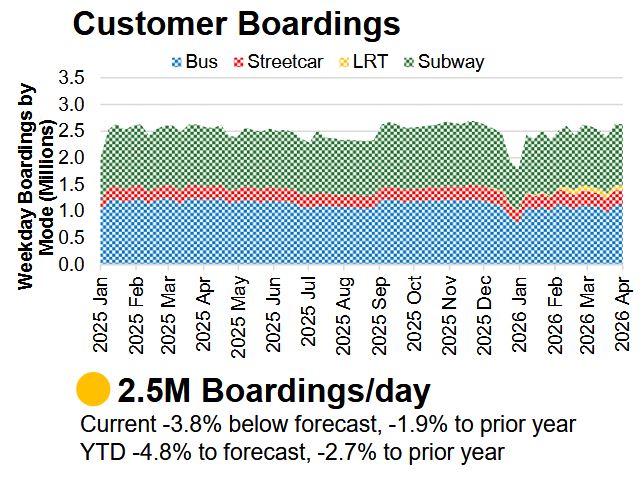
Ridership and Boardings are reported on a continuous basis in the charts below. (Boardings count each leg of a journey separately, whereas Ridership is loosely equivalent to fares paid.)
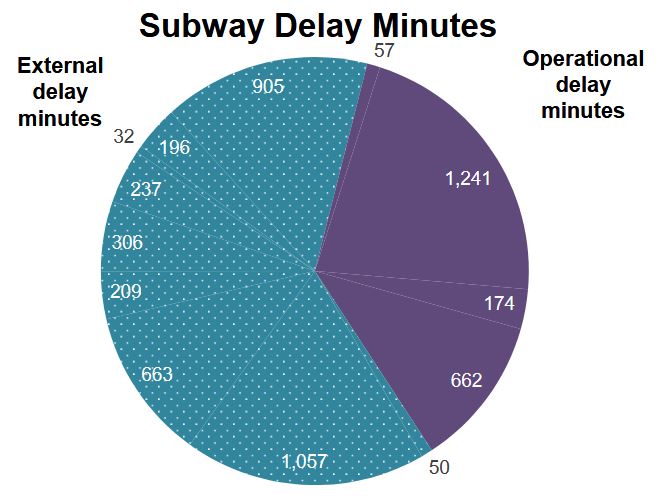
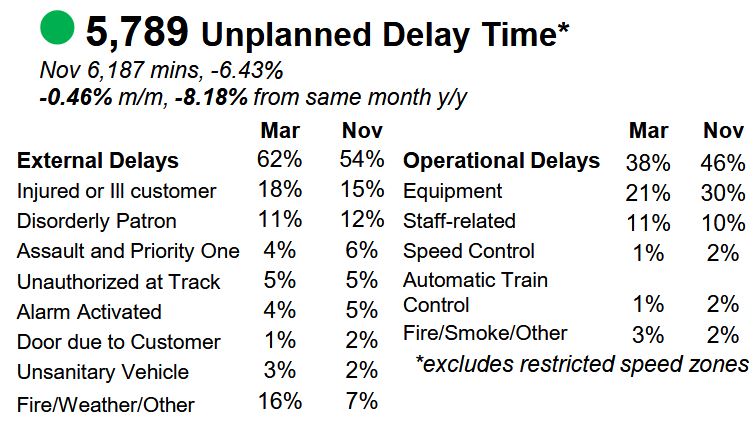
Subway delays are summarized both in tabular and chart format, but the latter does not include a legend making some work for readers to figure out which slice of the pie belongs to each delay type. Moreover, persistent delays caused by RSZs are not included in the data, and they would increase the share of delays considered as “operational”.
Note that only 5% of delay time is assigned to “Unauthorized at Track Level” although this gets a lot of discussion in the context of platform doors. Also “Assault and Priority One” are two very different types of events, but they are consolidated here. (The latter refers to a passenger injury at track level.)
Until quite recently (May 29) it was impossible to delve into delay statistics because the TTC did not update their Open Data pages for three months. The current posted data brings us to April 30, 2026. I will review recent data, notably for Lines 5 and 6, in a separate article.
Financial Issues
Financial Update for the Period Ended April 26, 2026
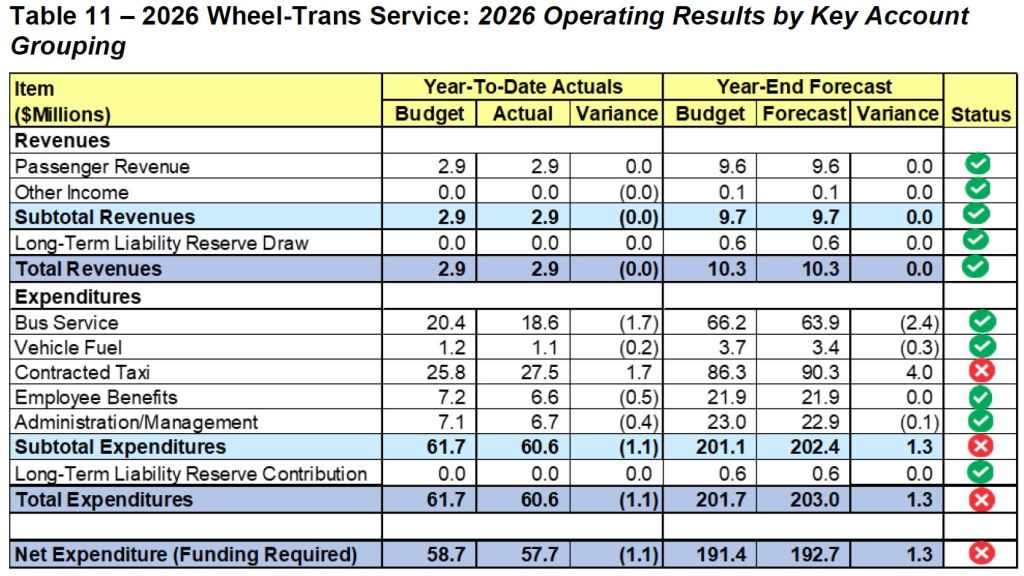
The opening months of 2026 were not kind to TTC thanks to a bitter winter, and revenue on the conventional system fell below expectations. However, this trend has continued into Spring and does not bode well for the full 2026 results. By contrast, Wheel-Trans ridership is running both above budget and above 2025 levels.
The budgeted riding level assumed that Line 5 Eglinton would have opened sooner than it did. The TTC has not reported on actual versus projected demand on Lines 5 and 6, nor on how these lines have affected actual revenues.
From a budgetary point of view, reporting revenue for the conventional system is a more meaningful number than ridership. With a variety of discount programs including passes, the two-hour transfer and, later in 2026, fare capping, the link between a “fare” and a “ride” requires a leap of faith in the conversion factor. The actual revenue number requires no conversion. Note that although projected revenue is generally higher than the 2025 values for the remainder of 2026, it does not exceed the budget projection.
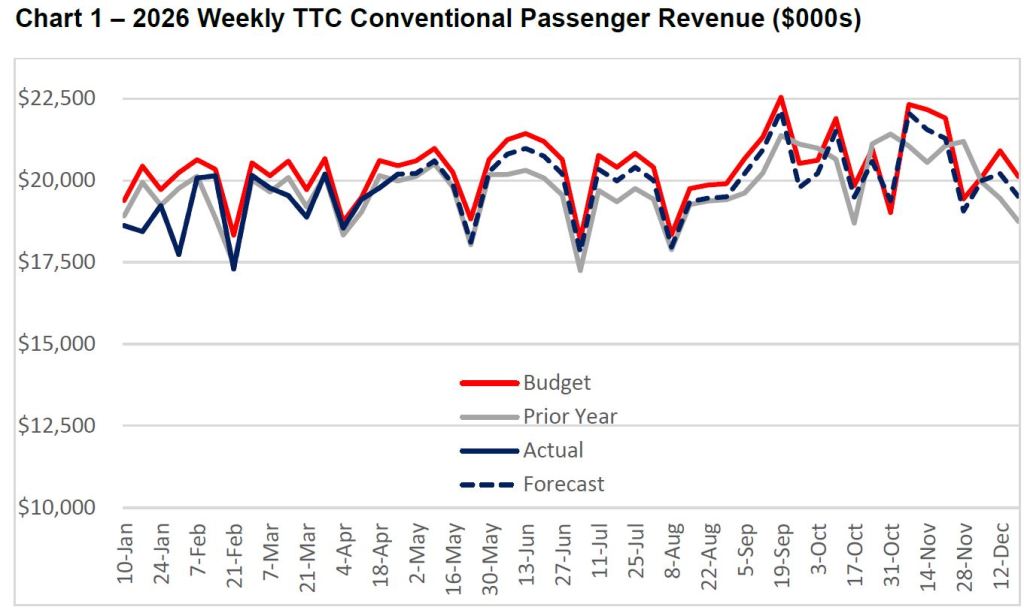
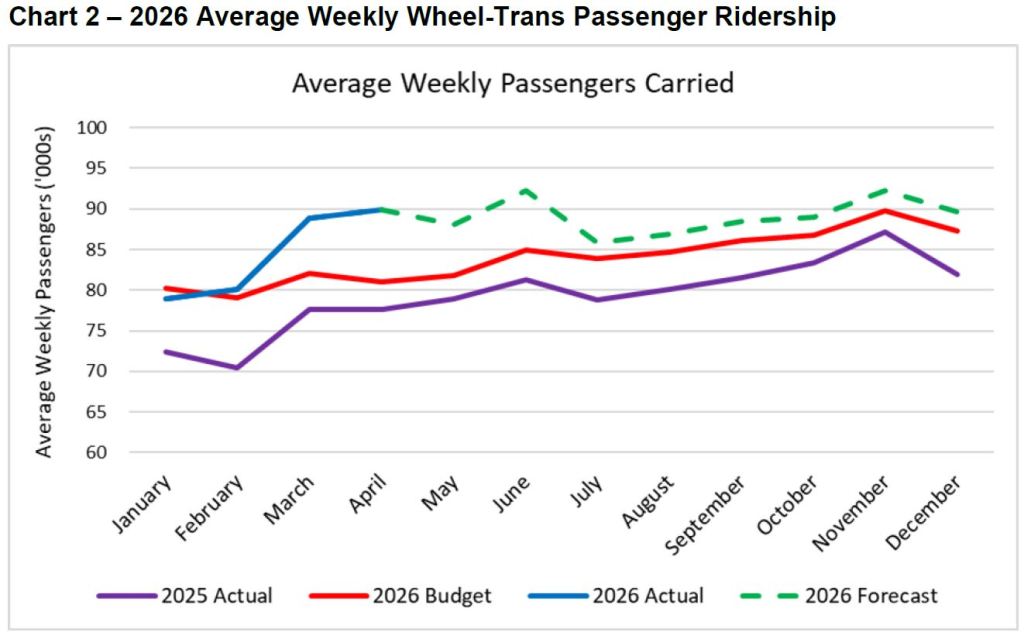
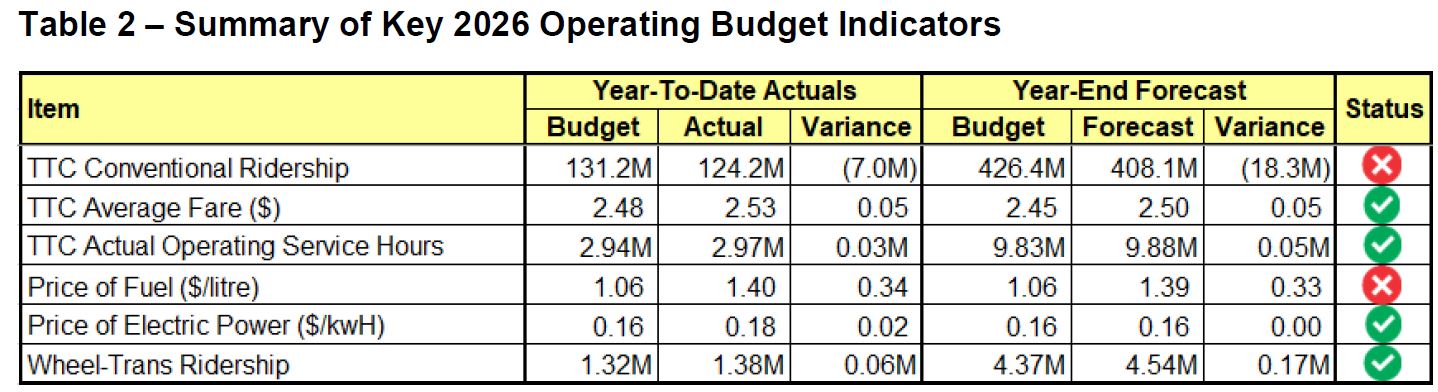
Key indicators track major factors in financial performance.
Ridership is below the budgeted level although the average fare is up slightly. In this context, a “ride” is a collection of trips (or boardings) paid for with a single fare.
Service hours are up slightly over budget in part because more operators were available than planned. Further improvements are planned later in 2026, but these will drive higher than budgeted costs.
The big jump in operating costs lies in diesel fuel where the cost/litre is running at about one third higher than budget.
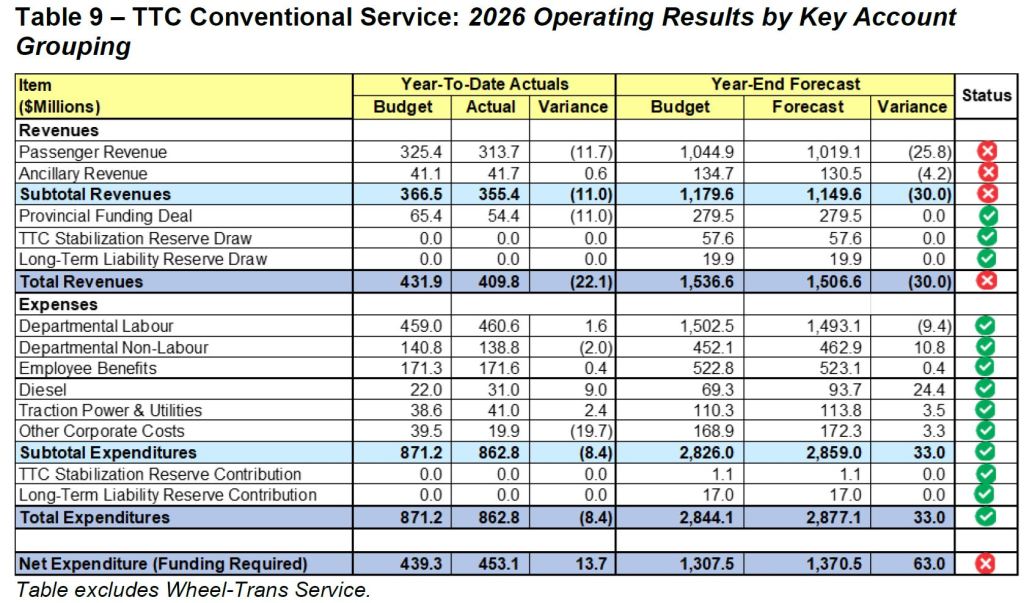
The detailed breakdown of revenues and expenses shows results to date and projected year-end numbers.
Fare revenue on the conventional system will remain below budget for the year, although the shortfall for the year is proportionately lower than the year-to-date figure which reflects both poor weather and the late Line 5 opening. Ancillary revenue is projected to be down because of lower advertising revenue.
The Provincial Funding Deal will contribute almost $280-million, but there is a catch going forward into 2027 because the deal will expire and a replacement has not yet been negotiated. A major challenge with line-specific special funding is that if/when it ends, the City must divert resources to a small part of the system (the new lines) possibly at the expense of service on the rest of the network.
Note that part of the Provincial Gas Tax goes to operating subsidy, but this is reported as part of the City’s funding as the money goes to Toronto, and is then divided between operating and capital subsidies.
The budget projects a large draw from the Stabilization Reserve. This rate of withdrawal is not sustainable in future years and this is another pressure in 2027 and beyond. (See financial statements for 2025 in the next section.)
The Long-Term Liability Reserve tends to balance out every year from a combination of withdrawals as older cases are settled, and contributions based on provisions for new cases.
Overall, there is a projected shortfall of $63.0-million for the conventional system and $1.3-million for Wheel-Trans that will have to be funded later in the year. Typically this has come from underspending in other parts of the City budget.
Draft Consolidated Financial Statements for 2025
The financial statements are in a different format from the budget presentations in that both capital and operating assets and their associated costs and revenues are combined. Although recent large projects such as Lines 5 and 6 are on the Province’s books, the rest of the TTC system including subways, vehicles, buildings and other assets are carried as capital on the TTC books. Some of the land used for TTC operations is acquired by and held in the City’s name and does not appear as a TTC asset. Most capital assets are funded by various subsidy programs at all levels of government, but a small amount comes from the operating budget
The interesting part of the statements lies in the extensive footnotes which explain some aspects of funding in more detail and clarity than sometimes appears in budget reports. Over the years, governments announced programs under various names, and it can be tricky to keep track of each of the subsidy streams and available funding. Because of the long lead time for capital projects, governments make “commitments” to fund, but do not actually transfer the money to the City/TTC until spending actually occurs.
Note 15 details the various operating subsidies received in 2025 with comparative data for 2024.
The lion’s share of the operating funding came from the City of Toronto at $1.119-billion. A further $91.6-million came from Provincial Gas Tax and $35.7-million from “New Deal” funding for operating costs of the new LRT lines. This subsidy is planned to end this year unless it is extended.
Substantial additional amounts (about $180-million) include payments into various City reserves (some of which is a passthrough of Provincial money) as well as provision for future costs that accrued in 2025 but are not payable until the future (e.g. accident claims and post-retirement benefits). This arrangement avoids having the City pass money to the TTC for costs that are not currently payable.
Note 16 details Capital subsidies. In 2025, a total of $1.6-billion was received from the City ($955-million), Provincial ($214-million) and Federal ($429-million) sources with a very small amount from “other”. Note that these are amounts actually paid, not the many announcements and promises that get most of the attention — those will fund future work, not what is already underway. Provincial funding does not include spending on their own projects such as new subway and LRT lines as these are not on the TTC’s books. City funding does not include property purchases on the TTC’s behalf where title remains in the City’s hands ($18.3-million).
The City share includes $5.4-million on the Spadina subway project (TYSSE) which is still an open account 20 years after funding was originally announced. There are still open claims on some contracts related to this line, and it continues to appear in the statements.
Provincial capital subsidies in 2025 totalled $214-million of which $87.2-million was from gas tax, $56-million was for the new streetcar program, $24.2-million for the Bloor-Yonge expansion project, and $46.5-million for new subway trains under the “New Deal” program.
Federal subsidies in 2025 totalled $429-million of which $55.2-million went to the new streetcar program, $27.1-million for the Bloor-Yonge project, $142.9-million for zero-emission buses and charging infrastructure, and $15.8-million for various vehicle programs under the CPTF (see below). The largest federal payment in 2025 was $187.9-million under the BCSF (Building Communities Strong Fund). This source historically was the Federal Gas Tax stream, but it was renamed a few times and decoupled from gas tax per se as the revenue source. BCSF funds are not tied to specific projects.
The Canada Public Transit Fund (CPTF) was originally announced as a $30-billion, ten-year public transit program split $5-billion in baseline funding, $20-billion for 10-year Metro Region agreements, and $5-billion for targeted funding. Part of this funding was reallocated to the BCSF, although existing commitments were not affected. Federal approval has been given to purchase of 105 Wheel-Trans vehicles, 200 hybrid buses, and 55 subway trains. There is a separate approval for 50 eBuses and 227 charge points under the “targeted” stream.
The challenge in following the various subsidy programs is that it is unclear how much remains in each of the various streams. Toronto has claimed substantial amounts, but at some point the streams will run dry unless the Feds decide to replenish them among their many other priorities. Actual spending on some of the earmarked projects will not occur for several years, and one challenge will be the effect of inflation on costs by the time they are incurred.
Note 19 lists reserves held by the City of Toronto. The Stabilization Reserve is a concern because it began 2025 at $99.9-million of which $22.9-million was drawn in 2025, and a further $57.6-million withdrawal is budgeted for 2026. This will leave less than $20-million going into the 2027 budget cycle.
The other major reserve is the “New Deal” funding which began with $300-million in 2024 and now has only $100-million left which will be drawn in 2026. Planning for 2027 begins with little reserve remaining to supplement revenue or pay for new service or fare initiatives.
Status of Previous Auditor General’s Recommendations
This report was discussed at the Audit, Finance and Risk Management Committee meeting on May 26, and the notes below are from that meeting. Part of the discussion was in camera regarding items that have not been made public.
The City Auditor General reviews aspects of various City departments and agencies from time to time. In this report she particularly flagged a number of long-standing issues at the TTC. This provoked a debate about the severity of the outstanding issues and why it had taken so long for management to address them.
A thread running through several of them related to the migration from manual procedures to the implementation of new or majorly revised IT systems. This concern has appeared before in reviews of maintenance activities. Management reports that most outstanding issues will be resolved by the end of 2026.
The migration of asset management to the Maximo IT system is in progress and will be completed for the subway by year-end, with remainder following in 2027.
Several items dealt with procurement practices. Management reported that part of the problem in resolving them was due to staff shortages, and part due to a reorganization to split procurement from contract management. Focus on issues is now improved, but it took time to work through the implementation.
One outstanding item is the capture of Mean Time to Repair statistics. TTC reports mean time between failures for vehicles, but does not break this down based on the severity and cost of a failure. This information has not been tracked until recently, and even then the process is very manual picking data out of records and deciding what should be monitored. A complication lies in whether this would be perceived as a performance issue for staff with similar jobs having target times to repair. Management does not believe that tracking MTTR will have a big effect on costs.
A common issue for the Auditor and for TTC Board members is fare evasion. There has always been some level of evasion, but various operational practices created new opportunities. One was the use of all-door loading on streetcars and some bus routes at busy stops. Another was via “crash gates” in subway stations that provided barrier-free access at unstaffed collector booths.
The Auditor claims that there has been a reduction of $13-million annually. Commissioner Osborne asked whether this was from direct observations. The Auditor replied that the number comes from management, but their methodology has been verified and the Auditor agrees with the number. The saving comes primarily from closing crash gates. The 2026 Operating Budget did not make provision for increased fare revenue through enforcement beyond what had already been achieved in 2025.
Management reported that there is a tangible improvement in fare evasion in every mode. On buses, the TTC has a new methodology with more inspections at stations, and comparing Presto tap rates with automatic passenger counter data. Given the size of the bus network, management feels that this is where the “prize” lies in improving revenue. This is still a work in progress, and the Auditor has not commented on the effects of the new methodology for estimating evasion rates. There is also a new fare collection method on Lines 5 and 6 where there are no onboard Presto readers.
Multiple door boarding has been an issue for the Auditor, but she tempered her recommendation to explore single door boarding, but if this does not work, then the recommendation would be closed.
Josh Colle, Chief Strategy and Customer Experience Officer, reported that management has analyzed the tradeoff in compliance versus longer travel times and the effects on service. The TTC is looking to trial this on some bus routes first, but streetcars are more challenging because they are not designed for single-door boarding.
The fact that this is even going to the point of an analysis and test shows how the TTC Board’s fetish with fare evasion as a possible source of lost revenue is deeply out of touch with how transit systems actually operate. The fundamental issue is the level of fare inspection and enforcement, and transit operations cannot be tied in knots because the TTC is unwilling to invest enough in inspection staff. Conversely, there is a point where the extra cost outweighs the revenue regained.
Commissioner Saxe asked what topics were next in the Auditor’s plans. She replied that the original plan was to review electric buses, but that there is an interest at the City’s Audit Committee to look into subway maintenance.
Capital Projects
Major Projects Update for the Period Ended April 26, 2026
The quarterly major projects updates usually get little discussion at the Board especially on days when there is a packed agenda with other items. However, there are several warning signs for those who follow the details. These include:
- Problems with the alignment of delivery dates for new subway cars and dates of various extensions opening.
- Demand projections that imply that growth trains will be needed earlier than previously expected.
- Lack of funding for maintenance facilities needed for added trains, particularly on Line 1, but longer term also on Line 2.
- No bus fleet plan to take into account growth beyond business-as-usual (e.g. a Ridership Growth Strategy), and the effect of migration to eBuses on service scheduling.
- A major shortfall in funding of future bus purchases.
- A streetcar fleet substantially larger than actual service operated thanks to bus substitutions and the slow rollout of the “six minute network” on the streetcar system.
Subway
The order with Alstom for new trains includes:
- 55 replacement trains for the existing Line 2 fleet.
- 25 trains for growth on Line 1.
- 8 trains for the North Yonge extension, and 7 trains for the Scarborough extension, both to be funded by Metrolinx as part of the expansion projects.
- 17 trains for additional growth on Lines 1 and 2.
The only cars with a specific delivery date are the 55 Line 2 replacements which should all be received by 2035. It is unclear whether other trains, e.g. the Metrolinx expansion trains, will be delivered before all of the Line 2 trains. The opening dates for the two extensions keep shifting, and Metrolinx has been evasive with dates in the early to mid-2030s.
Operation of new trains on Line 2 at a frequency below 140 seconds requires completion of the Automatic Train Control project. There is also an open question about what signalling will be installed on the Scarborough extension and whether the existing T1 fleet on Line 2 will be able to operate there. A study has confirmed that the existing Line 2 block signal system can be operated to 2040, although we already see reliability issues with existing signals implying a need for better long-term maintenance. The planned full cutover to full ATC on Line 2 is in 2037. About 20% of the ATC project is unfunded beyond 2035.
The Line 2 Capacity Enhancement Program includes station modifications (including expansion of the streetcar platform at Spadina Station), traction power upgrades, some track enhancements (a storage track at Warden Station), carhouse and shop modernization at Greenwood Yard, and signalling upgrades separate from the ATC program. The end date for this collection of projects is 2041, but over 60% of the work is not yet funded. Two key risks listed are:
The target headways for Line 2 may be required earlier than previously planned to reflect the updated ridership demand forecasts (currently under review). As a result, the achievement of 120-second target headways by 2037 (previously required by 2041) is subject to impact analyses on Line 2 CEP projects.
New Subway Train (NST) Program: Changes to the T1 replacement train delivery strategy and schedule may have an impact on program goals and objectives (headways and service levels). The TTC is proactively co-ordinating with stakeholders and seeking to confirm full funding for the NST option trains procurement.
This program is also dependent on the availability of subway work cars.
The Line 1 Capacity Enhancement Program includes station modifications (including expansion of the concourse levels at some locations), traction power upgrades, fire ventilation upgrades, a new maintenance facility for 34 trains,
There is a timing risk:
Headways of 100 seconds by 2037 were based on pre-pandemic projections. The updated ridership demand forecasts will require headways to be achieved earlier (2035). Full schedule and scope impacts are currently being evaluated.
The Line 1 CEP is only 17% funded, and with so much of the program in the design stage, there is a risk that the total value will increase.
The Bloor-Yonge Capaciy Improvement Project is fully funded at its current specification, but it is likely that provision for platform doors will be added. Only a small amount of design funding for this is allocated currently. Neither of the Line 1 or Line 2 CEPs have funding built in for Platform Doors which would be a net addition to their budgets and work plans.
Buses
TTC plans to replace much of its existing fleet over the 10-year span of its capital plans (the target life of a bus is 12 years). Plans call for 1,445 eBuses and 200 Hybrids over the period 2026-35, but only 17% of this is funded, and there is no provision for the effect of a Ridership Growth Strategy.
Similarly the project to install charging systems is only 35% funded. This is self-evidently an essential part of the migration to electric vehicles.
Streetcars
Although the TTC now has a fleet of 264 streetcars, the peak service scheduled in March 2026 was only 167 cars. For many years, the TTC has relied on bus substitutions to reduce streetcar usage when their fleet was tight, but with the larger fleet this leaves many cars spare that could be in service.
The TTC has no published plan for how it will use its now-larger fleet. Some routes have moved to more frequent service, but 501 Queen, 506 Carlton and 507 Long Branch are still operating only every 10 minutes. Some of the new cars might operate on Waterfront East, but that will not happen until at least 2032 and this line will not require a large proportion of the fleet.
Service levels are constrained by budgets and staffing.
Expansion of storage and maintenance facilities at Hillcrest are in progress for 2028-29 completion. Russell Carhouse modifications to support low-floor cars are in progress, again with a 2029 completion date.
Bloor-Yonge Capacity Improvement Project – Platform Edge Doors and Net Zero
This report provides an update on the Bloor-Yonge project and recommends approval of $6.35-million for 70% design for enabling infrastructure for future Platform Edge Door installation as part of the project.
Member Motion: Review of Subway Capacity and Densification Mandates
Commissioner Kim, seconded by Commissioner Matlow, move that the Board:
- Direct staff to:
- a. review and analyse projected density at subway stations designated as Protected Major Transit Station Areas and Major Transit Station Areas, as set out in Bill 23, More Homes Built Faster Act, 2022.
- b. review and analyse projected subway capacity to meet subsequent population growth, per Bill 23.
- Request City of Toronto Transportation Planning to:
- a. develop strategies to address increased density along Protected Major Transit Station Areas and Major Transit Station Areas designated stations;
- b. consider strategies for provincial funding assistance to increase transit capacity.
They explain the context for this motion:
Due to the elimination or reduction of developer fees, it is estimated that the City may have a $2.3 billion revenue loss over 10 years, and for the TTC, there is a risk of capital budget shortfall, as the developer fees are a primary source of funding for transit infrastructure.
Without infrastructure upgrades, the resulting capacity constraints, especially at stations, may cause safety issues, should Line 1 and 2 stations be unable to handle the surge in passengers from new high-rise developments.
Note that this motion also relates to projected subway demand levels as noted in the Major Projects Update above.
Safety Issues
The issues covered here cover a great deal of ground and will, no doubt, bring extensive debate at the Board Meeting.
A few recent events are worth noting.
The Ontario government has expanded the powers of Special Constables to include arrest of persons using drugs on the TTC system. While this might play to the story that there is open drug use on the TTC, the situation is much more complex. Many types of disturbing behaviour can be found on the TTC including people with mental health issues, homeless people living on vehicles, panhandlers and aggressive behaviour. Most of these people are not actively using drugs, although they might suffer from the effects of previous consumption. It is not clear what proportion of disturbing behaviour will be addressed by the new arrest powers, as opposed to other supports such as social services and enforcement of public order laws.
Council is now on record as committing to the installation of Platform Edge Doors on the subway, albeit with little funding in place and no timeline for project completion. Various schemes have been proposed, although what is planned for TMU station, essentially a fence with gaps for subway car doors, will do nothing to prevent people from getting to track level. An essential counterpart to this is the use of intrusion detection systems to halt oncoming trains if the track is not clear. These can bring problems with “false positives” as we have already seen on Line 5 tunnel stations.
A related issue will be to what extent added operating and capital costs will crowd out other potential budget items including service improvements and state of good repair projects.
I will cover this in a separate article after the Board meeting.
Advancing Safety on the TTC: 2026 Focus Areas
Toronto Council at its March 25-26 meeting, on a motion by Cllr Bradford seconded by Cllr Pasternak moved:
- City Council request the Toronto Police Service Board, in consultation with the City Manager and the Toronto Transit Commission Board, and having regard for the Memorandum of Understanding with the Toronto Transit Commission, including how responsibilities are shared with Special Constables and crisis services, to develop a plan to deploy uniformed police officers across all subway stations, including cost estimates and staffing considerations, as part of the 2027 budget process.
- City Council request the Toronto Police Service Board to include the report on the creation of a Safe Toronto Transit Commission Strategy requested in item 2025.CC33.1 in the report requested above.
- City Council declare its commitment to beginning its construction of platform edge doors across the Toronto Transit Commission subway system, with a mandate to commence construction of a multi-station pilot project no later than the fourth quarter of 2027.
- City Council request the Toronto Transit Commission board to direct the Chief Executive Officer, Toronto Transit Commission, in partnership with the City Manager, to develop a funded plan covering the first 10 years of implementation of platform edge doors (including a multi-station pilot, Line 1 high-priority stations and the Bloor-Yonge Capacity Improvements project), and report back to City Council as part of the 2027 budget process.
- City Council request the Toronto Transit Commission board to direct the Chief Executive Officer, Toronto Transit Commission to publish updated cleanliness standards for all subway stations and publicly report on station-level performance, no later than the first quarter in 2027.
- City Council request the Toronto Transit Commission board to direct the Chief Executive Officer, Toronto Transit Commission to report on a single network-wide lighting standard for vehicles, entrances, stairways, concourses, and platforms, including clear maintenance response standards.
- City Council request the Toronto Transit Commission board to direct the Chief Executive Officer, Toronto Transit Commission, in consultation with the local City Councillors, Toronto Police Service, local Business Improvement Areas and residents associations, to undertake safety design audits of all subway stations that evaluate the physical environment, including lighting conditions, from the perspective of both crime prevention and public perceptions of safety, and report back to City Council no later than the third quarter in 2027.
- City Council request the Toronto Transit Commission board to direct the Chief Executive Officer, Toronto Transit Commission, in consultation with the City Manager and the City Solicitor, to review the implications of implementing a one-year ban on any riders that harass or assault Toronto Transit Commission drivers and other staff members, and report back no later than the first quarter in 2027.
Service Issues
Administrative Inquiry: Community Bus Routes
TTC Chair Myers has posed a detailed inquiry about the cost and usage of the Community Bus Routes. The original intent of these routes was to provide a bridge between Wheel-Trans door-to-door service and the conventional system by linking significant destinations in various neighbourhoods with routes circulating between them. However, budget limits have strained this model with some services only running on select days, and headways widening as more stops are added and traffic affects running times.
Specifically, he is asking:
1) Can staff please provide the TTC Board the year each community bus started?
2) Can staff please give the TTC Board the ridership data disaggregated annually for each community bus route and the overall ridership data for community buses for 2025?
3) Can staff please give the TTC Board the 2025 costs of running the community bus service for each route, the overall costs of the community bus service for 2025 and the effective subsidy per rider using the service per route for 2025?
4) Can staff please give the TTC Board the estimated diversion rate from Wheel-Trans to the Community Bus service or what percentage of Community Bus riders would be eligible for Wheel-Trans service?
There is a fundamental difference between a scheduled Community Bus and a WT trip that requires individual pre-booking. Moreover, there is a question of how the TTC’s Family of Services program, which encourages riders to shift from WT to the conventional system, relates to the provision of local services where these might better serve neighbourhoods.
It is sadly ironic that this query comes just after the death of former Chair Howard Moscoe who was a strong advocate for services for the disabled community.
Member Motion: Request for Express Service on the Bathurst Bus
Commissioner Josh Matlow, seconded by Commissioner Dianne Saxe, are asking for a report
… on the feasibility and financial impacts of creating an express bus for the 7 Bathurst corridor, and direct staff to consider the introduction of a 7 Bathurst Express as part of the 2026-2027 Annual Service Plan process.
They argue that:
An express bus on the Bathurst corridor would deliver meaningful, near-term travel time benefits to riders who travel longer distances along the route. Previous TTC analysis has found that express bus routes can save customers at least 20 per cent in travel time, as riders travelling longer distances benefit from fewer stops and faster journey times.
The parallel Dufferin corridor offers a comparable precedent: the 929 Dufferin Express provides express service on Dufferin Street between the Exhibition and Wilson Station and has successfully sped up bus service along the corridor. The Bathurst corridor serves a similar density of residential and commercial destinations, and carries similar ridership, making it logical candidate for an express bus.
At the risk of raining on their parade, there is a huge difference between the existing level of service on the Bathurst and Dufferin corridors:
- 7 Bathurst: 6 articulated buses/hour all day
- 29 Dufferin + 929 Dufferin Express: 15 articulated buses/hour weekdays
The motion also claims that “35,000 Torontonians rely on the 7 Bathurst bus every day”. According to the TTC’s Planning Page, weekday ridership in 2024 on these routes was:
- 7 Bathurst: 21,002
- 29 Dufferin: 21,458
- 929 Dufferin Express: 19,292
It is hard to believe that ridership on Bathurst has grown so much since 2024, especially with no improvement in the scheduled service.
The challenge for adding an express bus is that with only 6 buses/hour today, there is no way to allocate these to separate local and express operations without very wide headways on each service. Even if the route changed to standard sized buses, there would still only be 9/hour to divvy between the services.
In effect, this is a request for additional service on Bathurst and it should compete with other proposals, including simply making up service shortfalls on already-crowded routes. A major shortcoming with the TTC’s Annual Service Plan is that it does not list the routes where there should be more service under the TTC’s own standards.





Well if they listed routes that needed more service in the service plan and proceeded to invest in something else, it will be embarrassing, so of course they aren’t doing that.
Steve: Yes. There is a problem that TTC does not granularly report on route behaviour or where the reliability and capacity problems are. In turn this means that the pols don’t see the budget shortfall and the work needed just to get to acceptable, attractive service. They focus on “shiny new things” rather than the basics.
LikeLiked by 1 person
Service on route 7 will be a disaster for the next 3 years as comprehensive watermain/roadway reconstruction projects will be performed from Steeles to Kingsbridge [south of Finch] in 2026-2027 and from Kingsbridge to Bainbridge [south of Sheppard] in 2028-2029. While these projects are going on traffic will be even worse than usual and route 7 will be adversely impacted.
Steve: Thanks for the update, unhappy though it might be. It will be interesting to see how TTC reacts to this in scheduling and line management.
LikeLike
How do you think CEO Lali is doing?
Steve: I am not particularly impressed. There are aspects of TTC operations he does not seem to understand, and has more focus on management structure than on day to day details. Far too often he answers questions simplistically, or hopes that others can fill in for him.
LikeLike
Left you a comment on 503 but no way to send it….. where is the vanished 503 streetcar?
Steve: It has been left as a bus to provide service on King while various diversions take the 504 elsewhere. That said, the TTC does not seem in a hurry to restore it as a streetcar even though they have a ton of spare cars.
LikeLike
Steve said: Note that only 5% of delay time is assigned to “Unauthorized at Track Level” although this gets a lot of discussion in the context of platform doors. Also “Assault and Priority One” are two very different types of events, but they are consolidated here. (The latter refers to a passenger injury at track level.)
The ttc delay data leaves a lot to be desired with regards to coming up with useful analysis. The groupings suggest not a lot of thought went into the TTC’s analysis here.
Some issues which really need to be fixed (I’ve submitted open data tickets requesting improvements) are:
1) location names are trimmed, often on ranges like “Yonge to Castl” some of the trimmings make it impossible to analyze those fields
2) no information about the number of vehicles or stations or customers impacted
3) mixing minor station or yard issues that likely won’t impact service but may prevent boarding or cause small gaps with major outages that impact multiple stations and leave riders stranded in tunnels
4) whether shuttle buses were called
5) how long service took to return to normal
6) whether power was cut, evacuation was needed, if first responders were called
7) items may fall into multiple categories and it’s not clear if there is an precedence order, or if it’s just based on initial reporting or updated after a review of some sort
8) often not clear if multiple platforms in the same station are impacted
It’s really important to understand that some of the delay codes are for things like operator forgot his keys, or someone fell down the stairs. While these issues may lead to a gap, or people unable to enter the station, and some customers may be impacted, it’s clear that significant outages where power is cut, customers are stuck on trains in tunnels and stations are shut with shuttle buses running are significantly different in terms of impact.
They will both be reduced to a metric based on minutes though. Where they should be expanded to include customer impact, cost to the system and reputational impact.
Someone dying and there being bad press for 3 hours on cp24, along with the social media backlash, the cost to the ttc, the cost to riders, the loss of future customers needs to be factored in…a trespass could result in 5 minutes or 5 hours of delays…an operator forgetting his keys getting out of the yard is 3 minutes extra, and likely nobody except those reading this data will ever know…
LikeLike
You note that the TTC ‘has ton of spare streetcars’ but continues to operate the 503 with buses. This is yet another example of poor (non-existent?) planning and very poor use of limited resources. It is not just that they bought streetcars they do not use, there is also the fact that over the past few years the TTC and the City have laid replacement track and installed upgraded overhead on both Wellington Street and Kingston Road and this now also sits virtually (or totally) unused. Wellington can be used as a diversion (though seldom is) and is fairly short but the new track/overhead on Kingston Road is about 3 km long. I really want to like the TTC but it is hard to do so when it seems unable to do even fairly simple things like hiring more streetcar operators (or the very simple things like ensuring the stop signage is accurate regarding the routes served!) Sigh!
LikeLike
Don’t forget about them taking 6 months to build the new overhead on Kingston Road. To date I’ve seen the rare westbound 504 using the Church/Wellington/York loop to turn around on 2 occasions.
LikeLike
Hi Steve, this has nothing to do with whats up here but I figured I might ask you.. on June 22nd of this year the 968 will cease service at all times… the ttc claims its due to seasonal demand but I dont get it… what about the weekday rush???
Steve: I have not yet seen the detailed service memo and don’t know if this is a summer change (as happens on many routes) or a permanent removal of service. I will try to find out.
LikeLike
I would like to caution our elected representatives again, do NOT waste taxpayers dollars on Waterfront LRT lines based on 30 years old ridership predictions. Let us commission new ridership studies and then proceed based on the results of the same. Why Steve not calling for new ridership studies? Any responsible advocate would do so.
Steve: Actually I have a review of the waterfront east project in preparation, and new ridership projections are essential. I have not published it yet because other issues kept getting in the way, including the fact that I have a life beyond this blog.
LikeLike
TTC ought to listen to residents’ complaints if there is excessive noise regarding their streetcars.
LikeLike