
With recent events of major subway delays and discussions at the TTC Board about a “Ridership Growth Strategy”, the whole question of “what can we do” is swirling through the Toronto media and online. This article is an attempt to pull together threads from several reports and discussions.
This is a very long read and I salute those who stay the course to the end.
In brief, there is a capacity crisis on every part of the TTC system that is the product of years of pretending the problem is not as bad as it looks, and that a few magic bullets can solve everything. This is compounded by underinvestment in the bus network, by Bombardier’s sluggish delivery of new streetcars, and by subway planning that leaves major components either unfunded or missing from the long range capital plans.
There is no easy fix to any of this, but that is no reason to throw up our hands in hopeless resignation to further decline of our transit network. Recovery has to start somewhere even though the benefits will take time to appear. Politicians are afraid of spending money and driving up taxes. Staff act as enablers by concocting budgets that fit within available funding. The numbers “come out right” only because we ignore the full scope of our needs and how badly we have deferred addressing them.
This article does not propose specific remedies, but sets out the history of what has been done (or not done) over past years. Reading through all of it, I cannot help thinking that “Ridership Growth” is a laughable goal considering how hard Toronto has tried to stifle transit’s capacity and attractiveness. But at least the TTC Board is talking about trying to build more demand on its system. To do that, they must first acknowledge the accumulated shortfall between transit we think we would like and transit that is actually on the street.
For convenience, the documents referenced are all linked here:
- TTC Ridership Growth Strategy (2003) Report
- TTC Ridership Growth Strategy (2018) Report & Presentation
- TTC Corporate Plan (2018-2022) Report and Presentation
- TTC Crowding Standards (January 18, 2018) Presentation
- TTC Subway Crowding (January 18, 2018) Report
- TTC CEO’s Report (January 2018)
- Toronto Budget Committee (January 23, 2018) 2018 Capital and Operating Budget Reports & Minutes
- TTC Presentation to Budget Committee
- TTC Briefing Note on Overcrowding
- Yonge Subway Extension – Final Report on Transit Project Assessment Process and Future Actions (December 17, 2008) Report
- Yonge Subway Extension – Recommended Concept/Project Issues (December 17, 2008) Presentation
- Yonge Subway Extension Post Transit Project Assessment Process Technical Amendment (May 1, 2012) Report & Presentation
- Yonge Subway Extension Conceptual Design (March 2012) Report [Large PDF]
- VivaNext Yonge Subway Extension Page
- Metrolinx Yonge Network Relief Study (June 25, 2015) Presentation
-
Amended 2012-2016 Capital Program and 10 Year Forecast – Shortfall Reduction Plans (September 16, 2011) Report
2003 Ridership Growth Strategy
Although the 2003 RGS was recently dismissed by current TTC Chair Josh Colle as if it were yesterday’s answer to transit problems, the context in which it was written is as fresh today as it was 15 years ago.
There is a growing expectation that transit in general, and the TTC in particular, must take on an increased role in providing travel for people in Toronto if the City is to grow and thrive economically and in an environmentally-sustainable way. Each level of government has recently announced plans and policy initiatives, that highlight the need for greater use of transit in urban areas – the City with its Official Plan, the Province of Ontario with its “Smart Growth Council” and “Gridlock Subcommittee”, and the Government of Canada with its approval of the Kyoto Accord. Achieving these policy objectives will require a fundamental shift in transit’s role in Toronto and the relative importance of automobile travel.
Unfortunately, these initiatives follow on the heels of a consistent lack of government support for the TTC in the past decade. Provincial funding was reduced a number of times in the mid-1990’s and is only now being partly restored. The TTC’s ridership and market share has fallen significantly during this period, to a large extent because of lack of government support. While there is no simple “magic answer” that will reverse this trend, government support for the TTC must be real and pronounced if the current widespread public and government expectations for improved transit are to be met.
The TTC’s mandate is to operate and maintain transit services that provide safe, fast, reliable, convenient, and comfortable travel in a cost-effective way. The TTC’s highest priorities are to our current passengers, and to maintain the existing system in a state-of- good-repair. The TTC needs a substantial, ongoing, funding commitment to meet these basic priorities and fulfill its role of providing transportation services to a large proportion of Toronto’s population. Once these needs are met, the TTC could attract more people out of their automobiles and onto transit with a stable source of increased funding and a commitment on the part of the City to implement policies that support efficient transit operations and transit-oriented development in Toronto. [Executive Summary, p. E-1]
Two points here cannot be made too strongly:
- There is no magic answer, and
- Looking after the system and riders we have today is essential to attracting new riders.
Investing in improved transit service makes sense for many reasons, but it must be done in a way that provides significant, measurable, and real returns on investment. If taxpayers’ funds are to be used to improve transit services, there needs to be a strong business case to prove that the money is well spent, and that any funding provided will generate significant additional ridership. There is no simple, low-cost solution to achieving increased transit ridership, or to reduce congestion and pollution. Attracting new riders to transit will require substantial increases in government policy commitments and subsidy, on a consistent basis, over a number of years. One-time funding arrangements and individual mega-projects will not result in significant changes in overall travel patterns over the long term or over a wide area. A consistent, long-term, staged program of providing priorities for, and investing in, expanded existing transit services, using proven technologies and operating strategies, provides the best opportunity to achieve sustained increases in transit ridership.
The underlying issue will continue to be the extent to which the City and senior levels of government will be willing to take the steps necessary to invest in transit to achieve their broader objectives. [p. 3]
There is a section titled “Why people choose to use transit” that is too long for me to quote in full here [see pp. 5-6], but a few excerpts are worth including:
The key factors governing mode choice are speed, reliability, comfort, convenience, and cost. Different segments of the market put differing values on these factors, and an understanding of market segments is critical to determining the potential for attracting transit riders. In addition, some modes of travel are simply not available or practical for some trips – few people will make very long walking trips for example – and people do not necessarily have an automobile available for any given trip. The availability and attractiveness of various modes is also very dependent on the location of both the origin and the destination of the trip being made.
…
The situations where transit can compete effectively with automobile travel are those where there is good pedestrian access to transit at both ends of the trip, and where transit can provide comparable speed to automobile travel when all factors are considered. Under these conditions, transit travel becomes attractive to many potential users. These conditions exist for travel to and from downtown Toronto in peak periods, where the roads are congested and rail lines (GO and subway) provide a comparable travel speed to automobile travel. There is also excellent pedestrian access from the downtown rail stations to destinations in the downtown. Transit achieves a 60%-to-70% mode split to transit in these favourable circumstances.
There is an obvious problem with this observation, and it applied even in 2003: much GTHA travel is not oriented to downtown and its concentrated destinations, and riders will not fall into transit’s lap simply because this is the obvious way to travel. Indeed, in many cases transit will be the last, not the first, choice. This begs the question of whether there are some trips for which making transit even grudgingly acceptable simply is not economic, but at the same time whether there are trips that are poorly served by a downtown focus on travel. This question is not new to transit debates.
If we abandon trips that are harder (or more expensive) to serve, or provide only minimal service to “show the flag” with a route map whose many lines hide less-than-ideal service, do we risk alienating potential riders especially in an era of population and density growth? Market conditions could evolve to give transit a greater role provided that it is there to establish credibility and a base of demand. This is not just an issue for the far suburbs in the 905, but for areas in both the outer 416 and in more central, redeveloping industrial neighbourhoods.
The strategy contained a mixture of proposals to be implemented over time including current operational and state of good repair funding, increased system capacity including surface rights-of-way and new larger trains for the SRT, fare structure changes to encourage use, and a modest extension of the subway network (either Sheppard East to STC or Spadina to York University). The revenue:cost ratio would be allowed to fall as a matter of policy to support increased service and new fare options.
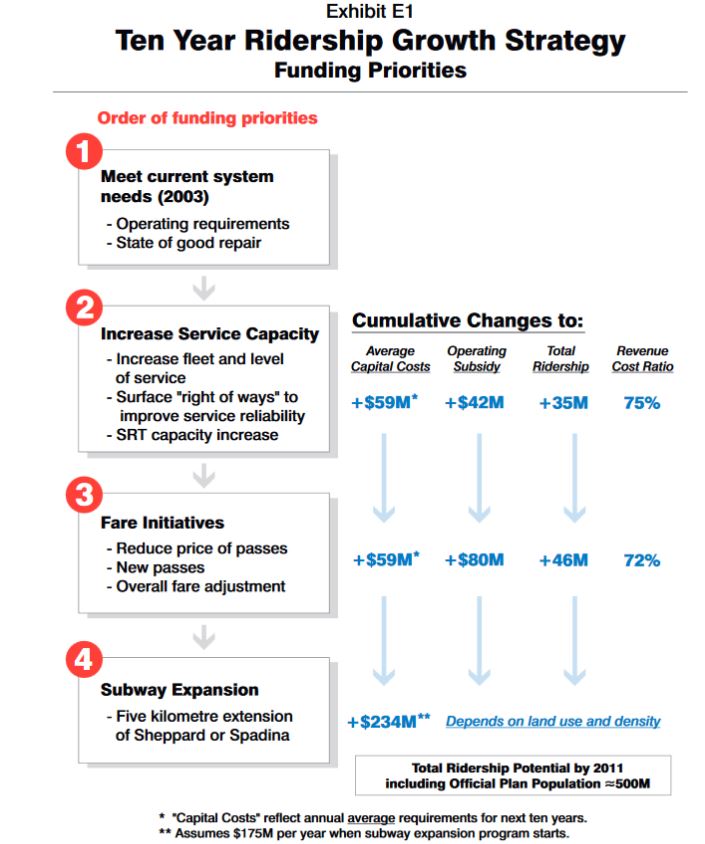
Some of the RGS recommendations either were not implemented, or were rolled back in the austerity years of the Ford administration, notably the more generous crowding standards. The increase in capacity involved purchase of vehicles to address peak requirements, but more generally a recognition that crowded transit is not attractive transit. The initial beneficiaries of less crowded service would be existing riders, but this would also provide room for growth that would not otherwise occur because transit was seen as “full”. This is very much the situation we face today where people are less than willing to join the transit riding community, and adult trips are actually being lost on the system (the flat ridership stats exist only because of increased riding by children, students and seniors).
The recession of the early 1990s had a cruel effect on TTC service and ridership:
When service was reduced on a system-wide basis during the 1990’s, vehicles were removed from most routes in the system at most times of the day. This resulted in passengers having longer waiting times for vehicles, increased crowding on vehicles with less chance of getting a seat, and less-reliable service as the remaining services struggled to carry the increased passenger loads. In total, 232 buses and 60 streetcars were removed from morning peak service during this period and overall, service levels fell by 11.5% between 1990 and 1997 while the population in Toronto grew by approximately 10%. [p. 27]
The proposed new standards would reduce the accepted average load during the peak period, set the off-peak average to a seated load, provide service on all routes for 19 hours per day, and set a 20-minute maximum on the scheduled headway, the space between vehicles on any route.
Riding did improve, although capacity constraints on some parts of the network limited growth to off-peak and shoulder-peak periods (subway and streetcar). In the fall of 2010, Rob Ford was elected, and service improvements planned for 2011 were cancelled. Further cuts came in 2012 as the more generous loading standards were rolled back. In spite of this, the system continued to gain riders for a few years, but the rate of increase fell and by the Tory years, ridership stagnated. Despite the reintroduction of some services and capacity, the system has lost its momentum to attract riders.
Although some budgetary proposals for improvements have been passed by Council, others have been turned down, and there is a sense of only making enough improvements to give the appearance of bettering transit, but on as small a scale as possible with any vestige of credibility. This is where Toronto stands today.
Crowding Standards
Crowding Standards (part of the overall Service Standards) have evolved over many years going back to an era when the (pre-amalgamation) City of Toronto under Mayor John Sewell proposed that the TTC have a standards for evaluating and allocating its service. Politicians and riders could count on these to determine when routes needed more or less service, although there was always a caveat “subject to budget availability”. Service to the standards was a nice-to-have, but not if the City could not or would not “afford” it.
This produced situations over the years which continue right to the present day where routes can be overcrowded by the standards, but there is no public reporting of the overall shortfall. The TTC Board recently directed that this information be included quarterly in the CEO’s Report, and it is amusing that for a “customer focused” organization, the absence of such basic reporting has gone on for so long.
By the early 2000’s, the standards dictated that routes with frequent (10 minutes or better) service would allow standees during the off-peak period, while less frequent routes would be designed for a seated load. This is calculated as an average across the peak hour, and with the irregularity of headways, some vehicles can be well over the standard and others well under it even though the overall average is maintained.
This is a critical factor in looking at attempts to shave route capacity because most riders see the crowded buses and streetcars, not the half-empty ones following closely behind. Bunching is a chronic problem on transit systems, but the TTC makes little effort to ensure that vehicles are evenly spaced. Indeed, their own “on time” metric used in the CEO’s report is such that service on frequent routes can be within the standard even when buses and streetcars run in pairs. The problem here is that service is measured relative to scheduled times, rather than by the space between vehicles which is the way riders experience the system.
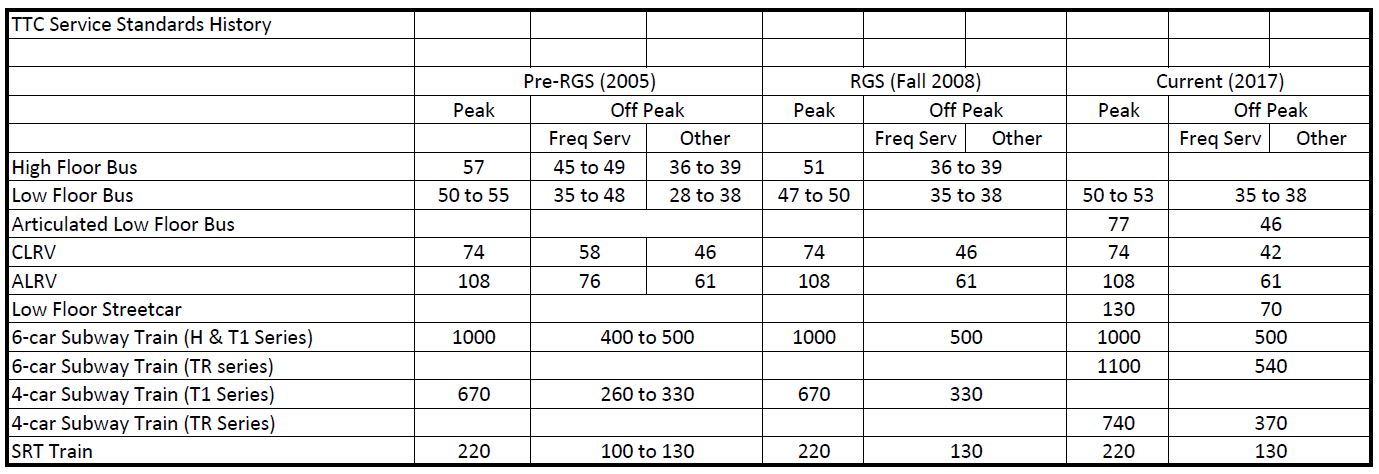
Although the original RGS report dates from 2003, it took several years before the more generous standard could actually be implemented. This was caused both by the need to acquire vehicles, but also by delays in staffing up to the required level thanks to a wave of retirements and to labour legislation that mandated limits on work hours. The new standards were actually implemented in November 2008.
The RGS standards reduced the peak load on buses by about 10%, and eliminated the provision for standees during off-peak periods on both bus and streetcar routes. Riders might be forgiven for wondering whether that standard was ever actually achieved given the usual level of crowding on busy routes.
With the election of Mayor Ford, the transit changes set in place by Mayor Miller were reversed, and the standards reverted to the pre-RGS levels. Another change was to roll back service on off-peak routes with low demand. Originally, the target set for a “non productive” route was that it had less than 15 boardings per hour (a boarding could be a new fare, or a transfer from another route). This was adjusted to 10 boardings per hour to save some periods of service, although there were debates about the accuracy of riding counts the TTC used to decide what would be cut.
After Mayor Tory was elected and he discovered the damage Ford had done (a rather disingenuous stance for someone who ridiculed the need for more buses during his election campaign), the standards reverted somewhat back toward RGS levels with peak bus loads set half way between the Miller and Ford standards.
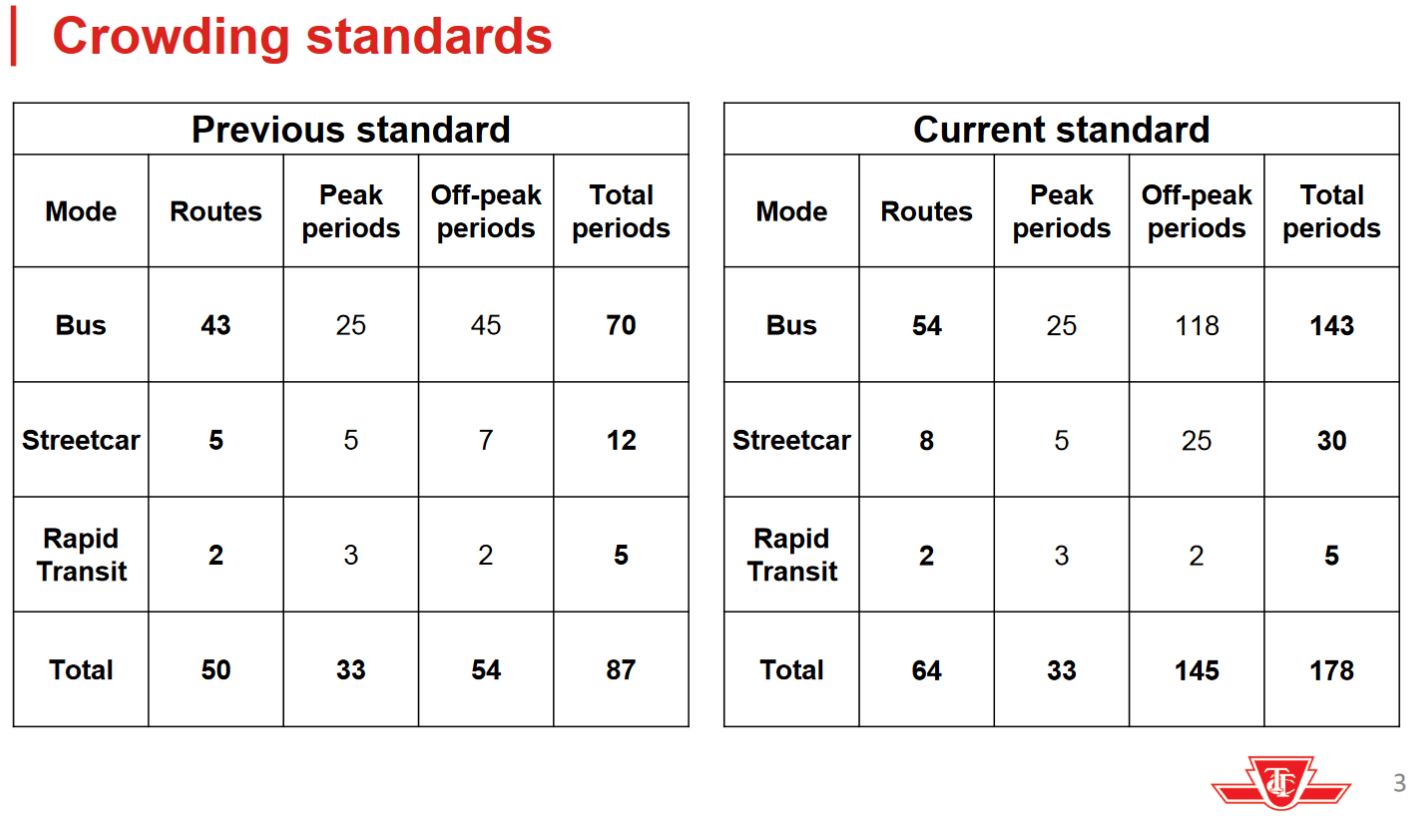
Recent debates about overcrowding have cited TTC figures about the number of routes and periods of operation where average loads exceed the standards. The two tables below show the degree of crowding based on the Ford and Tory eras of standards. Within TTC schedules, there are five periods over the course of the day and three types of schedules: weekday, Saturday and Sunday/Holiday. This gives a total of 15 periods for the week, of which 2 are the weekday peaks.
In the “current standard” section, this means that 64 routes have overcrowding relative to standards at some time during the week. There are 33 cases where a route is overcrowded during the peak period and 145 cases where a route is overcrowded during the off-peak. The information is not subdivided to show whether the problems exist mainly on weekday middays or on weekend evenings (for example). It is worth noting that the rapid transit system which only has 4 routes (and hence 8 peak periods) is overcrowded during 3 of them relative to standards, and also has 2 off-peak periods where crowding is a problem. Improved off-peak service on Line 1 Yonge-University was proposed by TTC staff, but this did not make the cut in the TTC’s budget discussions due to cost.
This is subdivided in another chart showing the degree of crowding on off-peak bus services.
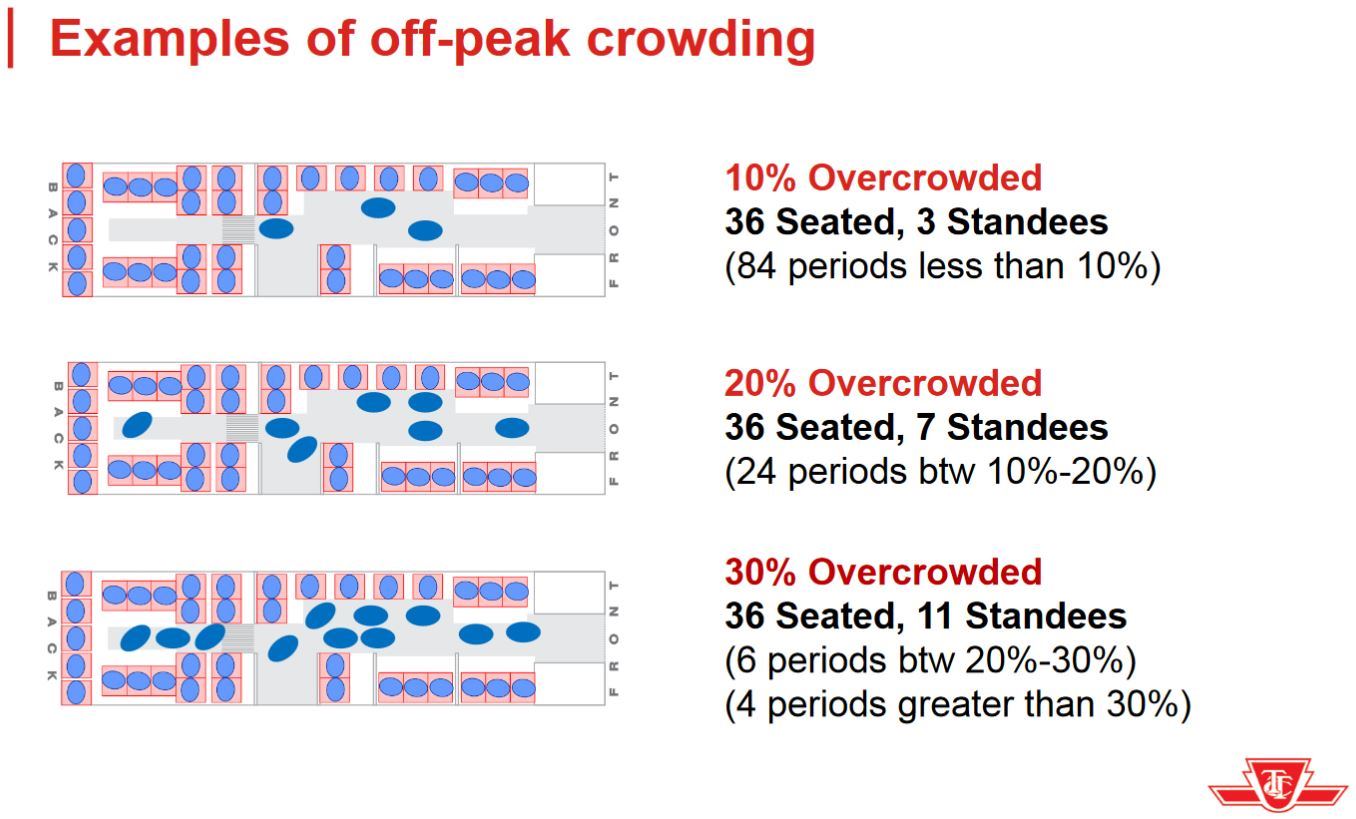
The majority of the 118 cases involve 10% or less crowding, in other words a few standees, on average. TTC Chair Josh Colle has mused that this standard is too generous, and there will likely be a move to change it when the matter comes to the TTC Board in April so that some degree of standing is permitted going forward. This will not change the actual situation on services, merely reduce the count of “overcrowded” routes.
A particular issue during off-peak periods is the disruption that can be caused by shopping buggies, luggage and baby carriages. These consume aisle space and effectively reduce the capacity of a bus while adding to stop service time as passengers make their way past obstacles that are usually near the front door.
Allowing a higher number of off-peak standees can also make a bus “full” with conditions close to peak periods. Remember that the peak standard is 50-53 riders/bus (depending on model), and at 30% over a seated load (47 riders), crowding approaches peak period levels, particularly when vehicle-to-vehicle variation is taken into account.
TTC riding growth, such as it has been, has come more in the off peak when the system has capacity and is less crowded than in the peak period. Making space for new riders was one of the RGS goals, but it is often sacrificed on the altar of “efficiency” and packing as many riders as possible on transit vehicles.
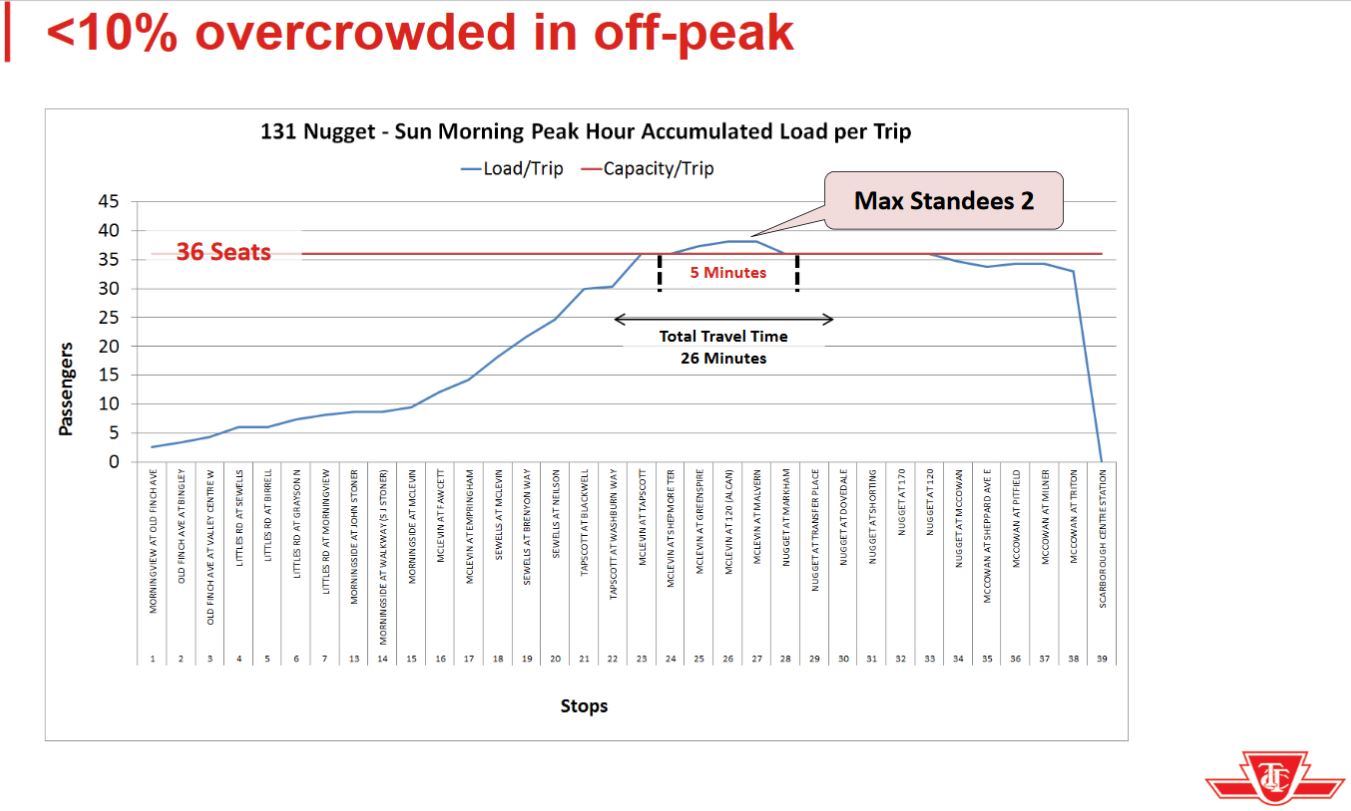
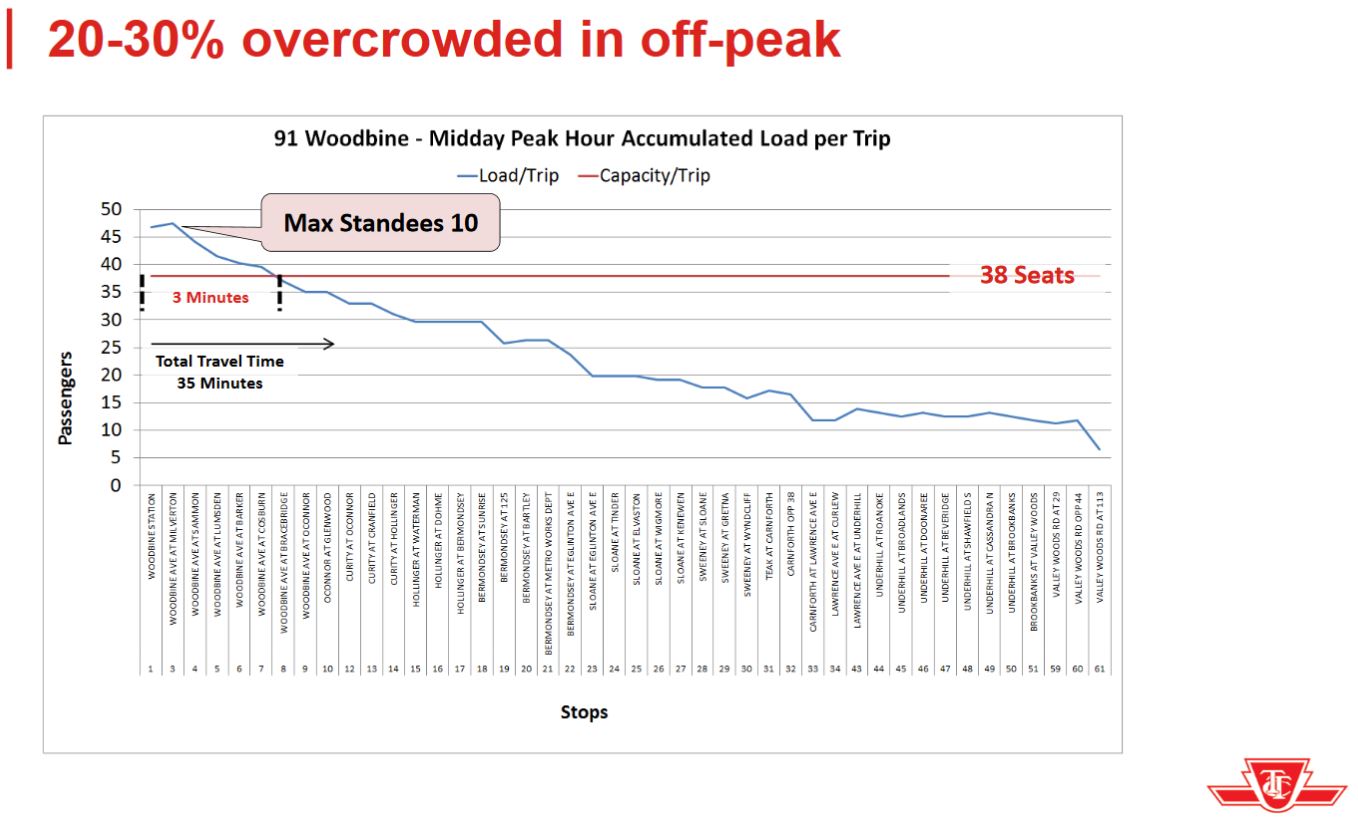
Another variation of the question of crowding is the length of time for which crowding persists on a route. This was illustrated by two charts in the crowding report.
The first shows minimal “crowding” on the Nugget bus on Sunday mornings. On average, there are a few standees, and the condition does not last for much of the trip.
The second shows the Woodbine bus on weekday middays where it goes well above standard, but only for the portion of the route closest to the subway.
In both cases, the demand on the outer parts of the routes is well below the seated load line, and this is typical for transit services that accumulate riders to a peak point. One could argue for a service design with a short turn partway along the route to raise the “efficiency” of those outer segments. However, the effect would be to cut headways to a point where service would be unattractive with a wait time making up a substantial portion of the total travel time. This is a balancing act in service design but a constant source of annoyance to those who see near-empty buses as a waste. They are part of the cost of doing business.
Another factor to be considered here is the portion of a route (measured in distance or time) where the standard is routinely exceeded. Brief “blips” are inevitable and might even be tolerable, but it is easy for these to grow into a chronic problem over longer sections of a route thanks to “budget availability” for more service.
The danger in nibbling away at the standards, whatever they may be, is that this begins a trend where unfavourable stats are made to vanish simply by changing the standard. Moreover, these are one-time savings, to the degree that the new standard saves any money at all rather than simply avoiding service improvements that the old standard would have triggered.
Finally, one goal of the off-peak seated load standard was to ensure that riders with mobility issues would be guaranteed a seat, and that all riders would have a comfortable trip especially considering longer wait times for off-peak service. Yes, there are now the “blue seats”, and with some good fortune they might even be occupied by riders who deserve them, but there is no guarantee.
By using examples of minimal overcrowding (few standees, short periods), the overall problem is downplayed as if we really shouldn’t worry ourselves about it.
During the TTC Board’s recent “Strategy Meeting”, Chair Josh Colle asked whether having three off-peak standees on the 90 Vaughan bus would trigger an additional vehicle at a cost of $97/hour when they might only have to stand for a few stops. How does the crowding standard fit, he asked, with what “any reasonable person” would think of as “crowded”. This misses the point that the standard is for comfort and attractiveness of the service, and it applies to much longer and busier routes than the Vaughan bus.
Staff will present a post-implementation review of the current (Tory era) standards to the April 2018 Board meeting. This could trigger adjustments and shifts of resources between routes later in the year.
Colle went on to talk about how one additional bus on Vaughan and other such routes would trigger the need for a larger fleet and another garage. Here he was completely off the mark because the standard under discussion is for off-peak service when no additional vehicles would be needed, only the operator hours to drive the bus and the marginal cost of its operation.
He asked how adding a bus drives riding and wondered whether customers show how much they need service based on usage. Would the TTC simply be adding an empty bus? Again this misses the point that riders choose whether to use or to avoid transit based in part on convenience and comfort. A short route like Vaughan requires a big jump in capacity when it crest the “overcrowded” line because there are so few vehicles on the route to begin with (2 or 3 during off-peak periods). One cannot add 10% of a bus to make a small change in capacity on such a route. Using this as an example misrepresents the more general need to add service as riding grows rather than using up all available capacity until it is full. This is a balancing act, but the issue deserves more than a superficial analysis.
Colle dismissed the 2003 RGS as being out of date with the idea that simply running more service will gain more riders in the face of modern alternatives such as Uber. This is a distortion of the situation. More buses on 126 Christie (another of Colle’s targets) would not necessarily bring more ridership, but this depends on the level of demand and on the perceived quality of the service. There are other routes where capacity and quality of service deter riders such as 29 Dufferin with which Colle should be familiar.
Saying, as Colle did, that “throwing more buses out there” is “1960’s thinking” misrepresents the whole concept of service standards. As a city we might decide that a seated load plus ten percent is acceptable if the condition only exists for a short distance on a route. However, once we set that standard, we cannot avoid the need to pay for the service it demands.
Counting Passengers
A long-standing challenge in reviewing the level of TTC service is the infrequency with which riding counts occur and are published. The most recent route-level counts on the TTC’s website are from 2014. (This is the list from which the “65,000 riders” on King, a value recently updated to “71,000”, came from.) Fine-grained stats on riding by time period are rarely published, although this may change with the planned quarterly reports of overcrowding.
There are three ways that the TTC counts passengers on surface routes:
- A “standing count” is taken by staff positioned at a route’s peak point (typically) estimating the ridership on each passing car. The same approach is used on the subway.
- A more detailed count can be done by having staff ride a selection of vehicles recording the ons and offs along the way.
- Vehicles equipped with automatic passenger counters (APCs) can perform detailed counts without the need for staff.
Counts involving people standing on the street or riding on the vehicles are labour intensive, and they are performed rarely. This exposes the results to the inherent variation in demand based on weather, day of the week, time of the year and other factors that can easily swing ridership up or down by 10% or more. For busy routes, it was not unusual in past years for the same count to appear in annual ridership tables (while the TTC still published them) for two or more years in a row.
Counts with APCs can be conducted every day on every vehicle providing an avalanche of data. The TTC’s problem is that only about 900 buses have this equipment, and none of the streetcars. Data transfer occurs separately from the APCs as the old vehicle monitoring system (“CIS”) has no capacity for additional data in its feed. This should be corrected with the new “VISION” monitoring system that will begin its implementation later in 2018 at one bus garage. There is an obvious benefit in having the loading and location data (among other information) transmitted in one package to eliminate the need to integrate multiple sources of data. Moreover, real time display of crowding problems should assist with line management.
There were plans to install APCs on 40 new cars, but this has not happened yet given other problems with Bombardier’s delivery. It is not necessary to have 100% of the fleet equipped as vehicles with counters can be assigned to routes as a group when a count for that route is needed. However, 100% coverage is needed to do real-time monitoring.
While riding counts, especially at the detailed stop-by-stop level, can tell us a lot about those who use a route, they do not tell us anything about those who chose not to ride, or who give up in frustration. The latent demand for service on King was obvious from the jump in ridership with the transit priority pilot, but even now with full streetcars, we do not know just how high the demand would go if capacity were there to carry it.
There is a similar problem in the subway where a service that is packed to the doors cannot carry more riders, but counts only tell us how many are on the trains, not how many would ride if service were improved.
The Role of “Micro Transit”
Another issue at the Strategy Meeting was the role of micro transit – basically anything smaller than a standard transit bus – in the TTC’s service offerings. What is the role for Uber or some similar service in areas of lower demand and density?
This topic comes up in discussions of the “last mile problem”, particularly for carriers with widely-spaced routes and lighter demand such as GO’s connections to local transit systems. Would it be preferable to ferry riders to and from major terminals with a jitney system that operated more on demand and closer to riders’ destinations than a conventional bus route? There may be a role for this type of service, although the cost per rider is likely to be higher than a typical transit service. Moreover, the day will come when some areas served by demand-based micro-transit reach a point that a regular bus route is justified. Prying riders out of a more convenient door-to-door service could prove difficult.
However, that is not the real issue in the ridership growth debate. Last mile rides can make transit a viable choice for those living and working in low density areas, but jitney services will not replace the busy trunk bus routes.
For example, in 2014, the peak bus requirements for routes carrying fewer than 3,000 riders/day amounted to 125 out of over 1,500 peak buses in service. That cutoff level brings in routes such as 62 Mortimer, 126 Christie, 83 Jones and many others which are not exactly “minor” routes. (It also includes the “premium express” bus routes which, in 2014, carried fewer than 2,000 riders/day between them and are classic examples of “squeaky wheel” benefits to riders in wards whose councillors have at some point sat on the TTC Board.) Setting the bar lower would reduce the number of affected buses to a trivial level – only 54 buses serve the routes with fewer than 2,000 passengers/day. One can argue that at the margins, the evening and weekend services where demand might be quite low, there is a role for a micro-transit service, but this would not eliminate the need to have a conventional fleet, garage space and operators for periods of higher demand.
A last-mile jitney service would be an enhancement to, not a replacement for, transit service on the vast majority of the network.
The Bus Network
Plans to expand the bus network have come and gone over the years thanks to changes in rapid transit plans. When Transit City was on the table and expected to be finished within this decade, the replacement of major bus routes with LRT would have offset the need for new buses. Nonetheless, as part of the original RGS, there were plans to buy more buses to improve peak services. At the time, garage capacity was thought to be sufficient to get through this period. Because of the budget cuts instituted in the Ford era, plans for this bus order were dropped in fall 2011 for the 2012 Capital Budget.
Bus Procurement – ($49.8 million): Bus procurements will be reduced by 134 forty foot buses (from 340 40 foot equivalents) as a result of the removal of 108 peak ridership growth buses and 26 contingency buses. It should be noted that the majority of these reductions, ie 108 of 134 are contingent on the policy RGS loading standard being approved to return to the pre RGS level. The reduction in contingency buses will impact TTC’s ability to respond to unexpected events as well as respond to higher than expected ridership growth.
…
Temporary Bus Storage Facility – ($23.1 million): With the removal of 134 buses from the fleet, additional storage will no longer be required as current garage capacity will only be slightly exceeded and crowding will cease with the opening of the new Eglinton – Scarborough Crosstown LRT.
This also left the TTC in a situation where no new bus garage would be required, and it was not until 2015 that the partially funded McNicoll Garage appeared in the Capital Budget. This garage will not open until 2020, and the remaining garages are badly overcrowded by the existing fleet. This has produced a convenient situation for the TTC in that it can claim not only to have no buses available for service, but no place to put them even if magically they appeared tomorrow. The more subtle issue is that owning and running more buses means a higher operating cost and subsidy call on the City of Toronto.
In recent years, the TTC has increased the provision for maintenance spares in its bus fleet so that more pro-active, “fix-before-fail” work can be done and bus reliability in service will rise. The benefits show up in the mean distance between failures (MDBF). However, the more-reliable fleet comes at the cost of having fewer buses available for service unless there is an offset between the higher spare ratio and a lower rate of buses being “available” in name only.
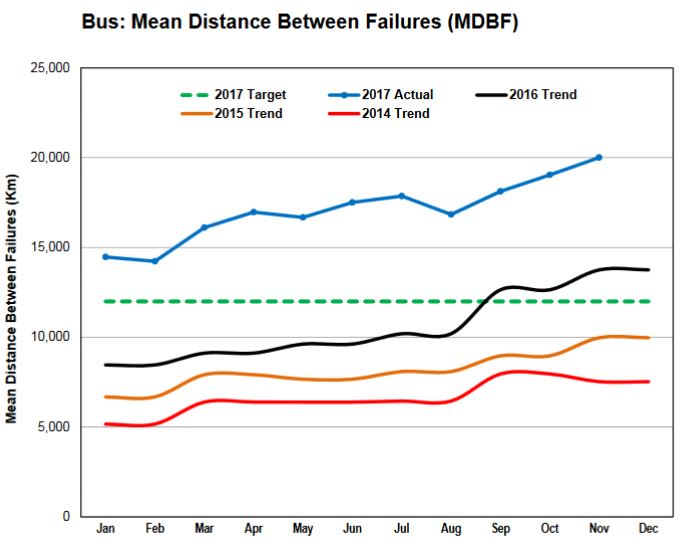
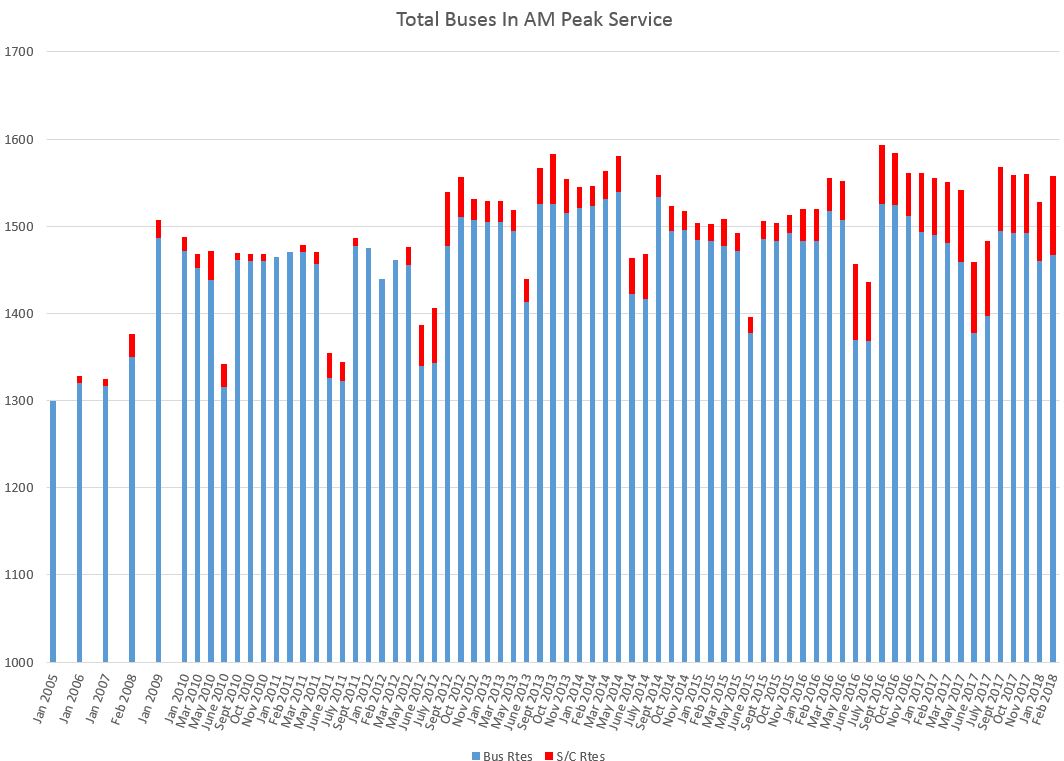
The total number of buses in service gives an indication of the evolution of service levels. The chart below shows the AM peak bus requirements since 2005 (with only the winter schedules shown for the first five years) as well as the number of buses required to fill in for construction and/or shortage of streetcars on that network. Note that the scale begins at 1,000.
The blue section below, buses that are operating on bus routes, has actually dropped since 2012. The most recent change beginning in 2017 is due to the increase in the maintenance spare pool. However, this does not tell the entire story because articulated buses with a larger capacity became part of the fleet in 2014. The second chart below shows the number of buses on a capacity basis for the AM peak, and this adds the equivalent of about 60 buses because of the larger capacity of the artics. (Typically 115-125 artics are scheduled in service for the AM peak.)
In either case, however, the apparent growth beginning in 2016 is due to buses operating on streetcar routes, not to an increase in the capacity of vehicles on the bus network itself (top of the green section in the second chart).
A further consideration when looking at data from the previous decade is that the old, high-floor buses had about 10% greater capacity than the low-floors that replaced them. There is no adjustment for this in the charts below.
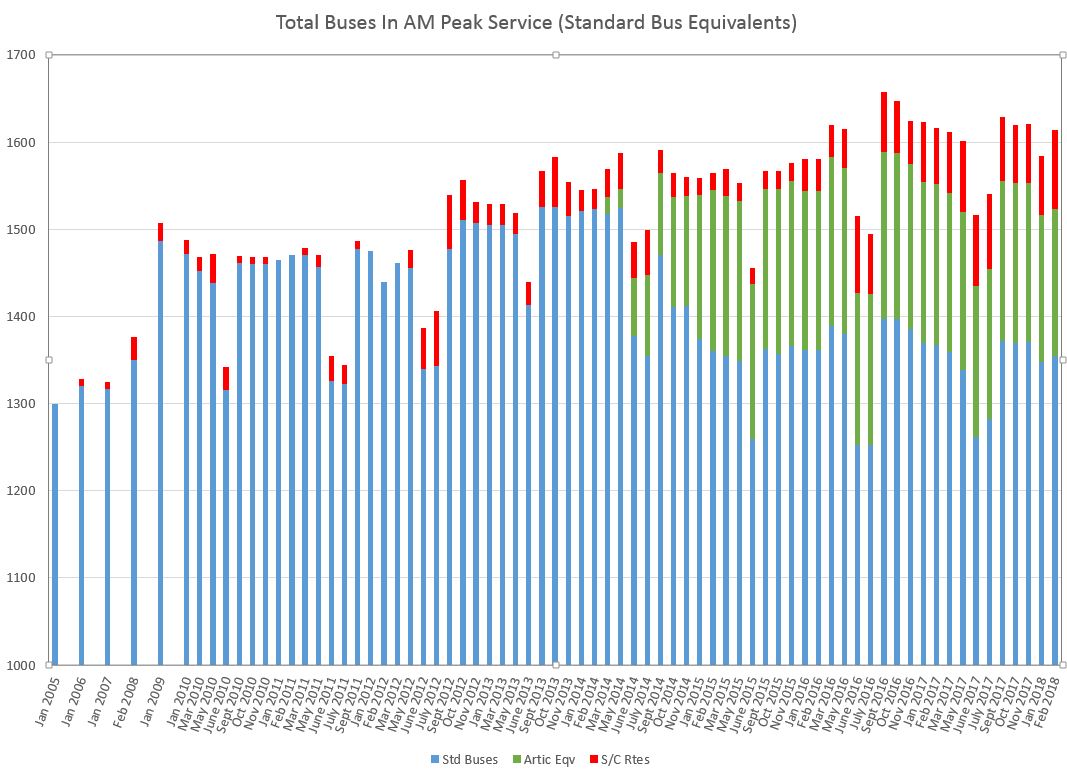
From a budget perspective, the streetcar shortage provides a handy way to save on operating costs because there are “no spare buses” with which to improve peak service. If not for the bus substitutions on the streetcar routes, the TTC would have an embarrassing surplus of buses sitting in garages, and would have to seek additional funding just to put them on the street.
The vehicle counts shown above are for scheduled service, and three sets of spares sit on top of these numbers (not shown here):
- Maintenance spares in each garage (includes spares for change-offs of vehicles that fail in service),
- “Capital spares” for buses in major overhaul projects, usually at Hillcrest, and
- “Warranty spares” for new buses undergoing modifications while they are still under warranty (location depends on the nature of the work).
This brings us to the problem of garage capacity. The bus fleet plan must provide not only for scheduled service, but also for the spare vehicles at garages. This has been a problem for some time because the capacity required exceeds the practical capacity of the various sites compromising their ability to function.
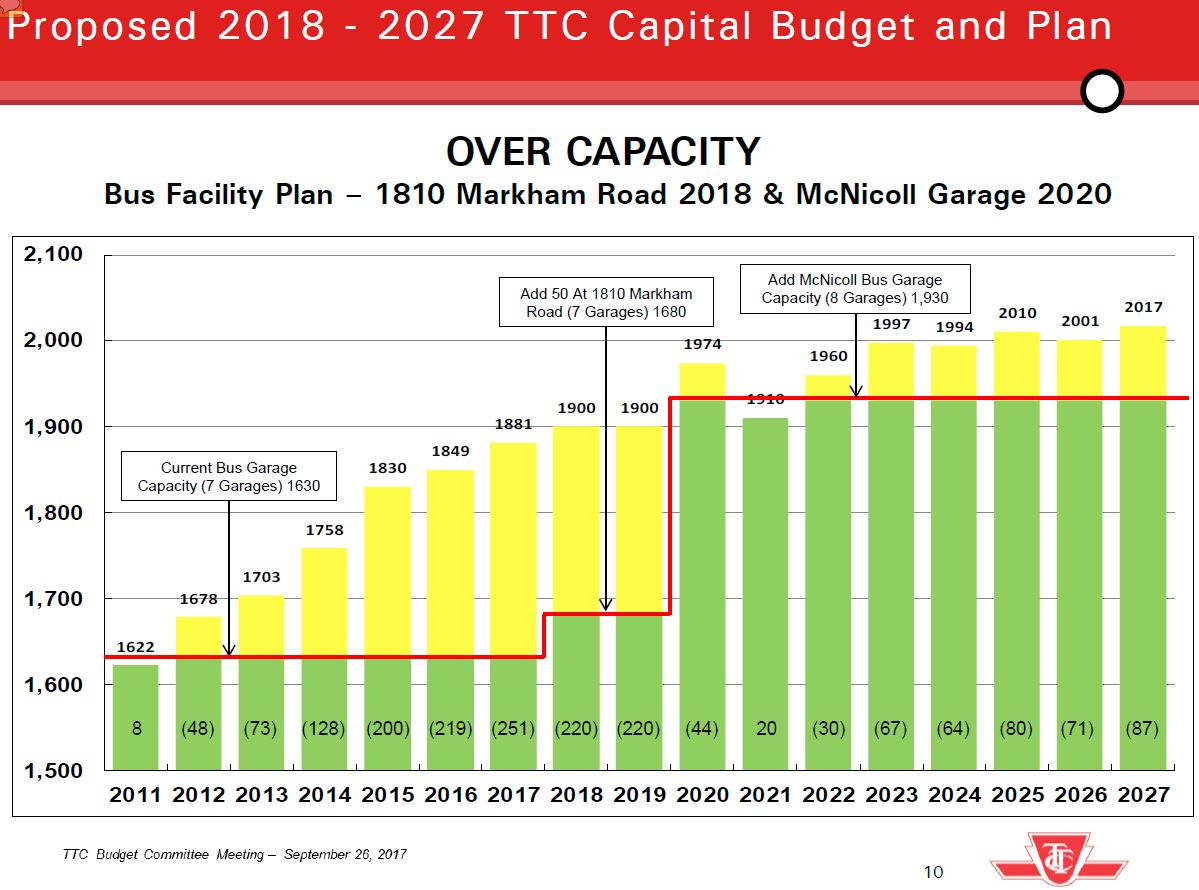
Note that the total number of buses (yellow) in garages is about 300 higher than the number required for service (shown in the earlier charts above). The next major jump in capacity comes in 2020 when McNicoll Garage opens, and there is no provision for additional peak service through 2018 and 2019.
Garage planning is complicated by the mix of vehicles in the fleet. Only certain sites can host articulated buses because of their physical layout and the availability of equipment specific to the longer buses. Artics now operate from Arrow Road, Malvern, Mount Dennis, and Wilson. If the TTC purchases a substantial number of electric buses, they will require either that an existing garage be modified or that a new purpose-built facility be created. There would be a rolling requirement to retrofit diesel-based garages for electric operation over the period of transition to a new fleet, and for older garages, this could even be an opportunity to rebuild rather than to renovate.
Because of the lead time for new facilities, the TTC and the City are locked in to the current capacity of the seven garages now in operation with an eighth to follow in 2020. Building up the fleet to add peak service will be challenging even assuming buses could be procured, or that older buses now planned for retirement could be kept active while the new orders now in place roll into Toronto.
We have burned through the surplus capacity in existing facilities, and then some, thanks to a decision to cut service standards and reduce the fleet back in 2011. The oft-cited additions to the fleet under Mayor Tory have gone largely to increase the pool of spare vehicles and to backfill for the failing streetcar fleet, not to improve service on the bus network.
As the 2018 TTC budget worked its way through various meetings, some progress was made on funding crowding relief for the bus network, but only for the most serious cases.
At the TTC itself:
Direct staff to adhere as much as is possible to the Toronto Transit Commission’s loading standard with a net zero budget impact:
- a. in the off-peak hours;
- b. in the peak hours using every available vehicle; and
To report quarterly on adherence to the loading standard through the Chief Executive Officer’s report.
The funding needs for better service were summarized in a Briefing Note to the City’s Budget Committee:
In 2018, subject to an increase in operating subsidy, the TTC can focus on addressing overcrowding in peak periods and off-peak periods where overcrowding exceeds 30% (i.e. 11+ standing customers per bus on average).
• Based on bus availability […] this change can be implemented starting in September 2018. The TTC would require approximately 24 AM / 19 PM additional buses and $1.0 million in operating costs in 2018 and $4.0 million annually thereafter ($3.5 million in peaks + $0.5 million for off-peak).
The Budget Committee approved:
An increase to the Toronto Transit Commission’s 2018 Preliminary Operating Budget of $1.0 million gross and net to bring bus overcrowding to 30% above the current overcrowding standard for non-peak hours.
An attempt by Councillor Mihevc (who also sits on the TTC Board) to fund all of the remaining shortfall was voted down. Whether an attempt is made at Council to reinstate this funding, and how successful that might be, remains to be seen.
Motion to Amend Item (Additional) moved by Councillor Joe Mihevc (Lost)
That the Budget Committee include in the recommended budget funds to support management of overcrowding on the TTC from September to December 2018, including peak and off-peak service, at a cost of $3,200,000.
This means that there is no budget provision, as things stand, for additional peak period service.
The Streetcar Network
It is no secret that the streetcar network has suffered from a car shortage thanks to Bombardier’s slow deliveries, but the problem has existed for about 20 years, ever since the 510 Spadina and 509 Harbourfront routes soaked up the last of the spare fleet. What had been adequate through the recession of the early 1990s has been inadequate to serve the streetcar network ever since riding began to grow as the economy recovered. (The TTC had also rebuilt several PCCs for the 604 Harbourfront route, as it was then called, but these were retired due to age and the general surplus of streetcars by the mid-1990s.)
The charts below show the AM peak scheduled service subdivided by type of car from 2005 to 2018 in a format similar to the bus charts above. The first chart simply counts cars regardless of their capacity, while the second adjusts the ALRV and Flexity (LFLRV) bands proportionately to the vehicle sizes and their service design capacities compared to the standard CLRVs.
What is evident here is that the scheduled service was more or less unchanged peaking at just over 200 cars during winter schedules until late 2015 when the new Bombardier Flexitys began to arrive. From that point onward, CLRV and ALRV retirements brought down the total scheduled service, and the larger size of the Flexitys has not completely offset the loss of the older cars. This brings us to February 2018 where two major routes, Carlton and Dundas, will be converted to bus operation although this is partly offset by a return of streetcars to Bathurst and Kingston Road, as well as an increase in the number of cars on Queen.
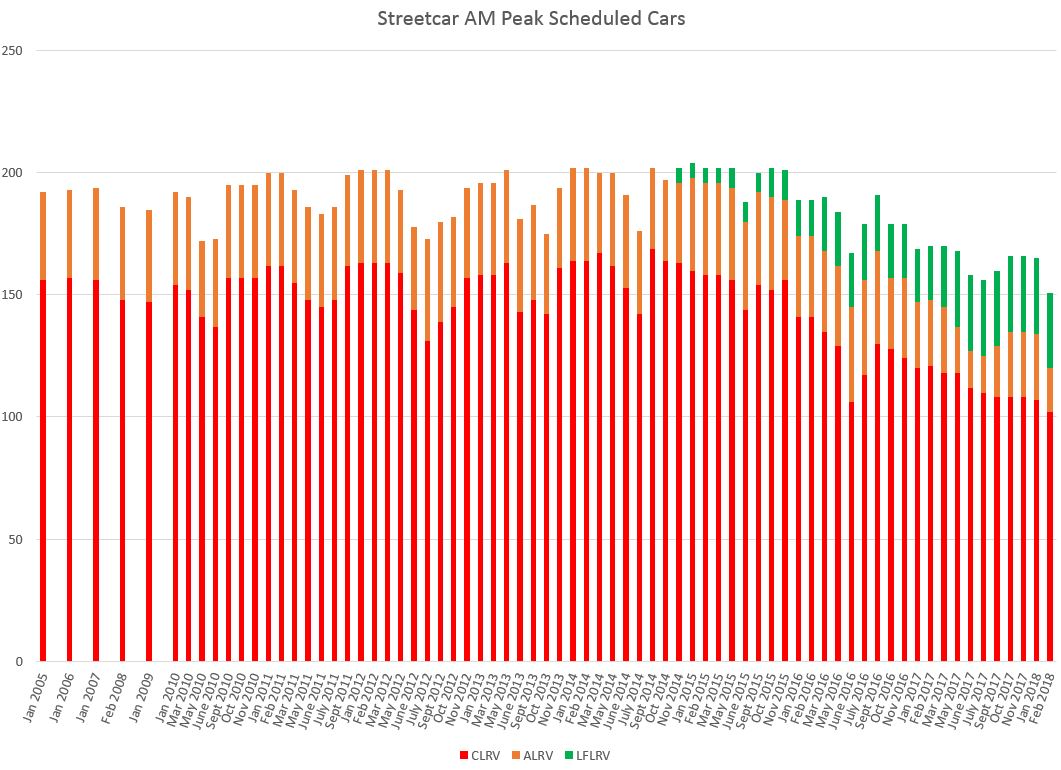
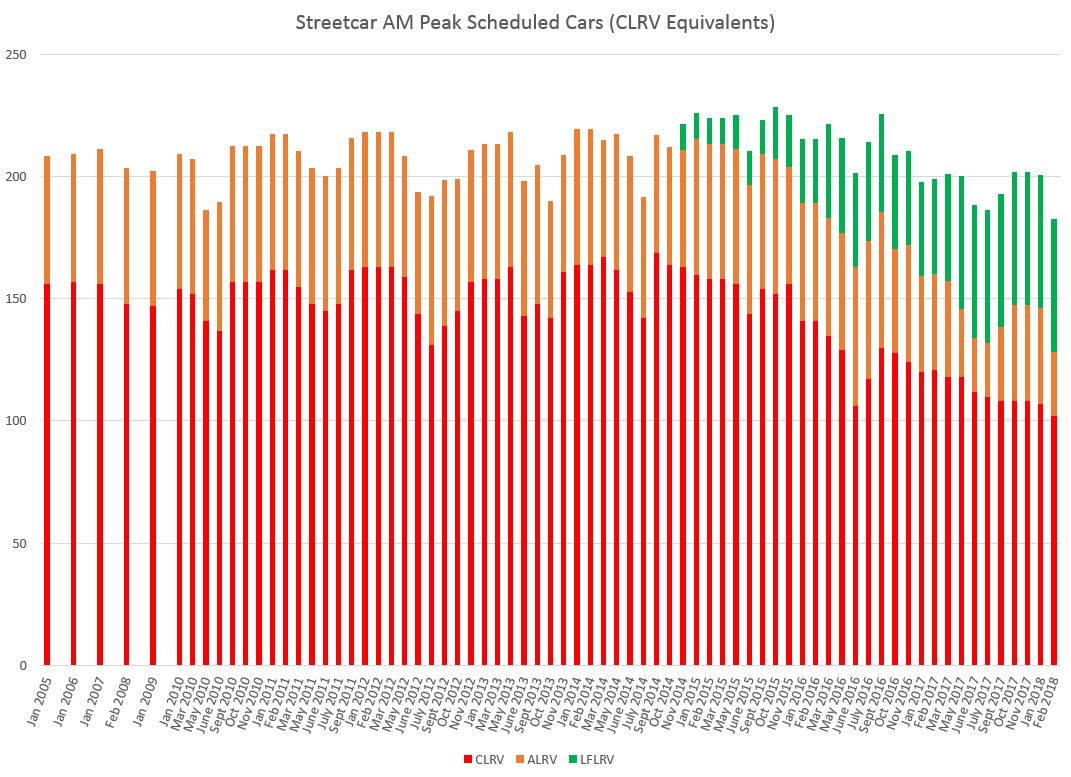
A full set of the bus and streetcar charts for both AM and PM peaks is available as a PDF below. The data are adapted from the Scheduled Service Summaries which are available on this site back to March 2008, and earlier from hard copies in my archives. (February 2018 is estimated from announced service changes.)
The TTC has been saved from the worst effects of the streetcar shortage by various construction projects that forced bus replacement, and the network has not run with 100% streetcar service since mid-2012 (see bus charts earlier in this article). A return to full streetcar service now depends both on Bombardier’s deliveries and the continued health, such as it is, of the CLRV fleet.
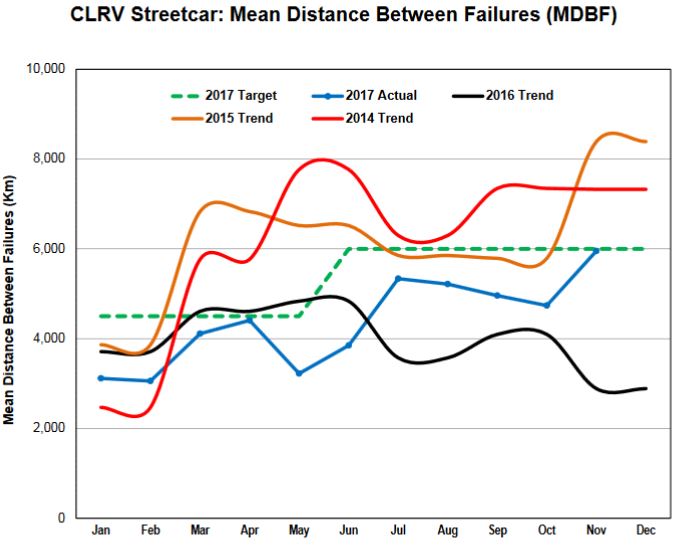
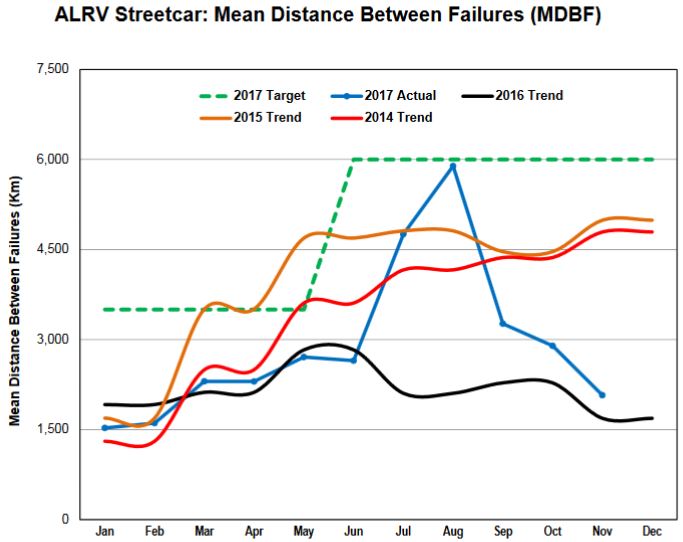
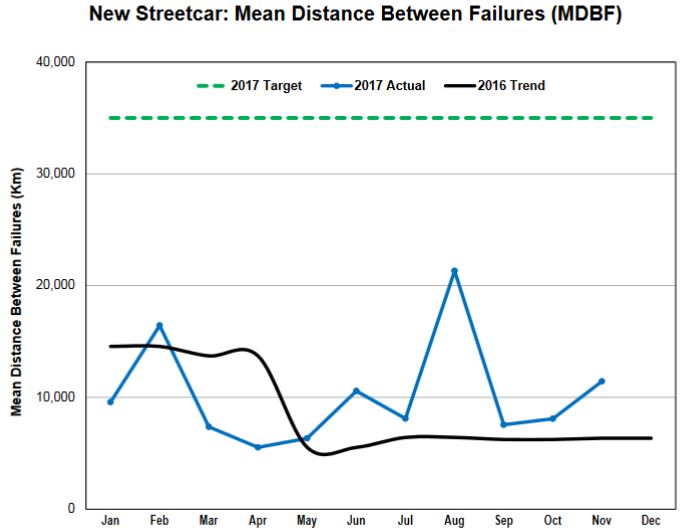
The reliability of the three streetcar fleets varies considerably. Note that in the following charts taken from the January 2018 CEO’s Report, the vertical scale is not the same for each chart.
The reliability of the CLRVs shows a downward trend year by year from 2014 (red) to 2017 (blue), although this is not clear cut. Recent maintenance work on the CLRV fleet has improved its reliability in 2017 over the low point in 2016. Also evident here is the annual dip in reliability during winter months which are not kind to these cars’ subsystems, a fundamental design problem ever since they were delivered.
The ALRVs (articulated streetcars) show similar patterns to the CLRVs, and this fleet hit a high point in August 2017 from which it quickly fell again. The winter months of 2017/18 are not yet in these charts and the numbers will not be good based on the amount of service the TTC has managed to field. Note that the fall in reliability predated the cold weather, and so more is going on here than just a case of severe streetcar frostbite. The spike in reliability through the summer is probably due to the reduction in the number of ALRVs actually in service so that only the best cars were on the road, and once a larger portion of the fleet was back in service, reliability fell again. The change in the number of scheduled cars is visible as a narrowing of the orange band in the AM peak scheduled cars chart above during mid-2017.
This is an example of problematic performance statistics that can be affected by factors that are not immediately obvious in a chart.
What is particularly galling is the decline in the number of ALRVs in service which will be down to 18 cars (10 on Queen and 8 on King) by February. Over the past year or so, the TTC has spent about $1 million per car rebuilding 25 of the ALRVs for continued service, but this work, according to the TTC’s Brad Ross was only cosmetic and did not address problems with some of the subsystems leading to withdrawal of the ALRVs from service during December 2017’s deep freeze.
The new Flexity cars are gradually improving, although their stats have bounced around a bit during the two years for which they are published. As problems with various subsystems, notably doors, are resolved, we can only hope that the rise in late 2017 will continue, and especially that there will not be the winter dip so characteristic of the older fleet.
As of February 2, 2018, the highest numbered car visible through tracking data is 4463, and this is well below the mark of 4470 originally expected for year end. Bombardier and TTC have not yet issued an updated delivery schedule. A related problem is the question of whether the TTC will, as new cars become available, simply use them as replacements for existing vehicles, or if the total fleet will grow and streetcars return to routes now operated with buses. This would make more buses available for service improvements on bus routes even with a freeze in the total fleet size. This is a question for later in 2018 when there is a better sense of what Bombardier will actually achieve.
The Rapid Transit Network
As everyone saw this week, the subway network is incapable of absorbing the effect of significant delays during peak periods, especially when multiple events combine to strangle system operations and capacity. A detailed report will come to the February 2018 TTC Board meeting, and I will leave comments about causes, effects and needed changes until then. The TTC has already acknowledged that some of the mess is on their heads, “own goals” one might say.
The evolution of subway capacity problems is a combination of several events and political pressures, and it can be traced back to the recession of the early 1990’s. In the late 1980’s, the subway was bursting, especially the lower Yonge line, and provision of new capacity was a big issue. This could be done in two ways: either run trains more frequently, or build a new parallel line, the route we now call the Downtown Relief Line, but which was once known as the Queen Subway.
With the recession, TTC riding dropped like a stone, and the system lost 20% of its ridership. Suddenly, subway capacity was not an issue. Meanwhile, the idea of an extension to Richmond Hill took root, and for a time it was assumed that extra demand could be handled by the existing infrastructure subject to several upgrades:
- New cars with open gangways would increase the capacity of trains by about 10%. This spare capacity could be counted on some years back when the Yonge line was served with the older cars, but the new trains’ capacity has long been absorbed by the latent demand for service in this corridor. Quite bluntly, it is dishonest to continue talking about this as if it were future capacity waiting to be tapped, but this still shows up in some presentations.
- A new signal system would allow trains to operate much closer together with train frequencies from 105 seconds down to as low as 90 seconds.
- Trains could be extended with a seventh car to fill out space on platforms that is now a buffer for inaccuracy inherent in manual train operation and stopping, but which disappears with Automatic Train Control (ATC).
- The capacity of key stations, notably Bloor-Yonge, would have to be increased to handle the larger passenger volume a more frequent service would bring to the platforms and circulation space.
The signal system, now in operation on the Vaughan extension and planned to be extended over the entire Yonge line in stages by late 2019, will allow trains to run much closer together because the control system “knows” exactly where trains are and can adjust speeds to match the safe braking distance. This allows trains to pull closer together when there is a backlog than would be possible with the existing signals that use a much coarser resolution of train location. In particular, a train waiting to get onto the platform at Bloor Station could pull much closer behind a train in the station, and be on the platform sooner than it would be with the current system. This provides more time for passenger handling rather than waiting in the tunnel.
Current plans are to extend ATC south from the current limit between Wilson Yard and Sheppard West Station to at least Dupont by the fall of 2018. The section from Yorkdale to Dupont is already completed and was active during testing before the extension opened, but it has been turned off again to avoid switching back and forth through the complex junction at WIlson Yard which is still a work in progress. Beyond Dupont, the current schedule is to complete “around the U” to Bloor as the next step in 2019, although this cutover might be broken into segments to allow the University side to convert sooner. The full conversion north to Finch will be complete in late 2019, and based on current experience, the TTC believes that this target will be met.
The Yonge line is scheduled for a 141 second headway (2’21”) in the AM peak, or 25.5 trains/hour. At a service design capacity (see the crowding standards above) of 1,100 per train, this is equivalent to about 28,000 passengers per hour. Once ATC is in place, the TTC plans to build up service to 30 trains/hour (2’00” headway, 33,000 passengers), and later in stages to 33 trains/hour (1’49” headway, 36,300 passengers). This jump will not be done all at once to ensure that other factors do not make actual operation at those headways difficult or impossible.
The problem is that choke points can exist both at major stations due to long dwell times, and at terminals due to physical constraints on turnaround times and operational delays. Because every other train inbound to a terminal must cross the path of a waiting outbound train, and in a worst case this is done from a standing start just beyond the crossover, there is a lower bound on the cycle time for trains. There are ways to get around this, but they require reconfiguration of the terminal. An easier approach is to have a short turn before the terminal so that all trains do not run through. This reduces the timing demands at the end of the line. For example, for the proposed Richmond Hill extension, only half of the trains will run north of Finch.
Until ATC is in place over the entire line, shorter headways cannot be operated, and especially not through the already crowded Bloor Station. However, an option available to the TTC and mentioned in the subway crowding report is the reinstatement of “gap trains” that could pull out onto the line when there is a delay. For the Yonge-University line, these trains used to sit at Davisville in the AM peak to fill gaps coming south from Finch, and at the centre track between Union and St. Andrew to fill gaps in either direction northbound from the core. These trains were cut from the schedule as a cost saving measure. The bean counters (including politicians) see only empty trains that do not always run, but sit awaiting their call, while those concerned with service see gap trains as a necessary measure to minimize the effect of gaps that will occur more often than not. A near empty train pulling into Bloor Station can swallow a packed platform’s worth of passengers and avoid severe problems for following trains, not to mention for the overcrowded platform.
There are limited places where gap trains can be stored for use on the line because little additional storage was provided when various parts of the YUS were built. An often-mentioned spot is in the tail tracks beyond terminals, such as at Finch, but this brings its own problems with the existing signal system. When a tail track is occupied, trains are forced to enter the station much more slowly than normal to guard against platform overrun into the parked train. This actually reduces the capacity of the terminal and throttles service. Once ATC is in place, the control system will be in charge of train speed and will not have to be as overly conservative on entering as the current system now enforces.
A further issue in planning for the YUS is the available fleet. Peak service now requires 61 trains in the AM and 63 in the PM. (Although the headways are wider in the PM, no trains short turn and so more are required to operate full service to Vaughan.) Moving to 30 trains/hour is an increase of about 18% taking the total fleet requirement to 74, not including spares or gap trains. However, the TTC only owns 76 TR trainsets, and cannot get to 30 trains/hour with the current fleet, let alone to 33. There are no plans in the capital budget for the additional trains required to improve service.
Another change possible with ATC is that trains can run at a higher speed than with the existing signals that are designed for lower-speed operation and cannot easily adapt to the higher speeds of which the trains are actually capable. This would reduce total train requirements, but the degree of this effect is not yet part of published plans in part because the TTC has not yet addressed the need for more trains when headways are reduced with ATC. Some of the headroom for this improvement was eaten up when four trains’ worth of TRs (24 cars) were converted to six, four-car trains for use on the Sheppard line.
On the Bloor-Danforth line, there are two possible locations for gap trains: Greenwood Yard in the east and Keele Yard in the west. The TTC has a surfeit of the T1 cars that operate on BD because early fleet plans for the Vaughan extension assumed that some of the T1s would remain on the YUS. However, converting them to ATC was considered impractical and costly given that they are due to be replaced in the mid-to-late 2020s, a project that could be advanced if the Scarborough Subway Extension is to operate with ATC.
The subway crowding report proposes the re-establishment of gap trains, but this runs into issues both with budget (operators to drive them) and availability of equipment.
There are about 61 trains’ worth of T1 cars in the fleet, but only 45 are used in peak service. Allowing for spares at 20% (9 trains), this leaves 7 trains available for minor improvements, notably gap trains on BD. More frequent service is not possible given the limits of the existing signal system that will not be replaced until the mid 2020s. Those 7 trains were earmarked for the Scaborough extension, although they will not run there because of the switch to ATC. If the T1 fleet is replaced car-for-car, this will allow the SSE to open with 50% of the trains turning back at Kennedy, but with no provision for shorter headways on BD that ATC would allow.
It is ironic that original plans for ATC would have seen YUS completed by 2016/17 and a ramp up of work on BD from 2016 through the early 2020s. However, work on BD was deferred because it was felt that the through service on a Scarborough-Eglinton crosstown route would divert traffic away from the Danforth subway.
BD Automatic Train Control – ($150.0 million): Signal equipment on the BD line has reached the end of its useful life and needs to be replaced. In addition, the line is nearing the capacity that a conventional signal system will permit. Thus the initial capital plan put forward by staff was to replace the current conventional signal system with an ATC signal system following the completion of the ATC implementation on the YUS line. However, since the conception of this plan, a major change to expansion plans was announced, namely the combining of the new Eglinton LRT line with the rehabilitated/modified SRT line into one continuous line, resulting in lower ridership projections on the BD line. Thus the need for ATC on the BD line has been deferred well into the future. [Amended 2012-2016 Capital Program and 10 Year Forecast – Shortfall Reduction Plans (September 16, 2011) at p. 5]
Such are the problems with shifting plans – the assumptions made under one set of circumstances might no longer be valid, but the dependencies and effects of changing policies are poorly understood (or forgotten).
In April 2018, the TTC will also bring out a major plan for renewal of the Bloor-Danforth subway which will include:
- New signals and ATC implementation.
- A new fleet capable of ATC operation and with provision for one person train operation (or “OPTO” in TTC-ese).
- A new yard and maintenance facility west of Kipling Station on lands formerly occupied by the CPR Obico Yard (property acquisition is already in progress).
- Station renovations including accessibility and fire safety changes.
- Co-ordination with the Scarborough extension so that the entire line is ready for modern operations by opening date.
The intention is that by co-ordinating these as one set of projects, there will be both economies of scale and an avoidance of the many “oops” that bedeviled upgrades on the YUS that were planned and executed on a piecemeal basis. The various subprojects exist, for the most part, in the capital budget, but not all are funded, and they are currently timed in ways that would cause conflicts in the overall execution. Timing is an issue in capital projects because the ebb and flow of spending requirements does not always fit with available sources of funding, particularly the City of Toronto’s borrowing plans. This has been a source of project delay in the past with needed work deferred simply because there is not enough money available to pay for it.
Greenwood shops is not configured for unit trains like the TRs running on the YUS. However, assuming that shorter trains operate on the Relief Line comparable to those on the Sheppard Subway, Greenwood could be home base for the RL trains. Obviously this cannot happen until the BD operations vacate Greenwood for the new yard at Kipling.
All of this may seem arcane, but fleet planning and associated capital budgets are essential for the TTC to achieve the capacity improvements touted as possible with ATC on both routes, not to mention for implementation of any extensions.
Crowding on the Subway
The crowding report includes diagrams showing the level of crowding for the YUS and BD lines. These do not tell the full story of what is happening. For starters, the yellow sections in the charts below show stations where trains “may not accommodate localized surges in demand”. In fact as riders well know, the problem is not with “localized” demand, but with full trains that cannot handle peak demand. This arises from a combination of inate demand such as occurs southbound from Finch and from irregular service. The smallest delay pushes almost full trains over the line, and this cascades as longer dwell times and occasional passenger emergencies thanks to overheating or panic.
What was once a “peak hour” now extends to a wider period, and the system is under stress and vulnerable to disruption for a longer time.
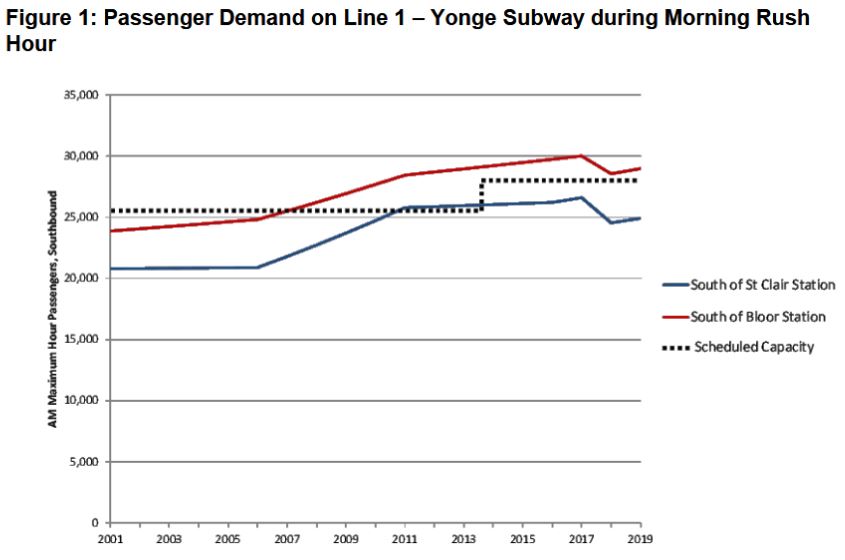
Customers have adapted to the morning rush hour crowding conditions by changing their commute times earlier or later in the morning. Whereas morning peak hour ridership on Line 1 southbound from Bloor Station has increased by about 10% since 2001, the three-hour morning peak period ridership has increased by nearly 20%. In other words, much of the growth in demand generated along the Yonge corridor has been accommodated on the shoulders of the peak hour and the “peak within the AM peak period” has spread. [Subway crowding report, p. 3]
A fundamental point about the design capacity is that one cannot operate a system at that level on a sustained basis. It is an upper bound, not a target to hit. Tell people that the Bloor and Danforth subways are not overcrowded, and they will laugh. The TTC does itself no favours with this type of presentation giving the impression that those trains you cannot get on every day are only an occasional problem.
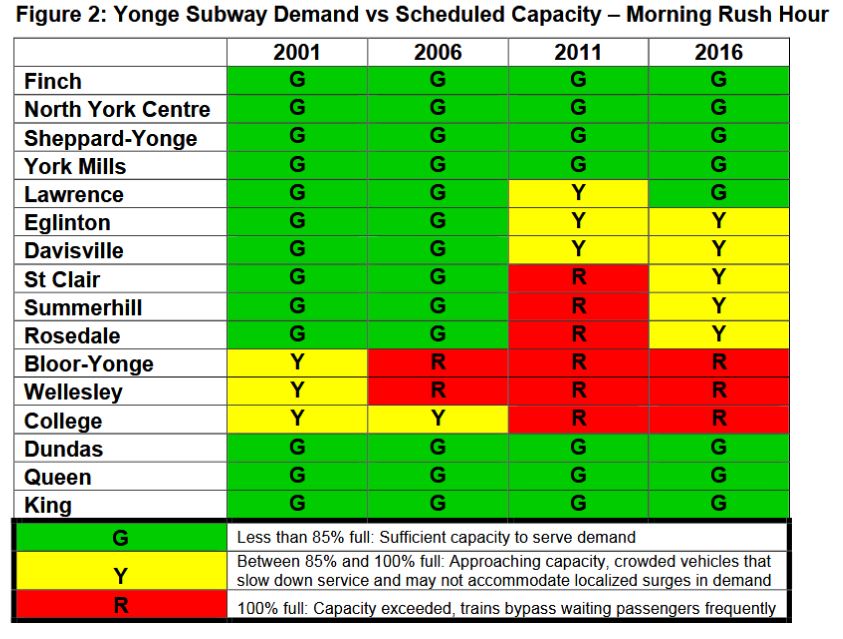
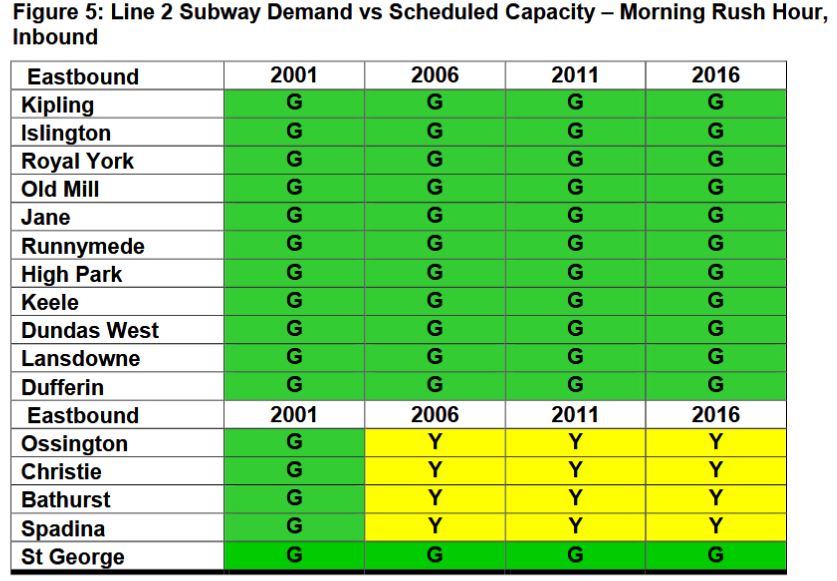
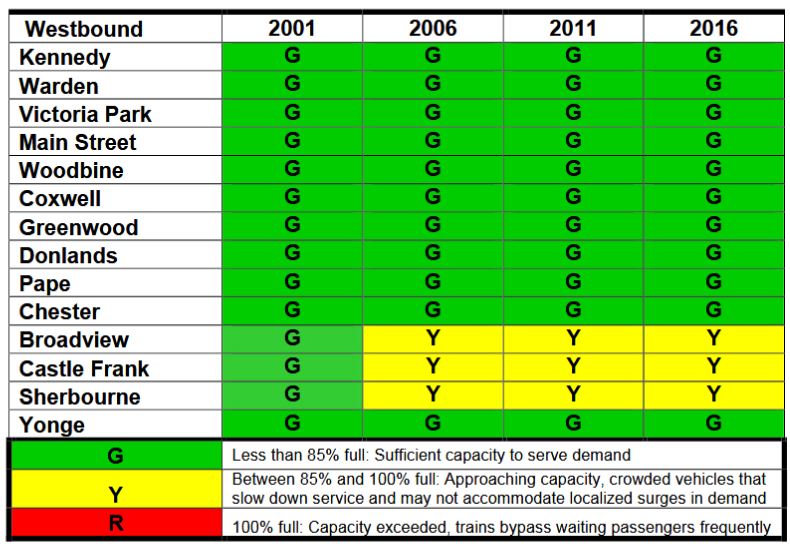
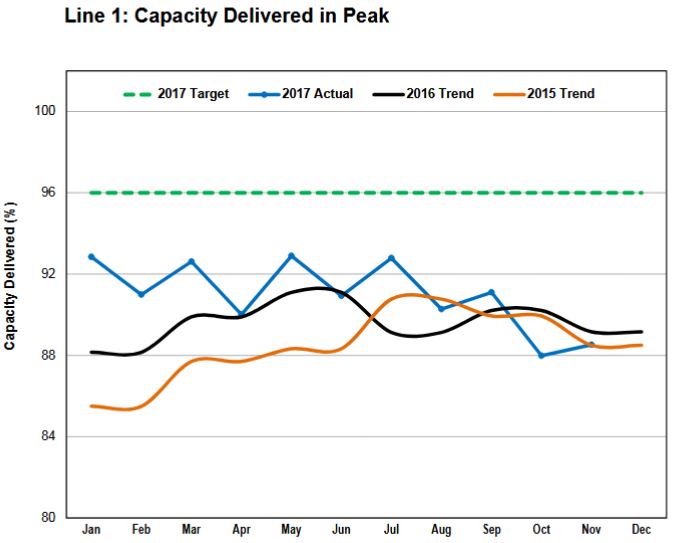
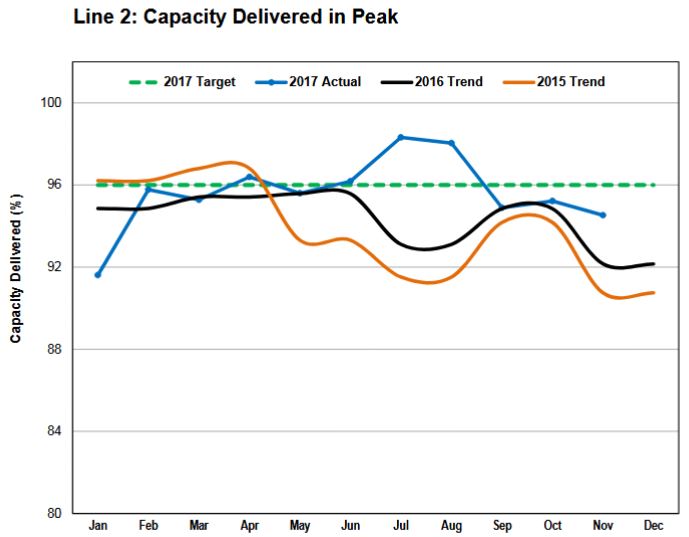
In fact the TTC never operates its service at the scheduled capacity as shown regularly in the CEO’s report.
The values shown below are averaged over the peak period and over various sampling locations. This understates the degree of the problem for the most congested locations and the most congested hour. It is of little value for 26 trains/hour to leave Finch southbound if by the time they reach Bloor, delays reduce the station throughput to a lower value.
The Yonge-University subway routinely delivers 90% or less of the scheduled capacity, and therefore conditions that appear as borderline in the tables above are actually critical. It is essential that the TTC disaggregate the data so that service levels can be matched against the claimed crowding and capacities along the routes. Far too often, the TTC uses averaged data which hides the most severe problems.
When the problem of service operating below scheduled capacity is combined with the question of “is the subway full”, the chart below verges on dishonesty. This shows the peak demand relative to scheduled service, but that level is almost never achieved and so the shortfall is much greater. The dotted line showing the YUS capacity at about 28,000 per hour should really sit at about 25,000 to reflect the 90% or less of service that actually operates. The subway has been overloaded for a decade when actual, not scheduled, capacity is used as the yardstick.
The jump in scheduled capacity in 2014 coincides with the introduction of the TR trains with about 10% greater capacity. As is quite clear here, that 10% was used up long ago and should not be spoken of as if it is a future addition to the service.
The Need for Subway Relief
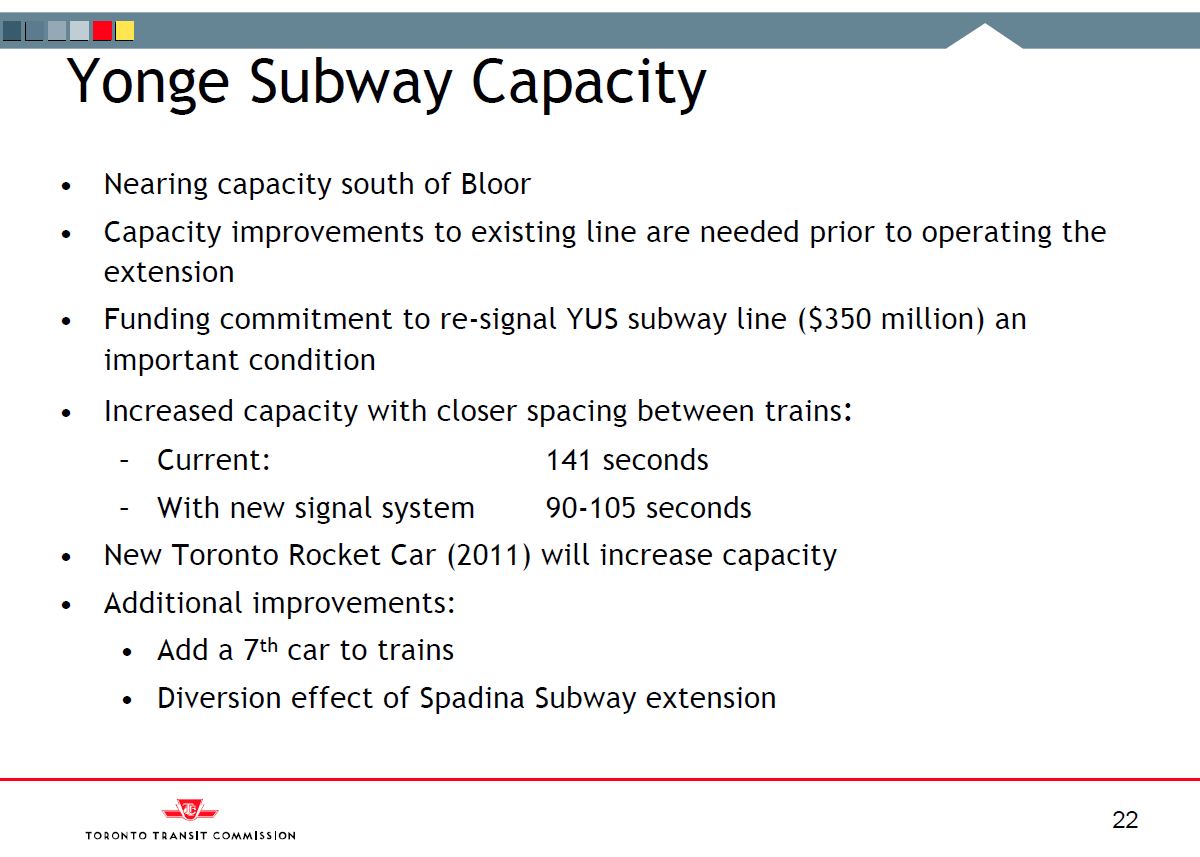
Back in December 2008, TTC staff gave a presentation on the recommended configuration of the Richmond Hill extension and the issues it raised. This presented a rather rosy picture of the ability to handle rising demand on Yonge without building the Relief Line, even though it recognized the huge benefit such a line would have in reducing demand on the heart of the subway system downtown.
In the slide below, note the claim that the new signal system could provide a 90 second headway. This has been the source of much misinformation about subway capacity. ATC can run trains quite close together, but this is intended only in backlog situations or where there is a crunch point with long dwell times. It is not achievable over the entire route, especially at terminals. A sustained 90 second headway (40 trains/hour) translates to a capacity of 44,000/hour, the sort of number that can be thrown about to claim we would never need a relief line.
However, projected demands tell a different story.
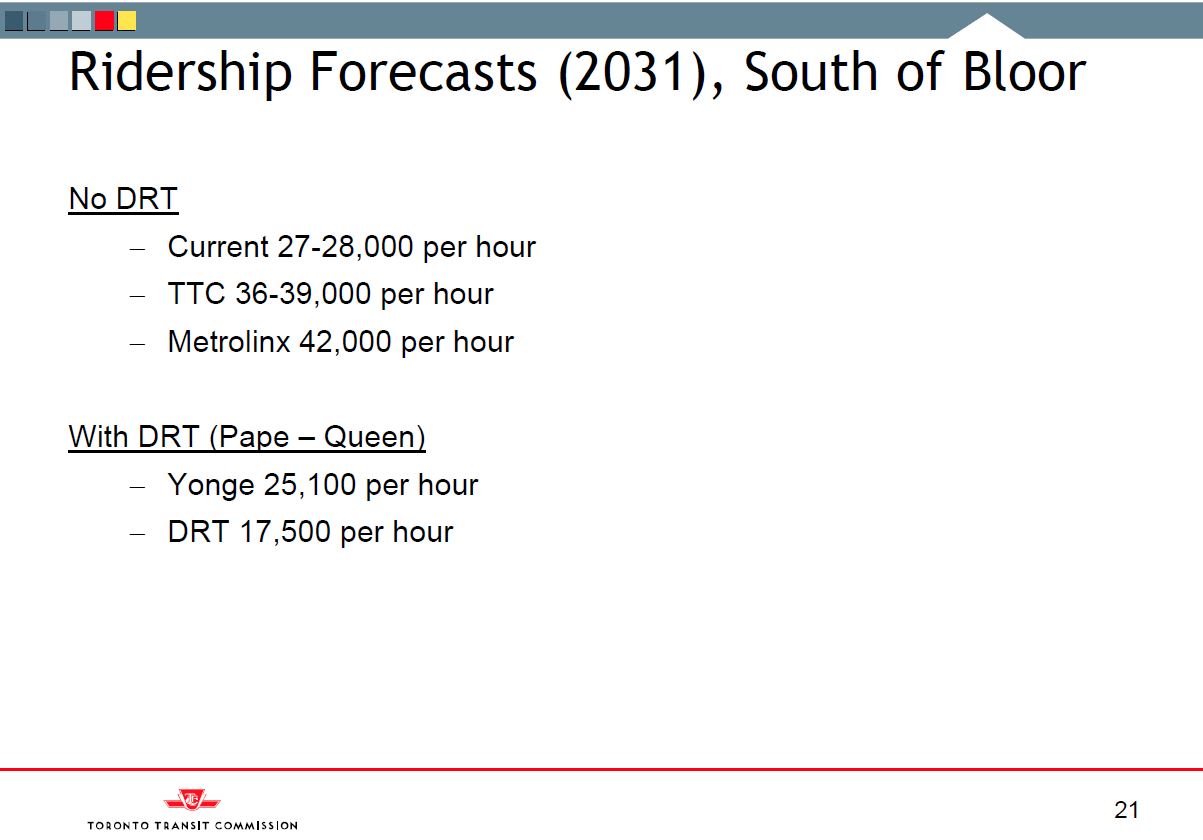
It was abundantly clear ten years ago that the DRL was required, but it languished as an unloved project while the focus looked outward to new subways for suburbia. A further problem with the projections is that they only look at the line south of Bloor when, as the TTC’s own chart shows (above) there are overcrowding problems well north of this point. That is the reason why the more recent Metrolinx Yonge corridor relief study showed a major benefit from taking the DRL all the way north to Sheppard.
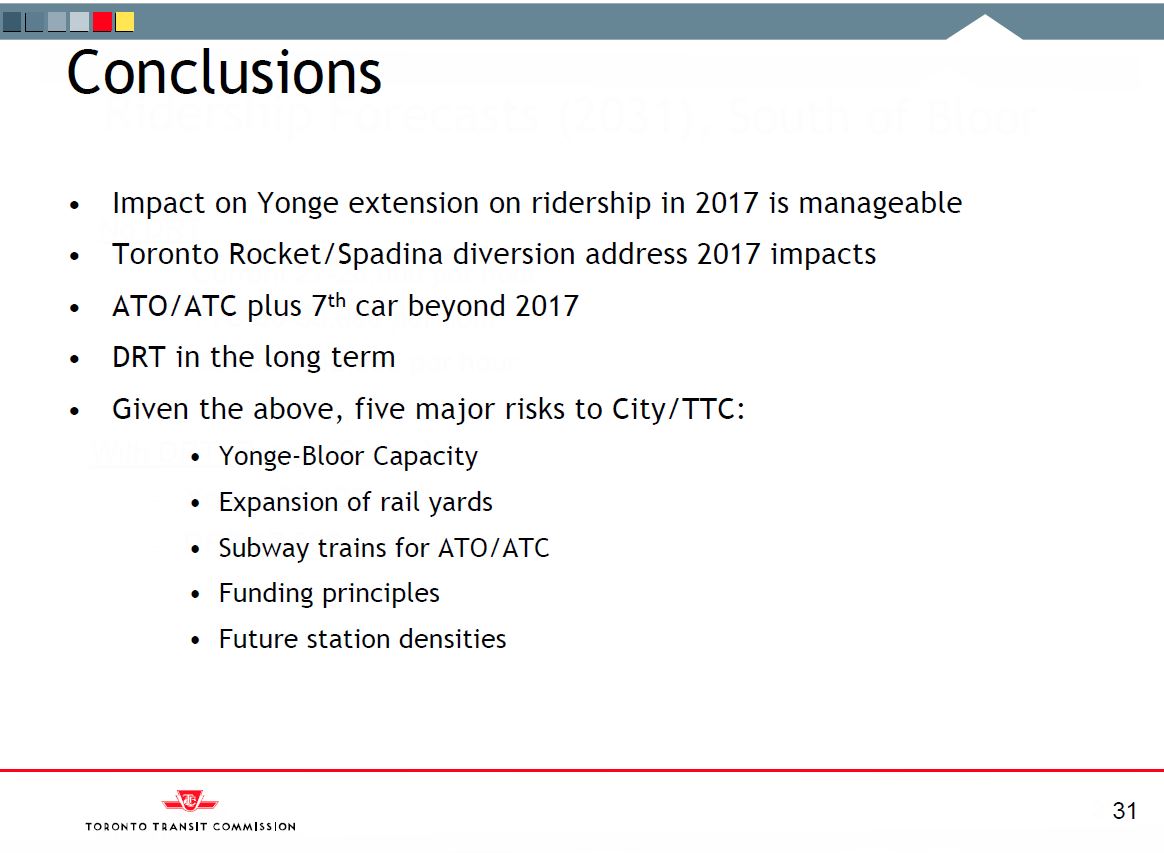
The 2008 presentation reached conclusions that are not supported by the situation as it then existed. Specifically, the claim that added ridership from the extension would be “manageable” in 2017 is complete bunk because the rate of growth in demand on the subway exceeded projections.
By March 2012, when the final Conceptual Design Report was issued, the projected demand at Richmond Hill had grown.
The projected transit ridership – developed during the TPAP – was updated during the Conceptual Design Study to reflect revised 2031 land use projections from York Region and the City of Toronto. Results suggest that more people (about a 25% increase) will board the subway at Richmond Hill Centre Station during the morning peak hour in 2031 than previously projected during the TPAP. The resultant increase reflects the implications of new secondary plans and development applications received since the completion of the TPAP in 2009. Based on current analysis, it is projected that ridership volumes in the Yonge corridor will warrant a subway within the next 10 years (i.e. before the year 2021). The minimum ridership required to warrant a subway is approximately 10,000 passengers during the peak hour. Within the next 10 years, over 12,000 peak hour passengers are expected to board or depart at RHC station alone. By 2031, ridership at RHC is expected to increase to 14,000 peak hour passengers. [page ii]
At no point did the updated report address the implications of this higher demand for the validity of earlier claims that the effects were “manageable”.
To the considerable unhappiness of York Region, the City of Toronto refused to contemplate a Richmond Hill extension until some type of relief was in place to offload demand from the subway. This is a major risk for the subway network thanks to the political influence of York Region and the cross-party hunger for its votes. Toronto could be forced to accept an extension with a half-hearted commitment to a Relief Line that might never quite materialize because of its cost.
The debate is further clouded by claims that GO’s RER plan coupled with John Tory’s SmartTrack will provide the needed relief. This ignores the relative location of RER/ST routes and their ability to drain ridership off of the subway network, even assuming GO would have the capacity to make a significant dent in subway demand.
Notable by its absence in GO’s planning is the upgrading of the Richmond Hill corridor. This is downplayed because of the cost of regrading the line through the lower Don Valley where flooding is common even though Richmond Hill GO Station would be right next door to the subway station. A related problem here is the desire by York Region travellers to get downtown for one TTC fare rather than the much higher GO fare.
The Metrolinx view of the capacity issue is summarized in the chart below.
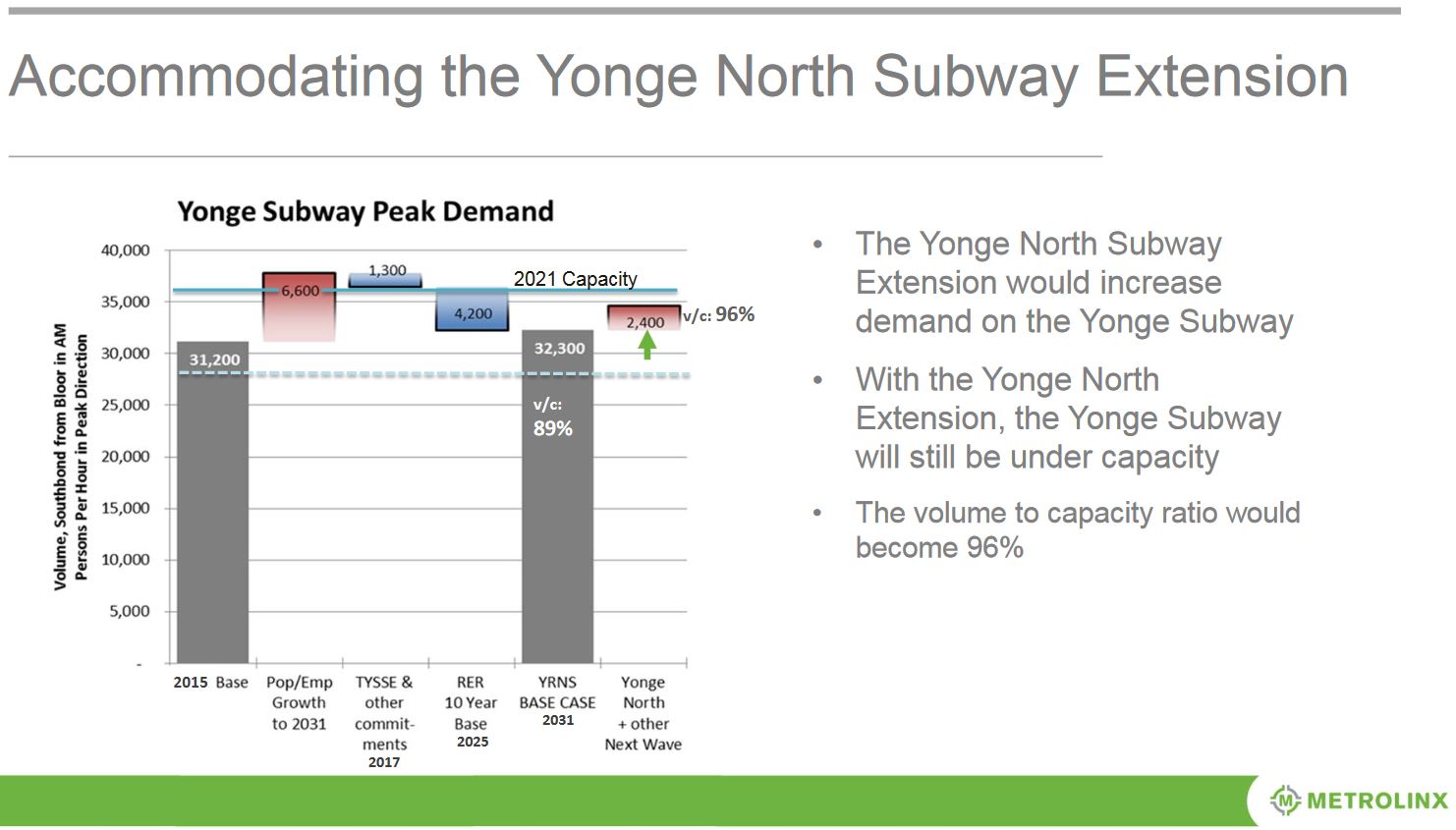
This chart develops projected demand and capacity through various steps:
- The subway’s existing capacity is taken as 28,000 (dotted line).
- The base ridership in 2015 is taken as 33,200, a value considerably higher than existing riding, but possible assuming the implementation of ATC and operation of more frequent service (the solid blue line).
- A further 6,600 riders (with unconstrained capacity) would arise from growth to 2031. This would push the subway over its capacity at 33 trains/hour.
- Although the TYSSE (Vaughan extension) will divert some riding away from the Yonge line, other planned changes such as the Eglinton Crosstown will add to demand with a net effect of another 1,300 riders in the peak hour.
- RER will divert 4,200 riders per hour away from the subway when it is fully implemented in 2025.
- The Richmond Hill extension and other related changes will add 2,400 per hour.
At this point, the subway would be almost full at 96% of theoretical capacity. However, the slightest error in any of the assumptions, not to mention the TTC’s inability to actually achieve its scheduled capacity, would put the route over the line.
Note that the additional ridership from the extension is only a fraction of the projected peak hour demand at Richmond Hill of over 14,000 according to the 2012 report. This does not line up with the premise that much growth at Richmond Hill will come from new development and suggests that the Metrolinx estimate lowballs the effect of the extension.
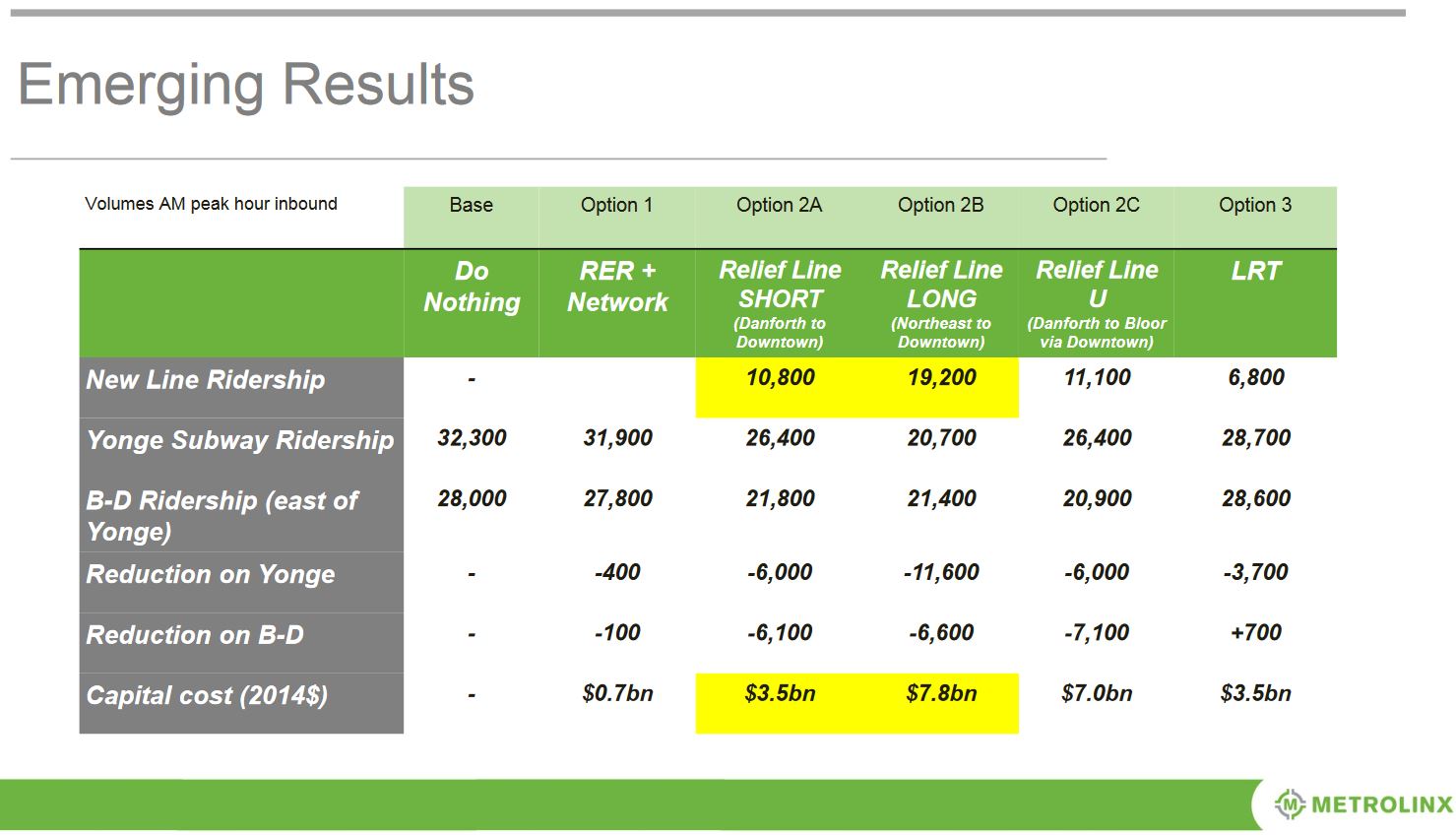
Metrolinx examined various options to relieve demand on the Yonge line, and the “Relief Line Long” running east and north to Sheppard and Don Mills would produce a huge drop in demand on the Yonge line to well below the current level. Any projections should be taken with caution, but the magnitude of change is substantial and considerable headroom would be created for growth from Richmond Hill and elsewhere. Queen’s Park’s renewed interest in the Relief Line arises directly from this projection, but whether it survives political changes over coming years could be the make-or-break issue for subway capacity.
Bloor-Yonge Station
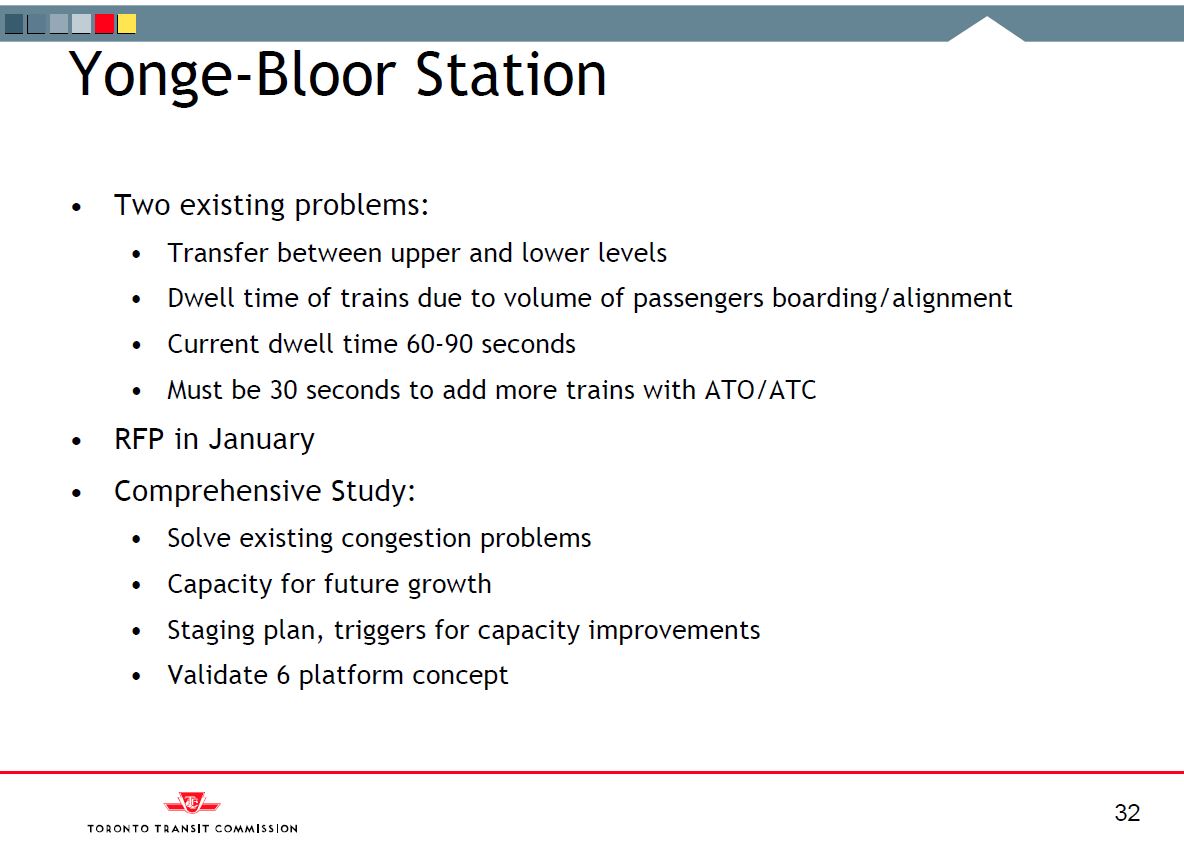
Bloor-Yonge Station routinely has crowding problems on the southbound platform in the AM peak, but this is not the only cause for concern. Circulation and stacking space for a backlog of riders during delays is limited as was seen all too clearly in the recent compound delay that totally plugged the station.
The problem also exists on the Bloor-Danforth line with its island platform that can easily fill if there is not a regular service of east-west trains to remove passengers in the PM peak. This becomes even more of an issue of more trains and more riders operate on the Yonge line because outbound riders could arrive at Bloor in the PM peak faster than they could be removed by the connecting BD service. Similar problems exist at St. George, and it is only a matter of degree because demand on the University line is not as severely over capacity as on Yonge.
A proposal to expand Bloor-Yonge capacity arises from time to time, and the pricetag on it sits at about $1 billion, a value that is almost certainly out of date. The following pages are from the December 2008 presentation about the Richmond Hill extension.
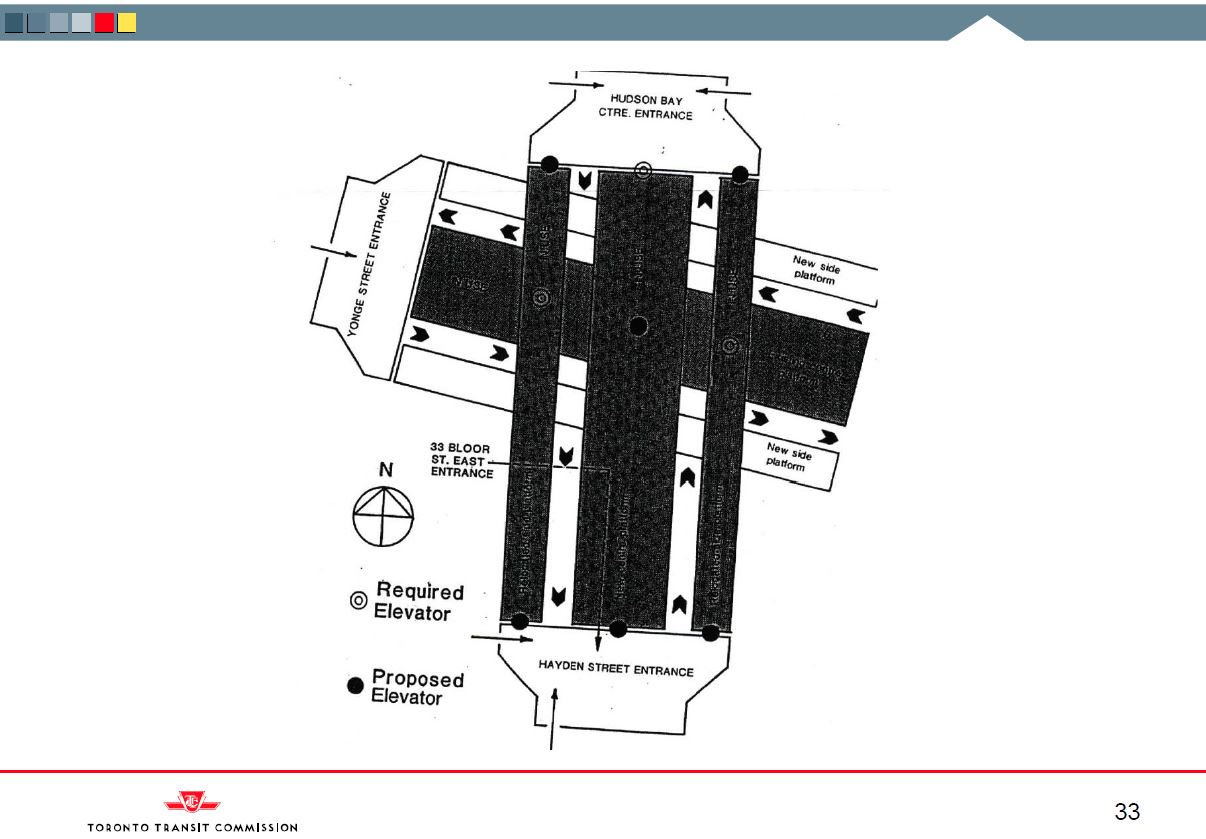
The 6 platform concept cited above requires extensive modifications to the station as shown in the diagram below. This involves moving the Yonge line’s tracks further apart so that a new centre platform can be inserted. Stations on both levels would have both a central and two side platforms. The circulation system to link all of these platforms adds to the complexity and consumes a substantial amount of platform space.
This layout has been studied before and it is extremely difficult to build. Bloor Station would have to close while the existing platforms were demolished, the tracks shifted, and new platforms constructed. It is my understanding that this scheme has been abandoned, but the assumption that “something can be done” at Bloor-Yonge remains.
Meanwhile downstairs on the BD subway, the addition of new platforms is constrained by the fact that the structure is surrounded by The Bay, its office tower and parking lot all of which were built after the Bloor subway opened. New platforms at that level would reduce crowding on the Yonge Station central platform, but would do nothing to aid with crowding upstairs in Bloor Station.
Even with all of the problems, the study downplayed the need for a Relief Line presenting it as a “last resort”.
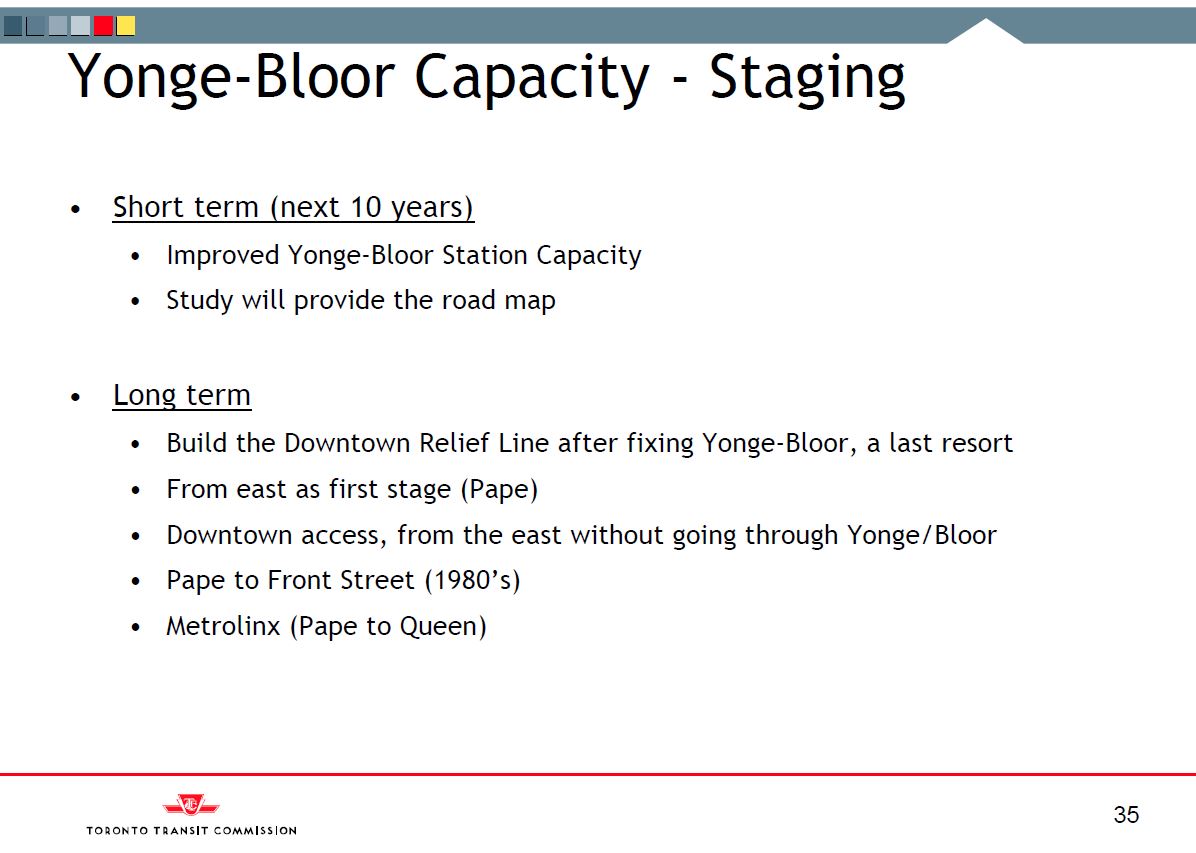
This is how we come to be in this mess with inadequate subway capacity that faces Toronto today – years of saying “relief is nice, but first let us try to fit more people on the existing line”.
The words “incompetent” and “dishonest” spring to mind, but this is what passes for planning when the imperative is to build where politicians want new transit, not where it is actually needed.
 Steve Munro
With the low-floor buses and streetcars (and elevators on the subway stations) came another problem. The SUV-stroller for babies.
Used to be that parents (me included) had to lift baby strollers up the steps to board transit vehicles. That meant light-weight baby strollers, like the umbrella stroller. Parents, like me, would fold up the stroller and put the baby on their lap, with the folded stroller between their knees. This allowed more people on board the vehicles. The people could even walk past them without difficultly.
Today, the low-floor vehicles allow the boarding of giant strollers, along with a week’s supply of diapers, change of clothes, food, and other supplies. While all-door boarding may help a bit (except for those who MUST board and egress through the front doors only), it can still be a problem because they can’t fold up the strollers to save on space and crowding.
LikeLiked by 1 person
Steve, I believe ATC was actually inaugurated late last year between Dupont and Yorkdale staitons. I am not sure if the gap between Yorkdale and Sheppard West is now ATC or not.
Steve: Yes it was, but has since been turned off as I think I mentioned. The gap from Yorkdale to Sheppard West is part of the Wilson Yard resignalling, and that is still in progress. The section south of Yorkdale was used both as a test and as a training bed for operators before operations north to Vaughan started. It will be reactived when the section at Wilson Yard comes online to provide continuous ATC from Vaughan to Dupont in fall 2018.
I experienced some of the Yonge line crowding in the late ’80s. One difference back then was that the north end of the line was nowhere as busy as today. Frequent trolley coach service on 6 Bay in the “Urban Clearway” could pull off some of the south-end demand, and north of Bloor wasn’t so bad. But as long ago as 2010, AM peak trains leaving Finch station were already standing-room-only, and people got on northbound trains at Sheppard and North York Centre to get a seat at Finch. I can only imagine how much worse it must be today. No matter what the time of day, if you get on a northbound train at Bloor, you can expect to stand to at least St. Clair, and more likely Eglinton.
Given that Yonge-Bloor, and to a lesser extent St. George, have long been “too big to fail”, I have to wonder at the logic of solving this by making them even bigger, at huge cost and long-term disruption. Anyone who remembers the mess at Union station during the construction of the south platform, or the mess at Bloor when the platforms were widened, would not look forward to years of this at Bloor/Yonge.
Which actually makes me wonder. You have written that there’s a group of subway-building enthusiasts within the TTC. Why have they not pushed for the relief line? It seems such an obvious project to me, and I would expect to anyone who has tried to board a southbound train at Bloor in the morning, or a northbound train at Queen in the afternoon.
Steve: Extending the Yonge line had more political support when this whole process started with York Region actively pushing for this route. All of the studies have the flavour of justifying the RH line and downplaying the need for the Relief Line. There are actually some direct contradictions between reports. On one hand, the RH line is not projected to add too much to the existing subway demand (i.e. most riders would be existing bus or park-and-ride arrivals at Finch). But when the goal is to justify subway-capacity construction, the story turns to future growth and development that will bring new riders and higher demand on the line. Exactly the same pattern happened in Scarborough. As for Vaughan, the demand there is so light nobody even tried to claim that it would ever reach subway-level riding. Indeed, if it did, the University-Spadina line would be swamped just like the Yonge line.
LikeLike
Well Steve, this is an example, maybe the greatest example, of the reason for all the accolades that you received in ‘Twelve’. I doubt that anyone could have covered the current situation with half the detail and understanding.
From your past experience, do you expect anything in the way of positive reaction from the ‘powers’?
Not that it should fall on your shoulders; but I wonder why there hasn’t been a more formal alliance among council members like Kristin and Joe, who tend to share your views. That would draw more public attention to these issues, in an election year.
Steve: I don’t expect much concrete from the “powers”, as you put it, in the short term in part because changing course right in the middle of the 2018 budget simply will not happen. However, the recent mess on the subway, and the more general malaise among TTC riders who simply do not believe staff claims that service is not overcrowded, sets the scene for change in 2019. Assuming Tory is still Mayor, and that Queen’s Park has not been taken over by total Neanderthals, we could see movement. The Bloor-Yonge meltdown will, I think, be a watershed moment for the Relief Line, although it is still close to a decade away just for the first phase unless someone starts spending serious money soon. Of course that ties in to the waste for the Scarborough Subway and for SmartTrack. Whether Tory will have second thoughts with the election out of the way and a real crisis today, not ten years from now, staring him in the face, is very hard to say. The cost estimates for the SSE and ST may scare the crap out of Council as well they should, but these have been conveniently parked until after the elections. Now that Council demands much more rigourous cost estimates (thanks to the mess with the TYSSE and ATC contracts), staff simply will not be able to lowball estimates for SSE and ST while maintaining “professional” integrity. (The acid drenched sarcasm there is intentional.)
My hope with this article was to pull together a wealth of reference information for political advocates and the media, as well as for many people behind the scenes who read this site anonymously. There is also more than a tinge of showing up TTC staff who should be producing this kind of analysis, but don’t. The silo effect within TTC which has been noted now in two five-year plans and in earlier studies leads to a situation where information is scattered through the organization and co-ordination is rare. A telling point in the current plan’s background presentation was the observation that cross-functional team members who worked on it had never done this kind of collaboration before.
The other problem is a lack of corporate memory as older staff retire and are replaced with younger folk who simply do not know where the skeletons are buried. Following a portfolio like this for 50 years, first as a fan, then as an activist/advocate and now as a “respected” commentator, it is comparatively easy to pull all of this together because I know which rocks to look under.
Still, it is immensely frustrating how often basic questions come up at TTC Board meetings and nobody knows the answer, or worse, ad libs something that is off the mark.
LikeLike
Ed’s comment about crowding SB from Finch is true during the morning peak. Most trains have some standing room capacity for the most part. It depends on the number of bus arrivals and layover times of runs waiting to leaving Finch. I use North York Centre station, the flow of passengers SB is usually steady during the morning peak. Usually no problem getting on the train when the headway between trains is close 3 minutes or less. I can get on the train, SRO.
The Bad: I noticed – the more people waiting, means there is a delay for the next train. You can expect the next train to be at “crush load” & not all those waiting may get on. Of course, this train will not be about to handle the normal amount of passengers waiting at the rest of the stations on the Yonge side of the YUS line.
The Good: For my commute to work, I noticed that there is a train that usually has a few seats in the front car (and other cars.) The only thing I can figure out is that this train departs Finch when the bus arrivals is minimal and the run is ready to leave as soon as the signal change. This run towards Bloor gets full, but is usually about to handle almost all waiting to get on except those with strollers or large bags(luggage).
Unfortunately, it appears the opening to the YUS stub into Vaughan had very little impact to ease capacity on the Yonge side of the line.
LikeLike
Were there not also gap trains in the storage track at Eglinton (soon to be eliminated), York Mills, Glencairn, and also the equivalent storage tracks on Line 2 at places like Ossington or Chester?
Steve: York Mills, yes. Not so sure about Eglinton given that Davisville is just down the line. Similarly Greenwood is close enough to Chester to source east end trains, and in any event, I don’t remember seeing gap trains scheduled for the BD line, only for YUS.
LikeLike
You were not kidding! I had to make notes while going through all this.
When the Bloor-Danforth subway was first being contemplated there were a number of alignments considered. One was for a U shaped line along Bloor south on Spadina (?) and east along Queen (?) and north up Donlands (?) There would be streetcars along Bloor between those two north/south segments. Too bad they did not choose this. It would have been easy to add a subway or LRT line along Bloor to replace streetcars when traffic demanded. Even the University line would not be needed.
Remember when the University line was built and trains operated east/west and north/south alternate trains. Then some element within the TTC did not want it and made sure it did not work. Again, this made sense. All you had to do was watch the Bloor train half empty out at University and Yonge to know most people wanted to go DOWNTOWN! Big surprise.
Instead we have the Sheppard Stubway, the Scarborough 1-stop boondoggle and Dumb Track.
90 story condos at Yonge & Bloor, Yong and St.Clair and other idiotic stuff on subways that are already unable to handle existing riders. Really Queen’s Park and City Hall need to get it together and stop this nonsense. Build transit FIRST then add development. Toronto is so crucial to the economy we cannot afford to have anything hamper it. There is NO WAR on the car. There should be war on congestion. Toronto should be a City State with maximum control over its existence. This means ability to tax property, sales tax, road tax including toll roads (DVP and Big Daddy Gardiner’s expressway), license plate added on for vehicles. Whatever it takes.
Let us hope and VOTE so we don’t get Trump North!
LikeLike
Quick question: Would giving an off-peak discount/on peak surcharge help shift ridership towards off peak times? It would buy some more time for the DRL.
Steve: Some riding might shift, but the basic issue is that a lot of trips in the peak are already timed based on start times for work or school, and by duties at home such as seeing children off to school or day care. Also, as the width of the super-peak gets wider, riders have to shift a considerable time to get outside of that peak.
In a previous existence, I was responsible for staffing coverage at a data centre in Scarborough, and we had a big problem getting people to agree to shift their work hours because this affected not just their own workdays, but those of their families.
This is not to say their will be no effect, but my gut feeling is that this is overstated, and in any event is a bandaid that simply avoids the hard decisions needed to get on with system-wide relief.
LikeLike
Briefly, as I’m going to let this content more fully digest… THANKS!!! – what a specialized and fact-based exposition of the devolution of transit to trans*it that has to be reversed, somehow. I do hope to keep exploring just what surface options might exist, or be developed in much less time than the one piece of Relief line that’s being touted. Absolutely this includes the free cars-only Don Valley Excessway that’s a long, direct and pretty wide corridor parallel to Yonge. With drainage issues in the lower Don, as 70% of it is storm surge from upstream eg. roads, parking and driveways, the City’s avoidance of action on ending the freebies from Tory’s ‘leadership’ is telling, and should be another black mark.
LikeLike
Surface route reliability is poor for everyone and not just the TTC. The roads are congested in Toronto whether the bus is operated by the TTC, GO Transit ot even Coach Canada. The 51 GO bus cannot even use the 401 to get on the 407 due to traffic. It has to use roads like Brimley or Kennedy to get on the 407. The 199 bus is well used and a lot of buses are used on the route. However, it is not moving very fast due to traffic. Buses should get priority lanes. Even in a car centric place like Nagoya (Japan’s Detroit), bus lanes are common.
The average car carries 1.1 humans. Just because someone else is driving, it does not improve traffic. In addition, micro transit already exists to a certain extent in York Region. Those GO station shuttles are micro buses carrying people to various residential neighborhoods. People still drive to the local GO stations. Door to door transit does not work for a group of people. Look at your neighborhood, just because you take the 17:10 Stouffville train does not mean everyone on your street does. Do you want to be on a milk run while a Uber/Lyft minivan circles around a neighborhood to carry the remaining passengers?
Unless we build rail lines everywhere, the movement of people will always be restricted by the surface space on a roadway. Cycling should be embraced as it is even more efficient than buses in terms of surface space usage. Here is a link to the Guardian newspaper. A bike lane carries more people than a lane on a carriageway. We should try to expand Bixi in Toronto. If every heavy rail metro station and GO station have a Bixi bike share within a 5 km radius, there will be a lot less traffic near the stations.
Look at the interview done by Urban Toronto and the CEO of Metrolinx. It seems that Mr. Verster and Mr. Tory are on the same page on fare equivalency. That is a ride from Downsview Park Station should cost the same whether one is taking Line 1 or the Barrie Line.
A lot of the TTC troubles come from the fact that many are using it for regional travel. There is no reason why Brampton Transit and YRT are terminating their buses at TTC’s metro stations. Most people wants to avoid paying the local trainst+GO fare+TTC fare in a commute. Most of the Viva stations do not even connect to GO stations and the same can be said for Zum. This is a fare policy issue. Why should someone from Bramlea head to Toronto using a combination of Zum and TTC?
GO RER will add capacity. Right now a bilevel can carry roughly 200 people. A 12 bilevel train can carry 2400 passengers. 4 trains per hour will move 9600 passengers. Subtracting the existing passengers (2 trains per hour), that will give 4800 additional passenger capacity. It is not much, but better than nothing. I am not saying that the TTC can do nothing while GO will solve their problems. At the very least, it will buy some time for the TTC to bring additional lines in operation.
Steve: I suspect that while Phil Verster and John Tory might be “on the same page” with respect to fare equivalency, the specific fares they are thinking of are not the same. John Tory has been talking TTC fares as we know them. Verster, if he is following Metrolinx’ stated plan, would raise subway fares and make this a separate zone from the rest of the TTC. Tail wagging the dog.
However, I do agree that more should be done to bring parallel GO capacity into operation as soon as possible. Unfortunately, this may not have as much benefit on the Yonge line as we need, especially if we don’t shift riders coming into the north end of the Yonge line.
LikeLike
I must salute you for producing this high quality analysis! I am glad I made it to the end.
Your quote got to me as I am in the bowel of a different public administration. It strikes me as I live through the same situation. For over 20 years now the message to public servants is that we know nothing and need to copy private sector practices. Hence we have been hiring people with no relevant expertise but they do have an MBA and might even be a member of a professional administrator organisation. I believe that there is no such thing as a generic administrator or manager. You must know what you claim to manage.
That type of manager tends to believe that they have all the answers and will not even consult their own staff (which according to them know nothing and will always defend the status quo) never mind other parts of the organisation. This is problematic for the reasons you mention. I do believe that there is a war on expertise, because that type of incompetent manager cannot stand to be told by their staff that they should not do something and of course they desperately want to please their political masters.
All the problems you listed are entirely political in nature compounded by the era of the “professional manager” and also of the “one-pager” report to senior management.
Gap service, relief line, more buses..etc… all that would require enlightened politicians but also an educated population who instead of complaining about that bus or train sitting there “doing nothing” or that public servants by definition must be hidebound lazy bones would understand how things work and demand better service. These politicians are partly a reflection of the public perception.
And whenever I read or hear about politicians saying that with self-driving vehicles we will have on demand transit I see not incompetence but desperation on their part. We keep electing people who are not attracted to provide good services to society but who are desperate to demolish said public services so that they can continue to pray at the altar of the private sector god.
I do keep hope that enough people will read your excellent analysis and will demand better service.
LikeLike
Ok, stupid question here, but trying to think of infrastructure already in place that might help: Peak period trains from the east using lower Bay as trippers?
Steve: There is a problem with mismatched capacity between the branches of the subway, not to mention limitations of the signal system and existing trains.
The demand north of St. George is such that cutting service through that leg is probably a non-starter. You might shave a bit, but not much. There is no spare “track time” on the University line until the YUS is running with ATC end-to-end in 2020.
Now supposing that we bring trains in from the Danforth branch, they will have to be ATC equipped, but the T1s to not have ATC gear. A retrofit would be expensive and complicated for trains with a limited remaining lifespan. Yes, a subset of trains could be converted that would then be captive to the Danforth-University-Finch service so you wouldn’t have to convert the entire T1 fleet.
However, without ATC on the BD line, this would leave the headway west of Bay station reduced by whatever trains were routed down University.
Taking every other Danforth train downtown would mean about 13 trains/hour from St. George westward and this could not possibly handle the demand on Bloor West. Also the 13 trains/hour from Danforth fed in at Museum would add to the 26 trains/hour already on the Yonge line for a total of 39, more than the line can reasonably handle when everything arrives at Finch (33 trains/hour). Yes, we might shave the YUS service itself to make room, but the problem on BD West would remain.
Taking every third Danforth train downtown would mean 8-9 trains/hour merging south at Museum plus the existing 26. This would just barely fit within the ATC capacity of 34, but I wouldn’t count on it. The service to Bloor West would be 17-18 trains per hour, and this would still be light for that end of the line, on top of which the service would be irregularly spaced.
Once BD gets ATC in the mid 2020s, there could be more trains on BD, thereby reducing the problem of having enough service on the western branch, but limits on the capacity of the merged service south from Museum would remain.
For any scenario, there would be crowding issues at Yonge westbound as riders awaited a through train to Bloor. At the wye, the TTC would have to operate on a first come, first served basis pushing trains through as quickly as possible, with none of the cock-ups they caused in the original “integrated” service with a tightly linked schedule for the three branches and problems caused by crewing and train routings requiring that everything stayed in the correct sequence. It was an experiment doomed to fail, and it achieved exactly what TTC management, who never wanted this scheme, wanted it to.
So, no. Lower Bay sings a siren song to railfans and planners who don’t do the math, but it is not an option.
And please, folks, don’t tell me about 90 second headways elsewhere. There are fundamental constraints in the Toronto network’s geometry and demand pattern. Heroic efforts to achieve something with interlining through Lower Bay will waste time that could be spent designing and building the Relief Line.
LikeLike
A bit of clarity: in looking for surface options to help fix the transit pressures, I’m thinking of RoWs and new-ish corridors for these RoWs, And we don’t do well at having semi-express or express routes offered though some of the latter should likely be the GO somewhere/somehow. But I don’t think we’re being at all logical or thorough in exploring just what all is possible east of Yonge, nor do we hear/get open sharing of the reasons as to “nope, not possible”. It’s one more eg. of how messed up the ‘planning’ is, and some cities move lots of people by surface.
Steve: I have included below the following comment by Hamish that was left in the “Twelve” thread, but doesn’t belong there.
I’m a little slow in adding Thanks!! – wanting to read thoroughly, and as always the comments are helpful. So thank you very much Steve and the myriad of commenters, most of whom have very valuable perspective/info to help a gashouse green city-core elitist learn a bit more about the broader region and the issues.
What’s really good about Steve and commenters, is that we get to read direct clear criticism of the bureaucracies and politicians, and it’s not mere polemic, but fact-based. As the Clowncil of TO voted 23-19 to ignore facts, and the provincial Liberals are also keen on that (and they have company, including at the federal level), we need these insights and incisions.
To echo Malcolm N a bit: while we clearly need Relief, the crisis is very much now, and while it’s been building for decades, as it takes a decade and more to begin to get a fix in place, for me it’s quite clear we need surface relief now and in this term, which may not be so adequate in the broad capacity issues yes. But I have company in Mr. Levy thinking that the proposed DRL stubway in the core is too central vs. going east to say Greenwood area, and there are a range of other options – both for N/S (including DVP) and for the relative east/west into/from the east end, and our ‘planning’ isn’t getting these thought of nor evaluated in a logical way, because it’s all carrupted, like our politics and media.
Clear fixes by this summer could be done on the Danforth and Yonge St. with repainting of these roads for bike and transit priority, though yes, bikes are just part of the fix, and a bus, even a long one, isn’t as capacious as a subway car. Political will would be required for a central-lane reversible busway, and some $$$, but pretty much everyone is chicken/stupid/beholden, and it is ‘roadical’ in ‘Caronto the Carrupt” (tho I’m thinking Moronto is more apropos these days, including after the last TTC meeting where nope, no interest in making the Mt. Pleasant express bus a single fare, and nope, no interest in fixing that bit of Bloor St. E. from Sherbourne to Church in the 2001 Bike Plan for cheap/simple/quick bike lanes.)
So I’m quite glad that Kevin Love takes the provincial NDP to task as well for a FAIL on mobility issues, which are interesting politics and subsidies yes – and carservatism is everywhere.
We are developing considerable climate liability from our failure to improve the transport GHG sector, which remains salient and expanding.
National Observer: Americans Pull Ahead of Canadians in the Race Against Climate Change
And let’s hope that those that might sue us for flooding damage etc. – including Paris – actually can target those that are voting for Suspect Subway Extensions as individuals, and that these people don’t get to hide behind the taxpayer for their choices of destruction. Our EAs don’t really consider options (any type of subway as long as it’s here), and these EAs also don’t measure concrete usage, and that’s significant. And are we covering air travel in our counts? No, and so we’re far far worse than the sustain-the-bull types are willing to stand up about as heck, that might jeopardize funding.
Let’s hope that with this blog, and the actually-good-news systemic dysfunction of trans*it on Tuesday, that we will have clear, informed, and persistent discussions about the fixes before both provincial and the civic election, and it’ll be far less about Smart Tricks and caronic denial and entitlement, and please Steve, don’t rest on your laurels quite yet, thank you all.
LikeLike
Who knows if this is just one of those pie in the sky ideas or questions – but would opening up lower Bay be an option to help with crowding? The TTC claims that the routing didn’t work all those years ago because people would be (confused?) about what level their train was coming on, but with advents in technology – one can only imagine that things wouldn’t be so difficult?
Again – maybe it’s just a big nothing burger to ask that.
Steve: See my reply to a previous comment. It’s basic math even if the TTC operated the junction flawlessly.
LikeLike
Strollers: as someone who has used strollers on the TTC, it is hardly an enjoyable experience. The umbrella strollers are not recommended for children under 6 months – what are those parents to do? Or is accessible transit not for them?
Garages: diesel buses have been pushed out to the suburbs and to be fair their fueling and noise hardly makes for good neighbours. With electric buses we should be looking again at sites in the inner city, like Lansdowne Garage, given that their operation is not noiseless and neither is their maintenance, the savings in non-revenue running must surely be significant.
Steve: Your last remark is unclear about whether you say electric buses are noiseless or not, but, yes, Lansdowne would be a good site for an electric garage, not to mention the historic link to the Toronto Railway Company’s former carhouse there. I do not know whether the City has managed to find a buyer to redevelop it yet.
LikeLike
One thing they could do right away, is raise fares during the morning and rush-hour commutes by 1$…all of which goes to funding the DRL….if done in conjunction with a few other mechanisms (maybe increasing all day parking fees and on street parking)….that said, what they really need to do is re-evaluate all their capital projects and whether they are best use of funds given the problems on the current system. SSE->DRL, new bus station to cover lack of SSE/SRT for near future, speed up plans for new rail yard on BD for DRL, get the tunnels started for DR, 60+ more streetcars, and waterfront….it doesn’t take a brain surgeon to figure out that if all the growth is in the core and you don’t improve transit there then there will be problems.
Steve: I look forward to your explaining to all the riders whose peak period trips have nothing to do with downtown subway crowding why they should pay $1 more to travel thanks to the brainless stupidity of pols and planners who have deferred the DRL for so long.
A bit of basic math: The TTC carries about 2 million rides per day, of which only 40% are in the peak, and half of those in the AM peak. That gives us at most 400,000 AM peak trips/day, but over half of those will use passes, and probably won’t be affected by an AM peak surcharge. So that’s maybe 200,000 rides, or a million per week, say $50 million per year, one billion every twenty years. And that’s being extremely generous. Not quite enough to build the DRL.
This is going to cost us all a lot of money, but the burden should not rest on travelling riders who have enough to put up with.
LikeLike
Very true. It looks like the average data the TTC is presenting for these routes in peak hours is averaging together the peak and the off-peak direction. Suppose there is a route where during peak hours, vehicles travelling in the peak direction are 100% jam-packed. But vehicles on the same line travelling in the other direction are empty. That would give an “average” load of 50% for the line.
In real life, there are TTC routes with significantly lighter loads in the non-peak direction during peak hours. Averaging them in with peak direction loads gives a grossly misleading result.
Steve: I don’t think that is what they are doing because it would be so severe an understatement as to not be credible. However the combination of irregular headways and peak-within-peak loading patterns could easily be hidden by averages that show crowding to be within standards when it isn’t often enough that passengers see this as “typical”.
LikeLike
Quite true. Here are the numbers, in terms of square feet of street space per user required for various forms of transportation:
Private automobile: 1,292 sqf
Conventional Bus: 129 sqf
Bicycle: 97 sqf
Pedestrian: 22 sqf
Source
Also note that in a dense urban environment, cyclists will be travelling much faster than users of private automobiles or conventional buses. In other words, cyclists use less street space and they use it for a much shorter period of time due to their higher speed.
In many cases, we can eliminate traffic congestion and at the same time increase the speed and volume of traffic by removing private automobiles from city streets. An example of such a street is Vredenburg in Utrecht. Congestion was eliminated and traffic speed and volume was increased by removing private automobiles from this street.
LikeLiked by 1 person
I’m very glad that both Benny Cheung and Kevin Love have highlighted how efficient biking is, though with Kevin’s list of area per mode, hmm, some of it seems to clunk, unless a speed is assigned, and then what speed is it? Faster moving vehicles consume more costly roadspace, so the free-flowing car traffic on excessways is the most costly to the public, which is why it’s called a ‘freeway’ right? Because why get any user pay for the most consumptive mode as it’s popular with the votorists who outvote the core and efficient modes?
Biking has been dismissed and ignored as a way of immediate transit relief of some quantity by many, despite nudgings over the last few years. (This includes going to the TTC with the TfLs c. 2013 noting of perhaps 10% relief in one segment; other cities also ‘get’ bikeway relief).
Bikes are competition to core transit especially; former Mayor John Sewell notes this in Straphangers. By keeping the competition dangerous, (and that includes streetcar tracks that make up a third of all serious injuries presenting at two core hospitals, and ruling noting these hazards out of order at TTC), the City and TTC keep the funds flowing from the crowded and lousy core transick to keep funding suburban transit. And transit is kept as a Big Spending item, and the car costs are thoroughly buried in multiple budgets, so the carservatives that dominate. ‘manage’ biking to give crumbs, maybe, and core is outvoted. And our alleged progressives won’t go beyond ward boundaries to follow a bike plan, or do better ie. a long-haul connected safer biking route parallel to the massive transit of Bloor and Danforth. And Bloor/Danforth was assessed with other core east-west routes in merely 1992, and it emerged as the best route on cycling merits alone, the concept of transit relief being less necessary then, and out of a silo anyways, and/or not part of the parameters of study. Silodarity forever!
Steve: This has been said before, but bears repeating: streetcars and cyclists are not mutual enemies, and arguments portraying them is this manner sets up a false “virtue” for cycling. If anything, one might argue that buses are just as much of a menace because their need to reach the curb interferes even with official cycling lanes, let alone on standard streets where bikes attempt to dodge all manner of mixed traffic. Moreover, many streets do not have streetcar tracks, and it is simply not credible that cycling, seen on a city-wide basis, would be massively safer without the streetcars.
The one part of the Bloor that was in the 2001 Bike Plan is still undone however, and it’s a true shit-show of danger and roughness coupled with speeding cars. (It’s a tiny bit between Church and Sherbourne, not even a km, and is a logical continuation of the Viaduct bike lanes of c 20 years of age, and was part of the Phase 1 of the 1992 study). Oh, Councillor Wong Tam says she supports bike lanes here, and, and, and…. but where are they? Not even a wider curb lane to give more consistent width is possible for $25,000 on an urgent basis just because it’s not, and everyone is chicken or callous, and/or needs to keep serving suburbs, or it’s winter, and no, we didn’t get around to it, or not enough staff as they’re doing suburban works and trails, and it’s being rebuilt, oh next year, if funding permits etc. And the PWICs are very suburban, ‘thanks’ Tory for screwing the core directly, and did any core member squawk when the PWIC was given to everyone north of Eglinton? (the only regular transit riders there would be Cnclr Robinson for sure, and perhaps Councillor Perruzza; unsure about others.)
Yes, PWIC and Council OK’d a third of the Bloor bike lanes to be studied again a decade ago, to ensure we got the headlines of “Bloor bike lanes” – part of the good calculus made on biking file ‘management’. While I appreciate them almost every day, the Annex third isn’t really the correct third, really, if we wanted bikeway relief.for the price of paint. And that may be another problem.
The only things that may be possible are those that cost huge sums, and use a lot of concrete.
While the City is abysmal with this, the Province isn’t blameless either. The Places to Grow Act 3.2.2 and 3.2.3 should make a degree of upgrade to better cycling automatic, but if a large City like Toronto ignores it, there are either no penalties or no enforcement, and no interest in having enforcement either from the politricks, including carservatives. Over the decade of PtoG about the only place I’ve seen an upgrade consistent with 3.2.2 and 3.2.3 is when the Danforth was repaved east of Pape, and road markings were reconfigured to Donlands to be the same as Broadview to Pape segment, which was/is bike-friendlier, thanks Jack, but not any bike lanes, and it’s still quite dangerous for commuting cyclists in wintertime due to a lack of enforcement of speeding cars, and lousy plowing so curb conditions where cyclists are made to ride are at-times treacherous.
But cyclists matter less. And how did Daryl Craig die? Was it from a streetcar track toss?? – just as one example. How to convey to a shattered family that maybe the City helped create what made your dearly beloved dead, and please take years from your life to sue the City where the lawyers are taxpayer funded, and nobody is personally responsible of course. And ‘funny’ how trees get cut down real quick when they’re deemed a ‘hazard’, but no, we won’t cut out the cars, and cyclists deserve it, right?
Steve: Again you imply that Craig’s death is a direct result of the presence of streetcars rather than a road arrangement that forces cyclists into the streetcar lane.
Another example of unequal care for well-being of cyclists is in how a broken (from freezing I presume) water source has been flooding out in to the curb of north-side Bloor St. E. just west of Church St, and presenting a batch of ICE!! on the roadway for how long now ? Two weeks? (I’m unsure). It’s highly dangerous,
Oh – call 311.
Like transit planning, like maintenance, 311 is somewhat broken, and doesn’t respond at all well – like the City – to systemic hazards and problems. This includes basic maintenance, and there’s been a few years of noting the seepage of salty water in to the bridge deck of the Viaduct, almost designed to make it all worse, right? There’s more money in bridge repair than in any maintenance, and more concrete/jobs with deferred maintenance, so that’s what it’s about. I know we’re carrrupt, but maybe we’re the more normal type too?
Biking doesn’t work for all of us, and some of us cyclists are passholes and beyond to other users on the road, so it’s hard to advocate for better biking conditions, sometimes, yes.
But better biking, especially on ALL of the Bloor/Danforth is an easy cheap and extremely overdue way of having some relief. The City, including PWIC Robinson and locals of Wong Tam, Bailao, Fragedakis etc, have been told for YEARS about it now. But even at the last TTC meeting, with a direct nudge, nope, no interest in seeing bikeway relief as a partial fix for the overcrowdings.
Pardon length; please see copenhagenize or movie Bikes vs. Cars for how truly backwards we are in Caronto/Moronto, and even catching up with Hamilton would be a good goal.The priority segment of Bloor is the small segment between Church and Sherbourne, then west of Ossington (as Harbord ends, and the road grid is irregular) to get to Dundas St. W. And then the Danforth, where a bi-directional lane on north side of road from Sherbourne to Victoria Park (with a wider travel lane on south side somehow) would be a good thing for this year, but it’s been a concerted decade,for trying for a linked route, (with the 1992 study as a logical basis) and if there is to be any integrity to the unanimous resolutions about climate change, this truly should be done by now.
LikeLike
I rode the Vaughan subway extension on Friday and took a look at the stations. We were talking about how, as of right now, there’s no new subway being built in Toronto unless you’re willing to include the Eglinton LRT or the single station extension in Scarborough which ground has not been broken on. There’s a lead time of designing and getting the various approvals and financing in place to build a new subway that could easily take several years before construction with crews and machinery arrive on site to actually build it, which itself will take years. My friend and I talked about how opening 6-8 new subway stations every 20 years in politically expedient locations has been woefully inadequate.
Meanwhile, above ground, surface service hasn’t really improved all that much since it was slashed in the 1990s since buses and streetcars clearly do not have the same cachet as “subways, subways, subways”. Honestly, we need more of everything and we really needed it years ago.
The trouble is, unless a lot of people got a cold hard dose of reality poured on them by those two subway meltdowns last week, I don’t think any of the current or post-2018 election future crop of politicians feel any sense of urgency about getting anything done on a compressed timeline. The crowding’s only going to get worse over time so the effects of any service disruption, minor or major, are only going to get worse with it. The question is, has there been any indication of this mindset changing in light of recent events?
Steve: Even mindset changes take time because pols whose pet projects might be threatened have to weigh the urgency of change to the embarrassment that their past policies might have been ill-advised. I do not expect to see substantial movement on this until after the coming elections, and until updated cost estimates for both the SSE and SmartTrack (including operating and fare subsidy costs) provide cover for changing their priorities.
LikeLike
Is there any news on what’s happening on the add on 60 car option with Bombardier? We’ve repeatedly heard the delivery of car #60 would trigger a decision on it and car #62 (4462) has already been accepted for service and there have been no updates on the contract front. There seems to be no urgency here seeing how the TTC claims they will need these cars within the next 5 years to meet ridership growth needs.
Steve: Extending the time for exercising the option is part of the negotiations now underway with Bombardier re late deliveries.
LikeLike
Here is a story about “network” and the Christie Bus. I like to travel around on a Sunday afternoon visiting Chinatown for lunch and shopping at the fruit stands. I also take side journeys to various other places. I like shopping at Fiesta Farms north of Bloor on Christie. One Sunday I thought it would be nice to go for Noodle Soup and then up to Fiesta Farms for some shopping. I looked at the schedule, confirmed that the Christie bus ran every 30 minutes. I drove to Fiesta Farms and skipped China Town. The City gained greenhouse gases from Shaw and King to Christie and Dupont and back. The City lost commerce in Chinatown, a ride on the Ossington Bus, Dundas Car, Spadina Car and Line 2 Subway and a return journey by Line 2 and Ossington because service on the Christie bus is so inadequate.
This is just an anecdote, but every time a vital link is underserved it has an effect elsewhere.
LikeLike
As we approach the June provinicial election in Ontario, I do have some comments. No, I am undecided, mainly because there is not one good choice.
Reminds me, way back, I met the Rhinocerous Party candidate, and he made a lot of sense, and I voted for him. I strongly suggest personally meeting your candidates. It makes a helluva difference, regardless of party affiliation.
This is a transit blog. So, let’s look at the transit policies from the parties. On the side, I live in the country, and I have a family of friendly bears, and I am also looking for their protection, despite the neighbours.
I get email communications from all the main 4 parties.
Greens – do you guys know how to spell TRANSIT??? All you do is ask for donations!
Global warming is an issue, but you never mention transit! Bear protection? FAIL.
NDP – another party with no transit policy. Oh, come on! FAIL.
Conservatives – actually mentioned transit in their recent policy paper, before the Patrick Brown meltdown.
Who knows what you guys think about transit today.
Last time, the PC’s promised $5 billion for transit, but $4.5 of that went for the Scarborough Subway extension.
Not at all bear friendly.
FAIL. FAIL.
Liberals, you have the advantage of being the incumbents, and you actually seem to have some idea about transit, but you have these particular fetishes. You support the SSE, never heard a word yet from you about the Relief Line. Plus, you Liberals support bear hunting.
FAIL. FAIL. FAIL.
Was it Winston Churchill who said democracy is the worst political system in the world, except for all others?
LikeLike
On the subject of subway construction and the lengthy time involved in getting everything together and the work completed, I am again reminded of a former mayor Allan Lamport whose position on subways was “build one mile a year (continuously) as this would keep a dedicated TTC staff working on it and engineering and contractors could work at a steady pace rather than trying to gather a large number of qualified contractors and workers in place not having to start over again. “Lampy” was farsighted. Too bad nobody listened to him. Too bad nobody has his farsighted position. I guess there really is no hope for us! Our fate is decided. We are doomed!
LikeLike
I wonder if offering a discount to transfer between line 2 and surface routes to/from downtown during peak periods be useful as a band-aid solution? e.g., incentivize going from UofT from the west via the 94 at Ossington instead of continuing on the train to St. George. Ditto for the 505 & 504 at Broadview & Dundas W.
But I assume it would need to be a hefty discount to motivate people to change their behavior.
Steve: You would also use up capacity on the surface routes that is now consumed by riders further in. All those people who cannot board inbound in the morning peak at Liberty Village would not be too happy with you.
Even assuming we had the vehicles to handle the transfers, this would add substantially to the traffic at the affected stations, and it would require people to tap on to the connecting vehicle. Inbound (eg Bloor subway to King or Dundas car at Dundas West) this is easy, but outbound (King car to subway) there is no fare gate line to pass through.
There are other issues about “fairness” in who gets a discount, but I’m not going to take paragraphs going through all of the permutations beyond this: remember that half of the adult fares are already paid using passes and you could only give a discount to a Presto user. Pass holders already get an effective discount on their single fare trip, and there’s not as much room left to give an incentive for something else like travelling early.
LikeLike
Open letter to Ontario Premier Kathleen Wynne.
Dear Ms. Wynne, this is a transit blog, and I have many concerns about the public transit situation in Ontario.
(But as an aside, I do not know of a bear blog. I’ve got a family of black bears on my property, TRCA protection, and I would wish for the Ontario bear hunt to be stopped and my bears to be safe.)
I am a long time resident of West Coventry, formerly Albion Township, now Caledon, just outside Bolton, Ontario, and I remember that we had passenger trains 3x a day, and buses every hour (Penetang Midland Coach Lines – PMCL) , seven days a week stopping at Pearson Airport before continuing to Yorkdale and downtown Toronto.
We don’t have that any more. No trains. Buses run only m-f, no weekends or holidays, no airport connection, no Toronto connection, no Orangeville or Alliston connection. Basically, really crappy service. And Bolton is now 3 or 4 times bigger than it used to be. Recently, I was stuck in Orangeville, got out of the hospital, I missed the last bus, somewheres around 2 pm. But, it would have gone to Brampton, not much help if I needed to go to Bolton.
I applaud your government for putting the Hwy 413 study on ice. We need more public transit and less private cars.
Oh, yes, the minimum wage increase is a huge plus!
I have a friend working in the Metrolinx planning department. Normally, one would say great. However, I have the impression that they are afraid to make any kind of waves. You are not going to get any great ideas from there.
If I were running GO or Metrolinx, I would put hourly service using micro-buses, from everywhere to everwhere, at least to midnight 7 days a week.
For example, I do not know the transit situation in Leamington or Cornwall, but I bet people there would want better service.
Ms Wynne, Bolton, Caledon, and Orangeville do not vote for you because the Liberals have ignored us all these years. Give us some good transit, and you might pick up a couple 100 thousand additional votes.
Respectfully,
Peter Strazdins
LikeLike
Raymond: I remember Allan Lamport very well. He was the original Leacock ‘hero’ who [every day] got on his horse and rode off in all directions, usually with a new idea. Selected carefully, his visions have the aura of futuristic genius. The big picture was not so pretty, and he lost several mayoral elections as a result.
His stewardship at the TTC was bombastic. It WAS a time of great progress for the TTC, but the foundations for that progress had been laid down in the late forties, before Lamport took over.
He was fun and made terrific copy; but, in our present sorrow and frustration, we tend to find greatness in the past, because we assume that it had to be better than the present.
LikeLike
I’ve lived in Toronto for 20 years now and over that time the TTC has gone from a mostly-functional system that was only occasionally overcrowded to a daily ordeal I dread to ride and endure only because there are no other tenable options. And now it’s too late for it to get anything but worse and more overcrowded for the foreseeable future because of all the short-sighted decisions made by politicians and voters who would rather spend five bucks a day on takeout coffee than tax increases that would pay for a working transit system. I love this city in a lot of ways, but in terms of transportation it’s a strong net negative when it comes to quality of life issues.
LikeLike
Steve,
Thanks for the massive re-cap. Your long dedication to transit in TO is justly praised. Congratulations on 12 blogging years! And thanks for the many years prior as well. Your blog is my “source” for the 411 on transit in TO, as you always try to provide a balanced point of view, and back your comments with facts.
Transit in Toronto is stagnant primarily due to three issues.
Political will – this is all over the place – we need a focus on a clear vision,
Funding – raise the taxes to pay for better transit, oops refer to political will – grow a pair,
Capacity – we need infrastructure – garages, track, tunnels, vehicles, etc.
I don’t have the answers, but some questions…
Subways
Could Short Turns/ Gap Trains work to stretch capacity on line 1?
I seem to remember as a kid in the 80’s the TTC added trains to the morning rush service by pulling out from the pocket track at Eglinton and heading south. With the compromised capacity south of Eglinton to Union, how difficult would it be to run a short turn service from the Eglinton pocket track to the Union pocket track?
Steve: The gap trains used to originate at Davisville. Eglinton is/was sometimes used as a short turn location, although the pocket track is about to disappear because the platform is to be extended north as part of the Crosstown project. Trains will still be able to turn back at Eglinton, but will have to use the crossover south of the station. This means they cannot wait for their time to leave southbound as they could in the pocket track.
If the timing is tight, alternate trains could run between Davisville and St. Andrew? Or would Lower Bay be a better turn point on the end?
Using Lower Bay as the end of line could provide some relief to Bloor/Yonge – easier transfer between trains might encourage ridership, and this could be a crew change point for rest/relief.
Is demand on the York/Spadina arm low enough that every 3rd or 4th train could short turn?
Steve: Ending a service northbound at Davisville would require trains to cross the southbound main line. To make this work really requires a crossover to the southbound track closer to the platform, and the use of the build-up track by the “through” southbound trains. This would effectively make the regular southbound platform a pocket track. All that said, it is much easier to simply originate gap trains from Davisville (on that build-up track) than to attempt a scheduled short turn.
There is no provision for turning trains back south to Museum from Lower Bay, and one could not be created because of the grades and curves on the tracks linking it to Museum.
This core short turn could also work between Ossington/Christie and Broadview/Chester on the BD line.
Steve: Yes, if there were track time, which there isn’t, and provided that the TTC abandoned its practice of taking two or three minutes for any short turn to ensure that all passengers are offloaded.
I am guessing this to be too “tight” with current signals, but perhaps possible with ATC? A few empty trains running every 3rd or 4th train in the peak would help shift the overload away from the core.
Steve: ATC is not coming to the BD line until the mid 2020’s. Even so, I am no sure Ossington to Broadview covers what is needed, especially to the east.
If the trains have capacity outside the core (Eglinton to Union on line 1, and Ossington to Broadview on line 2) if the headways get stretched slightly to allow the short turns to provide relief in the core would they be able to handle the increase in loading?
Steve: I think this is a moot point given my previous comments.
Would adding to the Stubway help?
Adding the “missing link” between Sheppard/Yonge and Sheppard West as a single stop (at Bathurst) would provide a fast “over the top” option to switch loadings to the York/Spadina arm.
And if built with loop operation in mind…. The track linkages at Yonge/Sheppard would make this difficult but the advantages of loop operation might be worth the hassles. And the land around Yonge/Sheppard is not yet built up enough to preclude building better interlining tunneling.
Steve: People who are already on the Yonge line will stay there, and so we are only talking about diverting riders already on the Sheppard subway as well as those who might now travel east to Yonge on the bus. The distance from Yonge to Sheppard West Station is about 4km, and the running time is about 6 minutes based on performance on the North Yonge line where station spacing is comparable. If trains are going to interline, they would not actually stop at Sheppard West as this is physically impossible for a train coming from the east and turning south on the Spadina line.
As things now stand, half the AM peak trains turn back at Glencairn, but all trains go north to Vaughan in the PM peak. Once ATC is in place on the YUS, one might send some of its service east on Sheppard, but this will require that Sheppard operates wit 6-car trains. Either we finish the stations to their full length, or get riders used to only being able to get on/off from four cars (with assorted changes to car door controls to prevent opening beyond the end of platforms. Again this is a lot of work to implement a workaround.
Streetcars
Why one new type?
Is there an alternate vendor to Bombardier? By sourcing a different vendor could we put pressure on the Bomb to build faster?
Steve: Because there were only two bids, and Siemens bid 50% more than Bombardier. Alstom has already been contracted by Metrolinx to build cars.
More routes?
Due to the lack of reliable vehicles new routes will be limited until the Bomb delivers as impossibly promised. But down the road as vehicles are freed up could additional links from the BD line help to shift ridership to high capacity streetcars? Coxwell linkage would give new tuning point for the 504 King car. The “new Broadview” car will eventually use the old 504 platform. Castle Frank to tie into Parliament could offer a quickly built mini-DRL, especially if stops where limited to major intersections. Ossington south to tie into existing lines would offer the western arm of the mini-DRL. Kipling to Kipling Loop (or Humber College) would offer a high capacity link to the BD line – and the street is wide enough that most of it could run in private right of way.Would a streetcar route from Jane to Eglinton/Jane or Mt. Denis have a place to link the western end of the city north/south?
Steve: Neither Coxwell nor Castle Frank Station loops can handle streetcars both for reasons of curve radius and conflicting bus services. I am not sure how a Coxwell car would make much of a difference for east enders considering they don’t use the Carlton car at Main Station as a bypass route — it’s just too long (not to mention unreliable). Parliament is a narrow street with many traffic signals and it was notoriously slow as a streetcar. The bus has many of the same challenges.
Bus
As streetcars free up buses more capacity will become available, but in low ridership areas would a WheelTrans bus work? Some route ridership would allow the use of a lower capacity bus at certain times (or all the time) and this use of WheelTrans would keep the fleet types from further fragmentation, and perhaps allow better utilization of assets, while maintaining accessibility.
Could WheelTrans work as a hub/spoke system from accessible subway stations? Think of this as dial-a-bus shuttle. With computer tracking on current bookings it should be straight forward to forecast usage to/from stations and schedule the WheelTrans buses.
Steve: Wheel Trans buses are busy providing Wheel Trans trips. They should not be viewed as a source of spare capacity, and in any event wouldn’t provide much.
The Mount Pleasant bus route, both standard Lawrence station to Lower Jarvis and express from Eglinton/Mt. Pleasant to Lower Jarvis needs to be enhanced to transfer demand off Line 1, and eventually the Crosstown.
Would an express bus (no stops) run from Broadview via Pottery Rd/Bayview to Cherry Loop help ease capacity?
Steve: The Mount Pleasant corridor does not contribute many trips to the subway now, and so there is not much to “divert”. As for Broadview/Pottery/Cherry, where would this originate to intercept traffic, and how would ending at Distillery Loop benefit people going downtown. That’s a roundabout trip.
My personal feeling about the express buses is that they should be killed off because of their high cost/passenger and the vehicles should be redeployed elsewhere.
As a more general observation, your proposals (and similar which I have heard from many others) concentrate on inbound travel, but forget that outbound riders who “bypass” Bloor-Yonge will attempt to rejoin the subway at points where congestion could make this difficuly such as Castle Frank and Broadview. This is a similar problem to that of proposals to encourage short-haul trips on GO Transit where riders will have to fight for space with long-haul travellers.
Remember also that if some demand is diverted from Yonge, the capacity will immediately backfill with riders who now cannot get on the first train. Relief will not be easy, and it will not be cheap.
GPS
If ATC can space trains, can the TTC version of GPS not be used to better space the buses and streetcars – signal the driver to speed up/slow down? Could the drivers get/lose a bonus based on spacing and on time performance? Tie in the supervisory staff to help keep vehicles on time and spaced. The bonus is money, or time off, or a schedule/route pick.
Steve: Service regulation is challenging, but is complicated by (a) the TTC’s lax attitude to what constitutes “on time”, and (b) padded schedules that would require many layovers enroute. It is fascinating to compare the drivingstyles of streetcar versus bus operators. The streetcar folks tend to attempt to drive to the schedule even if it means dawdling and laying over from time to time. The bus operators go like stink and take long layovers at terminals. This is immediately obvious whenever buses replace streetcars on a route. TTC “culture” is a hard thing to break.
As for automated management of service, I don’t know how much of this has been built into the new “VISION” system that is about to go into trial operation.
Some of these could help provide temporary relief of congestion. Or at least start a discussion on how to beat congestion.
LikeLike
A further question: does the 97 YONGE south of St. Clair Stn. really accomplish anything, besides getting stuck?….
Steve: No. It survives because a long time ago, a former Chairman’s mother lived at Belmont, and there was a desire for a surface bus. Oddly it now runs only in the peak now when seniors are unlikely to be shopping.
LikeLike
ATO will not increase train frequency on any subway line in Toronto very much because the terminal stations are basically at capacity in the rush hour. When the original Yonge line was built they had very short crossovers which minimized the amount of time required for a train to use them. Since then the tracks in the crossovers have got longer and so has the time required to traverse them.
I have had occasion to use line 1 three times in the past couple of weeks and there were lines of train at both ends waiting to get into the terminals. Finch crowding was delaying departures from Sheppard. VMC wasn’t as bad but trains were waiting to get in. The only way to increase frequency is to put short turn trains in the rush hour to reduce terminal delays but where do you do this on Yonge? There is a centre pocket track beyond the station. Perhaps they could use it to turn trains after unloading on the east platform then bringing it back to load on the west. If this isn’t good enough then connect the other two tail tracks together north of the existing pocket track.
Steve: A chunk of the problems at terminals arises from operators not be ready to take over their trains, even with step back crewing where they drop back one or two trains. This will get even worse with one person operation where they have to walk the length of the train just to be ready to take another one out. A related problem is that the washrooms are not necessarily conveniently located for crews at both ends of trains (this varies by terminal).
At Wilson and at Eglinton (which won’t be a crew change point after February 18), crews routinely sit in a room waiting for their train to show up, and then walk to their positions holding the train for a few minutes.
If the queues at terminals are not bad enough already, I heard talk (so far not manifest in the actual schedules) of adding even more running time to “keep trains on time”. This has been accumulating over a few years as gap trains were traded in for more running time requiring more trains to keep service at 141 seconds.
Something I would love to see the TTC do is to run a completely automated test in the middle of the night just to see what sort of turnaround they can achieve at Vaughan, the only ATC terminal we have so far. This could be done with existing equipment and would settle, once and for all, what the best case terminal throughput actually is.
LikeLike
Not only does the subway system get crowded especially during rush hours in the AM and PM, surface routes are known to also get crowded. This is especially true on some bus routes. Many years ago, I used to ride on two (or three) bus routes in the western half of Toronto, most notably the “96 Wilson”, the “165 Weston North” and the “36 Finch West” routes. Nowadays, I take the “7 Bathurst” route from Bathurst station on the Bloor-Danforth subway line up to the suburban crossroads of Bathurst Street and Finch Avenue West. This bus route gets especially crowded with large numbers of elementary and secondary school students when travelling through the suburb of North York. The “36 Finch West” route also gets crowded with students from elementary and secondary schools located along this route.
LikeLike
The GPS units on YRT buses provide this information, showing if the bus is up or down and by how many minutes. Of course, how or if this is used in the operation of the vehicle is beyond the control of the system.
By the way, it is ATO (Automatic Train Operation) that spaces trains as it has full control of both acceleration and braking. ATC (Automatic Train Control) is a system that can implement either ATO or ATP (Automatic Train Protection) which are modes of operation. Under ATP, the operator still operates the train (both accelerator and braking), but the system will keep an eye on things and step in by warning and, if the warning is ignored, by applying the brakes, should the operator exceed a speed limit or overrun a red signal. While trainstops are there for red signals, ATO is a second layer of protection.
Steve: We have a nomenclature problem here. The TTC refers to its new system as “ATC”, but the only thing the operator does is to initiate the door close process and start the train. The computer system takes over from there. The system is capable of running in a restricted mode where the operator drives and the train enforces speed/stopping limits. There are no trainstops at signals.
As for surface vehicles, the TTC was planning to put displays on vehicles so that ops could see where nearby vehicles were on the route and space themselves. I believe this was the victim of a budget cut, but I hope that it has been incorporated in the new VISION system now about to go into trial mode.
LikeLike
I’ve posted this elsewhere (a quasi-related article on Torontoist):
We are currently in a dangerous overcrowding crisis during rush hours in the downtown (including line 2 at Yonge-Bloor and St. George). Not ‘will be’, are.
As others have pointed out, it seems entirely likely that people will be killed outright (or die waiting for medical assistance), such is the danger. This is something that must be addressed on an emergency basis, not debated or sent to committee for further study.
Given that infrastructure relief is nowhere in sight, we must demand the city immediately adapt other measures, such as:
1. Spread demand to off-peak hours, by incentivizing large employers and public institutions (schools, colleges and universities), and
2. spread demand to other, less over-used locales (i.e. away from the downtown core).
These things could be incentivized by things like tax breaks/penalties, denying student/senior fares during rush hours and ???.
The TTC must staff up to anticipate and immediately manage crowd control requirements at diverse stations with participation of the TPS during outages.
Shuttle buses must be given priority, to the point of lane closures to non-transit and emergency vehicles on main arteries during rush hour.
I have seen some incredibly dangerous stuff going on the past few months. It seems the TTC and city are caught flat-footed each and every time, the TPS nowhere to be found. This is inexcusable, and unacceptable.
LikeLike
TransSee can show when a train is approching and its run number up to 3 trains away. I guess operators don’t have access to that information in the waiting room. (The run number must be enabled in the settings.) Bus and streetcar operators have used TransSee for this for a long time.
Wilson Station Northbound on Transsee.
LikeLike
I keep hearing about “ridership growth strategy” but why does ridership have to grow? Just accept that some people don’t want to take transit and there is no need to force anyone to take transit. TTC keeps talking about “ridership growth strategy” not because TTC wants to save the world but simply because TTC wants more money.
Steve: Actually the TTC is losing adult riders and if that continues it will also lose the constituency that will support expansion of transit. If your attitude is that’s not a bad thing, well, that’s your opinion, but if so, why are you bothering with this site?
LikeLike
Steve just to add onto your comment about the turn around time at VMC. I remember during the first week of operations for the extension, that trains were operating much faster over the crossovers at VMC and the trains were cycling through the terminal a fair rate. But nowadays it seems that trains are travelling over the crossovers at a much slower speed and there is a back up of trains approaching VMC during the afternoon rush. Do you have any knowledge whether they have imposed a slower travel speed over these brand new crossovers? Even in general, it seems trains have slowed down on the new extension; not travelling at full speed or at the speed during the first week of operations. It’s a rough observation but a significant one to me.
On a secondary note, are there speed restrictions currently between Wilson and Shepard West specifically at Wilson Yard? At first you mentioned that the slow down of subway operations was due to taking trains off from the end of evening rush hour. What I have noticed though are trains are crawling through the Yard even at 5:30pm. This is absolutely ridiculous as the effect can be felt all the way down to Lawrence West. And also creating two areas of bunching on this part of the line (including VMC).
Finally, this whole nonsense of adding running time is absurd. Would this not just lead to more delays due to great volumes of passengers waiting at each station? I feel like this is also a Richard Leary issue; after padding the running time on streetcar operations now it’s the subway. I’m hesitant to say this but I really hope we don’t go to the levels of padding run times like those found on the MBTA; eg. 10-15min frequencies on the subway.
Steve: Now that the TYSSE has been open a few months, and we’re starting to get delays ascribed to “signal problems” in the area where there is no old infrastructure to fail, I plan to follow up with the TTC on operations and reliability.
The area around Wilson Yard is under manual operation, and any slow order should be the result of track conditions, not signals.
As for more running time, yes, the TTC threatens to turn the subway into a perennial delay awaiting entry to terminals. There may be problems making the schedule in the peak direction for a relatively brief time in the peak period, but on the shoulders of the peak, more running time just makes for backlogs of trains. It’s not like a bus route where clouds of vehicles can congregate at the terminal.
Stay tuned.
LikeLike
Steve wrote:
Which is what I said, that ATC is a system that can have different operating modes, including ATO and ATP.
I failed to make clear that some ATC systems, such as the Speed Control System (SCS) that was previously installed on YUS, and remains installed on BD and, I believe, Sheppard, can only implement ATP, the restricted mode where the operator drives and the train enforces speed/stopping limits. While the new system does not use trainstops on the extension where full ATO can be used, the trainstops remain on the rest of the line for now, and on the entire BD line.
The addition of SCS was a result of the coroner’s inquest into the Russell Hill accident, though it took until nearly 2009 to be fully implemented.
LikeLike
Email to Michael Thompson, my representative on Council (Ward 37 Scarborough Centre)
Today at 10:26 AM
Subject: What is your price for a subway stop?
$50-billion?
$10-billion?
$5-billion?
$4-billion?
$3-billion?
Councillor,
I really hope you will agree that scarce transit money is indeed an object here.
I have personally witnessed, and been in well-publicized, life-threatening situations due to dangerous overcrowding on the subway during my daily commutes during the past two months.
This is not a joke or a pissing contest, as some Scarborough politicians appear to believe.
Let’s spend our transit dollars wisely, not foolishly.
Your constituent,
David Smith
LikeLike
As a reply to Jeff, a source who should be reliable has said that slowdowns at VMC crossovers are due to backups, or a train in the tail tracks. And slower operation in the tunnels is the system trying to maintain headways despite the usual tieups at the terminal, and also for trains entering/leaving service at Wilson.
I’ve only been up the line once, in January. I had the time to get off and explore every station. What I noticed is that, in the 4-5 PM window on a weekday, the headways showed by the northbound next train messages were really ragged, like 2min/3min/11min or 8min/9min/14min.
LikeLike
Longer term (post RL), do you see the city needing to consider an express service in the Yonge corridor, either by adding express tracks to the existing line or introducing a parallel limited-stop line?
Steve: That’s what the RL is for. I do not think it is physically feasible to bring another line into the core, and twinning the existing line in place is out of the question thanks to existing structures and station layouts.. A related issue is the long-term capacity of the rail corridors and Union Station.
LikeLike