King Street Update: March 2019 Part I

On April 16, 2019, Toronto Council by vote of 22-3 endorsed making the King Street transit and pedestrian priority area between Jarvis and Bathurst permanent. This is the first of two articles updating the collections of statistics I have been publishing about King Street since the pilot began in November 2017. This article reviews travel times and line capacity in the pilot area. The second will turn to service reliability both in the pilot area and in the outer parts of the 504 King route.

My thanks to the TTC for the raw vehicle tracking data on which these analyses are based. Presentation and interpretation of the data are entirely my own.

As a refresher, service on King between Jarvis and Bathurst was provided by two routes for much of the pilot period:

  • 504 King between Dundas West and Broadview Stations
  • 514 Cherry between Dufferin and Distillery Loops

Service on the 504 was generally more frequent than on the 514.

In 2018, there was a temporary change in service over the summer to a new design. This was reversed in September, but at Thanksgiving weekend in October the new arrangement became permanent:

  • 504A King between Dundas West Station and Distillery Loop
  • 504B King between Dufferin Loop and Broadview Station

Service on the two branches is generally the same so that, in theory, cars alternate in the central section of the route where service is supposed to be twice as good as on the outer ends. A detailed history of service changes was included in the October 2018 update.

The balance of this article includes charts that have been published previously, but with the data extended out to March 31, 2019. The winter season shows expected effects such as a dip in travel times over Christmas Week when traffic is very light, and a peak at January/February corresponding to a major snow storm. The effects vary depending on time of day.

To view any chart at a larger size, click on it. Full chart sets are available as pdfs at the end of each section.

Continue reading

61 Questions And Counting (Updated)

Update: Council’s action on this report has been added at the end of the article.

As I write this article on April 17, 2019, it has been three weeks since Toronto learned that Premier Doug Ford’s love for rewriting transit plans would turn Toronto’s future upside down. Ford’s special advisor Michael Lindsay wrote to Toronto’s City Manager Chris Murray first on March 22, and then in an attempt to paper over obvious problems with the provincial position, on March 25.

Just over two weeks later, Ford announced his transit plan for Toronto, and this was followed by the 2019 provincial budget.

A hallmark of the process has been a distinct lack of details about design issues, funding and the future responsibility for an “uploaded” subway system. In parallel with these events, city and TTC staff have met from time to time with Lindsay and his team to flesh out details and to explain to provincial planners the scope of TTC’s needs, the complex planning and considerable financial resources required just to keep the trains running.

On April 9, Toronto’s Executive Committee directed Murray to report directly to Council on the effect of provincial announcements, but his report did not arrive on Councillors’ desks until early afternoon April 16 with the Council meeting already underway.

The report reveals a gaping hole in the city’s knowledge of provincial plans with a “preliminary” list of 61 technical questions for the province. So much for the idea that discussions to date have yielded much information. Click on any image below to open this as a gallery.


To these I would add a critical factor that always affects provincial projects: cost inflation. It is rare to see a provincial project with an “as spent” estimate of costs. Instead, an estimate is quoted for some base year (often omitted from announcements) with a possible, although not ironclad, “commitment” to pay actual costs as the work progresses. This puts Ontario politicians of all parties in the enviable position of promising something based on a low, current or even past-year dollar estimate, while insulating themselves from overruns which can be dismissed as “inflation”. The City of Toronto, by contrast, must quote projects including inflation because it is the actual spending that must be financed, not a hypothetical, years out of date estimate from the project approval stage.

That problem is particularly knotty when governments will change, and “commitments” can evaporate at the whim of a new Premier. If the city is expected to help pay for these projects, will the demand on their funds be capped (as often happens when the federal or provincial governments fund municipal projects), or will the city face an open-ended demand for its share with no control over project spending?

Unlike the city, the province has many ways to compel its “partner” to pay up by the simple expedient of clawing back contributions to other programs, or by making support of one project be a pre-requisite for funding many others. Presto was forced on Toronto by the threat to withdraw provincial funding for other transit programs if the city did not comply. Resistance was and is futile.

How widely will answers to these questions be known? The province imposed a gag order on discussions with the city claiming that information about the subway plans and upload were “confidential”. Even if answers are provided at the staff level, there is no guarantee the public will ever know the details.

At Council on April 16, the City Manager advised that there would be a technical briefing by the province on the “Ontario Line” (the rebranded Downtown Relief Line) within the next week. That may check some questions off of the list, or simply raise a whole new batch of issues depending on the quality of paper and crayons used so far in producing the provincial plan. It is simply not credible that there is a fully worked-out plan with design taken to the level normally expected of major projects, and if one does exist, how has it been produced in secret entirely without consultation? The province claims it wants to be “transparent”, but to date they are far away from that principle.

The Question of Throwaway Costs

Toronto has already spent close to $200 million on design work, primarily for the Line 2 East Extension (formerly known as the Scarborough Subway Extension, or SSE). The province claims that much of this work will be recycled into their revised design, and this was echoed by TTC management at a media briefing. However, with changes in both alignment, scope and technology looming, it is hard to believe that this work will all be directly applicable to the province’s schemes.

The city plans to continue work on these lines at an ongoing cost of $11-14 million per month, but will concentrate on elements that are likely to be required for either the city’s original plan or for the provincial version. The need to reconcile plans has been clear for some time:

In order to minimize throw-away costs associated with the Line 2 East Extension and the Relief Line South, the City and TTC will be seeking the Province’s support to undertake an expedited assessment of the implications of a change at this stage in the project lifecycle. The City and TTC have been requesting the Province to provide further details on their proposals since last year, including more recently through ongoing correspondence and meetings under the Terms of Reference for the Realignment of Transit Responsibilities. [p 4]

The city/TTC may have asked “since last year”, but Queen’s Park chose not to answer.

The city would like to be reimbursed for monies spent, but this is complicated by the fact that some of that design was funded by others.

Provincial Gas Tax

As an example of the mechanisms available to the province to ensure city co-operation, the Ford government will not proceed with the planned doubling of gas tax transfers to municipalities. This has an immediate effect of removing $585 million in allocated funding in the next decade from projects in the TTC’s capital program, and a further $515 million from potential projects in the 15 year Capital Investment Plan.

At issue for Toronto, as flagged in the questions above, is the degree to which this lost revenue will be offset by the province taking responsibility for capital maintenance in the upload process. Over half of the planned and potential capital projects relate to existing subway infrastructure, but it is not clear whether the province understands the level of spending they must undertake to support their ownership of the subway lines.

Public Transit Infrastructure Fund (PTIF)

City management recommends that Council commit much of the $4.897 billion in pending federal infrastructure subsidies from PTIF phase 2 to provincial projects:

  • $0.660 billion for the Province’s proposed three-stop Line 2 East Extension project instead of the one-stop Line 2 East Extension project; and
  • $3.151 billion for the Province’s proposed ‘Ontario Line’ as described in the 2019 Ontario Budget, instead of the Relief Line South. [p 3]

This is subject to an assessment of just what is supposed to happen both with proposed new rapid transit lines and the existing system in the provincial scheme.

Mayor Tory has proposed an amendment to the report’s recommendations to clarify the trigger for the city’s agreeing to allocation of its PTIF funds to the provincial plan, so that “endorsing” the plan is changed to “consider endorsing”. Reports would come back from the City Manager to Council on the budget changes and uploading process for approval that could lead to the city releasing its PTIF funds to the province.

The Status of SmartTrack

Part of the city’s PTIF funding, $585 million, is earmarked for the six new stations to be built on the Weston, Lake Shore East and Stouffville corridors. The future of these stations is cloudy for various reasons:

  • The Finch East station on the Stouffville corridor is in a residential neighbourhood where there is considerable opposition to its establishment, and grade separation, let alone a station structure, will be quite intrusive.
  • The Lawrence East station on the Stouffville corridor would be of dubious value if the L2EE includes a station at McCowan and Lawrence. Indeed, that station was removed from the city plans specifically to avoid drawing demand away from SmartTrack.
  • There is no plan for a TTC level fare on GO Transit/SmartTrack, and the discount now offered is available only to riders who pay single fares (the equivalent of tokens) via Presto, not to riders who have monthly passes.
  • Provincial plans for service at SmartTrack stations is unclear. Originally, and as still claimed in city reports, SmartTrack stations would see 6-10 trains/hour. However, in February 2018, Metrolinx announced a new service design for its GO expansion program using a mix of local and express trains. This would reduce the local stops, including most SmartTrack locations, to 3 or 4 trains/hour. I sought clarification of the conflict between the two plans from Metrolinx most recently on April 3, 2019 and they are still “working on my request” two weeks later.

Some of the SmartTrack stations will be very costly because of the constrained space on corridors where they will be built. The impetus for Council to spend on stations would be substantially reduced if train service will be infrequent, and the cost to ride will be much higher than simply transferring to and from TTC routes. Both the Mayor and the province owe Council an explanation of just what they would be buying into, although that could be difficult as cancelling or scaling back the SmartTrack stations project would eliminate the last vestige of John Tory’s signature transit policy.

The Line 2 East Extension

The City Manager reports that the alignment of the provincial version of the three-stop subway is not yet confirmed, nor are the location of planned stations. Shifting the terminus north to Sheppard and McCowan and possibly shifting the station at Scarborough Town Centre will completely invalidate the existing design work for STC. This is an example of potential throwaway work costs the city faces.

The design at Sheppard/McCowan will depend on whether the intent is to through-route service from Line 2 onto Line 4, or to provide an interchange station where both lines would terminate. The L2EE would have to operate as a terminal station for a time, in any event, because provincial plans call for the Line 4 extension to follow the L2EE’s completion.

An amended Transit Project Assessment (TPAP) will be needed for the L2EE, and this cannot even begin without more details of the proposed design.

The Ontario Line

Although this line is expected to follow the already approved route of the Relief Line between Pape and Osgoode Stations, the map in the provincial budget is vague about the stations showing different names and possibly a different alignment. This could be a case of bad map-making, or it could represent a real change from city/TTC plans to the provincial version.

A TPAP will definitely be required for the extended portions of the line west of Osgoode and north of Pape. A pending technical briefing may answer some issues raised by the city/TTC including details of just where the line would go and what technology will be used, but the degree of secrecy to date on this proposal does not bode well for a fully worked-out plan.

Council Decision

The item was approved at Council with several amendments whose effects overall were:

  • The City Manager and TTC CEO are to work with the province:
    • to determine the effects of the provincial announcement,
    • to negotiate principles for cost sharing including ongoing maintenance and funding arrangements, and
    • to seek replacement of funding that had been anticipated through increased gas tax transfers to the city.
  • The city will consider dedication of its PTIF funding for the Line 2 extension and for the Relief Line to Ontario’s projects subject to this review.
  • The city requests “confirmation that the provincial transit plans will not result in an unreasonable delay” to various transit projects including the Relief line, the one-stop L2EE, SmartTrack Stations, Eglinton and Waterfront LRT lines.
  • Discussions with the province should also include:
    • those lines that were not in the provincial announcement,
    • compensation for sunk design costs,
    • phasing options to bring priority segments of the Relief Line in-service as early as possible,
    • city policy objectives such as development at stations, and
    • public participation on the provincial plans.
  • The City Manager is to investigate the acceleration of preliminary design and engineering on the Waterfront and Eglinton East LRT using city monies saved from costs assumed by the province.
  • The City Manager is to report back to Council at its June 2019 meeting.

Former TTC Chair Mike Colle moved:

That City Council direct that, if there are any Provincial transit costs passed on to the City of Toronto as a result of the 17.3 billion dollar gap in the Province’s transit expansion plans, these costs should be itemized on any future property tax bills as “The Provincial Transit Plan Tax Levy”.

This was passed by a margin of 18 to 8 with Mayor Tory in support.

Planning for Line 1 (YUS) Growth

At its meeting of April 11, the TTC Board considered several reports that bear on the question of future demand and capacity on Line 1 Yonge-University-Spadina.

Also discussed were the planned subway closures in 2019 which I covered in a previous article, and a contract amendment to the ATC signalling consultant to cover extending the implementation period for the Line 1 project.

This segment of the meeting contained far more technical material than we usually see at the TTC Board, but it was long overdue, especially with a large contingent of new Board members in 2019. Too many Board debates touch only the surface of issues without an appreciation for what is “under the covers” within this large organization, the largest single entity within the City of Toronto and its agencies.

Who Watches the Watchers?

A troubling aspect surfaced regarding the status of the Automatic Train Control (ATC) project and the question of why its delivery date will be so much later than originally planned. Some of this gets murky because of discussions earlier in the day in a private session, but there were two clear outcomes:

  • There is a clear implication that information about the status of the ATC project was withheld from the Board who have only recently come into knowledge of what is actually happening.
  • The Board wants an oversight/audit function to ensure that what management tells the Board about projects is actually credible.

On the second point, Commissioner Ron Lalonde moved, and the Board approved.

That the CEO of the TTC implement a function independent of the project management that would review major project implementation and report quarterly to the CEO and to the TTC Board on the status of major projects and on their compliance with TTC project management policies.

This is an astounding motion in that it effectively says nobody in management can be trusted to do their jobs and report accurately to the Board. One might reasonably ask why the CEO himself is not subject to such oversight, considering that the situation from which this motion arises clearly was the product of the previous CEO’s term. That “Transit System of the Year” award would be rather tarnished if the organization were provably misrepresenting its accomplishments.

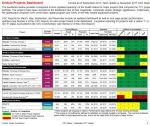
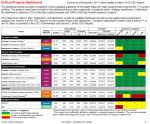
The complaint, as raised by Vice Chair Alan Heisey, was that the Board had been told repeatedly that the ATC project was on time and on budget, only to find that it was not. He cited a November 2017 status chart from the CEO’s Report showing “green” status for the project. In fact, this status continued into the March 2018 report which was the last one published in that format. The set from November 2016 to March 2018 appears below (click on any item to open as a gallery).

Throughout the six versions of this dashboard, the ATC project remains at an estimated cost of $563 million and a completion date of Q4 2019. Only the to-date expenditure and percent completion rise (from $266m to $381m, 47% to 68%), albeit with an anomalous lack of progress between November 2016 and March 2017 which show the same values. Note that the percentages are of spending versus final cost and they do not necessarily reflect the proportion of the work that is finished. For example, as I write this, only 40% of Line 1 is under ATC control (Vaughan to Dupont) with a further extension south (to St. Patrick) pending in May.

Reports on the status of major projects vanished from the CEO’s Report after March 2018, and these were eventually replaced as part of a quarterly report from the Chief Financial Officer. The first of these reports, in January 2019, flagged a schedule and budget problem with the ATC project.

Schedule reassessment: An operational review concluded that the required closures for Phase 3, the significantly longest continuous phase, were overly disruptive to customers. The multiple closures required would have shut down all subway service from St. Clair to St. Clair West stations. To mitigate this impact on our customers, a revised plan divides the area into three sub-Phases 3A, 3B and 3C. The project team is reviewing the schedule with the contractor to develop a mitigation plan.

For operational reasons it was necessary to advance Phase 6 (Wilson Yard) and implement it prior to both Phases 1 and 3. This Phase was extremely complex, requiring it be divided into 3 manageable sub-Phases which had schedule impact. These changes will delay the project scheduled completion date to 2021. [pp 16-17]

The idea of subdividing phase 3 was already being discussed for exactly the reasons stated above before 2018, and this was hardly news. Other extensions to the completion date arise from timing on competing projects (about which more later in this article). The need to reschedule Phase 6 was obvious from the moment the TYSSE to Vaughan opened and operations at Wilson Yard became a choke point on loading and unloading service from the line.

By the April CFO’s report, there was a further source of delay:

An operational review concluded the implementation of Automatic Train Protection (ATP) on maintenance workcars and Line 4 TR trains is required for efficient travel speeds in ATC areas to work zones and maintenance facilities.

The project team has reviewed the impact of these changes and performed a schedule reassessment. The revised project in-service completion date is 2022. [pp 18-19]

A consultant’s review of the ATC project by Transit Systems Engineering found that the ATC project itself was well-run, but that a combination of focus on getting the line ready for TYSSE opening in late 2017 together with a failure to fully appreciate other works that ATC and the planned capacity increase would trigger push out the completion date for the project. TSE did not criticize management of the ATC project itself, and indeed recommended that this team remain intact because of their knowledge and experience. It is ironic that a report dated January 13, 2019 makes this recommendation a month after the former ATC Project Director left the TTC to join Andy Byford in New York City.

The TSE report states:

… the installation of the ATC system would appear to be on-schedule and on-budget to meet the revised delivery date of Q3 2021 at an overall cost of $663M. [p 6]

This is different from the 2022 schedule now presented to the Board, and the changes noted in the April CFO’s report must have been “discovered” after the TSE review. I put that in quotation marks because a project to make the maintenance fleet ATC-compatible already existed in the 2017 Capital Budget, and the project remains in the 2019 version.

On the subject of keeping the Board informed, I really cannot avoid mentioning the management decision taken during the election interregnum in 2018 to rebuild rather than replace the T1 trains now used on Line 2 Bloor-Danforth. This has pervasive effects on other project schedules including:

  • delay of ATC implementation on Line 2 and the service improvements this could bring,
  • the future of Greenwood Yard and its availability for the Relief Line,
  • the timing of Kipling Yard (the Obico property) and
  • the choice of signalling on the Scarborough extension.

None of this was brought to the Board’s attention, and it was “approved” as one of many items buried within the Capital Budget with no explicit analysis or “heads up” for the Board.

Continue reading

TTC Board Meeting April 11, 2019

The TTC Board met on April 11 with a full agenda. Among the items discussed were:

  • The joint City/TTC “omnibus” transit report and the implications of the provincial intent to “upload” the subway system
  • Public Deputations at Board Meetings
  • Presto limited use tickets and the TTC/Presto contract generally
  • The Junction Area Study and proposed route changes
  • Subway Closures for 2019

The Board also discussed Line 1 (YUS) Capacity Requirements, State of Good Repair and Automatic Train Control. This is a complex enough issue to warrant an article in its own right, and I wil publish that separately.

Results of the King Street Pilot

The King Street Pilot report that was presented to Toronto’s Executive Committee on April 9 came before the TTC Board on April 11. There was a short discussion of the possibility of extension of the project further west. This review will be rolled into the surface transit network plan to come to the board in December 2019.

One item that may further complicate the taxi exemption for King Street was a proposal that Wheel Trans contracted vehicles be allowed to operate just like a transit vehicle when carrying Wheel Trans clients. This will come to Council when they debate the issue at their meeting of April 16.

The Board endorsed the report’s recommendations.

In future articles, I will update information about travel times, headways and line capacity on King street with data to the end of March 2019.

Continue reading

Ontario’s 2019 Budget: Transit Effects in Toronto

The Ontario Government introduced its 2019 budget on April 11. The section on transit and transportation begins with the usual statements about the cost of congestion, and the economic benefit of transit and highways. Transit specifics focus on the recent Toronto subway announcement. Metrolinx/GO continues on its expansion path, but with more emphasis on what has been done than what is to come.

The Subway “Upload”

Ontario reiterated its intention to take ownership of the Toronto subway network, but it is now clear that this will be done in two parts. First will come responsibility for system expansion as announced on April 10 with the existing system assets to follow in 2020. This puts the more complex problem off nominally for a year, but that debate is really underway now with negotiations between the City of Toronto, TTC and province.

By separating the upload into two distinctive parts, the Province can begin building subway extensions and new lines immediately while giving proper due diligence to the state of repair of the existing assets and fulfilling its commitments to consultation under the Terms of Reference.

The Province remains steadfastly committed to the full upload of the TTC subway network. [p. 64]

That “due diligence” is the nub of any transfer. Past provincial statements imply that the cost of life cycle maintenance (major repairs and replacement, items found in the TTC’s capital budget) would shift to the province leaving day-to-day costs to the City of Toronto. The problem lies in the inevitable tug-of-war between transit expansion and state of good repair. Provincial Treasurer Vic Fedeli, speaking on CBC’s Metro Morning, claims that the investment in new transit lines more than offsets gas tax revenue promised by the former Liberal government. However, this leaves a major hole in planned funding for system upgrades.

Gas Tax Transfer

Fedeli claimed that the Gas Tax can only be used for specific type of spending, but this is not true. The money today goes partly to subsidize day-to-day operations and partly to capital for state-of-good-repair (SOGR). Across the province, few cities are building rapid transit expansions, and their gas tax allocation goes to operation and maintenance of existing systems. Fedeli, in parliamentary language, is “badly briefed”.

The gas tax transfer from Ontario to Toronto for 2018-2019 will be $185 million, and this was expected to double in stages over the next four years. This increase has been cancelled in the new Ontario budget.

Beginning in 2019, Ontario will gradually increase the municipal share of gas tax funds up to a total of four cents per litre in 2021-22. Based on the averages from the past 10 years, gas tax funding is estimated to be about $642 million in 2021-22. There will not be any increase in the tax that people in Ontario pay on gasoline.

Year                            2018-19 2019-20 2020-21 2021-22

Municipal share (cents/litre)   2.0     2.5     3.0     4.0
Estimated funding (millions)    $321    $401.3  $481.5  $642

Source: Enhanced Gas Tax Program, Ontario Government Backgrounder, January 27, 2017

Note that the dollar funding above is for all of Ontario, not just for Toronto, although it gets the lion’s share due to its size.

The Province will not move forward with the previous government’s proposed changes to the municipal share of gas tax funding. The Province will continue to support municipalities through the existing Gas Tax program and ensure it continues to meet the needs of the people of Ontario in alignment with provincial priorities.

Over the next few months, the government will consult with municipalities to review the program parameters and identify opportunities for improvement. This review will be informed by the goals of responsible planning and a more sustainable government to ensure taxpayer dollars are being spent as effectively as possible. [p. 75]

Toronto allocates almost half, $91.6 million, to the TTC Operating Budget, leaving $93.4 million for capital in 2018-2019.

Planned spending based on federal and provincial gas tax transfers is summarized in the city’s 2019 budget papers. This document details the allocation of federal and provincial transfers planned over 2019-2028 with $1.358 billion broken out by TTC budget line. Note that this is less than the total that would have been expected over ten years because the “out years” of the TTC’c capital plan is constrained by city financing plans. Many projects are “below the line” in the budget, especially in the outer five years, and the rise in gas tax funding could have helped to bring some of these projects to approved, above the line status.

About 70% of planned provincial gas tax spending by Toronto is for assets that are subway related. If Ontario transfers responsibility for all of this to the provincial level, then this would offset the loss of expected gas tax. However, that depends on just what budget lines Ontario chooses to take on. When capital subsidies began under the Davis government, there was something of a shell game between Toronto and Queen’s Park over the classification of expenses because “capital” received at least a 50% subsidy while “operations” only got 16%. This sort of thing will bedevil negotiations between the two governments on funding of the uploaded subway system’s SOGR projects.

The table below summarizes the categories listed in the city’s budget and splits them between subway and surface networks. The breakdown is based on my experience in reviewing TTC budgets. Although some adjustment of percentages might be argued, the overall balance will not change much.

Continue reading

Ontario Announces Toronto Subway Plan

On April 10, 2019, Premier Doug Ford announced his government’s intentions to expand transit in Toronto. The plan includes:

  • The “Ontario Line”, a rebranded and extended version of the Relief Line, will run from Don Mills and Eglinton to Ontario Place.
  • The Yonge North Extension from Finch Station to Richmond Hill Centre
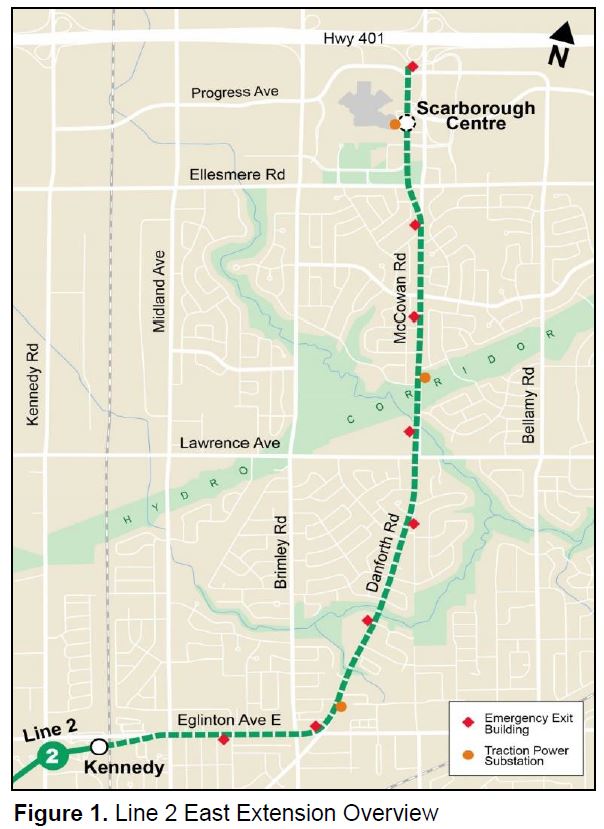
  • The three-stop version of the Scarborough Subway Extension from Kennedy Station to Sheppard with stops at Lawrence East and Scarborough Town Centre
  • Extension of the Sheppard Subway east from Don Mills Station to connect with the SSE at McCowan and Sheppard
  • Extension of the Eglinton Crosstown west from Mount Dennis to Pearson Airport

Continue reading

Toronto’s Omnibus Transit Report: Part III

This is the third and final part of my review of the transit reports that will be before Toronto’s Executive Committee on April 9, 2019, and at Council a week later.

In part one, I reviewed the financial issues presented in the reports together with the Scarborough Subway Extension, now known as the Line 2 East Extension (L2EE).

In part two, I turned to SmartTrack, the Relief Line and the Bloor-Yonge station expansion project.

This article reviews the streetcar/LRT projects as presented in the current set of reports.

Relevant documents include:

  • Main report: Toronto’s Transit Expansion Program – Update and Next Steps
  • Attachment 1: A status update on all projects
  • Attachment 3: Waterfront Transit Network – Union Station-Queens Quay Link and East Bayfront Light Rail Transit. [Note: The properties of this attachment were incorrectly set by the authors. Although it really is Attachment 3, it appears on browser tabs as if it were Attachment 2 for the Scarborough Extension.]
  • Attachment 4: Eglinton East LRT
  • Attachment 5: Eglinton West LRT

Much of the LRT network still at some stage of design or construction is a remnant of the Transit City plan announced in 2007. Pieces have have fallen off of that network proposal, notably in Scarborough, but also a few key links that would have knitted the network together allowing sharing of carhouse and maintenance facilities. Confusion about the planning, ownership and funding scheme for parts of the network complicates the situation further.

Although the province has announced that it wishes to take over “the subway”, the boundary is unclear because a previous government decided to take over at least part of the Transit City LRT network, notably the Eglinton/Crosstown and Finch West routes. The Ford government prefers to put as much transit underground as possible, but if Toronto wants to extend an existing route (for example on Eglinton East), the city’s preference will be for surface construction to keep cost within its ability to fund projects.

Continue reading

Toronto’s Omnibus Transit Report: Part II

On April 9, Toronto’s Executive Committee will consider a massive set of reports on the many transit projects at various stages of design and construction in Toronto.

In Part I of this series, I reviewed the financing scheme for four major projects as well as details of the Scarborough Subway Extension, aka the Line 2 East Extension. In this article, I will review the Relief Line, SmartTrack and the Bloor-Yonge Station Expansion project.

The reports applicable to this article are:

  • Main Report: Toronto’s Transit Expansion Program – Update and Next Steps
  • Attachment 1: A status update on all projects

There are related reports about signalling and capacity expansion of Line 1 Yonge-University-Spadina in the TTC Board’s agenda for their April 11 meeting. I will deal with these in a separate article.

After decades in which the focus of transit planning looked outward to the 905 beyond the bounds of Toronto, there is now a political realization that capacity into the core is a major issue for the region’s economy. Politicians and planners may show optimistic studies of suburban centres and growth, but the development industry, a bastion of free enterprise thinking, persists in building downtown because that’s where they can sell at the greatest profit.

The Relief Line, SmartTrack, Automatic Train Control, subway station expansions and even surface transit projects like the King Street Pilot all attempt to address the demand for travel to and through the core area. Looking beyond the city boundaries, there are subway and GO Transit extensions and service improvements. Some of these schemes are more successful than others, and some have very long lead times before any benefit will be seen. Political attention has shifted from the fights over which one project will be built each decade to the recognition that many projects must occur in parallel so that capacity can catch up with latent and growing demand.

Continue reading

Toronto’s Omnibus Transit Report: Part I

Planning for many transit projects in Toronto has been underway for years, but the public face of this work took a long holiday in 2018 thanks to elections at both the provincial and municipal levels.

In coming weeks, Toronto’s Executive Committee and then Council will consider an omnibus report that provides updates on many transit projects and recommends a path forward.

Today, that path is murky given uncertainty about provincial intentions and the degree to which consultation between the city and province is actually in good faith. Premier Ford’s approach on other portfolios, coupled with the breezy confidence of his Transportation Minister (seen recently on TVO’s The Agenda), do not bode well. With the arrival of Doug Ford at Queen’s Park, the provincial goal on transit is more about settling old scores with Toronto Council and proving that Ford’s transit vision is correct than it is about good planning. Recent correspondence between the province’s special advisor on a proposed subway takeover revealed just how much the province does not know, or chooses to ignore. This was not a good start and the province wounded its credibility on basic technical points, never mind the political context.

But for a moment, let us consider Toronto’s future from the point of view of what the city hopes to do, if only they have the control and the money to pull this off.

The report is long, and to break this article into digestible pieces, I will focus on groups of issues. This article covers overall financing of the transit expansion project and specific details for the Scarborough Subway Extension (SSE), now known as the Line 2 East Extension (L2EE). I will turn to other components of the plan in further articles.

Many reports are available on the City’s website (scroll down to the end for all of the links). The principal reports are:

Financing Transit Expansion

The most challenging part of any transit project, let alone a complex program, is to obtain funding from governments whose priorities do not necessarily align and which may talk at least as much about the sanctity of “taxpayer dollars” as they do about investment in public infrastructure.

In a media briefing, city staff were quite clear that no project can proceed to the stage of contract tendering and awards unless the contribution agreements underpinning a project are in place.

At the federal level, the primary funding source will be the Public Transit Infrastructure Fund (PTIF) which has two phases. An initial phase was time-limited, and was used in Toronto mainly to fund the purchase of hundreds of new buses. The second, longer-lived phase of PTIF will be used for transit construction projects. There is some urgency to nail down PTIF contributions given the fall 2019 election and uncertainty about this program under a new government.

Note that this entire discussion relates only to projects that would be funded in part through PTIF, not to many others such as the Eglinton LRT extensions or the Waterfront LRT.

Federal funding of $4.897 billion will be allocated by the city, assuming government approval, as below [Main Report, p. 2]:

  • $0.660 billion for the Line 2 East Extension project
  • $0.585 billion for the SmartTrack Stations Program
  • $3.151 billion for the Relief Line South
  • $0.500 billion for the Bloor-Yonge Capacity Improvement project

Negotiations with Ontario are ongoing, and the status of projects and associated $4.04 billion in provincial funding is unclear. This could be clarified in the provincial budget to be announced on April 11, 2019. Provincial interest in and plans for the Scarborough extension and the Relief Line will affect both of these projects.

City funding comes from a variety of sources:

  • Development charges
  • The Scarborough Subway levy
  • The City Building Fund levy
  • Interest on accumulated reserves from the levies

Financial projections are also affected by factors that have changed since projections made in past years:

  • Higher growth rates in development
  • Lower interest rates

PTIF2 has an assumed split of 40-33-27% for the federal, provincial and municipal governments respectively. This creates a breakdown of responsibilities as shown below.

The provincial share is supposed to be “new funding” and the amount here does not include prior commitments to Scarborough transit which originally were for the proposed LRT line, later for a subway. Exactly how much Ontario will contribute remains to be seen given discussions about ownership and the scope of the Scarborough subway project. I will return to this in more detail later.

Within the city share, $2.42 billion is unfunded (no revenue sources have been committed to fund/finance the expense), and only $885 million of the SmartTrack Stations Program has city funding. The report recommends that the city’s CFO and Treasurer report prior to the 2020 budget process on strategies for addressing the shortfall.

The project cost estimates for these are broken down below. In the chart, the acronyms are:

  • LTD: Life To Date
  • PDE: Preliminary Design & Engineering

The possible funding arrangements vary for each project, and these are complicated both by past history and by the uncertainty of early “class 5” estimates. A tentative breakdown is shown below, but this must be taken with a grain (or more) of salt due to technical and political uncertainties. For example, the assumed provincial contribution to the Line 2 Scarborough project is based on inflation of a commitment made in 2010 dollars where the city and province do not agree on the appropriate inflation factor.

Two separate numbers have been used for the Relief Line cost estimate: $6.8 billion in Table 2 above, and $7.2 billion in Table 3 below. In the media briefing, TTC staff explained that the change was due to an alignment revision (Carlaw vs Pape) and changes in construction techniques (mining vs cut-and-cover) at some locations. That may be so, but to have two different numbers for the same project so close together within a report makes one wonder about the care taken in other aspects. On top of that is almost $2 billion as a “provision” for the Relief Line to guard against potential cost increase as the estimate is refined from class 5 to class 3.

This sort of uncertainty is not unusual, but the constant variation in quoted “estimates” makes for no end of problems. The converse is seen with the Scarborough project where the “estimate” for the subway’s cost has remained fixed since 2014 despite major changes in project scope.

The report explains the difference between initial class 5 estimates and the class 3 estimates to be used in setting project budgets:

As a project moves through the three phases, project definition becomes more refined and the information used as the basis for developing a cost estimate is more mature.

  • A Class 5 cost estimate is typical when starting the initiation and development phase, where the project is conceptual (0-2% design level). This an order of magnitude estimate to inform the decision of whether or not to continue to study an option.
  • A Class 3 cost estimate is based on PDE work (10-40% design level), and is the estimate class recommended when establishing a project budget for procurement and construction. A Class 3 estimate should be used to inform full funding commitment decisions. [p. 16]

Note that the term “order of magnitude” has considerable leeway, and a change from one order to the next is a factor of 10. Saying that costs “A” and “B” are in “the same order of magnitude” gives huge scope which on projects of this nature is measured in billions of dollars. Too much past debate has assumed that minor swings in estimates might occur as designs are refined, but this is more wishful thinking and the political hope that a project will not get out of hand even before shovels hit the ground.

Overall Project Status

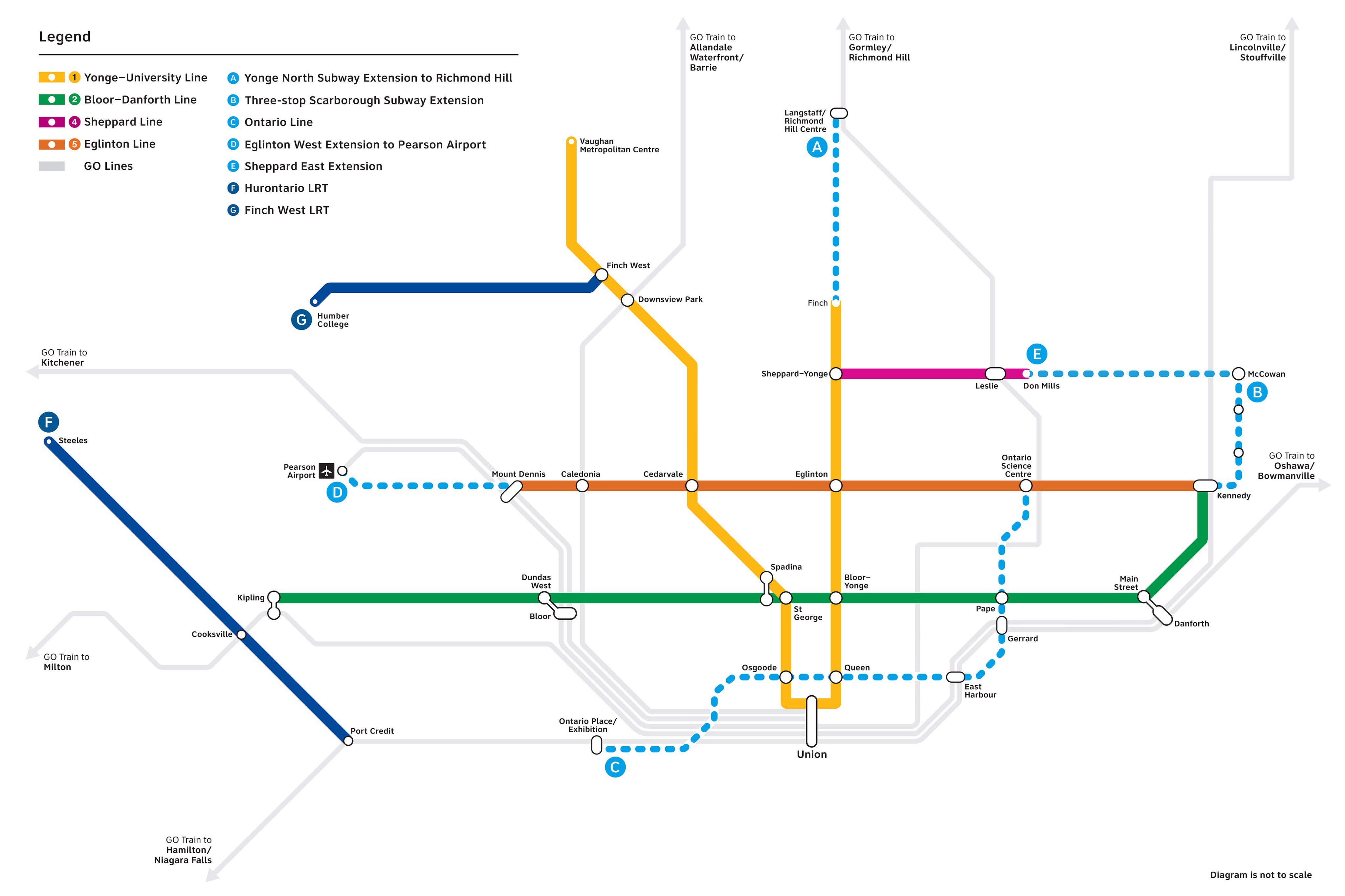
The map below shows the location of all projects in the transit network plan.

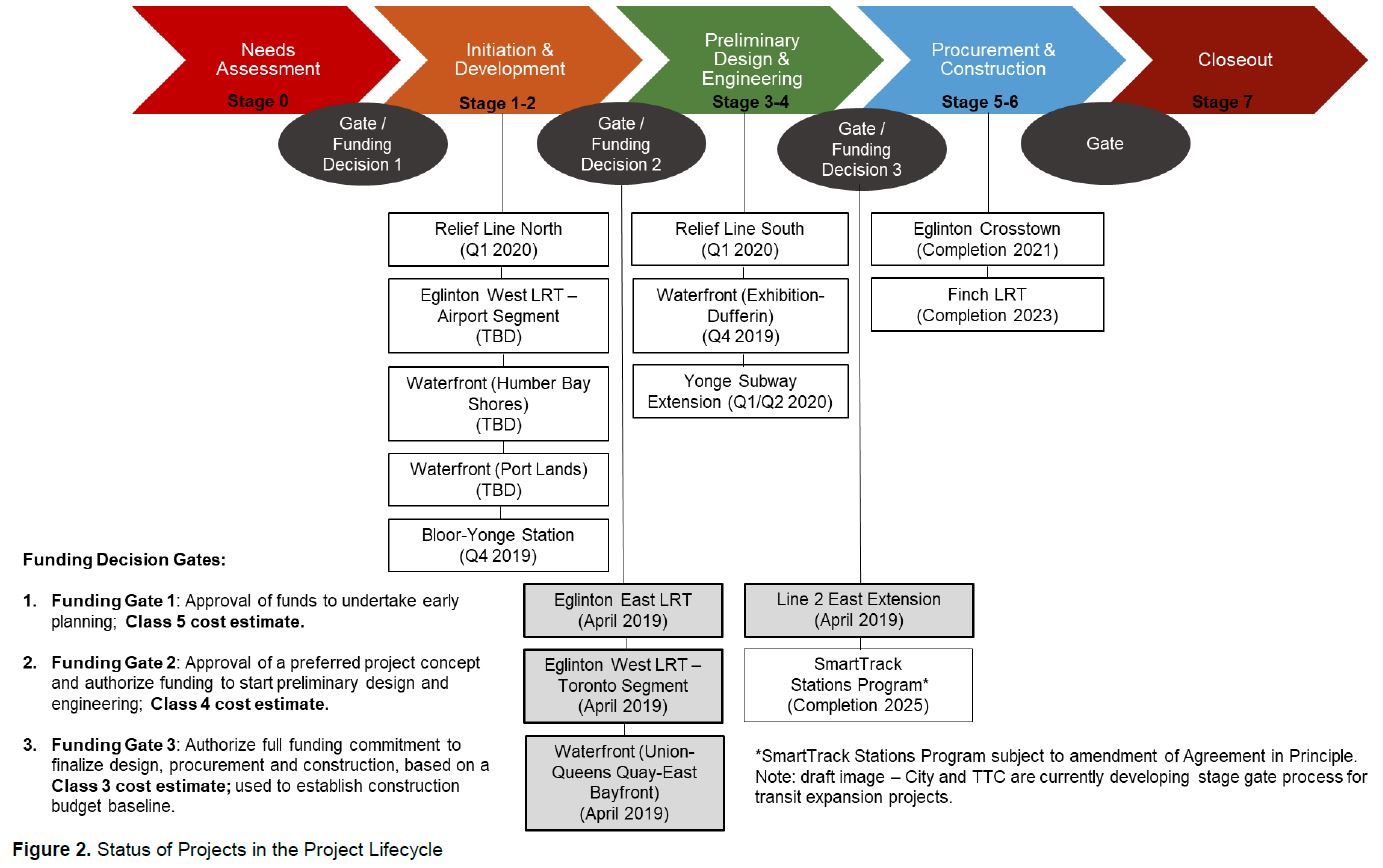
Projects will advance from stage to stage on their own timetables which are summarized in the chart below.

Line 2 East Extension (aka Scarborough Subway Extension)

This section reviews the status of the Scarborough extension as it is presented in the city reports. Obviously this is subject to major change given provincial announcements of support for taking ownership of the extension and for building a three-stop subway.

Continue reading

Metropass, Two-Hour Transfer and Presto

With the shift of TTC monthly passes from a dedicated swipe card to the Presto fare card in January 2019, I decided to track usage in detail as a sample size of one rider.

Presto provides tracking data on its site, but I was intrigued to discover:

  • How accurate is the tracking data?
  • What would my riding have cost under three scenarios: monthly passes, two-hour transfer rules and single fares?
  • How often was I unable to tap because readers were not working?

My travel pattern places me firmly in the category of a heavy user of transit. Living at Broadview and Danforth, I have the choice of the Bloor-Danforth subway and several surface routes, most with frequent albeit sometimes unreliable service. Almost all travel is within the “old” City of Toronto where there are many closely-spaced routes. This is very different from the environment riders in the suburbs face for choice, frequency and trip length.

For the first three months of 2019, my travels are summarized here.

Although I travel on an Annual Pass, I have tracked how many fares I would have paid under two transfer rule schemes:

  • In the “New” rules, any tap made within two hours counts as one trip/fare on a Presto card.
  • In the “Old” rules, TTC prohibits stopovers and changes of direction. These would trigger a separate trip/fare.
Month         Taps    Transfer Rules
                       New      Old

January        93       58       75
February       99       68       83
March         120       76      100

Total         312      202      258

The tap count is based on actual taps on fare machines and gates, and does not include transfers within fare paid areas.

Overall, the two-hour fare reduced my “trip” count by about 20%, although some of those “saved” fares are a result of my knowing that I do not face an extra fare, something I have been accustomed to since the Metropass was introduced in May 1980. In other words, I would not have “paid” all 258 fares were I paying by tokens/tickets, and so the reduction to 202 would not represent a “loss” of 56 fares. Moreover, careful choice of transfer locations would shave the single fare cost by adjusting travel to minimize the need to pay a new fare.

Similarly, as a long-time pass user, I have been paying a monthly equivalent of fewer fares than I would have paid with tokens or tickets. Using the fares in effect for this period, the break-even rates for passes versus tickets/tokens are shown below. The “multiple” is the number of tokens/tickets represented by the pass price, and is the trip count at which a rider “breaks even” with a pass.

Pass Type     Adult                     Senior/Student
              Cost     Token  Multiple  Cost    Ticket  Multiple
Annual        $134.00  $3.00  44.7      $107.00  $2.05  52.2
Monthly       $146.25  $3.00  48.8      $116.75  $2.05  57.0

The effect of the severe winter weather is clear above, and my riding increased in March. Three days in January and February were “snow days” where I made no TTC trips. Even so, during the worst month and with the new two-hour transfer rules, I took more trips (measured as fares) than the multiple for any of the available passes. I have a senior’s annual pass and easily crest the break-even point of 52.2.

In TTC budget discussions, some board members (not to mention management) railed against pass holders as freeloaders whose riding was subsidized by other less-frequent travellers and the city. What they completely missed is the fact that were someone like me on a pay-as-you-go basis, many of the trips shown here would not have been taken, or would have “artfully” been made without paying another fare. Optimizing one’s travel is easier where there is a dense network of routes and more choices to credibly use a transfer (e.g. for a stopover), and this technique predates all-door boarding where inspection at entry can be avoided.

If the point of a transit system is to encourage travel and make it more attractive for those who were penalized by the traditional transfer rules to use transit, then the fact that I or anyone else would pay a lower average fare (calculated against those rules) shows that the policy is working. For example, a common weekend shopping outing I make would be, at a minimum, a three-fare trip under the old transfer rules using ticket or tokens. It is now a one-fare trip because it is accomplished within two hours. Moreover, I have the option of additional stopovers and greater flexibility in route choices.

As tokens and tickets are replaced by Presto “Limited Use Media” (LUMs), tickets with one or a few TTC fares rather than a full-function Presto card, the two-hour fare will be available to almost everyone. All that will remain is the ability to issue a receipt for cash fares that confers a two-hour ride to bring this convenience to everyone.

In all of this discussion, the core argument is that paying for transit is changing, and has been changing for years. The system moves away from the nickel and dime approach of charging as often as possible to making transit attractive as a service that is simply “there” to be used, much as auto owners regard their vehicles. Some riders will pay more, some less, and frequent users will probably be better off than those who ride occasionally.

The complementary part, still to come in our low-tax obsessed era, is that transit service across the city will be truly attractive to those who wish to use it as a first choice.

Presto Reliability

The reliability of Presto equipment has improved quite substantially in recent months, and I encountered few cases where I could not “pay” a fare, or as a pass user, get an updated timestamp on my Presto card.

  • On two occasions, subway fare gates were locked open because the entire station’s system appeared to be “down”: Bay Station on January 21, and Union Station on February 2.
  • On one occasion, there was no working Presto device on a vehicle (a CLRV on Queen), but my trip was picked up when I transferred at Humber Loop.
  • On a few occasions, the reported location did not match where I tapped, although these were usually only off by one stop or city block. The most extreme example was a tap near Broadview and Danforth that was reported as being on Roncesvalles Avenue. In another case, a tap reported a location as if the vehicle were still in Leslie Barns. These would have been a problem for “old” transfer rules or for any distance-based fare scheme.
  • On two occasions, there was a forced transfer due to service problems, and one of these required a “walking transfer” from Queen to Dundas. These could have triggered extra fare charges under the old transfer rules, or challenges to the validity of the fare paid if I were not using a pass.

My Presto card was inspected on a few occasions, but at predictable locations: Broadview, Spadina and Union Stations. Only one of these registered as a transaction in my Presto activity summary.

The database of locations for stops, mainly on 504 King, only knows of stops by number, not by name, presumably as these are “temporary” locations for the King Street Pilot. The fact that these have not been updated with real location info over a year after the stops were moved says something about the dedication to clear customer information.

Finally, in all of my travels, I have not seen one rider “tap on” to a vehicle in a paid area. The TTC was pushing the idea of “always tap on” as part of the Metropass/Presto roll out, but riders behave just as they always have in subway stations. The claim is that this would give better planning data, and make fare inspection (if it ever actually occurred on surface vehicles) simpler, but the TTC will just have to make do with the “taps” they do get.

Postscript: A Long Journey on One Fare

Many years ago, before the abolition of “Zone 2” in Toronto’s fare structure, a friend and I set out to test the limits of transfer rules that allowed for a continuous trip in one direction. This rule had an exception that allowed one to avoid payment of an extra fare by staying within a single zone even if this meant travelling out of the way on one’s journey.

We began on the Port Credit Bus, then a TTC operation, a few stops west of Long Branch in Zone 3. There was a zone 3-2 combo fare, and this gave us Zone 2 Port Credit transfers, about as far remote from downtown as possible. Our goal was eastern Scarborough.

The journey took us to Humber Loop, then up to Jane and Bloor, up Jane, across Wilson and York Mills (staying clear of the zone boundary at Yonge and Glen Echo), then down Birchmount to Kingston Road. At that point, many hours after we began, our transfers were finally rejected, and we paid a new fare to ride out to West Hill.