
This article is an update to TTC Plans Massive eBus Order to include information from the TTC Board meeting of April 14, 2021. The staff presentation video is available on YouTube.
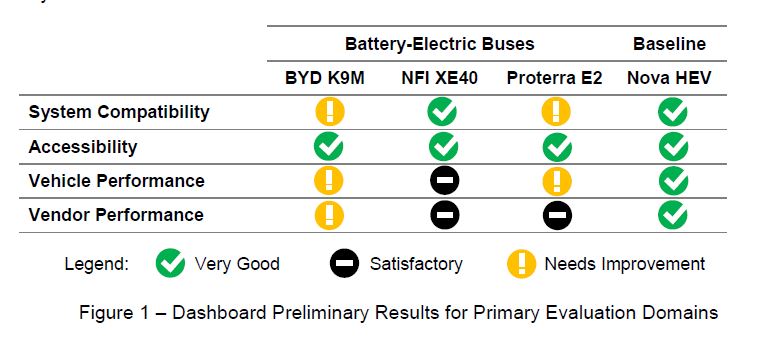
The TTC has tested eBuses from BYD, Proterra and New Flyer in a “head-to-head” comparison over the past year (times vary due to delivery delays). There was a sense when this trial began that it would reveal whether certain products were inherently better than others, and possibly winnow the field of potential bidders.
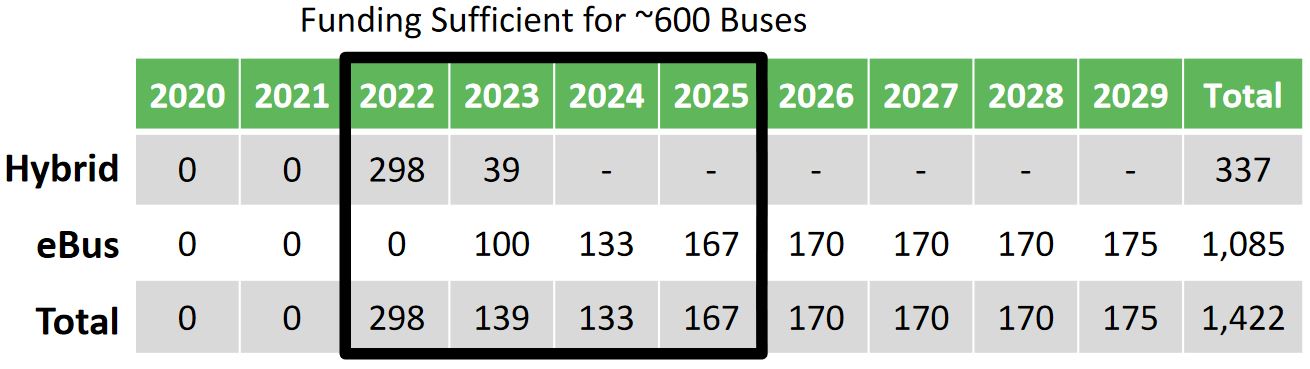
They plan to award a contract for 300 hybrid buses in 3Q2021, and a contract for eBuses in either 4Q2021 or 1Q2022.
In his presentation, Bem Case, Head of Vehicle Programs, made considerable effort to note that the trial was not intended as a selection process, but rather to inform vehicle specifications and contract provisions for a future purchase. Case claimed that BYD and Proterra would be “upping their game” for the large eBus RFP, and their bids should address many issues from the trial. The expected cost for an eBus is around $1 million, about $200k less than the average cost for the trial fleet.
The three trial vendors are not the only ones in the running. Nova Bus, was not part of the trial, but Case advise that they plan to be compliant with the requirements when a Request For Proposals (RFP) goes out.
There are two unnamed manufacturers, one in Canada, one in the US, described as “upstarts” who are trying to get into the market.
Reading between the lines, one can sense that lobbyists have been busy to ensure that no vendor has an inside track. With a 300-bus order on the line, there is a lot of money at stake.
The challenge for the TTC will be to frame a tender whose language actually protects the system up front from bad products rather than simply counting on provisions such as liquidated damages (penalties for non-performance). Issues with the first generation of hybrid buses and the Bombardier streetcars order are fresh in everyone’s mind.
An important clarification emerged regarding the “Negotiated RFP” process. It is not the TTC’s intent to select one vendor in advance and negotiate a contract, but rather to invite bids and then negotiate with vendors to fine tune requirements and issue a revised RFP if necessary. The intent is to avoid writing a spec that disqualifies most or all vendors and forces the entire process to start again from scratch.
Case emphasized that the eBus industry is maturing quickly especially with respect to spare parts availability and post-sales support. Both of these are essential to keeping the fleet on the road, and for ensuring that warranties are honoured promptly. The head-to-head comparison will continue through 2021, and this will provide additional experience to inform both the specifications and evaluations. The TTC expects that availability and reliability issues to date with the trial fleets will be resolved, and they expect strong competition between would-be vendors.
During the trial, many of the problems with vehicles did not lie with the propulsion systems, but with other factors such as vehicle quality, doors and heating. This implies that the ability to actually build a reliable bus is at least as important as packaging the electric technology, and bidders with a track record as bus builders should have an advantage.
A question arose about why management needs to have negotiation authority now when the trial period is still underway. Staff claim that this is needed to begin the process so that eBus deliveries can begin in 2023 rather than pushing the hybrid-to-eBus transition out to 2024. This puts the TTC Board in the difficult position of handing authority for a major procurement to management with little oversight of the decision, but that appears to be how the Board prefers to operate.
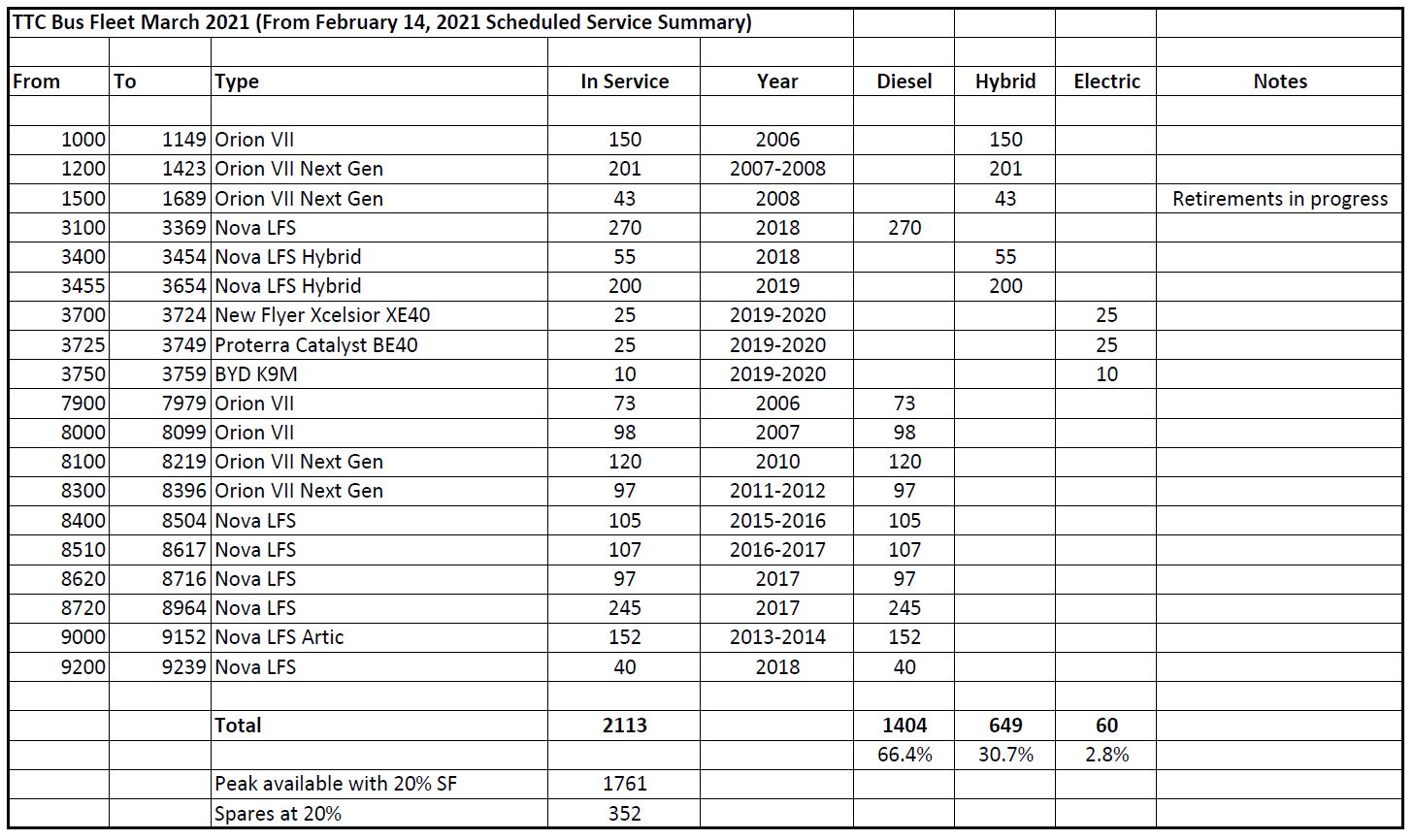
Commissioner Ron Lalonde asked whether a larger bus fleet would be needed to compensate for charging time. Case replied that at current battery capacity and usage, so-called “long range” buses can operate for only about 15 hours. This covers only about 40 per cent of TTC service as it is now scheduled. (Many diesel and hybrid buses enter service for the AM peak and stay out until well into the evening.) Various options are available to address this:
- Reschedule routes so that vehicles return to the garage before they run out of charge. With a 15 hour limit, this constrains vehicles to operate from the AM peak until the early evening, or from the PM peak through late evening.
- Hydrogen fuel cell buses were mentioned by Case as a longer-range option, although they bring their own challenges.
- On route charging was also mentioned, but with no details such as a distinction between charging stations such as those used in other eBus systems, or in-motion charging using trolleybus overhead.
Case advised that in the short term, eBuses would be used on routes where their range was not an issue, and that options to expand charging options could be left to the future.
Lalonde asked that management provide an ongoing comparison of the economics of eBuses with comparison to hybrids so that the Board can follow the evolution of the technology.
Deputy Mayor Denzil Minnan-Wong took the, for him, unusual step of promoting himself as an advocate for green technology. He noted that according to a Columbia University Study (done for New York’s MTA), although the capital costs of eBuses are higher than for other technologies, this is offset by lower operating costs and the green benefits are, essentially, a free benefit of converting. (The situation is a bit more complicated than this because the analysis also includes health care savings that do not accrue to the transit budget.) He did not mention that capital purchases are much more heavily subsidized than operating costs, and this has a beneficial effect on the TTC’s bottom line and City subsidy requirements.
There was only limited discussion of the proposed arrangement with Ontario Power Generation and Toronto Hydro for the supply and operation of the electrical distribution and charging systems. Responding to a question about various configurations of lease and purchase of system components, Bem Case noted that it is to the TTC’s advantage to buy buses and to specify an industry standard charging system because this avoids being locked into a single vehicle that is part of a vendor/lessor’s offering. This keeps electricity supply separate from vehicle selection.
An important factor in the timing of the planned order is the availability of federal subsidy. It is ironic that the feds will be pushing the transit market to buy eBuses as part of their “green” strategy, when a predecessor government (Paul Martin was PM at the time) forced the purchase of early generation hybrid buses that were quite troublesome.
An annoying part of the discussion was the TTC’s penchant for being the best and biggest and first in whatever they might do. Many other cities are testing eBuses. Toronto is not the only one with a cold climate (Edmonton and Winnipeg, for example, are much worse). Despite repeated statements that this order would give Toronto the largest fleet of electric buses in North America, the existence of three large trolleybus systems (Vancouver, Seattle and San Francisco) was not acknowledged.
TTC management would do well in future reports to include more comparative data and experience from other cities. This should not be difficult considering that they chair a regular online meeting of 26 properties who are testing and operating these vehicles.
The staff recommendations were amended by a motion from Commissioner Bradford asking management to include in their next Green Bus report a fleet plan showing the TTC’s existing fleet, potential eBus allocations and possible deployments to routes.
The presentation included a chart showing the planned rollout/conversion of garages to electric operation. This shows that the intent is a gradual buildup of eBus operations across all garages rather than full conversion of a few sites early in the program. This plan distributes whatever problems might arise with eBuses across the system, but more importantly it defers the need for large scale hydro infrastucture until 2024 and beyond.
This chart was included in the online presentation and is clipped from the video, but it is not included in the online presentation deck.







 Steve Munro