Will Line 2 Renewal Ever Happen?

Those of us who can remember back to days before the pandemic, when Andy Byford was the TTC’s CEO, will know that there were frequent questions at the TTC Board about upgrades to the Bloor-Danforth subway, Line 2. All of the focus seemed to be on the Yonge-University-Spadina Line 1 with new signalling, trains and the Vaughan extension.

Byford confirmed that work on a Line 2 plan was underway, but never presented one in public. However, it does not take a lot to work out what might have been in this plan.

  • Automatic Train Control (ATC) signalling to replace the 1960s-era technology still in use.
  • New trains to replace the existing fleet of T-1 trains that would reach their design life of 30 years in the late-2020s.
  • Additional trains for service increases possible with ATC as well as for the Scarborough extension.
  • Additional/new maintenance facilities for a larger Line 2 fleet, plus provision for the then-planned stabling of Relief Line trains at Greenwood Yard.
  • Storage and maintenance facilities for the growing fleet of subway work cars.
  • Potential integration of a western yard project with an extension of Line 2 beyond Kipling Station.

This plan requires a lot of funding that the TTC still does not have, action to launch procurement of long lead time rolling stock and infrastructure, and a level of project co-ordination for which the TTC is not particularly noted.

That co-ordination issue arises in part from the funding challenge, and the tendency politically to ask for only what is strictly needed for “today’s” work hoping that Santa Claus will arrive in time to fund the rest. This was a direct cause of technical problems with the Line 1 ATC project that was cobbled together over time. It started with a superficially simple desire to replace the then-existing 1950s signals on the original line from Eglinton to Union. The feeling was quite clear: the TTC Board and Council would never commit to a full ATC conversion project because it would be too expensive.

Unfortunately what resulted was a mixed bag of signalling technologies that were incompatible with each other. To rescue the project, Byford recommended ripping out some already-installed equipment so that the line could be standardized. A related decision was that the Vaughan extension would open with ATC in place rather than, as originally planned, a traditional block signal system that would have to be replaced as a separate project.

Continue reading

TTC Track Construction Update October 9, 2022

A Word About Diversion Notices

I have often written here and on Twitter about the proliferation of service change cards and posters as the constant changes in streetcar routes occur. Combined with conflicting and out-of-date online information, it is common to find at least two different versions of notices at the same stop, not to mention “stop not in service” notices in locations where streetcars are actually running.

Without question, the constant shifts in the operating plan are challenging to keep up with, but the lack of attention to removal of out of date information, particularly when new notices go up at the same location, does not serve riders well at all. Operating staff, in good faith, give out incorrect info leading passengers astray, and I have rescued a few lost travellers over past weeks.

This is a very serious issue given the amount of construction that will affect TTC routes (and not just the streetcar network) in coming years. Riders have enough challenges with service quality without having to divine whatever route their service might be taking today. There is a clear fragmentation of responsibility for keeping route information up-to-date and consistent within the TTC. Even in a recently announced reorganization, the responsibility for “closures and diversions” is in a separate branch (Operations and Infrastructure) of the TTC from “service delivery” (Transportation and Vehicles).

The phrase “Beware of the leopard”, for those who know the reference, seems particularly apt for some TTC “communications”.

The TTC needs to figure out how communications about service plans and changes can be centrally accessed and administered so that all notices speak with the same voice and contain current, accurate information.

Updated October 9, 2022 at 11:40pm: It turns out that there are four pages within the TTC website where service information might be found. At last count, the list includes:

There is the parent Service Advisories which links three of the four above. Some but not all of the items in the Updates page are also displayed on the main page under “Latest News”.

Although the same topic might be found through different pages, the text is not always the same indicating that multiple versions of the information have been posted. In this situation it is easy for their content to drift thanks to selective updating.

Continue reading

A Walk On New Cherry Street

Out of sight of most in Toronto, the mouth of the Don River has been transformed by Waterfront Toronto with earth moving and landscaping on a scale rarely seen in these parts. The work will shift the Don River’s course and provide floodproofing for a large area to be developed under the name “Villiers Island” after a street in the northern edge of the district.

Cherry Street will shift to the west the equivalent of a short city block, and the New Cherry will eventually have a branch of the Waterfront East streetcar service if the City ever gets around to financing and building it.

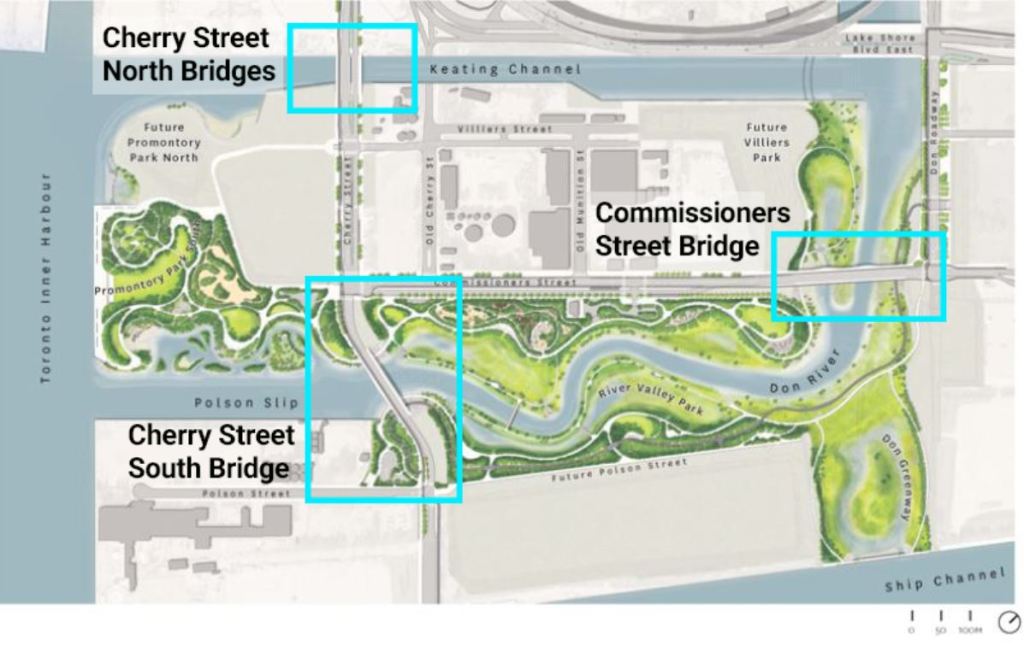
Three new bridges were built in Nova Scotia by Cherubini Metal Works. Waterfront Toronto has an article about the design process and, of course, many articles and photos of the overall project. The map below shows the positioning of the three bridges.

The bridges share a common design, but each is unique in its own way.

  • The Cherry Street North bridges, one for road traffic and one for transit, will connect the New Cherry Street across the Keating Channel to a reconfigured Cherry and Queens Quay intersection. Eventually, there will be streetcars on a realigned Queens Quay East as well as south from Distillery Loop connecting to New Cherry. These bridges are red.
  • The Cherry Street South Bridge is a road bridge over the future river connecting New Cherry to the existing road at Polson Street. This bridge is yellow. Depending on the route taken by the new streetcar service, there could be a loop somewhere north of the Ship Channel. If so, the Cherry South bridge will gain a transit twin like the north bridge.
  • The Commissioners Street bridge carries Commissioners Street over the future path of the river. Because of its length, it is a double span. This bridge is orange. Like the Cherry South bridge, it could gain a twin set of spans for transit if trackage is ever extended east from New Cherry either to an extended Broadview Avenue or further east to Leslie Barns at Commissioners & Leslie.

The new river is not yet flooded and so there is water in the old Polson Slip west of the Cherry South Bridge, but the riverbed east and north of there is completely dry as work to prepare it continues.

Continue reading

TTC Service Changes Effective Sunday, October 9, 2022

There are few service changes in the October schedules taking effect on Sunday of Thanksgiving weekend.

Route 501 Queen streetcar service will be extended nominally to Sunnyside Loop, although pending completion of overhead in the loop, cars will circle Roncesvalles Carhouse instead. The last westbound and first eastbound stops will be on the east side of Roncesvalles at Queen. 501L bus service will continue to operate from Dufferin to Long Branch with a small reduction of service in some periods.

Some routes have added trips to serve school trips and other time-of-day specific demands (details in the linked spreadsheet):

  • 9 Bellamy
  • 25 Don Mills
  • 37 Islington
  • 42 Cummer
  • 84 Sheppard West
  • 96 Wilson

New express stops are added on:

  • 905 Eglinton East Express
  • 985 Sheppard East Express

Seasonal changes:

  • 86 Scarborough Saturday late evening service adjusted for earlier Terra Lumina closing time.
  • 172 Cherry Beach weekend service suspended (weekday service will operate until November 18).
  • 175 Bluffer’s Park service suspended.

Miscellaneous:

  • 31B Greenwood to Eastern Ave service end-of-line location shifted west from Minto to Knox and Eastern.
  • 55 Warren Park adjusted to consistently leave Jane Station on the :15 and :45 after the hour.
  • 506 Carlton shifted from Roncesvalles Carhouse to Leslie Barns.
  • 600 Run As Directed crews reduced.

2022.10.09_Service_Changes

Continue reading

Service Standards, Metrics and the CEO’s Report (II)

This article continues a review of what the TTC aims for, at least on paper, in service quality, and how their success (or lack of it) in providing good service is reported for public and political consumption. The framework for this commentary is the CEO’s Report, using the August 2022 version as a reference point.

I deliberately broke this discussion into two parts. The first looked at the various figures related to system performance are presented and how they reveal or hide critical information.

See: Service Standards, Metrics and the CEO’s Report (I)

The TTC Board is notoriously unwilling to get into the weeds on system statistics, operations and finances. Superficial analyses in the CEO report give them nice pictures and charts to look at, but that is not the same as a discussion of key issues and future risk. This is vital in any planning for recovery from a pandemic that will continue to affect the TTC in 2023 and beyond. There is a separate detailed quarterly report that reviews finances and the state of major capital projects, but it does not address many issues notably the cost and capability for growth as ridership returns to the system.

While it may suit those who run the TTC and the City to keep this discussion under wraps, that cannot be done for long as the 2023 budgets will be upon us immediately after the coming municipal election. There is a lot of great talk about the importance of transit, but this does not translate into real understanding and support beyond a few very large construction projects. (That statement applies equally to Metrolinx and GO, but my focus here is on the TTC.)

Key points:

  • Although fare revenue recovery is reported, this is not matched against cost growth. Fares have been frozen through the pandemic. Even at recovery to 100 percent of pre-pandemic ridership, the proportion of costs borne by fares will have fallen and the need for subsidy will be higher. “Full service” will cost more in 2023 than it did in 2020, even without the added cost of improving beyond historic levels.
  • Ridership recovery takes place at a different rate on different routes and modes, not to mention time-of-day.
  • Underutilized fleets provide a reserve for service improvements, provided there are drivers for the vehicles, up to the point where the need for spare buses and streetcars limits service growth. After that point, growth hits a knee in the cost curve as new capital assets must be acquired.
  • Asset reliability is reported as the proportion of scheduled service actually operated, but with no sense of how much reserve exists in the fleet.
  • Fleet reliability is reported in a way that prevents direct comparison between segments, notably various types of buses. Although there is a target for reliability, the degree to which this is exceeded (in effect the headroom for better utilization) is not reported.
  • Service reliability and quality are reported on broad averages across routes and days, with no indication of the variation across the system. Purported “on time” metrics do not reveal actual rider experience.
  • There is no report of:
    • the amount of scheduled service that does not operate because no driver is available;
    • the utilization and effectiveness of Run-As-Directed buses;
    • the amount of bunching and gaps as a proportion of service operated;
    • routes with demand, service levels, crowding and headway reliability issues.

This review does not look at the WheelTrans system and accessibility in general because it has a raft of issues of its own on matters such as adequacy of service, dispatching, the online booking interface, qualification for service and the TTC’s attempt to shift riders at least partly onto the “conventional” system through the “Family of Services” program. An important issue for WheelTrans overall is that it is entirely funded by the City of Toronto with no assistance from other governments. This makes it particularly vulnerable to penny-pinching efforts by those who guard our “precious tax dollars”.

Continue reading

504A King Service Returns to Distillery Loop

Effective October 1, 2022, the 504A branch of the King car will return to Distillery Loop. The 504B branch will continue to operate to Broadview Station via Parliament and Queen as shown below.

Source: TTC Service Notice

This is a temporary arrangement pending completion of the re-electrification of switches at King and Sumach. Once that is completed, expected within a few days, the 504B will revert to the standard route via King between Parliament and the Don Bridge. If this situation lasts to Monday, October 3 or later, the 503 Kingston Road car will also continue to divert via Queen and Parliament.

This change will reduce streetcar congestion at Broadview Station because only half of the service will go that far east on the line. It will also eliminate some of the wheel squeal problems at King and Parliament, although not completely until the 504B service returns to its normal route.

Service will return to the Sumach and Cherry Streets that have been without reliable service since the beginning of August. The 504 shuttle bus was extremely erratic with very wide gaps in service, and it as cancelled completely on September 4 even though signs remained on transit shelters advertising its existence. The area is also served by the 121 Esplanade-River bus which has its own problems with reliability.

Updated October 1, 2022 at 7:10 am: The west end of the King car will divert to Wolseley Loop at Queen and Bathurst rather than operating to Exhibition Loop due to trackwork on Fleet Street. This also affects 511 Bathurst which diverts east to Charlotte Loop and 509 Harbourfront which short turns at Spadina and is replaced by a bus shuttle from the to the Exhibition. Normal service resumes on Monday, October 3.

Gil Penalosa Embraces Bus Rapid Transit

Updated Sept 29/22 at 7pm: A link to and short commentary on the TTCRiders mayoral candidate poll has been added at the end of the article.

Gil Penalosa, the primary challenger to Mayor John Tory’s re-election bid, released a transit platform this week. In place of Light Rapid Transit such as the Finch West line now under construction, Penalosa advocates a network of Bus Rapid Transit under the moniker FastLane.

My reaction, quite simply, was “is that all there is?”

This map ignores large parts of Toronto, and the platform is silent on Penalosa’s view on what might happen with the transit system as a whole. There is an unhappy echo of John Tory’s SmartTrack scheme eight years ago in the amount of empty space on that map.

Notable by their absence are several projects in various states of planning and engineering including many RapidTO corridors, both bus and streetcar, and the Waterfront LRT extensions. These may not figure in Penalosa’s transit view, but any candidate should at least explain where they stand on current planning proposals. Are they deferred? Replaced by an alternative? Dropped? Also missing are planned BRT corridors on Ellesmere and on Dundas West.

Continue reading

An Update Re Subway Special Work

There was a conversation recently in comments on this blog about a perceived improvement in the noise (or lack of it) of subway trains on special work (switches and crossovers, also known as “frogs”) at Lawrence and Keele Stations. I postulated a few possible answers, but wrote to the TTC to ask what they had done.

Their response, from Stuart Green, Senior Communications Specialist, confirms what I had expected and provides additional details.

Lawrence Double Cross-Over

  • It is an improved design with different type of heel that eliminates the joint at the heel of the switch.
  • Two turnouts are now flange bearing lift frogs that means continuous rail at the crossing – no jumping over the toe of the frog.
  • Newer rails that have no end battering at the joints
  • New ballast that provides better load transfer and required stiffness/flexibility to track.

Keele Double Cross-Over

  • New double cross-over is of the same design with some improvement in the design to make it smoother. The main reasons for smoother ride are new rails and new frog that do not have any end battering or excessive wear.
  • New ballast that provides better load transfer and required stiffness/flexibility to track.

Eglinton Crosstown Delayed (Again)

In what must be the most anti-climactic news on the planet, Phil Verster, Metrolinx President and CEO, has announced that the Eglinton Crosstown Line 5 will not open as planned. I will let Metrolinx speak for themselves.

Statement regarding the Eglinton Crosstown LRT

Sept. 23, 2022

Today, Metrolinx President & CEO Phil Verster issued the following statement:

We had expected the Eglinton Crosstown LRT to be fully built, thoroughly tested, and in service this fall in accordance with our project agreement with Crosslinx Transit Solutions, the construction consortium responsible for building the project.

Unfortunately, while progress has been made, Crosslinx Transit Solutions have fallen behind schedule, are unable to finalize construction and testing, and therefore the system will not be operational on this timeline.

We know construction has been difficult for commuters, communities, and businesses along the Eglinton corridor. We are doing everything to hold Crosslinx Transit Solutions accountable and to redouble efforts to meet their commitments and complete the work quickly so we can welcome riders onto a complete, tested, and fully operational Eglinton Crosstown LRT as soon as possible.

Source: Metrolinx Blog

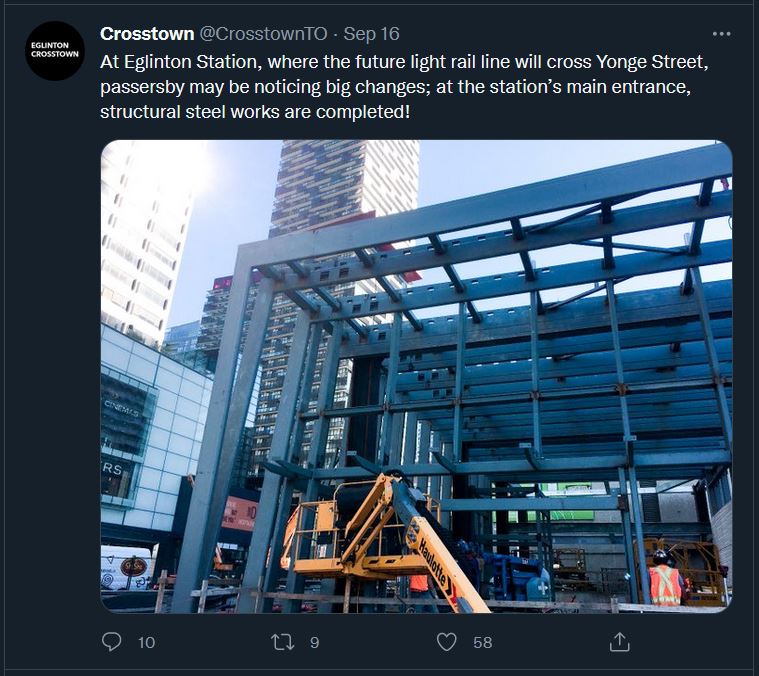
Anyone who has followed the construction project, to the degree it is visible at street level, would have trouble believing the line would be ready in 2022. Only a week ago, the project’s Twitter account announced that they had just finished structural steel at Eglinton Station. This is nowhere near the same as putting the last touch of paint on a building.

The TTC budgeted for a first quarter 2023 startup with training in advance, but that date sounds iffy considering Verster made no mention of a handover date from the builder, let along commissioning and opening the line.

If only Metrolinx were less secretive, less inclined to give us only “good news”, there would be more trust in their breathless announcements for all projects, not just Eglinton.

The key question, however, is not “when will it open”, but “how long has Metrolinx known”.

John Tory Has (Another) Transit Plan

On September 20, 2022, Mayor John Tory announced his transit platform as part of his re-election campaign. It contains little new but rests mainly on completing works already in progress.

He pledges to be “laser-focused” on four key projects that just happen to be provincial undertakings. How exactly Tory, or any other municipal politician can advance these, other than standing out of Premier Ford’s way, is something of a mystery.

The projects are, of course, the Scarborough Subway extension, the Ontario line, the Eglinton Crosstown extension “towards” the airport and the Yonge North extension to Richmond Hill. Collectively they represent a $28 billion provincial commitment that will keep the construction industry humming along for the next decade, but an unknown call on future city budgets to aid in their operation.

They also represent “investments” that will crowd other projects off of the table when Toronto calls on provincial and federal governments for more transit support. Toronto and Mayor Tory are thrilled to get such a huge transit investment, but whether this is the right investment is quite another matter.

The remainder of his platform focuses more on past achievements than new programs, and is silent on the question of how we will actually pay for much of this.

In the following text, the quoted items come from John Tory’s campaign website linked above. The order has been slightly changed to group related items.

  • Moving forward with the Crosstown LRT and Finch LRT, both of which will open soon.
  • Securing funding for the expansion of Bloor-Yonge station to meet current and future ridership demand.
  • Planning underway for the Eglinton East and Waterfront transit lines.
  • Investing in 60 new streetcars for the TTC through a $568 million funding commitment from all three levels of government.

Notable by their absence are the Eglinton East and Waterfront LRT lines for which the only mention is that planning is underway. I spoke with candidate Tory at the TTC’s August 20 open house, and he replied forcefully about his support for the Waterfront LRT and desire to see it built. Strange, then, that actual construction does not appear in his platform.

Many other items are works in progress or nearly completed including the original section of Eglinton Crosstown and the Finch LRT both expected to open fairly soon. Others include securing funding for Bloor-Yonge station’s expansion (a second platform in Yonge Station plus expanded circulation space between the Yonge and Bloor lines) and funding for 60 additional streetcars.

  • Introducing the City’s first-ever RapidTO corridor – a priority bus-only lane – on Eglinton East.
  • Creating the King Street Transit Priority Corridor to ensure more reliable and efficient streetcar service along the busiest surface transit route in the city.

The King Street transitway is a fait acompli as are the RapidTO bus lanes in Scarborough. The much greater challenge, on which Tory’s platform is silent, will be wresting transit’s priority back on King Street from the “wild west” that has evolved since the scheme was introduced. This is only one aspect of the need for much more aggressive enforcement of traffic laws and regulations so badly needed in Toronto.

As for RapidTO, many proposed bus lanes have encountered political headwinds because they would be on streets where space is much less easily set aside for transit. The Scarborough project was low hanging fruit.

  • Increasing subway service on Line 1 and 2 during peak periods to support return to office plans.
  • Increasing investment on 17 bus and streetcar routes this year, and increasing service on 29 bus routes and two streetcar routes beginning in September as riders return to work.

John Tory takes credit for recent service improvements in response to riding growth. What his platform does not mention is that service is still below pre-pandemic levels especially on the subway. Running more service, both to get back to January 2020 levels and to grow in the future will require money, and it is not clear where this will come from as provincial and federal governments are expected to reduce or cease their Covid budget supplements to cities in the fiscal year beginning April 1, 2023. The issue is not what the TTC managed to achieve for Fall 2022, but how long this can be sustained.

  • Rolling out the Automated Train Control signalling system on all of Line 1 and expansion of the Wi-Fi on buses pilot program this fall.

The rollout of ATC on Line 1 Yonge-University-Spadina will be substantially complete on the weekend of September 24, 2022, when the final segment from Eglinton to Finch switches over. There will be a clean-up phase to deal with changes identified since the project went live, but the main work is at last finished. It should be remembered that this project had a checkered life with a botched original implementation plan that was rescued by former CEO Andy Byford. The status of ATC for Line 2 Bloor-Danforth is not yet known, but is essential as part of the Scarborough Subway extension plans. (More about LIne 2 overall below.)

  • Bringing in the Fair Pass, a first-ever TTC discount for low-income residents, as well as free two-hour transfers on the TTC.

Worth remembering is that the Fair Pass and the Two-Hour Transfer were both products of community activism, not proposals that originated in the Mayor’s office. Both were hard-won in the face of budget hawks who saw them as added rider subsidies, not as investments in a better city.

The Fair Pass is still not fully implemented because the cost of extending it to the full projected market is not funded in the City’s budget. John Tory’s platform is silent on this.

  • Ensuring that the TTC continues to have the largest fleet of electric buses in all of North America. 

The City of Toronto has a Net Zero plan which sounds impressive, but only a portion of it has been endorsed by Council. Even the planned purchase of 300 battery-electric buses is not yet a fully funded project even though the TTC has been through a vendor evaluation and was expected to award contracts in September 2022.

The TTC will also require at least one more bus garage to handle the growing bus fleet assuming that plans to continue service expansion are not sandbagged. This type of change requires co-ordination of vehicle, plant and staffing many years in advance.

  • Implementing the SmartTrack program, with an agreement signed between all three levels of government and with Metrolinx now hiring builders for five new urban rapid transit stations.

SmartTrack, announced two elections ago when John Tory was first staking his claim to having a transit program, is a shadow of the original proposal. It is now a handful of new GO stations that will be built at the City’s cost, and marginal improvements in GO service that Metrolinx planned to operate whether SmartTrack existed or not.

Still to be settled is the question of GO and TTC fare integration.

SmartTrack was announced in 2014 as a plan that would solve every transit problem. In the intervening years, the program shrank, and Mayor rather than candidate Tory learned that there is more to transit than one commuter rail / surface rapid transit corridor including simple things like more buses for better service.

Ironically, the SmartTracker website telling us how much time we will all save in our travels is still active with the full proposed network for all to see.

  • Significantly upgrading the TTC system as part of the five and 10-year plan to improve customer experience and accommodate expected growth in ridership.

To say that this is a key investment made, as if it were a done deal, is a real stretch. The TTC has a huge backlog of capital projects many of which are not funded. A substantial collection of these are part of a Line 2 renewal plan that was first proposed, but not published, while Andy Byford was still CEO. It was pushed to the back burner because of the substantial cost. The plan includes:

  • New trains for Line 2 including vehicles for service improvements and the Scarborough extension
  • Automatic Train Control implementation
  • Station upgrades
  • A new storage and maintenance facility west of Kipling Station

The TTC plans to publish an updated Line 2 plan in 2023. There is no sense of how we will pay for it, nor how strong a commitment we will see from City Hall and other governments for special funding beyond their regular contributions.

Vital to any plan that will improve the TTC and handle growing ridership is a recognition that carrying more riders on a more attractive service requires more operating subsidies. These are not small scale investments in a demonstration project here or there, but a system-wide effort that will be invisible without significant new resources. Moreover, TTC management must be held accountable for operating and maintaining their system well rather than the lacklustre operation that passes for transit service on many routes today.

I am not convinced that Mayor Tory is even aware of the calls on City funding that the transit improvements he touts will require. If he is, then he owes voters an explanation of what we can actually afford to do and when. If he is in the dark, just spouting feel-good slogans like “SmartTrack”, then Toronto will wait a long time for substantially better transit.