Adelaide/York Construction Update

The intersection of Adelaide & York is taking shape with special work installation for the 501 Queen Ontario Line diversion.

Curves have been installed:

  • South to east for the 501 diversion.
  • North to east.
  • East to north.

Of these three, the north to east is net new compared with the track layout half a century ago as shown by a map drawn by John F. Bromley and hosted on the Transit Toronto website.

Here are my photos of the work in progress on November 10, 2023. (Yes, dear readers, I made a point of visiting when the sun was aligned with the downtown office canyons.)

Still to come is the installation of tangent track southbound from Queen to Adelaide, and the provision of an east to south curve at York and Queen. York Street will become two-way from Queen to Adelaide after its long era of one-way northbound operation implemented when the Gardiner Expressway opened.

TTC Changes Site Navigation Again

Updated January 14, 2024: The TTC has implemented auto-forwarding of URLs that point to the azureedge site to cdn.ttc.ca. Links to azureedge should now work properly. However, links to reports created on the old TTC site will fail because the URLs have completely changed and auto-forwarding is not possible.

Across various sites including this one, the City of Toronto, and the TTC’s own site, there are many links to reports on the TTC site.

The last time the TTC reorganized its site, the URL for all reports changed to a complex string that began with:

ttc-cdn.azureedge.net/

This has now changed to

cdn.ttc.ca/

If you click a link and it fails on a “server not found” error for “azureedge.net”, you will have to manually change the URL to the correct server name. (Do this carefully so as not to disturb the rest of the very long URL for reports on the site.)

At least the remainder of the URL still works. The last time the TTC revised its site, complete file names changed and finding reports required tracking down their revised locations. This also broke all of the results from search engines.

The TTC appears to have updated links within its own site, but not within files such as Board reports that refer to each other. This is a recent change. Reports within the September 26, 2023 Board meeting agenda include links to the old server name and these fail.

Why this was implemented without an auto-redirect from the old name to the new one is a mystery. This is yet another example of a change that makes the TTC’s site less useable. This is not just a question for a blogger like me who routinely links TTC reports, but for all agencies including the TTC and City who embed links to TTC reports in their documents.

I have sent a query to the TTC asking if this problem will be fixed, and will update this article when I hear back.

The King Street Diversion Debacle (III)

This is the final article in a series reviewing the effects of diversions around various construction and road repair project downtown during the month of October 2023, and especially the period from October 18 to 25.

Previous articles are:

In the third installment, I look at the effect of the route changes and congestion on the quality of service on affected major routes: 501 Queen, 503 Kingston Road and 504 King.

Service was badly disrupted not just downtown, but on other parts of these routes which already suffered from erratic headways (the interval between vehicles) in “normal” TTC operations. A major problem with TTC service quality reporting is that it does not consider the fine-grained detail, and yet that is the level at which riders experience the system.

“Congestion” is something the City talks about in the abstract, but does not really address especially in acknowledging that some roads are full.

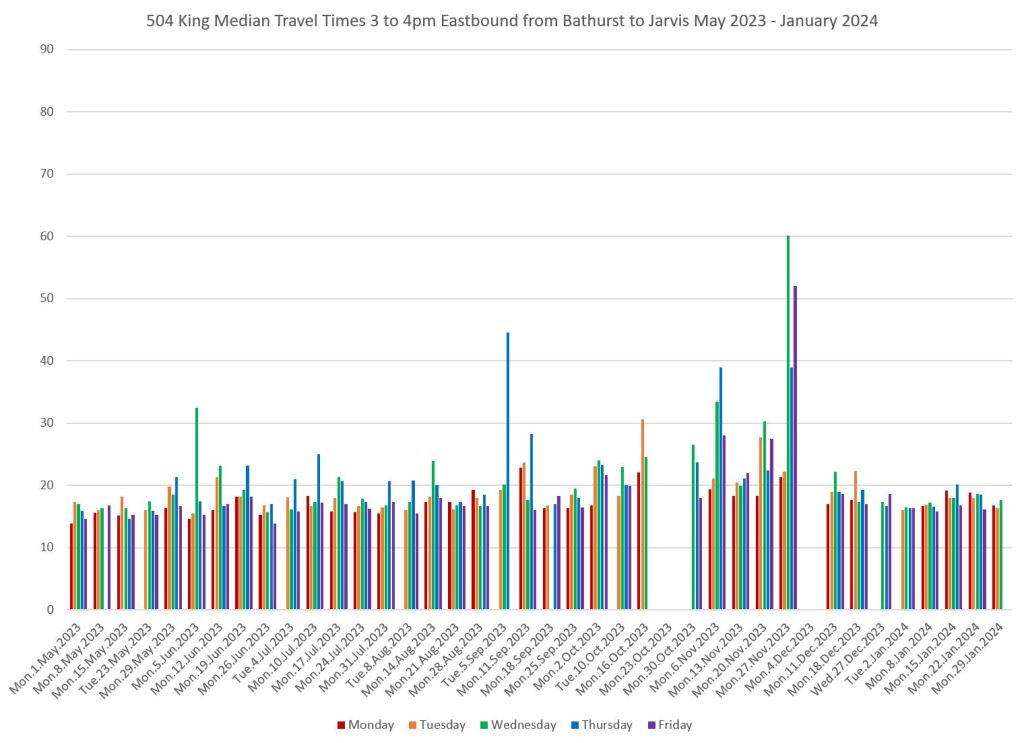
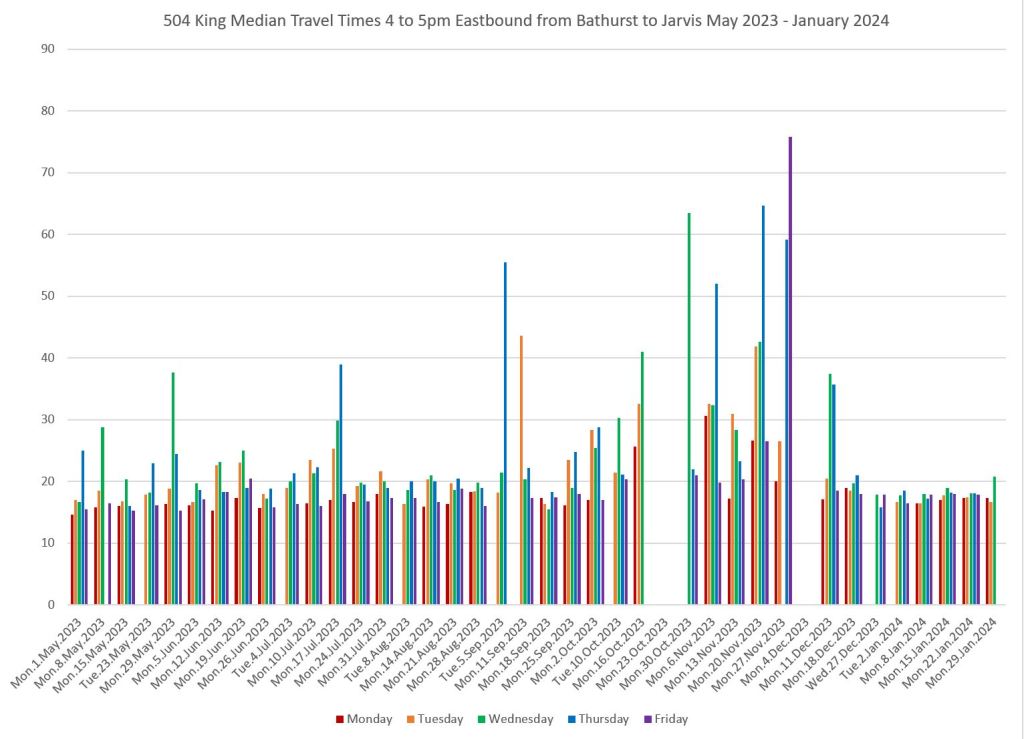
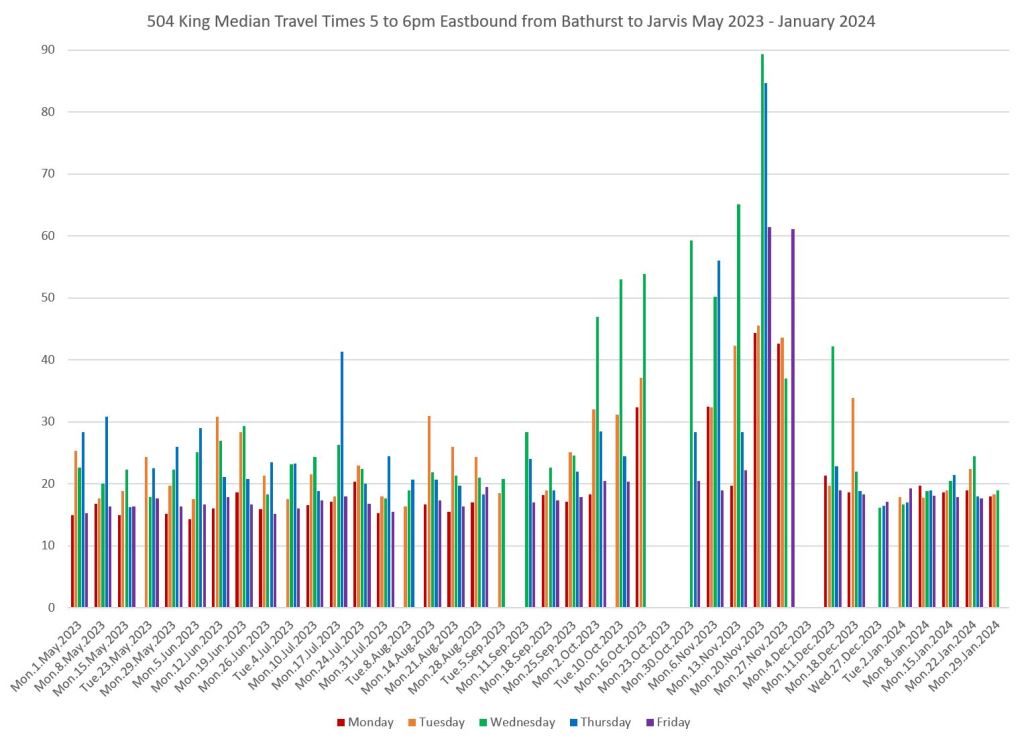
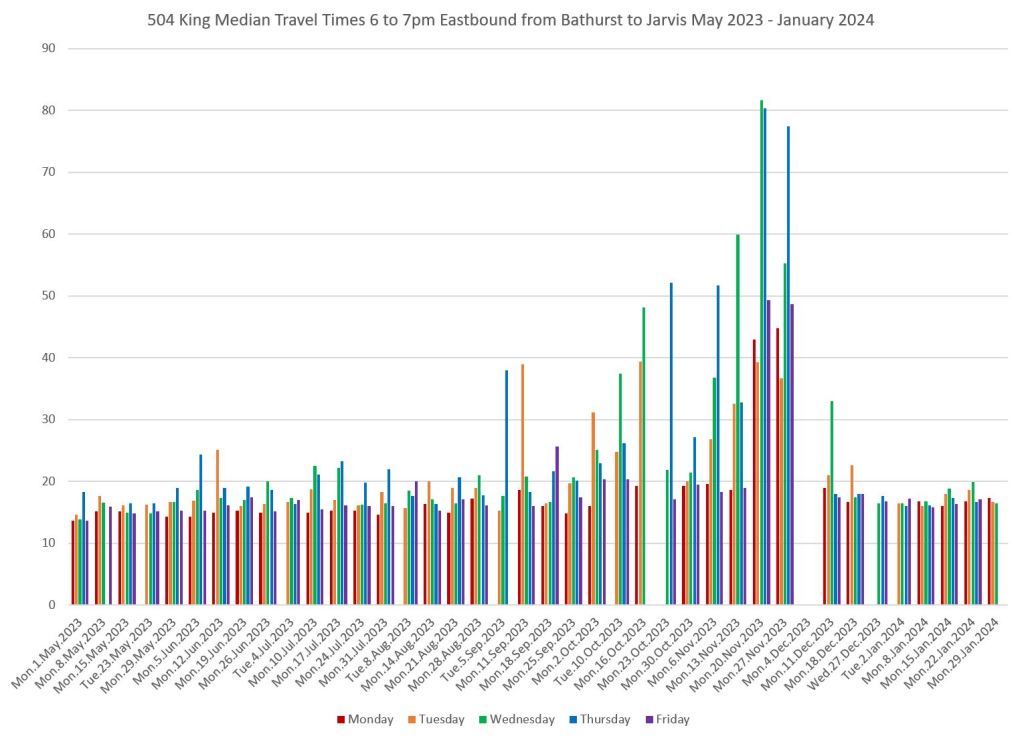
There are many detailed charts in this article, more than I would usually publish. They show how the view of data changes as one moves down from broad averages to specifics, and how seriously unreliable service was on routes affected by the sinkhole diversion even without that extra layer of problems.

Equally importantly, these charts show that problems are not occasional, but a chronic feature of TTC operations.

Data here goes only to the end of October, although the effects of the diversion carried over into early November. Even after service returned to “normal”, regular congestion effects remained on parts of King Street showing the underlying issue that was compounded by the diversion and its delays. I will turn to that in early December when I have all of November’s data.

Continue reading

The King Street Diversion Debacle (II)

This is a follow-up to my first article on this subject: The King Street Diversion Debacle.

From October 19 until early November, there was a major disruption of transit service downtown due to concurrent construction activities and the complete absence of transit priority or traffic management.

  • A sinkhole of King east of Jarvis blocked all streetcar service from the afternoon of Wednesday, October 18 to Tuesday, October 24. From October 25 onward, streetcars diverted only weekdays until 7pm.
  • Construction on Adelaide Street for the Ontario Line 501 Queen eastbound diversion track continued including the relocation of several underground chambers. This work closed York Street northbound at Adelaide.
  • Construction on Queen Street at Yonge for the Ontario Line closed that street from James to Victoria.

This event showed what can happen when a transit service and the streets it runs on are nearing the point of gridlock, and are pushed over the edge by loss of capacity. It also showed, quite starkly, how Toronto’s talk of managing congestion is much more talk than action.

This is a vital lesson in planning for future diversions and special events.

An important issue here is that some of the congestion problems pre-dated the sinkhole. Moreover, congestion did not occur in the same time at all locations, and some of it did not correspond to traditional ideas of peak periods.

The volume of turning movements overloaded the capacity of the intersections to handle transit, road and pedestrian traffic. A detailed list appears later in the article.

Streetcars and buses stop to serve passengers at many intersections, a fact of life for transit vehicles which behave differently from other traffic. Often two traffic signal phases would be consumed per vehicle: one for it to pull up to the stop, and one for it to make the turn. This limited the throughput of some intersections to fewer cars/hour than the combined scheduled service of the routes.

The electric switch southbound at King and Church was unreliable, and operators had to manually throw it so 501 Queen cars could go straight south to Wellington while other cars turned west on King. On its own, this would be an annoyance, but it compounded other delays.

Only 501 Queen ran on its scheduled route looping south on Church to Wellington, then west to York, north to King and east to Church. During some periods, the congestion was so great that the 501 Queen service was redirected from the Don Bridge westward via King to Distillery Loop. Off-route operation plays havoc with trip prediction apps adding to riders’ woes in finding when and where the service they needed would be.

In this article, I review the vehicle tracking data and travel times over the route from Queen and Parliament, west to Church, south to King and west to Peter (east of Spadina) using the 503 Kingston Road car as the primary subject. This was the only route that travelled the full length of the area during the diversion. Some cars did short turn, but most operated west to Charlotte Loop (King, Spadina, Adelaide, Charlotte) and they give a good representation of travel times experienced by all routes.

In the third and final part of this series, I will review the effect the delays downtown had on service of the three streetcar routes. This type of event has effects far from where it occurs, and these are not always acknowledged. A related problem is the inherent irregularity of TTC service even without a major diversion and congestion added to the mix.

After the break, there are a lot of charts for people who like that sort of thing, but there is also a summary for those who want the highlights.

Continue reading

Streetcars Return to The Queensway

Sunday, October 29 saw streetcars return west of Sunnyside Loop after a long absence during many construction projects. Service operates as far as Humber Loop on route 501, but with rush hour 508 Lake Shore trippers to Long Branch. The 507 Long Branch car will return on Sunday, November 19 at the next schedule change running between Humber and Long Branch Loops. Late evening service will run through with 501 Long Branch cars.

Here is a gallery of photos taken on November 3 and 5 of the restored operation.

While it is heartwarming to see streetcars back on a right-of-way that dates to the 1950s, the operation is hampered by the TTC’s fetish for caution with stop-and-proceed rules at all facing point switches (four between Queen & Roncesvalles and Sunnyside Loop, and even at the Humber Loop tail track), and at all intersecting roads. The concept of “transit priority” is diluted almost to vanishing.

Waterfront East Update: October 2023

Work on the Waterfront East LRT crept forward with the approval by Toronto’s Executive Committee of funding to continue design work, and of a tentative project plan. This must be endorsed by Council at its meeting of November 8-10, 2023.

For the previous update on this project, please see my April 2023 article.

Updated: Shortly after this article was published, the City of Toronto replied to questions I had posed about their report. The replies are integrated with the text of the article.

A combination of several factors push the completion date of this project, assuming that it receives full funding from provincial and/or federal sources, out into the 2030s. There is a danger that a so-called transit first community will actually see much of its redevelopment occur before adequate transit is in place to support it. Conversely, absent the transit service, some planned projects may simply sit as empty lots because they are not viable without it.

The current round of reports includes:

The WELRT has been divided into three segments.

  • Segment 1 (red) contains the Bay Street tunnel and the portals at Queens Quay where streetcars will surface. The existing west portal will be renovated and the new east portal added. Plans for decorative canopies have been dropped from the plan as a cost saving measure. This segment is under the TTC’s control for design and construction.
  • Segment 2 (blue) consists of the surface running on Queens Quay East to a revised intersection at Cherry Street which is realigned to the west. This segment primarily involved the reconfiguration of Queens Quay East similar to what already exists on Queens Quay West. (For details please refer to previous articles.)
  • Segment 3 (yellow) includes the southerly extension of trackage from Distillery Loop under the GO corridor, along a realigned Cherry Street, and east on Commissioners St to Villiers Loop (which is actually an around-the-block terminus, not an off street loop).

There are impediments to the work on segments 1 and 3 that dictate the timing of various works. The many delays in actually launching the WELRT project put other works in the same area in conflict that might otherwise be avoided notably the Ontario Line and the Gardiner/DVP realignment. The Bay Street tunnel has become more complex due to updated fire codes and the need to serve many more passengers than the Union Station Loop does today. Still outstanding is the redesign and expansion of Queens Quay Station and a link to the Island Ferry Docks which has been dropped from the project, as of the last update in April 2023.

The recommendations approved by Executive Committee are that:

  1. Council approve the alignment shown in the report.
  2. Council approve advancing design for the entire project, except segment 1 (underground), to 60%.
  3. Council approve
    • completion of environmental approvals,
    • undertaking of a traffic management plan to address interfacing the WELRT an other projects’ construction, and
    • design and coordination of the scope for the WELRT at the Cherry Lake Shore realignment, the Inner Harbour Tunnel at Jarvis, and the Hydro One relocation project at Cherry Portal.
  4. Council authorize an increase to the Transit Expansion Division’s Capital plan of $63.6 million in 2024-2026.
  5. Council direct the Executive Director of the Transit Expansion Division to report back at some point, unspecified, in 2024 with an update.

The estimated cost of the full project is $2.57 billion over a ten-year period assuming that full funding comes in Q1 2024, and the design work proposed in this report starts immediately. Any delay is a notable concern in an era when construction material and labour costs are rising quickly. It is not clear whether the figure cited is in current 2023 dollars, or includes inflation to the point the money is actually spent. I await clarification on this from the City.

Updated: The City of Toronto advises that:

The City is using as-spent dollars with future escalation included to the anticipated year of the expenditure. The cost estimate relies upon timely funding to meet the implementation schedule which is used as the basis for these inflation numbers.

Email from City of Toronto Media Relations, Nov. 2/23

The reason that the underground segment is excluded from approved design in recommendation 2 above is that this segment is proposed to be executed with a design-build contract where the detailed design will be undertaken by a contractor who is familiar with work in an underground environment.

Updated: This also keeps the design cost off of the City’s expenses for the moment. The City of Toronto advises that:

As noted in the staff report, staff are not recommending advancing the design of Segment 1 to 60% due to the City’s current financial pressures.

Email from City of Toronto Media Relations, Nov. 2/23

The project is subdivided into three parts:

  1. Union Station Loop, $932 million.
  2. Remainder of project except Cherry North, $1.3 billion. Includes East and West portals on Queens Quay, Queens Quay Station, Yonge Slip infill, Queens Quay East track from Bay to Cherry, Cherry Street south, Commissioners Street and Villiers Loop.
  3. Cherry North connection to Distillery District, $337 million, to be completed as a separate future phase.

The scope of work planned at Queens Quay Station is unclear because at the last update, much of this work had been dropped (platform expansion, link to adjacent building, link to ferry docks). I have asked the City for clarification of this.

Updated: The City of Toronto advises that:

The current scope for Queens Quay Ferry Docks Station is related to the station access upgrades (upgrade of the west entrance to improve accessibility) and it is part of the Segment 1 scope.

Email from City of Toronto Media Relations, Nov. 2/23

For the benefit of latecomers to the Waterfront East project, I have included a history at the end of the article. The idea goes back at least to the 2003 Central Waterfront Plan, and has languished without strong political support ever since the Ford era when all focus shifted to subways.

The greatest challenge was and remains that waterfront transit is not “important enough” to many on Council and lacked key leadership from the Mayor’s office through the John Tory era. Under Mayor Chow, it will compete with many other projects for priority and funding both for transit and in the wider context of City projects.

Three decades after the Central Waterfront Plan and a 2011 target opening date, we might still not have good service to our “transit first” neighbourhood by 2032.

Continue reading

Rick Leary Lives On

At today’s special meeting of the TTC Board, the expectation was that Rick Leary would be dismissed as CEO. This was not to be, for reasons yet, if ever, to be revealed.

Problems with Leary’s performance go back some years, and he is Andy Byford’s worst legacy. His original hiring was intended to bring a focus to operations as Byford’s deputy based on a supposed reputation from his stint at York Region improving operations there. Needless to say, there is a huge difference between a sprawling bus network with mostly infrequent service (YRT has fewer than 600 buses) and the TTC’s bus, streetcar and subway operations.

Leary came to YRT following his retirement under a cloud from Boston’s transit agency, the MBTA, quite a step down in the scale of systems. In Boston, a serious collision on the Green Line (the streetcar subway which has been a major part of the City’s transit system for over a century) led to a Nation Transportation Safety Board condemnation of the safety culture at the transit agency (then the MBTA). Leary was supposed to address the report at an MBTA Board meeting, but never showed up, and retired shortly afterward.

When Byford left TTC to become President of the New York City Transit Authority (one component of the larger Metropolitan Transportation Authority), Leary succeeded to the CEO’s role. There were warning signs of problems from early days with the abrupt departure of many of Byford’s TTC management team, and stories of a hostile work environment. Some were pushed out, some waited until their pension numbers were favourable.

Leary was known to have a quick temper, and stories of a poisonous work environment were common. TTC Board meetings became tightly scripted sessions with rehearsed presentations and responses to likely questions. Leary fit in well with the Tory era which, we now know, had a strong desire for news that “everything is all right” and the minimization of problems, especially fiscal ones.

Labour-management relations left a lot to be desired, although Leary’s moves to outsource some aspects of system maintenance responded both to the hawkish stance of some Board members, and carried over a program started under Byford.

Previous articles here have flagged the shortcomings of the CEO’s Report with metrics that hide more than they tell. Service quality is reduced to “on time performance” with the naive sense that vehicles leaving on time from terminals will magically provide even service across their routes. That, in turn, led to a scheduling regime that favoured padded travel times, and a “no short turns” operating policy that did as much harm as the problem it was intended to fix. More subtly, what was lost was the need to actively manage service, including the necessary skilled staffing, to deal with constantly changing conditions.

Another troubling problem is the size of the transit fleet unmatched by service. This problem existed before the covid-era service cuts, but worsened as service was reduced. Many elderly and/or less reliable vehicles could be sidelined without affecting service. However, as new buses are delivered, the excuse of an old fleet will not hold up, and the fleet should be out on the street, not sitting in garages and carhouses.

This has staffing and budget implications that have not been part of TTC’s planning. The question is not just can we run more service, but how much and how soon. Leary’s history on that point is dubious. After John Tory’s election as Mayor in 2014, he acknowledged that the system had been starved for resources under the Ford administration, a position for which then-candidate Olivia Chow was ridiculed during the campaign. Tory bought the TTC an extra 100 buses, but almost all of them went into the spare pool, not into regular service.

The degree of collusion between TTC management and John Tory’s office was on full show during the 2023 budget debates when the TTC, that is to say Leary, refused to release details of service changes even when they were requested by Councillors and Board members. Keeping secrets won’t hide the information, only delay the public’s seeing what happens with service on the street.

At the end of Byford’s era at TTC, there was a plan for Line 2 renewal including a replacement fleet, new carhouse and yard, automatic train control, power and station upgrades. This plan never saw the light of day, and Leary instead pushed a scheme to rebuild the existing Line 2 fleet. This would avoid a capital spending crunch, but would also limit service growth, including on the Scarborough extension, and expose the TTC to a potentially unreliable aging fleet of subway cars. In time Leary reversed his position, but key years and momentum were lost.

Most troubling has been the matter of safety. In June 2020, there was a “near miss” at Osgoode Station where a train leaving the pocket track nearly collided with a northbound train on the main line. The issue here is not the signal design, training and operational procedures that made this possible, but that Leary withheld any report of the incident from the TTC Board almost a year after the incident. This should have been a firing offense, but Leary remained in his position with an explicit Board directive that major incidents of this nature be reported immediately.

The SRT derailment that abruptly ended service on that route in July 2023 was very public. The full investigative report into its causes has still not been released although an overview was presented at September’s Board meeting. At this point it is not clear whether deferred maintenance was the culprit, but there are unhappy echoes here of another period of TTC financial constraint and maintenance cuts that led to the crash at Russell Hill.

Again the issue is whether a growing problem was not reported, or worse not even detected. This scenario has been seen on other transit systems where operations degrade through make-shift arrangements like slow orders over poor track while the repair backlog grows. We simply do not know the current state of the TTC, and the political focus has been entirely on maintaining service.

Those who follow TTC announcements of delays will recognize the frequently-used term “operational problems”. This can embrace a wide variety of issues ranging from operators who do not show up for their shift to disabled vehicles, derailments or power system failures. Over Leary’s tenure, the amount of information giving specific explanations for problems has declined sharply, and Leary himself is rarely seen as a spokesman and explainer for the TTC. This is much unlike Andy Byford who could articulate problems and more importantly a desire to fix whatever underlying problems might exist.

If Leary had been removed, the challenge faced by a new CEO would lie in rebuilding the management structure, gaining the trust and dedication of 15,000 employees, presenting a credible and thorough recovery plan and budget for Toronto’s transit system, all while keeping the lights on and the wheels turning. Leary is not the man for that job.

No, gentle reader, I am not going to write yet another article about what the TTC should be doing. We’ve been around that bush a few times recently. The context yet to be set is the amount of money the TTC will have both for day-to-day service and maintenance, as well as capital funding for key projects.

Toronto’s political preoccupation, with good reason, is on the housing and affordability crisis. Transit will not be front of the line for funding, although it is a key service. Into this uncertain future should come a new CEO and revived management.

This is a significant failure for Mayor Chow. A too-timid TTC Board has missed the chance for renewal of its senior management.

The King Street Diversion Debacle

Starting on October 19 mid-afternoon, streetcar service on King Street east of Church was blocked by a sinkhole caused by a broken watermain. Streetcar service was diverted from King to Queen, and the 501B Queen bus was shifted south to King.

The sinkhole repairs completed a few days ago, and effective October 25, the diversions are only in effect until 7pm while water main repairs continue. While this arrangement does improve evening service, it perpetuates the operational problems caused by the total lack of transit signal priority and traffic management at key intersections.

Updated Oct 27 at 11:15pm: The modified routes will not be in operation over the weekend, but will resume on Monday morning, October 30 according to the @ttchelps X account.

A separate problem occurs at the transition back to “normal” service in the evening. The buses revert to normal or run back to the garage, but it takes some time for the congestion to abate and normal streetcar service to resume. This puts a large gap between the two services.

Diversion Announcement This diversion announcement linked below has disappeared from the TTC site. As the TTC updates their info, I will amend this article.

In summary, here are the normal (now evening only) and modified (daytime) routes through the affected area:

  • 501B bus: Bathurst to Broadview/Gerrard
    • Normal: Via Queen, Bay, King/Richmond (EB/WB), Church to Queen
    • Diverted: Via Queen, Bay, King to Queen at the Don River (Both ways)
  • 501D streetcar: Neville to York & Wellington
    • Normal: Via Queen, Church, Wellington/York/King loop
    • Diverted: No route change, but many Queen cars never get to York street and are short turned further east including to Distillery Loop during the most congested periods.
  • 503 streetcar: Spadina to Bingham
    • Normal: Via King, Queen, Kingston Rd
    • Diverted: Via King, Church, Queen, Kingston Rd
  • 504 streetcar:
    • Normal: From King West to Distillery Loop via King, Sumach and Cherry
    • Diverted:
      • Streetcars short turn at Church via Church, Richmond, Victoria, Adelaide, Church
      • Bus shuttle to Distillery looping downtown via Bay, Adelaide, Yonge to King

This arrangement has extremely severe effects on transit and traffic in general notably at locations where streetcars must turn. There is no Transit Signal Priority (TSP), no Traffic Warden (aka “Agent”), and no attempt to manage the conflicts between turning streetcars, other traffic and high pedestrian volumes at affected intersections. Concurrent work on Adelaide Street diverts traffic to Yonge Street and adds to congestion on streets used for the bus diversion.

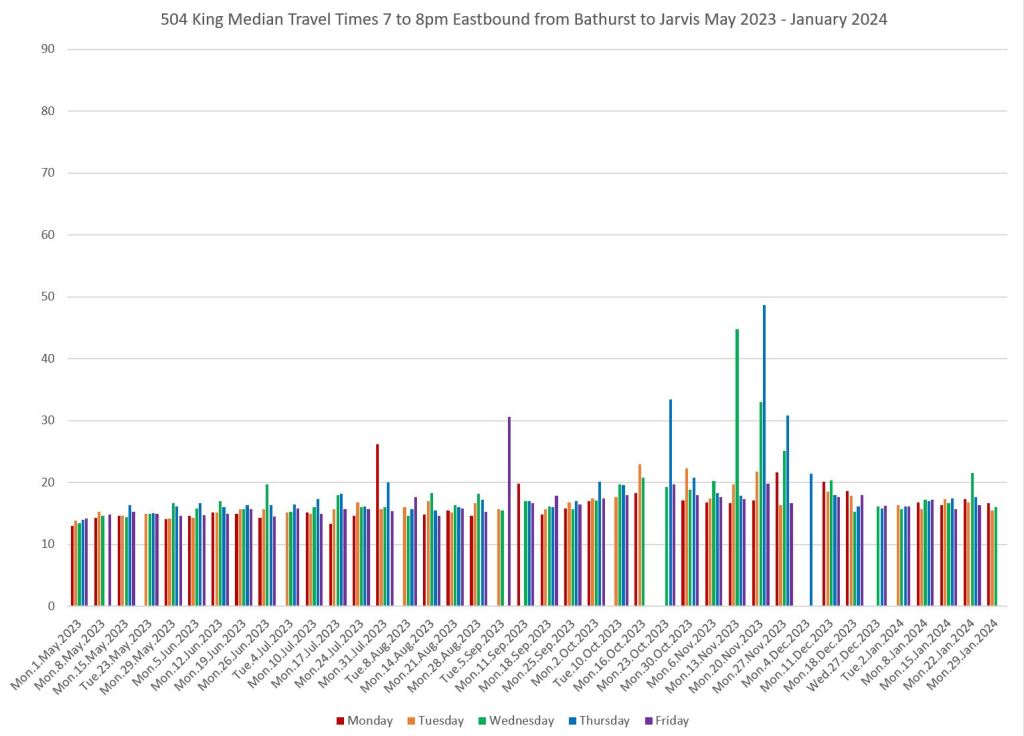
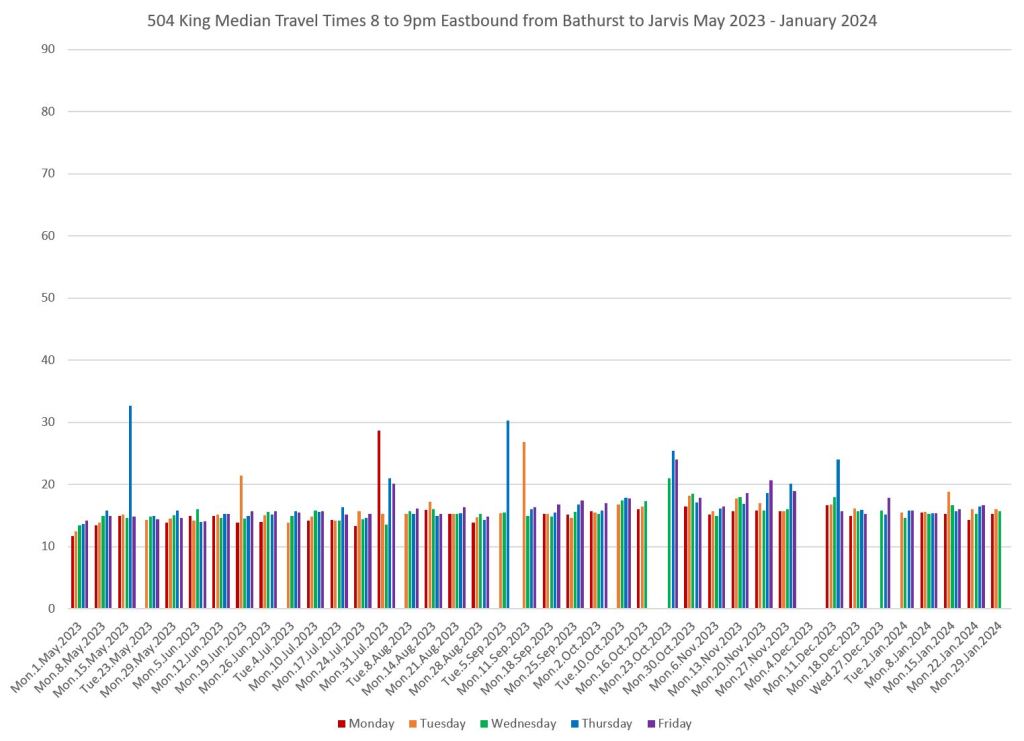
Travel times of half an hour and more between Spadina and Church are common.

The situation makes total mockery of the City’s recent Congestion Management Plan by showing how they are utterly unprepared and unwilling to respond to an event that requires major reallocation of road space and time among various types of users, and active management in place of passive acceptance of chaos.

A fundamental part of traffic planning is to determine intersection capacity. This is not rocket science. If there are “N” green phases per hour, and in practice it is only possible for at best one streetcar to turn per cycle, this sets an upper bound on capacity. In fact, one per cycle is amazingly optimistic and could only likely be achieved with both TSP signalling (a “white bar” transit only phase) and a Traffic Agent to ensure the TSP was respected.

Service frequencies on the streetcar routes, and the equivalent cars/hour are:

  • 501D Queen/Neville service: 10′ / 6 cars/hour
  • 503 Kingston Rd Bingham service: 10′ / 6 cars/hour
  • 504 King Church service: 4′ / 15 cars/hour

This translates to the following demands by turning cars/hour:

  • King/Church
    • Eastbound left: 35
    • Southbound right: 25
  • Queen/Church:
    • Westbound left: 20
    • Northbound right: 20
  • Church/Richmond:
    • Northbound left: 15

A typical traffic signal cycle time is 80 seconds, or 45 times per hour. It is self-evident that attempting to turn 35 cars/hour would be a challenge. This is compounded by the fact that many cars will stop to serve passengers before turning and will almost certainly lose one cycle for that purpose.

Another source of delay is that the electric switches for turns do not always work requiring operators to manually set their route where some cars turn and others go straight through. This can also affect TSP signals where they do exist because the switch electronics “tell” the signals that a transit phase is needed.

This is a crisis-level example of why TSP should be installed everywhere that streetcars might need it, not just for standard scheduled movements (e.g. eastbound at Queen and Broadview, turns at King & Sumach). It is precisely during events where operations go off kilter that the best possible priority is needed. If the facilities were sitting there, they would benefit occasional diversions and short turns, as well as major service interruptions like this one.

The City’s plan is utterly silent on this need, and that must change. For its part, the TTC must insist on improved TSP for streetcar and bus routes. This is not a panacea, but an important contribution to transit reliability and credibility.

Streetcars Return to Humber Loop

The TTC has announced that streetcar service west of Sunnyside Loop (where 501A service now ends) will be extended to Humber Loop on Sunday, October 29. Service to Long Branch will be provided by the 501L shuttle bus operating between Humber and Long Branch as shown below.

A 501M Marine Parade bus will operate from Humber Loop.

The 508 Lake Shore streetcar service will resume to Long Branch Loop on Monday, October 30. Cars will leave Long Branch roughly every 20 minutes from 6:40 to 8:10am. Westbound trips will leave King Station from about 4:25 to 5:45pm.

The eastern terminus of the 501A cars will continue to be at McCaul Loop.

The extension is possible between regular schedule changes because running time is already provided in the October schedules for 501 operation to Humber, and for 508 operation to Long Branch.

Full 507 Long Branch streetcar service will be restored at the next schedule change on Sunday, November 19.

Night service will continue with the 301 Queen Night Bus because of the need to divert around Ontario Line construction.