Toronto Considers Congestion Management, Again

At its meeting on October 25, 2023, Toronto’s Infrastructure and Environment Committee will consider a report titled Congestion Management Plan 2023-2026. With a familiar refrain, the report begins:

The City is facing an unprecedented amount of construction road closures creating congestion issues for motorists, cyclists and pedestrians and surface street transit. There has also been a significant demand for special events in the City post-pandemic with the needs for road closures and more comprehensive traffic management strategies to minimize the impacts. This situation emphasizes the demand for better coordination of access to the right-of-way and the need for improved traffic management overall to help mitigate the impacts of congestion while maintaining safety for all road users.

[Congestion Management Plan 2023-26 at p. 1]

It goes on to talk about “refocusing” on four key areas:

  • Leveraging Technology to Better Coordinate Construction on City Streets and expanding the Construction Hub program
  • Establishing a dedicated traffic management team that will work with stakeholders such as Toronto Police Services, Toronto Parking Authority, TTC, Metrolinx GO, the Office of Emergency Management and City Councillors to improve traffic management planning efforts around major events while also coordinating with ongoing construction
  • Providing increased traffic management support for surface street transit for both TTC and Metrolinx GO to help mitigate the impacts of construction related route diversions
  • Investigating Intelligent Transportation Systems (ITS), including Artificial Intelligence (AI) and Internet-of-Things (IoT) technology to better optimize traffic signal operations to help all modes move more efficiently and safely with less delay around the City.
[Congestion Management Plan 2023-26 at pp 1-2]

This appears modestly promising but for the fact we have heard many proposals before and, if anything, congestion becomes worse. If this is a “refocus”, one might ask what the City has been doing for the decade since the first Congestion Management Plan was adopted in 2013. In turn, that goes back to an October 2011 motion by Councillor Josh Matlow asking for “a report on the cost and feasibility of implementing a Synchronized Traffic Signal System”.

Looking back at years of reports, there is a common theme that changes are possible at the small scale with improvements of up to 10% in traffic flow at specific times and locations. However, these are one time effects in the sense that the improvement, once achieved, cannot repeated to cope with traffic growth.

Moreover, there is a finite capacity in the road system, and the major political challenge is to apportion this capacity among competing demands. Motor traffic, as the dominant use, inevitably must give up part of its share to give better service and space to others. This was a fundamental choice needed in the King Street Transit Priority Pilot scheme, and even there, the assumption was that some traffic could shift from King to parallel corridors.

[Full disclosure: I was a paid consultant on a project in 2014-15 to review the major east-west streetcar lines with a view to modifying traffic and parking rules to improve transit operations in the peak and shoulder-peak periods.]

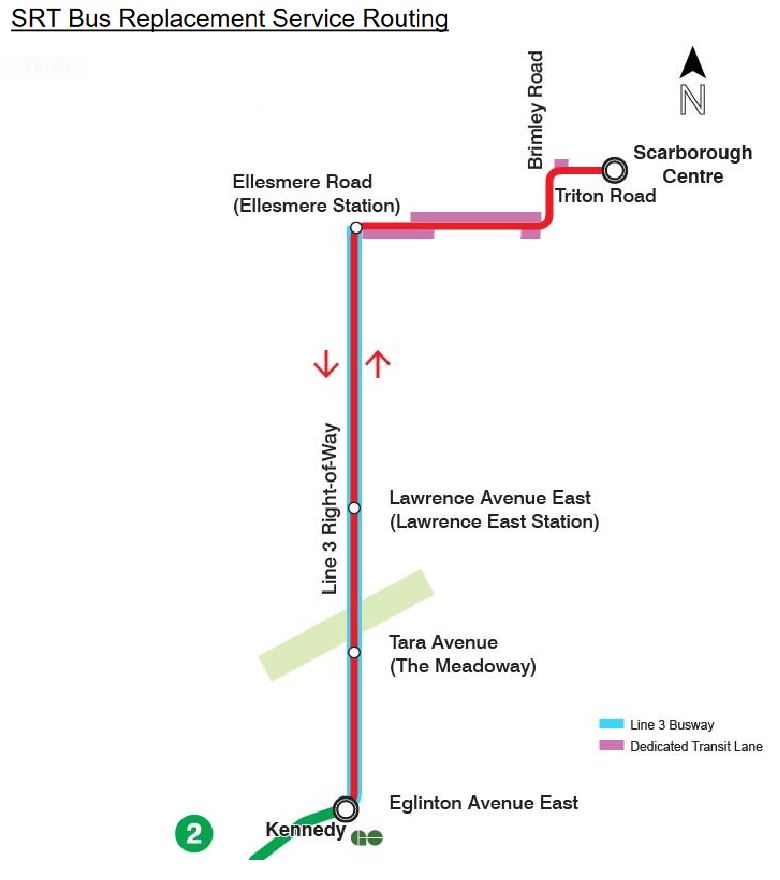
Although Transit Priority is one topic in the report, there is no mention of the RapidTO program which appears to be stalled after the initial implementation in Scarborough on Eglinton-Kingston-Morningside. I am not counting the red lanes for the 903 Scarborough Express bus replacing the SRT as they came from a force majeure situation and would not otherwise have been implemented. Any of the RapidTO proposals will involve substantial change in allocation of road capacity, and they have not been well received in some quarters.

A related question is whether dedicated lanes can be justified in areas where TTC service is not as frequent as it once was on King Street, especially on a fully dedicated 7×24 basis.

In March 2020, the Covid lockdowns made a lot of traffic vanish, although as reported both here and elsewhere, traffic is now above pre-pandemic levels. This is particularly true in the suburbs where there are proportionately more jobs that are not suited to work-from-home arrangements, and where transit’s share of the travel market is hampered by service levels, route structure and trip distances.

The pandemic also triggered a move to accelerate construction projects both as a job creation program and to take advantage of the lower effect on traffic possible at the time. However, construction does not appear to have diminished, but the normal traffic level is back.

The basic problem of finite road capacity is made much more complex by the removal of significant chunks of that capacity for rapid transit construction, utility repairs, streetcar track maintenance (downtown), road and bridge maintenance, and curb lane occupancy permits for building construction. All of this might be “co-ordinated”, but the sheer number of affected locations and the duration of temporary capacity removal means that the road system is rarely at an optimal condition.

This also hampers schemes to reallocate capacity permanently for transit, cycling and pedestrians.

The current report includes only two recommendations:

  • the reconfiguration and expansion of zones served by “construction hubs” which are supposed to provide co-ordination between all projects by various parties in different sections of the city, and
  • expansion of the Traffic Agent Program (aka “Traffic Wardens”) by use of police officers and special constables.

Any other effects would come from continuation of work already approved or in progress, notably from the “Smart Signals” project which is already underway, but which is not yet fully funded.

Notable by its complete absence in this report is the recognition that some congestion cannot be easily “fixed”, and that active intervention in allocating road capacity will be necessary in the worst cases. That is dangerous political territory, especially in a City that has lived through both the Ford and Tory eras where transit did not rank first.

Moreover, there is a danger that a focus on “congestion” will reinforce the TTC’s typical behaviour of assigning all blame for poor service on external factors when their own scheduling and line management practices make a substantial contribution.

In the remainder of this article, I will review various aspects of the City’s plan and actions to date. This is mostly in the same order as sections of the report, with some consolidation to group related items.

Continue reading

The Vanishing Transit Priority on King Street

At its meeting on October 25, 2023, Toronto’s Infrastructure and Environment Committee will consider a report about the City’s Congestion Management Plan. I will review that in a separate article, but to set the scene, it is worth looking back at the success and failure of the King Street transit priority pilot.

The original idea was to establish King Street, by far the busiest streetcar corridor downtown with consistently high demand, as a mostly-transit street to speed trips through the core area. A combination of forced right turns, enlarged boarding areas at stops, together with other road changes would make travel by car between Jarvis and Bathurst Streets difficult, if not impossible.

The scheme was quickly watered down thanks to protests from the taxi industry, including carriers like Uber whose vehicles were not branded, and this presented an immediate problem for enforcement. That problem was compounded by the lackluster efforts of Toronto Police who had more important things to do with their time. Occasional blitzes were separated by long periods of laissez-faire non-enforcement.

Despite these limitations, the changes actually did improve travel times, and in particular, the reliability of travel times, over the affected section. Then came the pandemic, and traffic downtown evaporated along with any vestigial efforts to enforce traffic laws. Motorists became used to driving as they pleased, and that has survived into the post-pandemic period along with the unsurprising result that many benefits of the transit priority scheme have been lost.

This article looks back at the actual data for 504 King cars operating through the core to show how travel times have evolved. I have included data going back well beyond the implementation of the King Street transit priority pilot in November 2017. Some of these charts appeared in earlier reviews of King Street, but they are included here for “one stop shopping”.

All data for the analysis here were supplied by the TTC from their CIS and Vision vehicle tracking systems, for which much thanks. The presentation and conclusions are my own.

Continue reading

Analysis of 512 St. Clair Service: Part III

This article continues my reviews of bus operations on 512 St. Clair in September 2023 and of streetcar operations in the preceding months.

One aspect of any route’s operation is the degree to which vehicles have time for a layover at terminals. If this time is too small (or worse, none at all), service can be disrupted by the simple need for drivers to answer calls of nature and just decompress for a few minutes.

There is no formal break built into schedules in Toronto as can be found in some other transit systems, but a quick look at the TTC’s schedule summaries will show that most routes have built in “recover time”. This is intended to compensate for random events during a trip, although sometimes it is simply a mechanism to make the round trip time come out to a multiple of the scheduled headway.

Some of the “service reliability adjustments” the TTC advertises with schedule change are nothing more than shifting time from “recovery” to “driving” time without actually changing the round trip time. In other cases, time is added or removed without changing the total number of vehicles causing the service headway to get longer or shorter.

When schedules have excessive travel and/or recovery time, vehicles queue up at terminals causing congestion on the approach if there is no place to park off-street.

In the case of 512 St. Clair, the time spent at St. Clair Station (the eastern terminus) was fairly consistent up to the end of June 2023, but things got really messy. This corresponded to the point where service on the line as a whole became considerably worse as we saw in earlier articles.

This was caused by two competing factors in route operations.

  • In July and August, the TTC extended streetcar service to Gunn’s Loop west of Keele even though it was only scheduled to run to Earlscourt Loop at Lansdowne. This made keeping “on time”, the TTC’s holy grail of service management, impossible.
  • The approaches taken in July and August were quite different, but a common factor was that streetcars spent more time sitting in St. Clair Station Loop to get back on time at the expense of providing the advertised service on the route.
Continue reading

Analysis of 512 St. Clair Service: Part II

This is the second part of my review of service quality before and after the substitution of buses for streetcars on 512 St. Clair in September 2023. Part I deals mainly with bus operations in September.

Until May 8, streetcars operated between St. Clair Station and Gunn’s Loop over the full route. Work on the GO bridge west of Caledonia was expected to start in May, and so on May 8 the streetcars were cut back to Earlscourt Loop and the 47A Lansdowne to St. Clair bus service was extended west to Gunn’s Loop.

The work did not occur as expected, and in response to problems with and complaints about service provided by the 47A, the streetcars resumed operation to Gunn’s Loop, but with no added running time, effective on July 4. That condition remained in effect until September 3 when buses took over the full 512 St. Clair route, and the 47A Lansdowne returned to its normal terminus at Earlscourt Loop.

The TTC has a lot to answer for here with the combined effect of service cuts and erratic operation of the service that remained while the line operated with streetcars. Buses look better by comparison because the streetcars, even with their dedicated lane, were so unreliable.

This was compounded by the effect of the long-running bus substitution on travel times discussed in Part I of this series, and by the inadequate preparation for transit priority as of day one of the bus replacement.

Continue reading

Analysis of 512 St. Clair Service: September 2023

Effective September 3 and until July 2024, the TTC has replaced streetcar service with buses on oute 512 St. Clair for various construction projects. The length and scope of this work evolved between May 2023 and the point where the full closure was announced at the end of August. See The Changing Scope of St. Clair Construction.

Replacement buses are scheduled far more frequently than the streetcars they replaced, but they are running in the mixed traffic lanes beside a now-empty streetcar right-of-way. Depending on traffic conditions, travel times can be substantially longer with buses.

In the months before the conversion, the streetcar service was already in upheaval for planned work at the GO overpass west of Caledonia, and the St. Clair car was cut back from Gunn’s Loop (Keele) to Lansdowne. It was subsequently restored when the timing of work at the overpass changed, but the schedules were not changed to reflect the longer route.

This article reviews, mainly, the bus service from September 3-30, 2023. In a following article, I will turn to the streetcar service it replaced and the less than ideal quality provided during the on-again, off-again service through to Keele over summer 2023.

Responding to complaints about the bus service, the TTC has stated that they are working with the City on traffic signalling changes, as well as modifications to road lane allocations to remove bottlenecks in the bus operation. For the length and potential effect of this streetcar service suspension, one must ask why these changes are studied and, maybe, to be announced, implemented after the fact rather than as an integral part of the switch to bus service using the regular traffic lanes.

This is not the first time in 2023 (or earlier) that the TTC plays catch-up with getting priority measures for its service during extended diversions and construction projects. The attitude seems to be that problems will be addressed as and when they occur, rather than being anticipated and planned for, with transit service and riders getting a raw deal.

Continue reading

Line 3 SRT Replacement Service and Derailment Investigation

The TTC Board received a presentation at its September 26, 2023, meeting updating the information in the report published with the agenda. The first part deals with plans for the Line 3 bus replacement service and gives additional details beyond those previously announced.

The shift to using all of the Red Lanes on Ellesmere, Midland and Kennedy is planned for November 19.

The travel time today is considerably higher than when the RT was operating (second bar in the chart on the right below). This will be reduced with the elimination of transfers at STC between feeder routes and the 903 shuttle service together with the full transit priority implementation in mid-November. Further saving is expected when buses shift to a busway in the SRT corridor.

On November 19, eight routes will be extended to Kennedy Station to eliminate the need to transfer to the 903 shuttle.

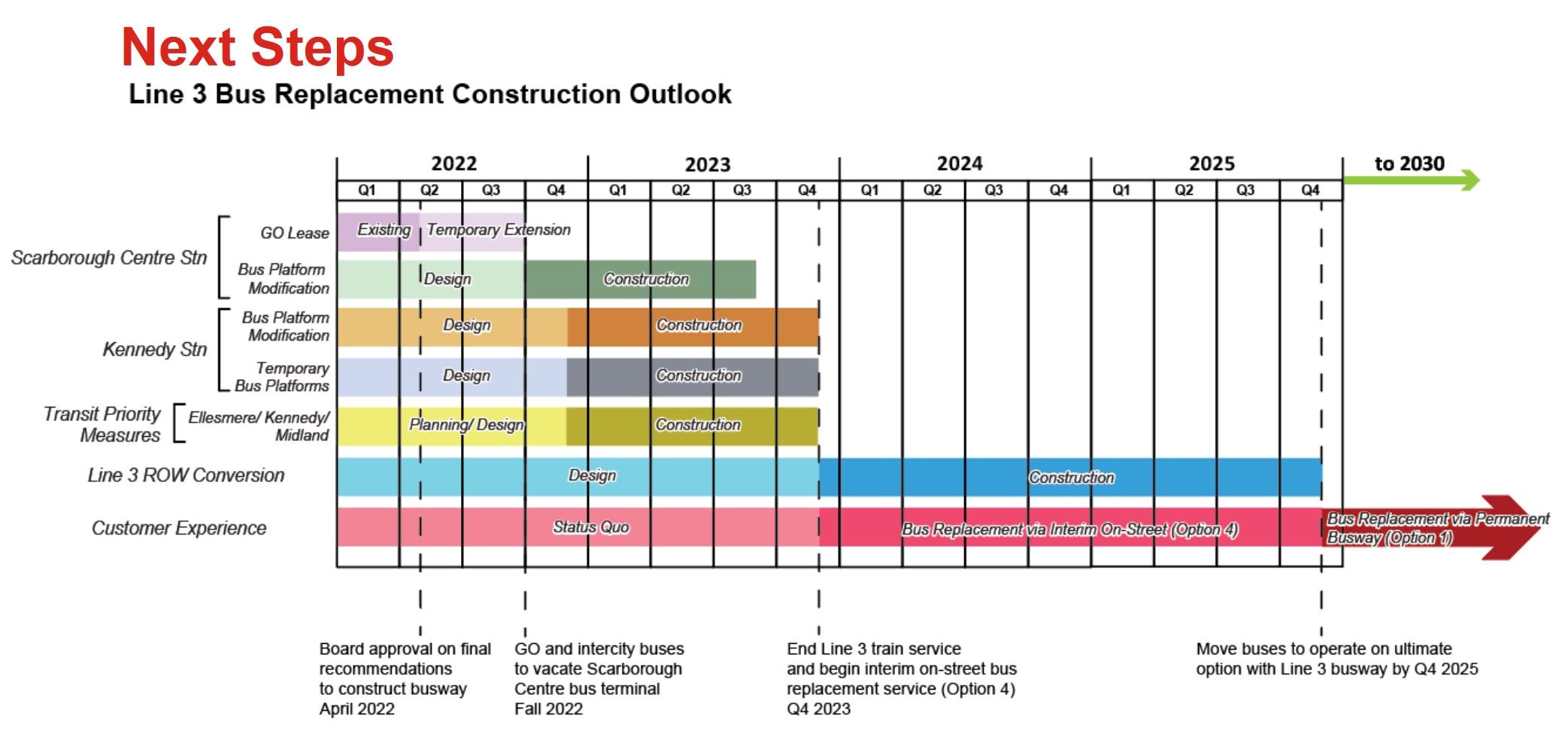
The most disappointing part of the presentation is the timeline overview which shows the opening date for the busway in the SRT corridor as 2026. Design work is underway to be completed in 2024 with construction in 2025 aiming at a mid-2026 opening date.

Continue reading

Streetcar Diversion Update, Sept. 24, 2023

The weekend of Sept 23-24 saw another shuffle in the streetcar diversion list on which I last reported a few weeks ago. This round of changes is triggered by two events:

  • Metrolinx work on the Lakeshore East corridor at Queen & Degrassi streets prevents streetcar operation through the underpass, and at times the road will be closed to all traffic.
  • Toronto Hydro work on Queen West has completed to the point that streetcars are no longer diverting via King Street through Parkdale.

Services now operating on Queen Street include:

  • 501L (aka 507) Queen bus from Long Branch to Dufferin. These buses do not appear on transit apps.
  • 501B Queen bus from Bathurst to Broadview & Gerrard, with downtown diversion around Ontario Line construction.
  • 501 Queen streetcar from Sunnyside Loop to McCaul Loop.
  • 501D (aka 513) Queen bus from Victoria Street (looping via Church, Richmond and Victoria) to Neville Loop. These buses appear on transit apps as 513 Queen East.
  • 503 Kingston Road bus between the Don River and Kingston Road.

During certain periods, the underpass at Degrassi will be closed to all traffic and the 501/503/513 services will divert via Broadview, Dundas and Carlaw.

Complete closures are planned for Sunday, September 24 all day, and from Friday, September 29 at 10pm to Monday, October 2 at 4am.

The 504 King car operates only west of Distillery Loop pending completion of road and track construction on Broadview from Gerrard to Broadview Station Loop. Heavy construction at the loop will begin on Monday, September 25. Paving in the curb lanes on Broadview south of Danforth has begun following completion of track work.

The 72A Pape bus serving King Street East will use the same diversion around Queen & Degrassi as the Queen services, and will not serve stops south of Dundas nor on Queen east of Broadview during periods when the underpass is closed.

The 505 Dundas car no longer serves Queen Street East except between Coxwell and Woodbine Loop. It now operates via Broadview, Gerrard, Coxwell and Queen to Kingston Road.

There is no map of the current route arrangement in the east end on the TTC’s Streetcar Service Changes page, and some maps for 505 Dundas reflect its route before the shift north to Gerrard Street. The 505 Dundas section also still includes a reference to the 506C bus from Castle Frank Station which no longer operates.

The 506 Carlton car is unchanged with normal service except at the west end where cars divert to Dundas West Station due to water main construction on Howard Park Avenue.

Routes 509 Harbourfront, 510 Spadina and 511 Bathurst are operating normally.

Route 512 St. Clair will remain a bus operation until summer 2024 for various construction projects.

TTC Board Meeting Preview: September 26, 2023

The TTC Board will meet at Scarborough Council Chambers at 10:00 am on September 26, 2023. This will be the first meeting of the reconstituted Board under Mayor Chow’s administration. Among the reports on the agenda are:

The agenda also includes a report Update on TTC’s Partnership Approach to Community Safety, Security and Well-Being on Public Transit. I will address this in a separate article.

Continue reading