The Transit Investment Panel: Hard Truths

After Metrolinx produced its report on revenue sources that might fund their regional plan, The Big Move, the whole thing was turned over to a newly created panel by Queen’s Park to review the options.

This panel now has its own website, and has issued the first of three discussion papers on the “Hard Truths” about transit in the GTHA.

One of the most damning statements about the depths to which Toronto has fallen appears in the Introduction:

Toronto used to be considered a transit system leader and all levels of government made bold investments to earn that reputation. We are reaping the benefits of those investments to this day, as a city, region, province, and country.

The Toronto region now ranks as the worst performer in Canada in moving people to and from work and is near the bottom of global rankings.

That’s what happens to a city that rests on a decades-old reputation for its transit network.  Toronto was spared some of the worst effects of hollowed-out downtowns thanks to postwar immigration and a robust local economy, but this masked deeper problems with the lack of investment in mobility around the city and region.  The central city, the one in all the tourist posters, prospered while gradually the suburbs strangled in traffic.

Debates about transit plans and funding are mired in misconceptions about what can and should be done, and the Hard Truths paper is intended to reset the discussion.  Whether the panel will be successful in their aim given the highly polarized political context remains to be seen.

These are hard truths, but until we accept them, we will not be able to have a mature discussion. Decisions will not be based on reason and evidence, but will be one-off decisions aimed at short term political gain.

The six truths are:

  • Subways are not the only good form of transit.
  • Transit does not automatically drive development.
  • The cost of building transit is not the main expense.
  • Transit riders are not the only beneficiaries of new infrastructure.
  • Transit expansion in the region is not at a standstill.
  • We can’t pay for the region-wide transit we need by cutting waste in government alone.

Continue reading

Moving People Downtown: The Gardiner East Is Only The Beginning

On October 16, 2013, the second public meeting in the Gardiner East Environmental Assessment presented additional information and refinement of the options for dealing with the expressway’s segment between the Don River and Jarvis Street.

The purpose of the meeting was to report on the options that would receive further analysis in the next step of the EA and to provide comparative information about costs and benefits of the various schemes.  Broadly, there are four families of options:

  • Maintain the existing expressway with necessary repairs to make it sound for several decades’ more service.
  • Replace the expressway on a new structure either above or below ground.
  • Improve the existing expressway by selective reconstruction to open up space under the road deck.
  • Remove the expressway and create an at-grade boulevard.

Some options have been dropped from further study:

  • An underground alignment 1km long transitioning to/from existing elevated structured at the Don and at Jarvis.
  • An elevated alignment over the rail corridor.
  • A surface alignment on a berm abutting the south side of the rail corridor.

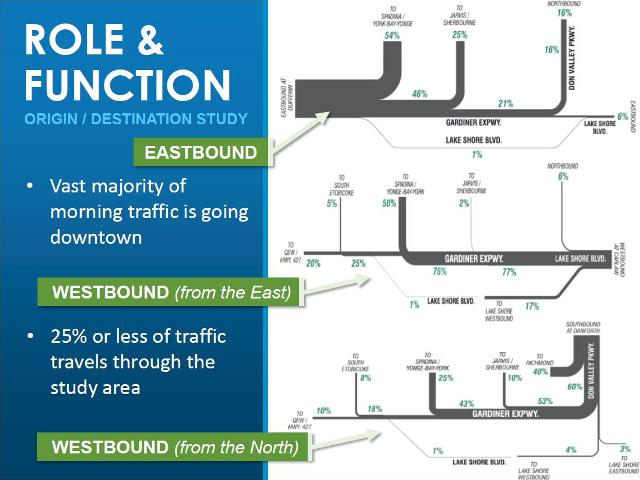
For any tunnel option, an important consideration is that most of the traffic arriving from the DVP and Lake Shore East is bound for the core area rather than as through trips to the western side of Toronto and beyond.  Therefore, access ramps are essential to any option that is not at grade so that traffic can actually get to downtown.  (By contrast, the “Big Dig” in Boston provided a link between the north and south sides of the core area on a route where 80% of the travel is through traffic and does not create demand for local ramp structures.)

The study claims that 80% of inbound trips have downtown destinations and this argues against a tunnel from which access would be difficult.  However, consider the origin-destination charts on page 15 of the presentation:

GE2P15

Of the traffic arriving from the DVP:

  • 40% leaves at Richmond Street
  • 7% exits to Lake Shore
  • 53% continues onto the Gardiner East, subdivided as
    • 10% exits at Jarvis/Sherbourne
    • 25% exits at Spadina/York/Bay
    • 18% travels beyond downtown.

If we were contemplating a tunnel across all of downtown, the argument about ramps and O-D patterns would be valid, but in this case, from the point of view of such a tunnel, most traffic is “through” traffic.  Only 10% of traffic that would enter a tunnel westbound at the Don leaves at Jarvis, and even this would be served if an off-ramp were incorporated in the transition from tunnel to elevated.  Similar arguments apply to the other O-D maps above.

The real problems with a tunnel are its cost and the barrier effect created by ramps linking the tunnel to the elevated structures at the Don and at Jarvis Street.

The schemes involving the rail corridor have both been dropped because they cannot be fitted into the space available.  In the case of an elevated, there is no room for the support structures needed (not to mention access ramps), and in the case of the berm, the area is reserved for future expansion of rail operations.

A far more important issue hinted at by the presentation but not explored in detail is the wider context of transportation into the core area.

Continue reading

Once Upon a Time in Scarborough

Mike Filey passed along to me a clipping from the Toronto Star of June 29, 1977.

A high-speed streetcar line providing service between the Scarborough Town Centre and the Bloor-Danforth subway has been approved by Metro Council.

The $108.7-million line … was approved on a 23-8 vote.

Streetcars on a separate right-of-way should make the trip in about 15 minutes.

The cost of this route was to be shared 75-25 between Queen’s Park and Toronto.

It is no secret that this line was not built, nor was the planned extension to what is now Malvern Centre.  Instead, Queen’s Park, always happy to meddle in Toronto’s transit planning, strong-armed Toronto and the TTC into changing to the technology we now have on the RT at a cost, by the time the line was finished, of about $240m.  The hope for low-cost transit expansion was dashed by a technology that was almost as expensive as a subway.

The network that might have sprung from this to serve Scarborough and other suburbs never materialized.  Instead, we have endured 36 years of arguments about where we can afford to put our next subway lines, one at a time.

Premier Bill Davis may have said that the city is for people, not for cars, but he did bugger all to advance that position by making Toronto a showcase for a failed transit technology rather than a burgeoning network that grew along with and shaped its suburbs.

Scarborough LRT Study, April 1977, Excerpts

TTC Service Changes Effective November 24 and December 22, 2013

Most of the service changes in November and December relate to construction projects that will wind down this fall.

Effective November 24, 2013

Bathurst Street Toronto Water work

The 511 Bathurst service will return to streetcar operation.  A special schedule for 512 St. Clair that kept mid-day service at peak levels (because the extra cars could not return to Roncesvalles Carhouse) will be replaced with the normal schedule.

Sterling/Dundas track and overhead work

The scheduled short turn of 505 Dundas, 506 Carlton and 306 Carlton Night services at Lansdowne will end and all service will run through to the usual destinations for these routes.

Dufferin Street paving

29 Dufferin will resume its normal route between College and Queen with the completion of paving north of Queen.

Dufferin Bridge

The Dufferin bridge at the CNE remains closed and all operations to Princes’ Gates have been dropped from the schedules.  This reduces the number of vehicles in service during certain periods.

Metrolinx construction

Service relief buses will be provided on 32 Eglinton West to compensate for construction delays with the LRT project.  A revised schedule will be implemented in January 2014.

Additional running time will be added on 59 Maple Leaf to compensate for work on the GO Transit grade separation in Weston.

Since August 19, 2013, 63 Ossington has looped at Eglinton Avenue rather than Eglinton West Station to avoid construction work.  This is expected to last until late November.

Lawrence West Station construction

Construction at Lawrence West Station required buses on many routes to be extended to Lawrence Station.  The following routes will now revert to their normal eastern terminus:   52C Lawrence West/Culford, 58 Malton, 59 Maple Leaf.  The 400 Lawrence Manor community bus will resume serving Lawrence West Station at the west end of its route.

Ossington Avenue trackwork

Service on 63 Ossington and 316 Ossington Night Bus will revert to Ossington Avenue between College and Dundas with the completion of the track replacement project.  Additional running time added for the diversion will be removed, but service improvements from August and September 2013 schedules will remain.

Updated:  Through service on Ossington resumed on October 28.

Queensway overhead work

In October, services on 501 Queen, 508 Lake Shore and 301 Queen Night Car were cut back to Humber Loop for streetcar island reconstruction on Lake Shore.  Starting in late November, the TTC will rebuild the overhead on The Queensway and these services will turn back from Sunnyside Loop.

The 301/501 Queen Shuttle bus will be extended east from Humber Loop via The Queensway and King to Dufferin Loop.  Service will operate every 6 minutes during peak periods, and every 6-10 minutes at other times (except for 30 minute night service).

The work is not expected to require the entire schedule period, and streetcar service will return to Humber Loop when possible.

Seasonal Changes

The Sunday/Holiday service to the Brick Works via 28A Davisville should have ended at the start of September, but this was missed in schedule changes at that time.  Saturday service is not affected.

Service to Canada’s Wonderland ends on Sunday October 27 after which buses on 165 Weston Road North will turn back at Major Mackenzie Drive.  The change will be formally in the schedule as of November 24.

Standby buses and streetcars will be provided across the system to handle demand due to Christmas shopping as needed.

Effective December 22, 2013

Kingston Road construction

Streetcar service on routes 502 Downtowner and 503 Kingston Road will resume to Bingham Loop.  The weekday extension of 22A Coxwell to Bingham will be dropped, and 22 Coxwell will operate as normal between Danforth and Queen.

Additional service on 12 Kingston Road, 64 Main, 69 Warden South, 92 Woodbine South that was provided during construction will be removed.

Lake Shore construction

Streetcar service on 501 Queen, 508 Lake Shore and 301 Queen Night Car will resume to Long Branch Loop.

Warden Avenue construction in York Region

68 Warden will revert, mostly, to the May 2013 schedules as provision for road work by York Region is no longer required.  Saturday late evening headways improved to 16’15” in September 2013, and this change will remain in place.

Christmas and New Year

For the two weeks of the holiday period, summer schedules will operate on weekdays except where these are holidays.  No school trips will be scheduled, but extra service using standby vehicles will be provided on many days.

The late night closing times for the Yonge Subway vary depending on the nature of each day.

Because of New Year celebrations downtown, the 501 Queen car will divert via Church, King and Spadina after 11:00 pm on December 31.  Extra service will be provided on 509 Harbourfront and 510 Spadina.

Service to the Zoo will be extended until 10:00 pm.

2013.12_Holiday_Summary

Who Will Reunite Toronto?

Mayor Rob Ford’s term began with a blowhard’s populist address at the inaugural City Council meeting.  An invited guest, Don Cherry, played to his sports jock patron with references to “left-wing pinkos” and “kooks”.  Clearly from Day 1 bellicose ignorance was to be the hallmark of the Ford administration.

Many of us thought, oh well, it’s just Rob Ford being Rob, although his brother Councillor Doug Ford quickly emerged as even more hot-headed, badly-informed fool.  If only he were just one more Councillor, out in the cold as Rob once was, it wouldn’t matter.  Still, there was hope that Council as a whole would prevail.

That was too much to ask.

The Ford style is to embrace your friends and destroy your enemies, preferably with open contempt.  It is not enough to win, but you must leave your opponents face down in the mud, demoralized, with the sure knowledge that the same or worse will follow in any rematch.

The “pinko kooks” found themselves outside the doors of City Hall, but so did many others, any who dared to disagree with the political aims of the Ford Brothers and their supporters.

Many Councillors must share blame for this.  Moderates who might be expected to take a stance mediating between the factions gave the new Mayor the benefit of the doubt.  Some eventually tired of his follies and embraced a truly independent moderate stance, while others sought favour at court and threw in their lots with the administration.  The vitriol of the Fords began to infect the language of many others who felt emboldened.  Insulting someone is easy when you’ve got two big brothers standing behind you.

To many, the words “pinko kooks” meant “downtown”, the “latte sipping elites” whose influence under former Mayor David Miller would not just be destroyed, but vilified at any opportunity.  Miller enjoyed broad support until the garbage shutdown provided the issue to turn the city against him and all of his policies.  He was portrayed as a downtowner, an enemy of right-thinking people all through “Ford Nation”.  The politics are far more complicated than that, but sound bites rule elections.

Three years in, after an on-again, off-again, on-again flirtation among transit technologies, we come to the Scarborough Subway debate that goes back to Ford’s campaign promise to build subways, not LRT.  True to his word, he killed Transit City on the day he took office, even though he had no authority to do so, and Council meekly stood aside.

Ford’s influence waned for a time, and a faction led by Councillor Karen Stintz engineered a coup to wrest the transit file back to Council’s control re-affirming support for the LRT network.  A year later, the same Councillors claimed that subways were the answer, and one could be built in Scarborough for only a small amount more than the LRT.  Some of that claim was creative accounting, but it set the stage for what would follow.

The recent by-election in Scarborough saw the subway issue turned into blatant pandering, a litmus test of how dedicated a candidate or party might be to Scarborough’s sense of being downtrodden, ignored, short-changed in the municipal parternership.  Scarborough’s mortal enemy, voters were told, lies downtown with those folks who already have their subways.  They want to foist second-class rattle-trap streetcars on the burbs, just like the Scarborough RT, the great-grand-daddy of rattle-traps, was so many years ago.

That’s hogwash, but it shaped the election.  By implication, someone who was pro-subway would be pro lots more to make Scarborough great.

Now we are back to a subway plan with the endorsement of Council by a 24-20 vote.  I could pick a few Councillors whose support might have helped keep the LRT plans alive, but it would have been a close vote either way.  Whoever lost, they would claim that “but for a few” their scheme would have prevailed.  Refighting that vote, if it happens at all, is a battle for another day under a new administration.

Possibly there will be less favourable projections of the subway’s cost that forces a rethink of this project and others in the transit network.  I am not counting on that outcome, and indeed, any decision to shift away from a subway and back to LRT must be based on more than the swing of a few votes on Council.  This cannot be a battle where two armies spend years fighting over a few hundred yards with the front lines never really moving.

The real tragedy in the subway debate was the outright hatred spewed by some members of Council for “downtown”, a block seen as working to undermine the suburban dreams of a Scarborough that would rise to its true place in the GTA.  If a Councillor wants to pitch a subway as an “investment in the future”, that at least is a positive outlook whether it fits with the likely outcome or not.

There is a good argument that “the future” won’t arrive if we do not prepare the ground with municipal investment.  After all, isn’t that what we are doing on the waterfront, that most “downtown” of projects.  There, ironically, all we want is an LRT line but nobody will front the money, less than a fifth the cost of the Scarborough Subway, to build it.

Land use planning is a tricky business.  Sometimes it is a function of who owns property and where, who stands to benefit from a swampland-into-goldmine transformation that generous zoning and heavy public infrastructure investments can bring.  Sometimes it is a statement of civic pride, the idea that former suburbs that were farmland in living memory can become centres in their own right.  They have been waiting a long time.

We need only look to North York Centre, Etobicoke’s Six Points or to Scarborough Town Centre where development, if any, is far less than original hopes.  Meanwhile, “downtown” thrives not because of an evil plot, but because that’s where developers found a market.  Indeed, much of the thriving was under conservative pro-development regimes.  The suburban centres, once the focus of regional planning, may come into their own, but not necessarily in the form expected — symbiotic office and residential clusters with local rather than regional travel demand.

I sat in Council Chamber listening to the debate, and as a “downtowner” heard myself and hundreds of thousands of my fellow citizens derided for being fat and happy and feeding off the contributions of suburban taxpayers who weren’t getting their fair share of the spoils.  The debate included disinformation and outright lies, but the worst was that these were directed at “downtown” as a class, not at advocates of a specific position on the issues.

There were moments when I could happily have sold Scarborough to Durham just to get rid of their politicians, but that would only perpetuate the rift.  There are good people in Scarborough both as voters and as politicians, but on this issue the argument turned very nasty indeed.  Was it really necessary to resort to such tactics?  To invent a polarized city with downtowners hating suburbanites?  That’s not what Toronto is really about, but will this be the 2014 election campaign theme?

Is tearing apart the city for real or invented inequities to be the badge of every politician?  Are a few subway lines the issue which should pit neighbourhoods against each other?  Whatever happened to social issues and services, severe problems all over Toronto, not just in Scarborough or Rexdale or Downsview or downtown?  Will the politicians so eager to promise subways in the future do anything about the quality of bus service today?

The Ford brothers are all about divisions, about heavy-handed, take-no-prisoners politics where winning is all that matters and whatever happens along the way, happens.  I don’t want my city to be collateral damage in the Ford wars.

Where is the will to talk about a united vision of anything more than tax breaks that favour well-off landowners far more than poorer tenants?  Where is the will to unite Toronto in a common purpose beyond hating those who live south of St. Clair?

I want leaders who can win my support with strong, positive arguments, not thugs and demagogues.

I want politicians who can lead all of the city, not just the cherry-picked wards where an isolationist, me-first attitude can lead to election victory.

Where are they?

Will Scarborough Get Its Subway? (Updated: Probably)

Updated October 9, 2013 at 1:20am:

Toronto Council, by a vote of 24-20, has approved proceeding with the Scarborough Subway project including a three-stage property tax increase totalling 1.6% to finance the City of Toronto’s share of the budget.

There is little new to add at this point on the technical issues all of which were covered on this site before.

My personal reaction is disappointment, but more strongly, disgust at the behaviour of some Councillors and a few City Officials.  The outright hatred and slander against “downtowners” and their motives in “pushing” LRT does not bode well for cordial relations on Council, not to mention sowing equivalent feelings among the electorate.  There are arguments to be made for the subway option (many of them have appeared here in the comment threads), but this should be done in a civil manner relatively free of distortion.

Instead, we got warped versions of the truth about both the subway and LRT options, and not a few outright lies.  TTC CEO Andy Byford, one who trotted out the “100 year subway” myth was forced to backtrack on two counts by questions at Council.  He admitted that the tunnels last for 100 years, but much of what is in them does not.  Meanwhile, he talked about LRT lasting 50 years, not the 30 year figure that has been bandied around of late.  The obvious issue is that a tunnel may very well last 100 years, but if you don’t have to build one in the first place, and can save the expense, what does it matter?

We will have to wait a decade to see whether the suddenly much rosier projections of demand for a rapid transit line in Scarborough come from the same well-cooked land-use and population assumptions that brought us the vastly overstated estimates for the Sheppard Subway (and for growth at Scarborough Town Centre).

In any event, the vote is taken, and barring a discovery of a major extra cost for the City appearing during detailed design, the decision is as final as we can expect to see from this Council and the provincial government.

How the rest of the LRT network will fare really depends on the 2014 municipal and provincial elections.  Mayor Ford has already declared that subways on Sheppard and Finch are goals for his next term.

The half-hearted advocacy for LRT from Metrolinx and Queen’s Park plays a big part in this situation, but I never thought their hearts were in it going right back to the early days of Metrolinx when I was persona non grata for asking their newly-minted Chair if they would consider this mode as an option in their grand plan.

How many more ridings will the Liberals feel the need to buy off with a subway promise?

The original article from October 4 follows the break.

Continue reading

Scarborough Subway (via SRT) Feasibility Study (Update 7)

Updated October 2, 2013 at 12:30 pm:

Metrolinx has released a transcript of a press conference held earlier today regarding their letter to the City Manager about the Scarborough subway.

In related news, Metrolinx advises (through a separate email) that they are “approximately 3 months away from making [a] formal recommendation on Sheppard and Finch” LRT lines, and the possible acceleration of these projects.

Also, regarding Eglinton-Yonge Station, they “hope to have a final concept that Metrolinx, City and TTC agree on in the coming weeks and will present in the public session of the Metrolinx December Board meeting”.

Updated October 2, 2013 at 10:30 am:

Metrolinx has sent a letter to Toronto’s City Manager regarding the proposed Scarborough subway.  Unlike some pronouncements from Queen’s Park, this takes a more conciliatory tone for discussions between Ontario and the City of Toronto.  Notable points include:

  • Metrolinx continues to believe that LRT “would provide an effective rapid transit solution to the transportation challenges in this area” within the available funding, but bows to the desire by all three levels of government to build a subway.
  • Metrolinx is not dictating that a specific route be chosen, but wants a proper alternatives analysis as part of the Environmental Assessment.  This contradicts earlier statements by the government implying that only one route was to be funded.  It also implies that the shorter “Transit Project Assessment” process (which does not include the potentially embarrassing need to review alternatives) will not be used.
  • The Province is sticking with a figure of $1.48-billion in available funding, from which must be deducted the $85m in sunk costs for the Scarborough LRT project and unspecified costs of scaling down the LRT car order from Bombardier.
  • Although the $320m reserved for the Kennedy Station reconstruction with both the Eglinton and Scarborough LRT lines may not all be required, additional costs are expected at the Yonge-Eglinton interchange beyond the current project budget.  Savings from Kennedy may be redirected to Yonge-Eglinton.  If there is anything left of the $320m between the two projects, then it could be directed to the Scarborough subway.
  • The Scarborough subway will be entirely a City/TTC project contrary to previous schemes for the LRT that would have seen provincial ownership and a PPP arrangement similar to that proposed for the Eglinton line.  This begs a question regarding the accounting for the provincial funding contribution: if you don’t own the line, you can’t book the asset as an offset to the money spent on it.  Does this mark a shift away from the creative accounting used to justify taking Toronto’s transit projects away from the TTC in the first place?
  • Provincial funding will begin to flow in the 2018/19 fiscal year implying that no serious construction will be underway until then.  The City and/or Federal government will have to front end the project with funding for the EA and preliminary engineering.  All risk for project cost overruns will be to the City’s account.
  • Infrastructure Ontario remains available to participate in this project, but this is no longer a requirement of the Province for funding.  The decision on whether to use IO or to proceed with a conventional procurement (as on the Spadina extension) is up to the City of Toronto.

Not included in the letter, but reported through Twitter by John Michael McGrath, is a comment from Metrolinx that they are reviewing the timing of the Sheppard and Finch LRT projects.

This letter provides a more balanced response to Scarborough subway issue than some recent statements by Ontario Transportation Minister Glen Murray, and it is good to see Metrolinx acting as a reasonable broker rather than simply as a rubber stamp for ministerial musings.  The next major step will be Council’s discussion of the matter at the October 8-9 meeting.

Continue reading

Metrolinx Benefits Case Analysis for the Richmond Hill Subway

Metrolinx has published a study of the proposed subway extension to Richmond Hill updating a Benefits Case Analysis done in 2009.  The new report is dated May 2013, but it has only recently been publicly released.

Background information in the study gives an indication of the demand challenges facing the transit network in coming decades.  The study itself shows many of the shortcomings of Metrolinx analyses in the selective use of information and limited scope of alternatives comparison.

The study looks at four options for the Richmond Hill line:

  • A Base Case assuming substantial additions to existing subway capacity, leaving things as they are with buses serving the existing terminal at Finch Station.
  • Option 1: Full subway extension to Richmond Hill Centre close to the existing GO station.
  • Option 2: A two-stop subway extension to Steeles with buses serving the area beyond.
  • Option 2A: A Steeles subway extension accompanied by improved GO service on the Richmond Hill corridor.

Notable by its absence is an option of both a full subway line to Richmond Hill and improved GO service or any analysis of how demand would divide between the two routes.

The study notes that the Metrolinx Board, in response to earlier analyses, requested additional information:

  • Possible adjustments in project scope, timing or phasing;
  • Consideration of the extent to which improved service levels on the parallel GO Richmond Hill rail corridor off-loads some of the demand on the Yonge Street subway; and
  • The cost impacts of the various options on the subway yards strategy, Yonge-Bloor subway station improvements, and a future Downtown Relief Line to bypass the Yonge-Bloor congestion pinch point.  [Par. 1.12, page 3]

The 2013 report does not address these requests because it does not include any option where both the subway and improved GO service operate to Richmond Hill.  Although parallel studies (such as the TTC’s own subway yards needs analysis) do look at some aspects of the third point above, this information is not integrated into the analysis, nor is there any review of configurations that could avoid some of the cost of increased subway capacity.  This should follow in the Metrolinx study now underway of the Relief Line and associated alternatives, but that sort of network-based review is years overdue.

Continue reading

TTC Service Changes Effective October 13, 2013 (Updated)

Updated September 24, 2013 at 11:20pm

Information has been added regarding the replacement of streetcars by buses on Lake Shore Blvd. in Etobicoke starting mid October.

Original article:

Several service changes will take effect on October 13, 2013.

Service improvements are almost exclusively in the off-peak period.

2013.10.13_Service_Changes

Night Service Improvements

  • 310 Bathurst service will be improve on Saturday nights / Sunday mornings between 1:00 and 3:00 am, and between 6:00 and 9:00 am.
  • 320 Yonge service will be improved by the elimination of the York Mills short turn.  All trips will operate to Steeles Avenue.  Service on Sunday morning between 1:30 and 3:30 am will be improved.

Construction Diversions

Many construction diversions now in place will continue, and two more will be added.

Continuing to mid-November 2013

  • Construction at Lawrence West Station causing extension of 58 Malton and 59 Maple Leaf routes to Lawrence Station.
  • 510 Spadina streetcars replaced by buses between Queens Quay and King.  Schedules on 504 King will be adjusted to provide additional running time to compensate for congestion at King & Spadina.
  • Track work on Ossington affecting the 63 Ossington route.
  • Water main and platform work on Bathurst requiring buses on 511 Bathurst and changes to mid-day service level on 512 St. Clair.
  • Road construction on Dufferin requiring a northbound diversion of 29 Dufferin from Queen to Dundas.
  • (New) Reconstruction on the Dundas bridge at Sterling Road requiring cutback of streetcar service to Lansdowne on Dundas and Carlton routes with shuttle buses beyond.

Continuing to mid-December 2013

  • Road and track construction on Kingston Road affecting 502/503 streetcar routes, 22A Coxwell, 64 Main and 92 Woodbine South.
  • Road construction on Kingston Road affecting 12 Kingston Road and 69 Warden South routes.
  • York Region bridge and road construction affecting the 68 Warden route.
  • (New) Reconstruction of streetcar platforms on Lake Shore requiring replacement of 501 Queen and 508 Lake Shore services west of Humber Loop with buses.

Updated September 24, 2013:

I asked the TTC why such a long shutdown was required for work on the safety islands on Lake Shore.  Here is their response:

There are 16 platforms needing either lengthening, widening or both, plus shelter installation. In short, a large scope of work. Contractors indicated to us when this was tendered that they’d need more time if they were to bid, so we amended the tender based on that feedback.

Brad Ross

Continuing to end of 2013

  • Yonge subway early shutdown for tunnel liner replacement north of Eglinton.

Continuing to at least the end of 2013

  • Additional buses and running time on many routes for Spadina subway extension project.

Continuing into 2014

  • 509/510 Harbourfront/Spadina services replaced by buses pending completion of track work on Queens Quay and construction at Union Station Loop.
  • 72 Pape diversion for Union Station Second Platform project.
  • Additional buses and running time on many routes for Metrolinx Weston Road bridge project.
  • 83 Jones diversion for utility reconstruction and track work on Leslie Street.

Continuing into 2015

  • Metrolinx LRT construction on Eglinton affecting 32 Eglinton West route.
  • 29/329 Dufferin and 316 Ossington buses turned back due to structural problems with the Dufferin bridge over the rail corridor.

TIFF Reviews 2013: Part I

The Toronto International Film Festival was underway once again in early September, and transit matters on this site went into eclipse for a week or so.  Here is a capsule view of the films I saw during the first half of the fest:

  • Only Lovers Left Alive
  • Southcliffe
  • Watermark
  • Triptych
  • Le Week-End
  • Philomena
  • Fading Gigolo
  • The Unknown Known
  • The Selfish Giant
  • The Lunchbox
  • The Double
  • The Invisible Woman

Continue reading