Construction That Never Ends (Update 4)

Updated November 14, 2013 at 6:20 pm:

According to the TTC CEO’s report for November, the date for resumption of streetcar service on Queens Quay has been changed to June 21, 2014.  Brad Ross of the TTC advises that their website will be updated to reflect this new target date.

Updated October 26, 2013 at 4:32 pm:

According to the TTC CEO’s report for October (at page 20), service will not resume on Queens Quay until August 2014, not the end of June as previously reported.  I have asked the TTC to verify this date and explain why completion has slipped yet again.

The TTC memo listing service changes for the November and December schedule periods came out today, and it contains a few startling items:

  • The Yonge Subway tunnel liner program, originally expected to wrap up at the end of 2013, will now run an additional year to the end of 2014.
  • The loop at the foot of Queens Quay will not be available for service as expected in November, and service on the 510 streetcar will not resume until mid-February 2014.
  • The track on Queens Quay itself will not be available for service as expected in December/January, and service on the 509/510 streetcar will not resume until the end of June 2014.

Updated October 2, 2013 at 10:25 am:

Waterfront Toronto has posted a Construction Update for the Queens Quay project.

Updated October 1, 2013 at 6:00 pm:

Yonge Subway Tunnel Liners

I have received a note from Brad Ross at the TTC explaining the current situation.  The work has proven more extensive both in complexity and scope than originally thought.  In reply to one comment in this thread, I gave the opinion that all of the asbestos had been removed from the tunnels, but according to Ross, there is still some present and this adds to the slowness of the work.

The tunnel liner project involves the inspection of some 10,000 tunnel liners. To date, 4,000 liners have been inspected, 950 identified in need of repair, and 850 of them repaired. The process is not a speedy one as many of the liners are covered in material, including asbestos, which needs to be removed before a liner can be inspected. Add to that the time it takes for crews to get to the work location, set up, clean up, and return to the yard. As we examine liners, we’re identifying more and more that need to be repaired, mostly due to water damage. In short, the project timeline increases as the work involved increases. We are now working to determine what a reasonable completion date might look like and what the overall impact to subway service north of Eglinton will be over the next 12-18 months. Once we have that, we’ll communicate it widely.

[Email from Brad Ross, Executive Director, Corporate Communications, TTC, October 1, 2013]

Waterfront Toronto Queens Quay Project

I met with Waterfront Toronto staff to discuss the status of the project.  They have issued a construction update detailing the current situation.

Because the lanes occupied by the TTC right-of-way are essential as extra space into which construction or temporary road lanes can be shifted for utility work, the new trackbed cannot be laid down until all utility work requiring traffic diversions in an area is completed.

This work has been affected by a number of factors notably:

  • A late start by Toronto Hydro who did not receive funding approval for their Capital Program from the Ontario Energy Board in time to meet the original schedule.
  • Ground water conditions that at some locations were more challenging than expected.
  • Subsidence and resulting damage to existing utilities when areas were de-watered for construction access.  This was anticipated, but the extent of the problem is hard to gauge before the work is actually done.

The area around Spadina and Queens Quay has many utilities competing for space and for construction access.  Some planned work has been complicated by new, more stringent provincial labour safety standards for work near live hydro lines.

Most of the splicing chambers for the new track are complete, but one critical one that will feed Queens Quay Loop is inaccessible at present due to competing work in the same area.  This has slowed installation of the grounding cables for the loop which will tie back to that chamber.

The intent is to have the trackwork in the loop finished by yearend.  TTC would then install its overhead in preparation for service at the start of the February 2014 schedule period which will fall in the middle of the month.  The track installation will likely be done mainly in November, and partial shutdowns of the streets around the loop will be required.

There are three sets of special work (loop entrance from Queens Quay, loop exit to Spadina and the Spadina & Queens Quay intersection).  A preliminary plan for this might have broken the work into three stages, but Waterfront Toronto hopes to consolidate this into two.

A further complication will be the partial closing of Lake Shore Blvd. to complete the track connection south from new rails on Spadina.

Waterfront Toronto expects to publish details of the work schedule soon.

As for the tangent track on Queens Quay, the major constraint is that the space cannot be given up until utility work in a section is clear.  The intention is to build the foundation slab in pieces as various sections of the roadway become available.  Track installation would be completed in spring 2014, followed by overhead catenary, with a target date for streetcar service in late June.  (If the schedule periods for 2014 follow the same pattern as in 2013, this would be Sunday, June 22, 2014.)

Waterfront Toronto’s work plan for summer-fall 2014 will concentrate on the area south of the streetcar right-of-way which will contain the new cycling path, an expanded pedestrian area, and many trees.  Some finishing work will occur in early 2015 in advance of the Pan Am Games.

What is frustrating about all of this is that the delay in Hydro’s approval at the OEB was well known a year ago, and Waterfront Toronto has maintained rather hopeful dates for resumption of service that strained credibility as the construction wore on and on and on.
The Big U and the little u

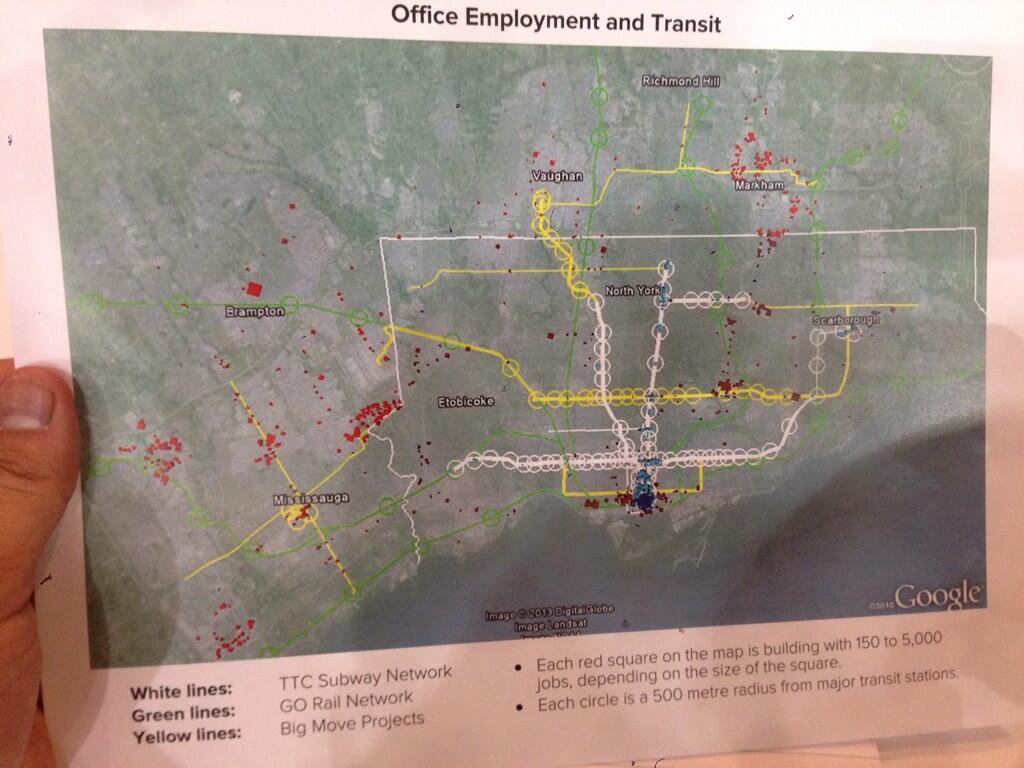
The Transit Investment Strategy Advisory Panel has ventured off its supposed path of looking at ways to fund transit growth in the GTHA to at least one proposal for a change to the Metrolinx Big Move plan.  This showed up at recent open houses in a handout that is not yet available online.

InvPanelOfficeEmpAndTransit

[The image above was posted on Twitter by Rishi L (@CdnEnginerd).  Click for full size version.]

The purpose of this map is to show how office employment is not sited along existing or proposed rapid transit lines.  With this as a jumping off point, the Panel suggests there is a need for a “Big U”, a much enhanced GO Transit route from Meadowvale, through Union Station and then north via the Uxbridge Subdivision (Stouffville line) to Markham.

A related factoid (one of those handy bits of information whose presence is supposed to silence critics) is that employment concentrations generate far more transit usage than residential ones.  It is certainly true that it is much easier to serve a place like downtown Toronto with a transit network that acts like a big funnel, but this does not eliminate the need to serve the residential ends of those trips.

Toronto’s Bloor-Danforth subway and GO’s commuter lines, for example, spend much of their time running through comparatively low-density neighbourhoods, collecting passengers as walk-ins, park-and-rides, and transfers from the surface transit network.  Every time a new transit route is proposed, we hear how it will only be viable if stations are surrounded by huge condo developments.  This is utter nonsense because any transit route has a catchment area.  The problem is to ensure that transit, sidewalks and bike lanes serve that area and deliver riders to a network that will take them where they want to go.

What is missing from the chart above is any indication of where the people who work in those centres actually live.  Looking at the Meadowvale end of the line, how many people come from the area that would be served by the GO corridor and a feeder network to it?  There is a lot of territory north, west and south of Meadowvale for which a rapid transit line to the east will do absolutely nothing.  Similarly, many who work in Markham live west, north and east of the employment centres.  Indeed, most of the red dots on that map are well west of the rail corridor.

Much as I sympathize with the Panel’s desire to get people talking about how parts of any network proposal might actually serve the region, I fear that we are seeing a classic example of someone who got out their crayons and drew a map.  The job will quickly change from discussing the philosophy of transit planning (and, don’t forget, funding) to defending the specifics of a proposal.

That is precisely why I have been so restrained about getting out my own crayons except in special circumstances.  The recent Don Mills Subway discussion needed a line on a map to illustrate how the “downtown” focus needed to change.  Well over half of the debate this triggered became a matter of dueling proposals between “my” line and “your” line that added little to the real issue — the need to see what such a line could connect and serve beyond simply diverting trips away from Bloor-Yonge Station.

People would even argue that there wasn’t “enough” development in some locations to justify such a route ignoring what is there today, what is in the pipeline for tomorrow and what could occur with planning and political encouragement.  Meanwhile, we build a subway to land that was recently the middle of nowhere, and propose one through miles of low density residential development as a vote-buyer claiming that only with a subway will Scarborough reap the development it “deserves”.

There is one big problem with the “Big U” — it diverts attention from the “little u” otherwise known as the “Downtown Relief Line”.  It doesn’t help one bit that the version of the “little u” shown on the map is the Pape-Queen-Roncesvalles alignment, one that is guaranteed to be very expensive and fails to recognize shifting development patterns (ironically, one of the goals of the “Big U”).  It ignores the southerly shift of population and jobs, avoids the available Weston rail corridor where we are spending a fortune to intensify transit infrastructure for a Toonerville Trolley to the airport, and it stops at the Bloor-Danforth subway missing the opportunity to reach further north to be more than a “downtown” line.

“Alternatives analysis” is a fine art in many projects, but the real art for many agencies is to ensure that what you always wanted to build is the “preferred” choice.  This is often guaranteed by setting up straw man comparisons so that the one you want shines out as the best of breed.  Such may be the situation with the DRL where, on darker days, I suspect that the whole idea is to paint as grim a picture as possible so that it will never be built.  Remember that the TTC for decades claimed we didn’t need a DRL, that they could stuff everyone into an upgraded Yonge-University line.  Expanding YUS capacity on a heroic scale was their “preferred alternative”.

With the Big and little U’s, we risk being trapped into specifics of route designs that looked good on a napkin in a bar, but which need much more thorough discussion as to purpose and specifics.  They are good as starting points for discussion, but are most definitely not the final answer in their respective fields.  Moreover, they are not alternatives to each other, a point that is often lost as the political imperative says “build in the suburbs, not downtown”.

The Big Move and the Investment Strategy that supports it have one gaping hole.  Very little attention is paid to the role of or funding for the feeder network to a regional system.  Moreover, the plethora of lines on the map hides the fact that many of them will not have the most frequent service on the planet.  Not all “rapid transit” lines are created equal.  As a recent Metrolinx report noted, the growth in “rapid transit” recently has mainly been in “BRT Light” for which the infrastructure requirements are minimal along with the service levels.  Crowing about progress in bringing transit to the millions ignores the question of how attractive that transit will be and how people will connect from the trunk routes, such as they may be, to their homes, work and other destinations.

This will be an important issue for network design on both the Big and little U’s.  One would serve rail corridors and be totally dependent on local service to deliver riders from homes and to employment locations.  The other would serve established and growing neighbourhoods and would enjoy an existing, well-developed set of local transit services as feeders.  These are not trivial differences, but they show the problems that will arise if the study does not look beyond the edges of station platforms.

This is the real debate the Transit Panel should engage — does The Big Move really serve the market it claims to address?  How useful will it be in attracting trips out of cars and onto transit?  Can developers and owners of residential and employment properties expect a real improvement in travel to and from their developments, or will their value be strangled by poor access?  Underlying all this is the basic question of whether we are spending all of those billions in the “right” place and what benefit each component of the proposed network will achieve.  That speaks directly to the concept of spending wisely, not just for the sake of generating construction jobs and photo ops for the next generation of politicians.

Returning to the “little u”, there will be a motion before Council from Councillor Josh Matlow, seconded by Cllr. John Parker (also a member of the TTC Board), to accelerate work on the EA for a “Relief Subway Line”.  Moreover, it asks that Council confirm such a route as “Toronto’s next subway expansion priority”.  It will be intriguing to see how this motion fares amid the current circus at City Hall, the recent battle over the Scarborough Subway and a faction claiming that downtown “has enough subways” already.

If this proceeds, it will be vital that it not be hamstrung with narrow terms of reference that filter out options before they are even discussed.  A major shortcoming of the new “Transit Project Assessment” protocol is that there is no consideration of alternatives because the decision that something is a “good project” is already assumed.  Debating alternatives just gums up the works in what is supposed to be an expedited process, but actually winds up as an exercise in selling an already-determined choice.  This is precisely the criticism many had of Transit City that compounded the process with less than stellar detailed planning and “sales”.  (Moreover, once a project is approved, it can be amended beyond all recognition, even though the original design was the one that “justified” the project in the first place.)

There is no point in doing a study if the underlying desire at the political and staff level is to sell a “Big U” as a replacement for the “Relief” line, whatever we call it.  The terms of reference must ensure that all options are reviewed, including cross-jurisdictional issues such as repurposing the Weston corridor’s UPX trackage for rapid transit.  We must not prejudge the outcome by requiring one continuous line to serve both legs of the U/u, especially considering that in some variants both western legs run in the same corridor.

Will Toronto Council, Metrolinx and Queen’s Park embrace the need for a full study of these routes without prejudice toward any preconceived doodlings on maps?

Measuring The Big Move

At it’s September Board meeting, Metrolinx received a report on a strategy for tracking the benefits of their regional plan, The Big Move.  At the time, this and other business was overtaken by their slavish support for Transportation Minister Murray’s alternative to the Scarborough Subway.  Now that the panel reviewing the Transit Investment Strategy has begun its public meetings and will soon report with recommendations on how we will all pay for The Big Move, a look at the measurement tools is in order.

Regular readers here will know that I deeply distrust “Key Performance Indicators” from my own days in public sector management.  They can be an exercise in so compressing information to a single-dimensional value that meaningful oversight is impossible.  Even worse, they may be constructed to validate what management is already doing in an uncritical way.  I have approached the new Big Move KPIs with the same skeptical outlook.

The Baseline Monitoring Report and its appendices are linked from the main Big Move page on the Metrolinx site (not to be confused with the Big Move’s own website).  By looking at the proposed KPIs, we can learn what Metrolinx considers to be a mark of “success” and, conversely, what they don’t bother to measure.

The Full Report gives an overview of the scheme and how it was developed, but the details of the KPIs are found in Appendix A: Monitoring Handbook.

The report notes that circumstances have changed since The Big Move was first published with shifting demographics, population growth, and economic effects that alter how people make choices (if options are available) about travel.  This provides a context for the current set of KPIs, although there is no discussion of how sensitive these might be to major shifts in the economic and transportation context.

The table below shows the questions Metrolinx seeks to answer and, broadly, the types of measurements they would use.  [Page 7]

BaselineKPIOverview

Having set out to define metrics, the Full Report then turns to the more general area of “progress” and poses these questions:

The Big Move sets out ten strategies with 92 Priority Actions and Supporting Policies to achieve its vision, goals, and objectives. Are we making progress towards each of the Priority Actions? Are we implementing the Supporting Policies? [Page 10]

What follows are many pages listing all of the projects in various stages of planning, execution and completion throughout the GTHA.  What is absent, however, is any quantification of the contribution each of these has made to achieving the overall goals (or will contribute when long-promised projects actually start providing service rather than photo-ops).  While all this has been going on, the progress, as measured by some of the KPIs, of actually improving transportation has been less than stellar.

A major challenge to any planner, operator or politician is that our environment is not static.  Every year, the regional population grows by about 100K, and much of that growth occurs in areas poorly served by transit.  Moreover, the travel demands from this growing population are many-to-many and do not lie conveniently along a handful of corridors where a few strategic upgrades could solve all of our problems.

If the population were static, we could talk about new lines providing real benefits.  However, when the population grows by 1-million in the decade needed to deliver major transit projects, any benefits are swamped in the losses to inaction in those parts of the region where no transit upgrades worth mentioning have occurred.

The past decade’s history is a classic cycle — a boom leading to grand announcements (including The Big Move itself), a bust in which the dreams are shattered and most plans go into limbo, and a tentative recovery where announcements of a bright future collide with “we’ve heard it all before”.  What did not stop was the population growth, and our collective timidity to invest in better transit has left the region ever more dependent, overall, on auto-based transportation.  This is not the work of evil, car-loving maniacs bent on environmental destruction; it is the simple choice of millions of people for whom the car is the only viable option.

Continue reading

The Transit Investment Panel: The Transit We Need

The provincial Transit Investment Panel has published the second of three discussion papers in advance of public meetings slated to start next week.  The paper is entitled “The Transit We Need” and it addresses filtering criteria by which possible transit projects should be judged.

This paper is odd on a few counts.  First off, it covers similar territory to the first “Hard Truths” paper by talking about meaningful criteria for inclusion of projects in competition for funding.  Second, it does not include specific proposals for alternatives to The Big Move, even though such a proposal was mooted by the panel’s Vice Chair Paul Bedford at a recent public presentation at UofT and obliquely mentioned in a Globe and Mail commentary (only available online).

The idea of a regional relief line that would connect several of the existing and proposed Metrolinx projects in a single line linking municipalities from Mississauga to Markham via downtown Toronto is worthy of exploration. Indeed, Metrolinx is in the midst of studying regional relief strategies right now. This would not constitute a re-mapping of the Big Move, but rather a strategic modification to better accommodate current and anticipated growth.

There is a fascination recently with advocacy for anything that might remove the need to build the Downtown Relief Line (or Don Mills Subway, or whatever we might call it), and the “Big U”, as Bedford calls it, is politically attractive because it goes out into the 905.  There is even a possibility at some distant future date that counter-peak flow to job centres in the 905 would add to the value of such a line provided that there is any local transit service to act as a distributor.

This does not eliminate the need for more local capacity into the core area especially if fare structures leave 905 residents clamouring for a subway to give them a cheap, frequent ride into downtown and riders from the 416 be damned.

The panel proposes a number of filters by which new lines would be evaluated, but gives no indication of the relative priority of these filters, or any relationship between the capital (and future operating) cost of a line versus the effect it might have (or not have) under these criteria.  This is rather like someone saying that we will cut taxes through “elimination of waste” without bothering to define the term or explaining how to find it.

Continue reading

A Don Mills Subway For Toronto

This is a companion article to one of the same name on the Torontoist website in which I argue that Toronto should have a subway line from Front & Spadina to Eglinton & Don Mills.  Formerly known as the “Downtown Relief Line”, this should be called the “Don Mills Subway” and there should be no pretensions about it stopping at Danforth.

Drawing subway lines on maps, especially for the DRL, has been a cottage industry among transit advocates and city watchers for several years, and everyone has their preferences.  I have stayed away from that territory most of the time because the torrent of comments (including a long thread on this side) is more than I care to moderate.

However, the Don Mills line needs advocacy and a good indication of what it might look like to counter the “downtown has enough subways” drivel dished out by Mayor Ford.

My proposed alignment is not intended to be definitive although parts of it are locked down to make specific connections and to take into account physical constraints on the route’s placement.  Other alignments are possible in places, but I don’t want to revisit that discussion in excruciating detail when the basic purpose is to show what a new line could achieve.
Continue reading

Measuring Service Quality

The quality of service provided on Toronto’s streets and in the subway has been a major, long-running topic on this site.  As reported last week, the TTC has just issued its third quarterly report on surface route reliability relative to a target of scheduled headway ±3 minutes.  They acknowledge that the methodology behind these numbers is flawed, and seek a better way to track reliability from the riders’ point of view.

To that end, the TTC is looking at the “journey time metric” used in London, UK, which tracks an entire trip’s experience including access, waiting and transfer times.  Leaving aside the need to define multiple trips both in location (downtown, suburban, in between) and in time (peak commutes, midday, evening, weekends), I believe that multiple metrics are required to flag problems at a level that is both meaningful and revealing of problem specifics.

What follows is a slightly reworked version of a proposal I made to the TTC recently on this subject.

Continue reading

Updating TTC Wayfinding

This article has been split apart from the coverage of the October TTC Board meeting to accommodate updates and to keep the comment thread separate from other issues.

The Board considered a presentation entitled New Wayfinding Standards which, among other things, proposed a change in naming for subway lines to the use of numerals.  This has provoked no end of comment, some on this blog, as an ill-advised waste of money.

More to the point, this presentation is neither a “standard” nor a comprehensive review of TTC wayfinding.  It is an overview of a few changes, and even these are not set out on a thorough basis.  What we have here is a proposed trial, but not a systemic review of wayfinding.

The goals are simple: avoid multiple styles of signs, convey information in a consistent way so that riders know the “language” of the signs across the system, make maps easier to understand, and make all forms of wayfinding more accessible.  One style, one letter font, one style of branding should identify a “TTC” message wherever it appears.

Consistency and legibility are not important just for the casual user, but for the regular passenger who  may be in an unfamiliar part of the system.  They may walk through their “home” station on auto-pilot, but off of their regular territory, they too will be “tourists”.

Continue reading

TTC Board Meeting October 23, 2013 (Update 3)

Updated October 26, 2013 at 5:20 pm to reflect discussions at the meeting.

The TTC Board met on October 23.

Update: The 2014 Operating and Capital Budgets are still not public, and they may now  appear in November (this has yet to be confirmed).  This is unusual because under Mayor Ford, the budget process for the City has been moved up so that the overall budget can be finalized early in the new year.  In 2012, the TTC budgets for 2013 were on the September agenda.

Will the TTC roll over again and accept a flat-lined subsidy placing the entire burden of extra costs on riders through fare hikes and compromises on service quality, or will they finally argue for better subsidies and force Council to debate just what transit should be doing – aside from building one subway line – for Toronto?

The CEO’s report (below) offers a hint in this statement:

“… discussions with the City continue regarding the TTC Operating and Capital Budget submissions for 2014-2023.  I am resolute in expecting an increase in subsidy to accommodate and service ever increasing customer numbers.”  [page 5]

Does this represent a strategic position on the TTC’s part, or division among the Commissioners about the direction the organization should take?

The City of Toronto will launch its 2014 budget process formally on December 2, 2013.

New Wayfinding Standards

Recent reports in other media have talked of a proposal to rename the subway lines with numbers to simplify wayfinding information for riders.  The details of this and other schemes to overhaul information will be presented at the meeting.

Updated October 23 at 10:55am:  The presentation is now online linked from the title above.

Updated October 26 at 5:00pm:  This topic will be split off into a separate thread given the volume of comments, and the accumulated comments will be moved to the new thread.

CEO’s Report

The CEO’s report has little new relative to the September edition.  Riding continues to be above 2012 but below budget.  For reporting period 8 (mainly the month of August), riding was up 3.5% over 2012.  On an annualized basis, riding is up 2.8%.  These results are 0.1% below budget for the period, and 0.5% below budget for the year to date.

Total ridership for 2013 is projected to be 527m, 1m below the budget projection.  This shortfall, coupled with higher-than-expected sales of passes versus token/cash fares, will mean revenue will fall $7.6m below budget.  This will be counterbalanced by various swings plus and minus on individual expense lines (details on page 24).

Update:  According to CEO Andy Byford, the lower ridership and revenue numbers for 2013 are mainly attributed to the severe weather and floods earlier in 2013.  Major shutdowns planned for 2014 will definitely affect ridership and this will be built into the budget estimates.

Subway punctuality on the Yonge-University line remains a problem particularly in off-peak hours.  It is unclear how much this is a side-effect of the yardstick of headways within ‡3 minutes of scheduled values.  During peak periods, it is much easier to meet this goal because there are more trains on the line, and entire trips can be missing without headways going beyond the 3-minute rule.

The BD line problems occasionally from the transfer of trains to the Yonge line to “cover shortages”, although this is not explained.  Are there simply not enough working trainsets to operate the Yonge service, or are BD trains poached to fill major service gaps?

Update:  I have asked the TTC to clarify what this section of the report actually means.

As if the wait hasn’t been long enough already, the CEO’s report states that the Harbourfront line will not return to streetcar operation until August 2, 2014.  No reason is given for the further slippage between the July date given by Waterfront Toronto and the TTC’s new August date.

One major issue that the CEO’s report does not address is the fleet availability in Toronto.  Only through the shutdown of substantial chunks of the streetcar system has the TTC managed to field enough cars to cover what remains in operation.  It is in their interest to prolong construction projects until they can get the first of the new fleet on the road.  What was originally touted as a “spring” startup of LFLRV service may now well slip to at least “summer”.

Production deliveries of cars are supposed to start later this fall.  What is the status of this order?

Service reliability is supposed to be reported quarterly for all surface operations, but the third quarter report has not yet appeared (it is expected to show up sometime on October 21).  When it does, I will be reporting separately on comparisons of the numbers over the past three quarters of 2013.

Update:  The quarterly report was published on October 23 and has been discussed elsewhere on this site.

I will follow up on questions raised here with TTC staff at the meeting and will update the article when further info is available.

TTC Fare Policy – Requests For Fare Discounts

This is a compendium report on various proposals/requests the TTC has received for reduced fares for various groups.  The staff position is that any additional subsidies for various classes of riders must be funded through a policy decision at City Council with adequate funding through the subsidy stream to offset the projected revenue losses.

This has been the TTC’s stock position for such requests for years, but at least we now have a consolidated report listing the projected cost for each option.  If Council wants to fund new discounts, the expected cost is known presuming that we accept the TTC’s estimates (some of which are dubious).

  • Extending “Family Pass” (6 people, maximum 2 adults) pricing to the entire week.  This is projected to cost only $2.2-8.6m per year, although I am suspicious of the figure because it is based on existing pass sales.  If the pass is more attractive, then more of them will be sold, but the estimate does not take this into account.
  • Free off-peak trips for seniors.  The cost is estimated to be at least $22m per year based on the number of non-pass trips by students/seniors today (45.2m), subdivided by the proportion of seniors (40%) and then the proportion of off-peak trips (65%).
  • Off-peak only pass for seniors.  The technology to handle time-of-day passes does not exist on turnstiles today, and so this option would best be left until Presto is rolled out across the system.  The estimated annual cost is $1.0-2.1m, but this depends on various assumptions regarding pass pricing, trip counts and conversion rates from the existing all-day passes.
  • Lower age for “senior” passes to 60 from 65.  The estimated cost is $3.3-4.9m, but this includes only the lost revenue from existing Metropass holders switching to the lower-priced pass.  No provision is included for token users for whom the senior’s Metropass would be more attractive than continuing to pay single adult fares.
  • Extend senior/student fare pricing to ODSP and OWP recipients (these are the Ontario Disability Support and the Ontario Works programs).  This is projected to cost $6.3-12.6m, but the mechanism for administering these fares is not discussed.  Of particular note, the calculation is based only on the actual recipient numbers within Toronto, not on their dependents and spouses.

Any special fare regime will be easier to administer once automatic fare collection is in place.  Time-of-day discounts and special fares associated with a rider’s status can be build into the fare structure, and the actual amount of discount provided for each target group can be tracked.  This will be important if special subsidies are involved so that they remain separate budget lines rather than simply merging into the overall TTC revenue stream.

Advisory Committee Activity

An interesting read in recent TTC agendas has been the meeting minutes for the Advisory Committee on Accessible Transit (ACAT).  This is a very active group whose discussion cover a wide range of issues with TTC staff, and the minutes report their activities in detail.

One might wish for the Customer Liaison Panel to be as forthcoming with information on its activities.  It is unclear whether the CLP has done anything since its formation, or what its areas of focus might be.  If the panel is intended to represent “customers” as part of TTC activities, why doesn’t it show the rest of the world what it is doing?

Supplementary Agenda

Yorkdale Fatality of September 14, 2012 – Final Investigation Report

This report contains the detailed findings regarding an accident last year in which a work car struck two employees during overnight maintenance near Yorkdale Station.

[New] York University Station Construction Status

Councillor Perruzza addressed the Board on the issue of York University Station where, as reported in the National Post, the station excavation is a lake, and no work appears to be in progress.

According to TTC staff, the tunnel construction contractor, Obrascón Huarte Lain and FCC Construcción, has handed off the site to the station contractor, Ellis-Don, but this process has taken longer than expected.  Meanwhile, Ellis-Don did not take over pumping of water even though they were now responsible it.  This is to be corrected, and Ellis-Don will begin active work on the site in 2-3 weeks.

Construction at this location was substantially delayed due to a worksite fatality in 2012.

[New] Time-Based Transfers for Eglinton West

Commissioner Colle requested a report from staff on the implementation of a time-based transfer arrangement on Eglinton West during the Crosstown tunnel construction similar to the setup still in use on St. Clair Avenue.  The TTC will ask Metrolinx to contribute to the cost of this if it is implemented.

[New] GO/TTC Fare Integration at Dundas West and Exhibition Stations

Chair Stintz requested that staff report on the provision of a joint TTC/GO fare between Union Station, Dundas West and Exhibition Stations as a way of relieving demand on the system, notably on the 504 King car.  The report should be on the November agenda.

How Does The City Grow?

The October 22 meeting of Toronto’s Planning & Growth Management Committee saw the launch of the 2013 edition of a report tracking residential and commercial development patterns in the city.

How Does The City Grow Website

If anyone needs proof that downtown is the focus of development in Toronto, they need only look at the numbers in this report.

Development in the Greater Toronto Area is strong, but Toronto itself is taking a larger proportion of the total.  Across the GTA, dwelling unit completions have been on a long decline since a peak in 2002 while completions within Toronto have grown.  Toronto’s proportion of the total rises as a result with over 40% now located inside the City.

Grows13Fig1

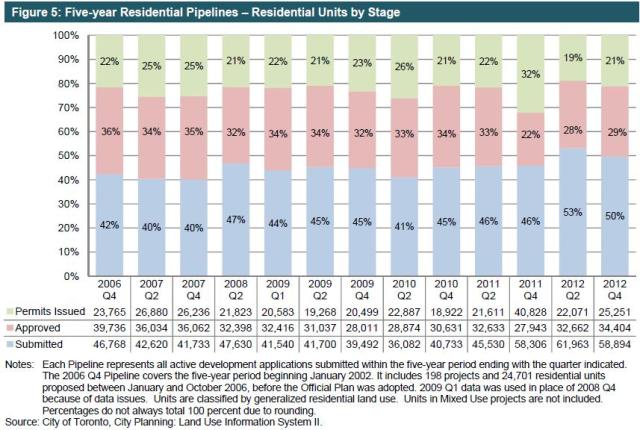
City Planning tracks development applications within a five-year “pipeline” which allows for the long lead times between initial applications, approval, construction and occupancy of buildings.  This smooths out year-over-year variations, but also flags a turndown in future growth if the early stages of that pipeline start to dry up.  There is little sign of this happening up to the 2012 data, although the proportion of applications relative to the total rose slightly.

Grows13Fig5

The overwhelming type of new residential development is in the apartment form (this includes condo and rental projects).  This is not surprising considering that there is almost no vacant land in the city suitable for low-rise development on the scale we see in greenfield subdivisions outside of Toronto.

Grows13Fig4

New development is not evenly distributed across the city, but is concentrated in a few locations, notably downtown.

Grows13Tab3

During the five-year period 2008-2012, 41% of the proposed residential units were downtown.  This shows very strong market demand to live close to the core, but a related number is the 39% of proposed non-residential floorspace (GFA in the chart above) that is downtown.  Downtown commercial development in Toronto is, today, 25% of all such development in Canada.

Although City Planning puts a brave face on things, Table 3 also reveals the comparative failure of the “Centres” as planning mechanisms to focus development.  Only 8.7% of all residential and 3.5% of non-residential proposals are in the four centres: Etobicoke, North York, Scarborough and Yonge/Eglinton.  Scarborough Centre has almost no development planned at all.

The data presentation caused some confusion at the P&GM meeting when North York Councillor Filion compared the “38%” number for his centre with the numbers for downtown.  He was gently reminded that this was 38% of the 8.7% for all of the centres combined.

Where data consolidation does mask important details is in The Avenues, those major streets that are targets for future development, and in the “Other” category.

Almost one quarter of residential proposals are sited on The Avenues (the brown stripes in Map 1 below), but this is not broken down by city region.  Some areas have a great deal of development proposed and already built (many of the early projects in the 2008-2012 pipeline are already substantially completed), while other areas have nothing.  Are The Avenues actually directing development or simply endorsing what would happen naturally?

Grows13Map1

Almost 40% of non-residential development lies in “Other” areas many of which are designated employment zones.

The actual development patterns are clear in the overview maps (for full size versions of all illustrations here, please download the source document from the City’s website linked above).

Grows13Map2

Grows13Map5

The growth of downtown residential population is not tracked in this report, but a few comments at recent meetings give some indication of what is happening.  Cllr. Vaughan spoke of the development pressures in the Entertainment District where the population has gone up 125% in the past four years.  At a recent briefing on the Gardiner Expressway, Deputy City Manager John Livey noted that the population of Planning District 1 (downtown from roughly Dundas to Lake Ontario) has tripled between 2006 and 2011.  With the developments in the pipeline, this pattern will continue.

Non-residential space translates to jobs, and this puts great pressure on the transportation network.  Some of these jobs will be taken by people who will walk, cycle or take surface transit to work, but many commuters will come from further afield via the subway and GO Transit.  The idea that downtown “has enough subways”, to quote Mayor Ford, would be dubious with the existing level of demand, but seen in the context of future development the statement shows foolhardy disregard for investment in city infrastructure.

There will be growth in the suburbs, but not at the scale of the core area.  Moreover, it is unclear that simply designating an area for growth will actually produce the desired effect without considerable incentives.  Motions by Cllrs. Vaughan and Nunziata approved by the Committee speak to opposite sides of the same issue:

The Planning and Growth Management Committee:

1. Directed the Chief Planner and Executive Director, City Planning to report on how to create a policy framework to cap growth in areas of hyper intensification and re-direct development in a strategic way to other parts of the city.

2. Requested the Chief Planner and Executive Director, City Planning in consultation with the General Manager of Economic Development and Culture, to report back to the Planning and Growth Management Committee on the methods the City of Toronto could employ to stimulate economic development in areas currently underused or vacant.

In the case of downtown, there are areas where developments, many proposed at substantially above the zoned density for the land, are skewing the property market and straining services for current and future residents.  In other parts of the city, notably Weston which is among the lowest income areas in Canada, there is plenty of land to develop, but no activity.  How much power does the City actually have (or wish to exercise) in shaping its future growth?

Major transit lines are planned or under construction, but it will be a decade before we see their effect.  Meanwhile, large areas now served by subway lines see little development.  How much of this is nimby-ism throttling growth and how much is simply market forces building where there is both a market and a profit?

The disconnect between actual and proposed development, and the goals and dreams of the City Councillors and their neighbourhoods is quite striking.  Without significant intervention by Council, a move that would be ideologically distasteful to many and certainly would be subject to legal challenges, controlling development, especially that which can occur “as of right”, will be very difficult.  Should the transit system be built to serve what is there today and what we know will develop, or will Council persist in planning based on dreams that do not match market realities?