GO Transit RER/Electrification Plans Announced

The details of GO Transit’s service improvements and electrification leading to the rollout of the “RER” (Regional Express Rail) network were announced today by Minister of Transportation Steven Del Duca.

The plans will please some and disappoint others, but there is little to surprise anyone familiar with the details of GO Transit’s network and the constraints of the rail lines around the GTHA.

RER rollout by line

RER rollout details

If there are “winners and losers” in this announcement, the benefits clearly fall (a) on lines that are completely under Metrolinx ownership and control and (b) on lines that do not already have full service, that is to say, there is room for growth.

Electrification is planned for most corridors by 2022-2024 starting with the Kitchener and Stouffville routes in 2022-23, followed by Barrie and the Lakeshore in 2023-24. The announcement is silent on the UPX service on the Kitchener line and whether the inner portion of the corridor will be electrified as a first step for UPX before 2022. (I have a query out to Metrolinx on this topic.) These dates have implications for rolling stock plans including purchase of whatever new technology — electric locomotives or EMUs — will be used for electric services, and, by implication the eventual fate of the existing fleet.

The scope of electrification will be:

  • Kitchener line: Bramalea to Union
  • Stouffville line: Unionville to Union
  • Lakeshore East: Full corridor
  • Lakeshore West: Burlington to Union
  • Barrie: Full corridor

There are no plans to electrify either the Milton or Richmond Hill lines, nor to substantially improve service on them. In Milton’s case, this is a direct result of the line’s status as the CPR mainline. On Richmond Hill, significant flood protection works are needed in the Don Valley as well as a grade separation at Doncaster. Plans could change in coming years, but Queen’s Park has clearly decided where to concentrate its spending for the next decade – on the lines where improved service and electrification are comparatively easy to implement.

The limits of electrification correspond, for the most part, to the territory where all-day 15-minute service will be provided. This will be the core of the “RER” network with less frequent, diesel-hauled trains providing service running through to the non-electrified portions.

One important aspect of the line-by-line chart of service improvements is that there will be substantially more trips (most in the offpeak) before electrification is completed. This allows GO to “show the flag” as an all-day provider and build into a role as a regional rapid transit service, not just a collection of peak period commuter lines. This will also give local transit a chance to build up to improved GO service over time rather than a “big bang” with all of the changes awaiting electrification.

Over the five years 2015-2020, the Kitchener corridor will see the greatest increase in number of trains, although many of these will not actually run through all the way to Kitchener. The service build-up will finish in 2017.

The Barrie line will receive weekend service in 2016-17 with weekday off-peak service following in 2017-18. The Stouffville line also gets weekday service in 2017-18, while weekend service follows in 2018-19.

Minor off-peak improvements are planned for both Lakeshore corridors in 2018-19.

Peak service improvements relative to today vary depending on the corridor:

  • Lakeshore East: 4 more trains by 2018-19 on a base of 45 (9%)
  • Lakeshore West: 6 more trains by 2019-20 on a base of 47 (13%)
  • Stouffville: 4 more trains by 2018-19 on a base of 12 (33%)
  • Kitchener: 6 more trains by 2019-20 on a base of 15 (40%)
  • Milton: 6 more trains by 2019-20 on a base of 18 (33%)
  • Barrie: 2 more trains in 2019-20 on a base of 14 (14%)
  • Richmond Hill: 4 more trains by 2018-19 on a base of 8 (50%)
  • Total: 32 more trains by 2019-20 on a base of 159 (20%)

Other than making trains longer (where this has not already occurred), that’s the limitation of peak period growth for the next five years on GO Transit. This has important implications for projections of greater transit commuting along the GO corridors, and especially for the shoulder areas within Toronto itself that lie along GO routes, but also face capacity and travel time issues with the local transit system. Unlocking gridlock may be the goal, but the rate of service growth could not be described as “aggressive” especially against the background growth in population and jobs.

This will, or at least should, lead to renewed discussion both of rapid transit capacity within Toronto, and on how GO Transit will address growth beyond 2020. Where should new capacity be provided? What are the realistic upper bounds for various options? How will Toronto deal with demand for expanded suburban subway service to handle growth in the 905?

It is quite clear from the electrification dates that an electric SmartTrack is not going to start running soon, and with frequent all-day service to Bramalea, Aurora and Unionville using diesel-hauled trains operating well before electrification is completed, one might wonder just where SmartTrack as a separate “local” service will fit in.

Beyond these questions lie the more complex issues of travel that is not bound for Toronto’s core. “Gridlock” is commonly cited as the rational for transit spending, and yet this spending does little to improve travel anywhere beyond existing corridors to central Toronto. Demand in the GTHA is not conveniently focused on a few points, not even on Pearson Airport which is a major centre, and single-route improvements do not address the diverse travel patterns of GTHA commuters.

Ontario will spend billions on transit in the coming decade, and sticker-shock has already set in with the huge amount of infrastructure needed. Even this is only a start and the work to truly address travel requirements of the coming decades is only just starting.
College & Spadina Reconstruction (Updated May 8, 2015)

Updated May 8, 2015: The TTC has posted a time-lapse video of the reconstruction for those who want to see the whole thing in two minutes.

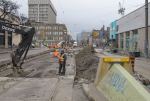
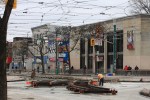
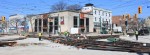
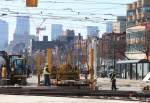
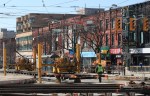
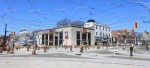
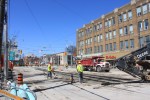
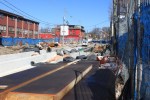
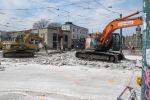
On Monday, April 6, 2015, the TTC began reconstruction of the intersection at College & Spadina. The work is planned for a three-week interval, and as of April 10 the project is moving along swiftly. During this work, 510 Spadina buses and 506 Carlton cars are diverting around the site. Resumption of through service is planned for Monday, April 27.

As with all such jobs, the work began with demolition of the existing intersection followed by the pour of a new concrete foundation on which the new track will sit. The track was pre-assembled at Hillcrest Yard and then broken apart into panels which have been delivered to the site on many trailers spotted around the intersection. The TTC’s Brad Ross posted an excellent photo on Twitter of the fully assembled intersection.

Reassembly begins with the diamond in the middle of the structure, and works outward to each arm of the intersection.

My thanks to Harold McMann for the photos of early stages in this work.

Updated April 12, 2015 at 1:40 pm: New gallery added.

Assembly of the intersection began on Friday morning, and two days later, it is nearing completion with only the south quadrant still missing. At the end of the gallery below, the track panel that will be the southbound section of the south quadrant is being reading for its move into position.
Updated April 18, 2015 at 1:10 pm: New galleries added.

Tuesday, April 14: Assembly of the approaches to the intersection is well underway.

Saturday, April 18: Concrete work around the tracks is substantially complete, and some pedestrian paths through the intersection have been shifted onto the pavement to allow work to begin on sidewalk and curb repairs.

The Evolution of Service on 512 St. Clair

The St. Clair streetcar route has seen its share of political battles over the years. Back in 1972, it was the heart of the fight to save the streetcar system from a plan that would have dismantled all routes by 1980 when, wait for it, the Queen subway would have opened. As a first step, trolley buses (remember them?) displaced from the North Toronto’s route 97 Yonge were to take over St. Clair with buses replacing streetcars on a 1:1 basis, a huge cut in the line’s capacity.

An ironic point about this plan shows how riding patterns can shift depending on other aspects of the network. Before the Bloor-Danforth subway opened in 1966, St. Clair had very frequent service (every 1’00” between Oakwood and Yonge including the Rogers Road cars), and the line carried many people east to the Yonge subway. Vaughan Loop was a major transfer point to the Bathurst cars which ran into downtown via Adelaide Street, returning on King.
After BD started running, many riders shifted to north-south routes to reach the new subway line and its connection to a route downtown via the uncrowded University subway. Demand and service on St. Clair declined. Years later, with the opening of the Spadina subway, many riders shifted back to the streetcar because it provided a direct link to the University line with one less transfer. More recently, the population along St. Clair is growing adding to demand on the line.

Unlike most streetcar routes in Toronto, 512 St. Clair operates on a street with more than four lanes. The TTC proposed conversion to a reserved right-of-way in the early 2000’s and this was approved by Council in 2005. The actual construction took forever thanks both to a legal attempt to block construction and to fouled-up co-ordination between various agencies and meddling by local Councillors in the timing of work. (You can read the whole sad story on Transit Toronto’s website.)

By spring 2007, the first segment from Yonge to St. Clair West Station was completed, and streetcar service returned, briefly between St. Clair Station and Keele Street. Summer 2007 saw the launch of work on the western portion of the line, and it did not fully reopen until summer 2010.

Recently, the TTC has been messing around with the schedules on this route and adding supervision in an attempt to provide reliable service, a sad situation given that the route is entirely on reserved lanes. The evolution of schedules from 2007 to 2015 is intriguing, and speaks to the failure of what should be a showcase route.

512_ServiceHistory

The information in this table is organized with the impending March 29, 2015 changes at the left and progressively older schedules moving to the right. Only the January schedules are shown for 2011-2013 to save on space during a relatively quiet period for service changes on this route.

  • April 2007: The line operated over its full length, but with a right-of-way only on the eastern leg.
  • June 2010: Service resumes over the full route with shorter running times, particularly on weekends, and more frequent service than in most periods in 2007.
  • January 2011: Service during some periods on Saturday and Sunday has been improved by 2011 to handle demand on the route.
  • January 2012: Weekday midday service has improved over 2011, but there are no other changes.
  • January 2013: Peak service has improved slightly, offset by some weekend service cuts.
  • January 2014: A 2012 service cut on Sunday afternoons was partly restored during 2013.
  • July 2014: Slightly wider peak service (typical for summer) with improvement in Saturday early evening and Sunday morning service.
  • October 2014: Running times substantially increased in response to a large number of transit priority signals being out of order (13 along the route)
  • March 2015: Running times reduced (but not all the way to July 2014 levels) in response to repair of most (9) of the non-working TSP locations, and experience from a higher level of route supervision implemented in fall 2014.

It is worth noting that during almost all schedule periods, the allocated running times in October 2014 were equal to or longer than those used in April 2007 when most of the route ran in mixed traffic. Some of this was due to added recovery time (weekday schedules), and some to added travel time. In effect, the benefit of the right-of-way on scheduled speed was almost completely undone. This is partly, but not completely, corrected with the March 29, 2015 schedules, but there is still generally two minutes more running time for the route compared with most schedules from 2010 onward (presumably for the residual effect of non-working TSP locations).

A related problem on St. Clair has been irregular headways. The TTC’s stock response to complaints about this sort of thing is that “traffic congestion” is the root of all evil, and reliable service is impossible. In fact, as has been demonstrated by repeated analyses on this site, the real problem lies in uneven departures from terminals and from intermediate time points along the route. This cannot be explained by saying that operators are adjusting to known conditions because these irregular headways appear under all seasons, days of week and hours of the day.

In the fall of 2014, the TTC added route supervisors on St. Clair to act as dispatchers and regulate the service. This had some effect, but the level of on-street supervision cannot be afforded across the system. Indeed, there is no reason why dispatching on headways cannot be achieved centrally and at least in part automatically. This problem is not confined to streetcar routes, and it is a fundamental issue that TTC  management must address particularly as the effects of larger vehicles and wider scheduled headways accentuate the problem on streetcar and articulated bus routes.

How has the actual service evolved over the years? For this we must turn to the TTC’s vehicle tracking data. As regular readers will know, I have been looking at routes on a selective basis since 2007. The discussion below includes data from April 2007 (pre-construction), July 2010 (full line re-opened) and September-November 2014 (pre/post implementation of longer running times and more aggressive supervision).

Continue reading

The Dubious Economics of the Union Pearson Express

In today’s Toronto Star, Tess Kalinowski writes about recently released Metrolinx reports concerning the Union Pearson Express (UPX).

The items of interest are down at the bottom of the Reports & Information page and they include ridership forecasts from December 2011 and May 2013. The latter report was cited as background to the Auditor General’s 2012 Report on Metrolinx [beginning on p. 6 of the pdf].

Given that the projection is almost two years old, one might be tempted to say “maybe things have improved”, but that’s a tad hard to believe in the absence of any newer studies from Metrolinx.

There are great hopes, and even greater hype, for the UPX, and getting some basic information on the table is certainly worthwhile. Continue reading

Recent Updates Sidebar

As topics evolve, articles on this site are updated from time to time. Notice of these updates will appear in the sidebar with hotlinks to the articles so that regular readers do not have to go hunting for the changes.

Articles will retain their original URL after the updates so that existing links to them will not break.

Leslie Street Update

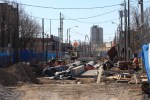
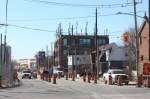
Track work on Leslie Street linking from Queen Street south to the new Leslie Barns is finally underway on the last remaining blocks of this project.

For a gallery of construction photos from 2014, please visit Building The Connection To Leslie Barns.

New Streetcars Come To Harbourfront

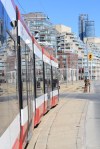
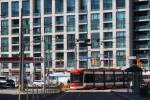
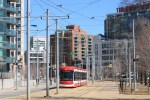
With the shutdown of the Spadina line for track work, the Flexitys have shifted to the 509 Harbourfront route. Here are a few images of these cars in a new context.

Green trees would make these so much better!

A New Way To Measure Service Quality?

At its recent Board Meeting, the TTC received a presentation [scroll to p. 3] from Chief Service Officer Richard Leary on plans to update management and measurement of surface route service quality.

The monthly CEO’s report includes a number of “Key Performance Indicators” (KPIs) intended to track various aspects of the transit system. However, the methodology behind some of the KPIs, notably those related to service quality, leaves a lot to be desired. Moreover, information that could track basic issues such as vehicle reliability is not included. This begs the question of whether the indicators exist more as a security blanket (“we have KPIs therefore we are good managers”) than as meaningful management tools, not to mention as reports to the politicians and public.

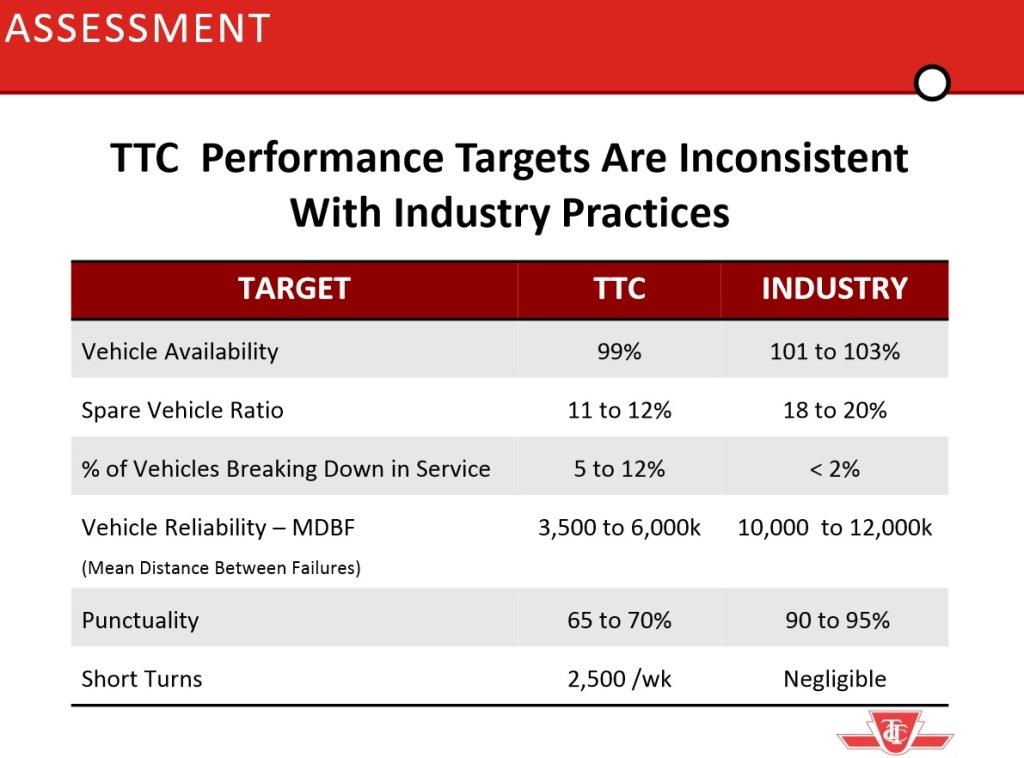
A telling chart on page 6 of the presentation shows how badly the TTC has drifted from transit industry norms:

ServiceKPIsAssessment

The TTC aims to have almost enough vehicles available for service relative to actual needs, and operates with a lower spare ratio than the industry overall. This has two effects.

  • When unusual demands for service arise, there is no cushion to roll out extras.
  • Vehicles are not maintained often enough to prevent in service breakdowns. This shows up in a mean distance between failures that is very much lower than the industry average.

The situation is actually compounded by an internal measure of service delivery: a garage counts a bus as “entering service” if it makes it across the property line onto the street. Whether the bus runs for an entire day or breaks down a block from the garage, it counts toward service provided. This is complete nonsense, but shows how the construction of a metric can induce behaviour that is counterproductive. Actually keeping the bus in the garage could allow it to be repaired and improve reliability, but that’s not what the garage is measured for.

Moving to a higher spare ratio and more frequent routine maintenance on vehicles is expected to yield better service with fewer in service breakdowns. Late in 2014, the TTC began this shift by slightly increasing spare ratios at each garage, and the MDBF for the bus fleet has risen to 7,000km. This will have to be tracked over a longer time, however, to ensure that the improvement is permanent and can be linked to further increases in spares and maintenance work.

This has a non-trivial cost for the TTC. With a total scheduled service of about 1,500 buses, a 6% increase in spares represents 90 vehicles, or a substantial portion of a typical yearly bus purchase, not to mention a fair amount of garage space.

Continue reading

The Evolution of TTC Signaling Contracts (Updated)

Updated April 19, 2024 at 10:40 am: The links to TTC reports have been updated again to reflect the current URL structure of the TTC’s website.

Updated September 29, 2022 at 1:30 pm: Links to TTC reports have been updated to point to the “new” TTC website except in cases where the report is no longer online. In those cases, a copy from my archives is linked on this site.

Updated April 4, 2015 at 6:00 am: The review of options for consolidation of the signal contracts by Parsons is now available as part of the TTC’s report online. Comments have been added at the end of this article.

Recently much attention has focused on the runaway project to extend the Spadina Subway north to Vaughan with a flurry of questions about project management, scope creep and cost controls. Another of the TTC’s megaprojects, one that is actually far more critical to the subway as a whole, is the replacement and upgrading of the signal system controlling the movement of trains. This project has dragged on for years while riders endure service problems with antique equipment and line shutdowns for installation and testing of the replacement system.

At its recent meeting, the TTC Board approved a proposal to restructure existing contracts for new signal systems and to simplify the signaling technology that will emerge as the standard on Yonge-University (Line 1) by 2020 with the remainder of the subway system to follow.

In order to make sense of the evolving design for new TTC signals, this article will begin with a short history of the system as it existed and the limitations the new system is designed to remove.

Continue reading

TTC Board Meeting March 26, 2015 (Update 2)

The TTC Board met on March 26, and considered a meaty agenda that begins to address some important policy issues.

Updated March 29, 2015 at 3:45 pm: The presentation on One Person Train Operation (OPTO) given at the meeting has been added along with comments.

Updated March 24, 2015 at 8:10 am: After this was published, the TTC posted the CEO’s Report.

In a previous article, I wrote about the Spadina subway extension project update. This will undoubtedly be the main attraction both for board members and the media. Other items of interest include:

  • An overhaul of system key performance indicators (KPIs)
  • A door monitoring system for Toronto Rocket trains and one person train crews (Updated March 29)
  • Revision and consolidation of the resignalling contract for the Yonge-University line
  • A study of express bus routes
  • CEO’s Report

Continue reading