Toronto Council Endorses Transit Plan, Seeks Background Details

At its meeting of March 31, 2016, Toronto Council passed several motions relating to the proposed rapid transit plan for the city.These evolved first as a set of staff recommendations, then amendments at the Executive Committee and finally amendments at Council. The changes along the way give a sense of how the attempt at a general approach taken in the new transit plan by staff can be warped into an emphasis on individual projects while losing sight of the overall purpose. This is not new in Toronto’s political theatre, but the city and region are at a crucial time when the “big picture” of the transportation network is essential. The challenge for those who would lead this process is to find a responsible balance between wider priorities and local concerns without making every decision only on political merits.

Many of these motions involve requests for additional reports, and at one point there was some concern about whether city staff could actually handle the workload. One might ask whether the city should be making such important decisions if staff are unable to produce sufficient background material and simply want approval trusting their recommendations. While studying issues to death is a well-known delay tactic, rushing decisions without all the details is a classic method of railroading through decisions the city might regret later. There is certainly nothing wrong with asking for a more thorough study of items that have been omitted, provided that the same requests do not surface over and over again.

If anything, Council has been woefully underinformed on transit options, priorities and tradeoffs, and such an environment “debate” often has little to do with the real world. Will every Councillor read every page of every study? No, but at least the material will be there to answer questions, support the good ideas and counter the dubious schemes. We hear a lot about “evidence based planning”, but this can be a double-edged sword where “evidence” might not support fondly-held proposals.

This article groups Council’s motions by topic so that readers do not have to sort through the relationship of recommendations and amendments.

Continue reading

GO/RER Details Emerge in Business Case Analysis

Metrolinx has published a set of documents containing the “Initial Business Case” for the GO Transit Regional Express Rail (GO/RER) network.

Updated Dec. 13, 2022: Due to a reorganization of Metrolinx’ site, the reports are no longer available there. However, I have archived copies of them. The Summary and Full Report links below are to my site. The Appendices are not yet available as I must break them into chunks small enough that WordPress will allow them to be uploaded.

  • Summary
  • Full Report
  • Appendices A-J
    • A: Corridor Specifications
    • B: Corridor and System Schematics
    • C: Model Assumptions and Results
    • D: Record of Assumptions – Direct Demand Model
    • E: Financial Performance of RER Systems
    • F: Sensitivity Analysis
    • G: Wider Economic Benefits
    • H: Line Speed Analysis
    • I: Environmental Assessment Program
    • J: Fare Structure Issues and Solutions
  • Appendix K:  Station Access Analysis

[Note that except for the Summary, the documents are large PDFs.]

This article begins a review of these documents and of the various RER proposals examined in the Metrolinx studies.

Overview

Work on this review of GO/RER began in April 2014 following the announcement by Queen’s Park of its commitment to the RER concept. Unlike previous reports, this study looks in depth at all of the GO corridors, and reviews the technical issues associated with both increased service and electrification. This is not a final review, and much engineering work remains to be done, but there is a great deal more information now publicly available as the basis for discussions.

These documents were completed sometime in 2015 as is clear from references to future events that will occur later in the year, notably reports from the City of Toronto on SmartTrack. That scheme gets only passing mention, some of it the usual political cover story, because the specifics had yet to be decided. Exactly what the incremental effect of ST will be beyond the proposed GO/RER configuration is not yet known. Preliminary information in City reports implies that ST will amount to considerably less than was foreseen by the Tory election campaign, possibly as little as a few more stations and some sort of TTC/GO fare integration.

Five scenarios were reviewed to compare the effects, benefits, costs and technical issues associated with various possible future networks.

  1. The “Do Minimum” scenario provides only marginal peak period improvements to the existing system in response to projected demand growth, but with no electrification. This is effectively a “business as usual” model for the base case.
  2. The “Two-Way All-Day” scenario expands off peak service, but with diesel operation and no electrification. This is a minimal level of service expansion.
  3. The “10-Year Plan” would provide frequent service on the inner parts of some corridors, but with limited electrification.
  4. The “Full Build” extends beyond the 10-Year Plan to provide frequent service on the inner parts of all corridors, and with full electrification.
  5. The “10-Year Plan Optimized” extends the scope of electrification beyond that contemplated in scenario 3.

This progression implies a certain sequence of events during the study where a full build is impractical and the original 10-year plan was not aggressive enough with electrification, a key component of the announced government direction.

The estimated capital costs rise from $5 billion for scenario 1, through $10b, $12b and $19b for scenarios 2 to 4. The price tag for the latter is well above what Queen’s Park has available, and scenario 5 was developed with a projected cost of $13.5b. All but scenario 4 are said to be achievable by 2024. Given that it is now 2016, and this is a 10 year plan, that date probably requires some adjustment.

Scenario 5 is the 10-Year Plan Optimized, it represents significant progress towards implementing the service levels of Scenario 4. It goes beyond the investments and service included in Scenario 3 (10-Year Plan), with electrification also to Bramalea, Barrie, Stouffville and to Pearson Airport. This scenario and the resulting recommended RER program has been defined to maximize return on investment while mitigating risks. Depending on resolving various challenges, it can be delivered over 10 years for approximately $13.5 billion. It does not preclude, but rather prepares for, services to Milton and Kitchener to be eventually electrified and frequent all-day services introduced when agreement is reached on co-existence of GO and freight on these privately-owned corridors. [p. iv, Full Report]

Annual ridership is expected to go up by a factor of 2.5 over the coming 15 years, but operation costs will not rise at the same rate. The study postulates that an operating profit would be possible, eventually, but that will depend a lot on future fare policies, and on the evolution of trip patterns (length, direction, average fare). The ridership model foresees that “hundreds of thousands” of auto trips would be replaced by GO ridership each weekday comparing scenario 5 to scenario 1. The proportion of trips and its relationship to expected growth is not specified in the Executive Summary. (Possibly in the demand modelling later.)

The rate of demand increase on GO overall is projected at 2.3% which is lower than recent levels, but allows for some leveling off in a more mature service.

One big issue is the problem of getting riders physically to and from the GO trains. Either this will be done with substantially improved local transit services (an option that brings many issues associated with fare integration and cross-system subsidies), or with parking. The cost estimates include $750m for 15,000 new parking spaces, or $50k per space. At that scale, simply paving empty lots is not an option. The study notes the possibility that some of this cost “may not be necessary if service integration and fare integration with local transit services can be improved”. [p. v]

Those 15,000 spaces represent nowhere near the ratio of new parking spaces to existing facilities that the projected ridership growth would entail if everyone arrived by car. Parking charges are listed as a way of raising additional capital for the RER project, and of encouraging a shift to ride sharing and public transit feeder services.

It is amusing to read about the benefits of proven technology, something for which Ontario has not been noted in past endeavours.

Virtually all of the works are within existing rail corridors, so environmental and community impacts are limited mostly to noise and vibration. RER will use proven technology that is working around the world. [p. v]

Descriptions of RER cite similar operations in more than 50 city regions worldwide [page 6], and list a number of factors that simplify implementation [p. 4]. I cannot help thinking of how badly past studies have downplayed the benefits of LRT which bears a family resemblance, but at a local rather than a regional level.

The first electric railway opened in 1883 (the Volks Tourist Railway on the Brighton seafront in the U.K.). Ever since that time, electric traction has increasingly become the default source of power for the world’s more intensively used rail systems. [p. 14]

Finding this statement in a Metrolinx report is quite amusing considering some of the remarks made during community meetings on electrification before Metrolinx and GO “got religion” on the subject. The report skirts that debate by observing that GO is now at the threshold where electrification makes sense:

Until recently, diesel traction has been the appropriate mode of traction for the GO rail operation. However, the service enhancements envisaged in the near future will take GO rail beyond the threshold of service intensity appropriate for electrification. Continued use of diesel traction will become a source of financial and economic inefficiency. [p. 14]

Metrolinx intends to pursue discussions with the railways regarding the upgrades needed on their trackage, and also intends to review “modern, proven technology” with Transport Canada and the railways.

This is an “initial” analysis, and changes are likely depending on the evolution of expectations, changes in provincial funding, and who knows what political meddling that could arise.

A decade is a long time in politics, and the likelihood that the current governing parties or councillors will still be in place at that distant time is minuscule. Moreover, changes could come at any level part way through the project, and only a very strong, unshakeable commitment (i.e. very popular and difficult to derail) is likely to survive. This is not simply a case of showing up for a photo op or two with a gigantic prop cheque, but of supporting the plan for the long haul, including building a constituency that can survive beyond current governments. The arrival of a Ford-equivalent who simply wanted to start over with his own plan would be disastrous.

Continue reading

Analysis of Service on Route 94 Wellesley Bus for January 2016

This is the second of two articles reviewing the operation of a comparatively short downtown bus route to see how it behaves in comparison to longer and busier routes. The first article covered 6 Bay for the same period.

The schedule for 94 Wellesley was adjusted in September 2015 to provide added running time, and to improve service so that the eastern part of the route was in the “10 Minute Network”.

Continue reading

Easter Parade 2016

Once again, the TTC participated in the Easter Parade through The Beach from Neville Loop westward. This year, I only photographed the departure from Russell Carhouse rather than walking the entire parade route.

Peter Witt 2766 led the fleet followed by PCC 4500, CLRV 4125, ALRV 4217 and Flexity 4412.

The Witt was driven by operator Frank Hood who after 31 years is retiring today.

The Easter Parade fleet at Russell Carhouse: 2766, 4500, 4126, 4217 and 4412

The Easter Parade fleet at Russell Carhouse: 2766, 4500, 4126, 4217 and 4412

Continue reading

TTC Board Meeting Follow-Up: March 23, 2016

The TTC Board met on March 23. In earlier articles, I have already reviewed the agenda, and discussed ridership statistics.

Arising from the debate on ridership, the Board passed a motion to revisit the whole issue of actively pursuing ridership growth. The motion by Commissioner Shelley Carroll reads:

That TTC staff report back to the Commission by the third quarter of 2016 with a development plan for a comprehensive multi-year strategy to address current ridership stagnation and to achieve a steady rate of ridership growth annually thereafter.

This is particularly important going into the 2017 budget year when there will be pressure to accommodate both the start of new expenses for the Spadina subway extension (TYSSE) and strong growth in the Wheel-Trans budget. Debates and decisions about which options might be pursued to improve transit and attract riders need to have more background than the annual need for politicians to have something to announce. At the very least, changes should be thought out with specific benefits beyond the photo ops.

Continue reading

Where Is TTC Ridership Going? (Updated)

Updated March 25, 2016 at 1:45 pm: Charts and commentary have been added at the end of this article regarding monthly ridership statistics published by the TTC through the CEO’s Report.

In a previous article, I wrote about a TTC management report giving a “Ridership Update” for early 2016. This was triggered by concerns that overall ridership had stagnated, and the obvious question management might hear: “what are you doing about this”.

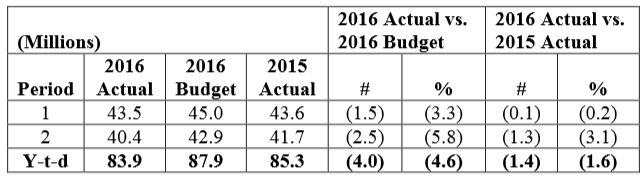
During the debate at the March 23, 2016 Board meeting, it became clear that to some extent, management was making up the story as they went along. The report includes data for the first two months of 2016, and February was particularly bad with a drop against both the budget target and against results in 2015.

20160323_JanFeb16Ridership

However, once the debate was well underway, management reported that March to date was almost on budget, and was up 2.5% over 2015. Why was this information not in the report, or at least in a supplementary paper published before the meeting got underway? The entire tone of the debate would have changed with the sense that, maybe, things were turning around and ridership was growing again.

The situation was further complicated by repeated claims from management and from TTC Chair Josh Colle that ridership was not on a decline, but that it simply did not achieve its budget target. This quite flatly is not true as anyone capable of reading TTC reports can see.

Continue reading

No Time For Panic on TTC Ridership Numbers

The TTC’s Ridership Update report will be discussed at the March 23, 2016 Board meeting. Its publication triggered an unwelcome round of hand-wringing about transit service and financing that could well undo momentum seemingly regained by the Tory regime at City Hall. How did we get so quickly from a pro-transit stance to one where just avoiding cuts will seem a victory?

Fun With Budgets at City Hall

During the Ford years, TTC ridership continued to climb despite the best efforts of Council to throttle the TTC budget, but a good deal of that growth came at the margins, filling up less crowded routes and time periods, and stuffing the busier ones to the extent any new riding was possible. John Tory ran on a platform that SmartTrack would fix absolutely everything, but once in office acknowledged that day-to-day service had taken a hit and needed fixing. Improvements to date have not addressed peak capacity for the simple reason that there were no spare vehicles, and that is only now being addressed.

Some of the new buses bought by the TTC will not directly address capacity shortfalls, but instead will be used to bolster the pool of spare buses so that maintenance standards can improve and fewer vehicles will fail in service. The streetcar system remains hobbled by a car shortage thanks to Bombardier’s missed deliveries, and this cascades down into the bus fleet. On the subway it is physically impossible to run more trains, a problem that will not be eliminated until 2019-20, and then only on Line 1 YUS. Riders might be forgiven for wondering if things will ever improve, especially for peak period travel.

Schedule adjustments have reduced the amount of short-turning on some routes, but gaps and bunching of vehicles remain a problem.

The TTC is far from out of the woods on service quantity and quality, and this situation cannot be fixed overnight.

Continue reading

Analysis of Service on Route 6 Bay Bus for January 2016

In previous articles reviewing the quality of service on various routes, I have concentrated on long, major lines such as Queen, Dufferin, Finch West and Lawrence East. However, a review of a few shorter routes has been on my “to do” list for a while because the problems that beset longer routes should not be present.

This brings me to routes 6 Bay and 94 Wellesley (the subject of a future article). Both of these routes are quite short, and they operate in the “old” city of Toronto mostly south of Bloor Street.

6 Bay went through the travails of construction at Union Station and, to a lesser extent, on Queens Quay, but that is now finished. 94 Wellesley didn’t have construction to deal with, but until September 2015, it had an old schedule which the bus operators could not meet.

How are these routes running today?

Continue reading

A Few Questions About “Emerging Transit Plans”

At the February TTC Board meeting, Chief Planner Jennifer Keesmaat took the Board through the road show presentation she and her staff have been taking around Toronto with the proposed new Toronto transit plan. This issue was held over to the March Board meeting because, for procedural reasons, there were limited questions in February.

One major issue here is that the body actually charged with setting transit policy, the TTC Board, was being briefed on a plan they had not seen before, and to which they had given no input or direction. This is only partly explainable by the fact that any long-term transportation plan would form part of the city’s Official Plan, and the Planning Department “owns” that document. However, one would hope that members of the TTC Board would have at least a passing familiarity with what was in the works. This situation is complicated by the presence of “citizen” members who are not also Councillors and are not part of the information flow, such as it is, at City Hall.

The plan and supporting reports will go to City Council a week after the TTC meeting.

A major problem, of course, is that “planning” in Toronto consists of catering to the whims of the Mayor, influential Councillors, the Minister of Transportation (and his government), and senior members of the government caucus. To describe planning in this context as unbiased and purely “evidence based” is something of a stretch.

That said, the situation is better today than in recent years because, at least, all of the proposals are on the table at once, and it is more difficult to dress up a bad proposal when it must compete for attention and analysis with many others at the same time. This does not prevent Councillors from making the attempt at advancing their pet projects, but some degree of comparative evaluation might keep them in check.

Continue reading

TTC Board Meeting March 23, 2016

The TTC Board will meet on March 23, 2016 at 1:00 pm in Committee Room 1 at City Hall. The agenda includes many items of interest:

Continue reading